


高纯锗(high-purity germanium,HPGe)探测器由于具有能量分辨率好、能量测量范围宽、运行稳定性好、探测效率高、内部放射性水平低等优点,在低水平放射性测量中得到广泛应用。例如:使用高纯锗探测器组成的γ能谱超低本底放射性核素平台进行环境监测、材料筛选、微量元素分析等[1-2];利用高纯锗探测器阵列寻找76Ge的无中微子双β衰变(neutrinoless double-beta,0υββ),如GERDA[3]、Majorana Demonstrator[4]、LEGEND[5]等实验;使用高纯锗探测器进行暗物质直接探测,如CoGeNT[6]、CDEX[7]、CDMS[8]、EDELWEISS[9]等实验。
高纯锗探测器在地面加工和运输过程中受到宇宙射线的轰击,活化后会产生宇生放射性核素,如锗晶体内产生3H[10]、结构铜中产生57Co[11]等。这类放射性核素来自探测器内部,无法屏蔽也无法去除,一些长寿命宇生核素还会对本底有长期贡献。如果将高纯锗探测器用于寻找0υββ或暗物质直接探测等极低本底实验,宇生放射性将成为主要本底贡献,直接影响到实验的探测灵敏度。
直接测量高纯锗探测器内部的宇生放射性核素对地下实验室条件、极低本底放射性核素测量平台要求严苛,同时宇生核素产生率的计算依赖于对探测器受曝历史的了解程度。目前,国际上开展高纯锗探测器内部宇生放射性核素的研究大多采用模拟计算方式,常用模拟软件有ACTIVIA[12-15]、YIELDX[16]、TALYS[17-18]、GEANT4[10, 14, 19]等。此外,EDELWEISS[13]和CDMS实验[18]给出了海平面处高纯锗探测器内部宇生核素产生率的测量结果。
本文基于一个新定制的高纯锗探测器。该探测器在制备和运输后立即送入中国锦屏地下实验室(China Jinping underground laboratory,CJPL),而后对其本底能谱进行测量,从而为评估高纯锗探测器制备和运输中产生的宇生本底提供参考。
1 实验设计和方法 1.1 整体实验设计2018年12月,清华大学从法国Canberra公司定制了一个低本底HPGe探测器(以下简称GeTHU-4)。在制备过程中,除在地面工厂进行必要组装及加工外,该探测器一直储存在地下厂房中。2020年6月30日至7月1日,制备完成的探测器经装箱,由卡车从法国斯特拉斯堡(Strasbourg)运往荷兰蒂尔堡(Tilburg),并于7月2日至21日,经中欧班列运至成都。2020年7月22日至25日,在成都通关后,由货车从成都直接运到CJPL一期实验大厅内。该探测器全程在地表停留了近一个月的时间。
到达CJPL后,在不同的时间点测量了该探测器在屏蔽条件下的本底能谱,获得了宇生核素的特征峰计数随时间的变化。
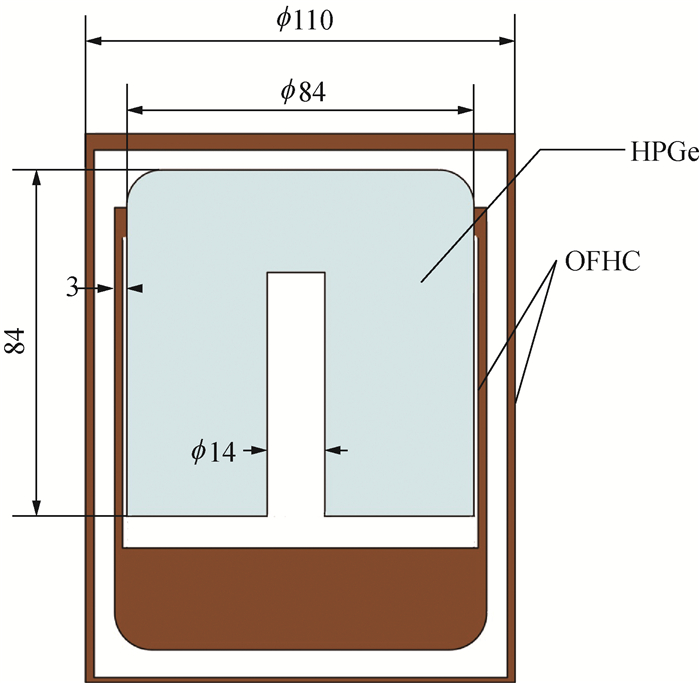
1.2 高纯锗探测器结构GeTHU-4是同轴P型的高纯锗探测器。锗晶体为圆柱形结构,高度和直径均为84 mm,中间为一直径14 mm的孔,放入长度为550 mm的冷指,锗晶体质量约2.48 kg。整体采用的是高纯无氧铜(oxygen-free high-conductivity copper,OFHC)制成的包壳,铜壳厚3 mm,质量约2.2 kg。探头外径为110 mm, 高度为210 mm(从法兰盘起算),如图 1所示。
|
| 图 1 探头的机械结构(单位:mm) |
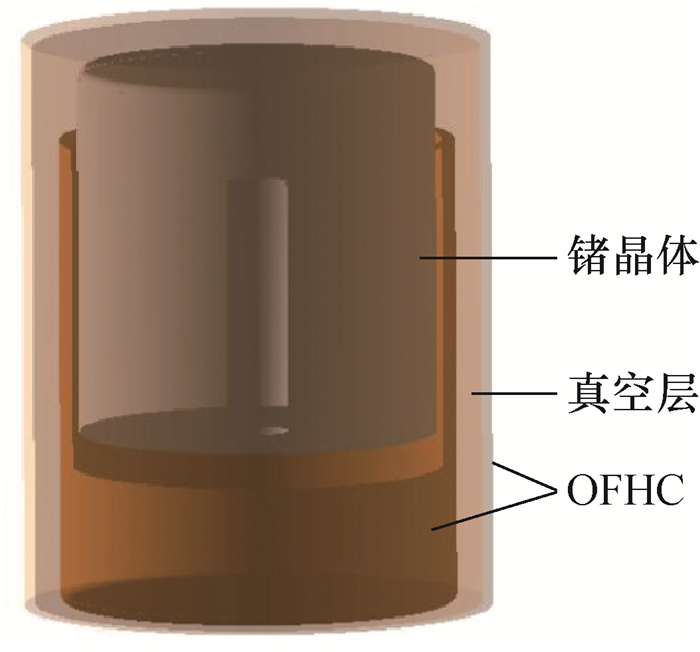
根据探头的机械结构,简化了其Monte Carlo模型(图 2)。主要考虑:1) 锗晶体;2) 包裹锗晶体的高纯无氧铜;3) 真空层。
|
| 图 2 探头的Monte Carlo模型 |
1.3 能量刻度
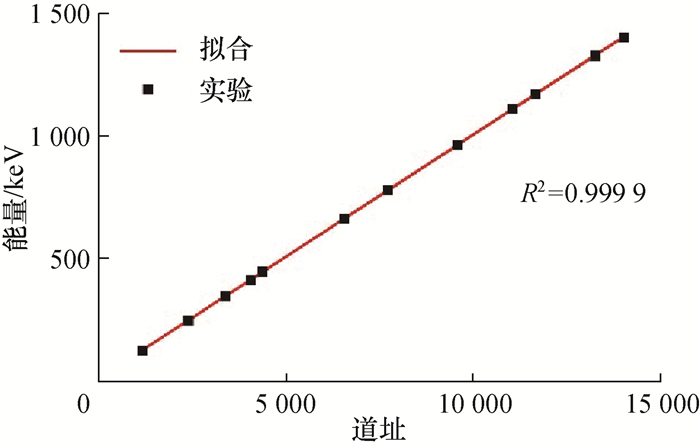
采用60Co、137Cs、152Eu等标准源对GeTHU-4进行能量刻度,刻度结果见图 3,拟合式为
| $ E=-0.335+0.100 \times \mathrm{CH}+9.054 \times 10^{-10} \times \mathrm{CH}^2 . $ | (1) |
|
| 图 3 GeTHU-4能量刻度曲线 |
其中:E表示能量,keV;CH表示道址。
1.4 效率模拟基于探头的Monte Carlo结构,使用SAGE模拟软件包[20]估算了不同宇生核素的探测效率。假设源项(即需要模拟的宇生核素)均匀分布在锗晶体内(或结构铜中)。每种宇生核素的模拟粒子数为1×10⁷。
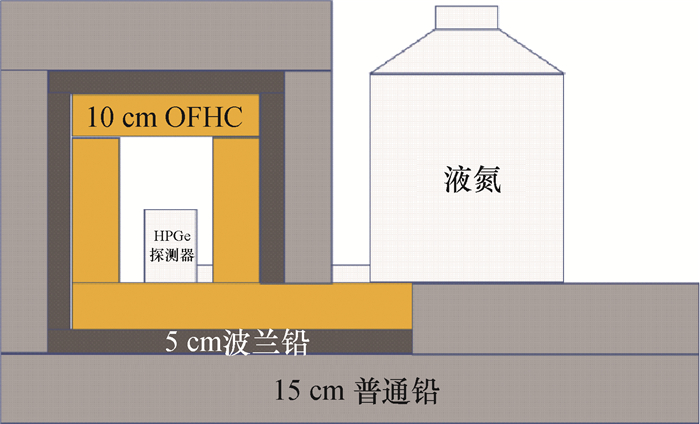
1.5 屏蔽与本底测量为了得到GeTHU-4探头自身的本底,在探测器外部设计了组合式的屏蔽系统(图 4),从外到内依次为15 cm厚的普通铅(210Pb 100 Bq/kg以上)、5 cm厚的低本底波兰铅(210Pb 30 Bq/kg以下)、10 cm厚的OFHC。此外,实验期间利用通风装置不断向内部输入新鲜空气,并在探测器周围屏蔽体内进行通氮气操作,以降低氡对实验本底的影响。
|
| 图 4 GeTHU-4本底测量屏蔽系统示意图 |
为了避免最内侧屏蔽系统铜自身的宇生放射性核素对实验测量造成干扰,本文实验用的铜是在地下实验室长期存放的老铜。根据前期研究[11],屏蔽系统老铜的实测谱中已经无法观测到宇生核素的特征峰,其活度低于高纯锗低本底谱仪的最小可探测活度,因此屏蔽系统铜对实验宇生本底的贡献可忽略不计。
能量刻度后,对GeTHU-4进行本底测量。自2020年8月15日开始取数,每6 h自动存储一次本底能谱。测量时间为2020年8月15日—2021年1月22日,共获得了约90天的有效能谱。
2 数据分析和讨论 2.1 宇生核素的产生方式和能谱特点当高能宇宙射线轰击锗晶体或铜材料时,会发生电子俘获、非弹性散射等反应,从而在材料内部产生一系列具有放射性的核素。根据以前的模拟研究,综合考虑宇生核素的半衰期和产生率,锗晶体和结构铜中主要考虑的宇生核素如表 1[10, 21]所示。
由于GeTHU-4的能量阈值约100 keV,在实测谱中明显观测到了宇生核素57Co、58Co、54Mn、60Co的特征峰,因此主要围绕这4种宇生核素进行分析。
宇生核素衰变能谱的模拟主要分两步:1) 统计宇生核素衰变产生的特征X射线、电子和γ射线在锗晶体中的能量沉积,得到原始模拟谱;2) 为了更好地与实验谱对比,需要用实验测得的能量分辨率对模拟谱进行展宽。模拟结果表明,锗晶体内、外的宇生核素的衰变能谱有很大差异。当宇生核素位于锗晶体内部时,特征X射线或电子的能量可以被完全收集,由于与随后产生的γ射线的间隔时间很短(一般ps量级),远小于探测器的分辨时间(一般μs量级),探测器会将两部分的能量沉积记录为一个信号,形成一个叠加能谱。当宇生核素位于锗晶体外部时,由于特征X射线或电子在物质中的平均自由程短,很难穿过锗晶体外部材料被探测到,此时探测器记录的主要是核素衰变放出的γ射线。
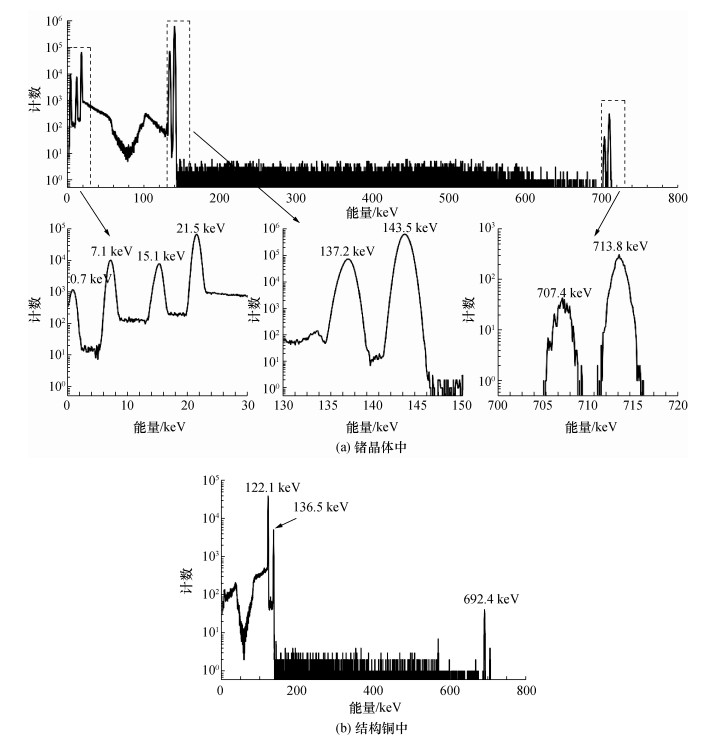
2.1.1 特征X射线和γ射线符合相加的能谱:57Co、58Co、54Mn57Co的衰变方式是100%的电子俘获(electron capture, EC)过程,会放出几种能量的X射线和γ射线,特征X射线之间是竞争关系,与γ射线是级联关系。若57Co在锗晶体内发生衰变,可以观测到0.7 keV和7.1 keV的特征X射线峰,其余均为“X+γ”合峰,比例与EC过程俘获各壳层电子的概率一致,见图 5a。若57Co在结构铜中发生衰变,则只能探测到能量较高的γ射线,见图 5b。
|
| 图 5 57Co在锗晶体和结构铜中的衰变能谱 |
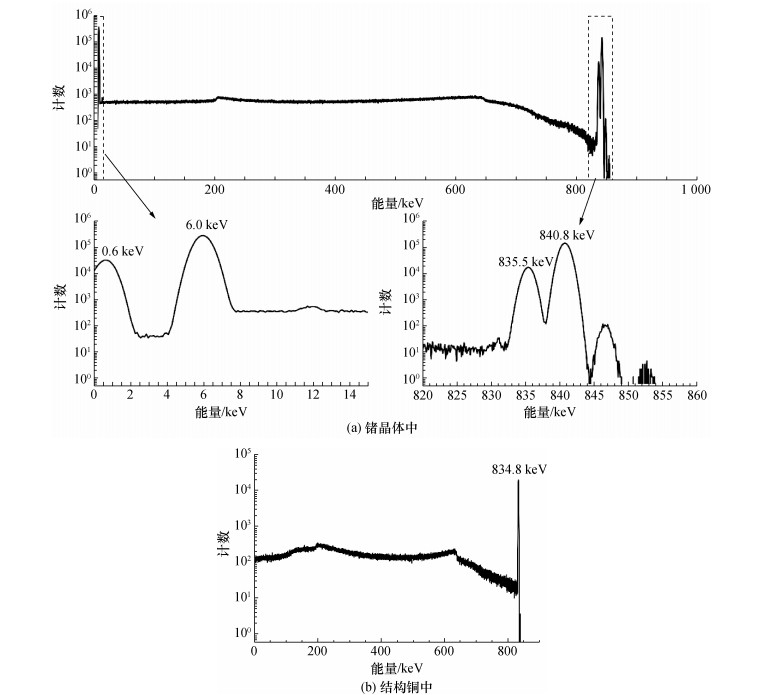
54Mn的衰变方式也是100%的EC过程,衰变能谱的特点及成因与57Co类似,如图 6所示。
|
| 图 6 54Mn在锗晶体和结构铜中的衰变能谱 |
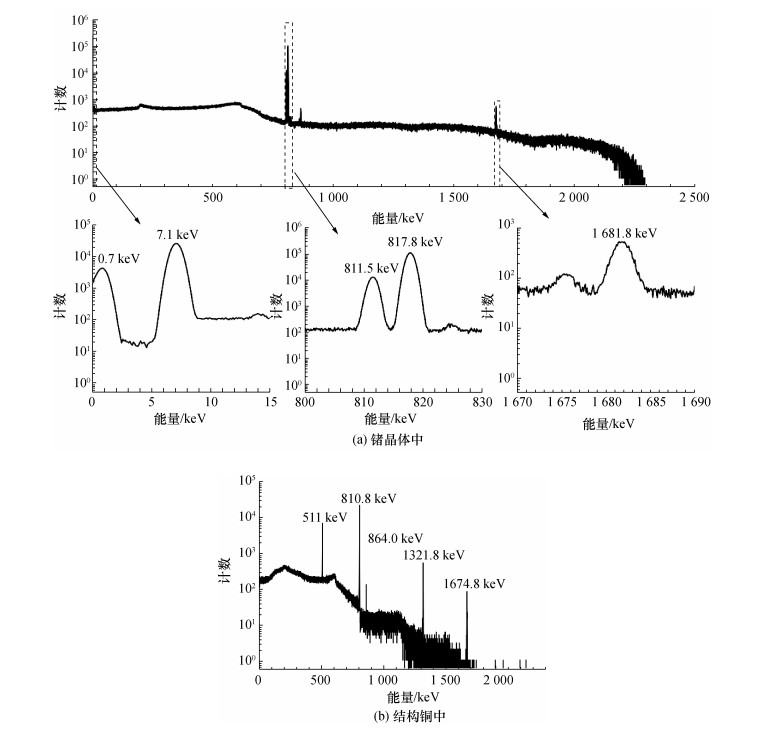
58Co的衰变方式是85.1%的EC过程和14.9%的β+衰变过程,两者属于竞争关系。EC过程放出特征X射线和γ射线,形成特征X射线峰和“X+γ”合峰,见图 7a,成因与57Co一致。β+衰变放出连续能量的正电子,与周围的电子发生湮灭,可能产生511 keV的湮灭峰,湮灭峰和γ射线符合相加形成1 321.8 keV的合峰,见图 7b。
|
| 图 7 58Co在锗晶体和结构铜中的衰变能谱 |
2.1.2 β射线和γ射线符合相加的能谱:60Co
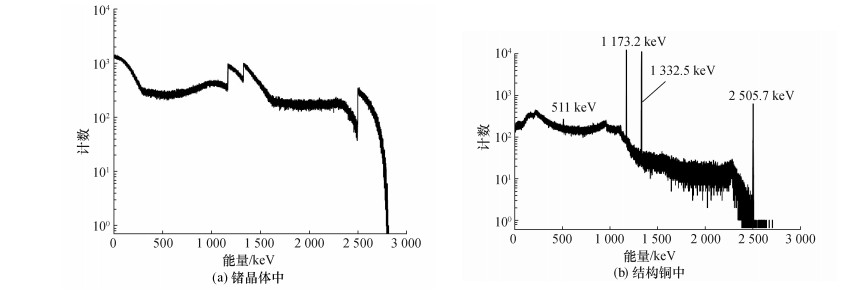
60Co的衰变方式是100%的β-衰变过程。β-衰变会产生能量连续的电子谱,端点能量分别为317.9 keV和1 492.2 keV。随即会发射1 173.2 keV和1 332.5 keV的γ射线,由于能量较高,可能产生全能峰、511 keV的正电子湮灭峰、双逃逸峰、单逃逸峰以及合峰,与前面的β-衰变存在级联关系,能谱叠加表现为相应的峰位产生台阶状的结构,如图 8a所示。若60Co在结构铜内发生衰变,β-衰变过程产生的电子很难穿过铜被探测到,因此能谱不会出现台阶状结构,见图 8b。
|
| 图 8 60Co在锗晶体和结构铜中的衰变能谱 |
2.2 探测效率模拟结果
分别统计模拟能谱(图 5—8)中各特征峰的计数,从而获得探测器对锗晶体和结构铜中宇生核素的探测效率,详细结果见表 2。
| 源项位置 | 探测效率/% | |||
| 57Co | 58Co | 54Mn | 60Co | |
| 锗晶体中 | 77.19 (143.5 keV) | 2.38 (811.5 keV) 19.15 (817.8 keV) |
2.74 (835.5 keV) 2.23 (840.8 keV) |
— |
| 结构铜中 | 4.71 (122.1 keV) | 3.45 (810.8 keV) | 3.74 (834.8 keV) | 2.39 (1 173.2 keV) 2.24 (1 332.5 keV) |
| 注:括号中数据为核素的特征峰。 | ||||
2.3 宇生核素比活度
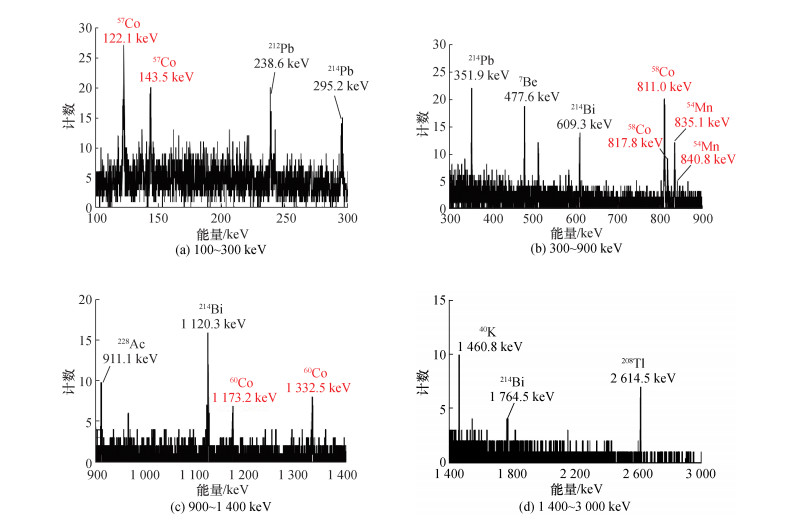
实测谱如图 9所示(取数56 d), 能够清晰观察到宇生核素57Co(122.1 keV、143.5 keV)、58Co(811.0 keV、817.8 keV)、54Mn(835.1 keV、840.8 keV) 和60Co(1 173.2 keV、1 332.5 keV) 的特征峰。根据模拟分析[10, 21],这些宇生核素是由于锗晶体和铜构件被宇宙射线活化产生的。此外,一些原生放射性核素,如来自屏蔽体或氡子体的214Bi(609.3 keV、1 764.5 keV)、214Pb(295.2 keV、351.9 keV)和来自岩石的40K(1 460.8 keV)的特征峰等,也能明显看到。
|
| 图 9 GeTHU-4实测谱 |
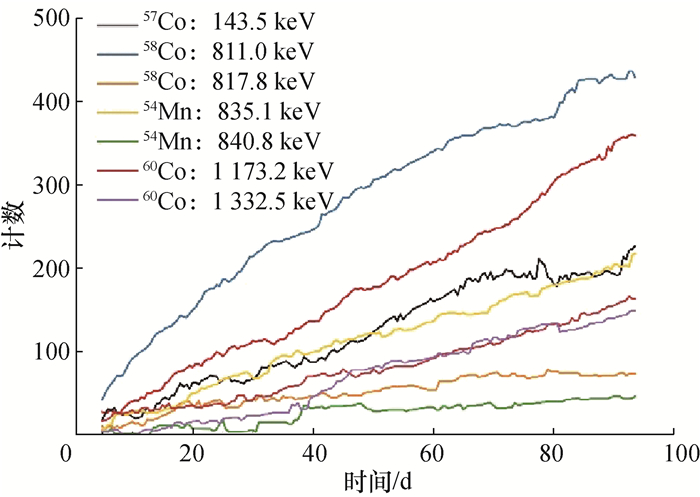
由于地下实验室的宇宙射线通量非常低,如μ子通量约(2.0±0.4)×10-10 s-1·cm-2[22],相比于海平面的μ子通量,降低了8个量级,因此探测器移至地下实验室后产生的宇生核素可忽略不计。分别计算57Co、58Co、54Mn、60Co的特征峰计数,并绘制峰计数随时间的变化曲线,示于图 10。可以观察到,宇生核素峰计数随着测量时间增加而增加,且增加趋势趋缓,尤其是58Co的特征峰计数有轻微的饱和迹象。这是由于58Co半衰期只有70.9 d,而测量时间约1.3个半衰期。
|
| 图 10 宇生核素特征峰计数随时间的变化 |
用式(2)对图 10的峰计数曲线进行拟合,可以得到宇生核素的比活度。
| $ N(t)=\frac{A_0 \varepsilon m}{\lambda}\left(1-\mathrm{e}^{-\lambda t}\right) . $ | (2) |
其中: N(t)是测量t时间后的特征峰计数;A0是开始测量时宇生核素的比活度,Bq/kg;ε是探测效率;m是锗晶体或结构铜的质量,kg;λ是衰变常数,s-1;t是测量时间,s。
对比实测谱和模拟能谱,可以发现能峰122.1 keV是由铜中57Co衰变放出的γ射线形成的,143.5 keV是由锗中57Co衰变放出的“X+γ”射线形成的,由此可分别计算出铜和锗中57Co的比活度。能峰817.8 keV是由锗中58Co衰变放出的“X+γ”射线形成的,811.0 keV是由铜和锗中的 58Co衰变形成的。计算比活度时,先根据817.8 keV计算锗中58Co的比活度,再扣除来计算铜中58Co的比活度。54Mn的比活度计算方法与58Co相同。由于锗晶体中60Co的特征峰呈台阶状,但在实测谱中没有明显观测到这一现象,因此这里近似认为60Co都来源于铜。比活度的详细计算结果及不确定度见表 3,主要考虑了拟合(fit)和效率模拟结果(ε)给比活度计算带来的不确定度。
| mBq/kg | |||||||||||||||||||||||||||||
| 宇生核素 | 锗晶体中 | 结构铜中 | |||||||||||||||||||||||||||
| 比活度 | 不确定度 | 比活度 | 不确定度 | ||||||||||||||||||||||||||
| fit | ε | fit | ε | ||||||||||||||||||||||||||
| 57Co | 0.016 | ±0.004 | ±0.001 | 0.452 | ±0.102 | ±0.016 | |||||||||||||||||||||||
| 58Co | 0.046 | ±0.007 | ±0.003 | 1.245 | ±0.039 | ±0.007 | |||||||||||||||||||||||
| 54Mn | 0.012 | ±0.004 | ±0.002 | 0.382 | ±0.017 | ±0.026 | |||||||||||||||||||||||
| 60Co | 0.389 | ±0.124 | ±0.035 | ||||||||||||||||||||||||||
3 结论
本文利用一个新定制的低本底高纯锗探测器(GeTHU-4),对探测器生产和运输中产生的宇生核素开展了实验研究。利用GEANT4 Monte Carlo程序,建立了GeTHU-4探头的Monte Carlo结构模型,基于该模型模拟宇生核素的衰变能谱并给出了宇生核素的探测效率。重点分析锗晶体内、外宇生核素衰变能谱的特征,发展了一套计算锗晶体内、外宇生核素比活度的方法。主要结论如下:
1) 产生于探测器灵敏体积内的放射性核素形成的能谱,与外部放射性核素的有很大差异。基于模拟的衰变能谱,总结了锗晶体内、外不同衰变类型的宇生核素能谱特征,有助于深入理解本底能谱构成。
2) 高纯锗探测器制作和地表运输一个月后,锗晶体内部宇生核素活度为57Co:0.016 mBq/kg,58Co:0.046 mBq/kg,54Mn:0.012 mBq/kg;结构铜中的宇生核素比活度为57Co:0.452 mBq/kg,58Co:1.245 mBq/kg,54Mn:0.382 mBq/kg,60Co:0.389 mBq/kg。该结果为解析低水平放射性测量中的本底能谱、创建本底模型提供了实验依据。
| [1] |
BUDJÁŠ D, GANGAPSHEV A M, GASPARRO J, et al. Gamma-ray spectrometry of ultra low levels of radioactivity within the material screening program for the GERDA experiment[J]. Applied Radiation and Isotopes, 2009, 67(5): 755-758. DOI:10.1016/j.apradiso.2009.01.019 |
| [2] |
KÖHLER M, DEGERING D, LAUBENSTEIN M, et al. A new low-level γ-ray spectrometry system for environmental radioactivity at the underground laboratory Felsenkeller[J]. Applied Radiation and Isotopes, 2009, 67(5): 736-740. DOI:10.1016/j.apradiso.2009.01.027 |
| [3] |
AGOSTINI M, ARAUJO G R, BAKALYAROV A M, et al. Final results of GERDA on the search for neutrinoless double-β decay[J]. Physical Review Letters, 2020, 125(25): 252502. DOI:10.1103/PhysRevLett.125.252502 |
| [4] |
ABGRALL N, ARNQUIST I J, AVIGNONE Ⅲ F T, et al. The processing of enriched germanium for the MAJORANA DEMONSTRATOR and R&D for a next generation double-beta decay experiment[J]. Nuclear Instruments and Methods in Physics Research Section A: Accelerators, Spectrometers, Detectors and Associated Equipment, 2018, 877: 314-322. |
| [5] |
D'ANDREA V. Neutrinoless double beta decay search with 76Ge: Status and prospect with LEGEND[C]// Proceedings of the EW Session of the 54th Rencontres de Moriond. La Thuile, Italy, 2019.
|
| [6] |
AALSETH C E, BARBEAU P S, BOWDEN N S, et al. Results from a search for light-mass dark matter with a p-type point contact germanium detector[J]. Physical Review Letters, 2011, 106(13): 131301. DOI:10.1103/PhysRevLett.106.131301 |
| [7] |
YANG L T, LI H B, YUE Q, et al. Search for light weakly-interacting-massive-particle dark matter by annual modulation analysis with a point-contact germanium detector at the China Jinping underground laboratory[J]. Physical Review Letters, 2019, 123(22): 221301. DOI:10.1103/PhysRevLett.123.221301 |
| [8] |
AGNESE R, ARALIS T, ARAMAKI T, et al. Search for low-mass dark matter with CDMSlite using a profile likelihood fit[J]. Physical Review D, 2019, 99(6): 062001. DOI:10.1103/PhysRevD.99.062001 |
| [9] |
MAISONOBE R. Status and prospects of the EDELWEISS-Ⅲ direct WIMP search experiment[J]. Journal of Low Temperature Physics, 2018, 193(5): 1129-1136. |
| [10] |
MA J L, YUE Q, LIN S, et al. Study on cosmogenic activation in germanium detectors for future tonne-scale CDEX experiment[J]. Science China Physics, Mechanics & Astronomy, 2019, 62(1): 11011. |
| [11] |
SHE Z, ZENG Z, MA H, et al. Study of cosmogenic activation in copper for rare event search experiments[J]. The European Physical Journal C, 2021, 81(11): 1041. DOI:10.1140/epjc/s10052-021-09827-w |
| [12] |
BACK J J, RAMACHERS Y A. ACTIVIA: Calculation of isotope production cross-sections and yields[J]. Nuclear Instruments and Methods in Physics Research Section A: Accelerators, Spectrometers, Detectors and Associated Equipment, 2008, 586(2): 286-294. DOI:10.1016/j.nima.2007.12.008 |
| [13] |
ARMENGAUD E, ARNAUD Q, AUGIER C, et al. Measurement of the cosmogenic activation of germanium detectors in EDELWEISS-Ⅲ[J]. Astroparticle Physics, 2017, 91: 51-64. DOI:10.1016/j.astropartphys.2017.03.006 |
| [14] |
WEI W Z, MEI D M, ZHANG C. Cosmogenic activation of germanium used for tonne-scale rare event search experiments[J]. Astroparticle Physics, 2017, 96: 24-31. DOI:10.1016/j.astropartphys.2017.10.007 |
| [15] |
BREIER R, MASARIK J, PALUŠOVÁ V, et al. Monte-Carlo calculation of production rates of cosmogenic radionuclides in a HPGe detector operating in the Modane underground laboratory[J]. Nuclear Instruments and Methods in Physics Research Section A: Accelerators, Spectrometers, Detectors and Associated Equipment, 2020, 978: 164355. DOI:10.1016/j.nima.2020.164355 |
| [16] |
CEBRIÁN S, GÓMEZ H, LUZÓN G, et al. Cosmogenic activation in germanium and copper for rare event searches[J]. Astroparticle Physics, 2010, 33(5-6): 316-329. DOI:10.1016/j.astropartphys.2010.03.002 |
| [17] |
MEI D M, YIN Z B, ELLIOTT S R. Cosmogenic production as a background in searching for rare physics processes[J]. Astroparticle Physics, 2009, 31(6): 417-420. DOI:10.1016/j.astropartphys.2009.04.004 |
| [18] |
AGNESE R, ARALIS T, ARAMAKI T, et al. Production rate measurement of tritium and other cosmogenic isotopes in germanium with CDMSlite[J]. Astroparticle Physics, 2019, 104: 1-12. DOI:10.1016/j.astropartphys.2018.08.006 |
| [19] |
YAN Y L, ZHONG W X, LIN S T, et al. Study on cosmogenic radioactive production in germanium as a background for future rare event search experiments[J]. Nuclear Science and Techniques, 2020, 31(6): 55. DOI:10.1007/s41365-020-00762-1 |
| [20] |
SHE Z, MA H, ZENG W, et al. SAGE: A Monte Carlo simulation framework for experiments with germanium detectors[J]. Journal of Instrumentation, 2021, 16: T09005. DOI:10.1088/1748-0221/16/09/T09005 |
| [21] |
胡庆东. 吨量级高纯锗暗物质探测器本底研究[D]. 北京: 清华大学, 2018. HU Q D. Background research of tonne-scale germanium detector for dark matter searches[D]. Beijing: Tsinghua University, 2018. (in Chinese) |
| [22] |
WU Y C, HAO X Q, YUE Q, et al. Measurement of cosmic ray flux in the China Jinping underground laboratory[J]. Chinese Physics C, 2013, 37(8): 086001. DOI:10.1088/1674-1137/37/8/086001 |