


目前煤炭在中国的能源结构中仍占据主导地位[1]。确保煤炭安全生产极为重要,如何有效抑制煤尘爆炸一直是亟需解决的热点问题之一[2]。
了解煤尘的快速热解和爆炸机理可以为高效抑爆剂的合成提供理论支持。准确的热解和爆炸模型可以帮助预测煤尘的产物分布和关键反应。Ma等[3]揭示了煤气化过程中挥发物和焦炭之间的相互作用机制,研究了含氧组分对煤热解过程的影响。Yang等[4]结合改进的化学渗透脱挥发分热解动力学模型,模拟了单个煤颗粒的热解过程,计算了不同工况下焦油的总收率。为了定量测定热解产物的成分,Zhou等[5]和Zhu等[6]使用热解真空紫外光电离质谱系统原位测量了不同温度下的热解产物,结果表明热解产物主要为轻质气体(如CH4、CO等)和挥发性化合物(如烯烃、酚类化合物等)。这些热解产物均是易燃组分,点燃后会维持煤尘爆炸火焰的传播。
添加抑爆剂可以有效防控煤尘爆炸[7],其原理是抑爆剂吸收火焰释放的热量,并通过化学作用干预煤颗粒的气相反应和表面反应[8]。其中,含添加剂细水雾一直是清洁高效的抑爆手段,将化学添加剂加入细水雾中,增强了化学抑爆性能。Gan等[9]研究了含钠化合物细水雾对聚甲基丙烯酸甲酯粉尘的抑爆特性,结果表明含NaHCO3细水雾的抑爆效果要优于含NaCl细水雾。同时,Zhou等[10]指出含磷抑爆剂(如ABC干粉)的抑爆性能优于NaHCO3。由此可以推测,含磷抑爆剂的细水雾应具有高效的抑爆效果。在含磷抑爆剂中,植酸(phytic acid, PA)的分子式中有6个磷酸基团。由于具有较高的磷元素含量,植酸也常被用作酸源来制备含磷阻燃剂[11-12]。Dong等[13]通过将聚苯胺接枝到植酸上并偶联石墨氮化碳制备了复合抑爆材料,发现含植酸复合抑爆材料具有良好的自碳化和隔热性能。Jiang等[14]合成了一种具有多孔结构的PA@NH2MCM-41复合抑爆剂,其研究结果表明含磷复合抑爆剂对粉尘爆炸的火焰传播和爆炸压力有显著影响。尽管含添加剂细水雾是一种清洁高效的抑爆材料,但对于含磷组分细水雾的抑爆特性和机理目前研究较为匮乏,抑爆剂对煤热解产物的影响以及抑爆剂自身热解产物的组成亟待深入研究。
本研究旨在探讨含磷抑爆剂(含植酸细水雾)对煤尘爆炸热解过程的抑制机理,采用原位热解飞行时间质谱(in-situ pyrolysis time-of-flight mass spectrometry, in-situ Py-TOF-MS)研究了植酸对煤尘热解过程主要产物的影响,可为新型煤尘爆炸抑爆剂及高效抑爆技术的开发提供理论支持。
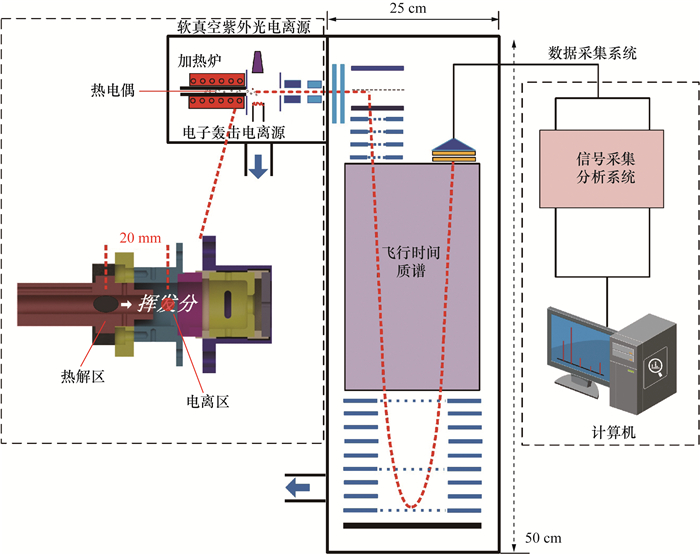
1 实验 1.1 实验装置细水雾抑制煤尘爆炸实验采用自制竖直Harttman爆炸实验管道(图 1),与之前研究[15]相同。为了深入研究煤尘爆炸过程,采用in-situ Py-TOF-MS,探究了抑爆剂对煤尘热解过程的影响机理。该装置由热解区、电离区和飞行时间质谱检测区等部分组成,具有以下关键特点:
|
| 图 1 实验装置 |
1) 热解与检测区域的距离被设计得非常短,仅有2 cm,确保了对生物质热解挥发物的原位捕获,这有助于准确捕捉煤尘爆炸过程中产生的挥发物。
2) 实验装置具备两种不同的离子源,即电子电离(70 eV)和软真空紫外光电离(10.6 eV),用于检测轻质气体和有机挥发物。
3) 实验装置在真空环境中运行,约为10-5 Pa,有效抑制了产物彼此间相互碰撞和二次反应,有利于获得初级挥发物的结构信息。
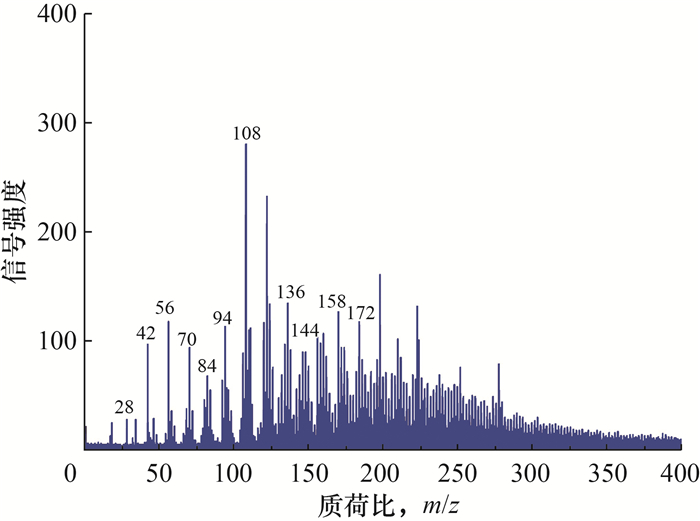
实验步骤:首先将煤尘或煤尘与植酸水雾溶液混合物的样品从50 ℃升温至650 ℃,热解产生的挥发物经软真空紫外光电离(或电子电离)和电场加速进入飞行时间质谱检测区,随后被微通道板检测器捕捉并转换为电信号。然后,捕获和放大离子信号,并将其转化成包含不同质荷比(m/z)的质谱信号,如图 2所示。此外,本文还使用热重分析仪(thermal gravimetric analyzer,TGA)来进一步分析样品的热解动力学特性,以获取样品热解过程的放热量与活化能等信息。
|
| 图 2 样品热解有机挥发物谱图 |
1.2 实验材料
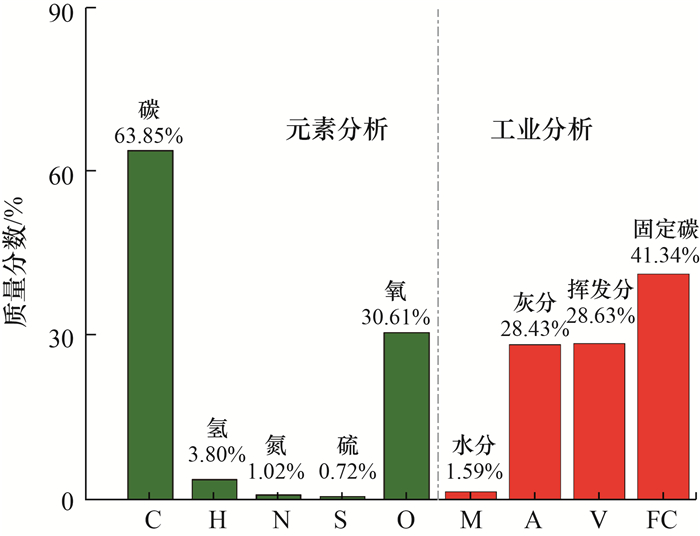
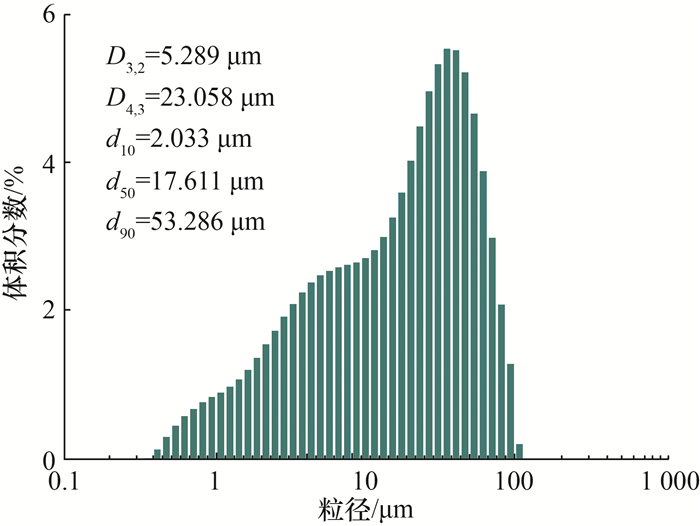
实验样品选用东滩矿的煤样,其元素含量和工业分析结果详见图 3。煤尘样品的氢碳比和氧碳比分别为0.71和0.36。实验前将煤块样品粉碎并筛分,煤尘的粒径分布如图 4所示。煤尘的体积平均径D4, 3为23.058 μm,中位径d50为17.611 μm。实验中采用的植酸溶液和其他药剂均购买自国药集团。
|
| 图 3 燃料特性 |
|
| 图 4 煤尘粒径分布 |
2 结果和讨论 2.1 含植酸细水雾对煤尘爆炸火焰的影响
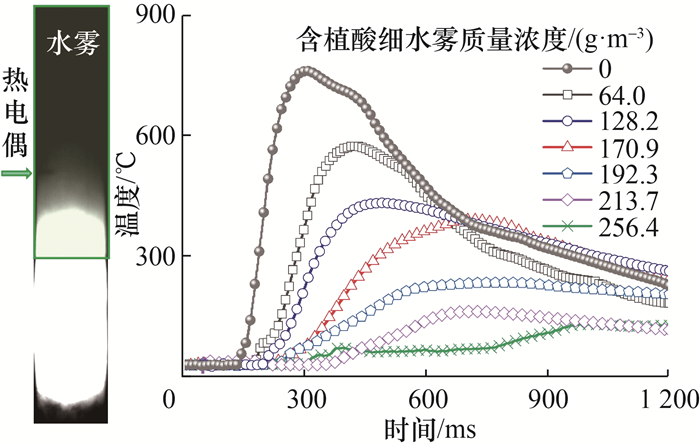
图 5所示为含植酸细水雾对煤尘爆炸火焰形态与温度的影响。添加含植酸细水雾后,煤尘爆炸火焰温度显著降低。随着细水雾质量浓度从64 g/m3增加至256.4 g/m3,煤尘火焰温度从798 ℃降低至203 ℃。煤尘火焰前沿反应区内,主要反应为煤热解产生的挥发分气体发生燃烧、主导火焰的发展和传播。煤尘热解产生的挥发性物质可以分为两部分,包括轻质气体(例如H2、CH4、CO、CO2、水蒸气)和有机挥发性物质(例如芳香族化合物),挥发分的具体组成随反应区温度的变化而变化。本文所采用的煤样在约500和700 ℃释放的主要挥发分分别为CH4和H2 [8]。含磷抑爆剂对氢和小分子碳氢化合物的抑制机理已被揭示。在反应区内含P小分子组分通过自由基捕获和催化循环(如HOPO2
|
| 图 5 含植酸细水雾(体积分数20%) 对煤尘(质量分数100 g/m3) 爆炸火焰温度的影响 |
当含植酸细水雾质量浓度增加到192.3 g/m3时,挥发分(尤其是轻质气体)中可燃成分的含量显著降低,添加含植酸细水雾有效抑制了煤尘的热解过程。由于火焰温度降低至500 ℃以下,会有效抑制H2和CH4的产生,因此此时热解可燃组分主要由有机挥发性物质组成。为了揭示在高质量浓度含植酸细水雾下(接近极限熄灭状态)煤尘爆炸火焰的抑制机理,下文将研究植酸对煤尘热解过程中有机挥发性物质释放的影响。
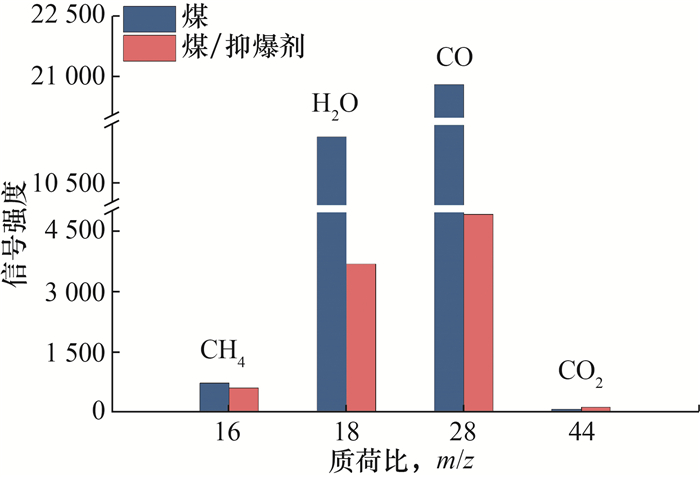
2.2 煤、煤/抑爆剂样品的热解产物分析本文对煤、煤/抑爆剂(含植酸溶液)样品热解过程的轻质气体和有机挥发物质进行了原位热解飞行时间质谱分析,探究了含植酸细水雾对煤热解过程的影响。如图 6所示,反应区温度低于700 ℃时,气体产物中几乎不产生H2,只生成了少量的CH4,其主要组分为CO和H2O。
|
| 图 6 煤、煤/抑爆剂样品热解过程的轻质气体组分 |
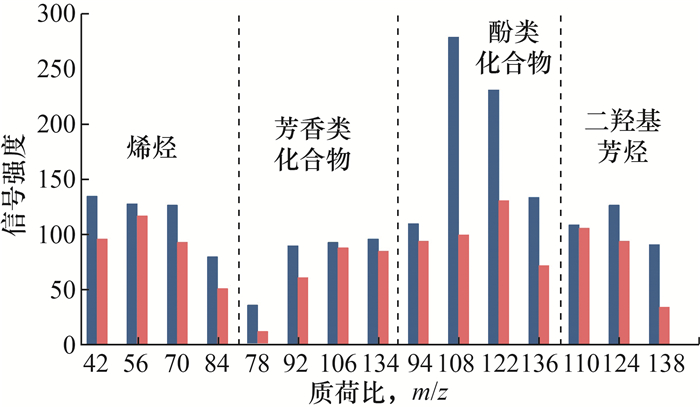
如图 7所示,热解产生的有机挥发物质主要分为4类,包括烯烃(质荷比m/z=42、56、70、84)、芳香类化合物(m/z=78、92、106、134)、酚类化合物(m/z=94、108、122、136)和二羟基芳烃(m/z=110、124、138)。可以看出,含磷抑爆剂的加入可以有效抑制煤尘的热解过程,煤尘热解产生的有机挥发物质产量降低,但产物成分的组成未发生明显变化。这是由于添加含磷抑爆剂后,磷酸基团可以优先与氢原子结合,阻止H原子与苯氧基反应生成二羟基芳烃,从而导致有机挥发物质的产量下降,其中酚类等化合物含量下降得最为明显[16]。
|
| 图 7 煤、煤/抑爆剂样品热解过程的有机挥发物质 |
2.3 抑爆剂的热解反应路径
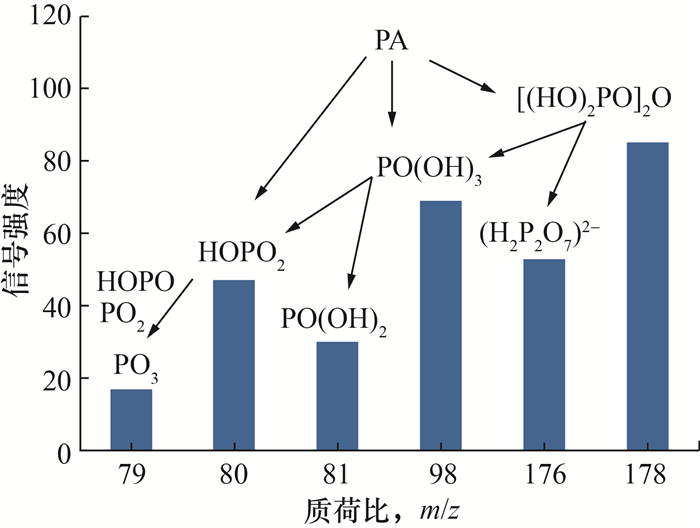
为了深入研究含植酸细水雾的热解过程和抑爆机理,本文探究了气相挥发分中主要含磷产物的组分。前人的研究表明,植酸的热解会生成焦磷酸盐、聚磷酸盐[17]以及偏磷酸[18]。图 8为含磷组分在热解过程中的主要产物和分解过程,主要产物包括焦磷酸、正磷酸、次磷酸和偏磷酸,可以推测出植酸在煤尘爆炸火焰反应区的热解路径。如图 8所示,根据原位热解飞行时间质谱测量结果,植酸对煤尘的抑制作用主要由[(HO)2PO]2O、PO(OH)3、HOPO2等小分子含磷物质决定。随着温度的升高,部分焦磷酸盐会脱水形成磷酸,其中一部分形成稳定的焦磷酸盐。磷酸会进一步形成磷酸二氢离子,然后经过加氢反应形成H2PO3(PO(OH)2),接着发生脱氢反应生成偏磷酸,最终生成HOPO、PO3、PO2等小分子物质。这些小分子含磷组分可以通过催化循环反应和自由基捕获等消耗煤尘火焰内的关键自由基(如H、OH等)。
|
| 图 8 含植酸细水雾抑爆剂的热解产物与路径 |
2.4 含植酸抑爆剂对煤尘爆炸的抑制机理
分析以上实验结果可知,植酸对煤尘爆炸抑制主要通过两个方面实现,包括热效应(抑爆剂颗粒的热分解)和化学效应(气相反应和表面反应抑制)。本文结合热分析结果评估抑爆剂分解过程的吸热能力。加入抑爆剂后,煤尘的放热量降低了15.8%。此外,采用Kissinger-Akahira-Sunose法计算了原煤与含抑爆剂煤样的活化能,添加抑爆剂后,样品的活化能从11.3 kJ/mol升高到了16.4 kJ/mol。
水雾中的植酸在高温下会经历一系列热解反应,包括脱去氢氧基团、羧基化、氢化以及形成磷酸盐化合物,从而形成含磷的小有机分子,如HOPO、PO3、PO2等。这些含磷的小分子组分可以消耗煤尘火焰内的关键自由基(如H和OH),其作用机制包括火焰中自由基的清除、键的断裂、通过氧或氢原子的自由基提取反应,以及氢原子或羟基的加成反应到磷氧键上,从而抑制了煤尘爆炸的连锁反应[19-20]。同时,植酸含有6个磷酸基团,已被确认是一种有效的阻燃添加剂。这是因为植酸中的磷(+5)以较高的氧化态存在,有助于促进在凝聚相中形成致密的炭化层,这一点已在研究中得到验证[10]。炭化层的低导热性能能够隔离煤尘颗粒和热源,减缓了热解过程,这便是凝聚相抑爆机制。此外,热解过程中产生的不可燃挥发物,如水蒸气等,可以在一定程度上稀释可燃物和氧气的体积浓度。
3 结论本文利用原位热解飞行时间质谱测量煤样与含抑爆剂煤样的热解产物,进一步分析了含磷抑爆剂对煤尘爆炸的抑制机理,所得结论如下:
1) 添加抑爆剂后,抑爆剂可在热解过程中吸收大量热量,并结合化学抑制作用,有效地抑制了可燃轻质气体组分与有机挥发物质的生成。由于磷酸基团可以优先与氢原子结合,成功地阻止了二羟基物质的形成,导致热解产物中酚类和二羟基芳烃含量的降低。
2) 植酸热解会产生[(HO)2PO]2O、PO(OH)3、HOPO2等含磷的小分子组分,这些含磷抑爆组分可以通过火焰自由基的清除、键的断裂、氧或氢原子的自由基提取反应,以及氢原子或羟基的加成反应,有效抑制煤尘爆炸的连锁反应,从而降低关键火焰自由基浓度。
| [1] |
CHEN Q Q, LV M, GU Y, et al. Hybrid energy system for a coal-based chemical industry[J]. Joule, 2018, 2(4): 607-620. DOI:10.1016/j.joule.2018.02.015 |
| [2] |
WEI Q X, ZHANG Y S, CHEN K, et al. Preparation and performance of novel APP/NaY-Fe suppressant for coal dust explosion[J]. Journal of Loss Prevention in the Process Industries, 2021, 69: 104374. DOI:10.1016/j.jlp.2020.104374 |
| [3] |
MA M, BAI Y H, WEI J T, et al. Decoupling study of volatile-char interaction during coal/biomass co-gasification based on a two-stage fixed bed reactor: Insight into the role of O-containing compound species[J]. Chemical Engineering Science, 2023, 265: 118262. DOI:10.1016/j.ces.2022.118262 |
| [4] |
YANG P X, GUO W, YU Z Y, et al. Modelling the influence of pressure inside particle with fractal structure on the tar distribution and Pareto optimal during pulverized coal fast pyrolysis[J]. Chemical Engineering Science, 2023, 272: 118585. DOI:10.1016/j.ces.2023.118585 |
| [5] |
ZHOU Y, LI G, JIN L J, et al. In situ analysis of catalytic effect of calcium nitrate on Shenmu coal pyrolysis with pyrolysis vacuum ultraviolet photoionization mass spectrometry[J]. Energy & Fuels, 2018, 32(2): 1061-1069. |
| [6] |
ZHU J L, XU J, HU H Q, et al. Novel detection of primary and secondary volatiles from cedar pyrolysis using in-situ pyrolysis double ionization time-of-flight mass spectrometry[J]. Chemical Engineering Science, 2021, 236: 116545. DOI:10.1016/j.ces.2021.116545 |
| [7] |
JIANG H P, BI M S, LI B, et al. Flame inhibition of aluminum dust explosion by NaHCO3 and NH4H2PO4[J]. Combustion and Flame, 2019, 200: 97-114. DOI:10.1016/j.combustflame.2018.11.016 |
| [8] |
JIANG H P, BI M S, HUANG L, et al. Suppression mechanism of ultrafine water mist containing phosphorus compounds in methane/coal dust explosions[J]. Energy, 2022, 239: 121987. DOI:10.1016/j.energy.2021.121987 |
| [9] |
GAN B, LI B, JIANG H P, et al. Suppression of polymethyl methacrylate dust explosion by ultrafine water mist/additives[J]. Journal of Hazardous Materials, 2018, 351: 346-355. DOI:10.1016/j.jhazmat.2018.03.017 |
| [10] |
ZHOU J H, LI B, MA D Q, et al. Suppression of nano-polymethyl methacrylate dust explosions by ABC powder[J]. Process Safety and Environmental Protection, 2019, 122: 144-152. DOI:10.1016/j.psep.2018.11.023 |
| [11] |
LAZAR S T, KOLIBABA T J, GRUNLAN J C. Flame-retardant surface treatments[J]. Nature Reviews Materials, 2020, 5(4): 259-275. DOI:10.1038/s41578-019-0164-6 |
| [12] |
HUO S Q, SONG P A, YU B, et al. Phosphorus-containing flame retardant epoxy thermosets: Recent advances and future perspectives[J]. Progress in Polymer Science, 2021, 114: 101366. DOI:10.1016/j.progpolymsci.2021.101366 |
| [13] |
DONG H X, WANG Y X, FENG T T, et al. Phytic acid doped polyaniline-coupled g-C3N4 nanosheets for synergizing with APP promoting fire safety and waterproof performance of epoxy composites[J]. Polymer Degradation and Stability, 2022, 198: 109879. DOI:10.1016/j.polymdegradstab.2022.109879 |
| [14] |
JIANG H P, BI M S, ZHANG T J, et al. A novel reactive P-containing composite with an ordered porous structure for suppressing nano-Al dust explosions[J]. Chemical Engineering Journal, 2021, 416: 129156. DOI:10.1016/j.cej.2021.129156 |
| [15] |
KOROBEINICHEV O P, SHVARTSBERG V M, SHMAKOV A G, et al. Flame inhibition by phosphorus-containing compounds in lean and rich propane flames[J]. Proceedings of the Combustion Institute, 2005, 30(2): 2353-2360. DOI:10.1016/j.proci.2004.08.095 |
| [16] |
JIANG H P, BI M S, GAO W. In situ analysis of suppression mechanism of DMMP water mist in coal dust explosions using pyrolysis time-of-flight mass spectrometry[J]. Chemical Engineering Science, 2022, 260: 117836. DOI:10.1016/j.ces.2022.117836 |
| [17] |
YAN W J, XU S, DING C J, et al. Novel bio-derived phytic acid and melamine interlayered/surface dual modified layered double hydroxide by one-pot method and its highly efficient flame retardant performance for polypropylene[J]. Applied Clay Science, 2022, 228: 106620. DOI:10.1016/j.clay.2022.106620 |
| [18] |
HUA L, CHENG T Z, LIANG Z Y, et al. Investigation of the mechanism of phytate-modified biochar-catalyzed persulfate degradation of Ponceau 2R[J]. Biochar, 2022, 4(1): 6. DOI:10.1007/s42773-022-00136-3 |
| [19] |
JIANG G P, QIAO J L, HONG F. Application of phosphoric acid and phytic acid-doped bacterial cellulose as novel proton-conducting membranes to PEMFC[J]. International Journal of Hydrogen Energy, 2012, 37(11): 9182-9192. DOI:10.1016/j.ijhydene.2012.02.195 |
| [20] |
JIANG H P, BI M S, GAO W, et al. Inhibition of aluminum dust explosion by NaHCO3 with different particle size distributions[J]. Journal of Hazardous Materials, 2018, 344: 902-912. DOI:10.1016/j.jhazmat.2017.11.054 |