


2. 北京科技大学 北京市工业波谱成像工程技术研究中心, 北京 100083;
3. 中日友好医院 放射肿瘤科, 北京 100029;
4. 北京永新医疗设备有限公司, 北京 102206
2. Beijing Engineering Research Center of Industrial Spectrum Imaging, University of Science and Technology Beijing, Beijing 100083, China;
3. Department of Radiation Oncology, China-Japan Friendship Hospital, Beijing 100029, China;
4. Beijing Novel Medical Equipment Ltd., Beijing 102206, China
随着核能与核技术的广泛应用,核辐射等词语逐渐进入公众视野,特别是在2011年日本福岛核泄漏事故之后,公众对核与辐射安全的关注度显著提升。确保安全性是核与辐射科学的应用前提和必要条件,避免事故的发生是核与辐射安全的最终目标[1]。人们在享受核技术带来的巨大便利的同时,也经受着核物质(核原料、核废料等)带来的潜在威胁。由于核物质自身所带的放射性,一旦核物质遗漏或者未经处理排放,不仅会造成生态环境的污染,还会对人民群众的生命和财产安全带来严重损害,这都将引起人民群众的恐慌心理,进而对社会的正常秩序造成恶劣影响。因此,针对失控、丢失或环境中潜藏的核放射源进行准确、快速的定位,对减少核辐射对人类和生态环境的危害至关重要[2]。因此,设计出能够快速检测核物质并迅速定位的设备对于保障核技术的应用具有重要意义。
目前常用的编码板成像γ相机趋向于便携化设计,但存在视场(field of view,FOV)受限、灵敏度低、探测效率低等问题[3]。为了扩大视野范围,一些研究者将Compton相机和编码孔径成像技术相结合。虽然Compton相机能够将FOV角扩展到4π,但该方法操作复杂且成本较高,并且只能对高能射线进行探测,因此这2种技术的结合对于低能放射源的搜索还存在缺陷[3]。
本文采用编码板结合针孔成像的方式,采用vGATE 8.1进行Monte Carlo仿真实验,搭建大视野放射源定位系统获得仿真数据;基于MATLAB语言对仿真数据进行处理,获得重建图像,验证方法的有效性。
1 研究方法 1.1 成像原理孔径编码是通过一块有规律的开孔的遮光片,对射入光子进行过滤,即每一个成功射入编码板的光子,均需位于编码板的最大倾角范围内。每一个点光源发射出的光子在经过编码板的过滤后,均会于成像端呈现出一个与编码板开孔情况相似的图像。多个点光源的成像经过线性叠加,最后在成像板上形成一个重叠的图像[4]。根据编码板开孔的规律,可以用相应的解调方法对重叠的图像进行还原,最后获得光源的图像[5]。
1.2 系统传输矩阵每一个不同几何结构的定位系统都对应一个特定的系统传输矩阵,计算出对应的系统传输矩阵并用其对装有γ光子数的数组进行运算,可获得投影图像。对投影图像进行相应计算,可获得反投影图像[6]。使用式(1)可计算系统矩阵中的元素[7]。
| $ A_{i j}=\exp \left(-u \cdot l_{i j}\right) \cdot \cos \alpha \cdot \cos \beta . $ | (1) |
其中:Aij是探测器像素i对源平面像素j的响应;u是钨的衰减系数,lij是从源平面像素j到探测器像素i时通过掩膜的辐射路径,α和β分别是射线与探测器平面的X轴和Y轴之间的夹角。在进行衰减计算后,用概率与cosα、cosβ相乘以考虑立体角度。为了得到更精确的系统矩阵,将探测器像素i划分为5×5个子像素。因此可以使用子像素的平均效率获得更精确的Aij,如式(2)所示,其中c是子像素的索引。
| $ A_{i j}=\frac{1}{25} \sum\limits_{c=1}^{25} \exp \left(-u_{i j}^c\right) \cdot \cos \alpha_c \cdot \cos \beta_c . $ | (2) |
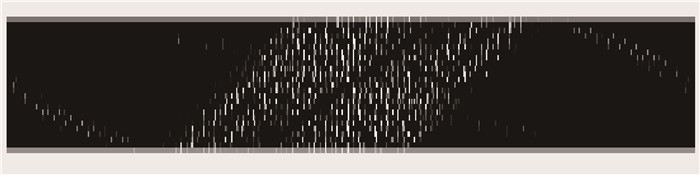
对应计算出的系统传输矩阵如图 1所示。为了模拟实验装置自身的本底辐射,将每秒7个光子计数随机添加到探测器作为背景噪声。
|
| 图 1 系统传输矩阵 |
1.3 系统描述与仿真
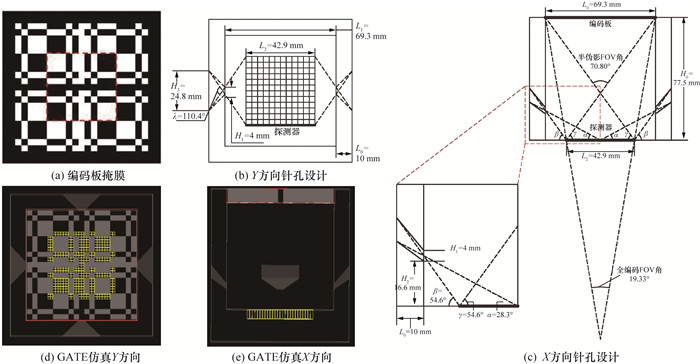
大视野放射源定位系统的编码板采用的是均匀冗余阵列掩模(modified uniformly redundant array, MURA),如图 2a所示,基本模式等级为11,单位尺寸为3.3 mm×3.3 mm,编码板边长L1为69.3 mm,掩膜厚度为9 mm[8],材料为钨。探测器为一个26×26 NaI(Tl)阵列,晶体像素尺寸为1.45 mm×1.45 mm×6.00 mm,晶体间隙为0.2 mm,探测器边长L2为42.9 mm。编码板中心到位置灵敏传感器(position sensitive detector, PSD)中心之间的距离H0为77.5 mm[9]。编码板全编码FOV角和半伪影FOV角分别为19.33°和70.80°。
|
| 图 2 大视野放射源定位系统设计和仿真结果 |
大视野放射源定位系统的针孔采用的是锥形针孔,针孔中心尺寸H1为4 mm,嵌在屏蔽层中。屏蔽层厚度L0为10 mm。屏蔽层四边各开有一个直径相同、方向依次旋转90°的针孔。以开在屏蔽层左侧的针孔为例,Y方向针孔的开口角度由探测器尺寸决定,如图 2b所示,Y方向开口角度λ为110.4°,针孔开口宽度H3为24.8 mm。X方向针孔的开口角度由编码板的半伪影FOV角、针孔中心尺寸、探测器尺寸决定,如图 2c所示,针孔下方与探测器平面距离H3为16.6 mm,α为28.3°。由几何关系计算得出,针孔FOV角为-61.7°~ -35.4°和35.4°~ 61.7°,将放射源定位系统的视野扩展为123.40°。大视野放射源定位系统的X和Y方向在GATE上的仿真结果分别如图 2d和2e所示。
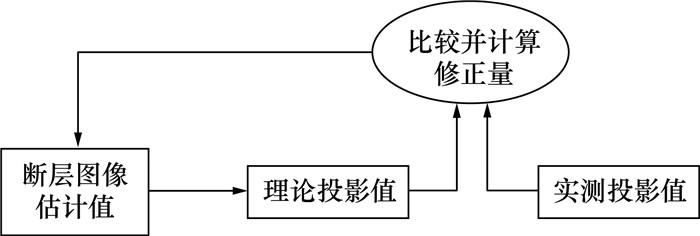
1.4 系统重建在生成系统矩阵后使用最大似然期望最大化(maximum likelihood expectation maximization,MLEM)算法[11]进行图像重建。MLEM的修正流程如图 3所示[12]。
|
| 图 3 修正流程图 |
MLEM的迭代序列按式(3)执行[13]。
| $ \lambda_j^{k+1}=\frac{\lambda_j^k}{\sum\limits_{i=1}^N A_{i j}} \sum\limits_{i=1}^N A_{i j} \frac{y_i}{\sum\limits_{j=1}^M A_{i j} \lambda_j^k} . $ | (3) |
其中:N是探测器像素总数,M是源平面像素总数,λjk是源位置j的第k次迭代结果,yi是探测器像素i中的计数。
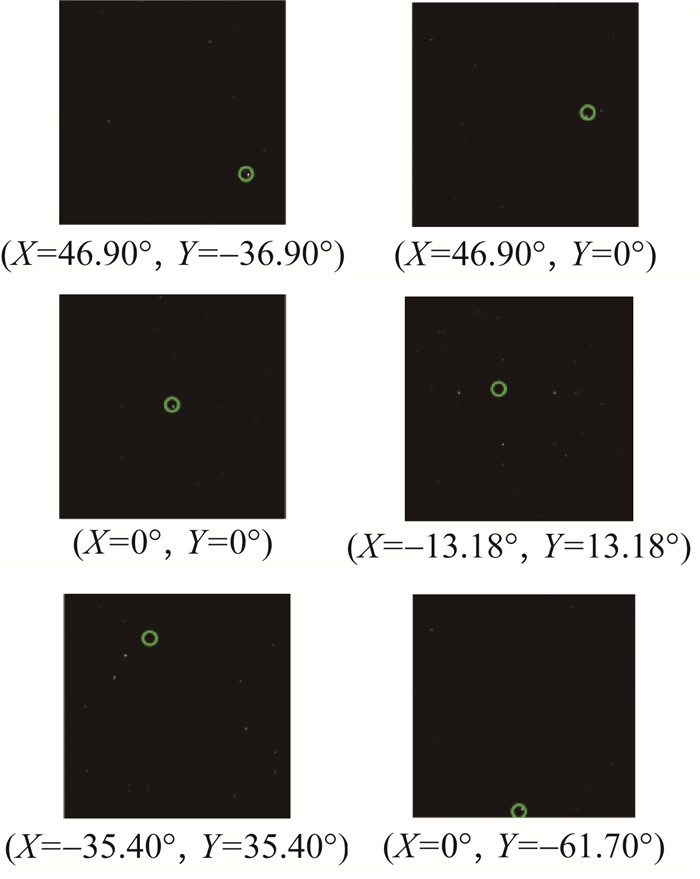
2 实验结果 2.1 单点源成像10mCi 137Cs在3 m处仿真3 s后,针对不同FOV角位置下的单点源进行30次迭代的重建结果如图 4所示,投影数据的采集时间为3 s。每张图均以中心作为坐标系的原点,亮点和绿色圆圈分别表示光源的重建和实际位置,由图可知,亮点基本都分布在绿色圆圈中,表明重建结果具有准确性。编码板无伪影FOV角为13.18°,半伪影FOV角为70.80°,针孔FOV角为-61.70°~-35.40°和35.40°~61.70°。
|
| (以图片中心为坐标系原点) 图 4 不同FOV角位置下编码板的单点源重建图像 |
计算出不同FOV角位置下单点源图像重建的信噪比(signal to interference plus noise ratio, SNR)[14],如表 1所示。由表可知,编码板FOV角范围内的SNR比针孔FOV角范围内的SNR高,成像质量更好,针孔范围的成像质量可基本满足快速成像需求。
| FOV角坐标/ (°) | SNR |
| (0,0) | 243.71 |
| (46.90,0) | 246.71 |
| (46.90,-36.90) | 182.04 |
| (-13.18,13.18) | 47.61 |
| (-35.40,35.40) | 92.29 |
| (0,-61.70) | 90.98 |
2.2 双点源成像
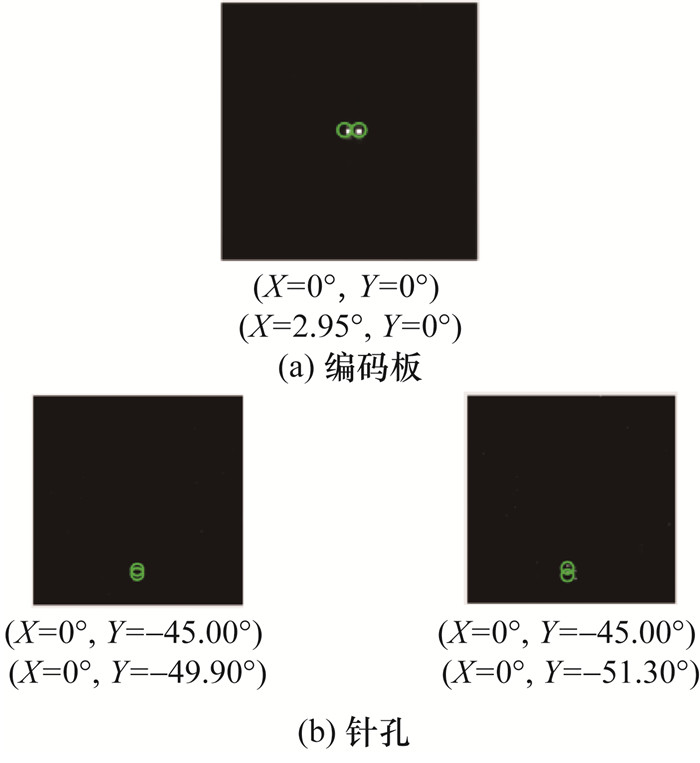
10mCi 137Cs在3 m处仿真3 s后,针对在编码板成像范围内的不同FOV角位置下的双点源进行30次迭代的重建结果如图 5a所示,投影数据的采集时间为3 s。每张图均以中心作为坐标系的原点,亮点和绿色圆圈分别表示光源的重建和实际位置,由图可知,亮点基本都分布在绿色圆圈中,表明重建结果具有准确性。
|
| (以图片中心为坐标系原点) 图 5 在不同FOV角位置下编码板和针孔的双点源重建图像 |
准直器的几何分辨率Δθ1及其检测器的固有角度分辨率Δθ2分别由式(4)和(5)计算得出。γ相机的空间角度分辨率Δθ由Δθ1和Δθ2计算得出,如式(6)所示。
| $ \Delta \theta_1=\arctan \left(\frac{p_{\mathrm{m}}}{b}\right), $ | (4) |
| $ \Delta \theta_2=\arctan \left(\frac{p_{\mathrm{d}}}{b}\right), $ | (5) |
| $ \Delta \theta=\sqrt{\Delta \theta_1^2+\Delta \theta_2^2} . $ | (6) |
其中: pm是准直器单元孔径的大小,b是准直器到探测器的距离, pd是探测器单元像素大小。
由式(4)—(6)计算可得,编码板的Δθ1为2.70°,Δθ2为1.19°,Δθ为2.95°。由图 5a可知,实际能实现的编码板的Δθ为2.95°。
10mCi 137Cs在3 m处仿真3 s后,针对在针孔成像范围内的不同FOV角位置下的点光源进行30次迭代的重建结果如图 5b所示,投影数据的采集时间为3 s。每张图均以中心作为坐标系的原点,亮点和绿色圆圈分别表示光源的重建和实际位置,由图可知,亮点基本都分布在绿色圆圈中,表明重建结果具有准确性。由式(4)—(6)计算可得,针孔的Δθ1为4.52°,Δθ2为1.89°,Δθ为4.90°,由图 5b可知实际能实现的针孔的Δθ为6.30°。
不同FOV角位置下双点源图像重建的SNR如表 2所示。由表可知,编码板FOV角范围内的SNR比针孔FOV角范围内的SNR高,成像质量更好,针孔范围的成像质量可基本满足快速成像需求。
| FOV角坐标/ (°) | SNR |
| (0, 0),(0, 2.95) | 157.35 |
| (0, -45.00),(0, -49.90) | 120.69 |
| (0, -45.00),(0, -51.30) | 150.29 |
3 结论
本文设计了一种编码板结合小孔成像的大视野放射源定位系统及定位方法,可以实现在123.40°的视场范围内快速准确成像。编码板的空间角度分辨率为2.95°,针孔的空间角度分辨率为6.30°。该大视野放射源定位系统及定位方法有效解决了编码板探测器的成像视野范围有限的问题,提高了探测效率。
| [1] |
高峰. 核技术利用行业核安全文化建设问题探讨[J]. 中国辐射卫生, 2017, 26(4): 412-413, 423. GAO F. Discussion on the Construction of Nuclear Safety Culture in Nuclear Technology Industry[J]. Chinese Journal of Radiological Health, 2017, 26(4): 412-413, 423. DOI:10.3969/j.issn.1004-714X.2017.04.010 (in Chinese) |
| [2] |
曲云欢, 周晓剑, 李小丁, 等. 核技术利用"十三五"辐射安全规划基本思路研究[J]. 辐射防护, 2017, 37(6): 490-494. QU Y H, ZHOU X J, LI X D, et al. Basic approach to "The 13th Five-Year Plan" on radiation safety in nuclear technology utilization[J]. Radiation Protection, 2017, 37(6): 490-494. (in Chinese) |
| [3] |
SUN S F, ZHANG Z M, SHUAI L, et al. Development of a panorama coded-aperture gamma camera for radiation detection[J]. Radiation Measurements, 2015, 77: 34-40. DOI:10.1016/j.radmeas.2015.04.014 |
| [4] |
金永杰. 核医学方法与仪器[J]. 世界医疗器械, 1998, 4(11): 60-65. JIN Y J. Nuclear medicine methods and instruments[J]. World Medical Devices, 1998, 4(11): 60-65. (in Chinese) |
| [5] |
田晓东. 环形编码孔径成像技术及数字重建[D]. 大连: 大连理工大学, 2003. TIAN X D. Ring-coded aperture imaging technology and digital reconstruction[D]. Dalian: Dalian University of Technology, 2003. (in Chinese) |
| [6] |
艾自辉. 几种常用闪烁体耐γ辐照特性研究[D]. 绵阳: 中国工程物理研究院, 2008. AI Z H. Study on γ irradiation resistance of several commonly used scintillators[D]. Mianyang: Chinese Academy of Engineering Physics, 2008. (in Chinese) |
| [7] |
肖洒, 兰明聪, 党晓军, 等. MURA编码孔成像中γ源分布的数值重建[J]. 核电子学与探测技术, 2013, 33(8): 913-918. XIAO S, LAN M C, DANG X J, et al. Digital reconstruction of γ-source distribution in MURA coded aperture imaging[J]. Nuclear Electronics & Detection Technology, 2013, 33(8): 913-918. DOI:10.3969/j.issn.0258-0934.2013.08.001 (in Chinese) |
| [8] |
孙萍, 谢敬辉, 周元林. 编码孔径和解码孔径的设计[J]. 仪器仪表学报, 2004, 25(3): 321-324. SUN P, XIE J H, ZHOU Y L. Designing of the coded aperture and decoded aperture[J]. Chinese Journal of Scientific Instrument, 2004, 25(3): 321-324. DOI:10.3321/j.issn:0254-3087.2004.03.011 (in Chinese) |
| [9] |
W Q, LIU X, ZHANG Z, et al. Artifact analysis of a far-field coded-aperture gamma camera extended to partially coded field-of-view[J]. Radiation Detection Technology and Methods, 2022, 6(4): 558-568. DOI:10.1007/s41605-022-00355-z |
| [10] |
SIDDON R L. Fast calculation of the exact radiological path for a three-dimensional CT array[J]. Medical Physics, 1985, 12(2): 252-255. DOI:10.1118/1.595715 |
| [11] |
李红艳. PET图像重建算法研究及实现[D]. 长沙: 中南大学, 2009. LI H Y. Research and implementation of PET image reconstruction algorithm[D]. Changsha: Central South University, 2009. (in Chinese) |
| [12] |
徐园, 刘倍, 孔海宇, 等. γ成像系统性能测试及其功能拓展[J]. 核电子学与探测技术, 2019, 39(5): 611-615. XU Y, LIU B, KONG H Y, et al. The performance test and function expansion of a gamma imaging system[J]. Nuclear Electronics & Detection Technology, 2019, 39(5): 611-615. DOI:10.3969/j.issn.0258-0934.2019.05.014 (in Chinese) |
| [13] |
杜晓闯, 梁漫春, 黎岢, 等. 基于卷积神经网络的γ放射性核素识别方法[J]. 清华大学学报(自然科学版), 2023, 63(6): 980-986. DU X C, LIANG M C, LI K, et al. A gamma radionuclide identification method based on convolutional neural networks[J]. Journal of Tsinghua University (Science & Technology), 2023, 63(6): 980-986. DOI:10.16511/j.cnki.qhdxxb.2023.22.011 (in Chinese) |
| [14] |
程李, 刘帆, 高丽蕾, 等. 碘-131 SPECT平片成像伪影校正算法[J]. 清华大学学报(自然科学版), 2023, 63(5): 802-810. CHENG L, LIU F, GAO L L, et al. Artifacts correction algorithm for iodine-131 SPECT planar imaging[J]. Journal of Tsinghua University (Science & Technology), 2023, 63(5): 802-810. DOI:10.16511/j.cnki.qhdxxb.2022.26.060 (in Chinese) |