


2. 中国科学院大学, 北京 100049;
3. 清华大学 航天航空学院, 北京 100084
2. University of Chinese Academy of Sciences, Beijing 100049, China;
3. School of Aerospace Engineering, Tsinghua University, Beijing 100084, China
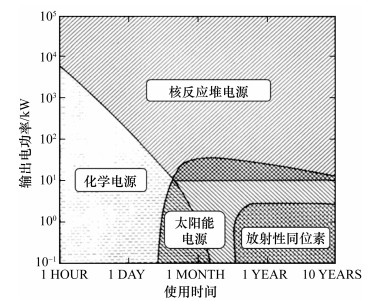
随着空间探索活动的不断深入,极端深空环境中长周期大功率的能源需求对能源动力装置提出了非常高的要求,传统能源系统面临着巨大的挑战[1-2]。核反应堆电源几乎可以满足任何任务周期内的各种电力需求(如图 1[1]所示),在大功率长周期的电源需求中优势更为明显,是空间供电与供能的理想选择,在近地轨道卫星、空间站、火箭以及星球表面基地等都具有应用前景[3-9]。空间核电源系统将核反应堆产生的热能通过热电转换产生电能,进而为航天器提供电能或推进动力[10],因此如何将堆芯产生的大量热量传递至能量转换装置关系着整个电源装置的输出特性。传统气体冷却方式与液态金属冷却方式传热效率高,适用于大功率堆,但在对空间体积和质量要求较为严格的空间反应堆应用中存在系统复杂、泄漏风险高以及对材料强度要求高等问题[11-13]。
高温热管以相变与蒸气扩散运输的方式将堆芯热量传递到热电转换回路,省去了高温泵结构以及其他辅助设备,使系统复杂性降低并且安全可靠性提高,是解决空间核能热能转换系统中高效传热与能源转换需求问题的理想选择[14-15]。20世纪60年代,美国Los Alamos国家实验室(Los Alamos National Laboratory, LANL)设计了一个碱金属热管冷却空间动力先进反应堆(space power advanced reactor, SPAR),开创了空间热管冷却反应堆研究的先河[16]。随着高温热管技术的进步与空间核能应用的发展,高温热管在空间核能热能转换系统的应用中展现出巨大的潜力,但同时也面临诸如热性能稳定性、传热极限以及适应性结构的影响等问题与技术挑战[17-19]。
本文讨论了空间核能热能转换系统中高温热管技术的应用现状和面临的挑战,总结了高温热管技术基础与研究现状,展望它在深空探索中的潜力,为空间能源系统的设计提供新的思路与解决方案。
1 空间核电源核热转换需求与难题随着空间探索任务向更远、更复杂的目标发展,空间核反应堆电源系统成为提供持续、可靠能量的关键技术。但是,这些系统在设计和运行中面临诸多问题,尤其是在能量转换效率和系统可靠性方面,解决这些问题是实现高效、可靠空间核电源系统的关键。
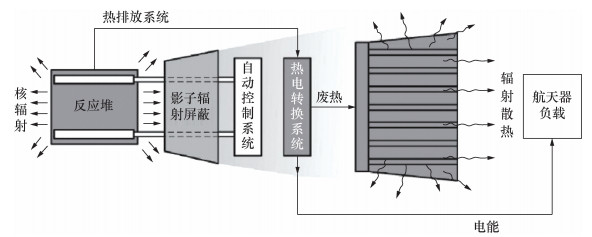
1) 受限空间下的稳定传热问题。在空间核反应堆电源系统中,系统的设计和布局通常比较复杂。如图 2[19]所示,系统需要在有限的空间内布置反应堆、传热部件、屏蔽器与热电转换装置等多个组件。这种结构复杂性不仅增加了系统的设计难度,而且可能导致热能传输路径长、热损失大,进而影响系统的效率和可靠性。
2) 长距离无动力循环的需求。使用冷却剂的反应堆冷却方式需要泵等外部动力源,会造成额外的能源消耗且技术难度较高。没有外部动力源的长距离热能传输可降低系统复杂程度、减少能源消耗,更符合空间应用要求[20],但对传热系统的设计提出了极高的要求,尤其是要确保传热效率和系统可靠性。特别是,在无重力或微重力环境下,传统的基于重力驱动的循环系统无法正常工作,需要探索新型的无动力传热技术,以实现长距离热能传输。
3) 适应性与可靠性的需求。空间任务可能会遇到多样的环境条件,包括极端的温度变化、高辐射以及剧烈的星表地质活动等,空间核电源系统需要能够适应这些环境,保证高效传热和稳定运行。
常见的空间反应堆冷却方式包括热管冷却、液态金属冷却和气冷。通常液态金属冷却装置质量最小,另外两种冷却装置质量也不大、可以忽略差别。在尺寸上,由于冷却工质密度及冷却装置结构上的差别,气冷体积最大,液态金属冷却体积最小,热管冷却体积居中[12]。热管冷却反应堆体积适中,具有较好的操控性、最优的热瞬态反馈性以及较高的安全可靠性,因此可认为热管冷却方式具有最优性能[14],为应对空间核电源系统面临的挑战提供了切实可行的解决方案。
2 高温热管技术基础高温热管作为热管冷却反应堆系统中关键的组成部分,其性能直接影响整个系统的热传输能力、能量转换效率以及长期稳定性。
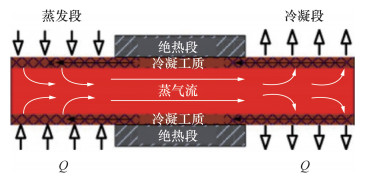
2.1 高温热管概念及原理以碱金属单质或者合金为工质的热管,称为碱金属热管或液态金属热管,可以稳定运行在750 K以上,按其工作温度划分为高温热管类别,具有良好的传热能力[21-22]。图 3[23]展示了高温热管运行原理:热源作用于高温热管蒸发段,蒸发段内的固态工质吸热后温度不断升高并熔化为液态。液态工质继续升温在吸液芯表面气化,蒸发段的局部压力使蒸气沿管道向前流动,在冷凝段释放热量后冷凝为液态工质,并在回复力的作用下(吸液芯毛细力、重力等)回流至蒸发段,如此不断循环,将热量从蒸发段传递到冷凝段。
在许多不同类型的传热系统中,以高温热管作为传热中间体的系统是当今已知最有效的系统之一[24]。高温热管具有非常高的导热性,可以在高效传热的同时保持蒸发段与冷凝段温度几乎均匀;并且热管在系统中各自独立,单根热管的故障不会影响整个系统的正常运行,从而保障热量顺利传输,避免系统失效出现严重事故,具有极高的安全性。高温热管技术广泛应用于核反应堆冷却、航空航天器热防护、太阳能集热、燃料电池热管理等领域[25-30]。在这些应用中,高温热管展现出超凡的热传导效率和在极端温度下稳定工作的能力。
2.2 高温热管基本特性高温热管由于其工质与结构特性,存在冷态启动、传热极限与寿命失效等问题,这些特性是高温热管技术的研究基础,本节将对高温热管的这些特性展开描述。
1) 冷态启动。
高温热管的工质在常温下通常处于冻结状态,在启动过程中工质需要经历从固态到气态的相变过程,涉及蒸气区、吸液芯和管壁的高度非线性耦合的传热传质过程。Jang等[31-32]率先建立了一个完整的冷态启动模型以描述冻结热管的启动过程,并进行了简化求解。他们使用一维瞬态可压缩流动模型模拟热管中蒸气流动,通过Knudsen数确定蒸气流动类型。不断变化的内部工质流动可能会产生非常大的径向和轴向温度梯度,在瞬态运行过程中,气-液界面热流密度分布与外壁面热流密度分布差别较大。Tourier和El-Genk[33]分析了钠热管的二维瞬态模型,模拟了高温热管启动过程中蒸气的连续和非连续状态,结果表明高温热管的冷态启动可分为3个连续的阶段:第1阶段,吸收的热量用于熔化蒸发段吸液芯内的工质,熔化的工质在气-液界面处蒸发。第2阶段,蒸气在蒸发段累积,蒸气压力上升达到连续流动状态。芯内的熔化前沿向冷凝段移动,位置稍微滞后于连续蒸气流界面。第3阶段,连续蒸气流界面到达冷凝段,冷凝段散热率逐渐增加,蒸气开始冷凝回流,到达稳态后整个热管内的蒸气处于连续流动状态。此后,研究者们针对高温热管的冷态启动在建立模型与实验研究方面进行了多个维度的探索[34-36],不仅探索了冷态启动过程的传热极限、冷态启动成功的条件与基本要求,还探索了冷态启动的影响因素。
2) 传热极限。
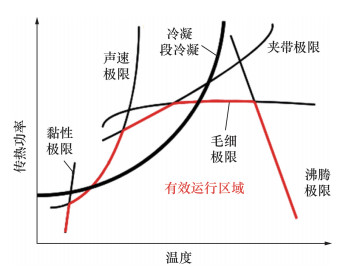
高温热管的传热能力较强,但仍受到许多因素的影响和制约,一些物理现象会限制热管的传热效率,主要包括黏性极限、声速极限、毛细极限、夹带极限以及沸腾极限[37],如图 4[18]所示,热管在不同的温度范围受到不同传热极限的限制。细长型热管以及在启动时蒸气压很低的碱金属热管中容易发生黏性极限,黏滞作用导致蒸气稀薄,冷凝段蒸气压力为零,热管传热受到限制。高温热管在启动初期由于蒸气密度低,流动速度会很大,一旦蒸气流动速度达到或超过蒸发段出口处的局部声速,蒸气流动就会受阻,出现达到声速极限的状态[38-39]。夹带极限与毛细极限都使参与相变循环的工质减少,从而削弱流动循环,限制了传热量的增加。其中,夹带极限是由于吸液芯内的液体工质被蒸气流带走,而毛细极限则是由于液体工质在毛细力的限制下回流不足。从夹带极限到毛细极限的过程中液膜减少,蒸发段发生剧烈的传质[40]。含有吸液芯结构的高温热管中各种极限的常见关系式如表 1所示。
| 传热极限 | 作者及文献 | 表达式 |
| 黏性极限 | Busse[37] | |
| 声速极限 | Busse[37] | |
| Levy[41] | ||
| 毛细极限 | Chi[42] | |
| Faghri等[43-44] | ||
| 夹带极限 | Tien等[45] | |
| 张嘉睿等[46] | ||
| 沸腾极限 | Chi[42] | |
| 注:Q为传热功率,Dv为蒸气通道直径,Dwi为热管内径,Leff为热管有效长度,Le为蒸发段长度,LHP为热管长度,Av为蒸气通道截面积,hfg为气化潜热,ρ为蒸气密度,p0为饱和蒸气压力,η为动力黏度,c0为蒸气声速,k为蒸气绝热系数,σ为表面张力系数,rc为吸液芯半径,rb为气泡半径,h为吸液芯特征长度,keff为吸液芯有效热导率,g为重力加速度,F为摩擦系数,θ为接触角,Ck、CW、Ct为无量纲常数,Tv为蒸气温度,Δpcap为吸液芯压降。下标v为蒸气,下标l为液体。 | ||
3) 寿命失效。
高温热管的寿命失效是一个复杂的过程,涉及多种因素和机制。寿命失效分析关注的是热管在长期高温运行中可能遇到的性能退化问题,如材料腐蚀、不凝气产生或吸液芯结构损伤等,这些问题均影响高温热管的使用寿命和可靠性[47-48]。
工质在高温下的化学稳定性和材料兼容性关系着热管的性能与寿命,在长时间的高温加热过程中,高温热管中的腐蚀主要来自氧化剂的循环效应和热管内碱金属的腐蚀,严重的腐蚀主要发生在有液体流动的冷凝段部分[48]。碱金属腐蚀难熔金属及其合金的潜在机制是与非金属杂质,特别是O、C、N和Si的化学反应。例如,Nb和Ta特别容易受到O的侵蚀,C扩散到合金钢管中会导致晶界碳化物形成,而基体Cr耗尽的复杂过程会增加材料腐蚀降解的风险[49]。工质中少量杂质的存在会使工质的表面张力和润湿特性发生变化[18],并且微量杂质与管壁和吸液芯材料反应形成的可移动化合物同样会影响高温热管的使用寿命,降低其性能[50]。通过选择适当的材料和工质,确保碱金属工质的高纯度,并使用适当的清洗和填充工艺,可以有效地抑制这些腐蚀机制。
针对高温热管寿命的测试以钠、钾、锂和钠钾合金等常见工质为主。Rosenfeld等[51]评估了以316L不锈钢为壳体时钠热管的长期兼容性,热管在650~700 ℃下成功运行超过115 000 h,没有任何故障迹象发生。涂善东等[52]测试了3种合金与钠、钾工质的兼容性,探究了材料的腐蚀过程和特征,通过提高热管的真空度,有效地降低了碱金属对热管壳体材料的腐蚀,延长热管的使用寿命。研究人员还致力于寻找具有良好热稳定性、低腐蚀性和合适沸点的工质,通过测试与应用新材料与新工质,提高高温热管的耐温耐蚀性能[53-54]。
4) 长度极限。
高温热管的长度极限是指在给定工作条件下,热管能够有效传输热量的最大长度。理论上,只要热管工质可以在热端和冷端之间循环,热管就可以持续地传输热量。然而,高温热管实际传输距离会受到一些限制,热管的长度极限主要取决于热管内部工质循环的能力以及热管设计制造中的各种参数。首先,热管的长度会影响工质的循环速度,过长的热管可能使工质循环变慢,从而降低热传输效率。其次,热管的设计制造也会对传输距离产生影响,例如,管道的直径、材质以及内部的吸液芯结构等。毛细力是驱动工质从冷端返回热端的主要动力,如果热管过长,毛细力可能无法克服液体返回热端的阻力,这将限制热管的有效传热距离。因此,热管的有效长度或长度极限与吸液芯等内部结构以及工质的表面张力和黏度等性质息息相关。除此之外,当热传输距离增加时,由于管道表面通过隔热层与环境传热的热损失和管道压力损失增加,会使热管有效传输距离无法达到设计要求[55]。
Mitomi等[55]指出,对于长距离传输的环路热管,随着传输距离的增加,补偿室内温度降低,与蒸发段的温差变大;他们还建立了一个数学模型以分析压力损失与热传输距离之间的关系。Chen等[56]将与蒸发段温度一致性较好(温差小于14 K)的热管长度定义为有效长度,并指出铯热管的有效长度与加热功率和工质充液率相关,当充液率或加热功率较小时,热管不能产生足够的蒸气和压差将热量驱动到冷凝段。通过以上分析可知,热管的长度极限并不是一个固定的值,而是根据热管的工作条件和设计参数来确定的。
2.3 高温热管研究现状高温热管技术的发展与研究,对于提升其应用场景中的能量转换效率和传热性能具有重要的理论与实践意义。
2.3.1 工质流动与传热机制研究液态金属的表面张力系数、气化潜热和热导率都很高,因此以液态金属为工质的高温热管的传热速率一般要比其他工质的热管高得多。高温热管内的流动与传热较为复杂,包括可压缩气体和不可压缩液体的流动,同时还存在相变与热扩散,其高热流密度的传输性能受到工质毛细蒸发冷凝、相变传热、自然循环流动等物理现象的共同影响[57]。通过开发模型与计算方法,可以准确捕捉这些现象并确定物理特性对热管行为的影响。
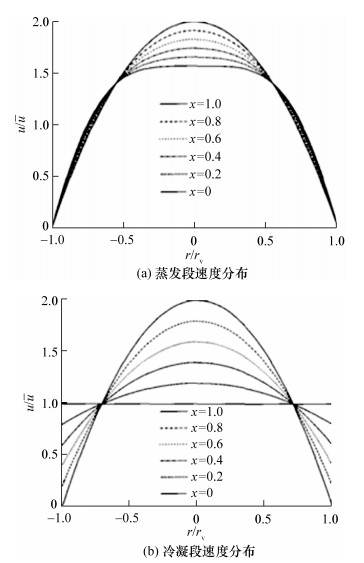
Cao和Faghri[58]考虑蒸气的可压缩性,提出了二维瞬态热管模型,将蒸气流动与壁面和吸液芯的热传导耦合,证明了高温热管的芯内热传导模型是分析热管瞬态行为的合理简化。Tourier和El-Genk[59]建立了二维热管瞬态分析模型“HPTAM”,研究了锂热管在温度为1 250 K和热功率为6.5 kW稳态条件下的性能。高温热管中高蒸发和高冷凝速率会产生明显的蒸气压力恢复和较大黏性耗散。蒸气流动方向上的压降会导致气-液界面的温降,影响热管总体性能[60]。段彦军等[61]对热管内蒸气流动的速度分布和压降特性进行了分析,提出了计算蒸气流动速度和压降的改进计算方法。蒸发段与冷凝段压降分别表示如下:
| $ p_{\mathrm{e}, \mathrm{Im}}=-\frac{\pi^2}{2} R e_{\mathrm{r}}^2-8 R e_{\mathrm{r}}, $ | (1) |
| $ p_{\mathrm{c}, \mathrm{Im}}=2 R e_{\mathrm{r}}^2-8 R e_{\mathrm{r}}. $ | (2) |
其中:pe, Im为蒸发段压降,pc, Im为冷凝段压降,Rer为径向Reynolds数。改进的计算方法弥补了Busse计算方法中蒸发段流量略大以及冷凝段压力恢复过大的不足,且适用于各个范围的Rer。设黏性力产生的压降与总压降的比值为x,则惯性力为1-x,改进后蒸发段与冷凝段的速度分布为:
| $ \frac{u_{\mathrm{e}, \mathrm{Im}}}{\bar{u}}=2 x\left(1-\frac{r^2}{r_{\mathrm{v}}^2}\right)+\frac{\pi}{2}(1-x) \cos \left(\frac{\pi}{2} \frac{r^2}{r_{\mathrm{v}}^2}\right), $ | (3) |
| $ \frac{u_{\mathrm{c}, \mathrm{Im}}}{\bar{u}}=2 x\left(1-\frac{r^2}{r_{\mathrm{v}}^2}\right)+(1-x). $ | (4) |
其中:ue, Im为蒸发段速度,uc, Im为冷凝段速度,u为平均速度,r为周向距离,rv为等效半径。改进算法的计算结果如图 5[61]所示。
在高温热管分析方法方面,Yilgor等[62]开发了一种使用低温热管研究高温热管的缩放分析方法,通过无量纲控制方程获得各种相似性参数,可用更容易测试与制造的低温热管作为研究对象,研究高温热管的相关现象。
高温热管吸液芯中工质传热传质机制的探索也得到了研究人员的关注。高温热管多孔吸液芯中钠液膜的蒸发特性对热管内部的传热十分重要。Wang等[63]研究了表面湿润性对钠液膜蒸发的影响,结果表明钠热管的实际设计应考虑传热表面的润湿性,亲水材料是制造多孔吸液芯结构的理想选择。Yin等[64]对高温液态金属钠在球形和矩形槽吸液芯中的毛细特性和蒸发换热过程进行了数值模拟,结果表明液态金属钠在吸液芯中的蒸发特性主要受到热传导路径和气-液界面面积的影响。黄庆等[65]通过实验结果总结得到,液态锂在温度到达500 ℃以上时能够在不锈钢丝网上产生毛细现象,并且随着温度升高,液态锂在丝网上的上升量显著增大,而丝网的层数和目数的影响较小。张贲等[66]建立毛细液膜冷凝的传热传质模型,分析了多孔结构的孔隙率与厚度、工质物性、操作条件等对传热性能的影响,可为高温热管中吸液芯的传热强化设计提供理论基础。
2.3.2 启动与传热性能研究高温热管内部流动难以直接观测,数值分析方法是研究高温热管冷态启动的重要手段,研究人员建立了不同的冷态启动模型描述高温热管冷态启动的瞬态行为,并进行实验验证。Zhang等[67]提出了将蒸气流动假设为一维可压缩流动的3段启动模型,模拟钠钾热管的冷态启动。启动时间共计1 550 s,分别在230 s和650 s进入第2和第3阶段。尽管启动的第2阶段受到声速极限的限制,钠钾热管最终仍成功启动。Guo等[68]提出一种将两区模型与网络模型相结合的简化模型,实现了高温热管瞬态特性的快速计算,并通过钾热管的启动实验结果验证了模型的准确性,最终确定了热管成功启动必须满足最低功率需求,
| $ Q_{\text {heating }} \geqslant Q_{\text {leakage }}+Q_{\text {convect }}. $ | (5) |
其中:Qheating为加热功率,Qleakage为通过隔热层泄漏的热量,Qconvect为冷凝段的散热量。式(5)表明,热管的保温效果不好将导致高温热管启动失败。
Yu等[36]建立了热管反应堆用高温热管冷态启动可压缩流动模型,并对钠热管在534~1 897 W不同加热功率下的启动性能进行了实验研究;基于模型和实验数据,分析了启动过程中加热功率对工作温度、启动时间和温度均匀性的影响。Tian等[69]基于实验数据建立了高温热管从冻结状态到稳态的数学模型,该模型的稳态误差小于1.04%,启动误差小于23.4%。仿真结果表明,在相同工况下,钾蒸气速度为钠蒸气的58.4%;在启动过程中,当稀薄连续蒸气界面位于蒸发段末端时蒸气速度最大,为稳态速度1.3倍。
在稳态传热性能方面,Yang等[70]通过实验研究了加热功率、吸液芯数目、充液率以及倾角对高温钾热管启动与传热性能的影响。随着加热功率的增大,工质在容器内的熔化和传播速度加快,热管启动性能得到改善。增加吸液芯目数和充液率都能提高热管的传热性能,但充液率过大时会出现间歇泉沸腾现象,威胁空间热管堆的安全运行。田智星等[71]对高温钾热管的传热性能展开了理论和实验研究,分析了不同加热功率与倾角的影响,实验结果表明加热功率的升高能够强化蒸气传热,而倾角的增加对冷凝液膜与工质回流既有负面影响又有积极作用,因此随着倾角的增加,热管等效热阻逐步增加且超过某一限值后趋于平稳。
2.3.3 传热极限研究高温热管传热极限的研究通常采用实验验证模型的形式,分析模型的准确性与适用条件并探索各种传热极限的影响因素。Tian等[72]将钠热管的实验结果与各种理论模型进行对比,表明在倾斜工况中不适合用Chi模型预测毛细极限,而Levy模型预测的声速极限总是高于实验结果,夹带极限更容易发生在倾斜条件下,且实验结果介于Wallis的剪切诱导模型(shear-induced entrainment)和波浪诱导模型(wave-induced entrainment)之间。张嘉睿等[46]通过钠热管实验测试对高温热管的传热极限进行了探索,发现倾角对高温热管连续流动极限与夹带极限影响十分显著。Liu等[40]提出不同传热极限对钠热管传热的影响是通过破坏原有稳定的相变流动循环过程来实现的,当钠热管遇到传热极限时,蒸发段的气液相变现象变化很大,并且蒸发段常出现壁温的波动。
3 高温热管在空间核能热能转换系统中的应用 3.1 空间热管堆的概念与发展热管冷却反应堆是指反应堆一回路系统不采用冷却剂回路式布置方式,而采用热管将堆芯产生的热量传导至二回路系统或热电转换装置的固态反应堆[9]。空间热管冷却反应堆也称为空间热管堆,通常用于空间探测器和卫星等空间应用场景。
Storm Pedersen最早提出热管可用于以核反应堆为热源的堆外热离子转换器中,将堆芯热量传导至转换器部分[73],即最早的热管冷却反应堆概念。此后,LANL进一步将热管冷却堆堆芯导热与热电转换技术结合,逐步形成燃料棒与热管互相间隔排布的热管冷却反应堆设计理念,并应用于空间核动力系统设计中。但是,受到热电转换装置的限制以及开发时间与成本的限制,空间热管堆一直未受到重视,发展较为缓慢。直到20世纪末21世纪初,由于空间探索需求与核能工业的发展,空间热管堆重新吸引了以美国为首的多个国家政府与研究机构的兴趣,应用于不同空间场景的空间热管冷却堆系统的概念设计和技术开发等工作[74-80]才得到深入开展。
当前空间热管堆的研究已进入重大突破阶段,相关实验论证与演示已取得突破性进展。美国国家航空航天局(National Aeronautics and Space Administration, NASA)在2015年启动了开发和测试用于太空行星或卫星表面的电功率1~10 kW小型裂变系统“Kilopower项目”。LANL和NASA Glenn研究中心进行了热管反应堆的带核试验演示(demonstration using flattop fission, DUFF),使用热管将热量从反应堆输送到Stirling发动机,验证了Kilopower项目的可行性,这是40多年来的第一次空间热管反应堆技术的核动力测试[81-82]。采用Stirling机的kW级反应堆(kilowatt reactor using Stirling technology, KRUSTY)是Kilopower系统的原型[83-84]:钠热管仅下端具有吸液芯结构,工质回流依靠重力驱动而不是毛细力。KRUSTY已经完成了一系列的建造与地面带核测试,实现了在相关环境条件下运行的类飞行系统演示。KRUSTY试验是美国新反应堆技术真正的第一次核动力运行[85],是空间热管堆应用尝试的一大进展。表 2汇总了部分国内外空间热管堆设计的主要参数[14, 16, 74, 80, 83-99],其中一些空间热管堆的概念设计与结构示意图如图 6[14, 16, 80, 89-90, 99]所示,这些研究结果都在一定程度上表明了空间热管冷却反应堆的可行性和优越性。
| 型号 | 热管工质 | 热电转换方式及工质 | 热功率/kW | 热管工作温度/K |
| SPAR[16] | Na | 温差发电转换 | 1 110 | 1 400~1 475 |
| HOMER-15[86] | Na | Stirling循环 | 11.5 | < 1 100 |
| HOMER-25[87-88] | K | Stirling循环 | 94.5 | 880 |
| MSR[89] | Li | 热离子转换 | 1 200 | 1 800 |
| HP-STMCs[90-92] | Li | 温差发电转换 | 1 600 | 1 500 |
| SAIRS[93] | Na | 碱金属循环(Na) | 407~487 | 1 100~1 200 |
| LEGO[94-95] | Na | Stirling循环 | 20~24 | |
| Kilopower[83-85, 96, 99] | Na | Stirling循环 | 4.3 | 1 050 |
| MW级空间热管反应堆[14, 74] | Li | Brayton循环(He-Xe) | 3 200 | |
| HPCMR[80] | Li | 温差发电转换 | 1 600 | |
| 月球/火星表面核反应堆电源[97-98] | Li | Stirling循环 | 210 | 1 350 |
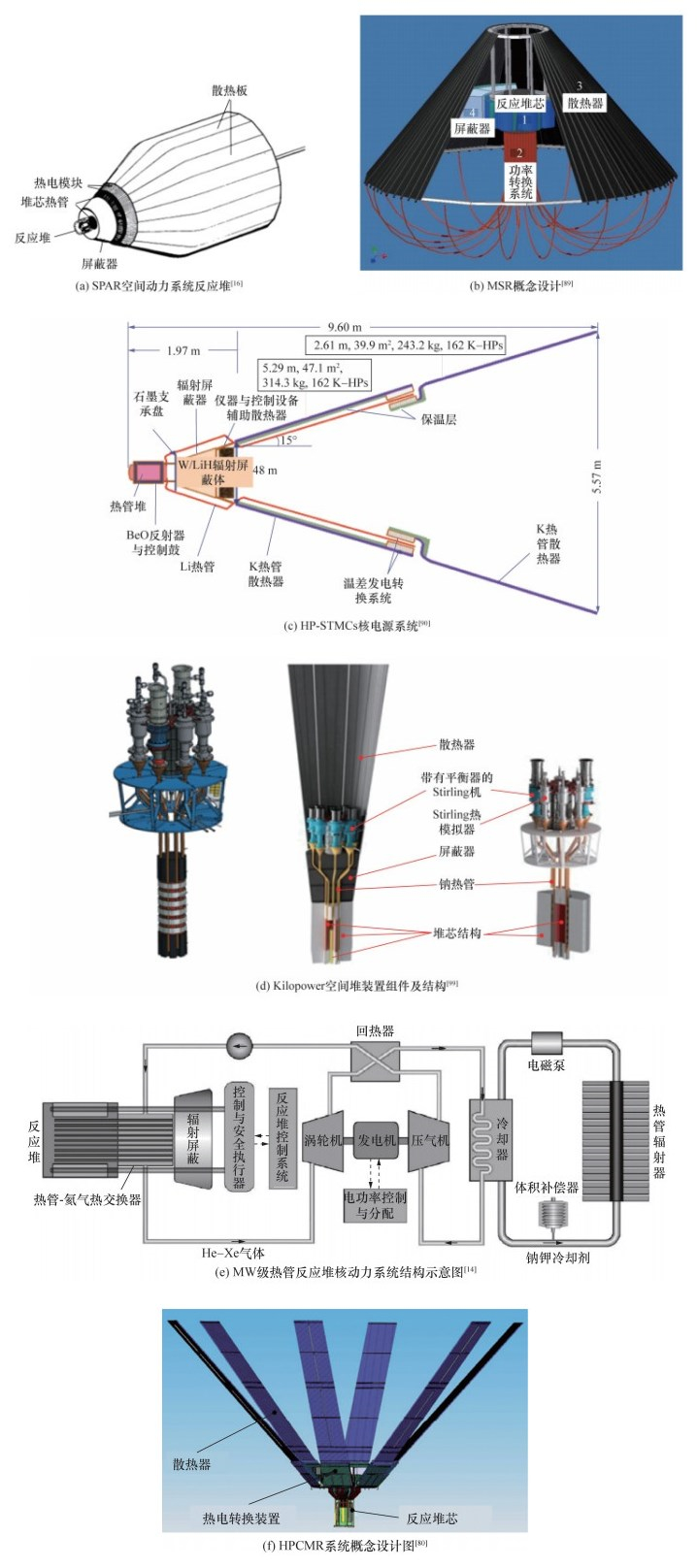
|
| 图 6 国内外主要热管反应堆设计 |
空间热管堆通常采用快堆设计,快堆质量尺寸特性好,更适合空间应用,并且较高的堆芯温度也有利于提高效率。空间热管堆的热电转换方式包括静态转换与动态转换两种[17]。根据表 2汇总,目前空间热管堆的热电转换方式多采用以温差发电转换和热离子转换为主的静态转换技术,以及以Brayton循环和Stirling循环为主的动态转换技术。其中Brayton循环工质通常为CO2或He-Xe,而Stirling循环工质主要为He[100]。温差发电转换与热离子转换的使用历史悠久,技术相对成熟与稳定,并且已成功应用于空间电源系统中;而动态转换方式还没有经历空间条件的考验,处于研究阶段。静态转换技术的效率与动态转换技术相比偏低[10],但是静态转换技术的热电转换效率跨度范围大,并且在小质量与小尺寸方面具有优势。由于大部分静态转换装置外围辅助设备少且不需要运动部件,采用静态转换方式的系统往往更为简化,因此可靠性更高[9, 12]。与地面核电厂追求最高转换效率不同,空间电源系统最重要的参数是比功率,即以最低的质量获得最高的电功率,也就是电源的体积和面积要受到限制[100]。Poston[88]对HOMER中能量转换方式的选择进行了分析,发现在空间热管堆中使用Brayton循环替代Stirling循环,会增加系统开发的技术风险和成本,但是随着功率的增加,Brayton循环在比功率方面的优势会增加。在低电功率(< 5 kW)时,静态转换技术在某些特定应用中或是最佳选择。可见,选择热电转换技术方案时需要考虑具体用途与功率需求。
3.2 空间热管堆研究系统分析热管冷却反应堆启动与稳态运行阶段的热电性能,探索适当的启动策略,能够为提升空间热管堆的效率与安全性提供理论支持和实践指导。
3.2.1 启动性能在空间热管冷却反应堆系统中,高温热管和能量转换系统最初处于冻结状态,热管在启动过程中需要经历高达800 K的温升过程。空间热管堆是一个高度耦合的传热系统,在启动过程中功率、温度和反应性在相对较短的时间内剧烈变化,成为重大的安全挑战。为了确保实现安全可靠地启动,需要对空间热管堆进行冷态启动分析。Guo等[101]对热管冷却堆的早期启动阶段进行了数值模拟,从室温到完全启动大约需要6 000 s。他们发现了功率脉冲现象,即功率快速增加时反应堆温度剧增,产生的热应力会损坏燃料;而当反应堆功率过低时,热管可能再次冷却。反应性反馈是影响空间反应堆安全性能的关键参数。Sun等[102]建立了不同工质的热管堆模型,利用MCNP程序计算了热管启动过程中反应性随温度的变化,分析了热管工质对反应性反馈的影响。袁园等[103]开发了空间热管堆系统瞬态分析程序TAPIRS,研究了SAIRS系统的启动特性,通过调节控制转鼓的转速,该系统可实现完全依靠核热的正常启动。Ma等[104]耦合了二维瞬态热管模型和开式Brayton循环模型,分析了MW级开式Brayton循环热管反应堆的启动过程。结果表明,通过控制转鼓的间歇运动来控制反应堆的启动,能够显著降低堆芯功率峰值和功率波动。
3.2.2 热性能与安全性能研究人员对热管堆的热性能与安全性能进行了大量的探索。Zhang等[105]设计了一个核静默热电反应堆(nuclear silent thermal-electrical reactor,NUSTER)并开发了用于NUSTER热电分析的特定程序HEART, HEART中建立了包括堆芯传热模型、热管模型和温差发电机模型等的完全耦合系统模型。该模型的最大偏差小于12.3%,通过计算得到热管表面温度小于1 300 K,温差发电模块可产生301.94 W的电功率,热电转换效率约为10.87%。李华琪等[106]建立了空间堆中热管传热极限的计算方法,计算了HP-STMCs堆芯锂热管和SAIRS堆芯钠热管的传热极限。在正常运行工况时,两个系统中堆芯热管的传热主要受到毛细极限的影响。张文文等[107]分析了单根热管失效状态下的热工特性,结果表明其设计的新型空间锂热管堆可保证与堆芯输出功率匹配的热传输量,并且能够满足反应堆的安全性能要求。Tang等[108]利用COMSOL Multiphysics研究了热管局部故障的热电耦合现象,发现当有5根相邻热管故障时,中心热管温度梯度有所上升,但仍然能够保证热电系统的输出功率与转换效率。
3.2.3 空间热管堆热管耦合性能热管在堆芯和能量转换系统中起着关键的冷却和热量输送作用。在堆芯中,热管负责从核燃料中迅速有效地移除热量,以避免堆芯过热和燃料的损坏。在能量转换系统中,热管负责将核燃料产生的热量输送到能量转换装置,将热能转换为电能。热管冷却堆运行中,热管对堆芯以及能量转换系统的都会产生一定的影响,需要分析其耦合特性。
Cao等[109]通过数值模拟研究了考虑装配间隙的空间热管冷却堆芯的传热问题。在启动过程中,固体堆芯的接触热阻随着堆芯内燃料棒的膨胀而发生变化,间隙太大时两个表面之间的传热可能仅取决于辐射传热;即使所有相对表面都接触,较高的热功率也不会对反应堆中的温度场产生太大影响。Wang等[110]经过数值模拟分析得到,单根热管出现故障时,裂变热可以通过其他相邻的热管排出,燃料最高升温超过50 K,但仍低于其熔点,并且温度会逐渐达到新的稳定状态,反应堆可以在不关闭的情况下继续运行。
能量转换系统与热管的耦合设计分析对于空间热管堆的系统控制至关重要。Wright和Houts[111]研究了一个耦合反应堆动力学、燃料棒传热动力学和热管瞬态行为的模型,揭示了反应堆反馈引起的耦合效应:当高温热管冷凝段温度足以支持闭式Brayton循环系统的运行时,功率转换系统启动,热交换器的入口温度缓慢提高,工质质量流量逐渐增加,这将暂时冷却反应堆。此时反应堆功率和温度出现振荡,直到系统自动匹配反应堆功率以满足功率需求。最终,反应堆和热交换器的功率在接近全功率时相互匹配。Zhang等[112]建造了一个简单的热管反应堆实验装置,研究了高温热管与温差发电模块组合在不同工况下的稳态运行情况。仿真与实验结果表明,当加热功率在1 000 W以上时,钾热管能够获得更好的性能;温差发电模块在稳态运行期间,冷热侧之间的温降始终在500 ℃以上,最大输出功率可达74.4 W,热电转换效率约为8.0%。Tang等[113]研究了一种采用温差发电转换的微热管冷却堆,结果表明接触热阻对热电转换装置热侧的影响更为显著,随着热侧热流密度的增加,输出功率和转换效率都显著提高。Li等[114]对闭式Brayton循环热管堆建立了动态模型进行综合分析,发现当稳态压力超过最大稳态压力时,系统中热管传热受到毛细极限的限制,存在热管烧坏的风险。孙永康[115]利用高温热管将1 m外的热能传递到温差发电模块的热端以实现热电转化。实验结果表明,在散热系数一定时,提高系统热管加热端的加热功率可以提高系统的输出电功率;而当加热功率一定时,降低散热端的散热系数可以提高系统的输出电功率;针对确定的热端加热功率,存在一个与之匹配的冷端散热系数使系统的输出电功率最大。
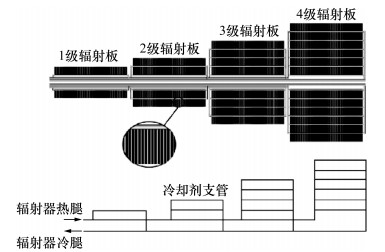
3.3 空间反应堆用高温热管散热器高温热管在空间反应堆中还可用于散热器中,将能量转换系统中的废热排出。高温热管辐射器散热系统基于当前的高温热管和辐射面板技术,具有较高的成熟度和工程可行性,已成为航天电力系统的主要选择。张文文等[14]设计了用于空间反应堆动力系统的钾热管辐射散热器,将辐射板按照数量分为4级,通过冷却剂支管与热管相连(如图 7[14]所示),该设计能够满足系统废热排出的需求。Zhang等[116]设计了用于空间反应堆的钾热管散热器,通过数值计算分析了热管散热器的特性,并与泵回路散热器进行了比较,发现采用热管设计可以克服单点故障问题,具有良好的等温性。
4 高温热管在空间应用面临的挑战
尽管热管冷却反应堆结构简单,在空间应用中具有巨大优势,但高温热管在系统中贯穿始终,涉及多个物理场,存在着复杂的物理现象[117],在空间反应堆中的应用遇到了一些特定的技术难题。
1) 热能的高效传输与管理。高温热管既需要从反应堆中迅速吸收巨大的热量,又需要高效地将这些热量传递到冷凝段的换能端[118]。这一过程要求热管具备高热导率和简单的热流动路径,从而保证热能可以被有效地分配和释放。
2) 在微重力环境中,传统依赖重力的回流机制将不再有效[119]。由于与Stirling机耦合以及绕过屏蔽器等需求,迫使热管采用弯曲或其他非传统形状,以适应特定的空间[90, 99],因此需要重新考虑气液流动路径和工质的回流机制,高温热管弯折或其他变形对工质流动与传热性能的影响需要进一步探索与明确。
上述需求还涉及热管结构与内部吸液芯的创新设计。设计时必须确保工质在对应环境中的有效循环,这不仅增加了设计和模拟的复杂度,也对高温热管的制造提出了更高的要求,必须保证非直形高温热管的结构完整性和性能稳定性。针对这些非传统结构的高温热管,开发有效的性能测试和验证方法也是一项挑战,需要新的测试装置和程序以准确评估其在空间条件下的性能和可靠性[120]。
3) 高温热管还需要适应反应堆以及空间中的极端环境。碱金属高温热管在核反应堆内或附近中子环境内会出现管壁材料硬化强度削弱的情况,而碱金属的中子捕获可能会使蒸气腔中产生不凝气体[18, 121]。反应堆系统在运行中可能会出现运动状态变化的情况,这对高温热管的影响是不可忽视的[122]。这些外部因素可能影响热管的结构完整性和长期性能,热管设计和材料选择必须考虑这些潜在威胁。
4) 高温热管系统的集成和兼容性也是一项挑战,需要确保热管能够与空间反应堆堆芯、能量转换系统及其他系统有效集成,同时满足空间和质量的严格要求[114]。
虽然高温热管在空间核能热能转换系统中存在上述问题和挑战,迄今为止还未实现在空间反应堆中的实际应用,但是研究人员并未停下探索的步伐,仍有大量的理论与实验研究不断推进。
5 针对热管空间应用挑战的解决方案本章将针对高温热管空间应用中的挑战,探讨现有技术的局限性,总结相关研究成果,提出可能的解决方案,为高温热管在空间核能热能转换系统中的应用进一步提供理论支持和技术基础。
5.1 空间环境的高温热管研究空间热管冷却堆会受到飞行器或空间站运动状态的影响。Sun等[122]研究了水平高温热管在运动条件下的热性能,测量了瞬时倾角、垂直隆起和周期摆动条件下热管表面的温度分布,总结了运动条件对水平放置热管传热的影响:高温热管的温度均匀性在瞬时倾斜时会遭到破坏,而垂直于热管的运动对其热行为的影响可忽略不计,周期性摆动会引起相同时间段的温度波动;当冷凝段过长时,高温热管在周期性摆动条件下更容易失效。
在正常重力条件下,热管可以在没有任何毛细管结构的情况下正常工作。重力会改变工质流动状态,一些在微重力条件下未观察到的现象对高温热管传热机制的影响值得关注。Kundan等[123]研究了微重力下可视为无芯热管的约束蒸气气泡(constrained vapor bubble,CVB)实验的传热性能,CVB内部传热过程非常复杂、多维。在微重力下,CVB的重力与表面张力之比很小,能够最大限度发挥毛细力的作用,适用于空间中的冷却传热系统。对CVB的研究可为应用于微重力环境的热管吸液芯设计提供参考。Paiva等[119]研究了微重力下的微型水热管性能,发现烧结多孔结构提供毛细力将工质泵回蒸发段,并将工质散布在蒸发段整个表面上,还发现使用相变材料作为冷凝段散热器可使热管在微重力下也具有较低的热阻。Berto等[124]在正常重力和微重力条件下同时测量通道内的液膜厚度和传热系数,分析微重力对两相换热系统中冷凝现象的影响。在微重力条件下,液体沿着管子的内圆周扩散,导致顶部的液膜比正常重力条件更厚。
与中低温热管相比,高温热管在微重力或无重力环境下的研究相对匮乏。
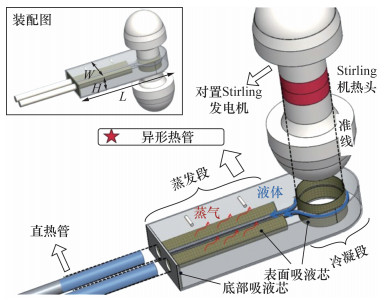
5.2 异形高温热管的尝试空间实际应用中异形热管的设计更符合应用需求[16, 90],但当前空间用高温热管的研究大多局限于传统直形热管,较少关注异形高温热管的设计与研究。许多研究对中低温热管的弯曲效应进行了探索,证明了弯曲对热管性能有显著影响[125-128],而高温热管的相关研究较少。在数值模拟方面,Hu等[129]建立了考虑Marangoni效应和弯曲效应的改进集总参数模型,模型模拟了HP-STMCs中超长且含有弯曲结构的锂热管稳态运行情况。研究结果表明,弯曲引起的蒸气压降约占总压降的22%~23%,液体压降的影响可以忽略不计。在异形热管设计研究方面,Liu等[130]设计制造了一种与Stirling机耦合的核反应堆用异形热管,其结构如图 8[130]所示,利用动脉直接连接冷凝面和蒸发面,大大缩短了两者之间的液体输送距离。动脉为液体提供单独的流道,在保证高毛细力的同时,还能显著降低液体回流损耗。
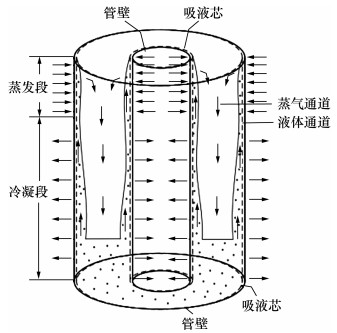
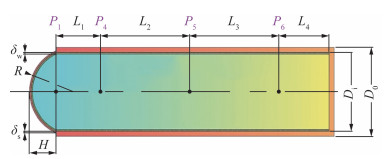
此外,中国科学院工程热物理研究所也进行了一些尝试。Zhao等[131]设计并制作了一种用于反重力工况的同心环形高温热管(如图 9[131]所示)。该热管吸液芯结构横截面积大,可以迅速产生足够的毛细力来驱动液体反重力流动,具有良好的冷态启动性能与温度均匀性。Liu等[132]设计制造了蒸发段为球冠面的异形高温热管(见图 10[132]),通过实验研究了它在轴向非均匀热通量影响下的冷态启动性能和传热特性。该异形热管能够将轴向不均匀大热流转化为均匀热通量,具有优异的均匀传热性能。
5.3 基于增材制造的高温热管成型技术
对于弯曲热管的研究发现,由于制造工艺,大多数弯曲热管是由直管直接弯曲成型的,热管弯曲后除了对工质流动造成影响,对内部吸液芯结构的破坏也是影响热管性能的一个重要因素。增材制造为轻量化、应用定制结构设计和优化提供了广泛的可能性[133],可以克服传统制造工艺中弯曲热管和复杂芯结构的问题。基于增材制造的空间热管堆用高温热管的制造方法,是高温热管在空间核反应堆热传输系统应用的一个重要研究方向。Park等[134]采用3D打印设计制造了热管复合吸液芯结构,并进行了优化,在蒸发段采用筛网和槽形复合吸液芯,提高了蒸发速率和透气性。激光粉末床熔融(laser powder bed fusion, LPBF)制造工艺的巨大设计自由度为热管及其吸液芯结构提供了新的设计和生产概念,可以提高热管性能,并能够直接集成到复杂的承载结构中。Kappe等[133]采用LPBF技术设计制造吸液芯,通过几何设计、工艺参数或两者组合来制造不同的芯结构,进一步提高了热管的性能和灵活性。
5.4 高温热管绝热段的气凝胶隔热技术为了确保热管能在空间环境下高效运行,选择合适的隔热材料至关重要。气凝胶具有低密度、低热导率,在常温常压空气中热导率仅为0.002 W/(m·K),室温真空热导率可达到0.001 W/(m·K)[135],能够以较轻的质量实现绝热效果。气凝胶还具有化学结构稳定的特点,可以耐受空间极端的高低温环境,使用寿命长,适用于高可靠性的航天任务[136-139]。气凝胶在空间高温热管绝热段隔热应用中展现出显著的潜力。
尽管气凝胶在热管中表现出较好的隔热性能,其应用仍面临一些挑战。气凝胶的脆性和多孔性要求特殊处理以避免材料损坏,这使得气凝胶具有较高的生产成本以及在加工和安装过程中的技术难度。此外,气凝胶在极端温度下的性能可能受限,未经适当处理的气凝胶可能会吸水,影响其隔热效果和结构稳定性。在考虑将气凝胶技术整合进热管系统时,必须全面评估其性能限制及环境适应性,确保在空间热管堆应用中实现预期目标。
中国科学院工程热物理研究所采用真空冷冻干燥技术,成功制备了具备优异热稳定性的氧化铝气凝胶及其复合材料[140-141]。此项创新不仅确保了所得气凝胶在物理参数上与传统超临界干燥法所制备的样品相匹配,而且有效规避了超临界干燥技术的高成本、低效率及高操作风险等局限性,显著提升了气凝胶的热稳定性和机械稳定性,确保了气凝胶在极端温度和机械负荷条件下的性能稳定性,能够保证空间热管堆的整体效率与可靠性。
5.5 其他相关研究由于工作温度高,应用传统的测量技术来研究高温热管运行时的内部机制是极具挑战性的。Qin等[142]总结了用于高温热管实验的先进测量和可视化技术的初步研究,这些技术可以用于支持微热管反应堆的研究、开发和示范。对于热管传热传质的研究,刘云[143]利用粒子图像测速技术(particle image velocimetry,PIV)对高充液率下环路热虹吸管内流动特性开展相关实验研究。该研究基于温度和压力波动信号,分析了高充液率下环路热虹吸管的启动特性和流动换热特性;基于PIV测速技术,获得高充液率下流场图像,对比分析了不同流态下环路热虹吸管内气泡泵效应,并量化气泡尺寸对气泡泵效应的影响。Lee等[144-145]以实验定量测试和初步理论分析的方法,探索如何强化热管换热能力,同时避免热管在较高热流作用下的失效问题。
6 结论与展望通过梳理高温热管的研究进展以及在空间核能热能转换系统中的应用,对当前研究的总结与展望如下:
1) 高温热管的理论与实验研究不断更迭,虽已有了较为完善的研究体系,但热管冷却堆要求高温热管具有大传热功率、长有效运行区域、弯曲通道以及快速冷态启动性能,这些都对高温热管的研究提出了新的挑战。未来的研究首先应关注热管模型的改进,在考虑工质充液率、复合吸液芯等实际因素的情况下,提高模型精度与适用范围;其次应关注传热极限和失效机理的模型验证,还可将热管模型纳入优化算法。
2) 空间热管冷却反应堆虽然是空间探测任务的理想电源,但受开发测试成本与时间限制,目前世界范围对热管冷却反应堆电源的研究主要集中于概念设计和方案可行性认证阶段。虽然研究者们已完成了一些相关的高温热管地面测试,但是地面实验条件与空间实际使用条件有较大差距,无法验证高温热管在真实空间反应堆中的性能,仍需要进行深入的研究使高温热管在未来深空探测任务中承担更加重要的角色。
3) 微重力条件下热管传热受到工质流动变化的影响,当前微重力下的热管研究主要涉及低温热管,针对高温热管的空间低重力环境适应性研究相对较为空白,这主要是受到碱金属工质热物理性质、高温热管制造与测试困难以及微重力测试条件难以复现的影响。尽管普通地面实验已较为成熟,但是微重力环境的测试至今还没有突破性进展,需要深入开展微重力下高温热管的理论研究与实验测试,在接近真实空间热管堆应用条件下考察其应用效果。
4) 空间热管堆中热管与堆芯以及各种能量转换装置的耦合关系着系统的热工特性。目前的大多数研究针对热管堆中的某一单独部分,例如高温热管性能、核反应堆堆芯的中子特性以及能量转换装置的转换效率等。热管对堆芯和能量转换系统影响的相关研究较少,且多为数值模拟,缺少实验研究。因此,需要继续在理论研究与数值模拟基础上,通过实验研究进一步分析热管在核能热能转换系统中的耦合特性,为空间热管堆的应用设计提供可靠的数据支撑。
5) 研究人员对异形热管的设计进行了尝试,适用于空间反应堆的高温热管需要根据需求进行定制,这无疑增加了研究难度。热管反应堆用高温异形热管大多停留在概念设计上,在地面测试中仍使用传统直形热管替代。利用吸液芯与高温热管特性保证空间热管堆中热管工质的正常循环是空间热管堆应用的技术基础,需要继续开展对异形高温热管的工质流动特性探究、吸液芯设计制造以及热管测试等工作。
6) 针对空间热管堆用高温热管的设计制造研究也是提高其实际应用潜力的重要方面。基于增材制造的高温热管成型技术为热管的设计和制造提供了新的可能性,这些技术可以克服传统制造工艺中弯曲热管和复杂芯结构的问题,提高热管性能。未来,基于增材制造的高温热管成型技术有望进一步发展,以满足更复杂的热管设计和生产需求。除此之外,对于高温热管绝热段隔热保温,气凝胶在优化空间堆高温热管热性能和提升系统整体性能方面具有极高潜力,未来的研究可关注气凝胶的制备工艺、极端环境下的性能持久性以及与高温热管的适配性,以确保其在空间热管系统中的实际应用效果。
| [1] |
ANDREYEV P V, BARANOV G D, GRAHAM J, et al. The role of nuclear power and nuclear propulsion in the peaceful exploration of space[M]. Vienna, Austria: International Atomic Energy Agency, 2005.
|
| [2] |
WALKER K L, TARAU C, ANDERSON W G. High temperature heat pipes for space fission power[C]// Proceedings of the 11th International Energy Conversion Engineering Conference. San Jose, USA: American Institute of Aeronautics and Astronautics, 2013.
|
| [3] |
EL-GENK M S. Deployment history and design considerations for space reactor power systems[J]. Acta Astronautica, 2009, 64(9-10): 833-849. DOI:10.1016/j.actaastro.2008.12.016 |
| [4] |
ROMANO L F R, RIBEIRO G B. Optimization of a heat pipe-radiator assembly coupled to a recuperated closed Brayton cycle for compact space power plants[J]. Applied Thermal Engineering, 2021, 196: 117355. DOI:10.1016/j.applthermaleng.2021.117355 |
| [5] |
XIAO W, LI X Y, LI P J, et al. High-fidelity multi-physics coupling study on advanced heat pipe reactor[J]. Computer Physics Communications, 2022, 270: 108152. DOI:10.1016/j.cpc.2021.108152 |
| [6] |
HUANG J L, WANG C L, GUO K L, et al. Heat transfer analysis of heat pipe cooled device with thermoelectric generator for nuclear power application[J]. Nuclear Engineering and Design, 2022, 390: 111652. DOI:10.1016/j.nucengdes.2022.111652 |
| [7] |
ZOHURI B. Heat pipe applications in fission driven nuclear power plants[M]. Cham, Switzerland: Springer, 2019.
|
| [8] |
苏光辉, 章静, 王成龙. 核能在未来载人航天中的应用[J]. 载人航天, 2020, 26(1): 1-13. SU G H, ZHANG J, WANG C L. Application of nuclear energy in future manned space flight[J]. Manned Spaceflight, 2020, 26(1): 1-13. (in Chinese) |
| [9] |
余红星, 马誉高, 张卓华, 等. 热管冷却反应堆的兴起和发展[J]. 核动力工程, 2019, 40(4): 1-8. YU H X, MA Y G, ZHANG Z H, et al. Initiation and development of heat pipe cooled reactor[J]. Nuclear Power Engineering, 2019, 40(4): 1-8. (in Chinese) |
| [10] |
薛翔, 王浩明, 王园丁. 国外空间核动力技术发展现状及启示[J]. 中国航天, 2023(11): 23-32. XUE X, WANG H M, WANG Y D. Development status of foreign space nuclear power technology and enlightenment to China[J]. Aerospace China, 2023(11): 23-32. (in Chinese) |
| [11] |
刘祥, 郝祖龙, 牛风雷. 空间核反应堆冷却剂热物性比较分析[J]. 实验室研究与探索, 2021, 40(5): 41-44, 242. LIU X, HAO Z L, NIU F L. Comparative analysis of thermophysical properties of space reactor coolant[J]. Research and Exploration in Laboratory, 2021, 40(5): 41-44, 242. (in Chinese) |
| [12] |
张明, 蔡晓东, 杜青, 等. 核反应堆空间应用研究[J]. 航天器工程, 2013, 22(6): 119-126. ZHANG M, CAI X D, DU Q, et al. Research on nuclear reactor in space application[J]. Spacecraft Engineering, 2013, 22(6): 119-126. (in Chinese) |
| [13] |
吴伟仁, 刘继忠, 赵小津, 等. 空间核反应堆电源研究[J]. 中国科学: 技术科学, 2019, 49(1): 1-12. WU W R, LIU J Z, ZHAO X J, et al. System engineering research and application foreground of space nuclear reactor power generators[J]. Scientia Sinica Technologica, 2019, 49(1): 1-12. DOI:10.3969/j.issn.0253-2778.2019.01.001 (in Chinese) |
| [14] |
张文文, 刘逍, 田文喜, 等. 兆瓦级空间热管反应堆动力系统概念设计[J]. 原子能科学技术, 2017, 51(12): 2160-2164. ZHANG W W, LIU X, TIAN W X, et al. Conceptual design of megawatt class space heat pipe reactor power system[J]. Atomic Energy Science and Technology, 2017, 51(12): 2160-2164. DOI:10.7538/yzk.2017.51.12.2160 (in Chinese) |
| [15] |
KOENIG D R, RANKEN W A, SALMI E W. Heat-pipe reactors for space power applications[J]. Journal of Energy, 1977, 1(4): 237-243. DOI:10.2514/3.62334 |
| [16] |
RANKEN W A. Heat pipe development for the SPAR space power system[M]// REAY D A. Advances in heat pipe technology. New York, USA: Pergamon, 1982: 561-574.
|
| [17] |
EL-GENK M S. Space nuclear reactor power system concepts with static and dynamic energy conversion[J]. Energy Conversion and Management, 2008, 49(3): 402-411. DOI:10.1016/j.enconman.2007.10.014 |
| [18] |
EL-GENK M S, TOURNIER J M P. Uses of liquid-metal and water heat pipes in space reactor power systems[J]. Frontiers in Heat Pipes, 2011, 2: 013002. |
| [19] |
胡古, 赵守智. 空间核反应堆电源技术概览[J]. 深空探测学报, 2017, 4(5): 430-443. HU G, ZHAO S Z. Overview of space nuclear reactor power technology[J]. Journal of Deep Space Exploration, 2017, 4(5): 430-443. (in Chinese) |
| [20] |
SAMSON J R, CUTTING F M. Thermal management for high performance computing in spaceborne applications[C]// Proceedings of the Seventh Intersociety Conference on Thermal and Thermomechanical Phenomena in Electronic Systems. Las Vegas, USA: IEEE, 2000: 247-254.
|
| [21] |
DEVARAKONDA A, OLMINSKY J. An evaluation of halides and other substances as potential heat pipe fluids[C]// Proceedings of the 2nd International Energy Conversion Engineering Conference. Providence, USA: American Institute of Aeronautics and Astronautics, 2004.
|
| [22] |
TIAN Z X, WANG C L, GUO K L, et al. A review of liquid metal high temperature heat pipes: Theoretical model, design, and application[J]. International Journal of Heat and Mass Transfer, 2023, 214: 124434. DOI:10.1016/j.ijheatmasstransfer.2023.124434 |
| [23] |
JOUHARA H, ANASTASOV V, KHAMIS I. Potential of heat pipe technology in nuclear seawater desalination[J]. Desalination, 2009, 249(3): 1055-1061. DOI:10.1016/j.desal.2009.05.019 |
| [24] |
FAGHRI A. Heat pipe science and technology[M]. Washington DC, USA: Taylor & Francis, 1995.
|
| [25] |
ZENG H Y, WANG Y Q, SHI Y X, et al. Highly thermal integrated heat pipe-solid oxide fuel cell[J]. Applied Energy, 2018, 216: 613-619. DOI:10.1016/j.apenergy.2018.02.040 |
| [26] |
SHAFIEIAN A, KHIADANI M, NOSRATI A. A review of latest developments, progress, and applications of heat pipe solar collectors[J]. Renewable and Sustainable Energy Reviews, 2018, 95: 273-304. DOI:10.1016/j.rser.2018.07.014 |
| [27] |
FUSARO R, FERRETTO D, VIOLA N, et al. Liquid metals heat-pipe solution for hypersonic air-intake leading edge: Conceptual design, numerical analysis and verification[J]. Acta Astronautica, 2022, 197: 336-352. DOI:10.1016/j.actaastro.2022.05.034 |
| [28] |
MA J, JIANG B, SI-MA W, et al. Deciphering high-efficiency solar-thermochemical energy conversion process of heat pipe reactor for steam methane reforming[J]. Fuel, 2022, 326: 124972. DOI:10.1016/j.fuel.2022.124972 |
| [29] |
SINGH R, SINGH OBEROI A, SINGH T. Heat pipes for PEM fuel cell cooling: State of the art review[J/OL]. Materials Today: Proceedings, 2023. https://doi.org/10.1016/j.matpr.2023.01.135.
|
| [30] |
WANG C J, LI J W, XU B W, et al. Design and thermal performance research of airfoil alkali metal high-temperature heat pipe[J]. Journal of Thermal Science and Engineering Applications, 2023, 15(4): 041006. DOI:10.1115/1.4056696 |
| [31] |
JANG J H, FAGHRI A, CHANG W S, et al. Mathematical modeling and analysis of heat pipe start-up from the frozen state[J]. Journal of Heat Transfer, 1990, 112(3): 586-594. DOI:10.1115/1.2910427 |
| [32] |
JANG J H. An analysis of startup from the frozen state and transient performance of heat pipes[D]. Atlanta, USA: Georgia Institute of Technology, 1988.
|
| [33] |
TOURNIER J M, EL-GENK M S. Transient analysis of the startup of a sodium heat pipe from a frozen state[J]. AIP Conference Proceedings, 1996, 361(1): 1121-1128. |
| [34] |
TOURNIER J M, EL-GENK M S. An analysis of the startup of a radiatively-cooled sodium heat pipe from a frozen state[R]. Washington DC, USA: National Aeronautics and Space Administration, 1996.
|
| [35] |
TOURNIER J M, EL-GENK M S. Startup of a horizontal lithium-molybdenum heat pipe from a frozen state[J]. International Journal of Heat and Mass Transfer, 2003, 46(4): 671-685. DOI:10.1016/S0017-9310(02)00324-1 |
| [36] |
YU D L, LIU J, HU C J, et al. Key features and highly effective prediction of complete startup from frozen state for high-temperature heat pipe in heat pipe reactor[J]. Applied Thermal Engineering, 2024, 236: 121766. DOI:10.1016/j.applthermaleng.2023.121766 |
| [37] |
BUSSE C A. Theory of the ultimate heat transfer limit of cylindrical heat pipes[J]. International Journal of Heat and Mass Transfer, 1973, 16(1): 169-186. DOI:10.1016/0017-9310(73)90260-3 |
| [38] |
KEMME J E. Ultimate heat-pipe performance[J]. IEEE Transactions on Electron Devices, 1969, 16(8): 717-723. DOI:10.1109/T-ED.1969.16845 |
| [39] |
曲伟, 王焕光, 段彦军. 高温及超高温热管的启动特性和传热极限[J]. 工程热物理学报, 2011, 32(8): 1345-1348. QU W, WANG H G, DUAN Y J. Startup characteristics and heat transfer limits of high and super high temperature heat pipes[J]. Journal of Engineering Thermophysics, 2011, 32(8): 1345-1348. (in Chinese) |
| [40] |
LIU J S, MOU Y P, LI X B, et al. Numerical study on the characteristics of sodium heat pipes for space application at operation limits[J]. Nuclear Engineering and Design, 2024, 420: 113044. DOI:10.1016/j.nucengdes.2024.113044 |
| [41] |
LEVY E K. Theoretical investigation of heat pipes operating at low vapor pressures[J]. Journal of Engineering for Industry, 1968, 90(4): 547-552. DOI:10.1115/1.3604687 |
| [42] |
CHI S W. Heat pipe theory and practice[M]. Washington DC, USA: Hemisphere Publishing Corporation, 1976.
|
| [43] |
FAGHRI A, THOMAS S. Performance characteristics of a concentric annular heat pipe: Part Ⅰ: Experimental prediction and analysis of the capillary limit[J]. Journal of Heat Transfer, 1989, 111(4): 844-850. DOI:10.1115/1.3250795 |
| [44] |
FAGHRI A. Performance characteristics of a concentric annular heat pipe: Part Ⅱ: Vapor flow analysis[J]. Journal of Heat Transfer, 1989, 111(4): 851-857. DOI:10.1115/1.3250796 |
| [45] |
TIEN C L, CHUNG K S. Entrainment limits in heat pipes[J]. AIAA Journal, 1979, 17(6): 643-646. DOI:10.2514/3.61190 |
| [46] |
张嘉睿, 田智星, 王成龙, 等. 液态金属高温热管传热极限研究[J]. 原子能科学技术, 2022, 56(10): 2024-2031. ZHANG J R, TIAN Z X, WANG C L, et al. Study on heat transfer limitation of liquid metal high-temperature heat pipe[J]. Atomic Energy Science and Technology, 2022, 56(10): 2024-2031. DOI:10.7538/yzk.2021.youxian.0806 (in Chinese) |
| [47] |
NARENDRA BABU N, KAMATH H C. Materials used in heat pipe[J]. Materials Today: Proceedings, 2015, 2(4-5): 1469-1478. DOI:10.1016/j.matpr.2015.07.072 |
| [48] |
TU S T, ZHANG H, ZHOU W W. Corrosion failures of high temperature heat pipes[J]. Engineering Failure Analysis, 1999, 6(6): 363-370. DOI:10.1016/S1350-6307(98)00057-0 |
| [49] |
MERTINGER V, BENKE M, KISS G, et al. Degradation of a corrosion and heat resistant steel pipe[J]. Engineering Failure Analysis, 2013, 29: 38-44. DOI:10.1016/j.engfailanal.2012.11.002 |
| [50] |
EL-GENK M S, TOURNIER J M. A review of refractory metal alloys and mechanically alloyed-oxide dispersion strengthened steels for space nuclear power systems[J]. Journal of Nuclear Materials, 2005, 340(1): 93-112. DOI:10.1016/j.jnucmat.2004.10.118 |
| [51] |
ROSENFELD J H, ERNST D M, LINDEMUTH J E, et al. An overview of long duration sodium heat pipe tests[J]. AIP Conference Proceedings, 2004, 699(1): 140-147. |
| [52] |
涂善东, 张红, 庄骏. 热管设备的强度与寿命[J]. 压力容器, 1997, 14(2): 30-37. TU S D, ZHANG H, ZHUANG J. The strength and life of heat pipe equipment[J]. Pressure Vessel Technology, 1997, 14(2): 30-37. (in Chinese) |
| [53] |
HACK N, UNZ S, BECKMANN M. Ceramic heat pipes for high temperature application[J]. Energy Procedia, 2017, 120: 140-148. DOI:10.1016/j.egypro.2017.07.147 |
| [54] |
WERNER T C, YAN Y Y, KARAYIANNIS T, et al. Medium temperature heat pipes: Applications, challenges and future direction[J]. Applied Thermal Engineering, 2024, 236: 121371. DOI:10.1016/j.applthermaleng.2023.121371 |
| [55] |
MITOMI M, NAGANO H. Long-distance loop heat pipe for effective utilization of energy[J]. International Journal of Heat and Mass Transfer, 2014, 77: 777-784. DOI:10.1016/j.ijheatmasstransfer.2014.06.001 |
| [56] |
CHEN H X, GUO Y X, YUAN D Z, et al. Experimental study on frozen startup and heat transfer characteristics of a cesium heat pipe under horizontal state[J]. International Journal of Heat and Mass Transfer, 2022, 183: 122105. DOI:10.1016/j.ijheatmasstransfer.2021.122105 |
| [57] |
MUELLER C, TSVETKOV P. A review of heat-pipe modeling and simulation approaches in nuclear systems design and analysis[J]. Annals of Nuclear Energy, 2021, 160: 108393. DOI:10.1016/j.anucene.2021.108393 |
| [58] |
CAO Y D, FAGHRI A. Transient two-dimensional compressible analysis for high-temperature heat pipes with pulsed heat input[J]. Numerical Heat Transfer, Part A: Applications, 1991, 18(4): 483-502. DOI:10.1080/10407789008944804 |
| [59] |
TOURNIER J M, EL-GENK M S. HPTAM, a two-dimensional heat pipe transient analysis model, including the startup from a frozen state[R]. Albuquerque, USA: National Aeronautics and Space Administration, 1995.
|
| [60] |
TIEN C L, ROHANI A R. Analysis of the effects of vapor pressure drop on heat pipe performance[J]. International Journal of Heat and Mass Transfer, 1974, 17(1): 61-67. DOI:10.1016/0017-9310(74)90038-6 |
| [61] |
段彦军, 王焕光, 曲伟. 毛细芯热管蒸汽流动特性研究[J]. 工程热物理学报, 2012, 33(6): 997-1001. DUAN Y J, WANG H G, QU W. Study on vapor flow in capillary wick heat pipes[J]. Journal of Engineering Thermophysics, 2012, 33(6): 997-1001. (in Chinese) |
| [62] |
YILGOR I, SHI S B. Scaling laws for two-phase flow and heat transfer in high-temperature heat pipes[J]. International Journal of Heat and Mass Transfer, 2022, 189: 122688. DOI:10.1016/j.ijheatmasstransfer.2022.122688 |
| [63] |
WANG Z T, YE T Z, GUO K L, et al. Molecular dynamics study of the wettability effect on the evaporation of thin liquid sodium film[J]. Nuclear Engineering and Design, 2023, 405: 112183. DOI:10.1016/j.nucengdes.2023.112183 |
| [64] |
YIN L, LIU H P, LIU W Q. Capillary character and evaporation heat transfer in the wicks of high temperature liquid metal heat pipe[J]. Applied Thermal Engineering, 2020, 175: 115284. DOI:10.1016/j.applthermaleng.2020.115284 |
| [65] |
黄庆, 卜建杰, 郑邯勇, 等. 液态锂在金属丝网上的毛细作用[J]. 舰船科学技术, 2007, 29(6): 130-134. HUANG Q, BU J J, ZHENG H Y, et al. The capillarity of liquid lithium on the metal screen[J]. Ship Science and Technology, 2007, 29(6): 130-134. (in Chinese) |
| [66] |
张贲, 王松柏, 魏子亚, 等. 超亲水多孔金属结构驱动的毛细液膜冷凝及传热强化[J]. 化工学报, 2023, 74(7): 2824-2835. ZHANG B, WANG S B, WEI Z Y, et al. Capillary liquid film condensation and heat transfer enhancement driven by superhydrophilic porous metal structure[J]. CIESC Journal, 2023, 74(7): 2824-2835. (in Chinese) |
| [67] |
ZHANG Z Q, CHAI X M, WANG C L, et al. Numerical investigation on startup characteristics of high temperature heat pipe for nuclear reactor[J]. Nuclear Engineering and Design, 2021, 378: 111180. DOI:10.1016/j.nucengdes.2021.111180 |
| [68] |
GUO Y C, SU Z L, LI Z G, et al. Numerical investigation on the startup performance of high-temperature heat pipes for heat pipe cooled reactor application[J]. Nuclear Science and Techniques, 2021, 32(10): 104. DOI:10.1007/s41365-021-00947-2 |
| [69] |
TIAN Z X, WANG C L, HUANG J L, et al. Code development and analysis on the operation of liquid metal high temperature heat pipes under full condition[J]. Annals of Nuclear Energy, 2021, 160: 108396. DOI:10.1016/j.anucene.2021.108396 |
| [70] |
YANG H W, WANG C L, ZHANG D L, et al. Parameter sensitivity study on startup characteristics of high temperature potassium heat pipe[J]. Nuclear Engineering and Design, 2022, 392: 111754. DOI:10.1016/j.nucengdes.2022.111754 |
| [71] |
田智星, 刘逍, 王成龙, 等. 高温钾热管稳态运行传热特性研究[J]. 原子能科学技术, 2020, 54(10): 1771-1778. TIAN Z X, LIU X, WANG C L, et al. Study on heat transfer performance of high temperature potassium heat pipe at steady state[J]. Atomic Energy Science and Technology, 2020, 54(10): 1771-1778. (in Chinese) |
| [72] |
TIAN Z X, ZHANG J R, WANG C L, et al. Experimental evaluation on heat transfer limits of sodium heat pipe with screen mesh for nuclear reactor system[J]. Applied Thermal Engineering, 2022, 209: 118296. DOI:10.1016/j.applthermaleng.2022.118296 |
| [73] |
STORM PEDERSEN E. Heat-pipe thermionic reactor concept[J]. Nuclear Engineering, 1967, 12(129): 112-114. |
| [74] |
ZHANG W W, ZHANG D L, WANG C L, et al. Conceptual design and analysis of a megawatt power level heat pipe cooled space reactor power system[J]. Annals of Nuclear Energy, 2020, 144: 107576. DOI:10.1016/j.anucene.2020.107576 |
| [75] |
RANKEN W A, HOUTS M G. Heat pipe cooled reactors for multi-kilowatt space power supplies[R]. Los Alamos, USA: Los Alamos National Laboratory, 1995.
|
| [76] |
HOUTS M G, POSTON D I, RANKEN W A. Heatpipe space power and propulsion systems[J]. AIP Conference Proceedings, 1996, 361(1): 1155-1162. |
| [77] |
POSTON D I, KAPERNICK R J, GUFFEE R M. Design and analysis of the SAFE-400 space fission reactor[J]. AIP Conference Proceedings, 2002, 608(1): 578-588. |
| [78] |
BRAGG-SITTON S M. Heat pipe reactor dynamic response tests: SAFE-100 reactor core prototype[C]// Proceedings of the Space Nuclear Conference 2005. San Diego, USA, 2005.
|
| [79] |
REID R S, SENA J T, MARTINEZ A L. Sodium heat pipe module test for the SAFE-30 reactor prototype[J]. AIP Conference Proceedings, 2001, 552(1): 869-874. |
| [80] |
HU G, ZHAO S Z, SUN Z Y, et al. A heat pipe cooled modular reactor concept for manned lunar base application[C]// Proceedings of the 21st International Conference on Nuclear Engineering. Chengdu: American Society of Mechanical Engineers, 2013.
|
| [81] |
POSTON D I, MCCLURE P R, DIXON D D, et al. Experimental demonstration of a heat pipe-Stirling engine nuclear reactor[J]. Nuclear Technology, 2014, 188(3): 229-237. DOI:10.13182/NT13-71 |
| [82] |
GIBSON M A, BRIGGS M H, SANZI J L, et al. Heat pipe powered Stirling conversion for the demonstration using flattop fission (DUFF) test[C]// Proceedings of the Nuclear and Emerging Technologies for Space. Albuquerque, USA: American Nuclear Society, 2013.
|
| [83] |
GIBSON M A, POSTON D I, MCCLURE P R, et al. Heat transport and power conversion of the kilopower reactor test[J]. Nuclear Technology, 2020, 206(S1): 31-42. |
| [84] |
MCCLURE P R, POSTON D I, GIBSON M A, et al. Kilopower project: The KRUSTY fission power experiment and potential missions[J]. Nuclear Technology, 2020, 206(S1): S1-S12. |
| [85] |
POSTON D I, GIBSON M A, SANCHEZ R G, et al. Results of the KRUSTY nuclear system test[J]. Nuclear Technology, 2020, 206(S1): S89-S117. |
| [86] |
POSTON D I. Nuclear design of the HOMER-15 Mars surface fission reactor[R]. Westmont, USA: American Nuclear Society, 2002.
|
| [87] |
POSTON D I, VOIT S L, REID R S, et al. The heatpipe power system (HPS) for Mars outpose and manned Mars missions[J]. AIP Conference Proceedings, 2000, 504(1): 1327-1334. |
| [88] |
POSTON D I. The heatpipe-operated Mars exploration reactor (HOMER)[J]. AIP Conference Proceedings, 2001, 552(1): 797-804. |
| [89] |
BUSHMAN A, CARPENTER D M, ELLIS T S, et al. The Martian surface reactor: An advanced nuclear power station for manned extraterrestrial exploration[R]. Cambridge, USA: Center for Advanced Nuclear Energy Systems, Massachusetts Institute of Technology, 2004.
|
| [90] |
EL-GENK M S, TOURNIER J M. Conceptual design of HP-STMCs space reactor power system for 110 kWe[J]. AIP Conference Proceedings, 2004, 699(1): 658-672. |
| [91] |
EL-GENK M S, TOURNIER J M. Performance analysis of potassium heat pipes radiator for HP-STMCs space reactor power system[J]. AIP Conference Proceedings, 2004, 699(1): 793-805. |
| [92] |
TOURNIER J M, EL-GENK M S. Reactor lithium heat pipes for HP-STMCs space reactor power system[J]. AIP Conference Proceedings, 2004, 699(1): 781-792. |
| [93] |
EL-GENK M S, TOURNIER J M P. "SAIRS": Scalable AMTEC integrated reactor space power system[J]. Progress in Nuclear Energy, 2004, 45(1): 25-69. DOI:10.1016/j.pnucene.2004.08.002 |
| [94] |
BESS J D. A basic LEGO reactor design for the provision of lunar surface power[R]. Idaho Falls, USA: Idaho National Laboratory, 2008.
|
| [95] |
BESS J D. Project Luna Succendo: The lunar evolutionary growth-optimized (LEGO) reactor[D]. Salt Lake City, USA: The University of Utah, 2008.
|
| [96] |
GIBSON M A, OLESON S R, POSTON D I, et al. NASA's Kilopower reactor development and the path to higher power missions[C]// Proceedings of 2017 IEEE Aerospace Conference. Big Sky, USA: IEEE, 2017: 1-14.
|
| [97] |
姚成志, 胡古, 解家春, 等. 月球表面核反应堆电源方案[J]. 科技导报, 2015, 33(12): 19-23. YAO C Z, HU G, XIE J C, et al. A scheme of lunar surface nuclear reactor power[J]. Science & Technology Review, 2015, 33(12): 19-23. (in Chinese) |
| [98] |
姚成志, 胡古, 赵守智, 等. 火星表面核反应堆电源方案研究[J]. 原子能科学技术, 2016, 50(8): 1449-1455. YAO C Z, HU G, ZHAO S Z, et al. Scheme research of Mars surface nuclear reactor power[J]. Atomic Energy Science and Technology, 2016, 50(8): 1449-1455. (in Chinese) |
| [99] |
POSTON D I, GIBSON M A, GODFROY T, et al. KRUSTY reactor design[J]. Nuclear Technology, 2020, 206(S1): S13-S30. |
| [100] |
苏著亭, 杨继材, 柯国土. 空间核动力[M]. 上海: 上海交通大学出版社, 2016. SU Z T, YANG J C, KE G T. Space nuclear power[M]. Shanghai: Shanghai Jiao Tong University Press, 2016. (in Chinese) |
| [101] |
GUO Y C, GUO X Y, GUO S M, et al. Numerical simulation of the early startup period of heat pipe cooled reactor system from the room temperature state[J]. Annals of Nuclear Energy, 2024, 195: 110190. DOI:10.1016/j.anucene.2023.110190 |
| [102] |
SUN H, ZHANG R, WANG C L, et al. Reactivity feedback evaluation during the start-up of the heat pipe cooled nuclear reactors[J]. Progress in Nuclear Energy, 2020, 120: 103217. DOI:10.1016/j.pnucene.2019.103217 |
| [103] |
袁园, 苟军利, 单建强, 等. 热管冷却空间反应堆系统启动特性研究[J]. 原子能科学技术, 2016, 50(6): 1054-1059. YUAN Y, GOU J L, SHAN J Q, et al. Startup characteristics of heat pipe cooled space reactor[J]. Atomic Energy Science and Technology, 2016, 50(6): 1054-1059. (in Chinese) |
| [104] |
MA Y G, ZHONG R C, YU H X, et al. Startup analyses of a megawatt heat pipe cooled reactor[J]. Progress in Nuclear Energy, 2022, 153: 104405. DOI:10.1016/j.pnucene.2022.104405 |
| [105] |
ZHANG Z Q, WANG C L, GUO K L, et al. HEART, a specific code for thermal-electrical analysis of heat pipe cooled nuclear reactor[J]. International Journal of Thermal Sciences, 2022, 179: 107666. DOI:10.1016/j.ijthermalsci.2022.107666 |
| [106] |
李华琪, 江新标, 陈立新, 等. 空间堆热管输热能力分析[J]. 原子能科学技术, 2015, 49(1): 89-95. LI H Q, JIANG X B, CHEN L X, et al. Heat transfer capability analysis of heat pipe for space reactor[J]. Atomic Energy Science and Technology, 2015, 49(1): 89-95. (in Chinese) |
| [107] |
张文文, 王成龙, 田文喜, 等. 新型热管反应堆堆芯热工安全分析[J]. 原子能科学技术, 2017, 51(5): 822-827. ZHANG W W, WANG C L, TIAN W X, et al. Thermal safety analysis of new type heat pipe reactor core[J]. Atomic Energy Science and Technology, 2017, 51(5): 822-827. (in Chinese) |
| [108] |
TANG S M, LIAN Q, ZHU L X, et al. Thermal-electrical coupling analysis of the static heat pipe cooled reactor under heat pipe failure condition[J]. Nuclear Engineering and Design, 2024, 417: 112812. DOI:10.1016/j.nucengdes.2023.112812 |
| [109] |
CAO H W, WANG G B. The research on the heat transfer of a solid-core nuclear reactor cooled by heat pipe through a numerical simulation, considering the assembly gaps[J]. Annals of Nuclear Energy, 2019, 130: 431-439. DOI:10.1016/j.anucene.2019.03.013 |
| [110] |
WANG C L, SUN H, TANG S M, et al. Thermal-hydraulic analysis of a new conceptual heat pipe cooled small nuclear reactor system[J]. Nuclear Engineering and Technology, 2020, 52(1): 19-26. DOI:10.1016/j.net.2019.06.021 |
| [111] |
WRIGHT S A, HOUTS M. Coupled reactor kinetics and heat transfer model for heat pipe cooled reactors[J]. AIP Conference Proceedings, 2001, 552(1): 815-821. |
| [112] |
ZHANG Y, CHAI X M, WANG C L, et al. Thermal-hydraulic analysis of heat pipe reactor experimental device with thermoelectric generators[J]. Progress in Nuclear Energy, 2022, 146: 104137. DOI:10.1016/j.pnucene.2022.104137 |
| [113] |
TANG S M, LIU X, WANG C L, et al. Thermal-electrical coupling characteristic analysis of the heat pipe cooled reactor with static thermoelectric conversion[J]. Annals of Nuclear Energy, 2022, 168: 108870. DOI:10.1016/j.anucene.2021.108870 |
| [114] |
LI J K, HU Z Y, JIANG H S, et al. Coupled characteristics and performance of heat pipe cooled reactor with closed Brayton cycle[J]. Energy, 2023, 280: 128166. DOI:10.1016/j.energy.2023.128166 |
| [115] |
孙永康. 基于空间核电源的高温热管热电耦合系统结构与性能研究[D]. 南京: 南京航空航天大学, 2022. SUN Y K. Research on structure and performance of high temperature heat pipe thermoelectric coupling system based on space nuclear power supply[D]. Nanjing: Nanjing University of Aeronautics and Astronautics, 2022. (in Chinese) |
| [116] |
ZHANG W W, WANG C L, CHEN R H, et al. Preliminary design and thermal analysis of a liquid metal heat pipe radiator for TOPAZ-Ⅱ power system[J]. Annals of Nuclear Energy, 2016, 97: 208-220. DOI:10.1016/j.anucene.2016.07.007 |
| [117] |
ZHANG Z Q, WANG C L, TAN C, et al. Investigation of neutronic and thermal-electric coupling phenomenon in a 100 kWe-level nuclear silent heat pipe-cooled reactor[J]. Applied Thermal Engineering, 2024, 236: 121765. DOI:10.1016/j.applthermaleng.2023.121765 |
| [118] |
WANG D Q, YAN B H, CHEN J Y. The opportunities and challenges of micro heat piped cooled reactor system with high efficiency energy conversion units[J]. Annals of Nuclear Energy, 2020, 149: 107808. DOI:10.1016/j.anucene.2020.107808 |
| [119] |
PAIVA K V, MANTELLI M B H, SLONGO L K. Experimental testing of mini heat pipes under microgravity conditions aboard a suborbital rocket[J]. Aerospace Science and Technology, 2015, 45: 367-375. DOI:10.1016/j.ast.2015.06.004 |
| [120] |
LEE H M, TSAI M C, CHEN H L, et al. Stainless steel heat pipe fabrication, performance testing and modeling[J]. Energy Procedia, 2017, 105: 4745-4750. DOI:10.1016/j.egypro.2017.03.1032 |
| [121] |
张明昊, 王成龙, 孙浩, 等. 辐照条件下高温锂热管不凝性气体产生特性研究[J]. 原子能科学技术, 2021, 55(6): 1024-1030. ZHANG M H, WANG C L, SUN H, et al. Non-condensable gas generation behavior in high- temperature lithium heat pipe under irradiation[J]. Atomic Energy Science and Technology, 2021, 55(6): 1024-1030. (in Chinese) |
| [122] |
SUN H, LIU X, LIAO H Y, et al. Experiment study on thermal behavior of a horizontal high-temperature heat pipe under motion conditions[J]. Annals of Nuclear Energy, 2022, 165: 108760. DOI:10.1016/j.anucene.2021.108760 |
| [123] |
KUNDAN A, PLAWSKY J L, WAYNER JR P C. Thermophysical characteristics of a wickless heat pipe in microgravity-constrained vapor bubble experiment[J]. International Journal of Heat and Mass Transfer, 2014, 78: 1105-1113. DOI:10.1016/j.ijheatmasstransfer.2014.07.044 |
| [124] |
BERTO A, AZZOLIN M, LAVIEILLE P, et al. Experimental investigation of liquid film thickness and heat transfer during condensation in microgravity[J]. International Journal of Heat and Mass Transfer, 2022, 199: 123467. DOI:10.1016/j.ijheatmasstransfer.2022.123467 |
| [125] |
ODHEKAR D D, HARRIS D K. Experimental investigation of bendable heat pipes using sintered copper felt wick[C]// Proceedings of the Thermal and Thermomechanical Proceedings 10th Intersociety Conference on Phenomena in Electronics Systems. San Diego, USA: IEEE, 2006: 570-577.
|
| [126] |
陶汉中, 张红, 庄骏. 小型微槽道热管90°弯曲前后传热性能比较[J]. 宇航学报, 2008, 29(2): 722-728. TAO H Z, ZHANG H, ZHUANG J. Comparison of the heat transfer performance in an AGHP with and without 90° bend[J]. Journal of Astronautics, 2008, 29(2): 722-728. (in Chinese) |
| [127] |
HABIBNEZHAD LEDARI B, SABZPOOSHANI M. A comparative empirical investigation on the thermal performance of gravity-assisted double-bent, double-ended cooling, and single-bent, single-ended cooling heat pipes[J]. International Communications in Heat and Mass Transfer, 2020, 112: 104505. DOI:10.1016/j.icheatmasstransfer.2020.104505 |
| [128] |
MOONEY J P, EGAN V, QUINLAN R, et al. Analysis of sintered wicked heat pipes for space-constrained multiple component cooling[J]. IEEE Transactions on Components, Packaging and Manufacturing Technology, 2021, 11(11): 1896-1908. DOI:10.1109/TCPMT.2021.3121497 |
| [129] |
HU C J, YU D L, HE M S, et al. Performance evaluation of ultra-long lithium heat pipe using an improved lumped parameter model[J]. Nuclear Science and Techniques, 2021, 32(12): 141. DOI:10.1007/s41365-021-00980-1 |
| [130] |
LIU S Y, HU J Y, AN R F, et al. A special-shaped sodium heat pipe with a "bridge-type" artery for coupling free-piston Stirling generator and fission reactor[J]. Applied Thermal Engineering, 2024, 245: 122768. DOI:10.1016/j.applthermaleng.2024.122768 |
| [131] |
ZHAO J, YUAN D Z, TANG D W, et al. Heat transfer characteristics of a concentric annular high temperature heat pipe under anti-gravity conditions[J]. Applied Thermal Engineering, 2019, 148: 817-824. DOI:10.1016/j.applthermaleng.2018.09.042 |
| [132] |
LIU Z M, YUAN D Z, HAO Y, et al. Experimental study on heat transfer performance of high temperature heat pipe under axial non-uniform heat flux[J]. Applied Thermal Engineering, 2024, 236: 121817. DOI:10.1016/j.applthermaleng.2023.121817 |
| [133] |
KAPPE K, BIHLER M, MORAWIETZ K, et al. Design concepts and performance characterization of heat pipe wick structures by LPBF additive manufacturing[J]. Materials, 2022, 15(24): 8930. DOI:10.3390/ma15248930 |
| [134] |
PARK Y Y, BANG I C. Experimental study on 3D printed heat pipes with hybrid screen-groove combined capillary wick structure[J]. Applied Thermal Engineering, 2023, 232: 121037. DOI:10.1016/j.applthermaleng.2023.121037 |
| [135] |
张兴娟, 孔祥明, 杨春信. 气凝胶消防服概念研究[J]. 中国个体防护装备, 2011(3): 15-17. ZHANG X J, KONG X M, YANG C X. Study on the concept of the aerogel-based fire protective clothing[J]. China Personal Protective Equipment, 2011(3): 15-17. (in Chinese) |
| [136] |
孟昊轩, 常晓晶, 艾素芬, 等. 气凝胶隔热材料在空间探测领域研究与应用进展[J]. 宇航材料工艺, 2023, 53(1): 13-20. MENG H X, CHANG X J, AI S F, et al. Research and application progress of aerogel insulation materials in the field of space exploration[J]. Aerospace Materials & Technology, 2023, 53(1): 13-20. (in Chinese) |
| [137] |
NEUGEBAUER A, CHEN K, TANG A, et al. Thermal conductivity and characterization of compacted, granular silica aerogel[J]. Energy and Buildings, 2014, 79: 47-57. DOI:10.1016/j.enbuild.2014.04.025 |
| [138] |
KOEBEL M, RIGACCI A, ACHARD P. Aerogel-based thermal superinsulation: An overview[J]. Journal of Sol-Gel Science and Technology, 2012, 63(3): 315-339. DOI:10.1007/s10971-012-2792-9 |
| [139] |
徐世玉, 邰菊香, 刘学宁, 等. 隔热用聚酰亚胺气凝胶研究进展[J]. 现代化工, 2022, 42(1): 71-75. XU S Y, TAI J X, LIU X N, et al. Research progress in polyimide aerogels for thermal insulation[J]. Modern Chemical Industry, 2022, 42(1): 71-75. (in Chinese) |
| [140] |
马毓, 张航, 朱震庭, 等. 一种基于冷冻干燥制备完整块状二氧化硅-氧化铝复合气凝胶的方法: 202211589122. X[P]. 2023-05-23. MA Y, ZHANG H, ZHU Z T, et al. Method for preparing complete blocky silicon dioxide-aluminum oxide composite aerogel based on freeze drying: 202211589122. X[P]. 2023-05-23. (in Chinese) |
| [141] |
马毓, 张航, 唐瑾晨, 等. 一种冷冻干燥制备完整块状纯氧化铝气凝胶的方法: 202210973633.5[P]. 2022-12-16. MA Y, ZHANG H, TANG J C, et al. Method for preparing complete blocky pure alumina aerogel through freeze drying: 202210973633.5[P]. 2022-12-16. (in Chinese) |
| [142] |
QIN S M, NUNEZ Ⅲ L, SELLERS Z D, et al. Advanced measurement and visualization techniques for high-temperature heat pipe experiments[R]. Idaho Falls, USA: Idaho National Laboratory, 2022.
|
| [143] |
刘云. 环路热虹吸管传热特性及两相流不稳定性研究[D]. 北京: 中国科学院大学(中国科学院工程热物理研究所), 2020. LIU Y. Study on heat transfer characteristics and two-phase flow instability in a two-phase closed loop thermosyphon[D]. Beijing: University of Chinese Academy of Sciences (Institute of Engineering Thermophysics, Chinese Academy of Sciences), 2020. (in Chinese) |
| [144] |
LEE S, YUAN D Z, WU B X. Experimental study on non-phase change heat pipe and its mechanism analysis[C]// Proceedings of the 20th National and 9th International ISHMT-ASME Heat and Mass Transfer Conference. Mumbai, India, 2010.
|
| [145] |
LEE S, YUAN D Z, WU B X. Experimental study on counter-gravity effect of non-phase change heat pipes[C]// Proceedings of 2010 14th International Heat Transfer Conference. Washington DC, USA: ASME, 2011: 369-375.
|