


陶瓷因其高硬度、高强度、高耐磨性、耐氧化等优点被誉为“未来的材料”,广泛应用于航空航天、精密仪器、工程机械、生物医学等领域[1-9]。摩擦磨损是导致陶瓷零部件失效的主要原因之一。据报道,过度磨损引发的断裂失效风险增大是导致航空航天用陶瓷零部件提前报废的重要原因[1];航空航天材料加工成本高昂与专用陶瓷刀具的耐磨性不足密切相关[2-3];陶瓷轴承球与轴承滚道间的磨损是影响轴承精度和服役寿命的重要原因[4];陶瓷人工关节的摩擦因数是评价其性能的重要参数,服役过程中的磨损易造成假体松动失效甚至断裂破坏,产生的磨屑可能引发骨溶解[8]。显然,陶瓷摩擦学性能对陶瓷零部件的长效、可靠服役至关重要,有必要全面、深入理解陶瓷摩擦磨损行为与机制,为设计优化陶瓷材料、提高陶瓷零部件服役性能提供理论基础。
目前,陶瓷摩擦磨损研究主要是通过试验和数值模拟2种方法进行。摩擦磨损试验需要使用摩擦磨损试验机,结合多种形貌和成分表征手段,研究特定工况下的陶瓷材料或零部件表面的摩擦磨损行为[10-11]。摩擦磨损试验具有结果真实、可靠的优点,但存在试验成本高、周期长和效率低等问题,且难以观测摩擦磨损过程中应力、温度、裂纹的实时变化[12-13]。数值模拟依靠电子计算机,结合有限元、离散元和分子动力学等方法,进行“试验计算”从而求解摩擦学问题[14-15]。与试验相比,数值模拟具有成本低、周期短、效率高等优点,并且能够实现摩擦磨损过程中应力、温度、裂纹的动态分析以及分子和原子尺度的研究探索,已成为研究陶瓷摩擦磨损行为与机制的重要手段,受到摩擦学研究领域的广泛关注[16-18]。但相关数值模拟研究大多孤立分散,缺少系统归纳和总结。
本文综述了陶瓷摩擦磨损数值模拟的研究进展。根据原理方法的不同,将陶瓷摩擦磨损数值模拟研究分为有限元模拟、分子动力学模拟和离散元模拟3类,阐述了各自的适用场景、研究现状和局限性,进而从多尺度、多场和多方法耦合以及人工智能辅助方面,提出了陶瓷摩擦学磨损数值模拟的未来发展趋势。
1 有限元模拟有限元模拟是一种基于计算机求解微分方程,利用数学近似的方法对真实物理系统(如几何和载荷工况)进行模拟的常用方法,广泛应用于结构分析、传热、流体流动等领域[19]。它将求解域看成是由许多称为有限元的、小的互连子域组成,对每一单元假定一个合适的近似解,然后推导求解这个域总的满足条件(如结构的平衡条件),从而得到问题的解[20]。陶瓷摩擦磨损的有限元模拟研究早期主要关注摩擦过程中陶瓷表面的弹性应力分布及其演变进程,进而分析揭示陶瓷摩擦磨损机制或优化陶瓷零部件设计[21-37]。随着有限元算法实现由线性计算到非线性计算、单一物理场到多物理场耦合的扩展,有限元分析被用于研究摩擦过程中陶瓷表面裂纹萌生与扩展以及接触摩擦界面温度变化[38-47]。随后,磨损计算模型的发展与改进使得有限元分析可以直接模拟陶瓷磨损表面形貌变化,从而定量研究陶瓷表面磨损行为[48-66]。
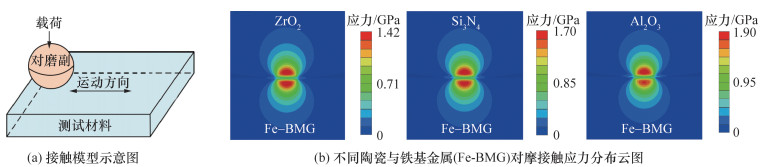
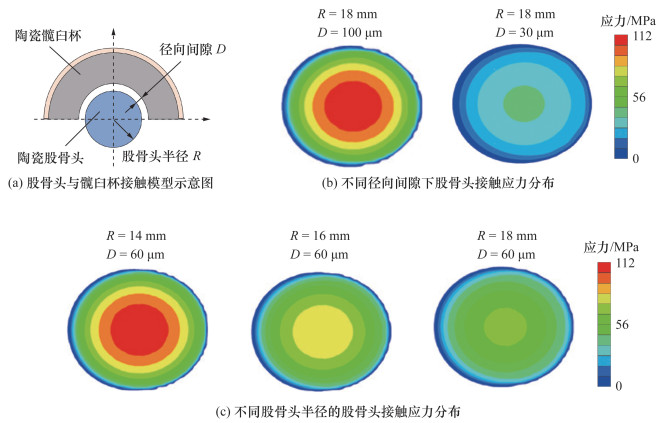
1.1 陶瓷摩擦表面弹性接触分析接触界面应力状态是影响材料表面摩擦磨损的重要因素,受材料力学特性、接触方式和边界条件等因素影响,并随着摩擦磨损进程不断变化[21-23]。因此,研究接触界面应力状态及其演变过程对探明材料摩擦磨损行为具有重要意义。有限元法在处理接触问题方面具有极高精度与效率,被广泛应用于陶瓷摩擦表面弹性接触应力分布与演变研究[23-24],如图 1所示。早期研究主要聚焦于陶瓷表面切应力与主应力对摩擦磨损行为的影响,发现高切应力是陶瓷表面材料去除的主要原因[25-27],局部切应力与主应力形成的合力会加剧陶瓷表面裂纹萌生、开裂和剥落等脆性破坏以及磨粒产生[28],而磨粒在陶瓷表面产生的主应力会进一步加剧陶瓷磨损[29]。基于陶瓷摩擦表面的弹性接触应力模拟分析结果,姚淑卿等[25]利用一种磨损预测模型计算了氧化铝(Al2O3)陶瓷的表面磨损率,该模型认为陶瓷磨损率和摩擦过程中最大切应力呈正相关,与陶瓷临界断裂应力呈负相关[30]。此外,有限元弹性接触分析也被用于复杂陶瓷零部件摩擦表面应力状态分析,主要聚焦人工髋关节摩擦学行为研究及其优化设计[31-37]。人工髋关节的摩擦磨损主要发生在人工股骨头和髋臼杯界面,两者间接触应力是评价人工关节摩擦学性能的重要指标[35-37]。研究显示,相比股骨头和髋臼杯对摩副等效球-面赫兹接触模型,有限元弹性接触分析考虑了对摩副材料梯度变化和接触界面曲面形状的影响,具有更高的接触应力预测精度[33]。在此基础上,有限元弹性接触分析发现股骨头半径和股骨头与髋臼杯之间的径向间隙是影响陶瓷髋关节摩擦界面接触应力的主要参数,增大股骨头半径会导致股骨头与髋臼杯之间接触面积增大,接触应力减小,径向间隙增大会增大股骨头与髋臼杯之间接触应力差,从而加速润滑剂流动、减缓表面润滑膜形成、加剧人工关节磨损[34-35],如图 2所示。
需要指出的是,有限元弹性接触应力分析将陶瓷材料简化为理想的弹性体,忽略了陶瓷表面摩擦磨损过程中材料失效去除、表面形貌变化、摩擦热等因素的影响,通常作为一种辅助手段,与摩擦学试验相结合,研究分析陶瓷材料或零部件的摩擦磨损行为。
1.2 陶瓷摩擦表面断裂与热-力耦合分析在陶瓷刀具切削和陶瓷零部件机械加工等摩擦接触过程中,接触界面受到高应力作用,导致陶瓷表面裂纹萌生甚至整体断裂失效并产生大量摩擦热,从而影响陶瓷刀具使用寿命和陶瓷零部件加工精度与制造效率[38-39]。因此,有必要探明高应力摩擦接触过程中陶瓷表面断裂失效机制和热-力耦合作用。试验研究通常难以直接观测陶瓷表面裂纹动态演变和接触界面温度变化,而基于断裂力学与热力学理论的有限元模拟则能够实时分析陶瓷摩擦表面裂纹萌生与扩展以及摩擦热[40-41]。
陶瓷摩擦表面裂纹萌生与扩展有限元分析主要采用内聚力法和Johnson-Holmquist(JH-2)本构模型,研究磨削加工过程中的磨削深度和速度对陶瓷表面开裂行为与表面质量的影响[42-45]。内聚力法利用牵引分离定律描述陶瓷材料受力时的应力-应变关系,以及在达到一定拉伸或剪切应变后的开裂行为,具有良好的稳定性和计算效率[42-43]。然而,在模拟高磨削深度和速度工况时,内聚力法的预测精度有所降低,这源于其未考虑高应力接触下陶瓷表面的塑性形变以及加工过程中的表面振动[42]。JH-2本构模型中的有效塑性应变断裂准则、拉剪耦合断裂准则和Griffith断裂准则能够有效描述高应力作用下陶瓷的塑性变形行为。Liu等[44]基于Griffith断裂准则模拟分析了磨削加工过程中碳化硅(SiC)陶瓷表面磨削力、微裂纹和表面粗糙度的动态演化过程,其变化趋势与试验结果吻合。Dai等[45]分别采用有效塑性应变断裂准则和拉剪耦合断裂准则预测了磨削加工过程中SiC陶瓷表面和亚表面形貌、磨削力以及等效塑性应变,发现基于拉剪耦合断裂准则的模拟分析能够准确预测SiC陶瓷加工过程中的韧性阶段、韧性-脆性转变阶段、脆性阶段,比有效塑性应变断裂准则具有更高预测精度。
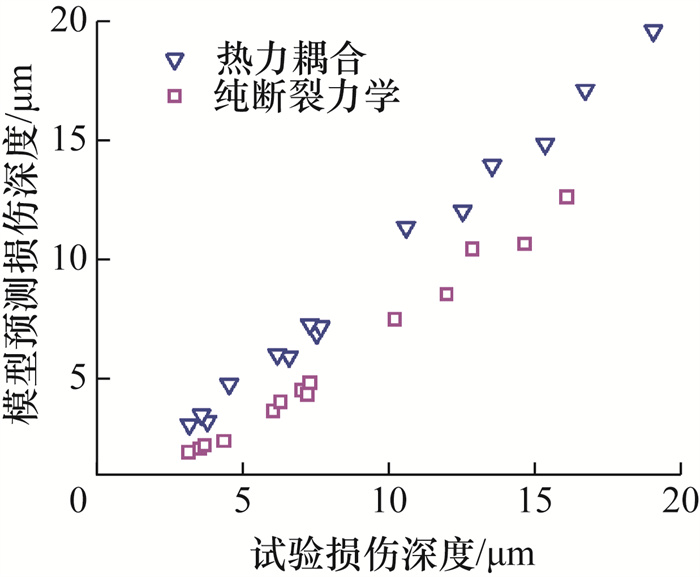
大多数陶瓷材料的导热性能较差,导致机械加工过程中摩擦接触区域温度升高、热应力集中,进而加剧陶瓷表面磨损,甚至引发断裂失效[39]。显然,摩擦热及其引发的热应力是影响机械加工过程中陶瓷表面磨损的重要因素。研究显示,相比基于纯断裂力学的氧化锆(ZrO2)陶瓷表面磨削模型,热-力耦合模型具有更高的表面损伤预测精度(见图 3),并且预测获得的表面温度与试验结果间误差小于6%[46]。通过模拟分析陶瓷刀具表面的摩擦热,可以对陶瓷刀具材料成分进行设计优化。Liu等[47]模拟分析了硼化钛(TiB2)质量分数对碳化硼(B4C)-TiB2复合陶瓷刀具车削过程中摩擦接触界面温度的影响,发现TiB2质量分数为30 %的复合陶瓷刀具车削过程中的界面温度最低,这有利于减少黏着磨损和扩散磨损,提高陶瓷刀具耐磨性。
值得注意的是,基于断裂力学与热力学理论的有限元法适用性不强,几乎仅局限于研究分析陶瓷刀具切削和陶瓷零部件机械加工等高应力摩擦接触过程。同时,该方法对陶瓷表面磨损多为定性描述,而非定量分析。
1.3 陶瓷表面磨损预测陶瓷表面磨损预测主要基于Archard磨损模型、陶瓷断裂机制、JH-2和Johnson-Cook(JC)本构模型以及能量原理等方法。其中,Archard磨损模型适用性最强、应用最广,而其他方法多为描述特定摩擦磨损工况而开发使用。
1.3.1 Archard磨损模型20世纪50年代,Archard黏着磨损模型被提出,并在此后完善推广至磨粒磨损、腐蚀磨损和疲劳磨损几种基本磨损形式,成为应用最广的磨损计算模型[48-51]。在Archard磨损模型中,磨损量被认为与法向载荷、滑动距离呈正相关,与材料硬度呈负相关,一般公式如下所示:
| $ V=K \frac{P}{H} s. $ | (1) |
其中:V为磨损体积;P为法向载荷;H为材料硬度;s为磨损发生的相对位移;K为磨损系数,一般通过磨损试验确定,Archard描述其为磨粒在磨损过程中形成的概率[51]。Archard磨损模型的微分形式为
| $ \mathrm{d} V=K \frac{\mathrm{~d} P}{H} \mathrm{~d} s. $ | (2) |
通常将P和s推广到应力-时间场[52]中:
| $ \mathrm{d} V=\mathrm{d} h \mathrm{~d} A, \mathrm{~d} p=\sigma \mathrm{d} A, \mathrm{~d} s=v \mathrm{~d} t . $ | (3) |
其中:h为磨损深度;σ为法向接触应力,通常是一个关于时间与位置的函数;t为磨损时间;A为接触面积;v为磨损速率。将式(3)代入式(2)得到基于应力-时间场的Archard磨损模型:
| $ \mathrm{d} h=K \frac{\sigma}{H} v \mathrm{~d} t. $ | (4) |
随后再将式(4)在磨损的全时间域进行积分,得到磨损深度计算公式:
| $ h=K \frac{v}{H} \int_0^t \sigma(t) \mathrm{d} t . $ | (5) |
在有限元计算中,对式(5)进行时间与空间的离散化,并对材料本构方程进行求解,计算出在第i次循环时间、第j个节点上的应力值σi, j,结合式(5),该循环时间j节点的磨损深度变化表示为
| $ \Delta h_{i, j}=K \frac{v}{H} \sigma_{i, j} \Delta t. $ | (6) |
其中Δt为一次磨损循环的时间。因此,在1次循环时间内,材料的总磨损深度可表示为
| $ h_{i, j}=\sum\limits_j^n K \frac{v}{H} \sigma_{i, j} \Delta t . $ | (7) |
其中n为节点总数。经历m次磨损循环,材料的总磨损深度W可表示为
| $ W=\sum\limits_i^m h_{i, j} . $ | (8) |
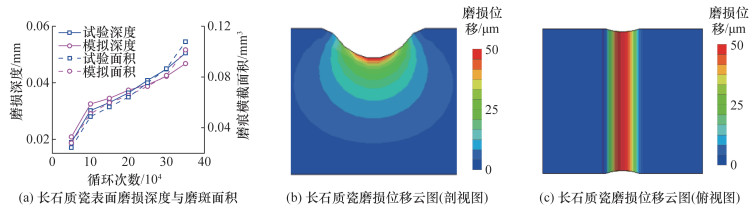
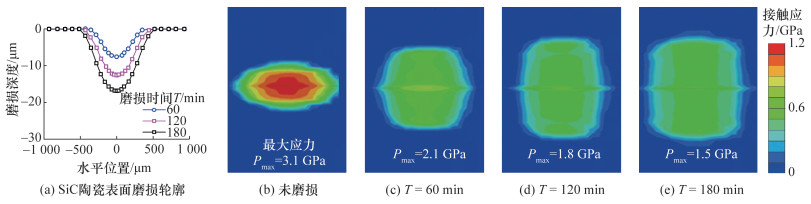
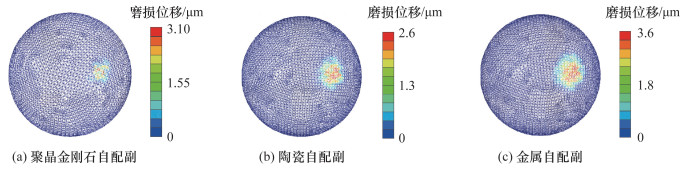
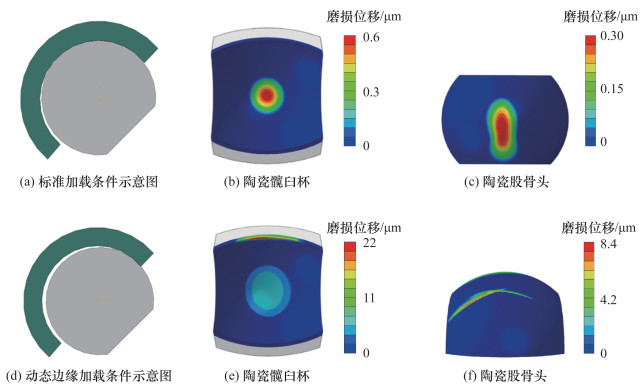
文[53-58]基于Archard磨损模型的陶瓷摩擦磨损有限元分析,研究了SiC、ZrO2、氮化硅(Si3N4)、长石质瓷等典型陶瓷材料在不同摩擦工况下的摩擦磨损行为,建立了磨损率与载荷、循环次数(滑动距离)之间的映射关系,其中长石质瓷和SiC陶瓷的结果分别如图 4和5所示。研究显示,基于Archard磨损模型的陶瓷表面磨损预测误差在10%左右甚至更低,部分误差被认为源于计算过程中恒定的摩擦因数[57-58]。除了分析陶瓷材料的磨损行为,Archard磨损模型还被应用于陶瓷人工关节的磨损预测,已成为评估人工关节产品摩擦磨损性能的重要手段,对筛选人工关节材料、探究不同边界条件下人工关节的摩擦学性能具有重要意义[59-62]。Uddin等[59]模拟对比了几种典型硬质材质人工髋臼杯与股骨头的界面磨损,发现聚晶金刚石自配副的磨损率最低,如图 6所示。典型动态载荷边界条件下的陶瓷人工髋臼杯和股骨头界面磨损模拟结果显示,在起立和下蹲动态载荷下Si3N4陶瓷与Al2O3陶瓷配副磨损率最高,而在负重移动动态载荷下ZrO2陶瓷与Al2O3陶瓷配副磨损最严重[60-61]。为了更精确地描述陶瓷人工关节的摩擦学行为,几种改进的Archard磨损模型被开发应用[63-65]。Prasad等[63]提出了一种适用于交变载荷的Archard磨损模型,可用于模拟分析动态边缘加载条件下陶瓷人工髋关节的磨损行为,如图 7所示。Askari等[64]将Archard磨损模型嵌入多体动力学计算流程中,开发了一种预测陶瓷人工髋关节磨损的多体动力学模型,兼顾了振动对髋关节磨损行为的影响。
需要指出的是,基于Archard磨损模型的有限元分析是一种依赖试验经验的数值模拟方法,其关键参数磨损系数缺乏真实的物理含义,可能随摩擦工况的改变相差几个数量级[48, 66]。
1.3.2 其他磨损计算模型除了Archard磨损模型外,研究人员还提出了基于陶瓷断裂机制、热力学作用、JH-2和JC本构模型、能量原理以及电化学模型的磨损计算模型,以模拟特定材料属性或摩擦工况条件下的陶瓷磨损行为。
大部分陶瓷被认为是脆性材料,其磨损失效通常伴随着开裂、剥落等脆性破坏现象[67]。因此,基于断裂力学理论的磨损模型被提出用于预测陶瓷表面磨损,典型磨损计算模型有横向裂纹模型和拉伸裂纹模型[68-69]。横向裂纹模型基于裂纹横向扩展方程描述陶瓷磨损,磨损体积被认为和接触应力与断裂韧性的比值呈正相关[68];拉伸裂纹模型由断裂能原理推导出磨损计算公式,磨损体积由最大拉伸应力与临界损伤应力的比值和与温度相关的硬度函数决定[69]。此外,针对高速干摩擦工况下摩擦热对陶瓷表面磨损的重要影响,摩擦热主导的临界速度模型被开发并应用于陶瓷表面磨损模拟,该模型认为陶瓷表面磨损体积与热扩散系数成正比,与弹性模量成反比[70]。Hsu等[71]总结了上述3种模型,并对比分析了Si3N4陶瓷摩擦磨损试验与模拟计算结果,发现在轻度磨损下,2种裂纹模型忽略了陶瓷材料的轻微塑性变形,因此模拟获得的陶瓷磨损率比试验结果高;在重度磨损下,2种裂纹模型很好地预测了陶瓷磨损率;在过度磨损下,2种裂纹模型的预测精度不如临界速度模型。
需要指出的是,尽管陶瓷通常被视为脆性材料,但在高应力条件下许多陶瓷仍表现出轻微塑性变形能力[72]。JH-2和JC本构模型广泛用于描述大应变、高应变率条件下材料屈服及失效过程,并基于损伤参数实现单元删除,从而量化磨损[73-77]。有研究采用JH-2和JC本构模型研究了SiC陶瓷的冲蚀磨损行为,其预测结果与Finnie、Bitter和Hashish等冲蚀磨损数学模型计算结果一致[76]。
此外,Mäntylä等[78]和Zhu等[79]在Archard模型的基础上,开发了一种基于能量原理的微动磨损计算模型。Cai等[80]基于该模型分析了陶瓷与合金配副的微动摩擦磨损行为。Fallahnezhad等[81]将Archard磨损模型与Swaminathan等[82]提出的电化学模型相结合,分析了合金与陶瓷配副的微动腐蚀磨损行为,
对比不同工况下化学作用和机械作用的占比。考虑到陶瓷磨损通常涉及多种磨损机制的共同作用,Singh等[83]建立了包含磨粒、黏着和扩散磨损机制的磨损计算模型,并用于模拟分析陶瓷刀具表面磨损。该模型对3种磨损计算模型进行线性求和,考虑了接触载荷、速度、温度和导热率等影响因素,并结合在大多数摩擦工况条件下磨粒和黏着磨损机制占主导地位的试验结果,提高了磨粒和黏着磨损计算模型的权重。
总体而言,本节所提到的几种计算模型研究较少,多针对特定摩擦工况使用,普适性不强,其准确性和适用性尚需进一步研究。
2 分子动力学模拟磨损是摩擦副表面和界面损坏和消耗的过程,存在分子/原子吸附、晶粒弱化与破碎和摩擦化学等微观物理过程和化学反应[12]。而有限元法作为连续介质假设下的力学数值方法,难以解决微观物理过程中的离散问题[84]。分子动力学模拟基于经典Newton运动定律,通过原子间相互作用计算并统计各原子的运动轨迹,从而得到热力学特性及其他体系的各种性质,为探索陶瓷微观摩擦磨损行为与机制提供了有效数值模拟手段[85]。
2.1 陶瓷原子间势能函数与分子动力学接触模型原子间势能函数是分子动力学模型的基础,定义了材料内原子的运动规律,直接关系到数值模拟结果的精确性和可靠性[86]。原子间势能函数可分为经典对势函数和多体势函数[87]。经典对势函数认为原子间相互作用是原子两两之间作用,与其他粒子无关,舍弃了一些粒子存在及其相互作用,使得势函数表达相对简单,降低了摩擦磨损分子动力学模型的运算成本,通常用于一些单质材料、简单合金材料的模拟。多体势函数描述了体系中多原子间相互作用,能够准确反应体系中的各类组分,可分为两体势函数、多体势函数(3种及以上原子体系)。考虑到陶瓷摩擦磨损过程涉及原子种类多、陶瓷晶体类型多为离子晶体或共价晶体,通常使用Tersoff、Rbeo等共价或离子晶体多体势函数描述陶瓷材料原子间作用[88-91]。此外,ReaxFF势函数可以用于研究陶瓷材料磨损过程中的摩擦化学作用[90]。
磨损是对摩副接触并发生材料去除的过程,因此建立合理的分子动力学接触模型是准确模拟材料摩擦磨损行为的前提。目前,摩擦磨损分子动力学模型主要存在3种接触类型,即平面-平面接触、粗糙峰-平面接触、粗糙峰-粗糙峰接触[12]。在平面-平面接触模型中,2个原子尺度平面在一定载荷和速度下彼此滑动并始终保持接触。在粗糙峰-平面接触模型中,单个粗糙峰划过平面并与平面保持接触,粗糙峰具有不同尺寸和形状(如球形、半球形、棱柱形、圆柱形等),多用于研究微纳米器件超精密切削过程中材料的摩擦磨损行为。在粗糙峰-粗糙峰接触模型中,2个粗糙峰相互划过,被认为最能真实反映宏观的摩擦磨损行为,因为宏观摩擦磨损可以被认为是许多不同尺度、不同取向的粗糙峰彼此相互作用的结果。
2.2 陶瓷摩擦学行为的分子动力学模拟研究进展目前,陶瓷摩擦磨损的分子动力学模拟主要聚焦于纳米加工过程中SiC陶瓷的摩擦磨损行为与机制分析,旨在为SiC陶瓷半导体器件加工制造提供理论指导[92-97]。根据研究尺度的不同,可将现有研究分为原子尺度、晶粒尺度和摩擦化学反应研究[91-92, 94-111]。
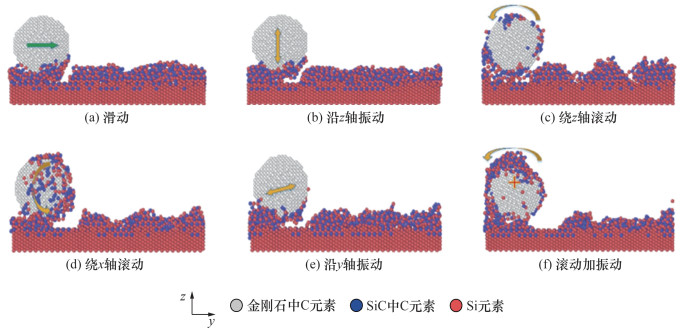
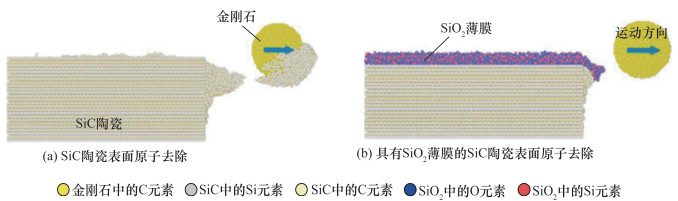
在原子尺度,分子动力学模拟研究主要关注SiC陶瓷摩擦磨损过程中原子去除、吸附、转移、摩擦化学反应和位错滑移运动等行为,从而预测SiC陶瓷表面加工质量[90, 94-109]。相关研究主要考察了抛光深度、抛光速度、振动幅度与频率等纳米加工参数对SiC陶瓷表面原子去除、亚表面损伤和残余应力的影响,发现抛光速度是影响SiC陶瓷表面加工质量的关键因素,并确定了最佳抛光速度区间[94-98]。Nguyen等[98]建立了4H-SiC陶瓷与金刚石配副的摩擦磨损分子动力学模型,并探究了4H-SiC陶瓷在不同摩擦工况(如滚动、滑动、振动及复合运动)下的摩擦磨损行为(见图 8)。结果表明,在摩擦过程中4H-SiC陶瓷表面与金刚石表面的碳原子形成新的碳-碳键,碳原子从4H-SiC陶瓷表面脱落并吸附在金刚石表面,陶瓷表面粗糙度增大;相比滚动和复合运动工况,滑动和振动工况下4H-SiC陶瓷表面脱落的碳原子更少,抛光质量更高。Zhou等[93]通过分子动力学模拟发现SiC陶瓷原子级缺陷会降低加工应力,减少金刚石刀具磨损,但同时导致SiC陶瓷力学和摩擦学性能下降。此外,分子动力学模拟还被用于研究分析表面薄膜、纹理以及环境介质对SiC陶瓷摩擦磨损行为的影响。Nguyen等[99]发现二氧化硅(SiO2)薄膜有助于降低4H-SiC陶瓷表面碳原子脱落转移(见图 9),提高4H-SiC陶瓷表面加工质量。多项分子动力学模拟研究发现SiC陶瓷表面纹理具有容留对摩副磨屑的功能,可减少SiC陶瓷亚表面损伤,其中三角形纹理的优化效果最佳[100-101]。最近,分子动力学模拟还被用于研究激光辅助纳米抛光过程中SiC陶瓷和氮化铝陶瓷的摩擦磨损机制。结果表明,激光照射能够抑制陶瓷中的位错滑移运动和非晶化,在提高陶瓷表面材料去除效率的同时减少了陶瓷亚表面损伤[102-104]。
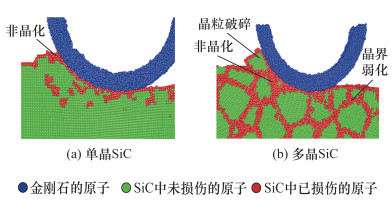
在晶粒尺度,分子动力学模拟研究主要聚焦SiC陶瓷摩擦磨损过程中非晶化、位错滑移运动、晶间滑移运动和晶粒破碎等行为[91, 105-107]。Meng等[105]通过分子动力学模拟研究发现多晶SiC陶瓷机械加工过程中,摩擦接触区域的晶粒首先发生位错滑移运动和晶间滑移运动,随后晶粒碎裂并发生非晶化。研究结果还显示,当SiC晶粒尺寸减小到10 nm以下时,多晶SiC陶瓷表面划痕硬度显著降低,其可加工性能随晶粒尺寸减小而升高。此外,一些研究利用分子动力学模拟对比分析了单晶和多晶SiC陶瓷的微观摩擦磨损行为,结果(见图 10)表明,单晶SiC陶瓷晶粒在磨损过程中主要发生非晶化;而多晶SiC陶瓷则呈现晶界弱化与晶粒破碎等晶粒变形机制,这有利于晶粒脱离和能量耗散,使多晶SiC陶瓷表现出更强的可加工性[91, 106]。
此外,分子动力学模拟能够基于ReaxFF势函数研究陶瓷材料磨损过程中的摩擦化学反应。研究发现,SiC和Si3N4陶瓷中的硅原子能够与水中的原子发生摩擦化学反应,生成SiO2,降低接触界面摩擦因数,减少陶瓷亚表面损伤[107-108]。Yuan等[90]研究了单晶SiC在含羟基自由基水溶液中的损去除行为,发现单晶SiC表面的硅原子和碳原子在机械作用下被羟基氧化,从而脱落并吸附在金刚石对摩副表面。进一步研究发现,SiC陶瓷能与过氧化氢水溶液发生摩擦化学反应,生成Si-H、Si-O和Si-OH三种化学键,从而保护SiC陶瓷表面,使之在磨损过程中表现出更低的摩擦系数并提升表面加工质量[109-111]。
综上,分子动力学模拟为探索陶瓷微观摩擦磨损行为与机制提供了有效途径,但现有研究大多局限于SiC陶瓷材料摩擦磨损分析,几乎未见关于其他陶瓷材料的相关报道。此外,分子动力学模拟存在计算成本高、流程复杂、时间和空间尺度有限、模拟结果难以试验验证等局限性。
3 离散元模拟离散元法的基本思想是将研究对象视为有限个刚性离散单元的集合体,根据过程中每一时步各单元间作用和Newton运动定律的交替迭代预测研究对象的整体行为[85]。这种基于不连续建模框架的数值模拟方法克服了连续介质力学中连续性假设的局限性,在求解断裂、破坏、磨损等强不连续问题上具有一定优势[11, 112]。陶瓷摩擦磨损的离散元数值模拟研究主要采用颗粒流离散元法、可移动元胞自动机(movable cellular automata, MCA)和滑移微尺度动力学(micro-scale dynamic model, MSDM)模型[113-123]。
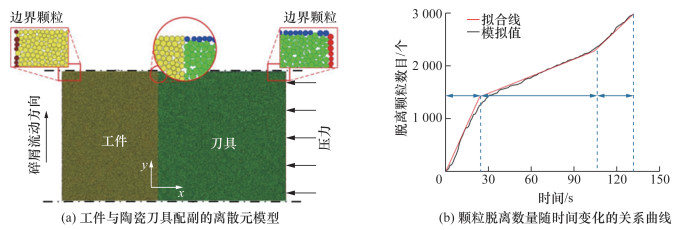
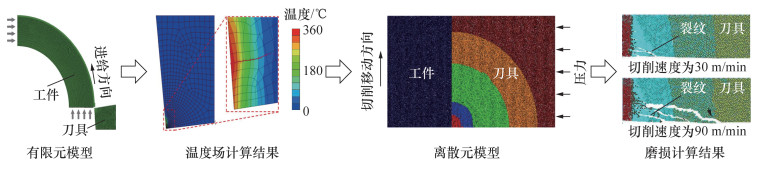
3.1 颗粒流离散元模拟颗粒流离散元法将陶瓷离散为多个相互接触作用的颗粒,相邻颗粒通过胶结键连接,当作用于胶结键上的拉应力大于胶结键的拉伸强度,或切应力大于剪切强度的剪切强度时,胶结键断裂,颗粒脱离,脱落的颗粒数量被用于量化陶瓷表面磨损[123-125]。陶瓷摩擦磨损的颗粒流离散元模拟目前主要聚焦于考察分析陶瓷刀具和砂轮的磨损行为。Peng等[113]建立了Sialon陶瓷刀具与高温合金Inconel 718接触界面离散元模型(见图 11a),并探究了切削Inconel 718合金过程中Sialon陶瓷刀具的磨损演变进程。模拟结果清晰展现了切削过程中陶瓷刀具的初始磨损阶段、稳定磨损阶段和剧烈磨损阶段(见图 11b),且刀具磨损模拟结果与试验结果一致。在此基础上,Luo等[114]将离散元法和有限元法相结合,模拟分析了切削加工过程中产生的摩擦热对陶瓷刀具磨损行为的影响,有限元计算结果为陶瓷刀具磨损离散元模型提供了温度场边界条件,如图 12所示。Godino等[115]建立了Al2O3陶瓷磨粒和白刚玉磨粒研磨过程有限元-离散元模型,模拟2种磨粒在研磨过程中产生的摩擦热和体积损失,模拟结果与试验结果误差在15%以下。基于上述研究,Pazmiño等[116]通过微米尺度陶瓷磨粒离散元模型,探明陶瓷磨粒的微观磨损失效机制,进而结合试验获得的砂轮磨粒数目和分布,构建陶瓷砂轮宏观离散元模型,预测砂轮磨损体积,具有很高的预测精度。Dong等[117]提出将冲蚀磨损计算方程和Coffin-Manson失效准则嵌入离散元计算流程中,模拟了SiC陶瓷的冲蚀磨损行为,模拟结果与试验结果吻合。
需要指出的是,颗粒流离散元模拟中的颗粒和胶结键难以对应陶瓷材料中的具体物质成分,缺少真实的物理含义,仅能通过试验校正获得。此外,颗粒流离散元模拟主要适用于高应力摩擦工况下的陶瓷摩擦磨损行为分析。
3.2 其他离散元模拟除颗粒流离散元模拟外,基于MCA和MSDM的离散元模拟也被用于研究陶瓷摩擦磨损行为。MCA将陶瓷视为可移动元胞的集合,而MSDM则使用方形晶格对陶瓷进行离散化[118-121]。在MCA和MSDM中,模型采用离散单元的质心位置、塑性变形值、旋转矢量等连续参量和相邻离散单元间的离散参量描述,根据对这些参量的计算迭代模拟摩擦陶瓷表面磨损行为[118-119]。Eremina等[122]基于MCA建立了氮化钛陶瓷涂层表面的离散元模型,并考察了涂层制备工艺对涂层表面摩擦系数的影响规律。Li等[123]开发了一种用于预测材料磨损的MSDM模型,并研究分析了微孔隙对TiB2陶瓷和TiB2复合陶瓷磨损行为的影响,结果表明,微孔隙会促进摩擦磨损过程中陶瓷开裂,并削弱陶瓷耐磨性。
值得注意的是,基于MCA和MSDM的陶瓷摩擦磨损离散元模拟需要通过编程或者开源代码实现,相比颗粒流离散元法的PFC2D/3D、EDEM等商用软件,操作难度大、开发时间长,这限制了其应用。
4 结论本文根据原理方法的不同,将陶瓷摩擦磨损数值模拟研究分为有限元、分子动力学和离散元模拟3类,并综述了各类模拟方法的适用场景、研究现状和局限性。
有限元模拟是目前应用最广、效率最高的陶瓷摩擦磨损模拟研究手段,经历了从表面弹性接触、表面断裂与热-力耦合分析和表面磨损预测3个阶段的发展。表面弹性接触分析将陶瓷材料简化为理想的弹性体,忽略了陶瓷表面摩擦磨损过程中材料失效去除、表面形貌变化、摩擦热等因素的影响,通常作为一种辅助手段,与摩擦学试验相结合,分析陶瓷材料或零部件的摩擦磨损行为;表面断裂与热-力耦合分析主要适用于陶瓷刀具切削和陶瓷零部件机械加工等高应力摩擦接触过程的定性分析;基于Archard磨损模型的有限元分析高度依赖试验经验,其关键参数磨损系数缺乏真实的物理含义,而其余基于陶瓷断裂机制、热力学作用等的磨损模型研究较少,多针对特定摩擦工况使用,普适性不强。
分子动力学模拟基于经典Newton运动定律,研究分析陶瓷摩擦磨损过程中分子、原子以及晶粒等微观尺度运动和摩擦化学反应,为探索陶瓷微观摩擦磨损与机制提供了有效途径,但现有研究大多局限于SiC陶瓷材料的摩擦磨损分析,几乎未见关于其他陶瓷材料的相关报道。此外,分子动力学模拟具有计算成本高,流程繁琐复杂,时间和空间尺度有限,模拟结果难以试验验证等局限性。
离散元模拟突破了连续介质力学中连续介质假设的局限性,在预测陶瓷材料摩擦磨损过程中的微裂纹萌生与扩展方面具有一定优势,但目前关于陶瓷摩擦磨损的离散元模拟研究报道较少,研究对象局限于陶瓷刀具和砂轮。
需要指出的是,陶瓷摩擦磨损是一个涉及多尺度(接触界面几何形状、晶粒和空隙等微观结构及分子和原子组成等)、多场(应力场、温度场、化学场等)的复杂过程。然而,现有模拟研究多局限于特定尺度和边界条件下的陶瓷摩擦磨损行为分析,难以系统、深入地理解陶瓷摩擦磨损行为与机制。同时,单一数值模拟方法难以兼顾复杂的物理场和化学场边界条件:有限元模拟善于处理陶瓷磨损过程中的物理场作用,但化学场作用仅在经验性参数中体现,难以具体分析; 分子动力学模拟能基于不同势函数描述陶瓷磨损过程中物理场和化学场作本用,但计算成本高昂;离散元模主要聚焦描述陶瓷磨损过程中的微裂纹演变,基本不涉及化学场作用。因此,有必要建立多尺度、多场、多模拟技术耦合的陶瓷摩擦磨损数值模拟方法。此外,摩擦学是一个数据驱动的、依靠经验发展的学科。基于机器学习与人工智能的摩擦学信息方法可以在摩擦学数据中建立新的相关性,实时获得摩擦磨损行为数值模拟中的经验性参数,并利用近似计算与代理模型提高数值模拟计算速度[126-127]。因此,可以将有限元、分子动力学和离散元等传统数值模拟技术与基于机器学习与人工智能的摩擦学信息方法相结合,建立高效的陶瓷摩擦磨损数值模拟方法。
| [1] |
李颂华, 魏超, 吴玉厚, 等. 面向极端工况的Si3N4全陶瓷轴承关键技术与研究进展[J]. 轴承, 2023(9): 1-10. LI S H, WEI C, WU Y H, et al. Research progress on key technologies of Si3N4 all-ceramic bearings for extreme operating conditions[J]. Bearing, 2023(9): 1-10. (in Chinese) |
| [2] |
ÇELIK A, LAZOGLU I, KARA A, et al. Wear on SiAlON ceramic tools in drilling of aerospace grade CFRP composites[J]. Wear, 2015, 338-339: 11-21. DOI:10.1016/j.wear.2015.05.009 |
| [3] |
ÇELIK A, LAZOGLU I, KARA A, et al. Investigation on the performance of SiAlON ceramic drills on aerospace grade CFRP composites[J]. Journal of Materials Processing Technology, 2015, 223: 39-47. DOI:10.1016/j.jmatprotec.2015.03.040 |
| [4] |
魏万鑫, 苏云峰, 樊恒中, 等. 氮化硅陶瓷轴承球的滚动摩擦磨损特性与损伤行为[J]. 摩擦学学报(中英文), 2024, 44(9): 1256-1265. WEI W X, SU Y F, FAN H Z, et al. Wear characteristics and damage behaviors of Si3N4 ceramic bearing balls[J]. Tribology, 2024, 44(9): 1256-1265. (in Chinese) |
| [5] |
GOUDARZI M M, JAHROMI S A J, NAZARBOLAND A. Investigation of characteristics of tin-based white metals as a bearing material[J]. Materials & Design, 2009, 30(6): 2283-2288. |
| [6] |
BAI X T, WU Y H, ZHANG K, et al. Radiation noise of the bearing applied to the ceramic motorized spindle based on the sub-source decomposition method[J]. Journal of Sound and Vibration, 2017, 410: 35-48. DOI:10.1016/j.jsv.2017.08.029 |
| [7] |
雷磊, 伍雨驰, 程子晋, 等. 牙科陶瓷材料的摩擦学性能研究进展[J]. 材料工程, 2022, 50(2): 1-11. LEI L, WU Y C, CHENG Z J, et al. Research progress in tribological property of dental ceramics[J]. Journal of Materials Engineering, 2022, 50(2): 1-11. (in Chinese) |
| [8] |
郑典涛. 陶瓷-陶瓷人工髋关节假体在全髋关节置换术中的研究进展[J]. 中国临床新医学, 2015, 8(7): 708-710. ZHENG D T. Research progress in application of ceramic-on-ceramic joint in total hip arthroplasty[J]. Chinese Journal of New Clinical Medicine, 2015, 8(7): 708-710. (in Chinese) |
| [9] |
陈燕, 张广彬, 韩冰, 等. 磁力研磨法对陶瓷管内表面超精密抛光技术的试验研究[J]. 摩擦学学报, 2015, 35(2): 131-137. CHEN Y, ZHANG G B, HAN B, et al. Experimental investigation of magnetic abrasive finishing for super precision polishing of inner surface of the ceramic tube[J]. Tribology, 2015, 35(2): 131-137. (in Chinese) |
| [10] |
SUN T, WANG Q, SUN D L, et al. Study on dry sliding friction and wear properties of Ti2AlN/TiAl composite[J]. Wear, 2010, 268(5-6): 693-699. DOI:10.1016/j.wear.2009.11.007 |
| [11] |
解挺, 杨华平, 杨辉. 摩擦磨损过程的数值模拟研究[J]. 润滑与密封, 2013, 38(12): 88-92. XIE T, YANG H P, YANG H. Numerical simulation of the process of friction and wear[J]. Lubrication Engineering, 2013, 38(12): 88-92. (in Chinese) |
| [12] |
柳培, 韩秀丽, 孙东立, 等. 材料摩擦磨损分子动力学模拟的研究进展[J]. 材料科学与工艺, 2017, 25(3): 26-34. LIU P, HAN X L, SUN D L, et al. Research progress in the application of molecular dynamics simulation in the frictional wear of materials[J]. Materials Science and Technology, 2017, 25(3): 26-34. (in Chinese) |
| [13] |
BUDINSKI K G. Guide to friction, wear, and erosion testing[M]. West Conshohocken: ASTM International, 2007.
|
| [14] |
ROBBINS M O, MUSER M H. Computer simulations of friction, lubrication, and wear[M]//BHUSHAN B. Modern Tribology Handbook, Two Volume Set. Boca Raton: CRC Press, 2000: 747-796.
|
| [15] |
EL-EMAM M A, ZHOU L, YASSER E, et al. Computational methods of erosion wear in centrifugal pump: A state-of-the-art review[J]. Archives of Computational Methods in Engineering, 2022, 29(6): 3789-3814. DOI:10.1007/s11831-022-09714-x |
| [16] |
LI S Q, TANG X Y, GUO W W, et al. Numerical simulations of piezoelectricity and triboelectricity: From materials, structures to devices[J]. Applied Materials Today, 2024, 37: 102092. DOI:10.1016/j.apmt.2024.102092 |
| [17] |
ZHONG Y H, ZHENG L, GAO Y H, et al. Numerical simulation and experimental investigation of tribological performance on bionic hexagonal textured surface[J]. Tribology International, 2019, 129: 151-161. DOI:10.1016/j.triboint.2018.08.010 |
| [18] |
LI B. A review of tool wear estimation using theoretical analysis and numerical simulation technologies[J]. International Journal of Refractory Metals and Hard Materials, 2012, 35: 143-151. DOI:10.1016/j.ijrmhm.2012.05.006 |
| [19] |
LARSON M G, BENGZON F. The finite element method: Theory, implementation, and applications[M]. Berlin, Heidelberg: Springer, 2013.
|
| [20] |
张墅野, 邵建航, 何鹏. 银纳米线透明导电薄膜仿真研究现状[J]. 材料导报, 2024, 38(10): 22110190-10. ZHANG S Y, SHAO J H, HE P. Research progress in simulation of silver nanowire transparent conductive films[J]. Materials Reports, 2024, 38(10): 22110190-10. (in Chinese) |
| [21] |
孙瑞雪, 段文军, 牟松, 等. 盾构滚刀刀圈材料的冲滑复合磨损性能研究[J]. 摩擦学学报, 2022, 42(2): 314-325. SUN R X, DUAN W J, MOU S, et al. Impact-sliding composite wear properties of shield cutter ring material[J]. Tribology, 2022, 42(2): 314-325. (in Chinese) |
| [22] |
顾凤麟, 乔乾, 余家欣, 等. 摩擦诱导次表面损伤对硼硅酸盐玻璃化学腐蚀的影响[J]. 硅酸盐学报, 2021, 49(12): 2797-2808. GU F L, QIAO Q, YU J X, et al. Effect of friction-induced subsurface damage on chemical dissolution of borosilicate glass[J]. Journal of the Chinese Ceramic Society, 2021, 49(12): 2797-2808. (in Chinese) |
| [23] |
HUA N N, ZHANG X N, LIAO Z L, et al. Dry wear behavior and mechanism of a Fe-based bulk metallic glass: Description by Hertzian contact calculation and finite-element method simulation[J]. Journal of Non-Crystalline Solids, 2020, 543: 120065. DOI:10.1016/j.jnoncrysol.2020.120065 |
| [24] |
刘军, 刘道新, 刘元镛, 等. 微动接触应力的有限元分析[J]. 机械强度, 2005, 27(4): 504-509. LIU J, LIU D X, LIU Y Y, et al. Finite element analysis for fretting contacting stresses[J]. Journal of Mechanical Strength, 2005, 27(4): 504-509. (in Chinese) |
| [25] |
姚淑卿, 邢书明, 邓建新, 等. Al2O3基陶瓷材料与硬质合金摩擦的应力分析[J]. 北京交通大学学报, 2010, 34(1): 132-136. YAO S Q, XING S M, DENG J X, et al. Stress analysis of new Al2O3-based ceramic materials against cemented carbide during wear process[J]. Journal of Beijing Jiaotong University, 2010, 34(1): 132-136. (in Chinese) |
| [26] |
姚淑卿, 邢书明, 邓建新. Al2O3基陶瓷刀具材料摩擦磨损特性及其有限元分析[J]. 摩擦学学报, 2006, 26(6): 566-569. YAO S Q, XING S M, DENG J X. Behaviors of friction and wear and finite element analysis of three ceramic tool materials[J]. Tribology, 2006, 26(6): 566-569. (in Chinese) |
| [27] |
曹同坤, 王晓娜. 三种陶瓷刀具材料的摩擦磨损性能研究[J]. 润滑与密封, 2009, 34(5): 31-33, 37. CAO T K, WANG X N. Friction and wear behaviors of three ceramic tool materials[J]. Lubrication Engineering, 2009, 34(5): 31-33, 37. (in Chinese) |
| [28] |
季春云, 金晓怡, 陈志鹏. 碳化硅陶瓷摩擦磨损性能及摩擦过程中接触应力分析[J]. 润滑与密封, 2018, 43(2): 78-81, 110. JI C Y, JIN X Y, CHEN Z P. Analysis on Tribological properties and contact stress during friction process of SiC ceramic materials[J]. Lubrication Engineering, 2018, 43(2): 78-81, 110. (in Chinese) |
| [29] |
ZHOU Y, FUNKENBUSCH P D, QUESNEL D J. Stress distributions at the abrasive-matrix interface during tool wear in bound abrasive grinding-a finite element analysis[J]. Wear, 1997, 209(1-2): 247-254. DOI:10.1016/S0043-1648(96)07490-X |
| [30] |
WANG Y S, HSU S M, MUNRO R G. A wear model for alumina sliding wear[C]// Proceedings of the Japan International Tribology Conference. Tokyo, Japan: Japan Society of Tribologists, 1990: 1225-1230.
|
| [31] |
YAMANEL K, ÇAGLAR A, GÜLSAHI K, et al. Effects of different ceramic and composite materials on stress distribution in inlay and onlay cavities: 3-D finite element analysis[J]. Dental Materials Journal, 2009, 28(6): 661-670. DOI:10.4012/dmj.28.661 |
| [32] |
DE OLIVEIRA DAL PIVA A M, TRIBST J P M, BORGES A L S, et al. CAD-FEA modeling and analysis of different full crown monolithic restorations[J]. Dental Materials, 2018, 34(9): 1342-1350. DOI:10.1016/j.dental.2018.06.024 |
| [33] |
CILINGIR A C. Finite element analysis of the contact mechanics of ceramic-on-ceramic hip resurfacing prostheses[J]. Journal of Bionic Engineering, 2010, 7(3): 244-253. DOI:10.1016/S1672-6529(10)60247-8 |
| [34] |
MENG Q G, LIU F, FISHER J, et al. Contact mechanics and lubrication analyses of ceramic-on-metal total hip replacements[J]. Tribology International, 2013, 63: 51-60. DOI:10.1016/j.triboint.2012.02.012 |
| [35] |
LIU F, FISHER J. Effect of an edge at cup rim on contact stress during micro-separation in ceramic-on-ceramic hip joints[J]. Tribology International, 2017, 113: 323-329. DOI:10.1016/j.triboint.2017.01.012 |
| [36] |
AMMARULLAH M I, SANTOSO G, SUGIHARTO S, et al. Minimizing risk of failure from ceramic-on-ceramic total hip prosthesis by selecting ceramic materials based on tresca stress[J]. Sustainability, 2022, 14(20): 13413. DOI:10.3390/su142013413 |
| [37] |
MATTEI L, DI PUCCIO F, PICCIGALLO B, et al. Lubrication and wear modelling of artificial hip joints: A review[J]. Tribology International, 2011, 44(5): 532-549. DOI:10.1016/j.triboint.2010.06.010 |
| [38] |
THOE T B, ASPINWALL D K, WISE M L H. Review on ultrasonic machining[J]. International Journal of Machine Tools and Manufacture, 1998, 38(4): 239-255. DOI:10.1016/S0890-6955(97)00036-9 |
| [39] |
刘有荣, 刘家浚, 朱宝亮. 陶瓷刀具切削区温度场的计算机模拟[J]. 摩擦学学报, 1997, 17(1): 81-88. LIU Y R, LIU J J, ZHU B L. The computer simulation of temperature distribution on the surface of ceramic cutting tools[J]. Tribology, 1997, 17(1): 81-88. (in Chinese) |
| [40] |
CAMACHO G T, ORTIZ M. Computational modelling of impact damage in brittle materials[J]. International Journal of solids and structures, 1996, 33(20-22): 2899-2938. DOI:10.1016/0020-7683(95)00255-3 |
| [41] |
WARNER D H, MOLINARI J F. Micromechanical finite element modeling of compressive fracture in confined alumina ceramic[J]. Acta Materialia, 2006, 54(19): 5135-5145. DOI:10.1016/j.actamat.2006.06.046 |
| [42] |
FENG J, CHEN P, NI J. Prediction of surface generation in microgrinding of ceramic materials by coupled trajectory and finite element analysis[J]. Finite Elements in Analysis and Design, 2012, 57: 67-80. DOI:10.1016/j.finel.2012.03.002 |
| [43] |
FENG J, CHEN P, NI J. Prediction of grinding force in microgrinding of ceramic materials by cohesive zone-based finite element method[J]. The International Journal of Advanced Manufacturing Technology, 2013, 68(5): 1039-1053. |
| [44] |
LIU Y, LI B Z, WU C J, et al. Simulation-based evaluation of surface micro-cracks and fracture toughness in high-speed grinding of silicon carbide ceramics[J]. The International Journal of Advanced Manufacturing Technology, 2016, 86(1): 799-808. |
| [45] |
DAI J B, SU H H, ZHOU W B, et al. Finite element implementation of the tension-shear coupled fracture criterion for numerical simulations of brittle-ductile transition in silicon carbide ceramic grinding[J]. International Journal of Mechanical Sciences, 2018, 146-147: 211-220. DOI:10.1016/j.ijmecsci.2018.07.043 |
| [46] |
WAN L L, LI L, DENG Z H, et al. Thermal-mechanical coupling simulation and experimental research on the grinding of zirconia ceramics[J]. Journal of Manufacturing Processes, 2019, 47: 41-51. DOI:10.1016/j.jmapro.2019.09.024 |
| [47] |
LIU C Y, ZHANG Z X, YANG G Y, et al. Finite element analysis and wear mechanism of B4C-TiB2 ceramic tools in turning AISI 4340 workpieces[J]. Ceramics International, 2022, 48(4): 5459-5467. DOI:10.1016/j.ceramint.2021.11.090 |
| [48] |
桂长林. Archard的磨损设计计算模型及其应用方法[J]. 润滑与密封, 1990, 15(1): 12-21. GUI C L. The Archard design calculation model and its application methods[J]. Lubrication Engineering, 1990, 15(1): 12-21. (in Chinese) |
| [49] |
HOLM R. Electric contacts: Theory and application[M]. 4th ed. Berlin, Heidelberg: Springer, 1967.
|
| [50] |
BURWELL J T, STRANG C D. On the empirical law of adhesive wear[J]. Journal of Applied Physics, 1952, 23(1): 18-28. DOI:10.1063/1.1701970 |
| [51] |
ARCHARD J F. Contact and rubbing of flat surfaces[J]. Journal of Applied Physics, 1953, 24(8): 981-988. DOI:10.1063/1.1721448 |
| [52] |
林高用, 冯迪, 郑小燕, 等. 基于Archard理论的挤压次数对模具磨损量的影响分析[J]. 中南大学学报(自然科学版), 2009, 40(5): 1245-1251. LIN G Y, FENG D, ZHENG X Y, et al. Analysis of influence of extrusion times on total die wear based on Archard theory[J]. Journal of Central South University (Science and Technology), 2009, 40(5): 1245-1251. (in Chinese) |
| [53] |
王萍萍, 孟令磊, 朱亚, 等. 长石质陶瓷磨损研究及有限元数值模拟[J]. 华东理工大学学报(自然科学版), 2024, 50(2): 310-318. WANG P P, MENG L L, ZHU Y, et al. Wear research and finite element analysis of feldspar ceramics[J]. Journal of East China University of Science and Technology, 2024, 50(2): 310-318. (in Chinese) |
| [54] |
KHADER I, RENZ A, KAILER A. A wear model for silicon nitride in dry sliding contact against a nickel-base alloy[J]. Wear, 2017, 376-377: 352-362. DOI:10.1016/j.wear.2016.12.019 |
| [55] |
SAURABH A, JOSHI K, VERMA P C. Load-dependent finite element wear simulation of semi-metallic and ceramic friction materials using ANSYS[J]. Transactions of the Indian Institute of Metals, 2023, 76(9): 2473-2482. DOI:10.1007/s12666-023-02917-1 |
| [56] |
李颂华, 李爽, 张宇, 等. 材料磨损系数的测定方法及试验[J]. 沈阳建筑大学学报(自然科学版), 2020, 36(5): 910-916. LI S H, LI S, ZHANG Y, et al. The method of measuring the wear coefficient of testing and materials research[J]. Journal of Shenyang Jianzhu University (Natural Science), 2020, 36(5): 910-916. (in Chinese) |
| [57] |
VIJAY R, AJU KUMAR V N, SADIQ A, et al. Numerical analysis of wear characteristics of zirconia coated aluminum 6061 alloy[J]. IOP Conference Series: Materials Science and Engineering, 2021, 1059: 012020. DOI:10.1088/1757-899X/1059/1/012020 |
| [58] |
KHADER I, KÜRTEN D, KAILER A. A study on the wear of silicon nitride in rolling-sliding contact[J]. Wear, 2012, 296(1-2): 630-637. DOI:10.1016/j.wear.2012.08.010 |
| [59] |
UDDIN M S, ZHANG L C. Predicting the wear of hard-on-hard hip joint prostheses[J]. Wear, 2013, 301(1-2): 192-200. DOI:10.1016/j.wear.2013.01.009 |
| [60] |
SHANKAR S, NITHYAPRAKASH R, SUGUNESH A P, et al. Experimental and finite element wear study of silicon nitride against alumina for hip implants with bio-lubricant for various gait activities[J]. Silicon, 2021, 13(3): 633-644. DOI:10.1007/s12633-020-00462-w |
| [61] |
SHANKAR S, NITHYAPRAKASH R, SUGUNESH P, et al. Contact stress and wear analysis of zirconia against alumina for normal and physically demanding loads in hip prosthesis[J]. Journal of Bionic Engineering, 2020, 17(5): 1045-1058. DOI:10.1007/s42235-020-0078-4 |
| [62] |
BELWANSHI M, JAYASWAL P, AHERWAR A. Wear and fatigue behaviour investigation of hip implant head-stem interface using finite element analysis[J]. Materials Today: Proceedings, 2022, 56: 2893-2901. DOI:10.1016/j.matpr.2021.10.188 |
| [63] |
NITISH PRASAD K, RAMKUMAR P. FEM wear prediction of ceramic hip replacement bearings under dynamic edge loading conditions[J]. Journal of the Mechanical Behavior of Biomedical Materials, 2023, 146: 106049. DOI:10.1016/j.jmbbm.2023.106049 |
| [64] |
ASKARI E, FLORES P, DABIRRAHMANI D, et al. Dynamic modeling and analysis of wear in spatial hard-on-hard couple hip replacements using multibody systems methodologies[J]. Nonlinear Dynamics, 2015, 82(1): 1039-1058. |
| [65] |
MATTEI L, DI PUCCIO F. How accurate is the Archard law to predict wear of UHMWPE in hard-on-soft hip implants? A numerical and experimental investigation[J]. Tribology International, 2023, 187: 108768. DOI:10.1016/j.triboint.2023.108768 |
| [66] |
ZHANG H B, GOLTSBERG R, ETSION I. Modeling adhesive wear in asperity and rough surface contacts: A review[J]. Materials, 2022, 15(19): 6855. DOI:10.3390/ma15196855 |
| [67] |
LAWN B R, BORRERO-LOPEZ O, HUANG H, et al. Micromechanics of machining and wear in hard and brittle materials[J]. Journal of the American Ceramic Society, 2021, 104(1): 5-22. DOI:10.1111/jace.17502 |
| [68] |
EVANS A G, MARSHALL D B. Wear mechanisms in ceramics[M]//RIGNEY D A. Fundamentals of Friction and Wear of Materials. Metals Park: American Society for Metals, 1981: 438-452.
|
| [69] |
WANG Y S, HSU S M. Wear and wear transition mechanisms of ceramics[J]. Wear, 1996, 195(1-2): 112-122. DOI:10.1016/0043-1648(95)06800-7 |
| [70] |
SIBLEY L B, ALLEN C M. Friction and wear behavior of refractory materials at high sliding velocities and temperatures[J]. Wear, 1962, 5(4): 312-329. DOI:10.1016/0043-1648(62)90133-3 |
| [71] |
HSU S M, SHEN M. Wear prediction of ceramics[J]. Wear, 2004, 256(9-10): 867-878. DOI:10.1016/j.wear.2003.11.002 |
| [72] |
MITTAL D, HOSTAŠA J, SILVESTRONI L, et al. Tribological behaviour of transparent ceramics: A review[J]. Journal of the European Ceramic Society, 2022, 42(14): 6303-6334. DOI:10.1016/j.jeurceramsoc.2022.06.080 |
| [73] |
HADAVI V, MORENO C E, PAPINI M. Numerical and experimental analysis of particle fracture during solid particle erosion, part Ⅰ: Modeling and experimental verification[J]. Wear, 2016, 356: 135-145. |
| [74] |
HADAVI V, MORENO C E, PAPINI M. Numerical and experimental analysis of particle fracture during solid particle erosion, Part Ⅱ: Effect of incident angle, velocity and abrasive size[J]. Wear, 2016, 356-357: 146-157. DOI:10.1016/j.wear.2016.03.009 |
| [75] |
WANG Y F, YANG Z G. Finite element model of erosive wear on ductile and brittle materials[J]. Wear, 2008, 265(5-6): 871-878. DOI:10.1016/j.wear.2008.01.014 |
| [76] |
ELTOBGY M S, NG E, ELBESTAWI M A. Finite element modeling of erosive wear[J]. International Journal of Machine Tools and Manufacture, 2005, 45(11): 1337-1346. DOI:10.1016/j.ijmachtools.2005.01.007 |
| [77] |
DAI J B, SU H H, ZHOU W B, et al. Experimental and numerical investigation on the interference of diamond grains in double-grain grinding silicon carbide ceramics[J]. Journal of Manufacturing Processes, 2019, 44: 408-417. DOI:10.1016/j.jmapro.2019.06.014 |
| [78] |
MÄNTYLÄ A, JUOKSUKANGAS J, HINTIKKA J, et al. FEM-based wear simulation for fretting contacts[J]. Rakenteiden Mekaniikka (Journal of Structural Mechanics), 2020, 53(1): 20-27. DOI:10.23998/rm.76261 |
| [79] |
ZHU T, SHIPWAY P H. Contact size and debris ejection in fretting: The inappropriate use of Archard-type analysis of wear data and the development of alternative wear equations for commonly employed non-conforming specimen pair geometries[J]. Wear, 2021, 474-475: 203710. DOI:10.1016/j.wear.2021.203710 |
| [80] |
CAI M X, ZHANG P, XIONG Q W, et al. Finite element simulation of fretting wear behaviors under the ball-on-flat contact configuration[J]. Tribology International, 2023, 177: 107930. DOI:10.1016/j.triboint.2022.107930 |
| [81] |
FALLAHNEZHAD K, OSKOUEI R H, TAYLOR M. Development of a fretting corrosion model for metallic interfaces using adaptive finite element analysis[J]. Finite Elements in Analysis and Design, 2018, 148: 38-47. DOI:10.1016/j.finel.2018.05.004 |
| [82] |
SWAMINATHAN V, GILBERT J L. Fretting corrosion of CoCrMo and Ti6Al4V interfaces[J]. Biomaterials, 2012, 33(22): 5487-5503. DOI:10.1016/j.biomaterials.2012.04.015 |
| [83] |
SINGH D, RAO P V. Flank wear prediction of ceramic tools in hard turning[J]. The International Journal of Advanced Manufacturing Technology, 2010, 50(5): 479-493. |
| [84] |
徐小倩. 基于分子动力学理论钢筋钝化膜力学性能及界面特性研究[D]. 青岛: 青岛理工大学, 2019. XU X Q. Study on mechanical properties and interface properties of reinforced passivation films based on molecular dynamics theory[D]. Qingdao: Qingdao University of Technology, 2019. (in Chinese) |
| [85] |
陈伟东, 邹芹, 李艳国, 等. 自润滑轴承摩擦学性能数值模拟的研究进展[J]. 轴承, 2019(10): 58-67. CHEN W D, ZHOU J, LI Y G, et al. Research progress on numerical simulation of tribological properties for self-lubricating bearings[J]. Bearing, 2019(10): 58-67. (in Chinese) |
| [86] |
FU Y, SONG J H. On computing stress in polymer systems involving multi-body potentials from molecular dynamics simulation[J]. The Journal of chemical physics, 2014, 141(5): 054108. DOI:10.1063/1.4891606 |
| [87] |
蔡文生, 林翼, 邵学广. 团簇研究中的原子间势函数[J]. 化学进展, 2005, 17(4): 588-596. CAI W S, LIN Y, SHAO X G. Interatomic potential function in cluster research[J]. Progress in Chemistry, 2005, 17(4): 588-596. (in Chinese) |
| [88] |
胡祥瑞. 微波电磁场作用下材料微结构演化的相场模拟研究[D]. 合肥: 中国科学技术大学, 2018. HU X R. Phase field simulation of microstructure evolution under microwave electromagnetic[D]. Hefei: University of Science and Technology of China, 2018. (in Chinese) |
| [89] |
李勇霞. 高性能氮化硅的制备及其性能研究[D]. 哈尔滨: 哈尔滨工业大学, 2013. LI Y X. Study on preparation and properties of high performance silicon nitirde[D]. Harbin: Harbin Institute of Technology, 2013. (in Chinese) |
| [90] |
YUAN Z W, TANG M L, WANG Y, et al. Atomistic removal mechanisms of nano polishing single-crystal SiC in hydroxyl free radical aqueous solution[J]. Physica Scripta, 2023, 98(8): 085404. DOI:10.1088/1402-4896/acdbf0 |
| [91] |
LIU Y, LI B Z, KONG L F. Molecular dynamics simulation of silicon carbide nanoscale material removal behavior[J]. Ceramics International, 2018, 44(10): 11910-11913. DOI:10.1016/j.ceramint.2018.03.195 |
| [92] |
SRIVASTAVA I, KOTIA A, GHOSH S K, et al. Recent advances of molecular dynamics simulations in nanotribology[J]. Journal of Molecular Liquids, 2021, 335: 116154. DOI:10.1016/j.molliq.2021.116154 |
| [93] |
ZHOU P, SUN T, SHI X D, et al. Atomic-scale study of vacancy defects in SiC affecting on removal mechanisms during nano-abrasion process[J]. Tribology International, 2020, 145: 106136. DOI:10.1016/j.triboint.2019.106136 |
| [94] |
LIU H, ZHAO P Y, WU D X, et al. Investigate on material removal of 3C-SiC crystals in nano-polishing via molecular dynamics[J]. Journal of Manufacturing Processes, 2024, 120: 467-477. DOI:10.1016/j.jmapro.2024.04.080 |
| [95] |
HUANG Y H, ZHOU Y Q, LI J M, et al. Understanding of the effect of wear particles removal from the surface on grinding silicon carbide by molecular dynamics simulations[J]. Diamond and Related Materials, 2023, 137: 110150. DOI:10.1016/j.diamond.2023.110150 |
| [96] |
WANG H X, DONG Z G, KANG R K, et al. Surface characteristics and material removal mechanisms during nanogrinding on C-face and Si-face of 4H-SiC crystals: Experimental and molecular dynamics insights[J]. Applied Surface Science, 2024, 665: 160293. DOI:10.1016/j.apsusc.2024.160293 |
| [97] |
DO T T, FANG T H. Atomistic analysis of the phase transformation and wear regimes of textured Wurtzite-SiC hexagonality using molecular dynamics simulation[J]. Tribology International, 2023, 188: 108907. DOI:10.1016/j.triboint.2023.108907 |
| [98] |
NGUYEN V T, FANG T H. Material removal and interactions between an abrasive and a SiC substrate: A molecular dynamics simulation study[J]. Ceramics International, 2020, 46(5): 5623-5633. DOI:10.1016/j.ceramint.2019.11.006 |
| [99] |
NGUYEN V T, FANG T H. Material removal and wear mechanism in abrasive polishing of SiO2/SiC using molecular dynamics[J]. Ceramics International, 2020, 46(13): 21578-21595. DOI:10.1016/j.ceramint.2020.05.263 |
| [100] |
DO T T, LE P C, FANG T H. Quantitative analysis of the polishing performance of Wurtzite-SiC surface texture on surface quality and material removal rate[J]. Tribology International, 2024, 199: 110020. DOI:10.1016/j.triboint.2024.110020 |
| [101] |
MENG B B, YUAN D D, ZHENG J, et al. Molecular dynamics study on femtosecond laser aided machining of monocrystalline silicon carbide[J]. Materials Science in Semiconductor Processing, 2019, 101: 1-9. DOI:10.1016/j.mssp.2019.05.022 |
| [102] |
LIU B, WANG Y R, YANG H J, et al. Effect of laser power on nanocutting mechanism of silicon carbide ceramic: A molecular dynamics simulation[J]. Advanced Theory and Simulations, 2024, 7(3): 2300613. DOI:10.1002/adts.202300613 |
| [103] |
DO T T, FANG T H. Surface quality and material removal rate in nanoscale micro-laser aided polishing on AlN monocrystal via thermal effect[J]. Tribology International, 2024, 198: 109950. DOI:10.1016/j.triboint.2024.109950 |
| [104] |
MENG B B, LI C. Thermal effects on removal mechanism of monocrystal SiC during micro-laser assisted nanogrinding process[J]. Ceramics International, 2023, 49(10): 15349-15356. DOI:10.1016/j.ceramint.2023.01.119 |
| [105] |
MENG B B, QIU P, YUAN D D, et al. Influence of microstructure on the diamond-machinability of hot-pressed silicon carbide: A molecular dynamics study[J]. Ceramics International, 2019, 45(17): 22872-22879. DOI:10.1016/j.ceramint.2019.07.330 |
| [106] |
MISHRA M, TANGPATJAROEN C, SZLUFARSKA I. Plasticity‐controlled friction and wear in nanocrystalline SiC[J]. Journal of the American Ceramic Society, 2014, 97(4): 1194-1201. DOI:10.1111/jace.12810 |
| [107] |
OOTANI Y, XU J X, ADACHI K, et al. First-principles molecular dynamics study of silicon-based ceramics: Different tribochemical reaction mechanisms during the running-in period of silicon nitride and silicon carbide[J]. The Journal of Physical Chemistry C, 2020, 124(37): 20079-20089. DOI:10.1021/acs.jpcc.0c04613 |
| [108] |
ZHOU P, LI J, WANG Z K, et al. Molecular dynamics study of the removal mechanism of SiC in a fixed abrasive polishing in water lubrication[J]. Ceramics International, 2020, 46(16): 24961-24974. DOI:10.1016/j.ceramint.2020.06.282 |
| [109] |
BAN X X, ZHENG S D, TIAN Z Z, et al. Microscopic removal mechanism of 4H-SiC during abrasive scratching in aqueous H2O2 and H2O: Insights from ReaxFF molecular dynamics[J]. Tribology International, 2024, 200: 110109. DOI:10.1016/j.triboint.2024.110109 |
| [110] |
ZHOU Y Q, XU K Z, LV W S, et al. Investigation of the tribological behaviors for 4H-SiC substrate under different lubrication conditions[J]. Wear, 2024, 556-557: 205537. DOI:10.1016/j.wear.2024.205537 |
| [111] |
ZHOU Y Q, HUANG Y H, LI J M, et al. Investigation of the chemical action mechanism based on reactive force field in SiC chemical-mechanical polishing process[J]. Applied Surface Science, 2024, 646: 158927. DOI:10.1016/j.apsusc.2023.158927 |
| [112] |
TAN Y Q, YANG D M, SHENG Y. Study of polycrystalline Al2O3 machining cracks using discrete element method[J]. International Journal of Machine Tools and Manufacture, 2008, 48(9): 975-982. DOI:10.1016/j.ijmachtools.2008.01.010 |
| [113] |
PENG R T, TONG J W, TANG X Z, et al. Crack propagation and wear estimation of ceramic tool in cutting inconel 718 based on discrete element method[J]. Tribology International, 2020, 142: 105998. DOI:10.1016/j.triboint.2019.105998 |
| [114] |
LUO Y, TONG J W, CHEN R, et al. Numerical study on the ceramic tool abrasion in machining superalloy[J]. The International Journal of Advanced Manufacturing Technology, 2020, 111(9): 2601-2614. |
| [115] |
GODINO L, POMBO I, GIRARDOT J, et al. Modelling the wear evolution of a single alumina abrasive grain: Analyzing the influence of crystalline structure[J]. Journal of Materials Processing Technology, 2020, 277: 116464. DOI:10.1016/j.jmatprotec.2019.116464 |
| [116] |
PAZMIÑO T, POMBO I, GIRARDOT J, et al. Multiscale simulation of volumetric wear of vitrified alumina grinding wheels[J]. Wear, 2023, 530-531: 205020. DOI:10.1016/j.wear.2023.205020 |
| [117] |
DONG Y S, SI F Q, CAO Y, et al. A new mechanistic model for abrasive erosion using discrete element method[J]. Powder Technology, 2021, 380: 486-496. DOI:10.1016/j.powtec.2020.11.017 |
| [118] |
CHAMPAGNE M, RENOUF M, BERTHIER Y. Modeling wear for heterogeneous bi-phasic materials using discrete elements approach[J]. Journal of Tribology, 2014, 136(2): 021603. DOI:10.1115/1.4026053 |
| [119] |
ÖSTERLE W, DMITRIEV A I, KLOβ H. Possible impacts of third body nanostructure on friction performance during dry sliding determined by computer simulation based on the method of movable cellular automata[J]. Tribology International, 2012, 48: 128-136. DOI:10.1016/j.triboint.2011.11.018 |
| [120] |
CHEN Q, LI D Y. Computer simulation of solid particle erosion[J]. Wear, 2003, 254(3-4): 203-210. DOI:10.1016/S0043-1648(03)00006-1 |
| [121] |
CHEN Q, LI D Y. Computer simulation of erosion-corrosion of a non-passive alloy using a micro-scale dynamic model[J]. Materials Science and Engineering: A, 2004, 369(1-2): 284-293. DOI:10.1016/j.msea.2003.11.040 |
| [122] |
EREMINA G M, SMOLIN A Y. Numerical modeling of wearing two rough surfaces of a biocompatible ceramic coating[J]. AIP Conference Proceedings, 2019, 2167(1): 020089. |
| [123] |
LI D Y, CHEN Q, COOK B. A further simulation study on the dual role of porosity in solid-particle erosion of materials[J]. Wear, 2011, 271(9-10): 1325-1330. DOI:10.1016/j.wear.2010.11.028 |
| [124] |
徐佩华, 黄润秋, 邓辉. 颗粒离散元法的颗粒碎裂研究进展[J]. 工程地质学报, 2012, 20(3): 410-418. XU P H, HUANG R Q, DENG H. Advances in fractures of particles with distinct element method[J]. Journal of Engineering Geology, 20(3): 410-418. (in Chinese) |
| [125] |
BI AĆG ANI AĆG N. Discrete element methods[M]//STEIN E, DE BORST R, HUGHES T J R. Encyclopedia of Computational Mechanics. New Jersey: John Wiley & Sons, 2004.
|
| [126] |
YIN F L, HE Z Z, NIE S L, et al. Tribological properties and wear prediction of various ceramic friction pairs under seawater lubrication condition of different medium characteristics using CNN-LSTM method[J]. Tribology International, 2023, 189: 108935. DOI:10.1016/j.triboint.2023.108935 |
| [127] |
YIN N, XING Z G, HE K, et al. Tribo-informatics approaches in tribology research: A review[J]. Friction, 2023, 11(1): 1-22. DOI:10.1007/s40544-022-0596-7 |