


在现代交通系统中,隧道火灾频繁发生,不断造成人员伤亡和经济损失。例如2022年韩国第二京仁高速公路隧道火灾,导致了42人伤亡,45辆车烧毁[1]。由于隧道的结构相对封闭,火灾产生的烟气会在隧道内快速沉积。沉积烟气不仅可能损毁固定于隧道内的火灾探测器,还会阻碍救援工作者对火势的直接观察,为隧道火灾的救援和疏散工作带来困难[2]。因此,探索更加智能、实时和准确的隧道火灾预测技术,是当代消防安全研究的重要课题之一。
传统的火灾探测技术常依赖于从火场中采集的信息,包括烟气[3]、温度[4]、亮度[5]、热辐射强度[6]以及声音[7]。在现代隧道火灾监测系统中,多采用线型光纤感温探测器[8]。基于光纤的连续性,该项技术可测量隧道内的整体温度分度,并可帮助预测火源的功率、位置以及蔓延趋势[8]。此外,一些新型的探测工具也被设计用于早期火灾探测[9],比如热电偶阵列[10]和摄像头[11]。然而,以上探测手段均存在一定的技术缺陷。比如,为应对随时可能出现的火灾,探测器需全天候运行,设备老化和超负荷运转引发误报;探测器需要在火场中持续工作,而火焰高温、人流干扰、烟气遮挡等都可能导致误报率提升。因此,急需探寻一种更简单高效的隧道火灾预测方案。
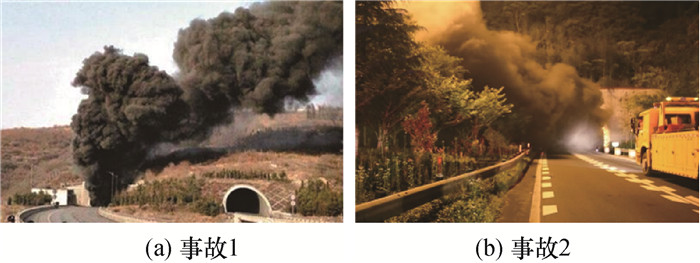
在预测火灾时,评判火势的关键信息包括:1) 火源功率,其通常以热释放速率(heat release rate,HRR)衡量;2) 火源位置[3, 12]。HRR可用于判断火灾规模和发展趋势,由于发生火灾时隧道内的能见度低,所以只有先明确火源位置才能针对性地实施救援灭火。而身处隧道外的安全区域,最容易观察到的火灾现象是从隧道开口不断外溢的烟气(见图 1)。这些烟气的形态、纹路、颜色等都受到隧道内HRR和火源位置的影响。在真实的隧道火灾救援中,消防员也经常根据外部烟气的形态,凭经验判断隧道内的火灾情况。因此,若能建立外部烟气与隧道内HRR和火源位置间的对应关系,则可实现从外界区域对隧道火灾的间接预测。然而,虽然前人研究中已建立大量的隧道烟气模型[13-17],但其往往受限于特定的隧道结构和燃烧环境,并不能对各类隧道火场进行统一描述。因此,尚需建立外部烟气与隧道火源间的可靠对应关系。
|
| 注:图源分别为https://app.360che.com/share_picture/198.html和https://m.sohu.com/a/142096469_703259/。 图 1 隧道火灾事故现场的外部烟气 |
近年来,通过人工智能(artificial intelligence,AI)方法实现火灾预测正逐渐成为研究热点。与传统以物理模型为基础的预测相比,AI可以直接挖掘数据背后的隐藏规律。基于这一特点,在各类深度学习算法的推动下,大量的火灾视频和图片被用于训练AI,并对火场关键信息进行预测。比如,可通过建筑烟气图像实时预测其内部的火灾规模[16],或可通过火焰形态预测HRR[17]等。然而,以上研究均只尝试预测单一火场信息(通常为HRR)。相比之下,隧道由于具有特殊结构,烟气可从其两侧的开口同时溢出。因此,若能将隧道两侧的烟气图像同时用于训练AI,理应实现对隧道内火源的HRR及其位置的同步预测。
考虑大规模烟气数据的获取难度,本文通过模拟全尺寸隧道火灾,获取不同火源功率、尺寸和位置下的外部烟气图像并构建数据库。同时分析不同的烟气观察视角对预测方案精度的影响,以及预测方案对移动式火源的适用性。由此系统验证上述隧道火灾预测方案的有效性。
1 隧道火灾模拟本文使用已广泛用于火灾研究的火灾动力学模拟工具(fire dynamics simulator,FDS)[18-22]搭建隧道火灾模型,模拟对象为100 m长的全尺寸弧顶隧道。该模型收录于FDS的火灾场景库中[23],由英国Arup公司设计验证,并已用于分析真实隧道火灾的顶棚温度分布。
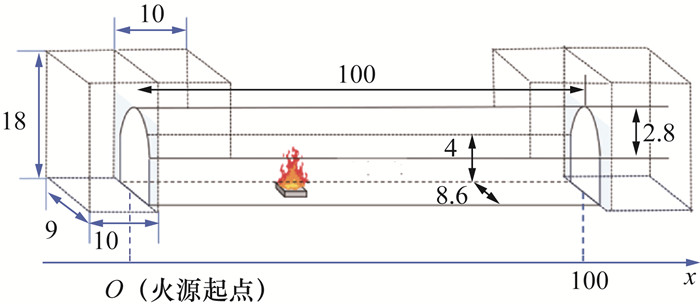
1.1 隧道模型设置本文所用隧道模型如图 2所示,其长度为100 m,宽度为8.2 m,最大离地高度为6.8 m。隧道侧壁使用绝热边界,以减少固壁导热和冷却对烟气输运的影响。隧道两侧设置开口,烟气可自由流出。为了能同时模拟隧道内外的火焰和烟气,本文使用“凹”字形的计算区域,在覆盖隧道主体的同时,还在隧道两侧开口处设置了额外计算区域,其长度为10 m,宽度为9 m,高度为18 m。计算区域的空间分辨率为0.2 m,满足独立性验证要求。为便于描述火源位置,本文定义隧道左侧开口为火源位置起点(x=0 m)。
|
| 图 2 隧道模型和计算区域(单位:m) |
1.2 火源设置
将隧道内的车辆作为火源,前人研究表明,小轿车的HRR约1.7~8.0 MW,巴士车的约25~35 MW,货车的约60~250 MW[24-27]。因此,本文使用的HRR范围为4~120 MW,火源的尺寸将随功率作相应变化。同时,由于车辆内的可燃物种类较多,本文设置火源产烟率的范围为0.02~0.18 kg/kg。
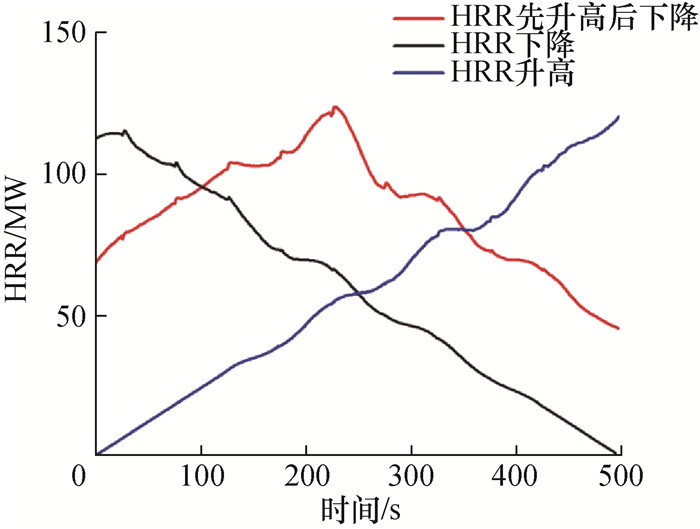
为模拟移动式火源,本文通过控制燃料在不同位置的连续出现和消失,复现车辆在隧道内的移动并控制其速度,火源移动速度变化范围为0.2~2.0 m/s。同时,为保证模拟结果更具有普遍性,本文设置了3种不同的HRR升降曲线用于训练、测试和分析模型准确度。火源HRR与火源位置的对应关系如图 3所示。考虑实际情况下,烟气从隧道中段蔓延至开口需要一定的时间。对于本文模型,该蔓延时间约为25 s。因此,本文设定每个火源的发展时间为50 s,并采集其在点火、发展和稳定阶段的所有烟气图像,以确保数据集的可靠性。
|
| 图 3 火源HRR与火源位置的对应关系 |
本文使用的隧道和火源参数如表 1所示,共模拟900个不同的隧道火灾工况。所有工况的时间步长均为1 s,总计算时长为500 s。每个工况的总网格数为1 440 000个,采用8个节点开展并行计算。单个模型完成计算需耗时约8 h。
| 参数名称 | 参数设置 | 工况数量 |
| 隧道尺寸 | 100 m×8.2 m×6.6 m | 1 |
| 火源产烟率/(kg·kg-1) | 0.02、0.06、0.10、0.14、0.18 | 5 |
| HRR/MW | 4、8、25、35、60、120 | 6 |
| 火源移动速度/(m·s-1) | 0.2,0.4,…,2.0 | 10 |
| HRR变化趋势 | 下降、升高、先升高后下降 | 3 |
| 总工况数/个 | — | 900 |
2 深度学习算法 2.1 烟气图像预处理
模拟完成后,本文将从4个视角(隧道左、右侧的正向和侧向视角)采集外部烟气图像。由于火焰存在浮力脉动,外部烟气图像也会不断变化[28]。因此,本文以1 s为间隔进行图像采集。所有模型共产出388 800张外部烟气图像用于训练AI。理论上,火源稳定后的烟气图像更有利于预测。但考虑到实际应用中模型的响应延迟,数据库中包含火源发展阶段的图像,可帮助提高模型的适用范围和预测精度。需说明的是,本文使用固定距离记录烟气图像以避免其对预测结果的影响。在实际应用中,可使用双目相机[29]标定拍摄距离并对预测结果进行修正。
模型所得烟气图像需进一步作灰度化处理,以减少背景干扰。其后,所有烟气图像均与其瞬时HRR和火焰位置做匹配并制作为数据集。所得数据集将分为3部分:一部分(60%)用于训练模型,另一部分(20%)用于在训练过程中评估模型性能,剩余部分(20%)用于判断模型的预测准确性。为分析烟气观察视角对预测精度的影响,本文所建AI预测模型将分为6种烟气输入组合:1) 仅左侧的烟气正视图;2) 左、右侧的烟气正视图;3) 仅左侧的烟气侧视图;4) 左、右侧的烟气侧视图;5) 仅左侧的烟气正视和侧视图;6) 左、右侧的烟气正视和侧视图。
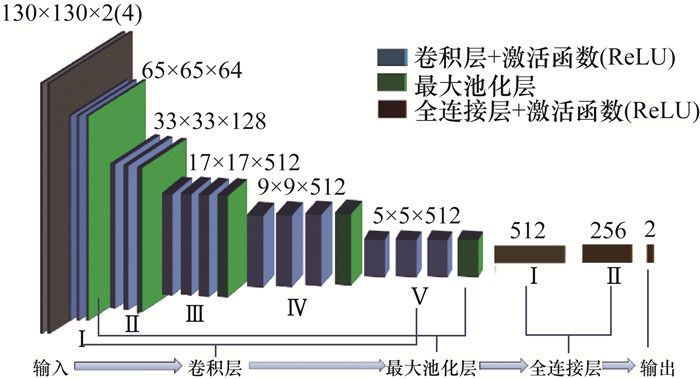
2.2 预测模型构建本文使用视觉几何群网络(visual geometry group, VGG16)卷积神经网络[30]建立烟气图像与火源参数间的对应关系。VGG16的框架结构如图 4所示,其左端输入为外部烟气图像,右端输出为HRR和火源位置。VGG16框架的内部共包含了13个卷积层、5个最大池化层和3个全连接层。其中,卷积层采用多个3×3的小卷积核,可有效减少卷积层的参数总量,同时增加网络深度,增强神经网络对图像特征的分辨能力。卷积层之后的最大池化层用于图像降维并提取特征,可将130像素×130像素×2个视角(正视和侧视)或130像素×130像素×4个视角(全视角)的原始图像转为5像素×5像素×512列向量,并通过全连接层与最终输出(HRR、火源位置)建立非线性关系。
|
| 图 4 VGG16架构 |
本文所用的卷积层和全连接层均使用ReLU函数作为激活函数,并使用均方差(mean-square error, MSE)作为损失函数,以此表示实际值和预测值之间的偏差。为避免过拟合,本文在每个最大池化层和全连接层后均使用Dropout操作,Dropout率为0.3。
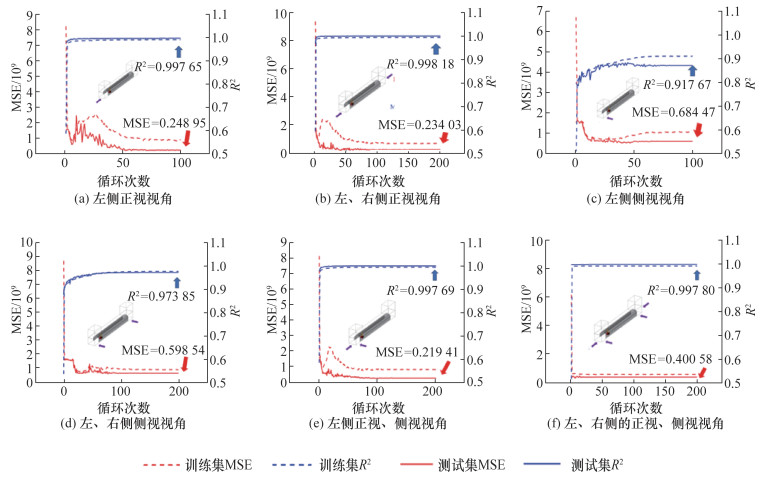
3 结果和讨论 3.1 AI预测模型训练由于MSE在特定样本中会随着输出函数的绝对值增大而增加,为更直观的展示模型的预测性能,本文将同时使用相关性系数R2评判模型预测准确度。R2值越接近1,则预测值与真实值越接近,此时MSE也应越小。
使用不同烟气视角组合训练AI时,所有预测模型的MSE和R2结果如图 5所示。由图可知,在200次循环迭代后,所有模型的MSE均不再下降,说明模型均已收敛。此外,各模型训练集和验证集的MSE值差异较小,表明训练过程中各模型均未发生过拟合。
|
| 图 5 不同烟气视角组合下的训练结果 |
基于上述训练结果,可进一步分析烟气输入视角对模型预测精度的影响。当仅以隧道左侧的烟气正视图训练AI时,所得R2约为0.997,MSE约为0.249,预测精度较高(见图 5a)。在此基础上,合并隧道右侧的烟气正视图一起训练AI,其R2和MSE得到进一步提升(见图 5b)。相较之下,若使用烟气的侧视图训练AI,无论是使用隧道一侧的侧视图,还是同时使用隧道两侧的侧视图,所得R2和MSE均比正视图的工况下更低(见图 5c-5d)。该结果说明,隧道烟气的正视图所涵盖的火场信息更充足,更能有效帮助AI预判隧道内的火势。推测其潜在原因如下:身处隧道的正向视角,不仅能观察到外部烟气的形态,同时也能观察到隧道内的烟气沉降高度;此外,当火势较大时,正向视角下还可能观察到部分顶棚射流火焰。因此,对于本文所提的基于外部烟气的隧道火灾预测方案,从隧道正向视角拍摄的烟气图片将更有利于模型预测。
图 5e-5f进一步展示了正、侧向视角的组合训练结果。可以看出,仅使用隧道左侧的正、侧向烟气图像训练AI时,所得R2和MSE应是最优解。若同时使用隧道双侧正、侧图像用于训练,所得误差反而会进一步提升。这应是对AI的输入信息过多,引发了模型过度训练。
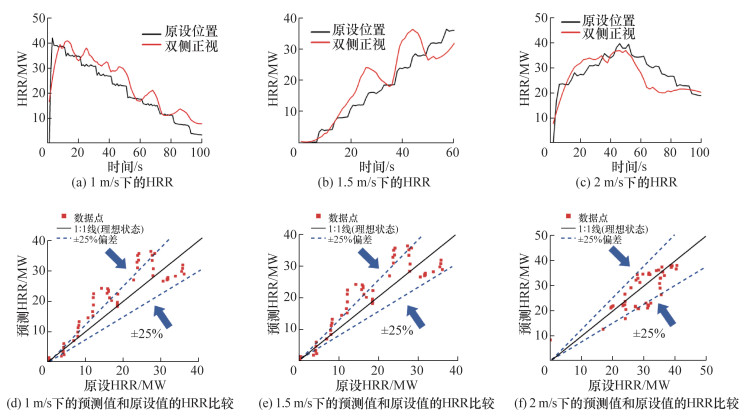
3.2 基于外部烟气的HRR预测训练完成后,本文重新设置了9个新的模拟工况用于充分测试AI的预测效果。新工况中的火源HRR和产烟率均取为训练集中的未设定值,即HRR取40 MW,产烟率取0.16 kg/kg;火源移动速度取训练集中较大的3个值:1.0 m/s、1.5 m/s、2.0 m/s。为增加预测难度,火源移动速度为1 m/s时的火源HRR为连续下降曲线,1.5 m/s时的火源HRR为连续上升曲线,2.0 m/s时的火源HRR为先上升后下降曲线。为便于讨论,本文仅使用基于隧道左、右侧正向烟气图像训练所得AI模型(见图 5b)开展分析。
不同火源移动速度下,AI对火源HRR的预测值与模型原设值的对比如图 6所示。由图可知,HRR预测值基本可以做到与原设值同时、同趋势变化,同时在所设火源移动速度范围内,无论火源移动到隧道何处,基于外部烟气图像的方案均能对其瞬时HRR值进行预测,且误差不超过25%,表明该模型已初步具备对灭火救援工作的参考价值。
|
| 图 6 不同火源移动速度下的HRR预测值与原设值对比 |
需说明的是,本文已尝试使用该模型预测更快速度的火源。但当火源移动速度超过4.0 m/s,预测误差会上升至约50%,原因为该速度超出了训练AI时所设置的最大速度(2.0 m/s)。后续工作可根据火源移动速度(车辆移动速度)对预测结果进行相对位置上的修正,或将车辆移动速度转为时间差参数并加入训练集,以进一步提升预测方案对快速移动火源的适用性。
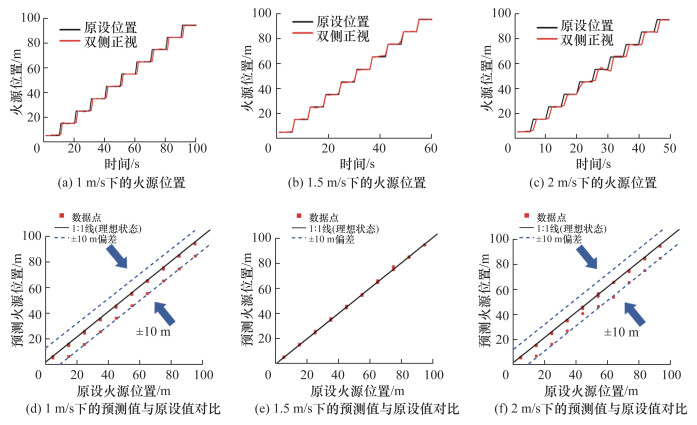
3.3 基于外部烟气的移动火源位置预测AI模型对移动火源瞬态位置的预测结果如图 7所示。由图可知,在不同火源移动速度下AI的预测值与模型原设值偏差均小于10 m。尤其在火源移动速度为1.5 m/s的工况下,预测误差值为1 m,几乎可以忽略不计(见图 7e)。这可能是因为本文仅通过“跳变”的方式在FDS中实现对移动火源的模拟。因此,单个火源位置会与更多的外部烟气图片建立对应联系,使AI对火源位置的预测能力增强。经测试,本文所建AI模型对4.5 m/s的火源依旧能准确预测位置,且对火源位置的预测误差小于10 m。
|
| 图 7 不同火源移动速度下的火源位置预测值与原设值对比 |
因此,基于对外部烟气图像的分析,本文所提预测方案基本可实现对移动速度2 m/s内的移动火源同步预测隧道内火源的HRR及其位置的能力。
4 结论本文提出利用深度学习算法分析外部烟气图像,以实现对隧道内火源功率和位置的同步预测。为验证该方案,本文通过火灾动力学模拟工具(FDS)对100 m长的隧道进行模拟,并通过修改火源功率、位置、速度和产烟率4个参数构建了烟气图像数据库。同时使用VGG16构建了基于烟气图像数据库的预测模型,并进一步验证了预测方案对移动式火源的有效性。研究结果表明,本文所建方案可实现对隧道火源功率和位置的同步实时预测。其中,以隧道双侧的烟气正视图为输入样本时的预测精度最高,其热释放速率的预测误差小于25%,火源位置的预测误差小于10 m。本文预测方案对移动式火源可实现实时火源HRR与火源位置的预测。
值得注意的是,本文所用烟气图像均为纯色背景,但在实际情况下,隧道烟气图像的背景往往比较复杂,会影响烟气图像特征的提取。因此,后续研究可考虑使用背景过滤或者语义分割算法对烟气轮廓进行独立勾画,以消除图像背景的干扰。
| [1] |
Yonhap News Agency. (5th LD) At least 5 killed, 37 injured in expressway tunnel fire[EB/OL]. (2022-10-29)[2024-10-22]. https://en.yna.co.kr/view/AEN20221229006156315?section=search.
|
| [2] |
MÉGRET O, VAUQUELIN O. A model to evaluate tunnel fire characteristics[J]. Fire Safety Journal, 2000, 34(4): 393-401. DOI:10.1016/S0379-7112(00)00010-2 |
| [3] |
KARLSSON B, QUINTIERE J G. Enclosure fire dynamics[M]. 2nd ed. Boca Raton: CRC Press, 2022.
|
| [4] |
IRVINE D J, MCCLUSKEY J A, ROBINSON I M. Fire hazards and some common polymers[J]. Polymer Degradation and Stability, 2000, 67(3): 383-396. DOI:10.1016/S0141-3910(99)00127-5 |
| [5] |
SPENCER R B. Adaptive control of the ignition timing of spark ignition engines utilising the combustion flame light emissions[D]. Christchurch: University of Canterbury, 1985.
|
| [6] |
MODAK A T. Thermal radiation from pool fires[J]. Combustion and Flame, 1977, 29: 177-192. DOI:10.1016/0010-2180(77)90106-7 |
| [7] |
STRAHLE W C. Combustion noise[J]. Progress in Energy and Combustion Science, 1978, 4(3): 157-176. DOI:10.1016/0360-1285(78)90002-3 |
| [8] |
ARALT T T, NILSEN A R. Automatic fire detection in road traffic tunnels[J]. Tunnelling and Underground Space Technology, 2009, 24(1): 75-83. DOI:10.1016/j.tust.2008.04.001 |
| [9] |
KOFFMANE G, HOFF H. More than just fire detection: fibre optic linear heat detection (DTS) enables fire monitoring in road- and rail-tunnels[C]//Fourth International Symposium on Tunnel Safety and Security. Frankfurt am Main, Germany, 2010: 525-528.
|
| [10] |
LIU Z G, KASHEF A H, LOUGHEED G D, et al. Investigation on the performance of fire detection systems for tunnel applications—part 1: Full-scale experiments at a laboratory tunnel[J]. Fire Technology, 2011, 47(1): 163-189. DOI:10.1007/s10694-010-0142-4 |
| [11] |
LIU Z G, KIM A K. Review of recent developments in fire detection technologies[J]. Journal of Fire Protection Engineering, 2003, 13(2): 129-151. DOI:10.1177/1042391503013002003 |
| [12] |
BABRAUSKAS V, PEACOCK R D. Heat release rate: The single most important variable in fire hazard[J]. Fire Safety Journal, 1992, 18(3): 255-272. DOI:10.1016/0379-7112(92)90019-9 |
| [13] |
TANG F, HE Q, SUN X P, et al. Experimental study of carriage fire in a tunnel: Evolution of flame geometry characteristics under relative strong crosswinds[J]. Proceedings of the Combustion Institute, 2021, 38(3): 4963-4970. |
| [14] |
TANG F, DENG L, MENG N, et al. Critical longitudinal ventilation velocity for smoke control in a tunnel induced by two nearby fires of various distances: Experiments and a revisited model[J]. Tunnelling and Underground Space Technology, 2020, 105: 103559. DOI:10.1016/j.tust.2020.103559 |
| [15] |
NYMAN H, INGASON H. Temperature stratification in tunnels[J]. Fire Safety Journal, 2012, 48: 30-37. DOI:10.1016/j.firesaf.2011.11.002 |
| [16] |
WANG Z L, ZHANG T H, WU X Q, et al. Predicting transient building fire based on external smoke images and deep learning[J]. Journal of Building Engineering, 2022, 47: 103823. DOI:10.1016/j.jobe.2021.103823 |
| [17] |
WANG Z L, ZHANG T H, HUANG X Y. Predicting real-time fire heat release rate by flame images and deep learning[J]. Proceedings of the Combustion Institute, 2023, 39(3): 4115-4123. |
| [18] |
GAO Z H, LI L J, SUN C P, et al. Effect of longitudinal slope on the smoke propagation and ceiling temperature characterization in sloping tunnel fires under natural ventilation[J]. Tunnelling and Underground Space Technology, 2022, 123: 104396. |
| [19] |
LI L J, DU F, YANG Y Y, et al. Research on the smoke mass flow rate in one-dimensional spreading stage in tunnel with multiple fire sources[J]. Case Studies in Thermal Engineering, 2022, 31: 101801. |
| [20] |
TAN T T, YU L X, DING L, et al. Numerical investigation on the effect of ambient pressure on mechanical smoke extraction efficiency in tunnel fires[J]. Fire Safety Journal, 2021, 120: 103136. |
| [21] |
WANG Y F, SUN X F, LIU S, et al. Simulation of back-layering length in tunnel fire with vertical shafts[J]. Applied Thermal Engineering, 2016, 109: 344-350. |
| [22] |
WU X Q, ZHANG X N, JIANG Y S, et al. An intelligent tunnel firefighting system and small-scale demonstration[J]. Tunnelling and Underground Space Technology, 2022, 120: 104301. |
| [23] |
MCGRATTAN K B, MCDERMOTT R J, WEINSCHENK C G, et al. Fire dynamics simulator, technical reference guide, sixth edition: 1018[R]. Gaithersburg: National Institute of Standards and Technology, 2024.
|
| [24] |
INGASON H, LÖNNERMARK A. Heat release rates in tunnel fires: A summary[M]//BEARD A, CARVEL R. Handbook of Tunnel Fire Safety. London: ICE Publishing, 2012.
|
| [25] |
INGASON H, LI Y Z, LÖNNERMARK A. Tunnel fire dynamics[M]. New York: Springer, 2014.
|
| [26] |
HURLEY M J, GOTTUK D T, HALL JR J R, et al. SFPE handbook of fire protection engineering[M]. 5th ed. New York: Springer, 2015.
|
| [27] |
LI Y Z, INGASON H. Overview of research on fire safety in underground road and railway tunnels[J]. Tunnelling and Underground Space Technology, 2018, 81: 568-589. |
| [28] |
RIGOLLET L. Investigating heat and smoke propagation mechanisms in multi-compartment fire scenarios: Final report of the PRISME project: NEA/CSNI/R(2017)14[R]. NEA, Paris, 2018.
|
| [29] |
WANG Z L, DING Y F, ZHANG T H, et al. Automatic real-time fire distance, size and power measurement driven by stereo camera and deep learning[J]. Fire Safety Journal, 2023, 140: 103891. |
| [30] |
SIMONYAN K, ZISSERMAN A. Very deep convolutional networks for large-scale image recognition[EB/OL]. arXiv: 1409.1556. (2014-09-04)[2024-10-22]. https://arxiv.org/abs/1409.1556.
|