


2. 国家卫生健康委粉尘危害工程防护重点实验室, 北京 100083;
3. 中国铁道科学研究院集团有限公司 节能环保劳卫研究所, 北京 100081
2. National Health Commission Key Laboratory for Engineering Control of Dust Hazard, Beijing 100083, China;
3. Energy Saving and Environmental Protection and Occupational Safety and Health Research Institute, China Academy of Railway Sciences Co., Ltd., Beijing 100081, China
湿式喷浆是指将骨料、水泥和水按比例拌合均匀后,在空气动力的作用下通过喷浆机喷嘴发射至受喷面的过程[1],是Austrian隧道施工方法(new Austrian tunnelling method,NATM)中重要的初期支护方式[2]。因其施工效率高、施工质量可靠、适应性强而得到广泛应用。然而,施工时产生的粉尘、铬及氯等有害物质,不仅严重危害工人身体健康,还会加速机械设备转动部位磨损、使电气设备接触不良,从而影响机械设备的工作寿命[3-4]。因此许多学者致力于降低湿喷环节的粉尘浓度、改善工人的作业环境。
现有研究发现,通过添加混凝土外加剂可显著降低湿喷工艺的粉尘浓度和回弹率。Pan等[5]分析了减水剂、速凝剂、增黏剂、纤维掺量的变化对混凝土回弹率的影响,发现在一定范围内增加减水剂掺量会导致回弹率升高。Li等[6]根据湿喷混凝土粉尘的分布情况划分安全区域,并通过添加速凝剂、调整风压和喷射角度达到降尘的目标。Zhou等[7]研制了一种显著降低湿喷过程粉尘浓度和回弹率的新型无碱液体速凝剂。曾宪桃等[8]通过磁化水拌制喷射混凝土,发现粉尘浓度较普通水拌制的喷射混凝土低50%以上。在当前的混凝土行业中,减水剂作为发展比较成熟的一类外加剂,其对水泥的作用机理已较为明晰。其中,聚羧酸减水剂(polycarboxylate superplasticizer,PCE)因其优秀的技术性能和环保优势成为减水剂市场中的主流产品,它主要通过静电斥力、空间位阻效应及润滑效应等起水泥分散作用[9-10]。文[11-12]研究发现,当水与水泥混合时,减水剂分子吸附在水泥颗粒上,通过空间位阻效应发生反絮凝作用分散水泥颗粒,释放絮凝结构中的水分子,进而改善混凝土的和易性。此外,也有许多学者探究了不同结构的减水剂对水泥颗粒的分散作用。Lewis等[13]通过研究2种不同分子结构的聚电解质对水泥悬浮液流变特性的影响,揭示了静电、空间、耗竭对水泥胶体稳定性的作用。Ma等[14]合成不同结构的PCE,测量其表面张力、吸附量和Zeta电位,探究了表面张力对塑性黏度的影响。
湿式喷浆降尘的研究重点为粉尘来源与降尘措施,对喷浆射流破碎产尘机理的认识尚不充分。因此研究混凝土射流破碎产尘的过程、探寻湿喷降尘的新思路、减少尘肺病的发生,已成为当前研究领域的迫切需要。本文通过改变混凝土配方中PCE掺量,获得不同流动性的混凝土,探寻湿喷混凝土射流雾化程度较小、粉尘浓度较低的PCE掺量。并基于PCE与水泥颗粒的作用机理,参考液体射流破碎雾化的相关研究,对湿喷混凝土产尘机理与粉尘特性进行分析,为湿喷混凝土的降尘工作提供参考。
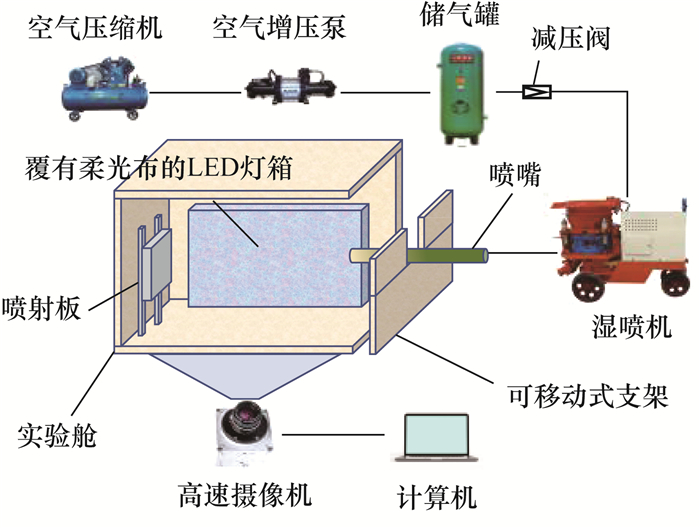
1 实验材料与方法 1.1 实验平台搭建喷射射流多维测试平台由混凝土湿喷机、供气系统、实验舱和拍摄系统构成。其中,供气系统由空气压缩机、空气增压泵、储气罐和减压阀组成,拍摄系统由高速摄像机和计算机组成。实验舱内设有喷射板、覆有柔光布的LED灯箱和可移动式支架,如图 1所示。
|
| 图 1 喷射射流多维测试平台示意图 |
实验舱的尺寸为2.0 m×1.6 m×1.6 m,前端放置喷射板,一侧安装1.5 m×1.5 m透明亚克力板,另一侧架设1.5 m×1.0 m的LED灯箱作为射流拍摄的背景板,上覆柔光布以消除光斑;实验舱后部为可移动式支架,进行混凝土喷射实验时将喷浆机喷嘴架设在支架上,将混凝土喷至喷射板。使用的Phantom VEO-710L型高速摄像机(Vision Research Inc.),搭配AF-S50mmf/1.8 Nikon定焦光学镜头,摄像机采集帧率为3 200 fps,拍摄时间为3.8 s。混凝土湿喷机的型号为河南天顺祥机械制造有限公司的PZ-3型;供气系统由空气压缩机、空气增压泵、压缩气罐、气体管路阀门等组成,压缩气罐容积为1 m3,可提供0~ 4.0 MPa压缩气体,实验开始前调节气罐出口减压阀,保证实验时空气压力的恒定。
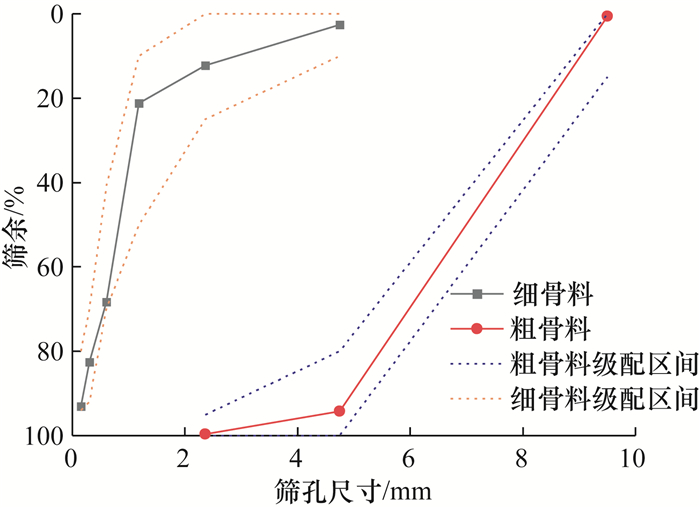
1.2 实验原料实验选用唐山福顺水泥有限公司的PO42.5普通硅酸盐水泥,技术指标符合GB175—2023 《通用硅酸盐水泥》[15]。粗骨料为公称粒级为5.00~10.00 mm的破碎石灰岩,细骨料为公称粒级为0.16~5.00 mm的天然河砂,细度模数为2.71,粗细骨料均符合JGJ52—2006 《普通混凝土用砂、石质量及检验方法》[16]。减水剂为江苏苏博特新材料股份有限公司的PCA®-Ⅰ聚羧酸高性能减水剂,产品符合GB8076—2008《混凝土外加剂》[17]、GB18588—2001《混凝土外加剂中释放氨的限量》[18]。
混凝土配合比为水泥、水、细集料、粗集料的质量比为1.000 0∶0.370 0∶ 1.837 5∶1.562 5∶0.011 5,每次实验水泥用量为4 kg,PCE掺量为水泥质量的1.00%、1.10%、1.15%、1.20%、1.25%、1.30%、1.35%及1.40%,喷射空气压力为0.40 MPa。粗细骨料级配如图 2所示。
|
| 图 2 粗细骨料级配 |
1.3 实验方法 1.3.1 混凝土流动性实验
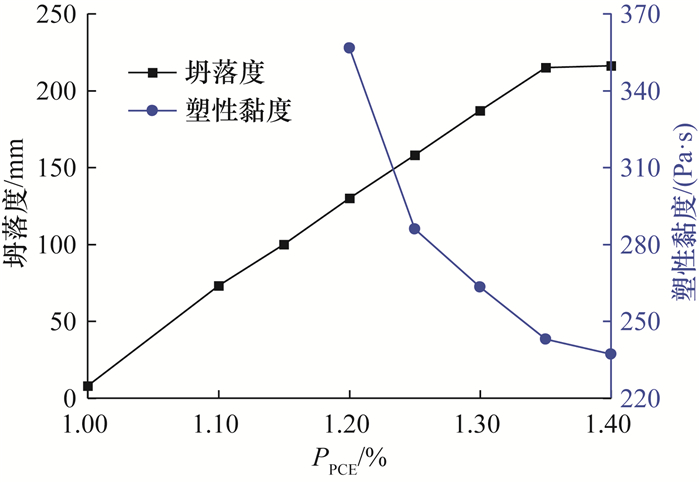
工程现场主要以坍落度评判混凝土的流动性,本文采用坍落度、塑性黏度二项指标评判拌合物的流动性[19]。坍落度测试方法按GB/T 50080—2016《普通混凝土拌合物性能试验方法标准》[20]规定进行,混凝土塑性黏度选用Germann Instruments的ICAR Plus混凝土流变仪进行测试,通过阶梯法测试坍落度大于130.00 mm混凝土的塑性黏度。实验结果如图 3所示,图中PPCE为PCE的掺量。
|
| 图 3 混凝土流动性实验结果 |
1.3.2 混凝土喷射实验
为探究不同流动度湿喷混凝土的射流破碎和产尘特性,实验拍摄了在不同PCE掺量条件下混凝土的射流状态,分析PCE掺量与射流状态和射流破碎过程的关系,并通过MATLAB程序处理实验舱侧板灯箱上黏附的粉尘图片,得到粉尘浓度、粉尘面积等效径及粉尘粒度分布,并通过光散射式激光粉尘仪的测量数据验证处理结果。
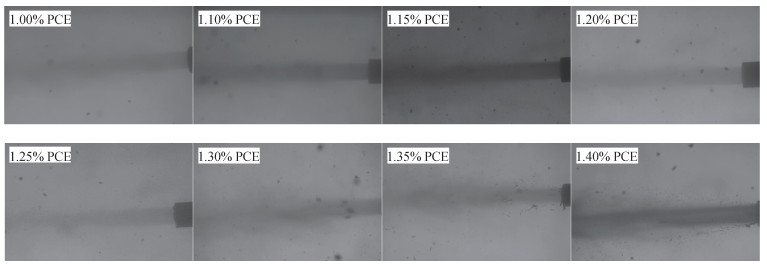
2 实验结果射流破碎分为初级破碎和次级破碎,初级破碎是指物料离开喷嘴后,在表面张力的作用下形成液膜,在外部扰动形成的扰动波作用下,液膜破碎成线、带、环状的过程。初级破碎分为表面破碎和柱状破碎,表面破碎是指液滴和液丝从射流表面分离的过程;次级破碎是指初级破碎产生的微小液滴受扰动作用继续分解为更细小液滴的过程。实验中选用转子式湿喷机,为便于分析,本文将单个料杯中的物料从喷口处喷出的全过程视为一个射流循环,并选取在不同PCE掺量条件下喷射状态最剧烈、雾化特征最明显的一次射流循环,以此作为该流动度混凝土的射流状态代表进行分析。此外,每个射流循环都会经历物料喷射由平缓到剧烈再到平缓的过程,现将每个射流循环划分为初始期、剧烈期和结束期3个阶段。形成稳定射流的阶段为剧烈期,未形成稳定射流的喷射开始和结束阶段分别为初始期和结束期。选取在不同PCE掺量条件下射流破碎特征最明显的初始期、剧烈期和结束期图片,分析射流运动状态。
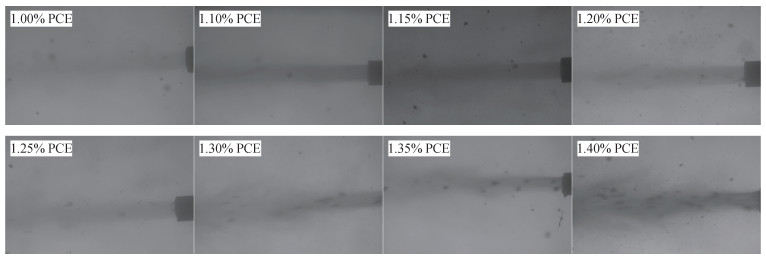
2.1 减水剂掺量对射流初始期和结束期的影响不同PCE掺量条件下初始期射流图片如图 4所示,结束期射流图片如图 5所示。
|
| 图 4 初始期射流照片 |
|
| 图 5 结束期射流照片 |
实验结果表明,当PCE掺量为1.00%、1.10%、1.15%和1.20%的射流初始期和结束期均未形成稳定的圆柱形段塞流结构,未出现明显射流破碎特征。当PCE掺量为1.25%时,初始期和结束期射流已呈现出初步的破碎特征,消散段射流柱体半径增大颜色变浅。在此流动度下混凝土中水泥基团间距较小,不易受外力作用而破碎,射流破碎长度较大,仍相对稳定,但产尘量相较于低PCE掺量条件有所升高。当PCE掺量为1.30%、1.35%时,初始期和结束期的射流均呈现出明显的初级破碎特征,形成箭形结构且射流破碎长度急剧缩短,射流柱消散段发生雾化,产尘量增大。当PCE掺量为1.40% 时,此流动度的混凝土初始期射流呈现二次破碎特征,射流发生轴向弯曲,此时射流破碎长度极短,产尘量很大。原因是减水剂掺量较高时,絮凝结构中的水分减少,自由水增多[21]。由于吸附在水泥颗粒表面减水剂分子的作用,水泥分子间距增大,降低了混凝土的剪切阻力与流动阻力,导致混凝土塑性黏度降低[22-24]。物料从喷口喷出时,射流受压差梯度力作用形成表面波动,使射流柱体表面破碎成小液滴逸散到空气中,形成初级破碎。之后随着射流运动空气动力学作用的影响加强,受剪切力作用形成涡流,导致射流柱体的运动轨迹沿轴向产生弯曲,形成次级破碎[25-26]。
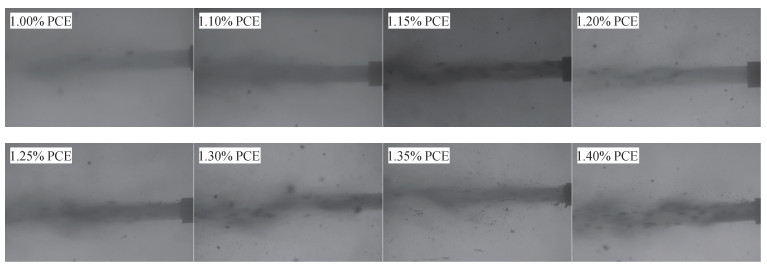
2.2 减水剂掺量对射流剧烈期的影响 2.2.1 雾化特性图 6为在不同PCE掺量条件下剧烈期射流照片。
|
| 图 6 剧烈期射流照片 |
实验结果表明,当PCE掺量为1.00%、1.10%、1.15%时,喷射剧烈期的射流呈现箭形的喷射结构。主要原因是物料离开喷口后,物料流与周边空气介质发生卷吸作用,导致射流剪切层运动速度显著降低,而射流核心区射流速度变化较小,从而在射流边缘层形成巨大的速度差梯度,空气动力学效应极为显著,使两流体界面发生剧烈的湍流扩散,表面波作用效果增强并促进射流解体,发生表面破碎[27-28]。当PCE掺量从1.00%提高到1.15%时,剧烈期的射流以初级破碎为主,粉尘浓度较低。当PCE掺量为1.20%时,剧烈期射流发生初步的次级破碎,呈现出沿轴向弯曲的运动态势。当PCE掺量为1.25%、1.30%、1.35%时,剧烈期射流已表现出极为明显的轴向弯曲态势,表明在此阶段射流发生了强烈的次级破碎,此时喷射流表面液滴被剥离后不断破碎成更小的液滴,粉尘浓度较初级破碎进一步上升。
此外,当PCE掺量为1.35%、1.40%时,可观察到射流周围有大量液滴、液线,且喷口处有液滴下落。原因是随着减水剂掺量的增加,更多的减水剂分子吸附在水泥颗粒表面发生作用,絮凝结构中的水被释放,混凝土中自由水增多。泵送时水填充在输料管壁与物料之间形成润滑层,在主体射流的黏附力作用下沿管壁运动。一部分水泵送至喷口时滑落形成液线,在重力作用下滴落;另一部分水在喷口处发生破碎形成微小液滴。而当PCE掺量为1.40%时,喷射初始期已发生次级破碎。混凝土的塑性黏度取决于其中包含的固体颗粒的尺寸、形状以及颗粒之间的吸引力,而覆盖固体颗粒的水膜厚度反映了颗粒间距。随着水膜厚度的增加,颗粒间距增大,减弱了颗粒之间的相互作用,从而降低了水泥浆体的黏度。因此随着PCE掺量的提高,水泥颗粒的分散程度增加,混凝土塑性黏度进一步降低[29-32]。在喷射剧烈期,高掺量的PCE促使射流发生强烈的次级破碎,宏观表现为射流半径极大、射流破碎长度极短。此外,随着喷射过程的进行,由于拌合物中自由水含量较高,宏观表现出泌水现象。这些泌出的水分会随着物料流动,导致混凝土团粒在喷口处与射流边界层共同发生破碎,产生大量粉尘与微小液滴,并在卷吸作用下不断碰撞、聚集,从而增大了粉尘粒径。
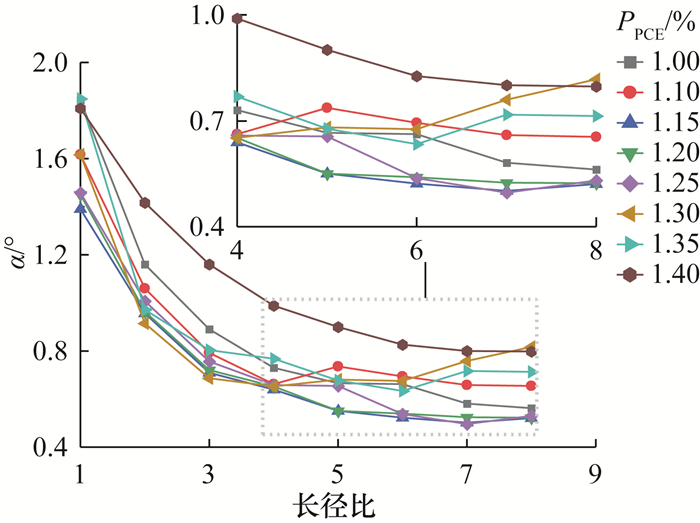
2.2.2 特征参数射流离开喷口时,射流侧壁面边界的位移限制条件被解除,射流逐渐产生径向的速度分量,产生表面扰动发生破碎和雾化并最终形成锥状射流[33]。本文选用扩散角这一参数分析射流的集束性,通过OpenCV计算机视觉库对射流图片进行灰度化、去噪、锐化、二值化、形态学处理、轮廓提取[34-35],测算高速摄像机拍摄图片尺寸与实际距离的比例尺。借助Photoshop测量处理图片中射流的喷射距离与射流半径,通过公式计算出射流扩散角,并以此作为评判射流雾化程度的参数。扩散角越大,雾化效果越好。射流扩散角表示如下:
| $ \alpha=2 \arctan \left(\frac{D}{L}\right). $ | (1) |
其中:D为射流直径;L为射流喷射距离,单位均为mm。按均等的时间间隔选取4张减水剂掺量不同混凝土的喷射剧烈期的图片进行处理分析,计算扩散角数值,并取其平均值记为该掺量下的射流扩散角。其中,长径比为L/d,d为喷口直径,长径比越大表明射流喷射距离越远,处理结果如图 7所示。
|
| 图 7 射流扩散角随喷射距离的变化曲线 |
在射流运动距离较近时(L/d≤3),射流扩散角随喷射距离的增加快速降低。说明在此阶段射流直径的增大速率远小于射流运动距离的增大速率,处于射流的初始段或转折段[28],射流形态稳定,未发生明显破碎与雾化。在射流运动距离较远时(L/d≥4),射流扩散角随喷射距离的增加缓慢降低,曲线斜率基本保持稳定。说明此阶段射流直径与喷射距离的增大,且速率基本相同,射流处于基本段或消散段,破碎和雾化程度大、产尘量高,宏观表现为形成锥状雾场。
各组混凝土射流扩散角均随喷射距离的增加呈现下降态势,当PCE掺量为1.15%时射流扩散角处于最低水平。PCE掺量由1.15%增大至1.40%过程中,由于混凝土塑性黏度的降低,导致射流扩散角逐步增大,并在掺量为1.40%时达到最高水平,射流发生初级破碎工况的扩散角和粉尘浓度整体小于发生次级破碎工况的扩散角和粉尘浓度。当长径比数值相同时,射流扩散角越大,射流集束性越差,射流边缘的扰动破碎越剧烈。可见当PCE掺量为1.15%时,射流集束性最好,雾化程度最低。
2.3 减水剂掺量对粉尘特性的影响 2.3.1 对粉尘浓度的影响喷射混凝土时形成的湿性粉尘充斥在实验舱内,其中一部分黏附在侧板灯箱表面。拍摄表面粉尘照片,通过MATLAB程序分析处理图片,得到粉尘浓度、粉尘面积等效径及粒度分布。
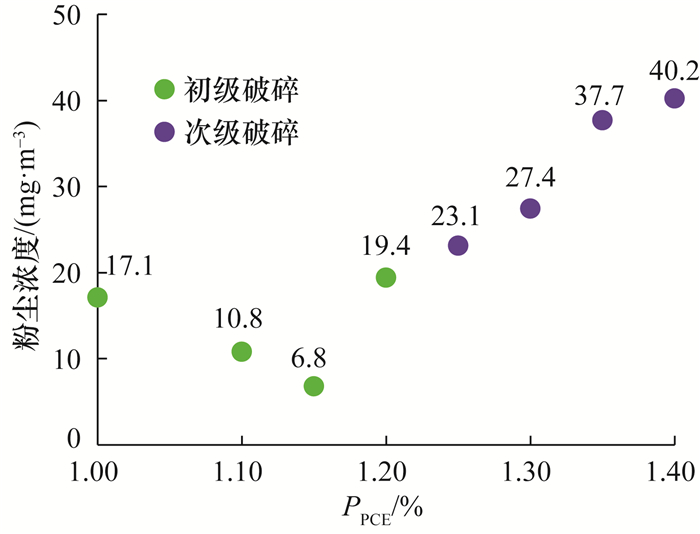
依据剧烈期射流状态所划分的雾化阶段,分析初级破碎工况点和次级破碎工况点粉尘浓度。结果显示,初级破碎平均粉尘浓度为13.50 mg/m3,次级破碎的平均粉尘浓度为32.10 mg/m3,较初级破碎提高了138%,次级破碎工况点的粉尘浓度整体高于初级破碎工况点。此外,随着PCE掺量的增加,粉尘浓度呈现先降低后升高的趋势,在PCE掺量为1.15%时粉尘浓度最低,为6.80 mg/m3。图 8为粉尘浓度与减水剂掺量的关系图。
|
| 图 8 粉尘浓度与减水剂掺量的关系图 |
当PCE掺量为1.00%时,拌合物中自由水含量低,拌合形成颗粒状混凝土,其流动性较差、难以密实成形,进而在混凝土喷射过程中产生大量粉尘,升高了环境中的粉尘浓度。PCE掺量自1.00%增加至1.15%的过程中,更多减水剂分子被吸附于水泥颗粒表面形成水化膜,润湿了水泥颗粒使其易于滑动,增强了混凝土拌合物的流动性。由于胶凝材料与骨料混合较为充分,湿喷时形成稳定的圆柱形段塞流。这种拌合物黏聚性好,宏观表现为拌合物稠度减小、黏性降低、流动性提高、和易性改善,喷射过程中受外力作用发生破碎和雾化的程度较低,从而降低粉尘浓度。PCE掺量自1.15%增加至1.40%的过程中,水泥颗粒继续被分散,胶凝材料与骨料的间距增大、混凝土黏聚力下降,最终在当PCE掺量为1.30%、1.35%、1.40%时,剧烈期射流发生以次级破碎为主的射流破碎,破碎程度更高。
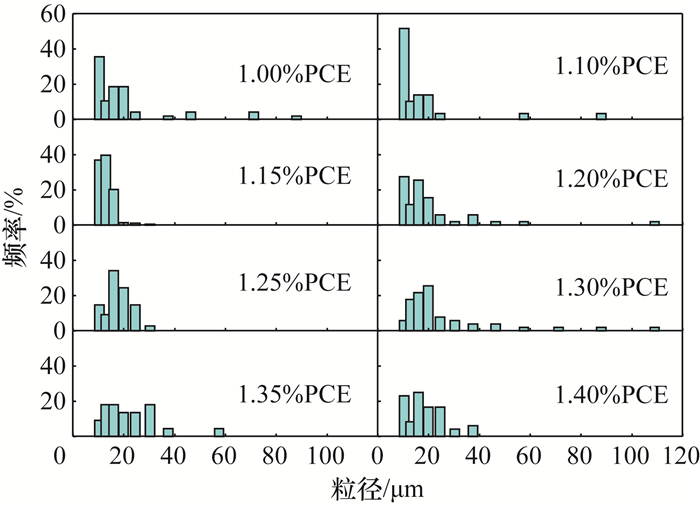
2.3.2 对粉尘粒径及粒径分布的影响粉尘粒径及粒径分布是在微观尺度上评判雾化效果的重要指标,本文选取D50用于分析喷射混凝土粉尘粒径,其含义为一个样品的累计粒度分布数达到50%时所对应的粒径大小。PCE掺量为1.00%、1.10%、1.15%、1.20%、1.25%、1.30%、1.35%和1.40%时的D50分别为12.31、9.68、10.75、12.59、14.04、15.87、15.81和13.81 μm。在PCE掺量增加的过程中,水泥的絮凝基团由于静电斥力和空间位阻的作用被逐步破坏,絮凝基团包裹的拌合水被释放,拌合物中水含量逐渐增大[36-38],混凝土流动性提高。图 9为减水剂掺量不同时粉尘粒径的频率分布图。
|
| 图 9 减水剂掺量不同时粉尘粒径的频率分布图 |
PCE掺量从1.00%增加至1.15%的过程中,混凝土流动性增大。同时D50总体呈现减小趋势,小粒径粉尘频度增大,且粉尘粒径分散度减小,PCE掺量为1.15%时粉尘粒径分散度最小。随着PCE掺量由1.00%增加至,粉尘粒径分布由10.40~88.00 μm缩小至10.40~19.80 μm。PCE掺量为1.00%时水泥颗粒分散程度低、胶凝材料包裹性差,混凝土和异性差难以密实成型;PCE掺量为1.15%时拌合物和易性优秀,混凝土密实度高,粒径的分散度较小。PCE掺量从1.15%到1.40%过程中,D50总体呈现增大趋势,小颗粒粉尘频度减小,粉尘频度分布趋于平均,粒径分散度逐渐增大,并在PCE掺量为1.30%时达到最大,为10.40~109.00 μm。PCE掺量越大,雾化产生的微小液滴越多,它们之间的相互碰撞和凝集越剧烈,导致粉尘粒径越大,粒径集中度越低[21, 39]。综上,粉尘浓度最低、粉尘粒径分布最集中的湿喷混凝土配比为水泥、水、细骨料、粗骨料、PCE的质量比为1.000 0∶0.370 0∶1.837 5∶1.562 5∶0.011 5。
3 结论本文通过自行搭建的喷射射流多维测试平台,进行了PCE掺量不同时混凝土的流动性实验和喷射实验,划分喷射阶段,探究湿喷混凝土中减水剂掺量与产尘特性的关系,分析不同喷射状态的产尘机理,以期为现场湿喷环节的降尘工作提供借鉴和参考。本文主要结论如下:
1) 基于射流状态将射流循环划分为初始期、剧烈期和结束期3个阶段。初始期和结束期未形成稳定射流;剧烈期射流形态变化较小,且破碎、雾化程度较高。对于初始期和结束期,PCE掺量为1.00%、1.10%、1.15%、1.20%的射流较稳定,未发生明显破碎;PCE掺量为1.25%、1.30%、1.35%的射流以初级破碎为主;PCE掺量为1.40%时以次级破碎为主。对于剧烈期,PCE掺量为1.00%、1.10%、1.15% 时以初级破碎为主;PCE掺量为1.20%、1.25%、1.30%、1.35%和1.40%射流以次级破碎为主。
2) 进行在不同PCE掺量条件下湿喷混凝土产尘特性与影响因素分析,次级破碎阶段平均粉尘浓度与初级破碎阶段相比升高了138%;PCE掺量为1.15%时粉尘粒径最集中,粉尘浓度最低。粉尘粒径分散度在PCE掺量增大的过程中呈现先减小后增大的趋势,PCE掺量为1.15%时粉尘粒径分散度最小,为10.40~19.80 μm。随着PCE掺量的增大,小颗粒粉尘频度减小,粉尘频度分布趋于平均,粉尘粒径分散度增大。得到粉尘浓度最低、粉尘粒径分布最集中的湿喷混凝土配比为水泥、水、细骨料、粗骨料、PCE的质量比为1.000 0∶0.370 0∶1.837 5∶1.562 5∶0.011 5。
3) 分析了混凝土射流破碎产尘机理,受喷口处巨大速度差形成的剧烈空气动力学作用,发生随射流运动距离不断增大的表面波,导致射流表面团粒被剥离,发生初级破碎或次级破碎形成粉尘。此外,PCE掺量较高时,一部分自由水附着在拌合物表面,泵送过程中填充拌合物与输料管间缝隙形成润滑层,喷口处混凝土团粒和润滑层发生初级破碎和次级破碎形成微小液滴,相互碰撞、黏结形成粉尘。
本文对湿喷混凝土射流的产尘机理和产尘特性进行了分析,并对于混凝土射流的喷射阶段进行了划分,探究了混凝土射流破碎产尘的机理,为湿喷降尘工作提供了一定的借鉴和参考,但关于不同流动性混凝土射流破碎微观层面的探究并不充分,尚有许多亟待解决的问题,留待下一步探究。
| [1] |
MALTESE C, PISTOLESI C, BRAVO A, et al. A case history: Effect of moisture on the setting behaviour of a Portland cement reacting with an alkali-free accelerator[J]. Cement and Concrete Research, 2007, 37(6): 856-865. DOI:10.1016/j.cemconres.2007.02.020 |
| [2] |
KARAKUŞ M, FOWELL R J. An insight into the New Austrian Tunnelling Method (NATM)[C]// Proceedings of the 7th Regional Rock Mechanics Symposium. Sivas, Türkiye: ROCKMEC, 2004: 1-14.
|
| [3] |
李小冬, 苏舒, 黄天健. 施工粉尘健康损害量化评价[J]. 清华大学学报(自然科学版), 2015, 55(1): 50-55. LI X D, SU S, HUANG T J. Health damage assessment model for construction dust[J]. Journal of Tsinghua University (Science & Technology), 2015, 55(1): 50-55. (in Chinese) |
| [4] |
CHEN L J, LI P C, LIU G M, et al. Development of cement dust suppression technology during shotcrete in mine of China-A review[J]. Journal of Loss Prevention in the Process Industries, 2018, 55: 232-242. DOI:10.1016/j.jlp.2018.07.001 |
| [5] |
PAN G, LI P C, CHEN L J, et al. A study of the effect of rheological properties of fresh concrete on shotcrete-rebound based on different additive components[J]. Construction and Building Materials, 2019, 224: 1069-1080. DOI:10.1016/j.conbuildmat.2019.07.060 |
| [6] |
LI P C, ZHOU Z, CHEN L J, et al. Research on dust suppression technology of shotcrete based on new spray equipment and process optimization[J]. Advances in Civil Engineering, 2019, 2019: 4831215. DOI:10.1155/2019/4831215 |
| [7] |
ZHOU G, CHENG W M, CAO S. Development of a new type of alkali-free liquid accelerator for wet shotcrete in coal mine and its engineering application[J]. Advances in Materials Science and Engineering, 2015, 2015: 813052. |
| [8] |
曾宪桃, 任振华, 王兴国. 磁化水降低喷射混凝土粉尘浓度与减少回弹的试验研究[J]. 煤炭学报, 2014, 39(4): 705-712. ZENG X T, REN Z H, WANG X G. Experimental investigations on reducing the dust density and the rebound rate of shotcrete by using magnetized water[J]. Journal of China Coal Society, 2014, 39(4): 705-712. (in Chinese) |
| [9] |
GELARDI G, FLATT R J. Working mechanisms of water reducers and superplasticizers[M]//AÏTCIN P C, FLATT R J. Science and technology of concrete admixtures. Amsterdam: Elsevier, 2016: 257-278.
|
| [10] |
YOSHIOKA K, SAKAI E, DAIMON M, et al. Role of steric hindrance in the performance of superplasticizers for concrete[J]. Journal of the American Ceramic Society, 1997, 80(10): 2667-2671. DOI:10.1111/j.1151-2916.1997.tb03169.x |
| [11] |
LIU J, YU C, SHU X, et al. Recent advance of chemical admixtures in concrete[J]. Cement and Concrete Research, 2019, 124: 105834. DOI:10.1016/j.cemconres.2019.105834 |
| [12] |
ALSADEY S. Effect of superplasticizer on fresh and hardened properties of concrete[J]. Journal of Agricultural Science and Engineering, 2015, 1(2): 70-74. |
| [13] |
LEWIS J A, MATSUYAMA H, KIRBY G, et al. Polyelectrolyte effects on the rheological properties of concentrated cement suspensions[J]. Journal of the American Ceramic Society, 2000, 83(8): 1905-1913. DOI:10.1111/j.1151-2916.2000.tb01489.x |
| [14] |
MA Y H, BAI J J, SHI C J, et al. Effect of PCEs with different structures on hydration and properties of cementitious materials with low water-to-binder ratio[J]. Cement and Concrete Research, 2021, 142: 106343. DOI:10.1016/j.cemconres.2020.106343 |
| [15] |
中华人民共和国国家质量监督检验检疫总局, 中国国家标准化管理委员会. 通用硅酸盐水泥: GB 175-2023[S]. 北京: 中国标准出版社, 2023. General Administration of Quality Supervision, Inspection and Quarantine of the People's Republic of China, Standardization Administration of the People's Republic of China. Common portland cement: GB 175-2023[S]. Beijing: Standards Press of China, 2023. (in Chinese) |
| [16] |
中华人民共和国建设部. 普通混凝土用砂、石质量及检验方法标准: JGJ52-2006[S]. 北京: 中国建筑工业出版社, 2006. Ministry of Construction of the People's Republic of China. Standard for technical requirements and test method of sand and crushed stone (or gravel) for ordinary concrete: JGJ52-2006[S]. Beijing: China Building Industry Press, 2006. (in Chinese) |
| [17] |
中华人民共和国国家质量监督检验检疫总局, 中国国家标准化管理委员会. 混凝土外加剂: GB 8076-2008[S]. 北京: 中国标准出版社, 2008. General Administration of Quality Supervision, Inspection and Quarantine of the People's Republic of China, Standardization Administration of the People's Republic of China. Concrete admixtures: GB 8076-2008[S]. Beijing: Standards Press of China, 2008. (in Chinese) |
| [18] |
中华人民共和国国家质量监督检验检疫总局. 混凝土外加剂中释放氨的限量: GB18588-2001[S]. 北京: 中国标准出版社, 2001. General Administration of Quality Supervision, Inspection and Quarantine of the People's Republic of China, Standardization Administration of the People's Republic of China. Limit of ammonia emitted from the concrete admixtures: GB18588-2001[S]. Beijing: Standards Press of China, 2001. (in Chinese) |
| [19] |
黄大能. 流变学与泵送混凝土[J]. 混凝土与水泥制品, 1992(1): 4-6, 10. HUANG D N. Rheology and pumped concrete[J]. China Concrete and Cement Products, 1992(1): 4-6, 10. (in Chinese) |
| [20] |
中华人民共和国住房和城乡建设部, 中华人民共和国国家质量监督检验检疫总局. 普通混凝土拌合物性能试验方法标准: GB/T 50080-2016[S]. 北京: 中国建筑工业出版社, 2017. Ministry of Housing and Urban-Rural Development, General Administration of Quality Supervision, Inspection and Quarantine of the People's Republic of China. Standard for test method of performance on ordinary fresh concrete: GB/T 50080-2016[S]. Beijing: China Architecture & Building Press, 2017. (in Chinese) |
| [21] |
HOVER K C. The influence of water on the performance of concrete[J]. Construction and Building Materials, 2011, 25(7): 3003-3013. DOI:10.1016/j.conbuildmat.2011.01.010 |
| [22] |
BANFILL P F G. Additivity effects in the rheology of fresh concrete containing water-reducing admixtures[J]. Construction and Building Materials, 2011, 25(6): 2955-2960. DOI:10.1016/j.conbuildmat.2010.12.001 |
| [23] |
FAROUG F, SZWABOWSKI J, WILD S. Influence of superplasticizers on workability of concrete[J]. Journal of Materials in Civil Engineering, 1999, 11(2): 151-157. DOI:10.1061/(ASCE)0899-1561(1999)11:2(151) |
| [24] |
AÏTCIN P C, FLATT R J. Science and technology of concrete admixtures[M]. Cambridge: Woodhead Publishing, 2016.
|
| [25] |
ANDRé M A, BARDET P M. Experimental study of shear layer instability below a free surface[J]. Physics of Fluids, 2015, 27(11): 112103. DOI:10.1063/1.4935363 |
| [26] |
ANDRé M A, BARDET P M. Free surface over a horizontal shear layer: Vorticity generation and air entrainment mechanisms[J]. Journal of Fluid Mechanics, 2017, 813: 1007-1044. DOI:10.1017/jfm.2016.822 |
| [27] |
GONG C, YANG M G. The experimental and numerical study of the stability of ultra-high pressure water jet[J]. Advanced Materials Research, 2013, 860-863: 1495-1498. DOI:10.4028/www.scientific.net/AMR.860-863.1495 |
| [28] |
薛胜雄. 高压水射流技术与应用[M]. 北京: 机械工业出版社, 1998. XUE S X. High pressure water jet technology and application[M]. Beijing: China Machine Press, 1998. (in Chinese) |
| [29] |
BENAICHA M, ALAOUI A H, JALBAUD O, et al. Dosage effect of superplasticizer on self-compacting concrete: Correlation between rheology and strength[J]. Journal of Materials Research and Technology, 2019, 8(2): 2063-2069. DOI:10.1016/j.jmrt.2019.01.015 |
| [30] |
FERRARI L, KAUFMANN J, WINNEFELD F, et al. Interaction of cement model systems with superplasticizers investigated by atomic force microscopy, zeta potential, and adsorption measurements[J]. Journal of Colloid and Interface Science, 2010, 347(1): 15-24. DOI:10.1016/j.jcis.2010.03.005 |
| [31] |
FUNG W W S, KWAN A K H. Role of water film thickness in rheology of CSF mortar[J]. Cement and Concrete Composites, 2010, 32(4): 255-264. DOI:10.1016/j.cemconcomp.2010.01.005 |
| [32] |
KWAN A K H, FUNG W W S, WONG H H C. Water film thickness, flowability and rheology of cement-sand mortar[J]. Advances in Cement Research, 2010, 22(1): 3-14. DOI:10.1680/adcr.2008.22.1.3 |
| [33] |
BIROUK M, LEKIC N. Liquid jet breakup in quiescent atmosphere: A review[J]. Atomization and Sprays, 2009, 19(6): 501-528. DOI:10.1615/AtomizSpr.v19.i6.20 |
| [34] |
JAISWAL A, UPADHYAY J, SOMKUWAR A. Image denoising and quality measurements by using filtering and wavelet based techniques[J]. AEU-International Journal of Electronics and Communications, 2014, 68(8): 699-705. |
| [35] |
FAN H H, ZHU H J. Preservation of image edge feature based on snowfall model smoothing filter[J]. EURASIP Journal on Image and Video Processing, 2018, 2018(1): 67. DOI:10.1186/s13640-018-0312-8 |
| [36] |
BESSAIES-BEY H, PALACIOS M, PUSTOVGAR E, et al. Non-adsorbing polymers and yield stress of cement paste: Effect of depletion forces[J]. Cement and Concrete Research, 2018, 111: 209-217. DOI:10.1016/j.cemconres.2018.05.004 |
| [37] |
EL-DIEB A S. Self-curing concrete: Water retention, hydration and moisture transport[J]. Construction and Building Materials, 2007, 21(6): 1282-1287. DOI:10.1016/j.conbuildmat.2006.02.007 |
| [38] |
FLATT R J. Dispersion forces in cement suspensions[J]. Cement and Concrete Research, 2004, 34(3): 399-408. DOI:10.1016/j.cemconres.2003.08.019 |
| [39] |
MALECOT Y, ZINGG L, BRIFFAUT M, et al. Influence of free water on concrete triaxial behavior: The effect of porosity[J]. Cement and Concrete Research, 2019, 120: 207-216. |