

燃烧室作为航空发动机核心部件之一,构型多样,结构复杂,内部物理化学过程多变。燃烧室的研制具有难度大、周期长和风险高的特点,其研制过程依赖大量的物理实验,亟需实现由“试验驱动”的传统研发模式向“仿真驱动”的预测研发模式转变[1-2]。目前,国内科研院所主要使用ANSYS Fluent、CFX和Star CCM+等商业软件开展燃烧室数值模拟工作。商业软件在湍流燃烧预测方面可准确模拟流量分配、压力损失和出口平均温度等部分性能参数,但对点/熄火、出口温度分布和污染物排放等的准确预测仍存在困难,而代码封闭性也导致该软件难以充分修正物理模型和完善算法。同时,商业软件并行计算规模在国内受到限制,针对上亿网格的全环燃烧室难以开展大规模并行计算,无法满足航空发动机燃烧室仿真需求。因此,亟需在自研软件平台上,以燃烧室仿真需求为牵引,在软件架构搭建、物理模型集成、数值方法研究、软件验证确认和工程仿真应用等方面取得进展与突破,提升航空发动机燃烧室的仿真水平和能力。基于此,中国航空发动机研究院联合中国航发动力所、中国航发动研所等工程单位,以及清华大学、北京航空航天大学等高等院校,依托航空发动机及燃气轮机重大专项基础研究项目和航空发动机燃烧室工程应用仿真需求,研制出了一套具有完全自主知识产权和满足工程适用性要求的燃烧室两相湍流燃烧数值仿真软件(combustor two-phase turbulent combustion numerical simulation software,CBTLES)。本文将基于CBTLES软件介绍航空发动机燃烧室两相湍流燃烧的模型构建与仿真计算。
1 燃烧仿真软件框架
航空发动机燃烧室具有内部结构复杂、燃烧组织多样和物理化学过程多变的特点。为了高精度仿真燃烧室内复杂的物理化学过程,数值仿真软件需针对性地开发和集成多类优势的物理模型,如雾化模型、蒸发模型、湍流模型和燃烧模型等。物理模型种类多,且在数值求解算法及代码的数据结构等方面具有个性化特点。这也导致数值仿真软件产生较多问题,如软件整体的函数与数据接口难统一、二次开发困难、继承性和可维护性差。如何在紧密结合流体力学理论发展前沿和保证CBTLES软件先进性的情况下,快速响应发动机实际仿真需求,并实现不同类型物理模型的高效集成,同时保证各模型算法的独立性和高可维护性,其关键点是建立可拓展性高的软件框架。
本文针对航空发动机燃烧室的仿真需求和特点,根据“凝聚共性、分离个性和分层设计”的指导思想,通过分析和沉淀个性化物理模型的共性数值算法,优化各模块的二次开发接口,设计了一套数据结构合理和流程架构可拓展性高的燃烧仿真软件框架,如图 1所示。该软件框架主要分为3个层级,从下至上分别为非结构网格高性能并行编程框架、可高效集成先进物理模型的粒子流体底层和面向燃烧室仿真需求的优势物理模型。本节主要介绍粒子流体底层和非结构网格高性能并行编程框架,优势物理模型详见第2节。
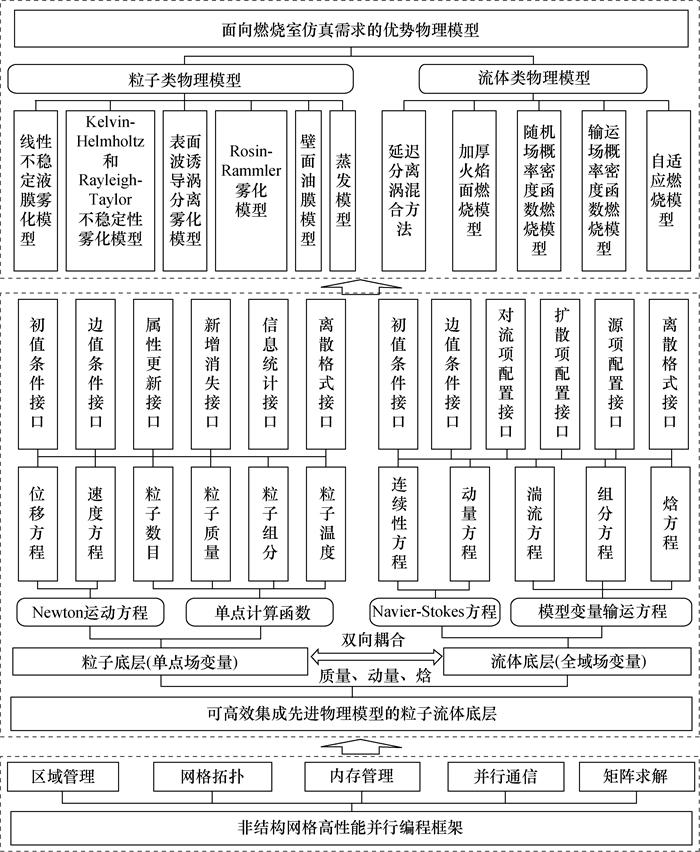
1) 非结构网格高性能并行编程框架。为了提升CBTLES软件的并行仿真效率,解决软件开发过程中因超级计算机体系结构的快速变化而出现的“编程墙”的问题,本文在自主非结构网格高性能并行编程框架[3-4](j parallel adaptive unstructured mesh applications infrastructure,JAUMIN)的底层支撑上开展软件的研发工作,研制出可高效运行于现代主流高性能计算机上的并行自适应非结构网格CBTLES燃烧软件。JAUMIN通过封装可拓展性高的网格拓扑关系和数据结构集成了高性能的矩阵求解算法和并行通信技术,可支撑和保障研发团队的研究,使其仅需专注于物理模型建模和数值求解算法的创新研究而无需熟悉并行计算和高性能算法的实现细节。典型工程全环燃烧室上亿网格规模算例的测试结果表明:CBTLES软件的103核并行效率达到104.50%、104核并行效率达到70.92%,展现出良好的并行可扩展性。
2) 粒子流体底层。粒子流体底层以JAUMIN为基础,通过集成计算与流体力学学科相关的离散求解算法和与物理模型相关的共性功能模块接口,支撑个性化物理模型的快速集成和研发。
流体底层的数据形式以全域场变量为主,其控制方程分为2类:第1类为通用Navier-Stokes方程,该方程由连续性方程和动量方程组成;第2类为模型变量输运方程(模型变量支持标量、矢量和张量形式),常见的方程有湍流方程、组分方程和焓方程。流体底层封装了多类主流的时空离散格式(如时间方向的隐式Euler格式和Crank-Nicolson格式,空间方向的一阶迎风格式、二阶迎风格式和中心差分格式)和数值求解算法,且提供Navier-Stokes方程与模型变量输运方程相关的初边值条件[5]、对流项、扩散项和源项等扩展接口。该流体底层封装的数值求解算法有解压力耦合方程的半隐式方法(semi-implicit method for pressure-linked equations,SIMPLE)、协调的SIMPLE方法(semi-implicit method for pressure-linked equations consistent,SIMPLEC)和基于算子分裂的压力隐式算法(pressure-implicit with splitting of operators,PISO)等。用户只需根据物理模型特征对相应方程接口进行个性化配置,无需关心方程离散格式和算法流程,即可完成模型的高效集成,这提高了研发效率。
粒子底层的数据形式以单点场变量为主,控制方程分为2类:第1类为Newton运动方程,该方程由位移方程和速度方程组成;第2类为粒子属性单点计算函数,主要涉及粒子的数目、质量、温度和组分等属性的计算函数。针对燃烧室内燃油的注入、运动、定位、新增和消失等物理过程,粒子底层封装了初边值条件、粒子属性更新、粒子新增与消失和粒子信息统计等共性功能模块,并开放了相应的函数和数据接口。粒子底层支持用户根据物理模型特征,设置多类属性的粒子在任意区域和任意时刻的注入,以及实现在多类非结构网格类型和多类边值条件下粒子的精准追踪和定位。
基于CBTLES软件框架,本文实现了计算机并行通信、方程离散求解、物理模型集成和代码测试验证4个方面的软件开发过程的解耦,同时研发人员能真正专注于自身领域知识的沉淀和创新性研究,充分发挥“专业专长”的协同研发优势,二者共同提高了软件的可维护性和可拓展性。
2 优势物理模型
燃烧室内部存在着一系列非常复杂的两相湍流燃烧过程。该过程为:燃油从喷嘴注入,在强旋流湍流条件下发生雾化,在火焰筒头部形成大量液滴;液滴在高温环境下发生蒸发,燃油从液相转化成气相,形成一定范围的燃气浓度分布;伴随着高速旋流、射流和回流等流动行为,燃气与空气掺混并发生化学反应燃烧,形成稳定火焰。为了提升CBTLES软件的仿真精度,保证其具备良好的工程适用性,需针对燃烧室内复杂的物理化学过程开发集成多类特定的雾化、蒸发、湍流和燃烧模型。基于此,本文通过分析燃烧室仿真的典型特征和难点,在自主开发的粒子流体底层基础上,开发集成了10类适用于发动机燃烧室仿真模拟的高精度优势物理模型,并构建了多套基础算例对各类模型的仿真精度进行了考核与校正。
1) 雾化模型。燃油雾化作为燃烧室一切物理化学过程的开始,对火焰稳定、燃烧效率和出口污染物排放等会产生极大的影响。根据燃油雾化过程不同阶段的特点,按照时间先后顺序可以分为一次雾化和二次雾化2个阶段[6]。在航空发动机燃烧室高温高压环境和强旋流条件下,开发集成工程实用的一次和二次雾化模型可实现106量级燃油液滴的雾化仿真过程。CBTLES软件针对航空发动机主燃烧室和加力燃烧室中涉及的雾锥和直喷2种典型雾化结构,开展了雾化模型的构建和集成。其中,针对雾锥雾化结构采用了线性不稳定液膜雾化模型(linearized instability sheet atomization,LISA)[7-8]与Kelvin-Helmholtz和Rayleigh-Taylor不稳定性雾化模型(KH-RT)[9-11]刻画一次和二次雾化过程;针对直喷雾化过程采用了表面波诱导涡分离雾化模型(WAVE)[9, 12-13]和KH-RT雾化模型刻画一次和二次雾化过程。为了进一步提升雾化仿真效率,CBTLES软件集成了Rosin-Rammler工程雾化模型(R-R)[14-15],该模型支持用户根据工程需要,选取点注入和环注入2种注入方式注入粒子,并灵活指定粒子的初始注入直径、锥角和速度等。
2) 壁面油膜模型。燃油从喷管注入后,在主燃烧室旋流器或加力燃烧室稳定器上撞壁形成油膜,油膜在气动外力的驱动下运动,部分发生剪切剥落,最终于端面处发生分离破碎。通过研究旋流器或稳定器内部这一复杂的油膜演化过程,从而建立高精度的壁面油膜模型,这对提升雾化仿真精度具有重要意义。目前,大部分软件缺乏成熟的壁面油膜模型,在模拟两相湍流燃烧过程时,由于旋流器或稳定器出口处的液滴状态只能人为给定,仿真模拟结果误差很大。为了准确模拟油膜的运动行为,CBTLES软件集成了一类可模拟油膜黏附、反弹铺展、破碎和飞溅等多种形态的壁面油膜模型[16-17]。测试结果表明:该模型具有较高的计算稳定性,同时可高精度仿真油膜的厚度和速度,以及端面分离时粒子的角度和速度,从而有效提升燃烧室油膜雾化的仿真精度。
3) 蒸发模型。燃油在燃烧室高温环境下发生蒸发,实现从液相到气相的转变。燃油蒸发集传热、传质和流动于一体,是一个极为复杂的过程,同时也是串联两相燃烧的关键环节。提升蒸发模型的仿真精度有助于在仿真过程中给出更合理的燃油液滴存活时间和燃气组分浓度分布。常见的蒸发模型一般指零维和一维模型,二者对高温环境的检验和对多组分因素的考虑不足。CBTLES软件集成了一类考虑浮升力驱动、温度、对流和组分物性等多影响因子的厚交换层蒸发模型[18]。测试结果表明:在燃烧室高温高压环境下,厚交换层蒸发模型针对航空煤油RP3的不同物性条件,给出了更符合物理规律的蒸发模拟结果,尤其在高温段能较好地描述燃油液滴的蒸发特性。
4) 大涡模拟(large eddy simulation,LES)方法。针对燃烧室内的复杂结构和流动行为,目前应用在工程领域的主流湍流模型是Reynolds平均模型(Reynolds average Navier-Stockes,RANS)和LES方法。相比于RANS方法,LES方法能较为准确地预测大分离等具有明显非定常特性的流动行为,可信度更高,但对于具有106量级Reynolds数的边界层流动,LES方法的计算量巨大。为此,学者们综合LES和RANS方法的优点,发展了多种RANS/LES混合方法。该类方法在保证精度的同时可节省计算网格数,被认为是下一代工程计算的主流方法[19]。CBTLES软件集成了一种可克服近壁衰减、网格诱导分离、旋涡破裂靠前和对数层不匹配等缺陷的延迟分离涡混合方法(delayed detached eddy simulation,DDES)[20-21]。该方法采用各向异性放缩因子的Fourier级数合成扰动,较为准确地给出了湍流入口发展条件,并通过引入的过渡函数降低对网格密度的过分依赖,推迟RANS区向LES区的提前转换,一定程度上缓解甚至避免了网格诱导分离等问题,为两相湍流燃烧仿真提供了准确的流动基础。
5) 燃烧模型。化学反应燃烧是燃烧室产能的核心[22],湍流燃烧仿真是燃烧室仿真的关键难点。在燃烧模型方面,CBTLES软件集成了3类优势燃烧模型,即动态增厚火焰面燃烧模型(dynamic thickened flame,DTF)[23-24]、随机场概率密度函数燃烧模型[25-28]和输运场概率密度函数燃烧模型[29-32]。其中,DTF模型在不改变火焰速度的前提下,可通过增大扩散系数、降低反应速率和人为增加火焰厚度达到在较粗网格下准确模拟火焰结构的目的;随机场概率密度函数燃烧模型在Euler体系下建模,考虑了湍流和随机源相的影响,通过增加随机场个数可有效提升燃烧的仿真精度;输运场概率密度函数燃烧模型在Lagrange体系下建模,该模型对预测局部熄火/再燃等近极限现象和污染物排放具有很大优势。3类模型均直接求解组分方程和焓方程,可准确解析化学反应与湍流流动之间的相互作用,具有较高的燃烧仿真精度。在3类模型基础上,针对湍流燃烧模拟快与准的“矛盾”,本研究团队突破了自适应燃烧建模和燃烧子模型耦合2个关键技术难点,将输运场概率密度函数燃烧模型与组分输运类燃烧模型耦合,建立了自适应燃烧模型[33-34],这在国际相关研究中尚属首次。典型射流算例测试结果表明:自适应燃烧模型与高精度的输运场概率密度函数燃烧模型预测性能相当,加速比达到2.8,具有较高的仿真精度和效率。
3 模型耦合一致性研究
燃烧室仿真不同于燃烧仿真,是涉及雾化、蒸发、湍流和燃烧等模型的复杂耦合仿真过程。在开展工程燃烧室仿真计算之前,本文构造了三级旋流构型、气相旋流构型、圆筒构型和模型燃烧室构型4套算例,对CBTLES软件的雾化蒸发模型、湍流燃烧模型和雾化蒸发与湍流燃烧两相模型的耦合一致性进行了测试。
1) 雾化蒸发模型耦合一致性。
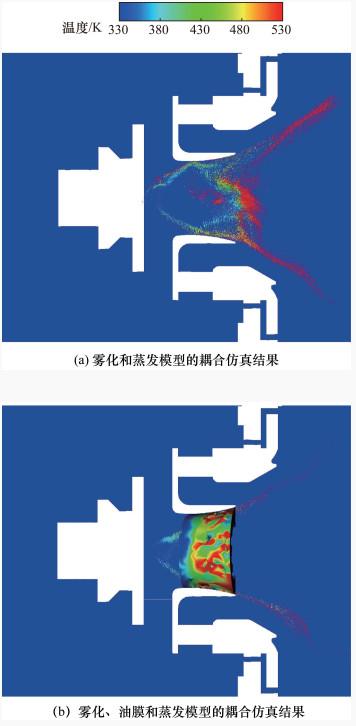
本文构建三级旋流构型算例,检验雾化、油膜和蒸发模型3类粒子类物理模型的耦合一致性。图 2a为雾化和蒸发模型的耦合仿真结果,由图可知,高速燃油从喷嘴喷出后,在旋流器内部撞壁反弹形成交叉,在强旋流湍流作用下发生雾化,在火焰筒头部形成大量液滴,并呈锥状分布;液滴受高温环境影响发生蒸发,运动一定距离后消失。图 2b为雾化、油膜和蒸发模型的耦合仿真结果,由图可知,添加油膜模型后,CBTLES软件能较好地模拟燃油在旋流器内形成油膜的过程和油膜在旋流器端面处分离破碎为液滴的过程,燃油液滴撞壁反弹后的角度和溅射比例明显减小,符合工程实际物理规律。三级旋流构型算例仿真结果表明:CBTLES软件实现了雾化、油膜和蒸发模型3类粒子类物理模型的耦合计算,可直接求解旋流器出口处的液滴角度和速度,减小了人工经验调试误差。
2) 湍流燃烧模型耦合一致性。
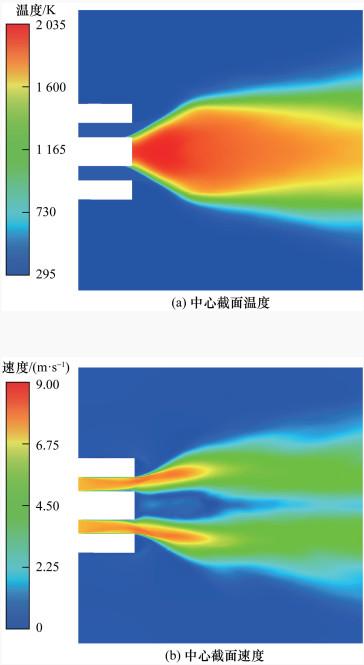
本文选用Dreizle开发的甲烷/空气非受限强旋流贫油预混燃烧算例[35],检验以DDES混合方法和DTF燃烧模型为典型的流体类物理模型的耦合一致性。图 3a为中心截面温度云图,由图可知,经旋流叶片流出的甲烷-空气预混气点火后,在主燃区进行稳定燃烧;图 3b为中心截面速度云图,结合该图分析可知,高速旋流产生的回流气流将高温火焰从下游带回上游,使火焰稳定在中心钝体区域,起到稳定火焰的效果;在气动力的驱动下,火焰向下游传递,温度下降,高温区范围增宽。为进一步验证湍流燃烧的仿真精度,本文选取流向距入口为10、20和30 mm的3个典型截面的时均温度和速度,与试验结果进行对比,其中温度的平均误差分别为12.72%、11.72%和9.39%,轴向速度的平均误差分别为3.48%、4.35%和4.40%。预混燃烧算例仿真结果表明:CBTLES软件具备以DDES混合方法和DTF燃烧模型为典型的流体类物理模型的耦合仿真能力,可准确捕捉湍流燃烧的相互作用,具有较高的仿真精度。
3) 简单算例两相模型耦合一致性。
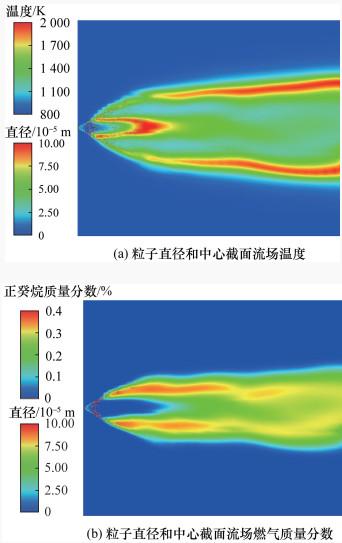
本文构建圆筒构型简单算例,检验CBTLES软件中基于流体底层的湍流燃烧模型与基于粒子底层的雾化蒸发模型的两相耦合一致性。计算域为直径240 mm、长度400 mm的圆柱筒,环境压力0.55 MPa,环境温度863 K;气流从左侧入口面流入,气流流速2 m/s;粒子从左侧中心直径为2 mm的圆形喷孔注入,喷雾锥角60°,喷油量1.15×10⁻² kg/s。图 4a为粒子直径和中心截面流场温度云图,由图可知,入口处粒子初始直径设置为喷孔直径大小,粒径较大;粒子注入后粒子直径表征油膜厚度,粒径明显减小;粒子随高速气流运动发生一次雾化,破碎出的新粒子的直径表征燃油液滴直径,粒径明显增大;受燃烧区高温影响,粒子蒸发,粒径减小,粒子运动一段距离后消失。图 4b为粒子直径和中心截面流场燃气质量分数分布云图,结合该图可知,受高速气流影响,蒸发出的燃气分布较为集中;在燃气集中分布区域的头部和两侧,氧气浓度较高,油气掺混,在高温环境下发生化学反应燃烧,形成局部高温火焰带,其余区域氧气浓度低,燃烧组织不充分,形成低温区域。圆筒构型简单算例仿真结果表明:CBTLES软件初步实现了雾化、蒸发、湍流和燃烧模型的两相耦合计算,计算结果符合物理规律。
4) 模型燃烧室算例两相模型耦合一致性。
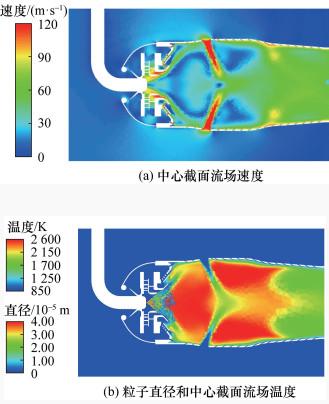
在进口温度为871.2 K、进口压力为551.3 kPa工况下,CBTLES软件的仿真计算结果与试验数据相比,总压恢复系数仿真误差为1.5%,关键截面温度平均误差为14.6%,出口温度分布系数(overall temperature distribution factor,OTDF)误差为9.7%,火焰形态与试验结果趋势一致。在进口温度为302.2 K、进口压力为101.3 kPa工况下,本文开展了熄火数值试验。数值试验结果表明:随着油气比减小,CBTLES软件能准确模拟燃烧室内的火焰从稳定燃烧到熄灭的动态过程,与试验值相比,熄火油气比仿真误差为15.1%。
模型燃烧室算例仿真结果表明:针对复杂燃烧室构型,CBTLES软件仿真的两相湍流燃烧过程符合物理现象和规律,仿真精度基本满足工程需要。
4 工程仿真计算
目前,航空发动机主燃烧室结构复杂,其内部物理过程多样、化学反应过程多变。相比于主燃烧室,加力燃烧室内燃油的雾化形式以直喷式雾化为主,具有流速较高、燃烧过程较长的特点。这使开展航空发动机主燃烧室和加力燃烧室的两相湍流燃烧过程仿真极具挑战。为进一步探究CBTLES软件针对工程构型算例的多模型耦合仿真性能,本文开展了针对某型涡扇发动机全环主燃烧室和全环加力燃烧室的典型工况的仿真计算,并对比了总压恢复系数ξ、OTDF等参数的仿真精度,相关计算表示为:
其中:${\bar P}$4为出口总压平均值,${\bar P}$3为入口总压平均值,T4max为出口温度最大值,T4ave为出口温度平均值,T3ave为入口温度平均值。
4.1 全环主燃烧室工程仿真计算
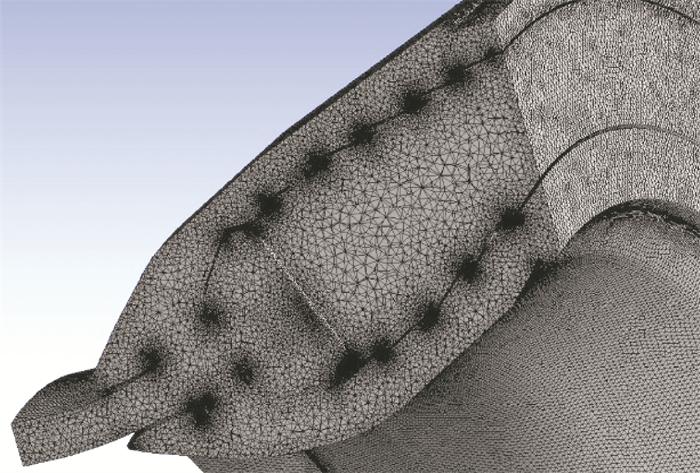
本文使用Mesh软件对某型涡扇发动机全环主燃烧室进行非结构网格生成(构型保留了除喷嘴之外的其他所有结构),对旋流器、头部孔和壁面孔等关键区域进行网格的局部加密,网格总量为1.24×10⁸,如图 6所示。仿真计算采用的物理模型为R-R一次雾化模型、KH-RT二次雾化模型、厚交换层蒸发模型、DDES混合方法和DTF燃烧模型,时空离散格式设置为Crank-Nicolson格式和二阶中心差分格式;迭代21 000步,使用1 120个中央处理器(central processing unit,CPU)核,总计算时长约为454 h。
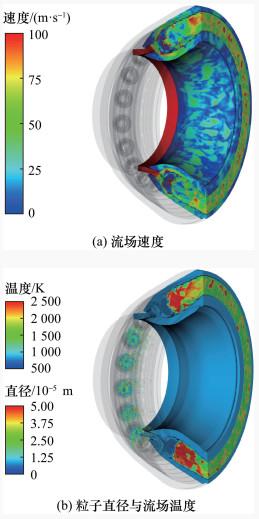
以典型工况下为例,CBTLES软件的仿真计算结果与试验数据相比,总压恢复系数仿真误差为1.16%,OTDF仿真值相对误差为9.7%。
综上所述,在航空发动机全环主燃烧室内强旋流条件下,CBTLES软件能准确捕捉燃油的雾化、蒸发和燃烧的非定常发展过程,软件仿真精度和计算能力基本满足工程实用要求。
4.2 全环加力燃烧室工程仿真计算
本文使用Mesh软件对某型涡扇发动机全环加力燃烧室进行非结构网格生成,对燃油喷射和气流稳定的关键区域进行网格的局部加密,网格总量约1.6×10⁸,如图 8所示。仿真计算采用的物理模型和设置的时空离散格式与主燃烧室一致;迭代21 000步,使用1 120个CPU核,总计算时长约为556 h。
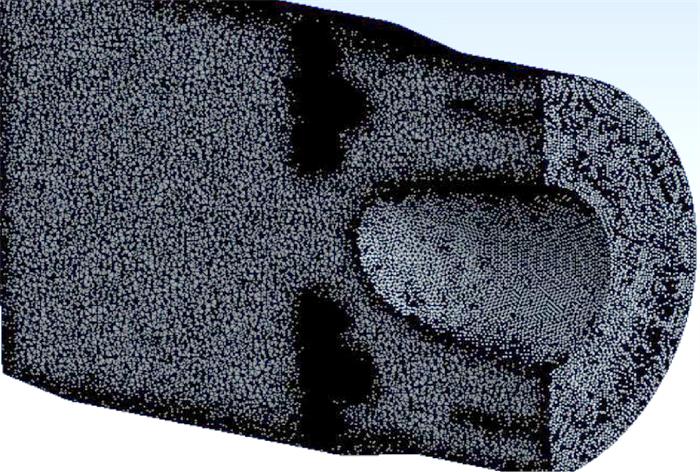
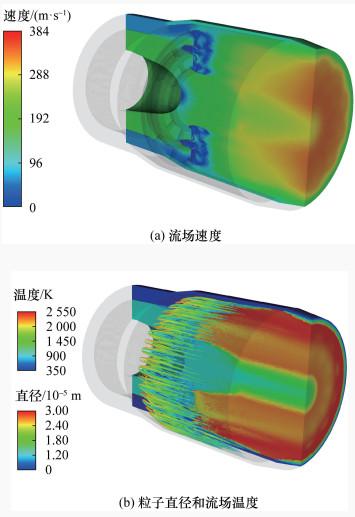
图 9a为流场速度云图,由图可知,入口段外涵速度较低,内涵速度较高,气流在火焰稳定器后形成回流,内外涵速度差异变小,起组织燃烧的作用;在燃烧区,随着温度升高,气流速度逐渐增大,出口附近速度周向分布较为均匀。图 9b为粒子直径和流场温度云图(共有540股入射燃油,其中火焰稳定器中心区域的入射燃油为逆向喷射,其余区域为周向喷射)。由图 9b可知,高速燃油从喷孔喷出后,受横向气流影响迅速向下游移动并发生一次和二次雾化,液滴数量显著增多;随着温度升高,液滴蒸发,液滴直径减小,燃油逐渐由液相转变为气相,燃气组分浓度随之升高;与外涵相比,入口段内涵温度较高,导致液滴在较短时间内完全蒸发,向下游运动的距离相对较短;在火焰稳定器后的燃烧区域,火焰燃烧稳定,由于内涵来流为尾气,外涵来流为空气(氧气含量较高),燃烧区外侧温度高于内侧;在加力燃烧室出口附近,温度的周向分布较为均匀。
以典型工况下为例,CBTLES软件的仿真计算结果与试验数据相比,总压恢复系数仿真结果误差约为5.6%,出口平均温度仿真结果误差约为0.92%。
综上所述,CBTLES软件能准确仿真航空发动机加力燃烧室内燃油的雾化、蒸发和燃烧的非定常过程,软件的仿真精度和计算能力基本满足工程实用要求。
5 结论
本文针对航空发动机燃烧室工程应用仿真需求,在架构设计、模型集成、软件研发、测试验证和工程应用5个方面,开展了全流程的仿真研究工作。本文研究团队通过设计的一套数据结构合理、流程架构可拓展性高的软件框架,高效集成了10类国内外优势的物理模型,从而研制出一套自主两相湍流燃烧并行一体化仿真软件,即CBTLES软件。在此基础上,本文通过开展模型耦合一致性研究,对大推力发动机涡扇全环主燃烧室和加力燃烧室进行了仿真应用计算。从初步的计算效果角度看,CBTLES软件仿真功能、精度和计算能力基本满足航空发动机燃烧室工程实用要求。
为进一步提升CBTLES软件在工程设计的应用价值,后续需在以下几方面继续开展相应的工作:
1) 燃烧室多学科耦合仿真的方法研究。燃烧室的设计研发涉及气动、强度和传热等多学科耦合仿真问题,为确保CBTLES软件仿真结果的可靠性和完整性,需继续发展适用于工程设计的燃烧室多学科耦合仿真方法,突破燃烧室流、固和热耦合仿真技术,实现喷嘴、火焰筒的受热变形和流场的耦合计算与预测。
2) 燃烧仿真软件校核与验证。基于工程试验和试验数据的软件校核与验证是提高CBTLES软件仿真置信度的重要环节,故需针对航空发动机燃烧室实际构型和工况,分析和分解其典型仿真特征和难点,对软件中模型和方法的适用范围、仿真精度进行系统性评估和检验,校准仿真参数,沉淀软件调试经验,形成真实可靠的三维两相湍流燃烧仿真预测能力。
3) 燃烧仿真软件工程仿真应用实践。针对航空发动机工程设计需求开展燃烧室仿真计算和应用,已成为航空发动机研制过程的必然趋势。后续CBTLES软件需紧密结合工程设计、研制过程,开展相应的仿真计算,在实践中提升其工程仿真的水平和能力。


