

野外火灾是一种严重破坏林草资源、威胁人类生命财产安全的灾害[1-5]。电焊作业、切割作业、架空线路故障等都可能产生高温金属热颗粒,引发野外火灾,例如:2019年中国山西省沁源县“3·29”森林火灾,过火面积达360公顷(源自中国新闻网https://www.chinanews.com.cn/sh/2019/03-30/8795287.shtml);2020年中国四川省凉山州西昌市“3·30”森林火灾,造成19人牺牲、3人受伤,过火面积达3 047.780 5公顷[6]。具备引燃能力的高温金属热颗粒掉落并接触可燃物是造成野外火灾的前提,研究野外火灾不仅需要分析热颗粒的掉落轨迹和温度等,还需分析可燃物的物理状态。可燃物颗粒的大小决定了其比表面积进而影响其热惯性,并直接影响着可燃物被引燃的难易程度和金属热颗粒引燃边界[7-9],从而决定着是否会引发野外火灾。因此,可利用目数衡量可燃物颗粒大小,开展可燃物目数对高温金属热颗粒引燃边界和燃烧行为的影响研究。
高温金属热颗粒点燃可燃物引发野外火灾是当前火灾科学领域的热点问题之一[10]。1998年,Tse等[11]针对铜、铝及其它燃烧颗粒的引燃能力进行了研究,明确提出铝质颗粒相较于铜质颗粒在引燃方面展现出更高的活性,并写入《火灾与爆炸调查指南》(NFPA 921 Guide for Fire and Explosion Investigations) [12-13];2002年,Rallis等[14]对架空铝导线短路迸溅熔珠对干草的引燃性能进行了深入剖析;2014年,Urban等[15]通过对铜、铝、钢、黄铜等多种金属颗粒加热至特定温度后的释放行为及其对不同易燃物的引燃效应进行了系统研究,并构建了高温金属颗粒引燃机制的理论框架与实践模型;Yang等[16]揭示了高温金属热颗粒在引燃过程中的5种典型现象;2023年,张玉等[17]研究了低速热颗粒冲击聚苯乙烯泡沫燃料床的点火行为,发现适当增加热颗粒初始速度(0~3 m/s)可提高其点火危险性,但增加过多(3~6 m/s) 反而降低点火能力;2024年,吕慧菲[18]发表了电弧迸溅熔珠引燃能力及痕迹特征辨识方法研究成果,实验模拟短路故障产生的迸溅熔珠引燃纤维素全过程,建立迸溅熔珠引燃能力预测模型。
可燃物类型也对高温金属热颗粒引发野外火灾具有重要影响。2016年,Yang等[16]对烟花爆竹、电焊作业等场景中产生的高温金属热颗粒如何引发聚氨酯泡沫、聚苯乙烯泡沫等保温材料着火进行了机理性阐释;2017年,李梦媛等[19]以加热黄铜颗粒模拟工业生产中的电焊、烟花制造、金属切削等过程,探究其对3种常见的工业堆积材料(木粉、炭粉、羟丙基甲基纤维素(HPMC)作为可燃材料的代表物的引燃行为;2018年,Urban等[15]针对铝质高温金属热颗粒在α-纤维素粉、干草混合物以及松针等介质中的引燃行为展开了详细的实验研究;2019年,刘冠宏[8]研究可燃物含水率对地表火的火蔓延和火强度的影响,并构建Rothermel模型和Van Wagner模型。
本文针对可燃物目数这一影响因素,开展不同目数(50、100、150、200、300目)松木粉对高温金属热颗粒引燃边界的影响研究,通过实验记录并分析了引燃边界温度、引火延迟时间、火焰高度(flame height)和火焰持续时间,研究可燃物目数对高温金属热颗粒引燃边界的影响机制。本研究可为调查认定高温金属热颗粒可引燃的可燃物颗粒大小提供理论依据,并为野外火灾的安全防治和应急处理提供一定参考。
1 实验方法
1.1 实验装置
自主设计搭建的高温金属热颗粒引燃可燃物实验装置示意图如图 1所示,主要包括马弗炉,送料装置和燃料盛放台。送料装置配备可伸缩条状加热勺,加热勺内连接热电偶,用于记录加热勺内高温金属热颗粒的温度。燃料盛放台被置于马弗炉和送料装置之间,为减少高温金属热颗粒在掉落过程中的热量损失,燃料盛放台采用支架架高以缩短颗粒在空气中的掉落时间。本实验布置了高速摄像机和70D摄像机,分别记录高温金属热颗粒落下时引燃可燃物的全过程和重要指标(火焰高度和火焰持续时间),以便进行数据分析和结果呈现。
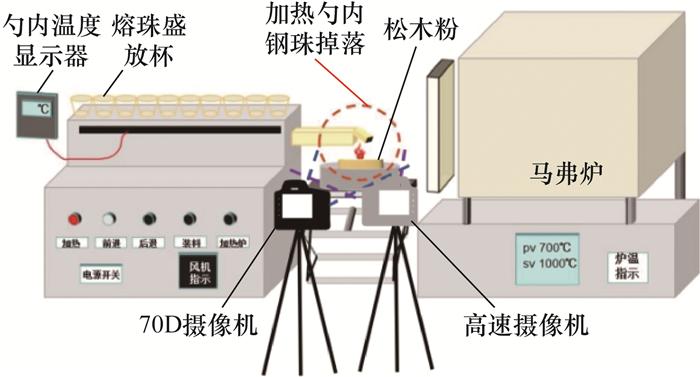
本实验采用9 mm的钢珠作为金属颗粒,使用同一木种(油松,产地为中国江苏省)的松木粉作为可燃物,松木粉的目数分别为50、100、150、200和300目。使用统一规格玻璃皿盛放相同体积和质量的松木粉,确保样品密度相同,并将制备好的松木粉样品置于恒温恒湿箱中进行48 h的预处理,确保样品的温度均为20 ℃,湿度均为30%。
首先开启马弗炉,设定实验温度,并将盛有钢珠的加热勺放入炉中加热;将完成预处理的松木粉样品放置于燃料盛放台上,调整其摆放位置,同时设置高速摄像机和70D摄像机的参数,确保实验录像清晰;待加热勺温度达到指定值。控制自动送料装置将燃料勺移出马弗炉,使高温金属热颗粒落入松木粉中,利用高速摄像机(1 000 fps)录制实验全过程,70D摄像机(30 fps)记录火焰高度和火焰持续时间。每次实验完成后更换新的钢珠,再进行下一次实验。同一设定温度下进行至少5次平行实验以确保结果的准确性。
1.2 引燃边界温度和引燃概率计算
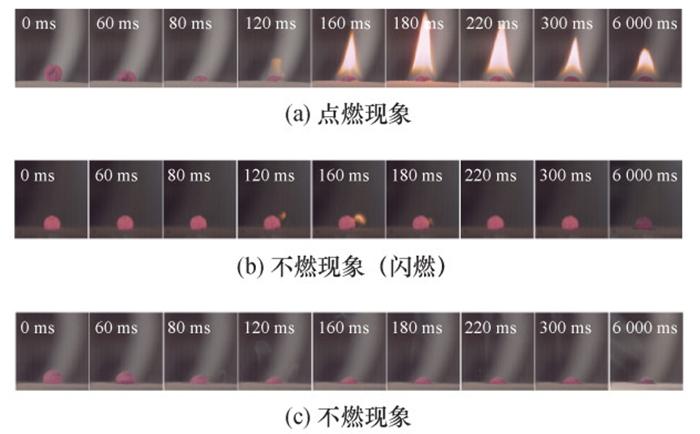
本研究中,观察高温金属热颗粒着床后能否成功引燃松木粉,根据前人的相关研究[23],将熔珠着床后成功引燃松木粉产生火焰且火焰持续时间超过1 s的现象定义为点燃;成功引燃松木粉产生火焰但火焰持续时间小于1 s的闪燃现象和未能成功引燃松木粉不产生火焰的现象定义为不燃。由此将每次实验的结果分为点燃和不燃。
将引燃成功概率为50%时的温度定义为松木粉可被引燃的引燃边界温度,将引燃概率P定义为成功引燃次数n1和实验重复次数n之比,计算方式为
1.3 引火延迟时间计算
引火延迟时间是指在燃烧过程中,可燃物受到外部热源或点火源刺激至实际燃烧开始的时间间隔。引火延迟时间可以评估火灾的发展速度和燃烧强度,引火延迟时间越短代表可燃物的易燃性越高。引火延迟时间ti的计算方法为
其中:t0为高温金属热颗粒首次接触燃料床的时刻,t1为首次出现可持续燃烧的火焰的时刻。
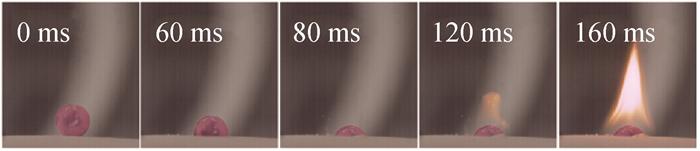
以图 2为例,根据高速摄像机帧率为1 000 fps,可以得出每一帧为1 ms,将高温金属颗粒首次接触燃料床的那一帧的时刻定义为0 ms,以方便计算,找到首次在图像中观察到火焰的那一帧,通过换算得到此时刻为120 ms,最终通过计算可以得到ti为120 ms。
1.4 火焰高度计算
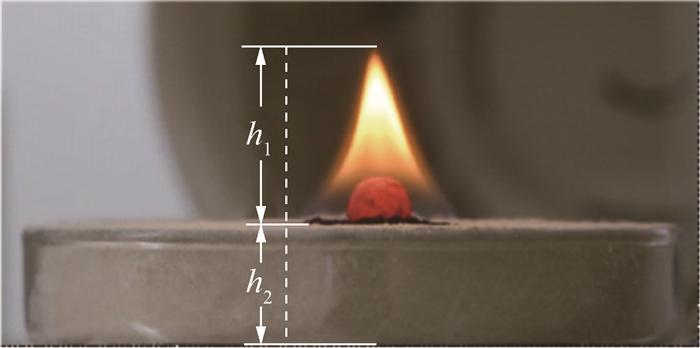
火焰高度是指从火焰的最高点到火焰底部的垂直距离。它是火焰的一个重要参数,反映了火焰强度和燃烧过程中释放的能量。火焰高度通过使用摄像机测量法进行测量。如图 3所示,将高速摄像机录制的燃烧过程进行逐帧分析比较,提取火焰高度最高时刻的图像,利用Photoshop软件的标尺工具测量火焰高度h1和培养皿高度h2,通过游标卡尺测量出培养皿实际高度h3,则实际火焰高度h的计算方法为
1.5 火焰持续时间计算
火焰持续时间是指火焰在燃烧过程中持续存在的时间长度,是评估燃烧过程的重要指标之一。在野外火灾中,火焰持续时间较长意味着火势可能更为猛烈,存在更大的火灾危险性,火灾对周围环境和建筑物的破坏程度更高,灾情扑救的难度更大。火焰持续时间td的计算方法为
其中t2为火焰完全熄灭时间。
以图 4为例,根据高速摄像机帧率为1 000 fps,可以得出每一帧为1 ms,找到首次在图像中观察到火焰的那一帧,通过换算得到此时刻为120 ms,之后逐帧观察,确定火焰熄灭的那一帧,通过换算得到此时刻为20 000 ms,最终通过计算可以得到td为19 880 ms。

2 结果与分析
2.1 钢珠引燃松木粉燃烧现象
2.2 松木粉目数对引燃边界温度的影响
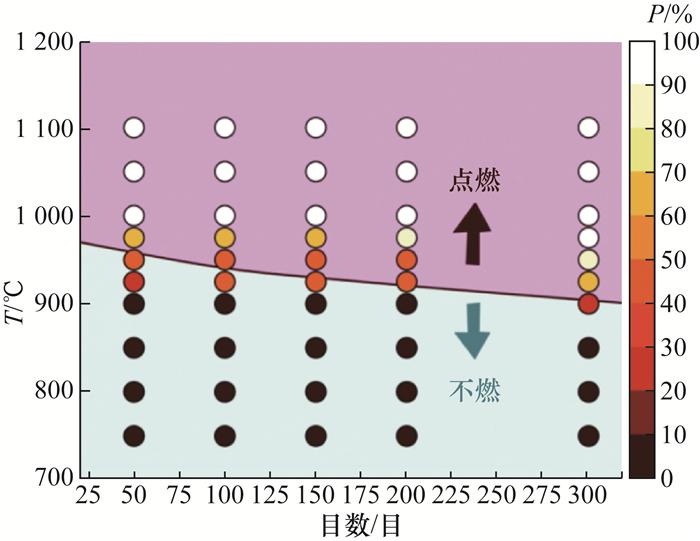
松木粉的目数对引燃边界温度的影响如图 6所示,紫色部分代表点燃区域,蓝色部分代表不燃区域,2个区域的分界线对应引燃边界温度。由图可知,引燃边界温度随松木粉目数的增加逐渐降低,从50目条件下的引燃临界温度965 ℃降低至300目条件下的910 ℃,这表明目数越大,松木粉越容易被点燃。当高温金属热颗粒着床时,周围的松木粉颗粒升温产生热解气体并与空气混合,当热解气体浓度达到一定值且周围空气充足,与不断降温的金属热颗粒接触就会被点燃,而松木粉目数增加则单个颗粒的比表面积增加,降低了单个颗粒的热惯性,从而加快了单个颗粒的升温速率,使其更容易热解,更快达到点燃所需的热解气体浓度,从而减少了金属热颗粒的降温时间,使得温度较低的金属热颗粒也可以点燃松木粉,从而降低引燃边界温度。同时,更大的比表面积意味着更多的氧气接触面积,也有利于促进燃烧反应的进行,导致更低的引燃边界温度。此外,目数的增加导致颗粒表面暴露出更多的纤维结构,提高了燃烧的效率。
2.3 松木粉目数对引火延迟时间的影响
松木粉的目数对ti的影响如图 7所示,由图可知,在相同金属热颗粒温度T下,ti呈现随松木粉目数的降低近似呈阶梯式下降。这与松木粉的颗粒尺寸和比表面积有关,目数较大的松木粉颗粒更为细小,比表面积更大,更容易与空气中的氧气充分接触,燃烧反应加速;目数较小的松木粉颗粒相对较大,比表面积较小,需要更长的时间与氧气接触并启动燃烧反应。同时,目数较大的松木粉颗粒通常更易形成紧密堆积,有利于热量传导,从而加速燃烧过程。此外,不同目数的松木粉存在木质素含量、纤维结构等特征的差异,导致其在燃烧时的反应速度不同,进而影响ti的长短。
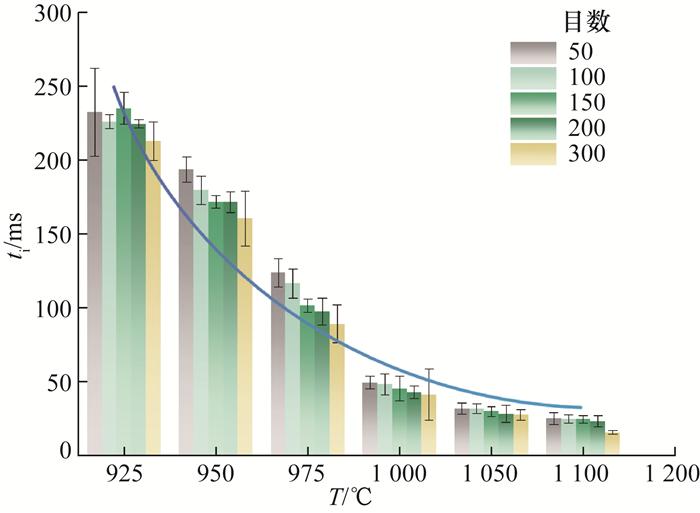
需要注意的是,在相对较低的温度,如950 ℃时,不同目数的松木粉之间的ti差值较大,这是由于不同目数的松木粉具有不同的物理特性和燃烧性能导致的,目数增大,则单个颗粒的比表面积增加,降低了单个颗粒的热惯性,从而加快了升温,使颗粒更容易被点燃。在相对较低温度时,可燃物目数对ti的影响占主导作用。然而,随着T升高至1 100 ℃,不同目数的松木粉仍然保持着目数越大ti越小的规律,但ti的差值变得相对较小。这是因为在更高的T下,燃烧反应速率加快,不同目数的松木粉之间的燃烧性能差异在某种程度上得到缩小,使得不同目数的ti的差值会减小。此时,即使目数较小的松木粉也能更快释放出燃烧产物并与氧气进行燃烧反应,从而减少ti的差值。因此,随着T的升高,不同目数的可燃物的ti之间的差值逐渐变小。
根据上述实验数据,以150目松木粉为例,可以得出其ti与T之间的经验公式为
2.4 松木粉目数对火焰高度的影响
松木粉目数对火焰高度的影响如图 8所示,由图可知,在T相同条件下,随着松木粉目数的增加,h也随之增加。因为目数较大的松木粉在燃烧时释放的热量更多。在高温条件下,不同目数之间h的差值更大,例如1 100 ℃时,不同目数松木粉的h的差值远远大于925 ℃。这表明温度对不同目数松木粉的h的影响程度不同,高温下不同目数松木粉h的差值更为显著。
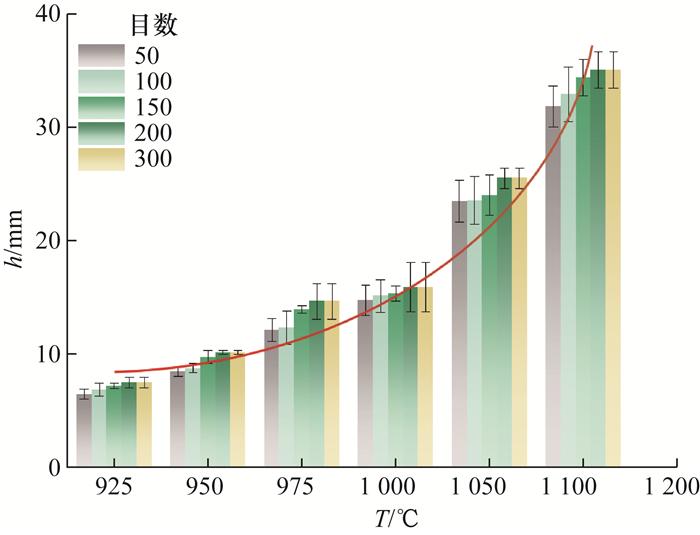
根据上述现象可分析出:1) 目数越大,松木粉燃烧释放热量更多,产生火焰更高。松木粉目数增大,单个松木粉颗粒比表面积更大,更易与氧气发生反应,释放更多热量和燃烧产物,使火焰增高。2) 高温下h的差值更为显著。T越高,松木粉燃烧更快,h增加;高温不仅加快燃烧速度,还提高燃烧产物活性,加剧了反应,进一步增大h,使得不同目数之间的h的差值更加显著。因此,目数对松木粉颗粒比表面积的改变以及高温对反应速率及产物活性的改变,使得在高温下不同目数之间的h差值更加显著。
根据上述实验数据,以150目松木粉为例,可以得出h与T之间的经验公式为
2.5 松木粉目数对火焰持续时间的影响
松木粉目数对td的影响如图 9所示,根据图中的数据显示,在各个温度节点下,300目松木粉的td通常大于200目、150目、100目和50目的。这表明300目松木粉的td相对较长,具有较高的燃烧性能。
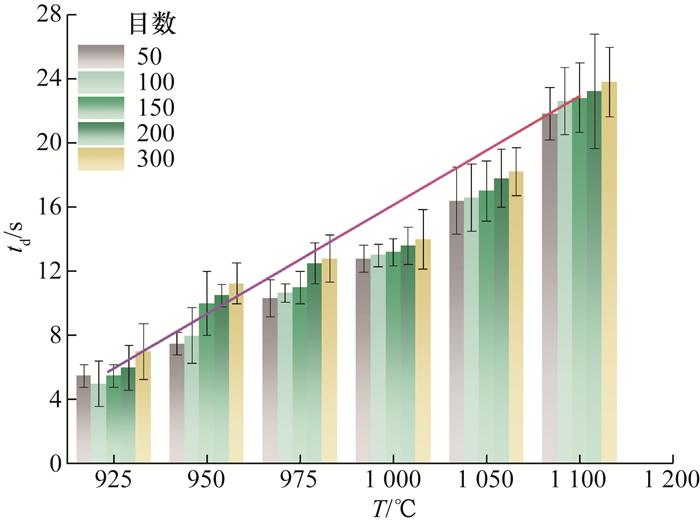
在考虑不同目数的松木粉在td上的对比时,需要考虑一系列因素导致的这种差异。松木粉的目数反映了其单个颗粒的大小和比表面积,而这直接影响了单个松木粉颗粒的热惯性和燃烧时的氧气接触面积,以及其燃烧速率。因此,较大目数的松木粉会在燃烧过程中释放更多的能量,导致td更长。
此外,松木粉的化学成分和结构也对其燃烧性能产生影响。例如木质纤维的含量和纤维结构的紧密程度等。这些因素使得更大目数的松木粉在燃烧过程中更容易产生更稳定的火焰,从而延长td。
根据实验数据,以150目松木粉为例,可以得出其td与T之间的经验公式。
3 结论
本文为探究可燃物目数对高温金属热颗粒的引燃边界和燃烧行为的影响, 以不同目数松木粉为试验对象开展高温金属热颗粒引燃试验。记录并分析了火焰延迟时间、火焰高度、火焰持续时间等参数, 得到如下结论:
1) 引燃边界温度随松木粉目数的增大而减小,从50目条件下的965 ℃降低到300目条件下的910 ℃。同时,根据图像趋势可以发现,当高温金属热颗粒达到1 000 ℃时,不同目数的松木粉均可以被点燃。因为松木粉目数的增加,松木粉单个颗粒的比表面积增加,导致单个颗粒的热惯性降低,产生大量热解气体从而降低高温金属热颗粒的引燃最低温度。
2) 引火延迟时间随目数的增加而减小。1 000 ℃条件下,引火延迟时间由50目条件下的49.8 ms降低到300目条件下的41.8 ms,呈阶梯式下降;同时,随着温度的升高,不同目数之间引火延迟时间差值逐渐减小。这与目数增加导致的单个松木粉颗粒比表面积增加有关,颗粒能够更快速地吸收氧气并进行燃烧,从而缩短了引火延迟时间。
3) 火焰高度和火焰持续时间均随着目数的增加而增加。火焰高度由50目条件下的14.78 mm增加到300目条件下的17.02 mm;火焰持续时间由50目条件下的12.8 s升高到300目条件下的14 s。目数增加致使火焰高度增加和火焰持续时间延长,燃烧更为剧烈,这就意味着目数的增大,增加了火灾危险性。
本研究在一定程度上揭示了可燃物目数对高温金属热颗粒引燃边界和燃烧行为的影响机制,后续研究可尝试对试验对象进行拓展,例如采用其他材质或直径的高温金属热颗粒,或选用其他种类的可燃物,进一步丰富相关实验研究和理论分析。


