

在对住宅室内热湿环境和空气品质的影响上,自然通风始终凸显其重要的作用[1]。因此,全面认识和把握住宅的自然通风状况对于住宅室内环境的合理营造具有重要作用。其中,建立高效准确的自然通风换气量的仿真计算方法又是开展自然通风研究的关键。
作为通风驱动力的风压及热压会随室外气象条件动态变化,同时居住者会根据自身的环境需求,随机调整外窗开关状态及其开度;而且,在内门开启的情况下,住宅内部相邻房间之间还存在空气交换。因此,住宅自然通风换气呈现非常强烈的随机性、动态性和多区域流动特性。
因此,尽管上述各项研究在一定程度上反映了住宅自然通风换气的平均状况,但无法体现住宅自然通风换气的动态特性。简毅文等[5]基于质量守恒准则,同样以人体释放CO2为示踪气体,建立了一种房间通风换气量的动态仿真计算方法,但该方法无法滤除CO2体积分数测量误差和人体CO2释放率计算不确定性所导致的偏差。针对人体释放CO2示踪气体法实施过程中的噪声干扰问题,Duarte等[6]提出利用Kalman滤波器求解示踪气体瞬态质量守恒方程的方法,并将其应用于教室自然通风换气量的仿真计算中。该项研究说明了Kalman滤波法在教室间歇性占用和窗户开关状态随机变化情况下对动态自然通风换气的跟踪能力,以及对噪声因素干扰的过滤能力,为动态自然通风换气量的仿真计算提供了新的思路。文[7]表明Kalman滤波器是具有过滤噪声影响且保持动态跟踪能力的最佳算法。
本文仍以人体释放CO2为示踪气体,但基于各态遍历思路,建立多区域空气流动模型,同时将Kalman滤波法引入各个区域空气流动的动态计算中,建立了一种用于确定住宅多区域动态自然通风换气量的仿真计算方法,并实验验证了该方法的可靠性,通过实际案例评价了该方法在工程实际中的适用性。
1 仿真计算方法的建立
1.1 多区域空气流动模型
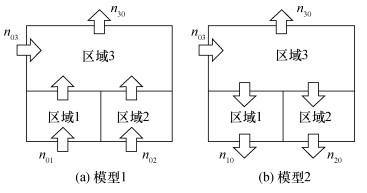
住宅一般包含多个使用功能不同的房间如客厅、卧室、卫生间和厨房等,外门和外窗是住宅房间与室外的空气流动通道,内门是房间之间的空气流动通道,由此构成了住宅多区域的空气流动。从净流量的角度,可认为各个时刻通过空气流动通道只有单一流向的气流。为表述方便,根据空气流动通道的数量对住宅房间进行分类,将仅具有2个空气流动通道(包括1个进口和1个出口)的房间定义为Ⅰ类房间,具有2个以上空气流动通道的房间定义为Ⅱ类房间。这样,住宅的卧室为Ⅰ类房间,客厅为Ⅱ类房间。Ⅰ类房间之间不存在直接的空气交换,可能的空气交换需以Ⅱ类房间为媒介来间接发生。进一步,为简化计算,将外窗始终开启的厨房和卫生间视为室外;对于没有外窗的卫生间或者外窗常处于关闭状态的厨房和卫生间,由于这2类房间的面积相对较小,可以与客厅视为一整个房间。
本文仅以人体释放CO2作为单一示踪气体,因此,并不能根据CO2体积分数直接判断某个区域的CO2气体的来源,相应也无法判定空气流向。对此,需要基于各态遍历思路,分析所有可能的空气流动模型,并尝试根据计算结果判断空气流动方向。假设某住宅包含N个房间,其中,第1至第(N-1)的卧室房间为Ⅰ类房间,第N的客厅房间为Ⅱ类房间。这样,该住宅客厅与室外以及室内其他区域相通的空气流动通道数量为(N+1)个,对此进行排列组合可以得到2N+1种空气流动模型,包含了所有可能的空气流动情况。
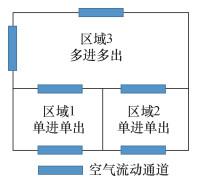
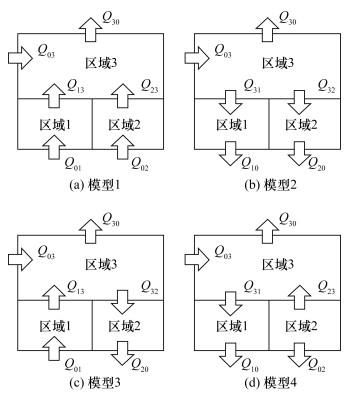
1.2 多区域空气流动平衡方程
仍以两室一厅住宅为例,针对图 2的4种空气流动模型,建立各区域的CO2质量守恒和空气质量守恒方程,以空气流动模型1为例,其方程式如下:
其中:Vi表示区域i的空间体积,m3;Ci表示区域i的CO2体积分数,10-6;C0表示室外CO2体积分数,10-6;Ei表示区域i内的人体CO2释放率,m3/h;Qij的单位为m3/h。
人体CO2释放率为[10]
其中:RQ为呼吸熵,一般设定为0.83;h为人体身高;m为人体体重;M为人体的新陈代谢率,1 met为58.2 W/m2。
1.3 多区域通风换气量仿真计算流程
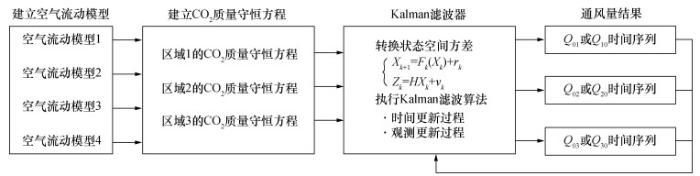
本文提出的多区域动态自然通风换气量仿真计算所遵循的原则是各区域的CO2示踪气体质量守恒和空气质量守恒。这样,某区域的通风量计算结果若为负值,则意味着所设定的空气流动方向与实际情况相反,由此排除不符合实际的空气流动模型,并同时确定出测试期间合适的空气流动模型和对应的通风换气量。
CO2示踪气体法的应用和计算容易受到噪声的干扰。一是因为CO2体积分数的测量容易受到测量仪器自身误差的影响;二是因为房间占用率的确定和人体CO2释放率的计算也存在误差。上述误差因素均会导致通风换气量仿真计算结果的偏差,在示踪气体法实施和计算过程中应将这些噪声因素考虑在内。
本文在针对单个区域通风换气量的仿真计算时引入Kalman滤波法,以有效滤除CO2体积分数测量和人体CO2释放速率估计的噪声影响。首先将各空气流动模型中每个区域的CO2质量守恒方程转化为适用于Kalman滤波算法的状态空间方程;进而以10 min的时间间隔为区间进行积分,得到扩展Kalman滤波的离散形式,以有效处理CO2体积分数、CO2释放率和通风换气量随时间动态变化所带来的非线性问题;最后通过时间更新和观测更新2个阶段,构成Kalman滤波器的完整计算过程,并以此计算获得连续时间间隔内3个区域的通风换气量。Kalman滤波法详细的分析计算过程参见文[6]。
Kalman滤波法的实际应用场景仍相对较少,因此,该方法针对实际住宅的适用性和可靠性还需要进一步的实验验证和应用评价。
2 仿真计算方法的实验验证
2.1 实验设置
为了进一步检验本文提出方法的可靠性,选取北京某无人居住的两室一厅住宅进行实验验证研究。在实验过程中,将厨房门完全密封,由此可不考虑厨房与客厅之间的通风换气;同时始终开启卫生间内门,鉴于卫生间面积较小,可将卫生间与客厅视为一个房间。这样,可将该住宅的房间数量简化为3个,同样将主卧定义为区域1,次卧定义为区域2,客厅定义为区域3。这3个区域体积分别为40.8、32.5和72.0 m3。
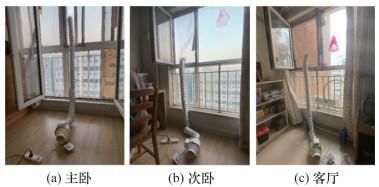
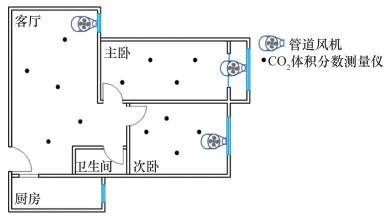
采用3台可变风量和方向的管道风机(最大风量为228 m3/h,精度为3%)来控制区域间的空气流动方向和风量,并以此作为仿真计算结果的对比基准。实验前,首先采用风量罩测量了管道风机各个档位的风量;然后在3个区域各放置1台管道风机,打开各个房间外窗的活动窗扇,再利用硬质塑料板覆盖窗口,使用胶带固定塑料板并密封外窗与塑料板的缝隙,在塑料板上开洞与管道风机相连,同样用胶带密封塑料板与管道的缝隙,管道风机与外窗之间的连接如图 4所示。外窗的其余缝隙同样使用胶带密封,但入户门的缝隙不做密封处理,这使得区域3可以通过入户门的缝隙与室外进行空气交换。这样,该住宅在实验过程中存在4个空气流动通道与室外进行空气交换,包括3个区域的外窗以及入户门缝隙。通过3个外窗的风量和空气流动方向由3个管道风机控制,通过入户门缝隙的风量和空气流动方向根据住宅的空气质量守恒计算得到。管道风机安装完毕后,实验操作人员在测试过程中调整风机风量和风向,以控制各区域之间以及区域与室外的空气流动方向和通风换气量,进而转换该住宅的空气流动模型。实验操作人员同时作为室内CO2释放源,人体CO2释放率可通过对各自身高和体重的测量而计算获得。通过TJHY-WEZY-1CO2体积分数记录仪(量程为5 000×10-6,精度为50×10-6),采用最新版的室内空气质量标准(GB/T 18883—2022)推荐的10 min的时间间隔[11],实时监测记录3个区域内的CO2体积分数,具体布置位置如图 5所示。
2.2 实验工况
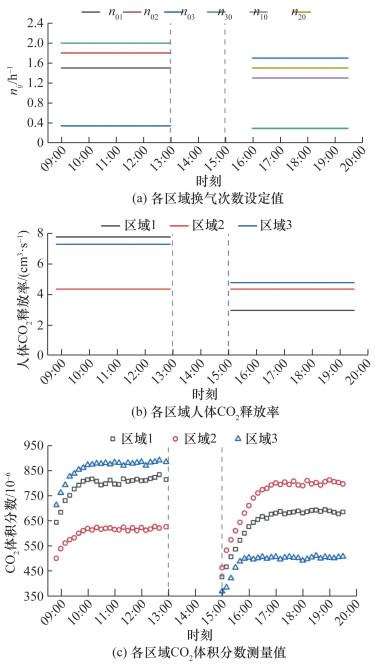
实验工况的设置应尽量涵盖空气流动模型、室内人员CO2释放率以及房间通风换气量的影响。本文将实验分为3个阶段,包括对应空气流动模型1的阶段1(9:00至13:00)、房间空置且风机关闭的阶段2(13:00至15:00)及对应空气流动模型2的阶段3(15:00至19:30),空气流动模型见图 6。为便于对比分析各区域的通风状况,使用nij表示由区域i流向区域j的通风换气量对应的换气次数,nij=Qij/Vi。
2.3 实验误差分析
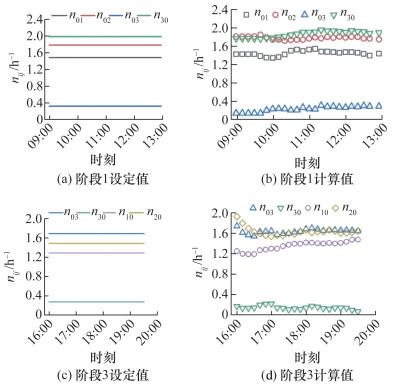
换气次数计算结果误差的分布情况如图 9所示。可以看出,绝对误差分布在±0.2 h-1范围内的占比达到85%左右,在±0.4 h-1范围内的数据量达到95%以上;相对误差在±10%以内的数据量达到75%以上,在±20%以内的数据量达到95%。
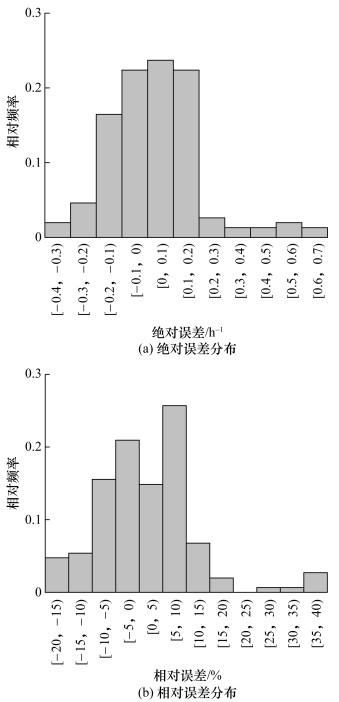
以上误差分析表明,本文提出的方法是可靠的,可有效反映测试住宅中各区域与室外及相邻区域间的通风换气量。
3 仿真计算方法的应用评价
相比实际环境的随机性和动态性,开展实验验证研究的受控环境重复单调。因此,还需要针对实际住宅从计算过程和计算结果两方面评价该方法在工程实际中的适用性。
对此,选择实际居住住宅进行各区域CO2体积分数和人员占用的现场测试和问卷调查,应用本文提出的仿真计算方法计算该住宅的多区域动态自然通风换气量。该住宅的户型为两室一厅,测试期间,厨房的内门常闭,外窗常开,且人员占用时间较短,所以不考虑客厅与厨房的空气交换;卫生间没有外窗,并且其内门常开,可将卫生间视为客厅的一部分。
现场测试的时间分别为2022年的3月12日,3月18日,3月25日,3月30日和4月6日,每次测试从17:00开始,持续24 h至次日17:00。测试期间以10 min为时间间隔实时测量并记录卧室和客厅的CO2体积分数。同时,通过每日发放的调查问卷获得各房间人员占用的实时变化情况,进而结合由居住者身高和体重所决定的CO2释放率确定测试期间各房间CO2释放率的时间序列数据。
该住宅所有可能的空气流动模型仍如图 2所示。针对这4种空气流动模型,以各区域的CO2体积分数时间序列和人体CO2释放率时间序列数据作为输入参数,采用本文提出的仿真计算方法,分别计算得到住宅各区域与室外以及区域之间的通风换气次数。然后对4种空气流动模型下的换气次数计算结果逐一进行筛选判断,发现存在换气次数计算结果为负值或发散的情况。由于本文提出方法的原理是各区域的CO2质量守恒和空气质量守恒,当换气次数计算结果为负值时,表明此时所分析空气流动模型的设定方向与实际空气流动方向不符,由此可以排除对应的空气流动模型及通风换气次数计算结果。对发散的通风换气次数计算结果及所对应的空气流动模型也加以排除。经过上述的筛选后,最后对住宅各个区域得到收敛且为正值的换气次数时间序列数据,如图 10—12所示。其中,图 10通风换气次数时间序列中n01和n10的交替表示通过区域1通道的空气流动方向的更替,如从某个时刻的空气流动模型1更替为下个时刻的空气流动模型2;图 11的结果与此类似。图 12中区域3的2个通道的通风换气次数的时间序列不存在交替,这是因为这2个通道的空气流动方向在4个空气流动模型中的设定保持不变。
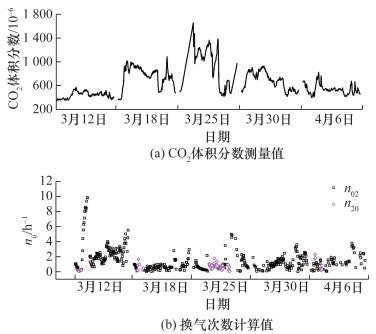
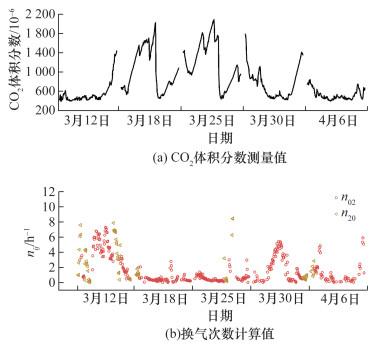
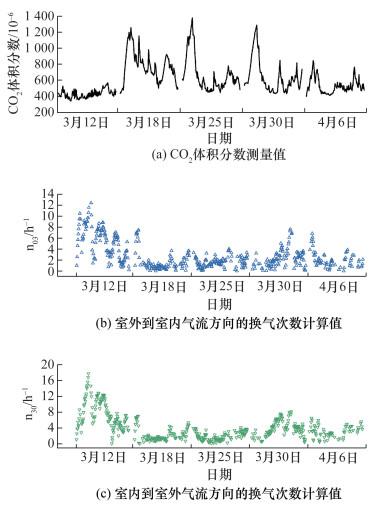
上述结果完整刻画出实际居住住宅自然通风的多区域和动态流动状况,说明了本文提出方法比现有的通风测量方法更适合评价实际居住住宅的自然通风换气状况。
4 结论
本文提出了一种用于确定住宅多区域动态自然通风换气量的仿真计算方法。该方法以人体释放CO2为示踪气体,由此保证使用的方便快捷性。进一步,在各态遍历的基础上计算确定最合适的多区域空气流动模型,可以准确刻画住宅自然通风的多区域流动状况。同时对各个区域的CO2瞬态质量守恒方程实施Kalman滤波法,有效滤除室内CO2体积分数的测量误差和人体CO2释放率的估计偏差,以此实现对住宅动态自然通风换气的合理跟踪。通过在可控风量和气流方向的实验环境中的实测分析,验证了该方法对住宅多区域通风换气预测的可靠性。进而针对实际住宅,应用该方法计算多区域自然通风换气量,评价了其在工程实际中的适用性。
该方法为住宅自然通风换气状况研究提供了新的思路和方法基础,有助于住宅室内环境的准确预测和住宅室内环境健康状况的合理评价。


