

针对高压细水雾的抑灭火有效性及关键影响参数,国内外学者开展了一些研究。Liu等[7]分析了喷雾压力和温度对细水雾抑制油池火的影响,发现20 ℃细水雾在中高压条件下灭火效果更佳。Lu等[8]通过对比研究含添加剂细水雾对汽油、柴油和变压器油等典型池火的灭火效果,发现添加添加剂可显著提高细水雾的灭火性能。Liu等[9]分析了细水雾扑灭池火的灭火过程、火焰温度分布,发现其灭火机理和过程以及所需的细水雾特性会随着火灾类型而变化。周洋等[10]搭建小型有限空间,分析了开口大小对有限空间内细水雾灭火有效性的影响。杨文涛等[11]采用灰色关联分析构建变压器油池火灭火有效性评估模型,发现细水雾具有较好的灭火效果。陈勇[12]开展了利用氮气-高压细水雾抑制汽油燃烧的实验研究,发现细水雾对汽油火的燃烧具有较强的抑制作用。梁天水等[13]针对典型的液体燃料油池火,分析了铁基添加剂的灭火机理,发现二茂铁与硫酸亚铁的质量分数分别为0.01%和1%时,灭火效果最好。蔡昕[14]通过模拟实验和理论分析,研究了高海拔低气压条件对细水雾基本特性的影响、环境压力对可燃物燃烧的影响、低气压条件下细水雾与火焰作用规律。房玉东等[15]研究了有障碍物存在的情况下细水雾抑制并熄灭油池火的有效性,验证了火焰区雾通量的提高有助于灭火。可见,细水雾扑灭液体燃料火灾效果明显;但以上研究主要基于开放空间或者中小尺寸有限空间开展灭火实验,而针对大尺度有限空间液体燃料火灾的细水雾灭火实验相对较少。此外,已有研究很少关注油品类型与细水雾流量对灭火有效性的影响,并且针对高压细水雾在扑灭油池火时油品温度和有限空间壁面温度参数变化规律的分析也较少。
本文通过搭建大尺寸有限空间高压细水雾灭火实验平台,开展了以变压器油和汽油为代表的典型液体燃料火灾灭火实验,分析了细水雾雾通量、灭火过程、特征温度等参数的变化规律,验证高压细水雾扑灭有限空间典型液体燃料火灾的有效性。
1 实验设计及工况
1.1 实验平台
为了准确还原实际仓库、厂房等有限空间场景的真实情况,探究高压细水雾灭火的有效性,搭建了全尺寸有限空间火灾场景高压细水雾灭火实验平台。实验场景布置如图 1a所示。实验空间包括空间整体、出入口、百叶窗、观察窗等。实验空间的长宽高为9 m×9 m×6.5 m,墙壁与顶棚均采用岩棉夹芯板,以起到良好的隔热作用;中心位置使用防火玻璃设置观察窗,观察窗距离地面高50 cm,长和宽均为2 m,用于观察和展示内部火焰形态;在实验空间的正面设置2个百叶窗,长1.5 m,宽1 m,在点火前使用防火板进行封堵,用于模拟真实火灾发生后百叶窗封闭的场景;在空间顶部与底部分别安置红外摄像机与水冷摄像机,用于观察火焰形态,计算明火熄灭时间。另外,设置长宽高为2.1 m×0.5 m×0.1 m的矩形油池,布置在壁面前侧;分别在油池内部(间隔1 cm)、壁面(间隔50 cm)以及油池上部(间隔20 cm)布置热电偶,用于监测实验过程中油品温度、壁面温度以及火羽流温度等参数的变化。
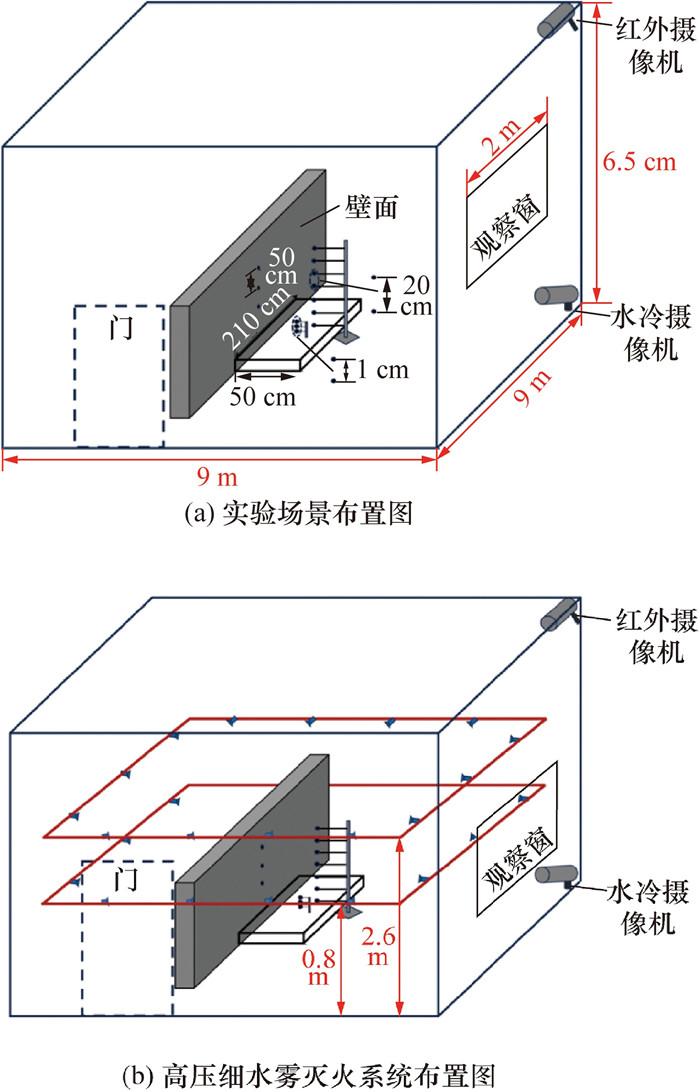
高压细水雾灭火系统布置如图 1b所示。高压细水雾喷头工作压力为10 MPa,单位面积细水雾流量应大于1.2 L/(min·m2)。高压细水雾灭火系统管网采用环形供水方式,进水管路采用耐高温不锈钢管制作。细水雾喷头分2层布置,第1层布置在0.8 m高度处,第2层布置在2.6 m高度处,每层布置14个喷头。
1.2 实验步骤及工况设计
本文以变压器油与汽油作为燃料油品。实验开始前进行细水雾冷喷测试,确保系统正常工作;同时,检查点火装置、数据采集装置运行状态。准备工作完成后,向实验油池内倒入KI25X变压器油或汽油,厚度2 cm,其中以正庚烷作为变压器油的引燃剂(正庚烷用量为200 mL/m2)。利用电子点火装置点燃实验油池,变压器油预燃90 s,汽油预燃30 s,然后开启细水雾系统进行灭火,观察并记录灭火过程及关键参数。汽油预燃时间较短主要是由于与变压器油相比,汽油挥发性较强,火灾发展更加迅速;现有研究表明,汽油预燃30 s便可达到稳定燃烧[16]。
设置112、224 L/min两种细水雾流量,共设计6个实验工况,见表 1。
表 1 实验工况 |
| 工况 | 细水雾流量/(L·min-1) | 油品类型 | 油品厚度/cm |
| 1 | 112 | 冷喷(无油) | |
| 2 | 224 | 冷喷(无油) | |
| 3 | 112 | 变压器油 | 2 |
| 4 | 224 | 变压器油 | 2 |
| 5 | 112 | 汽油 | 2 |
| 6 | 224 | 汽油 | 2 |
2 实验结果与讨论
2.1 冷喷结果分析
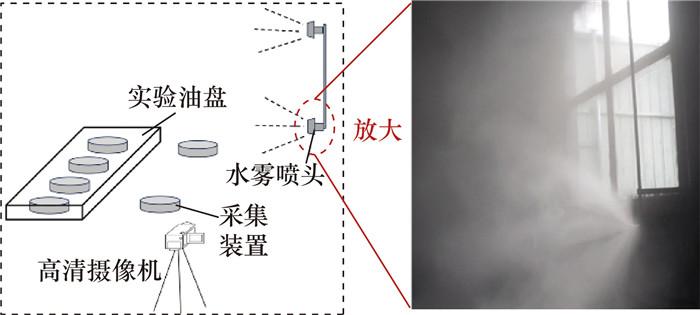
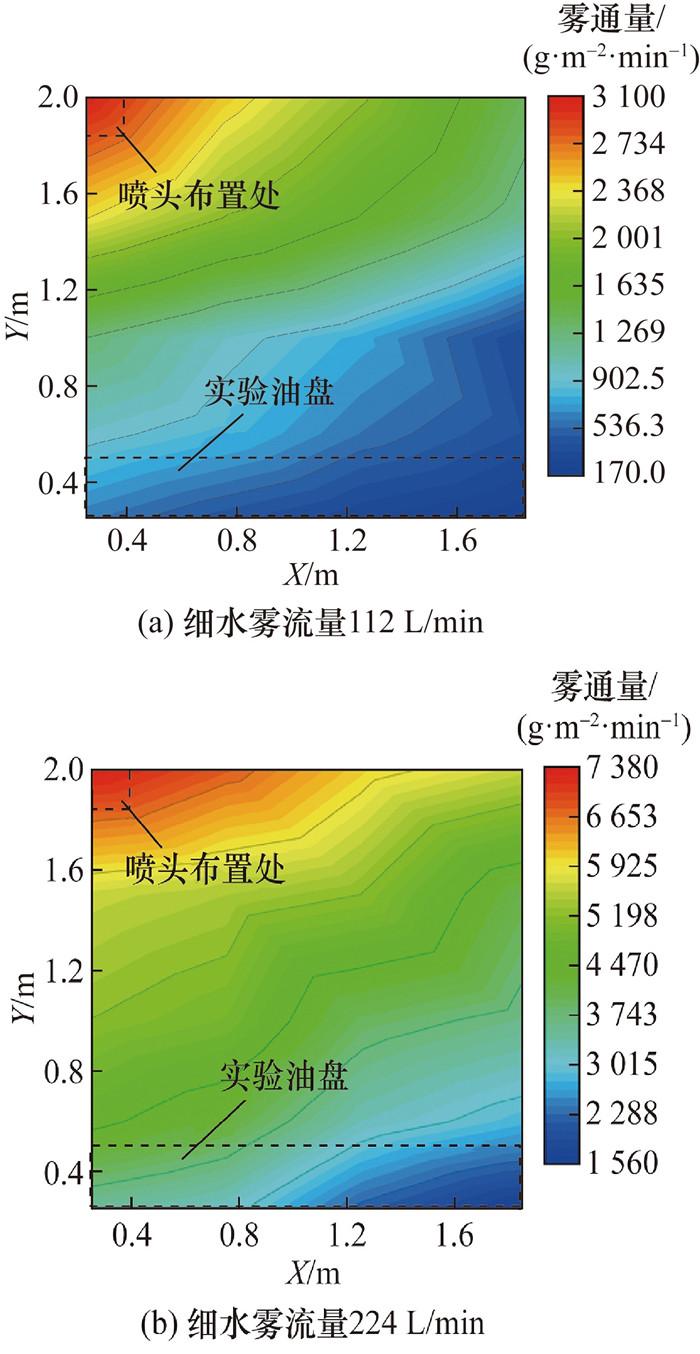
2.2 灭火过程与灭火时间
2.2.1 灭火过程分析
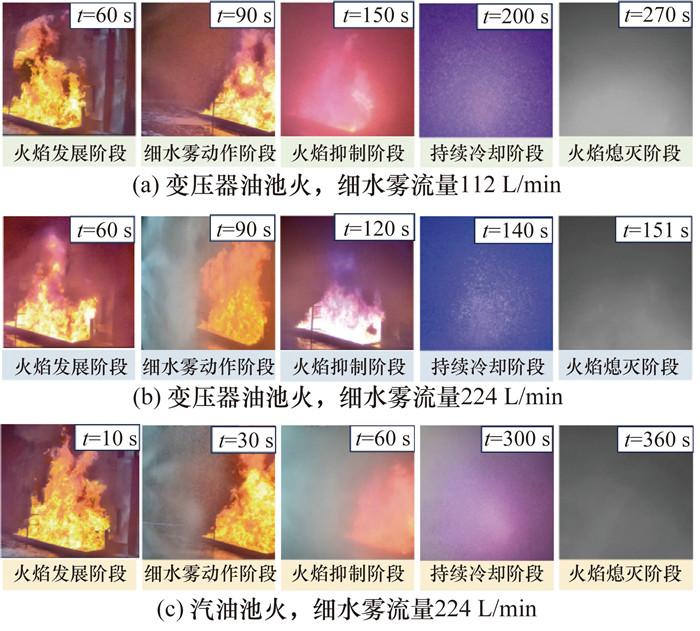
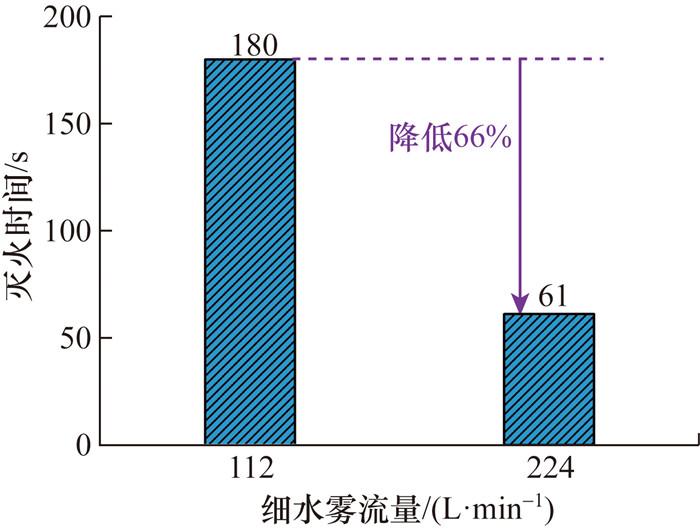
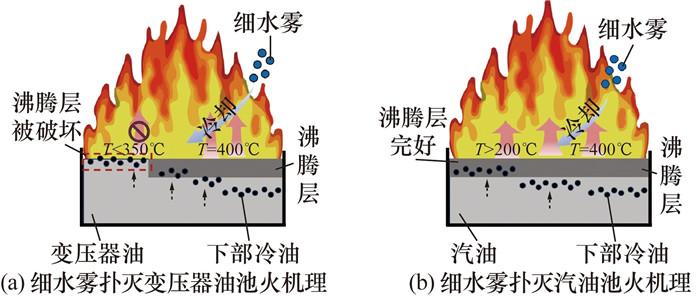
图 4为不同流量细水雾扑灭不同油品火灾过程。整个灭火过程可以分为细水雾动作阶段、火焰抑制阶段、持续冷却阶段及火焰熄灭阶段。在细水雾动作阶段,当雾滴刚接触到燃烧表面时,出现明显的火焰强化现象,且细水雾流量越大,火焰强化现象越剧烈。这主要是因为细水雾的扰动增大了湍流强度,加剧了燃料与空气的混合[18]。在火焰抑制阶段,随着细水雾的持续作用,火焰高度与燃烧面积不断减小,汽油池火的火焰高度下降速率明显低于变压器油池火。在持续冷却阶段,雾滴充满整个空间,燃烧强度持续降低,其下降速率与细水雾流量、油品种类有关。例如,当细水雾流量112 L/min时,变压器油池火熄灭所需时间为180 s。这是由于细水雾流量会直接影响雾场情况,根据冷喷和灭火实验结果,细水雾流量低,作用于保护区域的雾通量小,细水雾冷却、窒息效果减弱,灭火时间延长[19]。在火焰熄灭阶段,明火消失,通过持续喷射细水雾对燃烧区域、有限空间壁面冷却降温,防止火灾复燃。
2.2.2 灭火时间分析
2.3 特征温度分析
2.3.1 火羽流温度分析
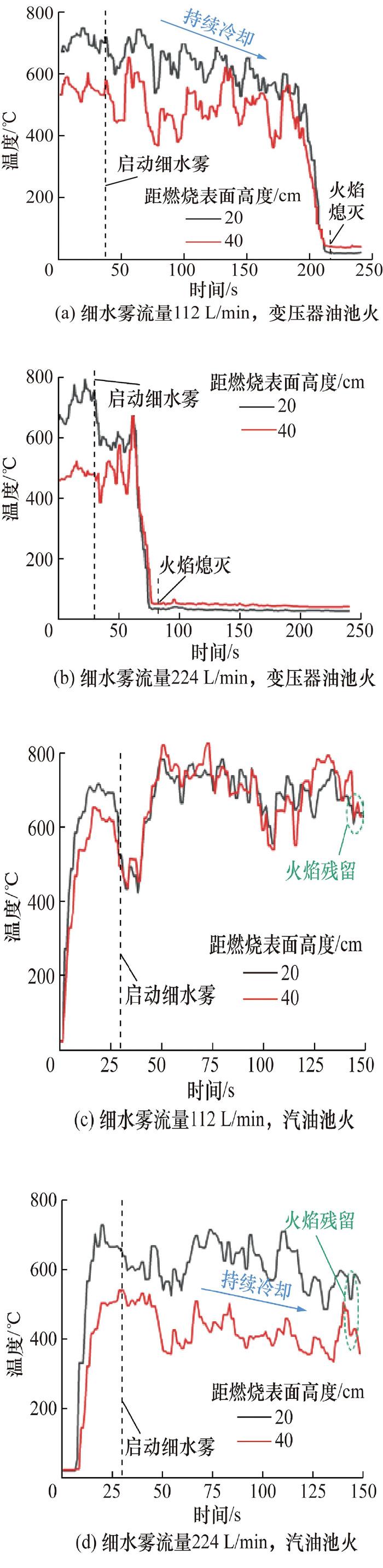
图 7为不同工况下的火羽流温度变化曲线。预燃一段时间后,燃烧达到稳定,火羽流温度最高可达750 ℃。细水雾作用于火焰会抑制燃烧,火羽流高度下降,温度明显降低。例如,图 7a中启动喷雾后稳定阶段温度为650 ℃,这主要是由于雾滴的蒸发吸热降温所致。同时,细水雾会影响火焰卷吸,造成火焰扰动,火羽流温度呈现波动性。对比图 7a和7b中不同流量细水雾作用下变压器油池火的火羽流温度的变化,可以发现细水雾流量与对火焰的抑制效果呈正相关。当细水雾流量为112 L/min时,细水雾动作170 s后,火焰温度仍可达到500 ℃;而当细水雾流量为224 L/min时,细水雾动作61 s后,火焰已经熄灭,燃烧表面上方40 cm处的温度已降低至30 ℃。
2.3.2 油品温度分析
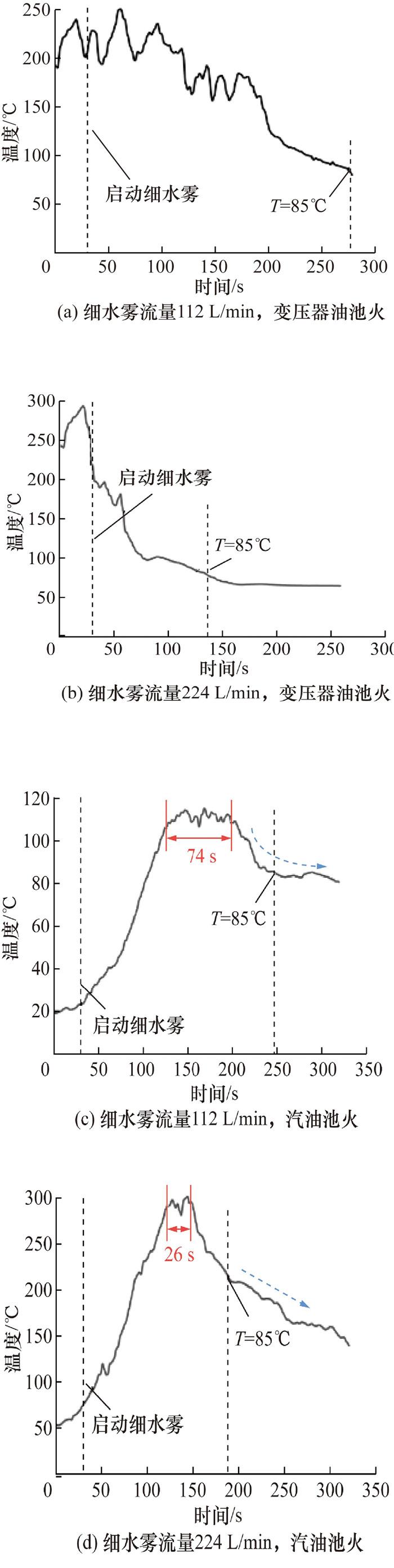
图 8为油层下方1 cm处油品温度变化曲线。图 8a和8b为细水雾不同流量下的变压器油品温度变化。对比图 8a和8b显示,细水雾冷却作用与细水雾流量成正比。当细水雾流量为112 L/min时,细水雾动作245 s后,油品温度降低至85 ℃;当细水雾流量为224 L/min时,冷却时间大幅度缩短至105 s。如图 8c和8d所示,当细水雾作用于汽油池火时,整个灭火过程中油品温度变化呈现“快速升高—逐渐稳定—缓慢下降”趋势。这主要是由于细水雾无法有效扑灭汽油池火导致的。对比流量为112 L/min与224 L/min细水雾作用下的油品温度变化发现,大流量工况下油品温度在稳定阶段保持的时间为26 s,而小流量工况下油品温度在此阶段保持的时间为74 s,保持时间缩短了48 s;此外,大流量工况下油品温度下降速率更快,呈直线下降趋势,比小流量工况提前60 s降至85 ℃。这说明增加细水雾流量能够更快地吸收油品热量,加速油品冷却。
2.3.3 壁面温度分析
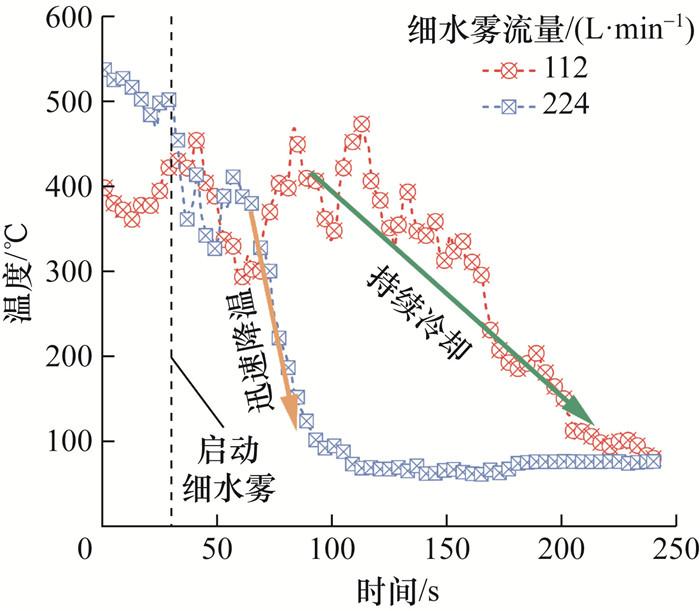
3 结论
本文通过搭建有限空间高压细水雾灭火实验平台,开展了细水雾扑灭以汽油、变压器油为代表的液体燃料池火实验和冷喷实验,分析了细水雾的雾通量、灭火过程、特征温度等变化规律,验证高压细水雾扑灭有限空间内典型液体燃料火灾的有效性。主要结论如下:
1) 高压细水雾对变压器油池火的灭火效果明显优于对汽油池火的灭火效果。对于变压器油池火,细水雾具有良好的灭火效果;对于汽油池火,细水雾仅能控制汽油火灾在有限空间内发展,细水雾持续作用于汽油池火5 min后,其燃烧面积、火焰高度和油品温度减小,但燃烧仍在继续,未能实现有效灭火。
2) 细水雾作用于保护区域的雾通量与细水雾流量呈正相关。流量为112 L/min细水雾系统的雾通量最高可达1 069 g/(m2·min),224 L/min细水雾系统的雾通量可达4 470 g/(m2·min)。
3) 不同流量的细水雾通过改变雾通量影响灭火效果,雾通量越大,灭火时间越短。与流量112 L/min细水雾相比,224 L/min细水雾扑灭变压器油池火的灭火效率提高了66%。
4) 细水雾能够实现对油品、保护对象(壁面)持续冷却,冷却效率与细水雾流量呈正相关。
根据本文研究结果,在实际工程中,可通过增加雾通量、延长细水雾动作时长等方式实现对液体燃料密集区域的重点保护。本研究为有限空间内重点区域的防火设计提供了技术参考。但是,本实验忽略了火源面积、位置和喷头布置方式等因素对细水雾灭火的影响,因此未来需进一步研究多因素耦合影响下的细水雾系统优化布置方式。


