

为探究气液两相流在管道内的流动与传热状态,国内外很多学者开展了数值模拟研究[13-18]。高雪琦[19]采用了Euler壁面模型来模拟低含液率气液两相流在管线内部的液膜形成过程,对其中气相的分布模式进行了分析与总结;吕秉坤等[20]建立了单回路液氦脉动热管的二维数值模型,基于流体体积(volume of fluid, VOF)模型,模拟了该液氦脉动热管的初始状态以及运行状态,分析了流动与传热特性;Kanizawa等[21]利用计算流体力学(computational fluid dynamics,CFD)软件发现不同制冷剂在水平管道中的换热系数随热流密度和饱和温度的增加以及管径的减小而增加。李文本等[22]用VOF模型对重力热管内两相流的流动和传热进行了数值模拟,成功再现了水蒸发和水蒸气凝结的物理过程。目前,针对低含液率气液两相流动传热的数值模拟普遍侧重于小直径和有限长度管道的研究,对于大直径且长径比较大的管道,数值模拟研究相对匮乏。
本文立足于工程实践,基于国内外液电管缆研究现状,设计了一种中心供液管外面包裹着电缆的管缆。这种设计大大提高了无人机系统在灭火时的稳定性,但电缆在边沿供电加热导致的泡沫灭火剂温升可能对灭火性能产生影响,因此本文利用Fluent数值模拟软件,对系留无人机灭火系统中泡沫灭火剂的温升开展数值模拟研究,旨在为后续液电管缆中泡沫灭火剂温升实验提供参考。
1 研究对象
在系留无人机灭火系统中,设计了一种由供液管外面包裹着38根电缆构成的液电同缆结构(直径85 mm),如图 1所示,由内至外依次为保形管、电缆导线层、填充层和保护层。最内层为保形管,内径为ϕ65 mm,外径为ϕ71 mm,用于输送泡沫灭火剂。保形管外面紧密包裹着38根横截面积为3.5 mm2的超轻航空导线,其中19根用于承载输入电流,另外19根用于承载输出电流。经实测,单根导线的100 m电阻值为0.48 Ω,输入总电流为420 A。导线之间通过填芯材料固定。最外层是保护层,由聚酯带和高强航空纤维组成。液电管缆的机械性能优异,抗拉力≥2 000 N,保形管的耐压力不小于1.5 MPa,能够在复杂工况下保持稳定的性能。
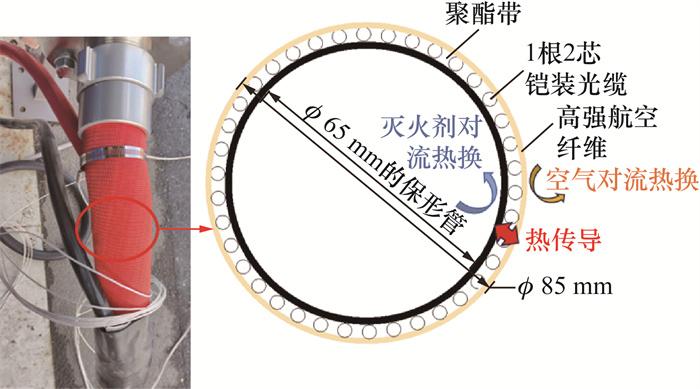
在管缆工作过程中,38根超轻航空导线在通电时会持续产生热量,导线产生的热量首先通过热传导作用传递到保形管壁,进而加热管内的泡沫灭火剂。与此同时,部分热量通过高强航空纤维和聚酯带向外传递,与周围空气发生对流换热。
2 数值模型
2.1 VOF模型
泡沫灭火剂在液电管缆内流动属于气液两相流动。VOF模型适用于管内气相与液相界面明确的流动。压力基求解器采用表面追踪方式,可以通过求解一组动量方程并跟踪整个区域内的每种流体的体积分数来模拟两种或多种不混相流体。对于添加到模型中每个附加相,VOF模型都会引入一个变量,计算该相的体积分数。在每个控制单元中,所有相的体积分数之和为1。αl表示某种流体的体积分数,则存在以下3种情况:1) αl=0,单元格里充满其他流体;2) αl=1,单元格里充满该流体;3) 0 < αl < 1,单元格里包含该流体与1种或多种其他流体之间的界面。
VOF模型通过求解1个(或多个)相的体积分数的连续性方程来跟踪相之间的界面。本文模拟只涉及气液两相,故方程为:
式中:α为体积分数,ρ为流体的密度,u为流体的速度矢量,t为时间;下标l代表液体,下标v代表气体。
基本控制方程主要包括:
连续性方程为
动量守恒方程为
在式(5)中:等式左侧为非稳态项和对流项;F为表面张力产生的动量源项;S为动量方程源项;μ为单元内流体的平均动力黏度;$ \nabla \mu\left[\nabla \boldsymbol{u}+(\nabla \boldsymbol{u})^{\mathrm{T}}\right]$ 为黏性力应力,g为重力加速度,p为压力。
2.2 湍流模型
湍流动能k输运方程为
湍流耗散率ε输运方程为
式中:Gk表示由平均速度梯度引起的湍流动能;Gb为浮力产生的湍流动能;Ym为可压缩湍流中波动膨胀对总耗散率的贡献;C1ε、C2ε、C2ε、Cμ为经验常数;σk、σε分别为k和ε的湍流Prandtl数(无因次数);ui、uj分别表示x、y、z方向的速度分量;xi、xj分别表示x、y、z方向坐标,i,j=1, 2, 3;μt为湍流黏度。
2.3 传热模型
本文的气液两相流的计算采用压力基求解器求解能量方程。在解不可压缩流时,默认设置中不包括压力功或动能,故传热能量方程为
式中:λ为导热系数;T为温度;H为单位体积的焓,可以表示为显热和潜热之和,
显热h与温度T之间的关系为
其中:hs, ref是在参考温度Tref下的显热,cp是常压下的比热容。
由于本文模拟不涉及相变,故最终的能量方程为
2.4 几何模型
本研究的背景是在系留无人机灭火系统中,设计一种中心供液管外面包裹着38根电缆的管缆。电缆在通电过程中,会产生连续的加热效应,其中一部分热量通过管壁传递给保形管内部的泡沫灭火剂,而另一部分则通过高强航空纤维和聚酯带传递给周围空气。已有关于地下电缆的热分析研究[5, 24]通常对复杂的介质非均匀性和边界条件进行简化,认为电缆的热量传递主要集中在导体与冷却介质之间的热传导。由于电缆通电加热过程中多个参数无法准确地确定,因此本文对导线自身温升、导线与空气对流换热以及与高强航空纤维和聚酯带、保形管等材料之间的热传导所引起的热量损失进行了粗略的理论估算,结果表明这些热量损失在总热量中占比较小,低于15%。同时,由于无法准确地确定电缆热量实际传递给泡沫灭火剂和空气的比例,因此本文假设所有38根导线产生的热量完全用于加热供液管中的泡沫灭火剂。这种假设忽略了导线自身温升、导线与空气对流换热以及与高强航空纤维和聚酯带、保形管等材料之间的热传导所引起的热量损失。
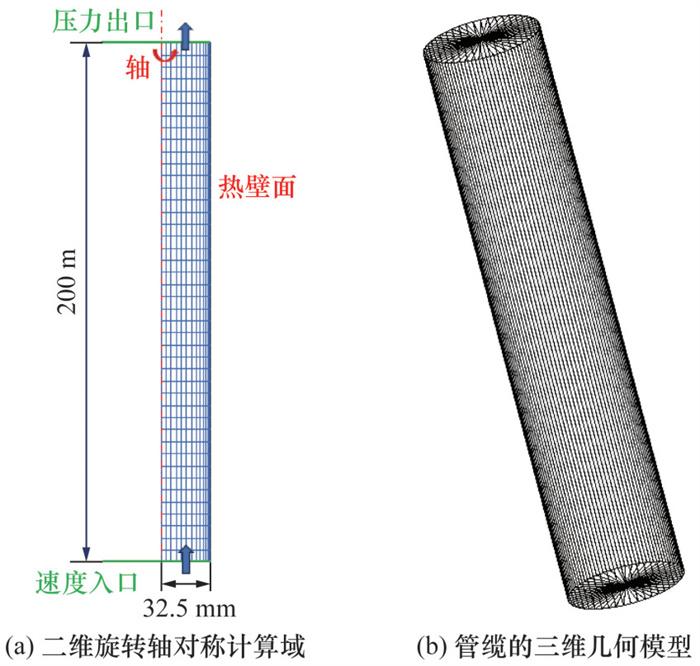
在ICEM软件中对管缆进行结构化网格划分。为检查网格的独立性,对一根200 m长的管缆分别采用26、52和104万个网格模拟管缆出口处泡沫灭火剂的温升,利用Quality方法检查网格质量,结果表明网格质量良好。模拟结果显示,采用26万个网格与采用52万个和104万个网格来模拟管缆出口处泡沫灭火剂的温升,误差都很小,因此在后续研究中选择26万个网格。
2.5 求解器设置与边界条件
本文模拟采用的泡沫灭火剂的具体物性参数如表 1所示。灭火剂发泡的气体体积为85%,液体体积为15%。由于泡沫灭火剂的含气率较高,需要考虑其流动状态。Mach数用于表征流体的可压缩程度:Ma≥0.3,则流体密度变化不可忽略,属于可压缩流动;而Ma < 0.3,属于不可压缩流动。本文模拟工况是在标准大气压、26.8 ℃下,当地声速c=343 m/s,根据公式Ma=v/c,管内泡沫灭火剂的Ma均小于0.3,故泡沫灭火剂的流动属于不可压缩流动,因此选择压力基求解器。
表 1 泡沫灭火剂物性参数 |
| 黏度/(Pa·s) | 密度/(kg·m-3) | 定压比热容/(kJ·kg·℃-1) | 表面张力/(N·m-1) | 沸点/℃ |
| 0.928 | 990 | 4.59 | 0.009 28 | 100.5 |
压力基求解器提供4种压力-速度耦合算法。本文选取通常用于瞬态计算的PISO算法,该算法允许使用较大的时间步长。以气相为主相、液相为次相;时间步长取0.01。采用隐式算法提高收敛性。空间离散中,梯度选择Least Squares Cell Based,压力选择PRESTO,动量、湍流动能和湍流耗散率分别为一阶迎风格式,能量选择二阶迎风格式。亚松弛因子采用默认设置。
管缆中的流体初始温度均为26.85 ℃,设置入口为速度入口,出口为自由出口,出口压力为标准大气压,管缆壁面设置为无滑移边界。由于无法确定电缆热量具体传递给泡沫灭火剂和空气的比例,故假定导线产生的热量都传递给管壁,并忽略管壁热阻,则可以将管壁设置为定热流密度边界条件。已知输入总电流为420 A,根据电流分配原理,单根导线承载电流为22.1 A。基于Joule定律P=I2R,结合单根导线的实测100 m电阻值0.48 Ω,可计算出单根导线单位长度(L= 1 m)的发热功率为2.344 W。因此,38根导线单位长度的总热功率为Pt =89.072 W。根据保形管内径ϕ= 65 mm,可计算出电缆与保形管间单位长度上的传热面积S= πϕL = 0.204 m2,进而得到单位面积热流密度q=Pt /S= 436 W/m2。
3 结果与讨论
3.1 泡沫灭火剂流动与传热过程
在标准大气压下,针对含气率为85%的泡沫灭火剂,开展泡沫灭火剂在管缆内温升的数值模拟。初始状态管内无液体,初始温度为26.85 ℃,流量为300 L/min,壁面固定热流密度为436 W/m2,管缆长度为200 m。本节以上述工况为例,基于计算结果对管缆的相场、速度场和管缆典型位置泡沫灭火剂的温升等进行分析。
为模拟气液两相在入口处混合流动的过程,将入口边界设为10个速度入口。对于泡沫灭火剂的流动,本文只关注入口处和出口处的流动状态,因此分别截取入口和出口0.5 m长的管段作为示意,如图 3所示。在初始时刻(t=1 s),气液两相冲进管内,在入口处0~0.2 m段,泡沫灭火剂处于混合过程中,0.2 m以后达到均匀混合状态。在初始时刻,由于泡沫灭火剂还未到达出口处,因此出口处199.5~200 m段内充满空气。在稳定时刻(t=134 s),泡沫灭火剂充满整个管缆,在入口处0~0.2 m段,由于初始边界的设置仍处于气液两相的混合过程;而在出口处199.5~200 m段,泡沫灭火剂气液两相已充分混合。
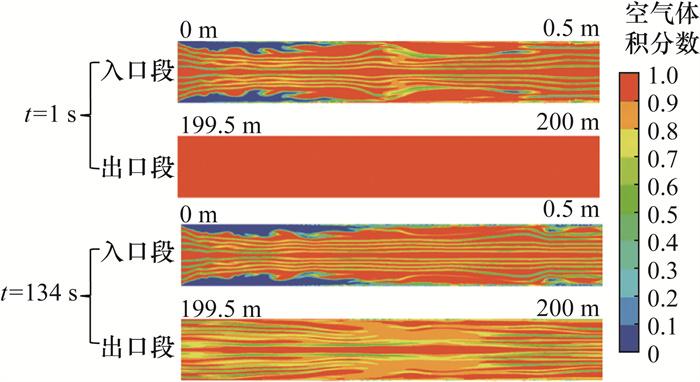
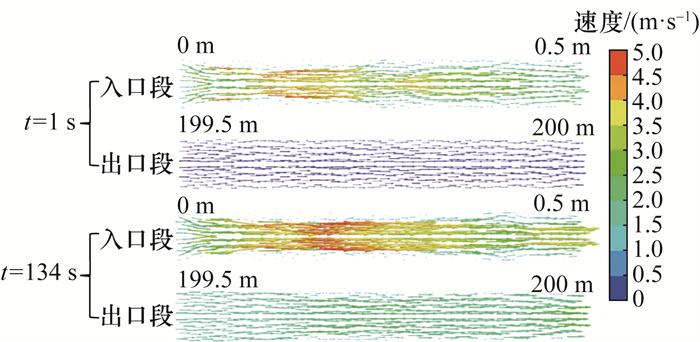
图 4是管缆入口处、出口处的速度矢量图。在黏性力的作用下,壁面附近形成速度梯度明显的边界层,速度呈现出从管缆中心向边缘递减的趋势。在初始时刻(t=1 s),管缆入口0~0.2 m段泡沫灭火剂处于混合过程,在0.2 m左右处达到速度最大值,泡沫灭火剂气液两相混合得较为充分,由于泡沫灭火剂还未达到出口,因此出口处速度为零。在稳定时刻(t=134 s),入口不断地有泡沫灭火剂进入,在入口段泡沫灭火剂总处于气液两相混合的过程中,新的泡沫灭火剂推动着管内的泡沫灭火剂,在0.5 m左右处速度才达到稳定值。由于出口边界为大气边界,因此出口段的速度略微增加。
选取5个典型时刻(10、25、75、100、125、150 s)和5个典型位置(25、50、100、150、200 m)研究管内泡沫灭火剂的温升。图 5展示不同时刻下不同位置的温升。在25 s前整个管道的温升不明显,整个管道温升不超过2 ℃,在25~75 s中,管缆25 m之后的位置开始出现明显温升,且管缆越长,泡沫灭火剂的温升越高。根据泡沫灭火剂的流量为300 L/min推算,在75 s时,泡沫灭火剂已达到管缆中间100 m处,100 m之前管缆的温度均保持稳定不再上升;在134 s时,整个管缆充满泡沫灭火剂,达到稳定状态,管缆的温度不再上升并开始保持稳定。
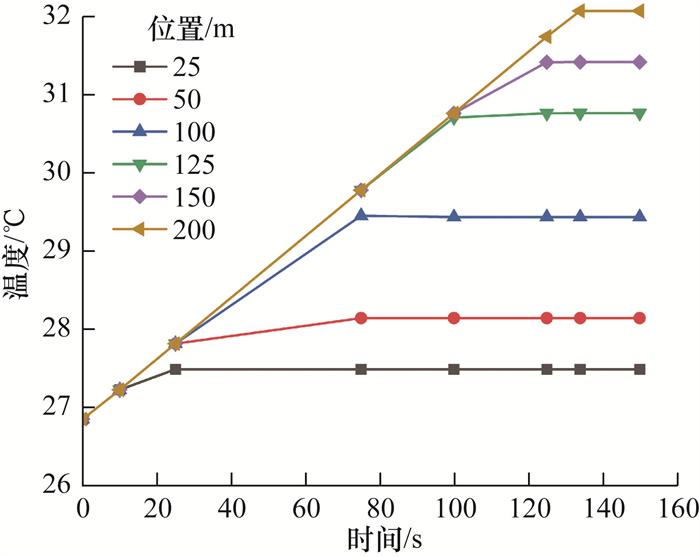
综上,在灭火剂填充供液管之前,管内充满空气,而由于电缆的持续加热,管内空气的温度会逐渐升高。当灭火剂向上流动并填充至某一位置时,该位置泡沫灭火剂的温度会在快速上升后达到稳定状态,并在后续的流动与传热过程中保持不变。并且,随着管缆长度的增加,泡沫灭火剂的温升增加,整个管缆内泡沫灭火剂的温度沿管缆轴向呈现线性递增的趋势。
3.2 管内输送流量对泡沫灭火剂温升的影响
本节针对泡沫灭火剂的4种不同输送流量(100、200、300、400 L/min)开展了泡沫灭火剂温升的数值模拟。管缆长度为200 m,固定热流密度为436 W/m2。由于管缆较长,因此选取管缆中3段典型位置研究其温度分布,分别为0~0.5、100~100.5、199.5~200 m,下文将这3段分别称为入口段、中间段、出口段。
如图 6所示,在100 L/min流量条件下,入口段泡沫灭火剂的温度变化很小,一直保持在初始条件26.85 ℃左右,200、300、400 L/min也是如此。在中间段,100 L/min流量条件下的管缆温度出现明显上升,如图 7a所示,温度上升8 ℃左右;对于200和300 L/min流量条件下的中间段,温升有所减小,分别上升了3.7和2.7 ℃左右,而400 L/min 流量条件下的中间段温度几乎不变。在出口段中,4种输送流量下泡沫灭火剂的温度在管缆中都达到了最大值,如图 7b所示。管缆出口段泡沫灭火剂的温升随泡沫灭火剂流量的增加而降低,100 L/min流量下泡沫灭火剂到达管缆出口段的温升最高,达到15 ℃左右并趋于稳定;200 L/min流量下的泡沫灭火剂温升有所降低,在6 ℃左右,400 L/min流量下的泡沫灭火剂温升最低。
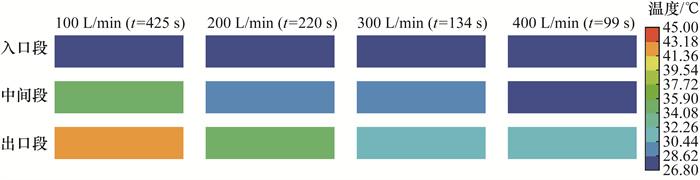
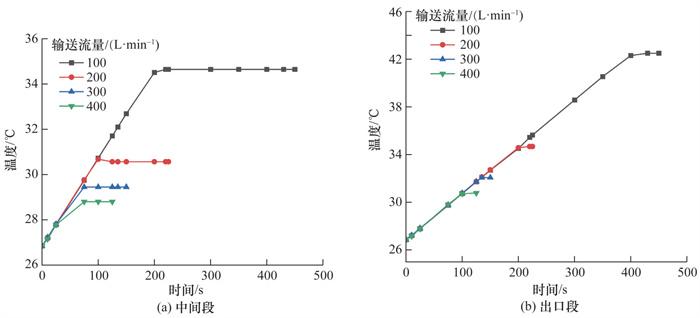
综上,在相同的管缆长度下,随着输送流量的增加,泡沫灭火剂会更快到达管缆出口段,并且管缆出口泡沫灭火剂的温度也更快趋于稳定,因此输送流量越大,管缆出口泡沫灭火剂的温升越低。
3.3 电缆载流量对泡沫灭火剂温升的影响
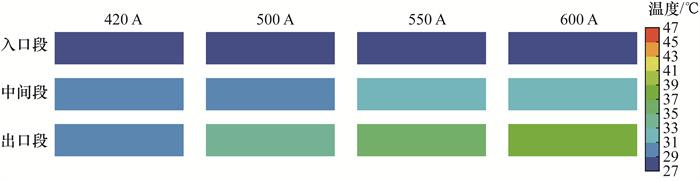
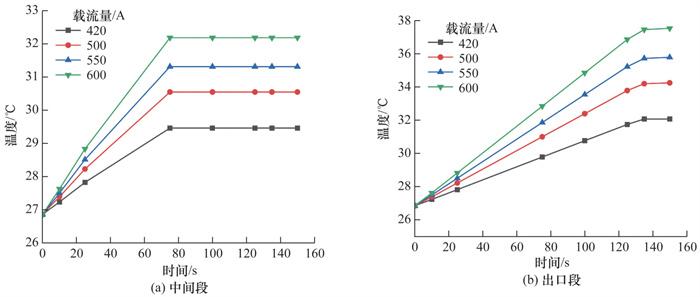
本节针对电缆不同载流量(420、500、550、600 A)下,输送流量为300 L/min、长度为200 m的管缆开展了数值模拟,本节依然选取3.2节中3段典型位置管缆研究其温度分布。
如图 8所示,4种载流量下的管缆入口段的温升几乎没有变化,保持在26.85 ℃,在管缆中间段开始出现不同程度的温升,如图 9a所示。载流量为420 A管缆中间段泡沫灭火剂的温升最小,升高了2.5 ℃左右;载流量为600 A管缆中间段泡沫灭火剂的温升最高,升高了5 ℃左右;载流量为500 A和550 A的管缆中间段泡沫灭火剂的温升分别为3.5 ℃和4 ℃左右。在75 s左右,泡沫灭火剂到达管道中间段,如图 9a所示,管缆中间段的温升在75 s左右开始稳定不再变化,此时泡沫灭火剂还未到达管缆出口段,出口段的温度一直在上升。在134 s,泡沫灭火剂到达出口,如图 9b所示,出口段温度达到稳定值,管缆出口段泡沫灭火剂的温升随电缆载流量的升高而升高。
4 结论
本文基于VOF模型和传热模型,针对泡沫灭火剂在液电管缆中的流动与传热耦合过程开展了数值模拟研究,分别模拟了4种输送流量条件(100、200、300、400 L/min)下相同电缆载流量(420 A)的管缆内泡沫灭火剂的温升情况,以及4种不同载流量的电缆(420、500、550、600 A)在相同输送流量条件(300 L/min)下的管缆内泡沫灭火剂的温升情况。
结果表明:泡沫灭火剂在管缆中流动时,在入口处的温升几乎为0,灭火剂温度沿管缆轴向由内向外呈现线性递增趋势;当灭火剂向上流动并填充至某一位置时,该位置的泡沫灭火剂会在经历快速的温度上升后达到稳定状态,并在后续过程中保持温度不变;当管缆长度和电缆载流量一定时,泡沫灭火剂的输送流量越大,泡沫灭火剂到达管缆出口时的温度越低,两者呈现负线性关系,反映了输送流量对热传递效率的直接影响;当输送流量和管缆长度一定时,电缆的载流量越大,泡沫灭火剂温升越大,两者呈现正线性关系。
根据本文模拟结果,输送流量为100 L/min时泡沫灭火剂在管缆出口处温升最高,约15 ℃;载流量为600 A时灭火剂在出口处温升最高,约为11 ℃。由此可得出结论:液电同缆设计对供液管内灭火剂产生的加热效应不会显著影响其输运效率和安全性,但对泡沫灭火剂灭火性能的具体影响仍需通过进一步实验加以探究。


