人机语音通讯

基于尖峰特征的口音识别和语音识别多任务学习方法

  • 肖素杰 1, 2 ,
  • 黎塔 , 1, 2, * ,
  • 郝锐朋 1 ,
  • 仁增多杰 3 ,
  • 赵庆卫 1, 2
展开
  • 1. 中国科学院声学研究所 语音与智能信息处理实验室,北京 100190
  • 2. 中国科学院大学,北京 100049
  • 3. 西藏大学 信息科学技术学院,拉萨 850000
黎塔,研究员,E-mail:

肖素杰(1989—),女,博士研究生

收稿日期: 2024-08-26

  网络出版日期: 2025-06-26

基金资助

新一代人工智能国家科技重大专项项目(2022ZD0116103)

版权

版权所有,未经授权,不得转载。

Multi-task learning method for accent and speech recognition based on spike features

  • Sujie XIAO 1, 2 ,
  • Ta LI , 1, 2, * ,
  • Ruipeng HAO 1 ,
  • Duojie RENZENG 3 ,
  • Qingwei ZHAO 1, 2
Expand
  • 1. Key Laboratory of Speech Acoustics and Content Understanding, Institute of Acoustics, Chinese Academy of Sciences, Beijing 100190, China
  • 2. University of Chinese Academy of Sciences, Beijing 100049, China
  • 3. School of Information Science and Technology, Tibet University, Lhasa 850000, China

Received date: 2024-08-26

  Online published: 2025-06-26

Copyright

All rights reserved. Unauthorized reproduction is prohibited.

摘要

口音是语音识别面临的主要挑战之一,为解决多口音语音识别问题,进一步探索口音识别与语音识别任务之间的相互作用,该文提出一种基于尖峰特征的口音识别和语音识别多任务学习方法。该方法首先通过共享部分编码器底层网络,利用口音信息隐式增强特定口音的声学特征,提升口音语音识别性能;其次,通过分析口音特征可发现,口音特征大部分由空白帧组成,而更能反映口音差异的有效标签帧未发挥主要作用。因此,该文在多任务学习框架下,将有效标签对应的连接主义时序分类(connectionist temporal classification,CTC)尖峰特征作为口音识别的输入特征,从而在一定程度上提升口音识别性能。在英文Common Voice和AESRC2020数据集上的试验结果表明:与直接混合所有数据训练的模型相比,该文方法在语音识别性能上分别绝对提升0.6%和1.0%;在口音识别上,基于CTC尖峰特征的口音识别性能分别绝对提升0.7%和1.9%。

本文引用格式

肖素杰 , 黎塔 , 郝锐朋 , 仁增多杰 , 赵庆卫 . 基于尖峰特征的口音识别和语音识别多任务学习方法[J]. 清华大学学报(自然科学版), 2025 , 65(7) : 1310 -1319 . DOI: 10.16511/j.cnki.qhdxxb.2025.26.029

Abstract

Objective: Accent is a significant challenge in speech recognition. To address the problem of multi accent speech recognition and further explore the interaction between accent and speech recognition tasks, this paper proposes a multi-task learning method for accent and speech recognition based on spike features. The multi-task learning approach can simultaneously model both accent recognition and speech recognition, simplifying system complexity and making the model more compact. In addition, the information shared between tasks can complement each other, improving the performance of each task. However, these methods also have several limitations. First, there should be more exploration and analysis of the accent information captured by different encoder layers and its effect on speech recognition performance. Second, the interaction between the two tasks has yet to be further explored, such as using speech recognition information to assist in accent recognition. Therefore, this paper will conduct further research on the aforementioned issues. Methods: In this paper, a multi-task learning framework for accent and speech recognition is constructed within the ESPnet environment. By sharing parts of the encoder's underlying network, the accent information is used to implicitly enhance the acoustic features of a specific accent to improve the performance of accent and speech recognition. This paper analyzes the encoder's hidden layer features to further investigate the interaction between the two tasks. The results show that the accent features are mainly composed of blank frames, whereas the effective label frames, which better reflect accent differences, do not play a significant role. To address this problem, this paper proposes using connectionist temporal classification (CTC) spike features corresponding to valid labels as the input features for accent recognition within a multi-task learning framework to improve accent recognition performance. During forward propagation in model training, CTC pseudo-label alignment information is calculated, and the corresponding hidden layer encoding features are obtained through the indices of non-blank frames. These features are then subjected to statistical pooling, and the resulting features are used for accent recognition training. All the parameters are updated synchronously during the joint training process. Given that speech sequences are typically much longer than text sequences, experiments are conducted using Spike-Frame and Spike-Chunk features as the accent features, respectively. The Spike-Chunk refers to extending a certain number of frames on both sides of the Spike-Frame index. Results: Experiments conducted on English Common Voice and AESRC2020 datasets demonstrated that the proposed method improved speech recognition performance by absolutely 0.6% and 1.0%, respectively, compared with the model trained with all the data mixed directly. In accent recognition, the performance based on CTC spike features improved by absolutely 0.7% and 1.9%, respectively. Conclusions: This paper proposes a model for both accent recognition and speech recognition within a multi-task learning framework. The experiments show that the accent information can enhance the hidden layer features of the encoder to some extent, thereby improving the speech recognition performance. Meanwhile, the spike features of valid labels in speech recognition also enhance the accent recognition performance to some degree. This study aims to further explore the interaction between accent and speech recognition tasks to improve the performance of both tasks and achieve the expected results.

口音是特定语言下的一种多样化的发音变体,主要反映在重音、音调和语速3方面。口音受地区、母语和教育等因素的影响,广泛存在于人们日常生活和学习的口语交流中。近年来,随着端到端自动语音识别(end-to-end automatic speech recognition, E2E ASR)技术的发展,语音识别性能取得了显著提升。然而,由于口音语音声学特征的变化,通用语音识别模型在处理带有口音的语音时性能显著下降。如何有效建模口音语音声学特征变化,提高口音语音识别的鲁棒性,一直是语音识别技术发展要解决的关键问题之一[1-4]
快速自适应方法是解决口音语音识别的主要方法之一,包括迁移学习(transfer learning)[5]、元学习(meta-learning)[6]和在模型结构中插入口音适配器[7-8]。上述方法使语音识别系统能在短时间内快速自适应到新的口音,从而提高口音语音识别的性能。近年来,研究人员开始将语音识别和口音识别任务放在同一模型框架下,解决多口音语音识别问题。文[9]通过在语音转录文本的开始或结束位置插入口音类别标签,可在同一模型框架下同时学习口音和语音内容信息。文[10]则通过领域对抗训练学习口音一致的声学表征,提高口音语音识别的鲁棒性。与上述方法不同,文[11-13]利用多任务学习(multi-task learning, MTL)[14]方法,通过共享部分底层神经网络和利用多任务的互补信息提高各任务的性能。文[11]探索使用口音嵌入和多任务学习改进口音语音识别,提出了一种多任务学习框架。该框架联合学习一个口音分类模型和口音声学模型,同时模型还引入了一个单独的网络提取口音嵌入,以增强语音声学表征。文[13]在多任务学习框架下,同时执行端到端(end-to-end, E2E)口音识别和语音识别任务,所建议的框架不仅更紧凑,而且可以产生与独立系统相当,甚至更好的结果。
综上所述,基于多任务学习的方法可以同时解决口音识别任务和语音识别任务,简化系统的复杂性,使模型更紧凑;同时,多任务之间的信息也可以互相补充,从而促进在各自任务上的性能提升。然而,这些方法也存在一些不足。一方面,未深入探索和分析不同编码器层包含的口音信息和对语音识别性能的影响;另一方面,未进一步探索口音识别与语音识别任务之间的相互作用,如利用语音识别信息辅助口音识别。
本文在ESPnet[15]环境下搭建口音识别和语音识别多任务学习框架。首先,通过共享部分编码器底层网络,同时对口音识别和语音识别进行建模,探索不同编码器层包含的口音信息和对语音识别性能的影响。其次,为进一步探索口音识别与语音识别任务之间的相互作用,本文对编码器隐层特征进行分析,发现口音特征大部分由空白帧组成,而更能反映口音差异的有效标签帧并未发挥主要作用,因此,本文在多任务学习优势下,提出基于连接主义时序分类(connectionist temporal classification,CTC)尖峰特征的口音识别方法,采用基于CTC的伪标签对齐方法[16],在线提取CTC伪标签对应的尖峰特征,并用于口音识别。

1 多任务学习方法
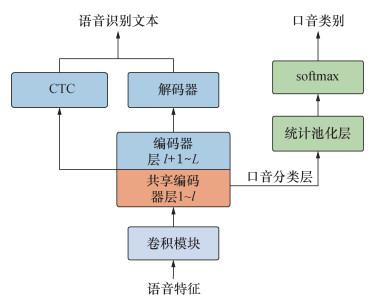
本文在CTC-attention语音识别模型[17]的基础上,通过共享部分底层编码器网络,构建口音识别和语音识别多任务学习框架,如图 1所示,l为口音分类层,L为编码器总层数。
图 1 口音识别和语音识别多任务学习框架

1.1 混合CTC-attention模型

混合CTC-attention模型结合了CTC和注意力模型的优点,显著提高了语音识别性能,因而被广泛关注。
CTC[18]是一种连接主义时序分类器,常用于序列到序列的学习方法,无须帧级别标注,在输出序列和最终标签之间增加了多对一的映射关系,并在此基础上定义了CTC损失函数,其训练过程实际上是自动对齐使损失函数最小化的过程。
基于注意力机制[19]的Encoder-Decoder模型是一种改进的序列到序列模型,通过在Encoder和Decoder之间加入注意力机制,通常称为交叉注意力(cross-attention),计算当前位置输出对编码器不同时刻输出的关注度;此外,其在编码器和解码器中引入了自注意力机制(self-attention),因此可计算当前位置对不同位置的关注度。注意力函数将查询(query)和一组键、值对(key-value)映射到输出。输出由值的加权和计算得到,其中分配给每个值的权重由查询与相应键的点积经过函数计算得到,权重和为1。常用的注意力函数为缩放点积注意力函数,表示如下:
$\operatorname{Attention}(\boldsymbol{Q}, \boldsymbol{K}, \boldsymbol{V})=\operatorname{softmax}\left(\frac{\boldsymbol{Q K}}{\sqrt{d_k}}\right) \boldsymbol{V} .$
其中:Attention为注意力函数;softmax为指数归一化函数;QKV分别为查询、键、值向量组成的矩阵;dk为键的向量维度,对QK的点积进行缩放,防止将softmax函数推入梯度极小的区域。
多头注意力机制通过线性映射矩阵分别将查询、键、值映射到dqdkdv维度,多头注意力h决定映射次数。经过线性映射的多个查询、键、值并行经过注意力函数,产生dv维度的输出,将这些输出拼接起来再次经过线性映射得到最终的输出,多头注意力函数可表示如下:
$\begin{gathered}\text { MultiHead }(\boldsymbol{Q}, \boldsymbol{K}, \boldsymbol{V})= \\\text { Concat }^{+}\left(\mathbf{head}_1, \boldsymbol{\operatorname { head }}_2, \cdots, \boldsymbol{\operatorname { head }}_h\right) \boldsymbol{W}^O, \end{gathered}$
$\mathbf{h e a d}_i=\operatorname{Attention}\left(\boldsymbol{Q} \boldsymbol{W}_i^Q, \boldsymbol{K} \boldsymbol{W}_i^K, \boldsymbol{V} \boldsymbol{W}_i^V\right) .$
其中:MultiHead为多头注意力函数;Concat为矩阵拼接函数;O为多头注意力函数的输出;head为其中一个注意力函数的输出;i为注意力头索引;$\boldsymbol{W}_i^Q \in \mathbb{R}^{d_{\text {model }} \times d_q}, \boldsymbol{W}_i^K \in \mathbb{R}^{d_{\text {model }} \times d_k}, \boldsymbol{W}_i^V \in \mathbb{R}^{d_{\text {model }} \times d_v}$, $\boldsymbol{W}^O \in \mathbb{R}^{h d_v \times d_{\text {model }}}$分别为查询、键、值、输出映射矩阵,dmodel为映射向量维度。多头注意力使模型能同时关注不同位置和不同特征子空间的信息,因此性能比单头注意力好。
混合CTC-attention模型最终的损失函数为CTC损失和注意力模型交叉熵损失的加权和,表示如下:
$\mathcal{L}_{\mathrm{ASR}}=\lambda ~\mathcal{L}_{\mathrm{CTC}}+(1-\lambda) \mathcal{L}_{\mathrm{ATT}} .$
其中:$\mathcal{L}$ 为损失函数;$\mathcal{L}_{\mathrm{CTC}}$为CTC损失函数;$\mathcal{L}_{\mathrm{ATT}}$为注意力模块损失函数;λ为CTC损失的加权系数,0≤λ≤1;$\mathcal{L}_{\mathrm{ASR}}$为加权后的自动语音识别(automatic speech recognition,ASR)损失函数。

1.2 口音识别模型

基于深度学习的口音识别首先通过神经网络提取口音特征;其次,通过统计池化层获得句子级特征;再次,经过一层线性层和softmax层输出每种口音的概率分布;最后,利用交叉熵损失函数计算口音分类损失,表示如下:
$\mathcal{L}_{\mathrm{AR}}=-\frac{1}{N} \sum\limits_{j=1}^N y_j \ln \left(p_j\right), $
$p=\operatorname{softmax}\left(\operatorname{FC}\left(\operatorname{Pooling}\left(\boldsymbol{h}^l\right)\right)\right) .$
其中:$\mathcal{L}_{\mathrm{AR}}$为口音识别(accent recognition, AR)损失函数;N为训练样本数;j为样本索引;p为输出的概率分布;y为真实标签的概率分布;Pooling为统计池化层;FC为全连接层;hl为编码器第l层的输出。
最终的多任务学习损失函数表示如下:
$\mathcal{L}_{\mathrm{MTL}}=\alpha \mathcal{L}_{\mathrm{AR}}+(1-\alpha) \mathcal{L}_{\mathrm{ASR}} .$
其中:α为口音损失的加权系数,0≤α≤1;$\mathcal{L}_{\mathrm{MTL}}$为最终的多任务损失函数。

2 基于CTC尖峰特征的口音识别方法

在口音识别和语音识别多任务学习框架的基础上,通过分析编码器的中间隐层特征,可发现大部分口音特征由空白(blank)帧组成,而更具有发音表征的非blank(即有效标签)帧未发挥主要作用,因此,本文提出了基于CTC尖峰特征的口音识别方法,可在训练过程中在线提取有效标签对应的尖峰特征。

2.1 CTC尖峰特性
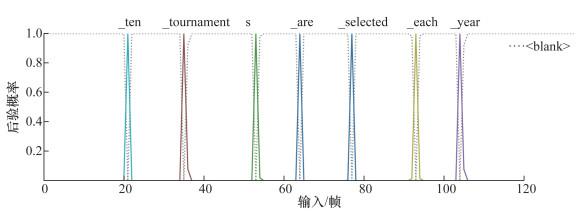
CTC是一种损失函数,最早由Graves等[18]于2006年提出,并被用于端到端训练,以处理输入与标签长度不一致的情况。CTC将句子级别的对齐信息融合在损失函数中,通过最大化所有语音帧和标签对齐序列的概率和,对模型进行训练,CTC损失函数的特性使其输出的标签概率呈尖峰分布,如图 2所示。
图 2 CTC尖峰概率图

2.2 口音特征分析

通常情况下,口音识别直接使用编码器中间某一层的特征经过统计池化层获得口音特征向量,语音信号的每一帧特征均参与计算。为探索不同标签帧对口音识别的重要性,本文可视化分析了口音特征向量,包括非blank帧、blank帧和所有帧对应特征向量组成的口音特征。为获得相对准确的对齐信息和节省计算资源,本文采用与文[16]相同的对齐方法——直接利用CTC预测的伪标签获取对应的尖峰特征,CTC模块逐帧预测标签序列,包括blank,第n帧的伪标签表示如下:
$\hat{y}_n=\underset{\hat{y}_n}{\operatorname{argmax}} p_{\text {стс }}\left(\hat{y}_n \mid X\right) .$
其中:X为输入的语音特征,$\hat{y}$为输出对应的伪标签;pCTC为CTC输出标签的概率分布。
首先,本文从每种口音的测试数据中随机挑选200条;其次,提取每条数据的隐层编码特征;再次,计算CTC输出层的softmax概率,获得每一帧输出标签和对应位置索引;最后,根据上述获得的信息,分别计算编码器隐层特征非blank帧、所有blank帧、所有帧的统计池化特征,经过t分布随机邻域嵌入(t-distributed stochastic neighbor embedding,t-SNE)降维后进行可视化,分别如图 3a3b3c所示。经可视化分析可知,大部分口音特征由blank帧组成,其分布与所有帧特征分布基本一致,而更能反映口音差异的非blank特征未发挥主要作用,因此,本文将有效标签对应的尖峰帧作为口音识别的特征,以更好地区分不同地区口音的差异。
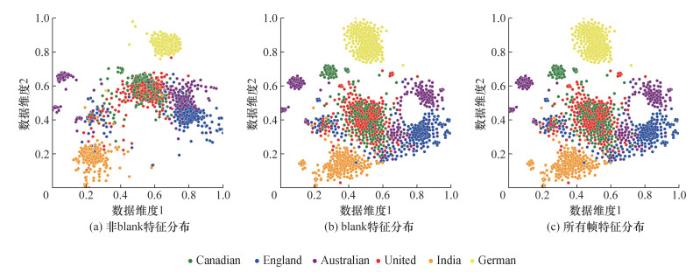
图 3 编码器隐层特征向量可视化

2.3 基于CTC尖峰特征的口音识别

在语音识别和口音识别多任务学习框架下,本文首先使用在线提取非blank帧的方法,在模型训练前向计算过程中,计算CTC伪标签对齐信息;其次,通过非blank帧的索引获取对应隐层编码特征,并计算其统计池化特征,以作为最终的口音特征进行训练;最后,联合训练过程同步更新所有参数。由于语音序列的实际长度远大于文本序列,因此在提取口音特征时使用尖峰帧(Spike-Frame)和尖峰块(Spike-Chunk)特征进行试验,Spike-Chunk即在Spike-Frame索引左右各扩展一定帧数。口音特征提取过程如图 4所示。
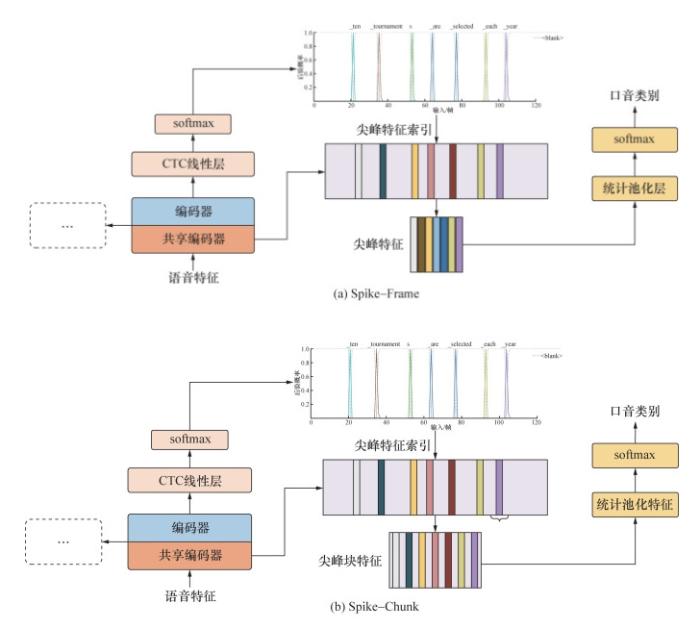
图 4 基于CTC的Spike-Frame和Spike-Chunk特征提取

3 试验结果与分析

3.1 试验数据及配置

本文试验将开源英语口音数据集Common Voice 9.0[20]和AESRC2020[4]作为训练和评估数据集。此外,由于英语口音数据集AESRC2020的数据量较少,因此在该数据集上,本文通过对数据使用0.9、1.0和1.1倍的速度扰动进行扩增。此外,本文将Librispeech数据集[21]作为有监督预训练数据集,用于训练ASR预训练模型。Common Voice 9.0、AESRC2020和Librispeech数据集的详细信息如表 1所示。
表 1 试验数据
数据集 口音 缩写 语音数据时长/h
训练集 验证集 测试集
Common Voice 9.0 Australian AU 365.80 92.40 50.77
Canadian CA 124.82 31.20 17.28
England EN 104.39 26.01 14.66
German GE 59.16 14.62 8.22
India IN 50.79 12.84 7.07
United States UN 55.08 13.71 7.55
AESRC2020 United Kingdom UK 18.50 1.54 2.21
Russia RU
India IND
South of Korea KR
Japan JPN
China CHN
Portugal PT
United States US
Librispeech 960.90 10.70 10.40
本文试验使用的语音数据的采样频率均为16 kHz,每个采样点均占16 bit,并使用窗长为25 ms、窗移为10 ms的汉明窗对语音信号进行分帧、加窗。在此基础上,对语音信号进行短时Fourier变换,并提取80维FBank(Filter Banks)特征用于神经网络模型的输入。本文试验的语音识别建模单元数为5 000,口音识别建模单元数为对应口音类别数。
模型采用基于注意力机制的编码器-解码器结构,语音特征经过2层卷积神经网络(convolutional neural network,CNN)进行4倍降采样,编码器包含12层Conformer[22]块,多头注意力维度为512,包含8个注意力头,前馈网络维度为2 048,卷积核大小为31,此外还利用批量标准化(BatchNorm)和Swish激活函数帮助训练深层次模型。解码器包含6层Transformer块,多头注意力维度为512,包含4个注意力头,前馈网络维度为2 048。在编码器的中间层添加口音分类损失,经线性映射输出对应口音类别,该模型总的参数量为116 M。
模型训练使用2张A100显卡,λ设为0.3,α设为0.1,优化器选择Adam,梯度更新设为4,学习率设为0.001,训练迭代50个epoch。为增强数据多样性,防止模型过拟合,本文试验对输入特征进行数据增强(SpecAug)[23],即分别对输入特征进行时间扭曲、频率掩码和时域掩码操作。

3.2 解码配置与评价指标

在解码阶段,本文提出的多任务学习方法支持同时输出口音分类结果和语音识别结果。口音分类取编码器第6层的特征输出,并对该特征进行统计池化,获得句子级别的口音分类特征,经过分类输出层,将概率最大的标签作为最终的口音输出。语音识别采用基于束搜索的标签同步解码算法,束大小设为20。试验分别将口音识别准确率(accuracy, Acc)和语音识别词错误率(word error rate, WER)作为口音识别和语音识别性能的评价指标。其中:Acc为对应口音识别正确的语音条数与该口音所有语音条数的比值,WER为字替换错误、删除错误、插入错误之和除以答案中的总字数,表示如下:
$\text { Acc }=\frac{\text { Correct_Nums }_{\text {accent_id }}}{\text { All_Nums }_{\text {accent_id }}} \times 100 \%, $
$\mathrm{WER}=\frac{\mathrm{Sub}+\mathrm{Del}+\mathrm{Ins}}{\mathrm{Ref}} \times 100 \% .$
其中:accent_id为口音类型,Correct_Nums为正确语音条数,All_Nums为所有语音条数,Sub为替换错误字数,Del为删除错误字数,Ins为插入错误字数,Ref为答案中总字数。

3.3 试验结果分析

在口音识别和语音识别多任务学习框架下,选择不同的编码器层对口音识别和语音识别性能有一定影响。为探索不同层编码器特征包含的口音信息和对语音识别性能的影响,本文对不同层编码器特征进行消融试验,分别将编码器4—11层的特征用于口音识别,观察口音识别和语音识别性能的变化,试验在Common Voice数据集上进行,性能变化曲线如图 5所示。分析可知,口音识别性能的整体变化趋势是先上升后下降。由此可知,编码器浅层特征对口音识别的建模能力并不是很强,随着编码器层数的加深,更高层的编码器特征更倾向于识别与口音、说话人、信道等无关的文本序列,逐渐淡化了口音信息。编码器第6层输出特征包含的口音信息最丰富,用于口音识别时,口音性能最优。同时,在该层增加口音分类损失,对编码器特征进行增强,语音识别也取得了最优性能。因此,后续试验将编码器第6层输出特征用于口音识别,并在此基础上验证本文方法的有效性。
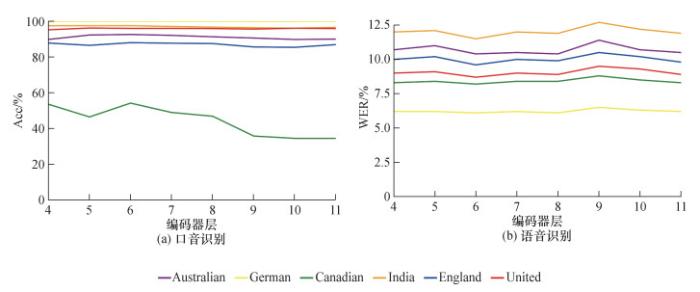
图 5 口音识别和语音识别性能
本文在Common Voice和AESRC2020数据集上验证试验方法,对比多任务学习方法与直接混合所有数据进行训练的方法的语音识别性能,分别如表 23所示。基于有监督预训练模型的ASR的性能显著提升。因此,对于AESRC2020数据集,后续对比试验均基于预训练模型。在多任务学习框架下,经过口音信息增强的语音识别性能进一步提升,在Common Voice和AESRC2020数据集上分别绝对提升0.6%和1.0%。
表 2 Common Voice数据集的WER %
训练方法 AU CA EN GE IN UN 平均值
ASR 10.9 8.6 10.3 6.3 12.4 9.2 9.7
AR+ASR 10.4 8.2 9.6 6.1 11.5 8.7 9.1
表 3 AESRC2020数据集的WER %
训练方法 UK RU IND KR JPN CHN PT US 平均值
ASR 16.8 21.9 21.7 17.4 18.9 23.5 18.7 19.7 19.7
AR+ASR 11.2 15.2 14.8 10.2 11.5 19.7 11.2 12.2 13.2
ASR(Pretrain) 2.5 11.9 9.1 7.6 9.2 11.5 6.9 6.0 7.8
AR+ASR(Pretrain) 1.8 11.1 7.3 7.0 8.7 10.1 5.8 4.8 6.8
在口音识别和语音识别多任务学习框架下,本文分别验证了Spike-Frame和Spike-Chunk方法在口音识别和语音识别任务上的性能。Common Voice和AESRC2020数据集上的试验结果分别如表 45所示,与基线多任务模型相比,Spike-Chunk方法的口音识别性能分别绝对提升了0.7%和1.9%,语音识别性能基本无损失。对比Spike-Frame与Spike-Chunk方法可知,与Spike-Frame相比,Spike-Chunk的口音识别性能虽略有提升,但变化不大。由此表明,有效标签对应的尖峰帧包含了大部分口音信息,周围blank帧可在一定程度上提升口音识别性能,但不明显。
表 4 Common Voice数据集上的口音识别和语音识别性能 %
任务 评价指标 训练方法 AU CA EN GE IN UN 平均值
AR Acc AR+ASR 92.7 54.2 88.1 100.0 97.6 96.1 91.7
Spike-Frame AR+ASR 93.2 58.5 89.3 100.0 97.9 96.1 92.3
Spike-Chunk AR+ASR 93.5 58.5 89.2 100.0 98.2 96.2 92.4
ASR WER AR+ASR 10.4 8.2 9.6 6.1 11.5 8.7 9.1
Spike-Frame AR+ASR 10.3 8.1 9.6 6.2 11.5 8.7 9.1
Spike-Chunk AR+ASR 10.3 8.1 9.7 6.2 11.5 8.7 9.1
表 5 AESRC2020数据集上的口音识别和语音识别性能 %
任务 评价指标 训练方法 UK RU IND KR JPN CHN PT US 平均值
AR Acc AR+ASR(Pretrain) 92.9 72.0 90.2 80.4 62.5 72.2 78.6 61.9 75.6
Spike-Frame AR+ASR(Pretrain) 93.0 69.8 91.5 84.3 69.5 74.6 79.8 62.8 77.5
Spike-Chunk AR+ASR(Pretrain) 93.0 70.8 91.3 83.5 69.1 75.1 80.1 62.4 77.5
ASR WER AR+ASR(Pretrain) 1.8 11.1 7.3 7.0 8.7 10.1 5.8 4.8 6.8
Spike-Frame AR+ASR(Pretrain) 1.8 11.1 7.1 7.1 8.7 10.1 5.8 4.8 6.8
Spike-Chunk AR+ASR(Pretrain) 1.8 11.2 7.2 7.0 8.7 10.2 5.9 4.8 6.8

3.4 所提方法与已有工作的对比

在AESRC2020数据集上对比本文方法与已有研究工作,包括基于语言声学相似性偏移(LASAS)[24]和基于预训练wav2vec2.0的方法[25],同时复现了基于CTC-attention框架的将口音标签扩展到识别标签[9]的方法,以及单独训练口音识别和语音识别任务的方法。
AESRC2020数据集上的对比结果如表 6所示,与单独训练口音识别(AR only)和语音识别(ASR only)的模型相比,本文方法的口音识别和语音识别性能提升较大。由此表明:口音识别任务可在一定程度上增强特定口音的声学特征,进而辅助语音识别任务;语音识别任务通过学习语音序列对应的文本忽略信道、说话人信息,降低信道和说话人对口音识别的影响,提升口音识别性能。对比文[9] 中的方法(method-1和method-2分别在语音识别标签开头和结束位置添加口音标签)发现,在语音识别任务上,口音信息同样可以辅助语音识别任务,但口音识别任务上的性能较差,表明本文方法有效。与文[24]中基于语言声学相似性偏移的方法相比,口音识别性能相近,但本文方法基于多任务学习框架,可以在线实时获取有效标签对应的尖峰帧,并可简化训练流程和节省存储空间。
表 6 在AESRC2020数据集上各方法的性能对比
方法 WER/% Acc/%
LASAS[24] 77.4
Deng等[25] 7.0 73.9
Gao等[9](method-1) 6.8 75.0
Gao等[9](method-2) 6.7 74.0
AR only 71.3
ASR only 7.8
Spike-Chunk 6.8 77.5

4 结论

为进一步探索多任务学习框架下口音识别与语音识别任务之间的相互作用,本文提出一种基于尖峰特征的口音识别和语音识别多任务学习方法。在多任务学习框架下,本文首先探索了不同编码器层包含的口音信息和对语音识别性能的影响,结果表明,经过口音信息增强的编码器特征可进一步提升语音识别性能;其次,在线提取了基于CTC伪标签的尖峰特征,并用于口音识别,在Common Voice和AESRC2020数据集上的试验结果表明,提取的尖峰特征能更好地反映口音信息,并能摒弃冗余信息,一定程度上提升了口音识别性能,同时对语音识别性能基本无影响;最后,在AESRC2020数据集上对比了本文方法与现有方法的性能,结果表明,本文方法的口音识别和语音识别性能均较好。
1
刘明宽, 徐波, 黄泰翼, 等. 音节混淆字典及在汉语口音自适应中的应用研究[J]. 声学学报, 2002, 27 (1): 53- 58.

LIU M K , XU B , HUANG T Y , et al. Study on syllable confusion dictionary and putonghua accent adaptation[J]. Acta Acustica, 2002, 27 (1): 53- 58.

2
庞程, 王秀玲, 张结, 等. 基于多特征融合的GMM汉语普通话口音识别[J]. 华中科技大学学报(自然科学版), 2015, 43 (S1): 381- 384.

PANG C , WANG X L , ZHANG J , et al. Mandarin accent identification based on GMM with multi-feature fusion[J]. Journal of Huazhong University of Science and Technology (Natural Science Edition), 2015, 43 (S1): 381- 384.

3
张超, 刘轶, 郑方. 面向多口音语音识别的声学模型重构[J]. 清华大学学报(自然科学版), 2011, 51 (9): 1161- 1166.

ZHANG C , LIU Y , ZHENG F . Acoustic model reconstruction for multi-accent Chinese speech recognition[J]. Journal of Tsinghua University (Science and Technology), 2011, 51 (9): 1161- 1166.

4
SHI X, YU F, LU Y Z, et al. The accented English speech recognition challenge 2020: Open datasets, tracks, baselines, results and methods[C] // Proceedings of the 2021 IEEE International Conference on Acoustics, Speech and Signal Processing. Toronto, Canada: IEEE, 2021: 6918-6922.

5
DAS N, BODAPATI S, SUNKARA M, et al. Best of both worlds: Robust accented speech recognition with adversarial transfer learning[C] // Proceedings of the 22nd Annual Conference of the International Speech Communication Association. Brno, Czechia: ISCA, 2021: 1314-1318.

6
WINATA G I, CAHYAWIJAYA S, LIU Z H, et al. Learning fast adaptation on cross-accented speech recognition[C] // Proceedings of the 21st Annual Conference of the International Speech Communication Association. Shanghai, China: ISCA, 2020: 1276-1280.

7
GONG X, LU Y Z, ZHOU Z K, et al. Layer-wise fast adaptation for end-to-end multi-accent speech recognition[C] // Proceedings of the 22nd Annual Conference of the International Speech Communication Association. Brno, Czechia: ISCA, 2021: 1274-1278.

8
TOMANEK K, ZAYATS V, PADFIELD D, et al. Residual adapters for parameter-efficient ASR adaptation to atypical and accented speech[C] // Proceedings of the 2021 Conference on Empirical Methods in Natural Language Processing. Punta Cana, Dominican Republic: Association for Computational Linguistics, 2021: 6751-6760.

9
GAO Q, WU H W, SUN Y Q, et al. An end-to-end speech accent recognition method based on hybrid CTC/attention transformer ASR[C] // Proceedings of the 2021 IEEE International Conference on Acoustics, Speech and Signal Processing. Toronto, Canada: IEEE, 2021: 7253-7257.

10
SUN S N, YEH C F, HWANG M Y, et al. Domain adversarial training for accented speech recognition[C] // Proceedings of the 2018 IEEE International Conference on Acoustics, Speech and Signal Processing. Calgary, Canada: IEEE, 2018: 4854-4858.

11
JAIN A, UPRETI M, JYOTHI P, et al. Improved accented speech recognition using accent embeddings and multi-task learning[C] // Proceedings of the 19th Annual Conference of the International Speech Communication Association. Hyderabad, India: ISCA, 2018: 2454-2458.

12
YANG X S, AUDHKHASI K, ROSENBERG A, et al. Joint modeling of accents and acoustics for multi-accent speech recognition[C] // Proceedings of the 2018 IEEE International Conference on Acoustics, Speech and Signal Processing. Calgary, Canada: IEEE, 2018: 1-5.

13
ZHANG J C, PENG Y Z, PHAM V T, et al. E2E-based multi-task learning approach to joint speech and accent recognition[C] // Proceedings of the 22nd Annual Conference of the International Speech Communication Association. Brno, Czechia: ISCA, 2021: 1519-1523.

14
ZHANG Y , YANG Q . An overview of multi-task learning[J]. National Science Review, 2018, 5 (1): 30- 43.

DOI

15
WATANABE S, HORI T, KARITA S, et al. ESPnet: End-to-end speech processing toolkit[C] // Proceedings of the 19th Annual Conference of the International Speech Communication Association. Hyderabad, India: ISCA, 2018: 2207-2211.

16
HOU W X, WANG J D, TAN X, et al. Cross-domain speech recognition with unsupervised character-level distribution matching[C] // Proceedings of the 22nd Annual Conference of the International Speech Communication Association. Brno, Czechia: ISCA, 2021: 3425-3429.

17
KIM S, HORI T, WATANABE S. Joint CTC-attention based end-to-end speech recognition using multi-task learning[C] // Proceedings of the 2017 IEEE International Conference on Acoustics, Speech and Signal Processing. Orleans, USA: IEEE, 2017: 4835-4839.

18
GRAVES A, FERNÁNDEZ S, GOMEZ F, et al. Connectionist temporal classification: Labelling unsegmented sequence data with recurrent neural networks[C] // Proceedings of the 23rd International Conference on Machine Learning. Pittsburgh, USA: ACM, 2006: 369-376.

19
VASWANI A, SHAZEER N, PARMAR N, et al. Attention is all you need[C] // Proceedings of the 31st International Conference on Neural Information Processing Systems. Long Beach, USA: Curran Associates Inc., 2017: 6000-6010.

20
ARDILA R, BRANSON M, DAVIS K, et al. Common Voice: A massively-multilingual speech corpus[C] // Proceedings of the 12th Language Resources and Evaluation Conference. Marseille, France: European Language Resources Association, 2020: 4218-4222.

21
PANAYOTOV V, CHEN G G, POVEY D, et al. Librispeech: An ASR corpus based on public domain audio books[C] // Proceedings of the 2015 IEEE International Conference on Acoustics, Speech and Signal Processing. Brisbane, Australia: IEEE, 2015: 5206-5210.

22
GULATI A, QIN J, CHIU C C, et al. Conformer: Convolution-augmented transformer for speech recognition[C] // Proceedings of the 21st Annual Conference of the International Speech Communication Association. Shanghai, China: ISCA, 2020: 5036-5040.

23
PARK D S, CHAN W, ZHANG Y, et al. SpecAugment: A simple data augmentation method for automatic speech recognition[C] // Proceedings of the 20th Annual Conference of the International Speech Communication Association. Graz, Austria: ISCA, 2019: 2613-2617.

24
SHAO Q J, YAN J H, KANG J, et al. Linguistic-acoustic similarity based accent shift for accent recognition[C] // Proceedings of the 23rd Annual Conference of the International Speech Communication Association. Incheon, South of Korea: ISCA, 2022: 3719-3723.

25
DENG K Q, CAO S J, MA L, et al. Improving accent identification and accented speech recognition under a framework of self-supervised learning[C] // Proceedings of the 22nd Annual Conference of the International Speech Communication Association. Brno, Czechia: ISCA, 2021: 1504-1508.

文章导航

/