

目前,风电在推动“双碳”目标的快速实现中扮演着重要角色。随着技术的不断进步,风电机组的设计趋势逐渐向着更高的轮毂和更长的叶片发展,这导致所需的支撑结构在高度和截面尺寸上的不断增加。为了在提升塔筒承载能力的同时兼顾经济性,行业有3种解决方案:大直径分片式全钢塔筒、混凝土-钢混合塔筒以及桁架式塔架。
传统圆锥塔筒结构随着高度的增加,采用降低刚度或分片的方法解决成本高和运输受限问题,其代价是固有频率更低且摆幅增大[1]。当塔筒固有频率小于风轮旋转频率1 P(叶轮转速产生的频率的1倍)[2]时,不仅存在机组启停时与叶轮共振的风险[3],在自然条件下亦容易达到触发涡激振动的临界风速[4],需采取一系列控制措施[5-6]。现有研究结果表明,全钢圆锥塔筒受共振、疲劳、运维及运输等因素制约[7],导致其很难再向高空化进一步发展。Brughuis[8]通过对混凝土-钢混合塔架的结构形式进行设计分析,指出混合结构塔架在造价方面具有明显优势。Jimeno等[9-10]将预制混凝土塔架的塔身分成多个扇形混凝土板,在施工现场通过横向加强螺栓进行连接,发现该类塔架不受运输条件的限制,更加适合大型的风力发电机组。张志川[11]提出的实体力筋降温法能有效地对复杂预应力混凝土结构中的预应力进行等效模拟。王长军等[12]通过对某预应力钢-混凝土混合塔架有限元模型进行模态分析,表明该风电塔架固有频率避开了1 P和3 P频率,产生共振的可能性较小。从现有研究看出,新型塔架结构设计的趋势是通过混凝土材料、预应力技术和模态优化,提升塔架的抗风性能、刚度与稳定性,同时避免共振风险并降低成本和运输限制。
基于传统圆锥形钢塔筒结构特点,借鉴高层结构钢管-混凝土构件的设计原理[13],本文提出一种内置预应力钢绞线的分片式钢混塔筒结构(以下简称新型塔筒)。
同时,为研究圆锥形钢塔筒与新型塔筒结构的基本力学性能差异,采用有限元软件ABAQUS建立力学模型,分析新型塔筒的主要设计参数如预应力水平、塔筒壁厚、塔筒半径、混凝土强度以及材料非线性等因素对结构静力性能、模态、屈曲等力学性能影响的内在规律,从而为新型塔筒的工程应用提供科学依据。
1 塔筒结构及有限元模型
1.1 传统塔筒
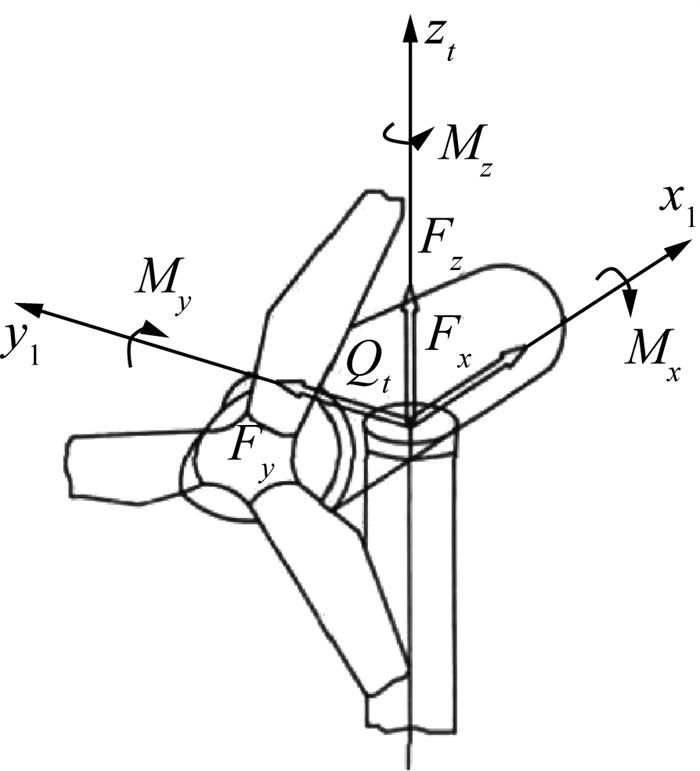
表 1 圆锥形塔筒几何参数表[14] |
| 塔段 | ||||
| 1 | 2.176 | 2.064 | 27 | 78.84 |
| 2 | 2.290 | 2.176 | 28 | 70.08 |
| 3 | 2.404 | 2.290 | 29 | 61.32 |
| 4 | 2.518 | 2.404 | 30 | 52.56 |
| 5 | 2.631 | 2.518 | 31 | 43.80 |
| 6 | 2.745 | 2.631 | 32 | 35.04 |
| 7 | 2.859 | 2.745 | 34 | 26.28 |
| 8 | 2.973 | 2.859 | 35 | 17.52 |
| 9 | 3.086 | 2.973 | 36 | 8.76 |
| 10 | 3.200 | 3.086 | 37 | 0.00 |
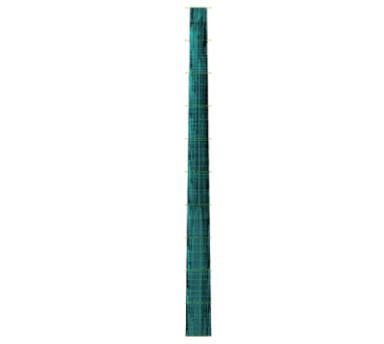
表 2 塔顶各方向最大载荷(参考载荷)[14] |
| 555.3 | -1 033.2 | -3 609.6 | 2 624.8 | 8 378.0 | -4 705.6 |
1.2 新型塔筒
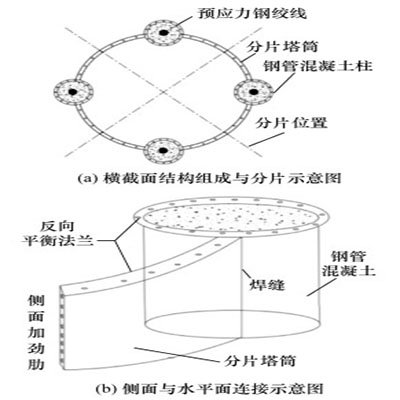
新型塔筒结构是将传统的圆锥形钢塔筒先按环形构造分解为若干片,再将分片后的弧形钢圆筒单元与钢管混凝土柱侧面连接,并在高度分段部位通过反向平衡法兰完成塔筒整体组装。同时,在钢管混凝土柱内置预应力钢绞线。具体结构横断面组成如图 3所示。
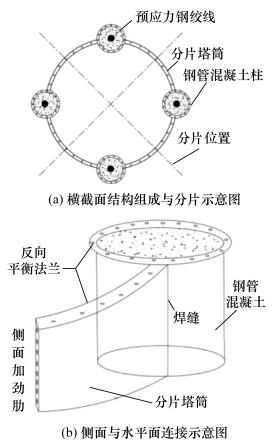
表 3 新型塔筒几何参数表(无预应力) |
| 塔段 | 钢管数量 | ||||||
| 1 | 2.176 | 2.064 | 27 | 78.84 | 14 | 0.5 | 4 |
| 2 | 2.290 | 2.176 | 28 | 70.08 | 14 | 0.5 | 4 |
| 3 | 2.404 | 2.290 | 29 | 61.32 | 16 | 0.5 | 4 |
| 4 | 2.518 | 2.404 | 30 | 52.56 | 16 | 0.5 | 4 |
| 5 | 2.631 | 2.518 | 31 | 43.80 | 18 | 0.5 | 4 |
| 6 | 2.745 | 2.631 | 32 | 35.04 | 18 | 0.5 | 4 |
| 7 | 2.859 | 2.745 | 34 | 26.28 | 20 | 0.5 | 4 |
| 8 | 2.973 | 2.859 | 35 | 17.52 | 20 | 0.5 | 4 |
| 9 | 3.086 | 2.973 | 36 | 8.76 | 22 | 0.5 | 4 |
| 10 | 3.200 | 3.086 | 37 | 0.00 | 22 | 0.5 | 4 |
式中:fyk为钢材屈服强度;Is为横截面抗弯惯性矩;R为横截面上离中性轴的最大距离;Is1为钢管抗弯惯性矩;Is2为塔筒片抗弯惯性矩;Ic为核心混凝土抗弯惯性矩;λ为钢材与混凝土的弹性模量比值。
为确保有限元仿真结果的精度与可靠性,新型塔筒模型需要进行合理简化:暂不考虑塔段之间的法兰与螺栓连接;塔段之间采用共节点连接;使用塔顶集中质量点,即参考点(reference point, RP), 代替风轮叶片与机舱质量,将参考点与顶部表面耦合,并在参考点处施加弯矩和轴力等集中载荷。
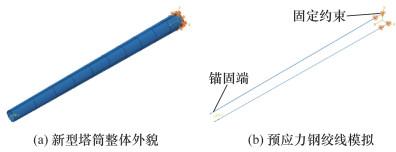
钢管使用S4R壳单元,混凝土采用C3D8R实体单元,预应力钢绞线采用T3D2桁架单元。网格尺寸为0.3,底部为固结边界条件。四束预应力钢绞线内置于钢管混凝土中,上端与锚具采用多点约束(multi-point constraint, MPC)方式绑定连接,底部固结。模型的材料参数见表 4。
表 4 材料参数 |
| 材料 | Poisson比 | 线膨胀系数 | ||
| C50混凝土 | 3.45×10⁴ | 0.2 | 2 400 | |
| Q345分片塔筒、钢管 | 2.1×10⁵ | 0.3 | 7 860 | 1.2×10⁻⁵ |
| 预应力钢绞线 | 1.95×10⁵ | 0.3 | 7 850 | 1.2×10⁻⁵ |
2 传统塔筒的静力学分析
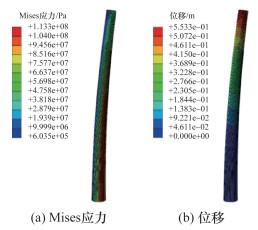
2.1 结构线弹性分析
2.2 结构弹塑性分析
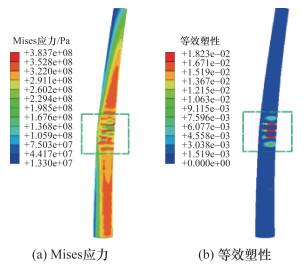
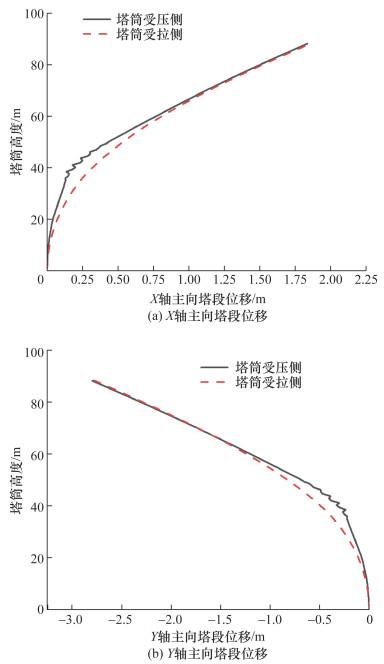
3 无预应力钢绞线的新型塔筒
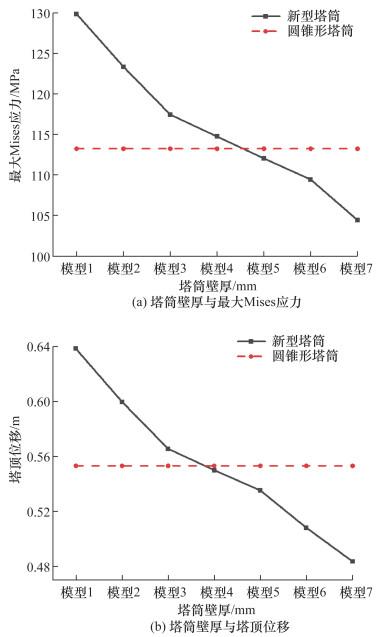
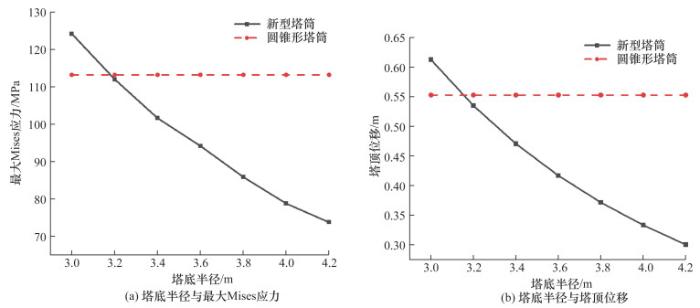
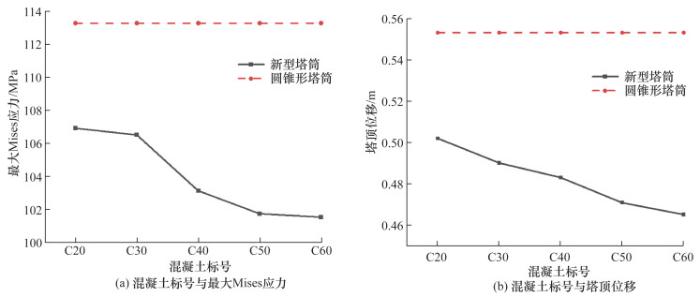
3.1 新型塔筒设计参数的影响
3.2 模态分析
无预应力钢绞线的新型塔筒的模态分析主要考虑低阶模态,将一阶固有频率作为性能评价指标,讨论塔筒壁厚、塔筒半径和混凝土标号对模态的影响,仿真结果如图 11所示,虚线表示圆锥形塔筒的基频为0.402 17 Hz。
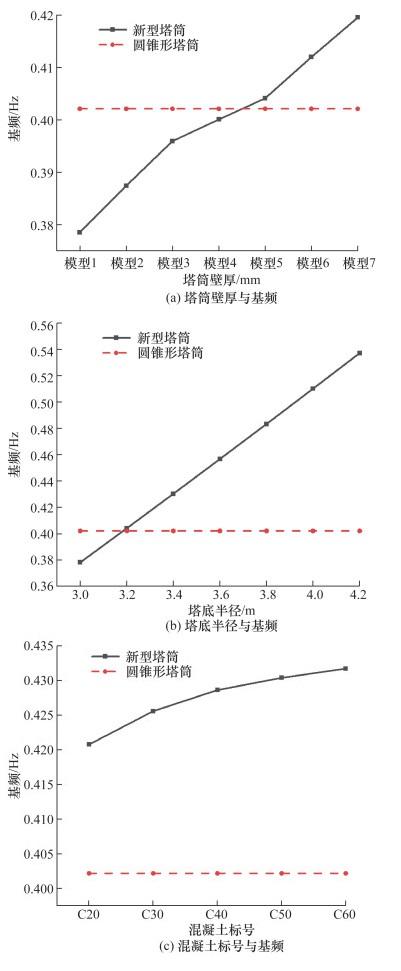
从图 11可以看出,基频曲线整体呈现递增趋势,塔筒壁厚-基频曲线在接近圆锥形塔筒基频时,增长趋势变缓;塔底半径的变化对新型塔筒基频影响最大,基本呈线性增长;而不同强度等级的混凝土对新型塔筒基频影响最小,曲线的增长趋势缓慢。
3.3 新型塔筒尺寸定型
基于上述对新型塔筒静力学性能与模态的研究,最终确定新型塔筒结构设计尺寸如表 6所示。新型塔筒整体用钢量332 603.72 kg,相较于传统塔筒节省了9.51%。
表 6 新型塔筒最终结构设计尺寸 |
| 塔段 | 钢管数量 | ||||||
| 1 | 2.196 | 2.064 | 19 | 78.84 | 14 | 0.5 | 4 |
| 2 | 2.330 | 2.196 | 20 | 70.08 | 14 | 0.5 | 4 |
| 3 | 2.464 | 2.330 | 21 | 61.32 | 16 | 0.5 | 4 |
| 4 | 2.598 | 2.464 | 22 | 52.56 | 16 | 0.5 | 4 |
| 5 | 2.731 | 2.598 | 23 | 43.80 | 18 | 0.5 | 4 |
| 6 | 2.865 | 2.731 | 24 | 35.04 | 18 | 0.5 | 4 |
| 7 | 2.999 | 2.865 | 26 | 26.28 | 20 | 0.5 | 4 |
| 8 | 3.133 | 2.999 | 27 | 17.52 | 20 | 0.5 | 4 |
| 9 | 3.266 | 3.133 | 28 | 8.76 | 22 | 0.5 | 4 |
| 10 | 3.400 | 3.266 | 29 | 0.00 | 22 | 0.5 | 4 |
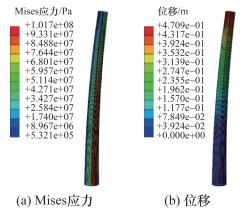
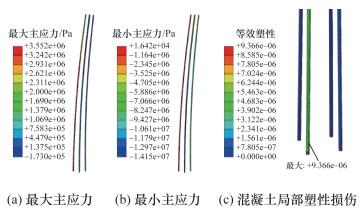
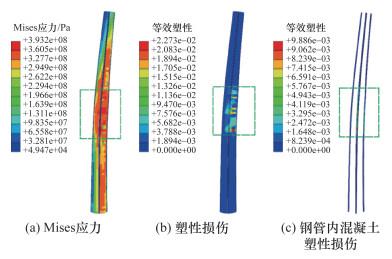
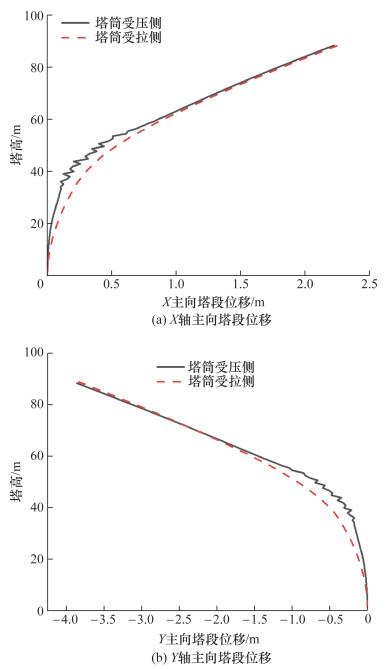
3.4 新型塔筒的弹塑性分析
4 有预应力钢绞线的新型塔筒
4.1 预应力施加方法
降温法[22]施加的预应力大小可通过对预应力筋单元施加的降温值灵活控制;等效荷载法是将预应力简化为外力来模拟预应力钢绞线对混凝土的作用。
预应力损失值是随着时间的增长和环境的变化而变化的,如混凝土的收缩、徐变及钢筋松弛,而且这些因素之间相互影响。为了简化计算,通常对于复杂预应力混凝土结构,其总预应力损失值可取张拉控制应力的15%[23]。
据文[11],确定等效荷载的计算公式与降温法的计算公式,降温值的计算是利用温度产生的线应变与轴力产生的线应变相等的原则。采用等效荷载法计算预应力钢绞线对端部的集中压力Npe。
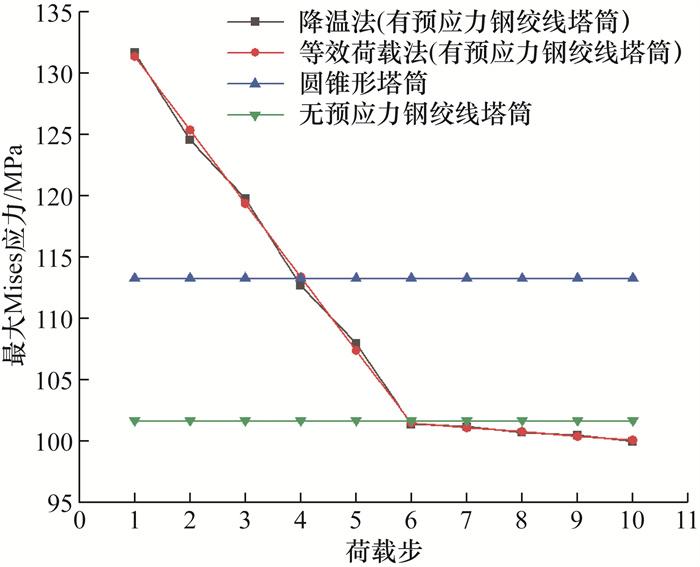
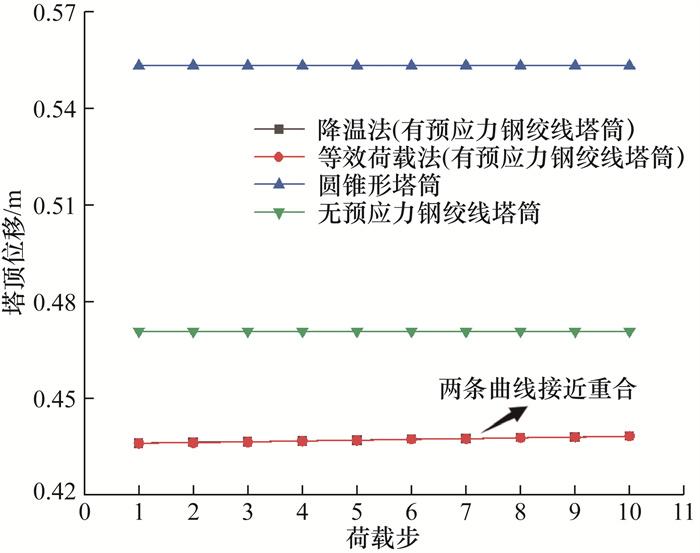
新型塔筒采用C50强度等级混凝土,钢绞线的横截面积Ap为0.011 m2。采用等效荷载法和降温法分别在新型塔筒上施加不同的预应力,其对应的荷载步如表 7所示。
表 7 等效荷载法与降温法等效模拟预应力 |
| 荷载步 | 等效荷载法 | 降温法 | ||
| 有效预应力值σ/MPa | 端部集中压力Npe/kN | 降温值ΔT/℃ | ||
| 1 | 165.8 | 7 293.0 | 33.0 | |
| 2 | 153.0 | 6 732.0 | 30.0 | |
| 3 | 140.2 | 6 171.0 | 28.0 | |
| 4 | 127.6 | 5 610.0 | 25.0 | |
| 5 | 114.8 | 5 049.0 | 23.0 | |
| 6 | 102.0 | 4 488.0 | 20.0 | |
| 7 | 89.2 | 3 927.0 | 16.0 | |
| 8 | 76.6 | 3 366.0 | 15.0 | |
| 9 | 63.8 | 2 805.0 | 13.0 | |
| 10 | 51.0 | 2 244.0 | 10.0 | |
4.2 静力学分析
4.3 模态分析
为了避免共振引起的振动,风塔的固有频率f1st需要与旋转转子引起的频率f1P和叶片通过频率f3P充分分离。塔筒的一阶固有频率应该避免这2个频率,容差为5%[24],
5.0 MW风机风轮额定转速12.1 r/min,则1 P频率为0.202 Hz,3 P频率为0.606 Hz,由式(4)可得
经过验证可知,传统圆锥形塔筒一阶固有频率0.402 Hz、无预应力钢绞线的新型塔筒一阶固有频率为0.430 Hz,以及表 8所示的不同预应力水平时新型塔筒的一阶固有频率,均满足频率设计要求。有预应力钢绞线新型塔筒的一阶固有频率比无预应力的新型塔筒最大提升7.6%。
表 8 不同预应力水平对应的新型塔筒固有频率 |
| 预应力水平σ/MPa | 一阶固有频率f1st/Hz |
| 165.8 | 0.463 |
| 153.0 | 0.459 |
| 140.2 | 0.455 |
| 127.6 | 0.451 |
| 114.8 | 0.450 |
| 102.0 | 0.448 |
| 89.2 | 0.441 |
| 76.6 | 0.438 |
| 63.8 | 0.437 |
| 51.0 | 0.432 |
4.4 线性与非线性屈曲分析
4.4.1 线性屈曲分析
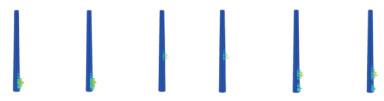
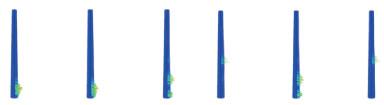
4.4.2 非线性屈曲分析
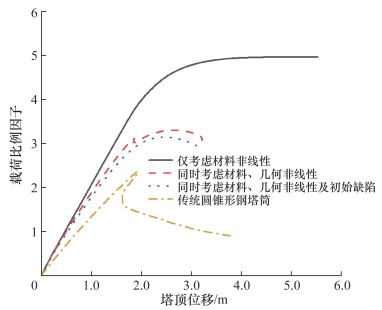
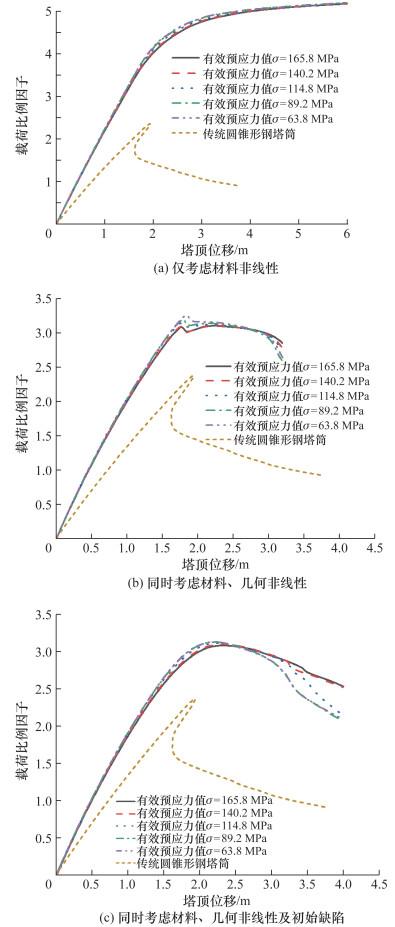
表 9 有预应力钢绞线与无预应力钢绞线的新型塔筒载荷比例因子峰值 |
| 有效预应力值σ/MPa | 仅考虑材料非线性时LPF峰值 | 考虑材料、几何非线性时LPF峰值 | 考虑材料、几何非线性及初始缺陷时LPF峰值 |
| 165.8 | 5.180 | 3.319 | 3.147 |
| 140.2 | 5.185 | 3.322 | 3.149 |
| 114.8 | 5.187 | 3.337 | 3.213 |
| 89.2 | 5.199 | 3.383 | 3.289 |
| 63.8 | 5.203 | 3.443 | 3.297 |
| 无预应力钢绞线新型塔筒 | 4.973 | 3.306 | 3.145 |
首先,从表 9可知,添加预应力钢绞线后新型塔筒载荷比例因子相较于无预应力钢绞线塔筒, 在仅考虑材料非线性,同时考虑材料、几何非线性,同时考虑材料、几何非线性及初始缺陷时最大提升分别约4.6%、4.1%、4.8%。其次,分别观察图 23a、23b、23c可知,图中不同预应力水平下曲线近乎重叠,这表明仅考虑材料非线性,同时考虑材料、几何非线性,同时考虑材料、几何非线性及初始缺陷时,不同预应力水平对载荷比例因子峰值影响较小,改变预应力的大小对新型塔筒屈曲能力的提升不明显。图 23a、23b、23c这3个图相比较而言,同时考虑材料、几何非线性及初始缺陷时(图 23c)新型塔筒的载荷比例因子最小,这一计算结果更接近工程实际[26]。
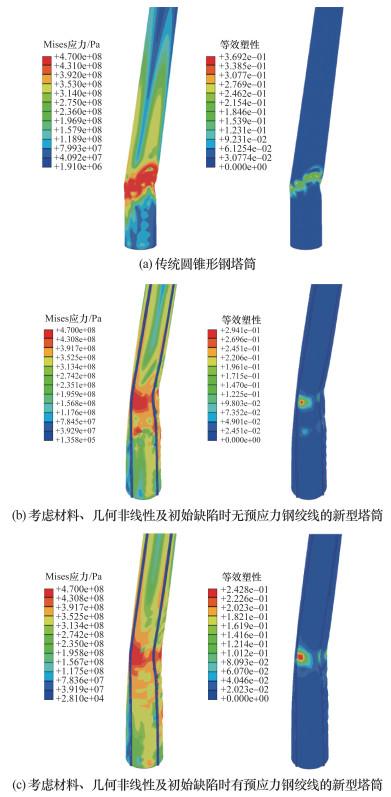
研究表明[27],提高预应力水平有助于提升钢管混凝土屈曲性能。然而,组合后的新型塔筒,考虑整体结构屈曲时,其结构薄弱部位仍取决于钢塔筒本身。这一仿真结果表明,对钢管混凝土柱添加预应力钢绞线并不能决定性地提升新型塔筒的屈曲性能。根据本算例结构,建议在实际施工中预应力的取值不超过63.8 MPa为宜。
5 结论
本文通过研究分片式钢混塔筒结构主要设计参数对结构力学性能的影响,确定新型塔筒结构选型,再对比分析无预应力钢绞线和有预应力钢绞线新型塔筒与传统圆锥形塔筒在静力学性能、模态特征、弹塑性性能以及屈曲性能4个方面的差异,可得出以下结论:
1) 塔筒半径对静力性能和模态影响最大,塔筒壁厚的影响次之,混凝土等级对新型塔筒静力学性能和基频影响最小。
2) 相同参考载荷作用下,圆锥形塔筒与新型塔筒均处于弹性工作阶段。与传统圆锥形塔筒相比,无预应力的新型塔筒的最大Mises应力减少了10.24%,塔顶位移减小了14.89%,用钢量减少了9.51%,一阶固有频率满足频率要求,最大提升7.5%;施加预应力后,比无预应力时,结构最大Mises应力继续下降0.36%,塔顶位移进一步减小6%,结构的一阶固有频率最大提升7.6%。
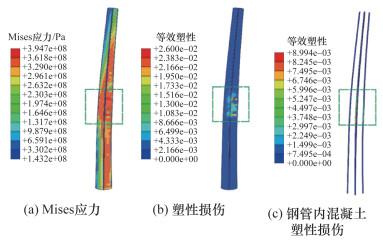
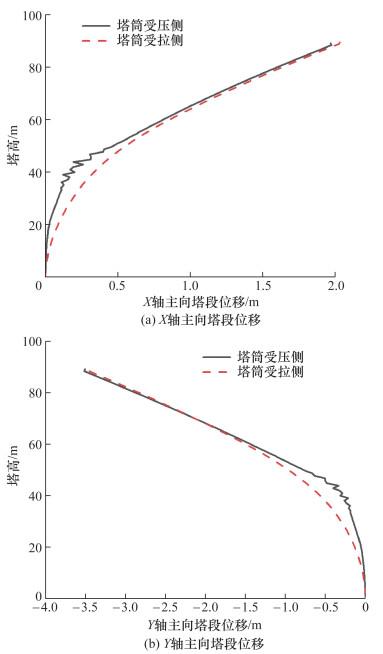
3) 静力弹塑性分析可以有效地反映结构在极限载荷作用下的变形性能。新型塔筒和圆锥形塔筒的薄弱部位都出现在塔段6,即塔高1/2处,无预应力的新型塔筒抗弯极限承载力是圆锥塔筒的1.15倍,添加预应力钢绞线后,抗弯极限承载力可进一步提高6.5%。
4) 相比传统圆锥形钢塔筒,有无预应力钢绞线的新型塔筒的屈曲性能都有明显提升,在添加预应力钢绞线并改变有效预应力值的情况下,相比无预应力时,新型塔筒的屈曲性能并未得到显著提升。就新型塔筒而言,分片塔筒自身特性在整体屈曲行为中起主导作用。从临近屈曲状态来看,有无预应力的新型塔筒的初始屈曲都发生在结构薄壁部位即分片塔筒上,随后导致结构整体屈曲。


