

为研究复杂情况下的热声耦合问题,首先需要对火焰-声波相互作用(flame-acoustic interaction)的过程进行研究。在半封闭通道/管道中传播的火焰是一种最为直接且简单的火焰-声波相互作用的研究对象[6-8]。在半封闭通道内,火焰受到初级不稳定性(primary instability)的影响而产生振荡,同时压力幅值被放大。在压力振荡幅值达到足够大时,将产生二次不稳定性(secondary instability),通常还伴随着火焰前锋的参量不稳定性(parametric instability)。为理解初级不稳定性的产生机理,研究者已做了大量的工作,以下是对产生初级不稳定性机理的概述。主要包含2类:压强耦合机理[6](即压强直接影响化学反应热释放)和速度耦合机理[9](即声波影响火焰前锋面积从而影响化学反应热释放),而压强耦合强度一般远小于速度耦合[10]。
以上提及的2种理论都是一维/准一维的模型,无法描述真实的更为复杂的火焰形态。针对管内传播的火焰,已有较多工作探讨了火焰形态变化给振荡过程带来的问题。Dubey等[11]首次观察到半开放垂直管道内火焰振荡模态的变化现象,即在火焰从开口端向闭合端传播过程中,压力脉动的频率会从高阶谐波转变为低阶谐波;并认为这种模态转变源自火焰前锋上的参量不稳定性,这些不稳定性表现为火焰前锋上出现小尺度褶皱,且其振荡周期刚好是声波振荡周期的2倍。Petchenko等[12]的研究显示,在狭窄通道(毫米级)内的振荡现象与实验室常规尺寸管道(厘米级)存在许多不同的物理现象。例如观察到了剧烈的火焰形态变化,但是没有直接观察到参数不稳定性,这一观点也得到了Dubey等[8]的实验验证。Veiga等[13]通过实验研究了狭窄通道内热声耦合过程中火焰形态呈现出的复杂变化,并讨论了影响火焰从初级不稳定转变到二次不稳定的决定性因素。Jimenez等[14]指出,在半开放微通道内的火焰,其形态会由对称形态(类似于郁金香火焰)转变为非对称形态,且非对称形态往往更为稳定。同时火焰形态是一项不可忽略的因素,对称形态和非对称形态的火焰在热声耦合方面存在差异。然而以上提及的文献并没有研究另一个更基础的问题,即火焰为什么会自发地产生形态变化,导致火焰形态改变的因素与压力脉动之间存在何种耦合关系。
近年来,模态分解技术在燃烧领域得到了广泛应用,用于从能量和动力学角度提取场的主要特征。Li等[15]运用本征正交分解(proper orthogonal decomposition, POD)和动模态分解(dynamic mode decomposition, DMD)探究了在固体燃料冲压发动机燃烧器中的非线性燃烧不稳定性的流动特性。赖安卿等[16]对比了POD和DMD方法对燃烧室中火焰脉动特征描述上的差异性。Boulal等[17]通过谱本征正交分解(spectral proper orthogonal decomposition, SPOD),研究了后向台阶燃烧室中多种流动不稳定和声波之间的复杂耦合。SPOD是一种较新的后处理技术[18],能够提取不同频率下的模态信息,有助于探究火焰脉动频率信息与火焰形态之间的关系。本文着重应用POD和SPOD来探究火焰在狭长通道内的振荡。
本文采用数值模拟计算,探讨火焰在二维狭长通道中传播时初级不稳定性阶段的问题。首先介绍了数值方法,然后介绍了POD/SPOD的基础知识,接着讨论火焰前锋褶皱的问题,并结合POD/SPOD的结果分析其物理意义。
1 数值方法
其中:ρ为密度;t为时间;xi为空间坐标;Y为预混气体组分;R0为普适气体常数;W为分子摩尔质量;μ为动力黏度系数;内能ε=QY+CvT;焓${\bar h}$=QY+CpT, 其中Q为化学热释放, Cv和Cp分别是定容和定压比热容,T为温度;Sc为Schmidt数,是无量纲参数,Sc=μ/ρDm,其中Dm为质量扩散系数。应力张量τij和能量扩散qi为
其中:Pr为Prandtl数,是无量纲参数,Pr=μCp/λ,其中λ是热导率。
单步不可逆一阶Arrhenius化学反应速率定义为
其中:Ea为化学式能,tR为化学反应时间。
本文假设Pr=0.75;μ=1.7×10⁻⁵N·s/m2;Lewis数(Le) 为Sc和Pr的比值,取值为1(本文不考虑热扩散不稳定);Q可表示为Q=Cp (T2-T1),其中T1和T2分别表示未燃区和已燃区的温度,并设置T1=300 K;热膨胀比定义为Θ=ρ1/ρ2=T2/T1,本文取Θ=8,该值接近碳氢燃料的热膨胀比[23]。理想预混气体的W=0.029 kg/mol(与空气接近),Cp=7R0/2W,Cv=5R0/2W。标准大气压p1=1 bar。定义初始Mach数Ma=SL/c1,其中c1是未燃气体中的声速,可以通过$c_1=\sqrt{\gamma R^0 T_1 / W}$ 计算得到,其中γ是热容比,γ=Cp/Cv=1.4;SL是平面层流火焰速度。为实现较为明显的火焰振荡[6],设定初始Ma为0.003,也即初始火焰速度为102 cm/s。最后,通过特征值匹配的方法即可求得化学反应特征时间tR。
扩散火焰厚度定义为δL=μ/(ρ1 PrSL)。在本研究中,Peclet数(Pe)可被定义为无量纲通道宽度,Pe=D/δL,其中D为通道宽度,D≡2R,R称为半宽。本文仅以案例Pe=70, 通道长度L=2 000δL为例展开讨论。此外,定义无量纲时间$\widetilde{t}$ =tSL/R,无量纲温度$\widetilde{\theta}$ =(T-T1)/(T2-T1),无量纲化学反应速率$\widetilde{\omega}_{\mathrm{R}}=\dot{\omega}_{\mathrm{R}} / \dot{\omega}_{\mathrm{R}, \max }$ 。燃烧速率Uw的计算表达式为
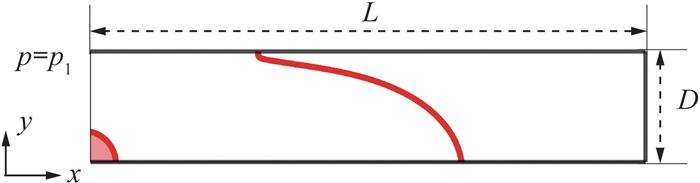
本文采用基于单元中心的有限体积法。使用均匀网格,网格尺寸为dx=dy=0.25δL。一般情况下,扩散火焰厚度比实际火焰厚度小很多。网格无关测试(见表 1)表明该网格尺寸满足要求。这里测试案例的参数选为L=900δL,Pe=40和Θ=8以及Ma=0.003,网格大小从0.125δL倍增到1.0δL。对不同网格大小计算案例的$\widetilde{t}$ =1.83时刻处的燃烧速率进行了提取。其相对变化定义为ΔUw, i/Uw, i=(Uw, i-Uw, i-1)/Uw, i,其中i是表格行数。
表 1 网格无关测试 |
| Δx/δL | Uw/SL | ΔUw/% |
| 1.000 | 1.798 | — |
| 0.500 | 2.071 | 15.17 |
| 0.250 | 2.139 | 3.32 |
| 0.125 | 2.156 | 0.75 |
使用了虚拟网格方法对边界条件进行处理。基本的数值格式如下:采用特征值方法对对流项进行离散,通过三阶的迎风格式重构网格壁面值。扩散项则采用二阶中心差分格式。时间推进使用三阶Runge-Kutta法,而时间步长通过CFL(courant-friedrichs-lewy)数来控制。关于数值方法的更详细信息可参见文[21]。
2 本征正交分解和谱本征正交分解
其中:Φi(x)被称为POD模态,ai是对应时间系数。一般情况下,空间点的数量n远大于时刻数m,因而通常采用“快照法”POD以减少计算。其基本算法思路如下:
首先,计算场信息的相关矩阵C,其大小为m×m。
然后可计算相关矩阵的特征值和特征向量。
将特征值进行从大到小的排列:Λ=Λ{λ1>λ2>…>λm}。为获取空间系数,可将场矩阵投影到特征向量方向,即Φ=UTA。因为特征矩阵A是正交的,因此有U=AΦT,进而也就找到了一种将场信息进行正交分解的形式。由于已经将特征值进行了大小排序,因此模态Ui的能量随着模态数的增加而减小。
然后通过频率信息对$\hat{\boldsymbol{U}}^{(j)}$ 进行整理,对于第k个频率,
对每个频率元素进行交叉谱密度(cross spectral density,CSD),矩阵计算。
其中:W被称为权重矩阵,“*”表示复共轭。W的选值不会改变SPOD频谱,具体计算方法可参见文[27]。本文使用了单位矩阵作为W。最后,对CSD矩阵进行特征值分解。
其中:Φk被称为第k个频率所对应的SPOD模态,Λk是对应特征值。Λk关于频率的分布被称为能谱图(energy spectrum)。
3 分析与讨论
3.1 火焰前锋褶皱分析


3.2 POD结果分析

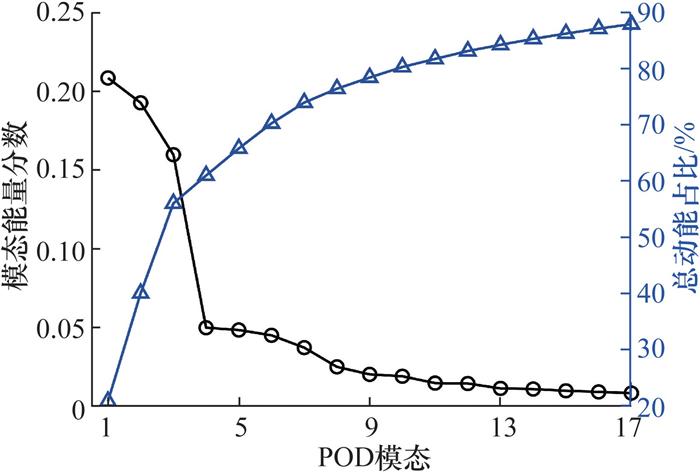
图 5中第1~4个POD模态的分解系数随时间的变化如图 7所示。由图可知,前3个模态的分解系数振荡周期基本一致,且彼此之间存在相位差,说明前3个模态是成组的(paired)[32]。而第4个模态具有更短的振荡周期,是另一独立模态。因此前3个模态实际上是同一种模态在不同时刻的表现,这反映了某种周期性运动[31]。同时,通过测量发现前3个模态的拟序结构的波长约为57δL,与统计结果(见图 4)十分接近。因此,前3个模态反映了由流动不稳定引起的褶皱沿着火焰前锋呈现出周期性运动的特性[20];相比之下,第4个模态的拟序结构更小,尺寸大致为28~56δL。此外,高阶模态所刻画的结构更加复杂,对火焰前锋的复杂运动的贡献较小。

研究这些火焰振荡行为的频率信息也十分必要。半封闭狭长通道内火焰的固有频率(eigenfrequency)可以通过理论计算得到。假设火焰前锋是将已燃气体和未燃气体分隔的自由面,可视为一个密度断面,则无量纲固有圆频X0可以通过以下方程计算得到[6]:
其中:无量纲固有圆频定义为X0=ω0L/c1;ω0为有量纲的固有圆频;此外,还定义了无量纲圆频ω ~ =ωL/c1;r为火焰前锋相对位置,r=x/L。通过数值方法求得的解X0=X0(r, N)是关于火焰前锋位置和模态数的函数。例如N=1被称为基频,N=2被称为第一谐频,以此类推。
同时测量了通道封闭端端口中心处的压力脉p′,并对p′进行了短时Fourier变换,以获取其随时间变化的频谱特征。为了获得最高的频率分辨率,使用了Welch窗口,并将重叠度设置为99%。为了便于将理论计算值与频谱结果进行比较,根据火焰前锋位置的时间平均值进行转换[22],将式(16) 的计算结果转化为随时间变化的形式,即X0=X0 (t, N)。压力信号及其频谱信息随时间的变化如图 8所示。由图可知,在$\widetilde{t}$ =12.5之前,压力振荡幅度大致在0.8 kPa以下,这种幅值的振荡对应于实验提到的初级不稳定性[7, 10]。在时刻$\widetilde{t}$ =12.5,压力振荡幅度迅速增加,最终超过2.0 kPa,这对应于二次不稳定性[7, 10]。在考察的时间段内,火焰处于初级不稳定性阶段,压力振荡频率基本属于基频模态,而第一谐频频率占比较少。

3.3 SPOD结果分析
温度场的SPOD计算结果如图 9所示。其中图 9a是能量谱的分布,横坐标是无量纲的圆频率。可以清晰地观察到频率的峰值,这里提取了前4个峰值的模态信息。图 9b—9c对应于基频的SPOD模态,图 9d—9e则是第一谐频对应的模态。图 9b的结果与POD的第一模态结果非常相似,它们都描绘了由流动不稳定引起的褶皱的周期性运动。值得注意的是,压力脉动频率是随火焰前峰位置移动而逐步变大的。因此,图 9b描述的是接近$\widetilde{t}$ =5.6处的基频模态,其拟序结构波长约为64δL,而图 9c对应的则是更接近$\widetilde{t}$ =12处的基频值,其拟序结构波长约为30~55δL。因此,我们可以得出以下结论:随着火焰的传播,火焰前锋生成的褶皱尺寸随时间逐步减小。这结论和Gonzalez[31]基于Rayleigh-Taylor不稳定线性理论的定性分析结果一致。

以下对比2种模态分解的结果。与POD不同的是,SPOD能够提取出每个频率对应的模态,而POD的模态可视为SPOD不同频率模态的线性叠加。对比图 9和图 5,可以发现POD的前3个模态主要是由SPOD在$\widetilde{\omega}$ =1.92的模态组成的,而POD的第4个模态主要由SPOD在$\widetilde{\omega}$ =3.64的模态组成。图 9d—9e中对应的SPOD第一谐频模态具有更低的能量,其刻画的拟序结构尺寸与图 5中模态10和模态15的较为接近。因此,POD的较高模态往往也对应着SPOD的较高频率下的模态。文[24]对于高阶模态的物理意义进行讨论后指出,高阶模态往往不描述某一实际结构,而更多的是反映了与低阶模态结构相关的附加信息。此外,高阶模态的拟序结构大小往往取决于谐波频率相对于基频频率的大小。对于SPOD而言,如果谐波频率是基频的2倍,那么谐波对应的结构大小大致是基频对应结构的一半。

4 结论
本文通过数值模拟计算,研究了半开放通道内火焰声波耦合的过程。并采用POD/SPOD方法提取了火焰前锋附近温度场在热声耦合过程中的主要结构。本文主要结论如下:
1) 在初级不稳定阶段,非对称火焰的前锋上出现了许多褶皱,并观察到了褶皱的周期运动。经统计,这些褶皱波长的值与DL不稳定性线性理论的最大增长率对应的波长接近。
2) POD的前3个模态描述了褶皱沿火焰前锋运动的特性,这个过程类似于DL不稳定性的非线性阶段。POD的更高模态反映了更为复杂结构的信息。
3) SPOD的优势是能够提取出不同频率下火焰振荡的主要特征。SPOD结果显示,褶皱的周期性运动频率接近通道的基频值。而基频的值随着火焰传播逐渐增大,此时基频对应的模态的拟序结构减小。SPOD的谐频模态与POD的高阶模态相似,反映了更复杂的流场信息。同时,在SPOD的高频模态中发现了微弱的涡。
本文结论有利于理解热声振荡模态和频率之间的关系,可为热声不稳定的控制提供借鉴意义。在下一步的研究中将考虑复杂化学机理,并结合动模态分解(DMD)方法进一步分析火焰振荡的问题。


