

环境空气可以分为室(或称建筑物)内空气和室外空气, 室外空气环境又常被简称为“大气”。本文关注的地表土壤氡析出内容属于室外大气环境范畴。在铀尾矿、伴生放射性矿及部分天然放射性物质(naturally occurring radioactive materials, NORM)现场以及在生产或退役等不同工况或场景下, 氡释放量(radon releases)或称表面氡析出率(单位时间单位面积氡析出活度, Bq/(m2·s))常作为回填土或覆盖层工程设计或工程评价的重要参数。国际原子能机构(International Atomic Energy Agency, IAEA)早年曾以铀尾矿为关注对象颁布了TRS333号技术报告《Measurement and calculation of radon releases from uranium mill tailings》 (铀尾矿氡释放的测量与估算)[4]。此后, 伴随氡测量技术不断发展, 氡析出模型的不断完善, 特别是其在不同场景中应用经验的不断累积, IAEA于2013年又颁布了TRS474号技术报告《Measurement and calculation of radon releases from NORM residues》 (NORM废渣氡释放的测量与估算)[5]取代TRS333号技术报告, 其中包括了对影响废渣中氡释放因素的描述、氡浓度及氡析出率的测量和计算方法以及废渣覆盖层效果评价的模型等内容, 同时也明确指出TRS474报告涵盖铀尾矿场景, 从而拓展了技术报告的适用领域。
本文在阐述氡析出过程的物理机理的基础上, 分析了氡析出过程的影响因素, 介绍了土壤表面氡析出率测量方法, 最后对氡析出率这一物理量的应用进行尝试性探讨。
1 土壤介质中氡的运移机制
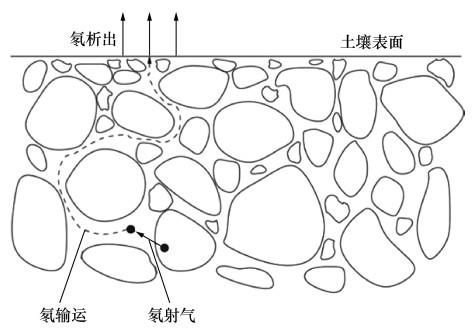
1.1 射气过程和射气系数
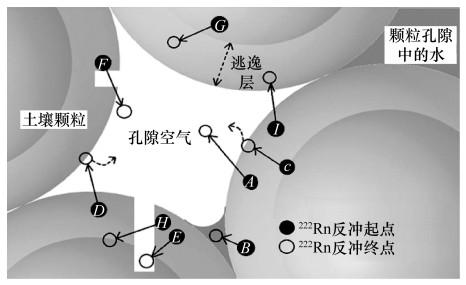
表 1 222Rn在几种介质环境中的反冲射程[5] |
| 介质类型 | 密度/(g·m-3) | 最大射程/nm |
| 空气 | 1.58×10⁻³ | 53×10-3 |
| 水 | 1.00 | 77 |
| 石英 | 2.65 | 34 |
土壤介质中可移动的氡量与介质内226Ra衰变产生的氡总量之比定义为射气系数(emanation coefficient), 是表征某一种类的岩石土壤中具有多少可移动的氡的重要参数, 无量纲。
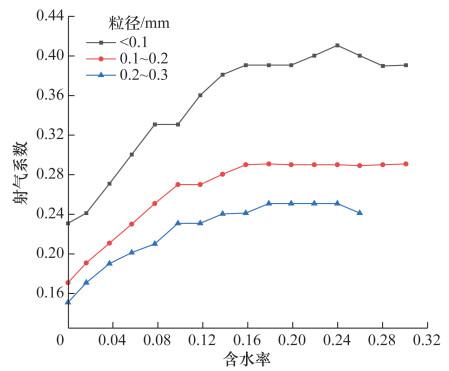
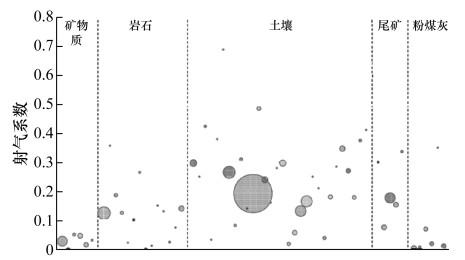
1.2 运移过程和扩散系数
1.2.1 氡的运移过程
氡从土壤介质颗粒中经射气过程进入孔隙空间后, 就开始了扩散和迁移, 直至土壤-大气界面, 此过程称为运移过程。氡运移过程可以通过2种物理机制进行, 一种是由浓度梯度导致的分子扩散(molecular diffusion), 另一种是空气压差导致的对流(advective flow)。土壤介质内部在稳态环境下通常不发生对流, 存在断层、裂痕和地质板块运动发生挤压或塌陷等特殊条件下才有对流发生。故在此不讨论对流。
氡的扩散过程可以用Fick第一定律来描述, 氡扩散通量密度与其浓度梯度成线性关系, 在均质介质中, 可以简化表达为
其中: J为扩散过程中产生的氡活度通量密度(radon flux density), Bq/(m2·s); 负号表示氡是从高浓度向低浓度扩散; ∇C为氡在土壤气体中的活度浓度梯度, Bq/m4; DM为氡的分子扩散系数, m2/s。
在土壤等多孔介质中, 由于孔隙结构的存在, 氡的扩散路径比较曲折, 移动速度或通量比在均匀介质(如空气)中小。引入孔隙度n和孔隙曲折系数τ这2个参数, 可将式(1)修正为
由于τ和DM的乘积为孔隙流体的扩散系数D, 因此式(2)可表达为
1.2.2 氡的扩散系数
式(3)中的D可作为表征氡在岩石土壤介质中运移过程的核心参数, 其数值大小受土壤类型, 土壤孔隙度以及孔隙结构、土壤含水率等因素的共同影响, 其中影响力最大的因素是土壤含水率。在土壤含水率小于0.25时, D的变化相对较小, 大多在9×10⁻⁷~7×10⁻⁶ m2/s [5]。虽然通过经验公式或数学模型可以推算出D, 但IAEA还是建议在尾矿回填或覆盖等相对复杂的现场, 最好通过实测以确定D。
1.3 析出过程和影响因素
1.3.1 氡的析出和表达
氡气从岩石土壤深处扩散运移至地表浅层, 最后穿过土壤-大气界面释放进入大气的过程为析出过程。表面氡析出率可用于衡量土壤面源对大气中氡的贡献大小, 是评价铀尾矿和NORM场所对大气环境氡贡献的重要参数。
在只考虑土壤中氡扩散迁移运动的前提下, 氡在土壤中的运移方程[8]为
其中: C(x)为土壤中距离土壤-空气界面x(m)深度处孔隙空气中的氡浓度, Bq/m3; A为单位时间、单位体积土壤介质中产生的可移动氡的活度, Bq/(m3·s), A=λρRE, 其中R为土壤介质中226Ra含量, Bq/kg, ρ为介质密度, kg/m3, E为射气系数(无量纲); λ为氡的衰变常数, s-1; De为氡在土壤介质孔隙中的扩散系数, m2/s, 在干燥土壤介质中, De可用氡在空气中的扩散系数DMA代替, 在含水土壤介质中,
其中m为介质的质量含水率[9]。
对式(4)求解并结合式(3), 可得到土壤介质表面的J为
其中C0为近地表空气中的氡浓度。
若土壤介质表层还有厚度为z(m)的覆盖层, 且覆盖层中的氡产生率忽略不计, 则覆盖层表面的氡通量Jc为[5]
其中Dc为覆盖层的扩散系数。由式(6)可知, Jc随着z的增加呈指数衰减。可利用式(6)估算所需覆盖层的厚度, 或评估已有覆盖层的作用。
1.3.2 氡析出影响因素
由于氡来自镭的衰变, 所以土壤中镭含量与氡析出率呈正相关, 即镭含量越高氡析出就越强[10]。

2 土壤氡析出率测量
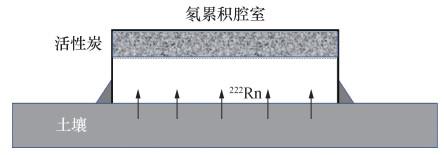
土壤表面氡析出率的现场测量方法通常包括累积测量法、流气式测量法和活性炭吸附法。
2.1 累积测量法
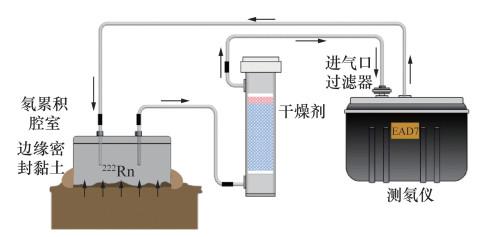
假定氡累积腔室内t时刻氡浓度为C(t), 可建立t时刻氡浓度变化规律[14]。
其中: S为腔室覆盖的面积, m2; V为累积腔室和氡测量系统的有效容积, m3; λe为累积腔室的有效衰变常数(λ、反扩散系数和泄漏系数之和)。求解可得
当测量时间比较短, 即$\lambda t \ll 1$时, 式(8)可简化为
通过测量不同时刻下的氡浓度, 并用式(9)对数据进行线性拟合处理, 就可以得到斜率$\frac{J S}{V}$, 进而可以计算得到J。
土壤表面氡析出率现场测量的常用方案是通过采样泵将测氡仪与氡累积腔室联通循环, 以10 min作为一个测量周期, 每个待测点测量5~6个周期, 通常只要累积时间不超过60 min, 反扩散就可忽略, 由此得到5~6个氡浓度数据基于式(9)拟合计算得出J。析出率测量装置既可以是基于闪烁体的Lucas闪烁室, 也可以是基于静电收集的半导体探测器。
2.2 流气式测量法

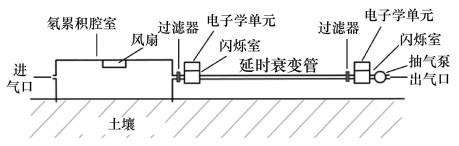
根据流气式测量法的工作原理, 可建立t时刻氡浓度变化规律[12]。
求解可得
其中ν为腔室内气体的换气速度, m3/s。由于$\lambda \ll\frac{\nu}{V}$, 当t足够大时, 式(11)可简化为
由式(12)可知, 采用流气式测量法时饱和氡浓度与ν成反比。因此, 在流气式测量中, 既要保持一定的ν以防止累积氡浓度过高; 又要注意ν不能太高, 防止氡浓度过低, 增大不确定度, 同时过高的ν还会带来气压差, 使得J增大。
2.3 活性炭吸附法
3 氡析出率量值的应用探讨
辐射防护与环境保护领域在早年多关注铀矿山、铀尾矿等工作场景, 目前则更多面对的是伴生放射性矿和NORM现场。氡从放射性残渣和土壤介质表面向大气环境的释放过程会受到工程设计、安全监管和环境评价等多方面的考量, 从关键人群组-公众的附加剂量出发, 氡释放总量应是十分受关注的核心指标之一。
氡释放总量通过面积与J相乘后对时间积分获得, 但在实际工作中, 人们更关注的是J, 因为J的测量更为方便, 可直接用于评价。美国环境保护署(U.S. Environmental Protection Agency, EPA)于1983年颁布并于1995年修订的《Health and environmental protection standards for uranium and thorium mill tailings 》[16]中规定了0.74 Bq/(m2·s)为J的限值。此限值的计算依据可能是下风向地区关键人群所受的来自铀钍矿的附加剂量, 可以依据关键人群居住地与现场的距离、局域地区气象参数、大气扩散参数和模型进行估算。随着铀钍矿现场的多样性和复杂性增强, 此限值针对伴生放射性矿开发利用中确保公众辐射安全的作用已存在不确定性, 其普适性也有待提升。
IAEA于1992和2013年先后颁布的TRS333号和TRS474号技术报告中, 包括了对铀尾矿及伴生放射性矿相关的放射性废渣中有关氡排放的基本理念。由于测量技术和预测估算模型的快速发展以及现场经验的不断积累, TRS474号报告所涉及范围从铀尾矿扩展到了NORM, 报告的主要内容围绕氡从介质中析出释放的机理及影响参数; 核心参数如射气系数、扩散系数或扩散长度等的测量和估算; 现场J的测量方法的介绍等, 并指出了J等参数是场所比较、回填或覆盖体等工程设计和工程效果评价的重要参数, 但没有出现J的具体参考限值, 也没有提及对J通过制定限值来进行控制和管理。
因此, 仅控制析出率, 不控制析出面积大小, 则无法控制氡释放总量, 也无法准确评估尾矿、废渣等对关键人群的辐射剂量影响。
4 结论与展望
放射性惰性气体氡从岩石土壤向大气环境扩散析出的物理过程受多种因素影响, 氡释放总量的估算、比较和评价是辐射环境和工程设计评价的重要考量因素, 而氡析出率因便于现场测量, 一直是此领域的核心参数。经过近一个世纪的深入研究和实践, 研究者们对氡的扩散析出机理和影响因素的认识日趋完善, 同时发展出了用于不同目的的氡析出率的测量方法。
由于尾矿渣及放射性伴生矿现场具有复杂性和多样性, 即使现场氡释放量可以较为准确地进行测量与计算, 但其与关键人群居室内氡浓度之间几乎不存在定量的确定性关联, 很难用于估算来自伴生放射性矿贡献的关键人群氡暴露剂量。关键人群室内氡暴露剂量和健康风险只能通过室内氡水平测量来估算和控制, 这一观点在国际放射防护委员会于2019年颁布的《Radiological Protection from Naturally Occurring Radioactive Material(NORM)(ICRP, 2019)》[17]也有相同的表述。因此, 氡析出率虽然是现场需要测量计算的重要参数, 但不适宜设定固定限值进行监管。


