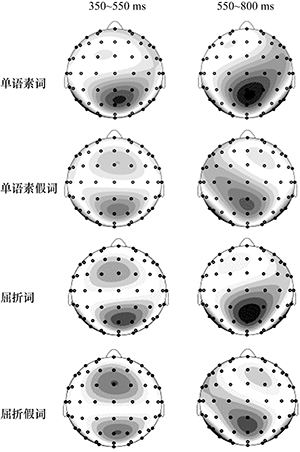
该文使用事件相关电位(event-related potentials,ERPs)以词汇判断的实验范式探讨了维吾尔语形态复杂词加工的认知神经机制。实验刺激材料设计了4个因素,分别为单语素词(没有带任何词缀)、单语素假词(真词中替换2个音构成)、屈折词(单语素名词后加格附加成分构成)、屈折假词(假词干真词缀的词)。实验材料的长度严格控制在平均词长为6个字母。脑电实验数据显示,屈折词和屈折假词在350~550ms时间窗口出现比较明显的N400效应。其中屈折假词的N400效应是被试加工假词时词汇搜索失败的标志,但屈折词的N400效应则反映了词汇通达时词干和词缀之间的交互作用。另外还发现单语素词、屈折词和屈折假词这三者的认知神经基础也不同。在大脑右半球屈折词引发的负波平均振幅比左半球要大。结果表明:母语为维吾尔语者的被试在加工维吾尔语屈折词时按其语素分解加工,但是加工维吾尔语单语素词时是整体加工及存储的。
Event-related potentials (ERPs) were used to investigate electrophysiological correlates of Uyghur morphological word processing in lexical decision paradigms. Four stimuli were used with monomorphemic words, bimorphemic inflected nouns (case suffix is added to the stem), monomorphemic pseudowords (changing one or two letters in monomorphemic nouns) and inflected pseudowords (changing one or two letters in stems). The mean phonemic length of all the words was controlled to be six letters long. EEG data showed N400 effects for the bimorphemic complex words and pseudowords in the 350-550 time windows. The N400 effects for the bimorphemic pseudoword were demonstrated that subjects failed all lexical searches when processing bimorphemic pseudowords. The effect for the bimorphemic complex words most probably reflects the access and possible interaction of the stems and suffixs. The EEG data also showed the differences in the neurocognitive underpinning that supports monomorphemic words, bimorphemic inflected words and both types of pseudoword processing. The mean amplitudes for bimorphemic words are more negative in the right hemisphere electrodes than for monomorphemic words. The experimental results reveal that native Uyghur speakers represent and access inflected Uyghur words in a morphologically decomposed form, while monomorphemic words are accessed as a single form.
[1] Coltheart M, Curtis B, Atkins P, et al. Models of reading aloud: Dual-route and parallel-distributed-processing approaches?[J]. Psychological Review, 1993, 100(4): 589-608. [2] Post B, Marslen-Wilson W, Randall B, et al. The processing of English regular inflections: Phonological cues to morphological structure[J]. Cognition, 2008, 109(1): 1-17. [3] Mcqueen J M, Cutler A. Morphology in Word Recognition[M]. Oxford: Blackwell Publisher, 1998. [4] Butterworth B. Lexical representation[C]//Language Production. London: Academic Press, 1983: 257-294. [5] Bradley D. Lexical representation of derivational relation[C]//Juncture. Saratoga, CA: Anma Libri, 1980: 37-55. [6] Kempley S, Morton J. The effects of priming with regularly and irregularly related words in auditory word recognition[J]. British Journal of Psychology, 1982, 73(4): 441-454. [7] Lukatela G, Gligorijevi Ac'5 B, Kosti Ac'5 A, et al. Representation of inflected nouns in the internal lexicon[J]. Memory & Cognition, 1980, 8(5): 415-423. [8] Feldman L B. Morphological Aspects of Language Processing[M]. Hillsdale, NJ: Lawrence Erlbaum Associates Inc., 1995. [9] Morton J, Marshall J C. Psycholinguistics 2: Structures and Processes[M]. Cambridge, MA: MIT Press, 1979. [10] Taft M, Forster K I. Lexical storage and retrieval of prefixed words[J]. Journal of Verbal Learning and Verbal Behavior, 1975, 14(6): 638-647. [11] Taft M. Prefix stripping revisited[J]. Journal of Verbal Learning and Verbal Behavior, 1981, 20(3): 289-297. [12] Mackay D G. Derivational rules and the internal lexicon[J]. Journal of Verbal Learning and Verbal Behavior, 1978, 17(1): 61-71. [13] Jarvella R J, Meijers G. Recognizing morphemes in spoken words: Some evidence for a stem-organized mental lexicon[C]//The Process of Language Understanding. New York, USA: Wiley, 1983: 81-112. [14] Caramazza A, Laudanna A, Romani C. Lexical access and inflectional morphology[J]. Cognition, 1988, 28(3): 297-332. [15] Niemia J, Laineb M, Tuominenc J. Cognitive morphology in finnish: Foundations of a new model[J]. Language and Cognitive Processes, 1994, 9(3): 423-446. [16] 玛依拉·亚克甫, 周晓林. 词素效应到底是什么?——来自维吾尔语的证据[J]. 心理学报, 2004, 36(5): 515-524.YAKUP Mahire, ZHOU Xiaolin. What are really morphological effects in lexical processing? Evidence from the Uyghur language[J]. Acta Psychologica Sinica, 2004, 36(5): 515-524. (in Chinese) [17] Hankamer J. Morphological parsing and the lexicon[C]//Lexical Representation and Process. Cambridge, MA, USA: MIT Press, 1989: 392-408. [18] Gürel A. Decomposition: To what extent? The case of Turkish[J]. Brain and Language, 1999, 68(1-2): 218-214. [19] Münte T, Say T, Clahsen H, et al. Decoposition of morphologically complex words in English: Evidence from event-related brain potentials[J]. Cognitive Brain Research, 1999, 7: 241-253. [20] Linares R E, Rodriguez-Fornells A, Clahsen H. Stem allomorphy in the Spanish mental lexicon: Evidence from behavioral and ERP experiments[J]. Brain and Language, 2006, 97(1): 110-120. [21] Weyerts H, Münte T F, Smid H G, et al. Mental representations of morphologically complex words: An event-related potential study with adult humans[J]. Neuroscience Letters, 1996, 206(2-3): 125-128.


