

动力锂离子电池是电动交通载具的能量来源,但是其可靠性高度依赖于工作温度。动力锂离子电池理想工作温度在15~35 ℃之间[1]。若工作温度低于15 ℃,电池放电和充电效率会降低;然而,高于35 ℃时,副反应加剧以及电解液的挥发可能导致电池的循环寿命会缩短以及电池热失控风险增加。因此,必须采取有效的电池热管理系统(battery thermal management system, BTMS),将电池的工作温度实时控制在合理的范围内。
1 单相电池热管理方法
为了更好地理解电池的温度工作范围,图 1展示了动力锂离子电池在各温度工况下的性能。单相电池热管理研究主要涵盖强制空气冷却、自然空气冷却、浸没式液冷和微通道液冷等冷却方式,聚焦新型流道结构、表面结构/材料、强化换热机制和冷却工质。

1.1 空气冷却
表 1 空气冷却研究的代表性文献 |
| 序号 | 作者 | 冷却方式 | 电池型号 | 研究方法 | 结论 |
| 1 | Yang等[13](2015) | 强制冷却 | 26650(LiFeO4) | CFD | 对齐排列时最高温度为34.55 ℃, 而交错排列时为33.83 ℃ |
| 2 | Fan等[14](2019) | 强制冷却 | 18650(LiNiCoMnO2) | Exp. | 2 C放电倍率且风速为4 m/s时,电池温升14 ℃且最高温度只上升5.5 ℃ |
| 3 | Kang等[15](2020) | 强制冷却 | 18650(LiNiCoMnO2) | Exp. & CFD | 呈矩形排列时最高温度为38.06 ℃,并且温差为17.57 ℃ |
| 4 | Mahamud等[16](2011) | 强制冷却 | 圆柱形(LiMn2O4/C) | CFD | Reynolds数(Re)为6.67×10⁴时, 最高温度上升了25 ℃ |
| 5 | Han等[17] (2018) | 强制冷却 | CFD | 传热系数h=150~200 W/(m2·K) | |
| 6 | Li等[18] (2020) | 强制冷却 | 18650 | CFD | 风速为1.6 m/s时,电池平均温度下降到21.35 ℃,且最高温度下降到24.9 ℃ |
| 7 | Sun等[19](2014) | 自然冷却 | 软包 | Exp. | 电池包的最高温度下降1.1 ℃,且最大峰值温度减少大约8.0 ℃ |
| 8 | Lu等[20](2018) | 自然冷却 | 18650 | CFD | 当β =89.81时,电池最高温度为29.45 ℃ |
| 9 | Liu等[21] (2019) | 自然冷却 | 软包(LiMn2O4/C) | Exp. & CFD | 最高温度下降到26.83 ℃且温差下降0.46 ℃ |
| 10 | Zhang等[22] (2023) | 自然冷却 | 棱柱形 | CFD | 相比“Z”形通道,电池最高温度下降2.28 ℃,且温差下降4.36 ℃ |
1.1.1 强制空气冷却
强制空气冷却通过风扇使空气流过动力锂离子电池(组)表面以提高散热效率,相关研究集中在空气的流速流量控制、电池布局和气流优化设计等。
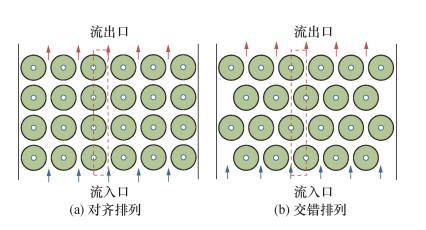
Yang等[13]通过数值模拟研究了圆柱形锂离子电池对齐排列和交错排列(如图 2a和2b所示)风冷效果,发现冷却空气流量在0.013 26 m3/s下,交错排列电池组的单体电池最大温升与纵向间隔(S r)成正比,而对齐排列时二者成反比。Fan等[14]对比了两种排列方式的功耗差异,发现交错排列时流动阻力系数更大,冷却效率随着风速的增加而降低,与对齐排列方式相比功耗增大约23%。Kang等[15]讨论了锂离子电池组排列形状对热特性的影响,通过数值模拟方法分析了电池组在强制空气冷却下的散热效果,发现矩形(2×8)比方形(4×4)排列方式具有较低的最高温度,但后者的温均性优于前者。Yang等[23]采用数值仿真开发了32个动力锂离子电池的二维模型,仿真结果表明增加电池之间的径向距离会使平均温度轻微上升,但有利于电池(组)的温均性。
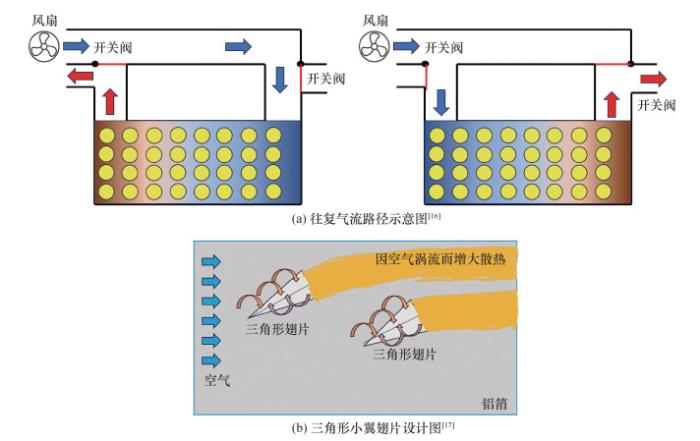
Mahamud等[16]借助数值模拟方法,研究了气流往复周期流动中电池组的温度(见图 3a),发现在120 s的周期内,气流往复流动的单体电池温度比单向流动的电池降低约4 ℃、降幅达72%,电池最高温度减小了1.5 ℃。Na等[24]提出通过电池组内横向划分单体电池建立反向分层气流通道控制电池温度,发现与单向通道相比,反向分层气流通道降低最大平均温差47.6%。Mohammadian等[25]提出了二次通道设计来降低电池最高温度和温差,设计的翅片散热器经三维仿真分析,结果表明冷却效果优于传统电池热管理方法。Dan等[26]设计了一种微热管阵列作为二次通道的热管理方法,仿真结果表明相比于未采用二次通道的风冷电池热管理,该热管理方法的温升和温度波动更小。Han等[17]设计了三角形小翼翅片阵列的涡流发生器(见图 3b),能够在尾流制造空气涡流,由于涡流强化对流换热并破坏近壁面边界层,当空气质量流量达到300~400 m3/h时可保证传热系数提升至150~200 W/(m2·K)。Li等[18]提出了一种具有交错结构的人字形翅片,该结构能够更有效地利用冷热流体之间温差的传热特性,同时有利于提升换热均匀性,在3 C放电倍率下进气速度为0.15 m/s时电池平均温度降低了4.15 ℃。
1.1.2 自然空气冷却
Ye等[31]仿真设计一种空气冷却模型,将电池组装置倾斜5°从而减小气流阻力,在风速6 m/s且环境温度为20 ℃时,观察到电池的最高温度为37.58 ℃,最大温差为2.3 ℃。Yu等[32]开发了一种三叠堆电池组台架开展自然风冷和强制风冷实验,在0.5 C充电倍率下,强制空气冷却的温升为3.1 ℃,明显低于自然空气冷却的温升12.3 ℃,表明强制风冷方式可显著降低最高温度。Severino等[33]开发了一种多目标粒子群优化算法,该算法可通过周期的改进、设计成本的降低以及更好的计算方案,基于电池单元数、单元距离和入口通道位置等参数实现最优电池组设计。该研究发现电池以对角线方向排列可获得更多的空气流量,散热效果更佳;在赛车案例中经过50次优化算法迭代,电池模块中冷却效果最差的一组模块温度达到34.3 ℃,模块间最大温差为8.36 ℃。Li等[34]通过建立多目标优化模型以实现最小体积、低温差、低温度标准差一体化,数值模拟结果表明该系统体积减小了34.2% (从3.281 3×10⁻³ m3到2.158 2×10⁻³ m3),最大温差减小了51.9%(从8.5 ℃减小到4.1 ℃),温度标准偏差减小了70.0%(从4.1 ℃减小到1.2 ℃)。
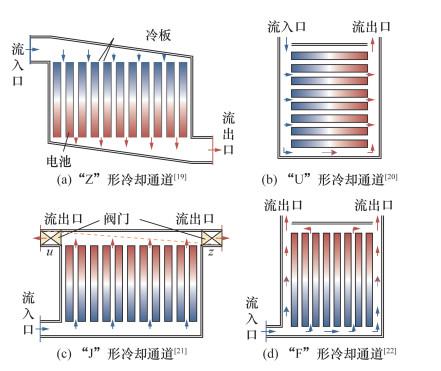
Sun等[19]设计了一种整体呈“Z”形、管道呈锥形的冷却通道入口和出口(见图 4a),借助实验设计(design of experiment, DOE)方法,分析出该方法可以减小流速波动和温度变化,降低总气流压降,适用于自然对流中风速不稳定的情况。额外的孔板结构可以引导空气从主管道流向冷却通道内的小管道,从而使最高温度降低了约1.1 ℃。Lu等[20]设计了一种“U”形(见图 4b)冷却通道,采用顶部进风口和顶部出风口以获得更好的冷却性能,其最大温差比相应的“Z”形设计低3 ℃。此外,Liu等[21]将“U”形和“Z”形设计策略相结合,提出了“J”形冷却通道(见图 4c)。该热管理策略通过在“U”形和“Z”形通道之间切换来控制两个出口阀,改善系统温度均匀性。同时,Zhang等[22]也提出了一种“F”形风冷通道(见图 4d),借助CFD方法研究其冷却性能,并通过实验验证了模拟的准确性。结果表明,出口位置对冷却效果有重要影响。与“Z”形相比,优化后的“F”形的最高温度和最大温差分别降低了2.28 ℃(5.22%)和4.36 ℃(89.33%)。最后,他们在一些气流通道上增加挡板,并改变电池组外壳的顶部转角形状,进一步优化其散热性能。与“Z”形相比,最高温度和最大温差分别降低了2.48 ℃(5.66%)和4.60 ℃(94.26%)。
1.2 液体冷却
空气冷却效果受工质的低比热容和低导热系数等的限制,难以满足高效散热管理需求,液体冷却因此应运而生。本节将重点介绍浸没式液冷和微通道液冷,代表性文献见表 2。
表 2 液体冷却研究代表性文献 |
| 序号 | 作者 | 冷却方式 | 电池型号 | 研究方法 | 结论 |
| 1 | Liu等[35] (2022) | 浸没冷却 | 18650(LiCoO2/C) | Exp. | 4 C放电倍率时最高温度小于40 ℃,且温差小于2.5 ℃ |
| 2 | Satyanarayana等[36](2023) | 浸没冷却 | 18650(NMC) | Exp. | 3 C放电倍率时采用热油冷却的电池最高温度为43 ℃,采用矿物油时为41 ℃ |
| 3 | Wang等[37] (2023) | 浸没冷却 | 模拟热源 | CFD | 氢氟醚-7100作为冷却液, 最高温度小于30 ℃,且h ≈ 100 W/(m2·K) |
| 4 | Tian等[38](2024) | 浸没冷却 | 280Ah(LiFeO4) | CFD | 将冷却液的导热系数和比热容分别提高到0.6 W/(m·K)和1 500 J/(kg·K),在流速为0.03 m/s工况下可使电池模块最高温度分别降低2.78%和6.20% |
| 5 | Patil等[39] (2020) | 微通道冷却 | 软包 | Exp. & CFD | 最高温度小于40 ℃,且温差小于4 ℃ |
| 6 | Wang等[40](2021) | 微通道冷却 | 软包 | CFD | 电池模组的最高温度从38.1 ℃降到35.4 ℃,平均温度从35.6 ℃降到32.8 ℃ |
| 7 | Monika等[41](2022) | 微通道冷却 | 软包 | CFD | 所有通道在3 C放电倍率时平均温度小于40 ℃,但六角形和蛇形通道具有更好的冷却性能 |
| 8 | Wiriyasart等[42](2020) | 微通道冷却 | 18650 | CFD | 电池表面最高温度约为51.26 ℃,且平均温度约为38.15 ℃ |
| 9 | Yin等[43] (2022) | 微通道冷却 | 18650 | CFD | 与无蛇形通道相比,平均壁面温度降低了1.8 ℃,平均Nusselt数(Nu)增加约2倍 |
| 10 | Wang等[44] (2024) | 微通道冷却 | 18650 | CFD | 通过调整通道数量,最高温度减少4.62 ℃,且温差小于5 ℃ |
1.2.1 浸没式液体冷却
氢氟醚、硅油和烃类介质物理性质稳定、不导电、低毒、化学性质稳定、成本低和表面张力特性小,因此成为动力电池特定应用场景的浸没式冷却液。电池浸没式液体冷却的研究重点包括强化传热机理与效率、冷却液选用与开发、热管理系统优化设计和能耗效益等。
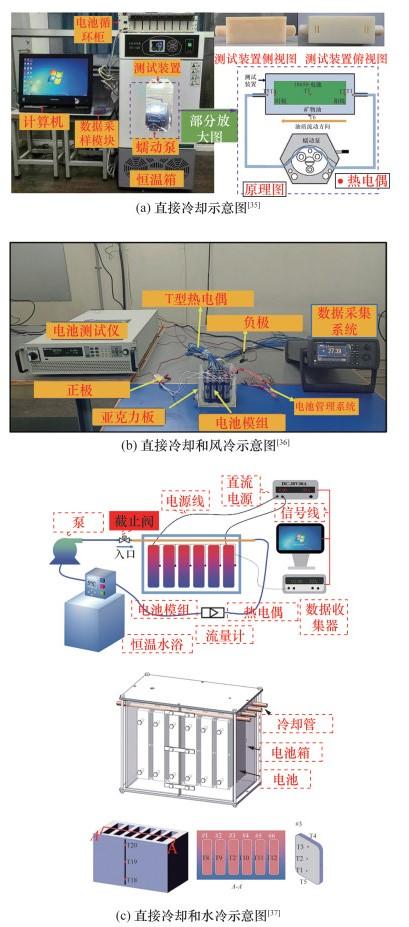
Liu等[35]通过实验研究了动态充放电循环的锂离子电池在矿物油冷却下的温度表征(见图 5a),发现在4 C放电倍率下,因为主导传热机制随电池放电倍率和流体Reynolds数的变化而变化,自然对流的传热效果优于强制对流。Satyanarayana等[36]通过实验观察到在3 C放电倍率下(见图 5b),采用强制空气冷却、导热油冷却和矿物油冷却的电池组的最高温度分别有效降低了43.83%、49.17%和51.54%。Wang等[37]将单相浸没式液冷与水冷系统相结合,通过水冷系统辅助带走浸没冷却液所吸收的电池热量(见图 5c),使得电池最佳温度工作时间相较于单一采用自然对流冷却或单相浸没式液冷分别延长150.3%或45.7%。Tian等[38]通过数值模拟方法发现,在静态流动冷却、强制流动冷却和耦合直接冷却3种模式下,同样的环境温度中强制流动冷却的散热效果是耦合直接冷却的2倍;当电池组间距为3 mm时,强制流动冷却下的散热性能最佳;当流速从0.03 m/s变化到0.1 m/s时,冷却液的导热系数从0.02 W/(m·K)增加到0.4 W/(m·K),使得电池的最高温度分别降低了2.78%和2.59%;当选取冷却液的比热容从原先的700 J/(kg·K)提升到1 500 J/(kg·K)时,电池组的最高温度降低了7.13%。
1.2.2 微通道液体冷却
微通道电池热管理的基本原理是将冷却液引导通过微小、密集排列的通道,快速吸收并带走电池表面产生的热量。其特点在于响应迅速、传热均匀、应用灵活,并易实现紧凑和轻量化,因而微通道电池热管理成为近年来研究的热点。
矩形锂离子电池的微通道性能优化和控制主要包括结构设计和冷却液流量控制等。在流道结构方面,Pan等[45]发现与传统直线形微通道相比,流线型微通道具有更低的压降和更均匀的温度分布,增加通道深度也可以改善传热性能。Rao等[46]提出了收敛的楔形微通道,采用数值模拟方法研究了出口高宽比、流量和分支结构因素对冷板散热性能的影响,发现在3.5 C的放电速率下,当流量为1×10⁻⁴ kg/s时电池温度被控制在45 ℃以内,最大温差减少约35.78%(从7.27 ℃降至4.67 ℃),但同时增加了泵送功率。Patil等[39]设计了基于U形流道的微通道结构(见图 6a),通过使用冷却液流向交错布局实现更均匀的温度分布和更低的平均温度,其中蛇形布局具有更好的温均性[40]。Monica等[41]考察了6种不同的微通道的传热特性(见图 6b),发现蛇形和六边形结构具有更均匀的温均性和更低的平均温度。Yang等[47]发现南瓜形结构具有最高的散热性能;六边形结构的微通道与直线形结构的相比,温度分布更均匀且最大表面温度更低。Salimi等[48]设计了用在软包锂离子电池上的非均匀波浪形微通道冷板,通过数值模拟方法比较了共流和逆流模式下的散热效果,结果表明逆流模式下电池的最大温差会有所降低,其最大平均温差降低73.1%。Zuo等[49]研究了车辆振动条件下微通道冷板的散热性能,重点考察频率、振幅和质量流量对电池温度的影响,发现当振动工况为频率10 Hz、振幅0.8 mm时,最高温度从42.63 ℃下降到38.38 ℃,温差从12.42 ℃下降到9.39 ℃。

圆柱锂离子电池的微通道可通过增加波纹通道与电池表面的接触角,同时增加冷却液质量流量,来优化电池的散热能力和温均性[50];若接触面积过大,则会降低散热性能;增加充放电倍率会导致电池组的最高温度升高,温均性变差[51]。Tang等[52]利用导热块和装有冷却液的扁平管对电池进行冷却,发现增加电池块和接触角会降低电池的最高温度。当梯度接触角增加15°、流体进口速度为0.015 m/s时,在放电过程结束后测得的电池模块温差为2.58 ℃,最高温度为29.47 ℃。Wiriyasart等[42]借助数值模拟方法发现具有非对称流动结构的两层波纹微通道比单层具有更好的散热性能。在双层微通道设计中(见图 6c),电池的最高表面温度比单层降低了27.59%。Fan等[53]基于三重周期最小曲面的不同结构,创建混合流动来改善通道的冷却性能,发现在进口流量为0.003 kg/s时,电池组的最高温度和温差分别比常规直管降低了约9%和59.8%。Yin等[43]发现车辆振动时,在蛇形通道中,平均壁面温度降低了1.8 ℃,且平均Nusselt数提高了约2倍。Sun等[54]利用COMSOL Multiphysics仿真软件设计并优化了一种应用于21700型圆柱锂离子电池的间接微通道液冷系统,借助Kriging近似模型,使得电池平均温度降低到33.29 ℃,最大温差控制在1 ℃左右。Wang等[44]设计了双入口双出口的环形散热通道,并通过实验确定了最优的不同通道组合,使得电池组的最高温度降低4.62 ℃,温差小于5 ℃。
2 气/液两相电池热管理方法
表 3 气/液两相热管理研究近年进展 |
| 序号 | 作者 | 冷却方式 | 电池型号 | 研究方法 | 结论 |
| 1 | Wang等[56](2020) | 浸没式沸腾冷却 | 18650 (NMC) | CFD | 当过冷度为3.0~5.0 ℃、进口风速为0.07~0.1 m/s并且放电倍率为3~5 C时,电池最高温度小于38.37 ℃、温差小于3.71 ℃ |
| 2 | Zhou等[57](2020) | 浸没式沸腾冷却 | Li(Ni0.6Mn0.2Co0.2)O2/C软包 | Exp. | 最高温度小于47 ℃且各点温差小于2.1 ℃ |
| 3 | Li等[58] (2023) | 浸没式沸腾冷却 | 18650 | CFD | 在2 C和3 C充电倍率下电池模组的峰值温度分别降低7.7 ℃和19.6 ℃,功率损耗仅仅是强制风冷的14.41%和40.37% |
| 4 | Li等[59] (2023) | 浸没式沸腾冷却 | 18650 | Exp. | 快充下电池温度约为50 ℃且温均性提升 |
| 5 | Yang等[60](2019) | 喷雾冷却 | 模拟热源 | CFD | 环境温度小于35 ℃、风速大于2 m/s且喷雾的质量流量为0.2 g/s时,电池包能够稳定工作 |
| 6 | Yue等[61](2021) | 喷雾冷却 | 棱柱形 | CFD | 最高温度和温差相比于无喷雾情况分别下降了29.6 ℃(21%)和1.6 ℃(57%) |
| 7 | Wu等[62] (2022) | 喷雾冷却 | 棱柱形 | Exp. | 风速2.5 m/s且质量流量1 664.9 g/h时,总传热系数h=201 W/(m2·K),是强制风冷h的409.3%;若风速4 m/s,温度仅仅上升10.3 ℃且温差稳定在5 ℃以内 |
| 8 | Fan等[63] (2022) | 喷雾冷却 | 软包 | CFD | 喷雾冷却可在3 C放电倍率下将电池的最高表面温度从53.6 ℃下降到39.7 ℃,且最大温差从9.1 ℃下降到6.0 ℃ |
| 9 | Dhuchakallaya等[64](2023) | 喷雾冷却 | 18650B (LiNi0.8Co0.15Al0.05O2/C) | CFD | 喷雾的质量流量为20 g/s,最高温度和温差大约分别降低了6 ℃和4 ℃ |
| 10 | Jiang等[65](2024) | 喷雾冷却 | 18650 | Exp. | 3 C放电倍率且风速为3 m/s,电池组的温升降低32.1% |
表 4 常用冷却工质关键参数 |
| 名称 | 密度/(t·m-3) | 比热容/(kJ·kg-1·K-1) | 沸点/℃ | 气化潜热/(kJ·kg-1) | 导电性 | 环境污染性 | 经济性 |
| 氢氟醚-7000 | 1.4 | 1.3 | 30 | 142 | 不 | 无 | 昂贵 |
| 氢氟醚-7100 | 1.51 | 1.18 | 61 | 112 | 不 | 无 | 昂贵 |
| C6F12O | 1.66 | 1.01 | 49 | 88 | 不 | 无 | 一般 |
| FC72(C6F14) | 1.68 | 1.1 | 56 | 22 | 不 | 无 | 极为昂贵 |
| SF33(C4H2F6 /HFO-1336) | 1.4 | 1.17 | 33 | 202 | 不 | 无 | 便宜 |
| BTP(C3H2BrF3) | 1.7 | 29~30 | 不 | 无 | 昂贵 | ||
| FS49 | 1.6 | 0.06 | 49 | 88 | 不 | 无 | 一般 |
2.1 浸没式沸腾冷却
浸没式沸腾是一种典型的液-气相变过程,已被广泛应用于能源热管理领域。当电池的温度超过液体的饱和点时,液体沸腾并通过气化潜热带走大部分热量。该冷却方式在紧凑的空间内具有优异的散热能力。
Li等[55]以SF33作为冷却工质,研究了快充条件下6种锂离子电池的散热效果。实验结果表明,自然对流条件中LTR-18650和A123-26650型锂离子电池在3 C快充下最高温度低于40 ℃,若采用冷却液冷却两类锂离子电池的最高温度均不超过34 ℃,且温度均匀性更出色。Wang等[56]发现直流式沸腾电池热管理利用氢氟醚-7000为冷却工质(见图 7a),在强制对流下能够降低温度,而且核沸腾对温度分布的改善更明显。随后,Wang等[66]进一步研究了低沸点乙醇的含量,发现因壁面沸腾增强,在3 C放电倍率下加入乙醇后温均性提高了57%。Zhou等[57]设计了一种热管和浸没沸腾的混合热管理(见图 7b),热管的顶部作为热交换器并对蒸气态全氟己酮冷凝,研究发现在过充条件下该混合热管理不仅抑制了热失控的发生还阻碍了其传播。Li等[58]研究了由21节18650锂离子电池构成的75 V电池组,通过数值模拟发现当3 C放电倍率时,电池组温度在自然对流、强制对流或微通道液冷方式下超过40 ℃,而FC72单相直接冷却或氢氟醚-7000两相浸没冷却可在5 C放电倍率下使电池的最高温度低于30 ℃。Li等[67]使用多尺度电化学-热-流体模型对18个磷酸铁锂离子电池串联构成的54 V电池组进行仿真模拟,发现在10 C放电倍率下,不同冷却方式的散热效果有显著差异:自然对流下电池组的平均温度大于75 ℃;强制对流下电池组的平均温度为70 ℃;采用氢氟醚-7100作为冷却液强制对流冷却,最高温度低于65 ℃,平均温度在45 ℃左右;采用浸没式沸腾冷却,能够将最高温度控制在35 ℃以下,平均温度维持在28 ℃左右。Wang等[68]评估了18650锂离子电池在空气自然对流、强制对流、矿物油(单相)和SF33(两相)4种冷却工况下的热管理效果,在4 C放电倍率下4种工况电池温升分别为43.7、18.6、16.5和5.8 ℃,甚至在10 C放电时两相冷却依然能够限制温度在34 ℃以下。Williams等[69]则使用氢氟醚-7000进行液体浸没热管理,在10 C放电结束时电池的温升和平均温度分别限制在3.6 ℃和35.9 ℃以内,最大轴向温差为1 ℃。
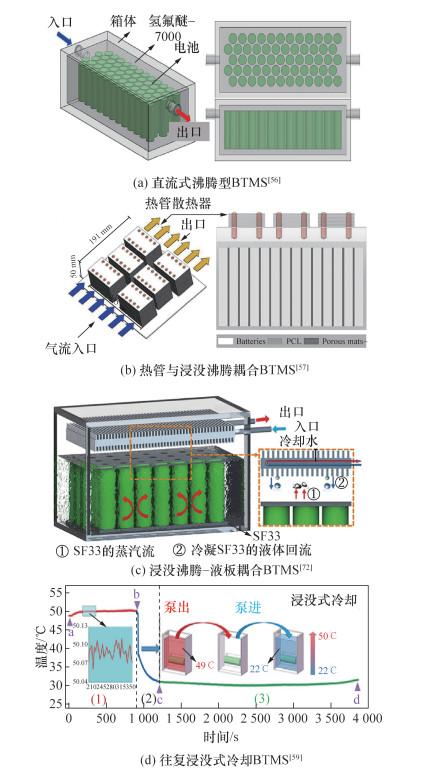
浸没式沸腾具有良好的散热性能,但仍缺乏更多实际工程应用。Li等[70]通过研究发现10~15 ℃的低温液体会导致圆柱形锂离子电池在正常工作下的电压损失,故而需要进一步确定该电池热管理方法的预热或保温功能。此外,在沸腾传热中也需要考虑工质的热物性。Li等[71]比较了应用在锂离子电池上的5种氟碳基冷却液的性能(BTP、HFO-1336、C6F12O、氢氟醚-7100和F7A),发现除BTP外的其他4种冷却液都与电池有较好的相容性,并且低沸点的两相冷却相比于高沸点的单相冷却具有更优秀的散热效果。文[72]采用浸没沸腾-冷板一体化的动态热管理,冷凝器部分装有冷板和翅片用于散热(见图 7c),在制冷剂FS49吸收热量并向上蒸发的同时,冷凝器吸收热量以达到动态平衡。他们发现主动优化浸没液体的参数可以满足不同冷却需求,例如正常运行状态要求低流量、高温度的冷板等。Li等[59]通过实验发现往复浸没式冷却可实现快充条件下急速冷却(见图 7d),该策略使电池在4 C充电倍率时温度下降约19 ℃,并保持稳定的温度梯度。
综上,现有研究发现,在小于5 C充放电倍率条件下单相浸没式液冷能够很好地散热,冷却工质为FC72时可限制电池的最高温度在30 ℃以下;当放电倍率进一步增大达到10 C时,电池需要快速降温避免其热失控造成损失,此时浸没式沸腾液冷优于单相浸没式冷却,使用氢氟醚-7100或SF33等类型工质能够很好地控制电池温度在35 ℃左右且温差很小。因此,针对不同应用场景应充分考虑沸点、气化潜热和稳定性等问题,以采用不同的热管理方法满足散热需求。
2.2 空气与喷雾综合冷却
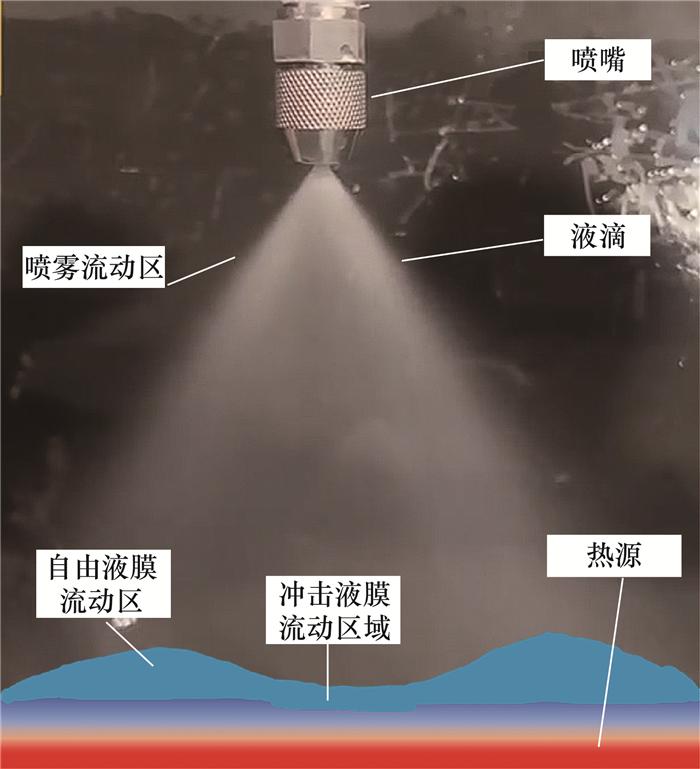
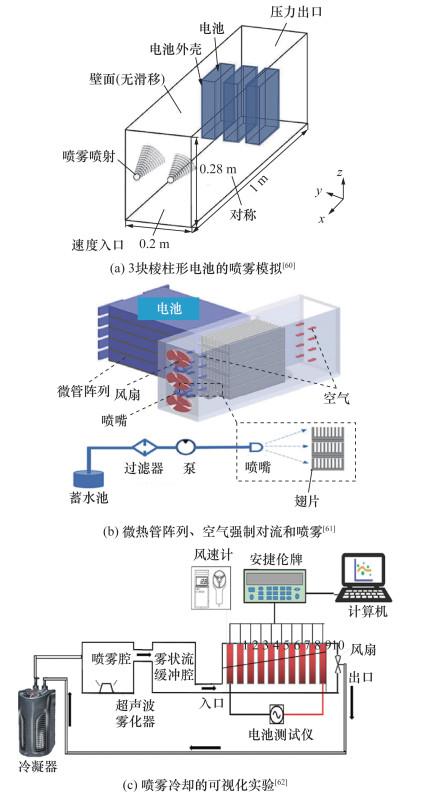
Yang等[60]比较水流流速、液滴大小、风速、环境温度不同条件下的喷雾冷却效果(见图 9a),数值模拟结果表明,当液滴大小为60和80 μm时,最高温度在低风速时下降缓慢,而在高风速时下降明显。当环境温度低于35 ℃、空气流速超过2 m/s并且喷雾的质量流量为0.2 g/s时,可保证电池组的安全运行。Qian等[89]利用表面响应优化法讨论了喷雾冷却的影响因素,数值模拟结果表明,优化后的最高温度比未优化低4.88 ℃,而温差从2.32 ℃减小到0.03 ℃。Yue等[61]设计了一种由微热管阵列、空气强制对流和间歇式喷雾组成的混合电池热管理(见图 9b)。当产热量较小时,热管和空气对流能够满足散热需求,在大倍率放电时,激活间歇式喷雾。与空气冷却相比,3 C放电倍率下该混合热管理能够使电池组的最高温度保持在35.1 ℃以下。Wu等[62]借助可视化实验比较了不同喷雾量与不同风速组合的冷却方式(见图 9c),发现增加空气流速导致液滴没有时间完全蒸发,进而不能有效降低电池温度;他们还发现,当喷雾量约1 665 g/h、风速为2.5 m/s时,总传热系数最大。
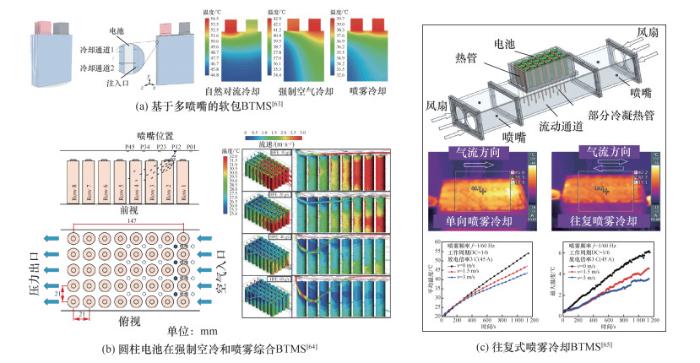
空气的对流方式和喷嘴的布置也会对冷却效果产生显著影响。Fan等[63]采用数值模拟研究了多喷嘴对置于两个冷却通道之间的软包锂离子电池的散热效果(见图 10a),发现在3 C放电倍率下电池的最高温度从53.6 ℃减少到39.7 ℃,最大温差从9.1 ℃减少到6.0 ℃,但随着喷雾速度增加,最大温差可降至5.0 ℃。尽管喷雾冷却拥有优秀的散热能力,但冷却液(如水雾)的安全问题仍未被解决。Dhuchakallaya等[64]以氢氟醚-7100(HFE)作为冷却液,通过CFD模拟了空气强制对流和喷雾相结合的方法对圆柱形锂离子电池的冷却效果(见图 10b),并借助两相蒸发模型研究了冷却液质量流量和喷嘴排列的影响。该研究发现,在第1列和第2列电池中间位置的顶端设置多个喷嘴,并且冷却液质量流量达20 g/s时,所提出的热管理策略能够稳定地控制电池的最高温度和最高温差在安全范围内。Jiang等[65]使用新策略进一步减少了电池组的最高温度和最大温差(见图 10c),即将热管贴附在锂离子电池表面、将热管的冷凝段放置在往复式喷雾冷却系统里进行冷却;实验结果发现,当放电倍率3 C且进口风速为3 m/s时(喷雾占空比为1/6),电池组的最高温度降低到42.5 ℃,且最大温差降低到3.6 ℃。
综上,喷雾冷却中影响锂离子电池的最高温度和温差的主要因素包括风速、液滴粒径、冷却工质和质量流量等。液滴粒径过小和过大都会降低对电池的散热性能,在粒径大小为60和80 μm时,配合一定的风速和质量流量可使散热最大化。在3 C放电倍率时使用该热管理策略也可限制电池的最高温度在40 ℃以下,但是在针对较为大规模电池组时,应注意喷嘴的排列位置及其优化方法。
3 总结与应用展望
从上述动力锂离子电池主动热管理研究进展可知,单一和混合电池热管理策略在一定条件下均可较好地控制电池最高温度和温均性,风冷、液冷和气/液两相冷却策略均需依据电池散热的不同需求优化多维物性参数。不同类型的动力锂离子电池在不同的应用场景和充放电倍率下,其使用的冷却工质、结构、功耗等应有所改变,以达到优异的热管理效能。尽管目前该领域研究取得显著进展,但仍有如下几个突出的问题亟需解决:
1) 空气冷却在一定条件下可实现有效散热目的,强制风冷优于自然风冷,而自然风冷在一定的低气温条件下也具有优异的散热性能。目前空气冷却的研究主要聚焦于空气的流量控制、电池布局和流道设计等,并通过最优的参数配置组合达到高效散热。因此,当低放电倍率电动载具用于常温、低温场景时,应设计一种复合式强制与自然冷却交互的冷却策略,以发挥空气冷却的最大优势。例如,在低空飞行中,固定翼全电通航飞机因其飘降性能好,最大放电倍率不超过2 C,故其电池总体产热速率和产热量不高,应考虑采用空气冷却。针对不同的飞行高度,飞行器的电池可采用不同的冷却策略。设飞行地海平面温度为25 ℃且标准大气压。当飞行高度1 km以下时,因空气温度较高应采用强制空气冷却策略;当飞行高度在1~3 km之间时,由于温度降低应使用强制与自然冷却交互的复合式冷却策略;当飞行高度超过3 km时,因环境温度更低应采取自然空气冷却策略。当然,整个电池热管理系统的构型转换、流量控制以及轻量化等因素也需考虑,以达到优良的散热效果。
2) 单相液冷热管理具有较高传热系数和比热容,单相浸没式冷却可以通过增加流速来降低电池(组)温度,但流速超过一定值后散热效果会变差。微通道冷却在冷却液流速加大和接触角增加时散热优势明显。因此,短途通行的海空电动载具在大倍率充放电下需要快速散热时,应采用不同的单相液冷策略。就电动船舶而言,当运行在水上时应采用浸没式冷却;当航速较低时,应单独使用浸没式液冷对电池散热;若航速较高,可从环境中获取水源对电池的冷却液快速降温,从而实现循环瞬态散热。就新能源电动汽车而言,应采用微通道冷却,其冷却液应具备较高的比热容而不易气化;当汽车在高速公路上行驶时,动力锂离子电池组产热速率偏高,可调整冷却液流速满足散热需求。当然,浸没式液冷和微通道液冷还应考虑采用往复周期流动、内部增加翅片、算法优化以及新型仿生流道结构等方式强化传热。
3) 气/液两相冷却气化散热能力优异,浸没式沸腾冷却便于优化系统配置,即使是在10 C的大倍率放电条件下也具有优异的温均性。因此,城市群间通行的低空垂直起降飞行器及直线飞行器应采用气/液两相冷却策略。垂直起降电动飞行器当处于起降及悬停阶段时放电超过10 C,产热量极高,受热快速汽化的冷却液与环境交界处遇高速气流冷却而凝结再返回系统,可实现气/液两相循环冷却散热。支线固定翼全电通航飞机因其航程超过1 000 km且载客量大,应采用浸没式沸腾与空气冷却一体化的综合策略,选用轻型不导电、沸点低以及气化潜热高的液体作为冷却液,以保障其运行可靠。当然,浸没式沸腾冷却还应考虑冷却液的成本和散热效果,以及空气流道在整个热管理系统的体积占比等综合因素。
4) 喷雾冷却便于在更大范围管理温度,其优异的散热性能可有效控制大倍率充放电动力锂离子电池的温均性及温度峰值。因此,区域通勤全电垂直起降飞行器和干线全电飞行器因载重大,飞行时间长,起飞或降落时需求持续、大倍率放电甚至达到15 C,应采用喷雾与空气冷却相结合的综合策略满足其散热需求。不同的飞行阶段其放电倍率也有所差异,精准地控制喷雾的质量流量和占空比可以达到工程上的效益最大化;在电池包底部加装收集器和冷凝系统可以循环利用受热后气化的蒸气。当然,不同热负荷下保持理想温度范围的综合热控制策略应成为未来研究的重点,应考虑结合比例积分微分(proportional integral derivative,PID) 等控制算法来精准计算间歇式喷雾冷却的冷却液需求,应设计紧凑的喷雾系统以满足飞行器上的空间体积限制。
5) 在选择热管理策略时应特别考虑直接成本和间接成本。空气冷却是一种相对廉价的策略,采取该策略时应关注风道和扇叶设计成本。单相液冷不仅要关注冷板材料费用,还需考虑冷却液的选择以及强制冷却的能耗问题。气/液两相冷却系统复杂,能耗更高,且前期投入和运营成本更高,故而应综合考虑节能设计和材料费用等问题。随着技术进步和规模化生产,一些先进冷却方式的成本有望逐步降低,从而提高其经济可行性。此外,热管理系统的设计会与座舱的舒适性产生矛盾,特别是在采用气/液两相冷却系统的工具上,会不可避免地遇到噪声、振动、系统安全性等问题,一些实际工程应用已出现无法收回成本的现象,因此有必要设计综合考虑成本和空间体积等的热管理系统。
未来的工作中,在考虑冷却液成本和密度等的基础上,不仅要关注其沸点问题,更是要对其环保性能严格要求。海陆空新质生产力的交通工具所选用的冷却工质必须满足不燃、无色无味、无毒、无腐蚀性且无挥发残留等物化特性,从生成制作到使用过程应充分考虑产品的可回收性和可持续性,以保证中国在发展新质生产力上对环境的危害降到最低。同时,也需开发针对常用冷却液的专业过滤设备,以保证冷却液能够循环使用且具有较长循环周期。


