

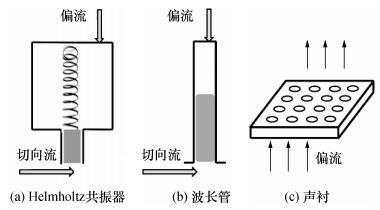
Rayleigh准则给出了2种抑制热声振荡的方法:第一种方法为通过主动控制改变压力脉动与释热率脉动之间的耦合关系;第二种方法为增加燃烧系统整体声耗散损失[4]。与前者相比,采用声学抑制器进行被动控制具有结构简单、可靠性高和成本更低等优势。典型的声学抑制器有Helmholtz共振器、1/4或1/2波长管和声衬等[5],结构如图 1所示。燃烧室安装有Helmholtz共振器或波长管,接口处因声阻抗突然改变,声波会产生反射和透射能量变化,其中一部分声脉动能量会通过抑制器颈部开口进入抑制器内,并被阻尼作用耗散。通常抑制器背腔需通入冷气流冷却腔体壁面,同时接口处存在切向流,流动效应将进一步增强脉动能量的阻尼耗散。声衬结构主要通过有平均流的孔洞来耗散脉动能量:在声波作用下,冷却流通过声衬孔时诱发产生的涡效应能有效耗散燃烧室内的声波脉动。
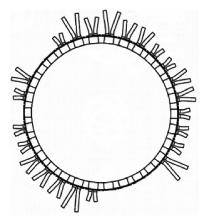
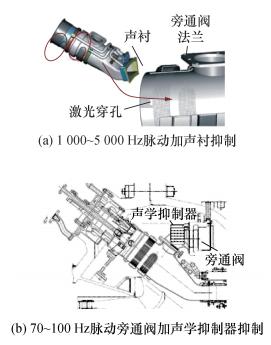
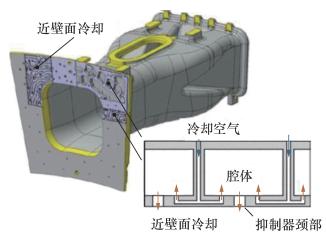
各主要燃机公司在其各型号低排放燃气轮机上均有大量的声学抑制器应用实践。GE公司在其LM6000工业低污染燃机三环腔燃烧室集气腔侧周向上安装了23根长短不一的1/4波长管以抑制热声振荡[6],如图 2所示。西门子公司提出了一种结合了穿孔声衬、声腔和侵入冷却管结构的声学抑制器[7],该种结构综合了穿孔声衬、声腔及导管各自的吸声特性优点。三菱重工公司的G级燃机低污染燃烧室压力脉动在低频段和高频段均出现峰值[8],其被动控制方案如图 3所示。为抑制1 000~5 000 Hz的高频脉动,在火焰筒上安装了多排微孔声衬进行抑制,由于需要与火焰筒壁面冷却部件进行集成,因此该声衬结构造价昂贵。为抑制70~100 Hz频率范围的低频脉动,在燃烧室与旁通阀之间的管道上安装声学抑制器[8]。Alstom公司在其GT13E2和GT26等燃机型号上均使用了声学抑制器[9],2种机型的声学抑制器均布置在燃烧室头部面板中。为增加运行灵活性,GT13E2集成了宽频的多腔声学抑制器[10],GT26将宽频声学抑制器与前面板冷却空气系统集成为一体,冷却空气经冷却通道后进入声学抑制器,此设计简化了整体结构,如图 4所示。
然而,为提高现代燃气轮机效率,燃烧室运行温度更高,并要求能在更低的负荷下运行且具有更宽裕的工况运行范围,同时还需适应更活泼的碳中性燃料,如氢气与合成气等,这将导致燃烧室运行过程中脉动频率发生较大程度变化[14],且燃烧室结构更为复杂。例如先进重型燃机的轴向分级燃烧室,引入了二级燃烧段,运行中更易产生多个脉动频率和热声模态[11, 15]。对于环形燃烧室,还存在横向热声模态及其与轴向模态耦合的复杂模态[16]。对于先进燃烧室多热声模态、多变频率等特性,抑制频带单一且有效吸声频段窄的传统声学抑制器存在一定局限性,亟需开发多模态、宽吸收声学抑制器并开展系统级燃烧室多声学抑制器参数设计优化研究。但声学抑制器引入的额外模态与燃烧室热声模态间将耦合,对于真实燃烧室,强非线性、高温差和流动效应对声学抑制器特性及其抑制效果影响明显。上述问题均对燃烧室声学抑制器设计及优化带来很大挑战。
针对以上挑战,本文概述了国内外及作者近年来在常规及多频段声学抑制器机理分析、抑制效果分析计算、复杂热声系统参数对声学抑制器特性影响,以及基于伴随方法的多声学抑制器多参数快速优化等方面的研究工作,并对未来燃烧室声学抑制器发展进行了讨论,为先进燃气轮机高效、宽负荷、低碳和低排放燃烧室复杂声学抑制器的设计和研发提供相应理论指导。
1 声学抑制器机理
1.1 消声孔吸声机理
Helmholtz共振器、穿孔板/声衬等声学抑制装置普遍依赖于有平均流动的圆孔吸收声波能量,即通过孔射流将入射声波的能量转化为流体中涡的动能,而后涡运动演化为湍流,最终经黏性耗散转为流体内能。图 5a为传统无限薄消声孔模型,${\bar u}$为孔入口平均流速,D和L分别是孔径和孔长,虚线表示当有声波入射时,从孔入口边沿脱落下来的涡的运动轨迹,即涡线。
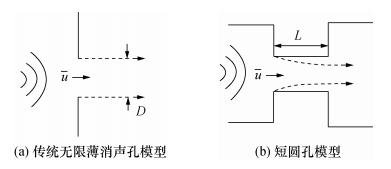
如图 5a所示,假设圆孔无穷薄,孔两侧都为半无限大空间,孔边缘脱落下来的涡沿着与孔直径相同的圆柱形涡线笔直向下游无衰减地传播到无穷远的情况下,可解析得到预测该声涡耦合过程的线性理论模型[17]。该理论模型可预测出:孔在整个频率区间内只吸收声音,不产生声音(能量只会从声波传递到涡波)。该模型被学术和工业界广泛用于消声孔的设计,而在实际应用中,孔总有一定厚度,如图 5b所示,声波入口流动分离后将产生流动收缩,导致孔入口产生的脉动脱落涡将沿着弯曲的剪切层传播,并与孔出口边缘附近的声场进一步相互作用。文[18-19]的实验和数值计算表明,在与热声振荡密切相关的低频范围内,这样的孔可吸收声音,也可能产生声音(能量既可从声波传递到涡波,也可能逆向传递)。而预测和防止声学抑制器设计中的声产生是至关重要的,如设计不合理,抑制器不仅不能消除热声振荡,反而可能加剧振荡。目前没有解析的理论模型能预测孔产生声音的频率范围,且在其吸收声音的频率范围内,当频率较高时,也没有解析的理论模型能准确预测孔吸收声音的效果。
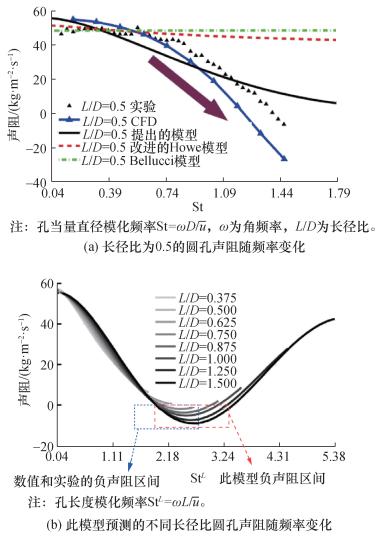
该模型解决了以往消声孔解析模型无法考虑的3个难题:有限的孔长度、弯曲的涡运动轨迹和孔两侧有限的几何扩张,且能同时预测圆孔的声吸收和声产生[20-21]。图 6a所示为长径比为0.5的圆孔声阻随以孔当量直径模化频率St的变化,图中CFD为计算流体动力学(computational fluid dynamics)相较于先前的理论模型,此模型成功预测到长径比为0.5的消声孔声阻随频率的急剧下降。图 6b所示为模型预测的不同长径比圆孔声阻随孔长度模化频率StL的变化,此模型预测的不同长径比下消声孔的负声阻区间(即声产生区间)与数值和实验结果较为吻合。该模型同时表明孔入口边缘产生的非定常涡脱落轨迹对孔声学特性影响明显。
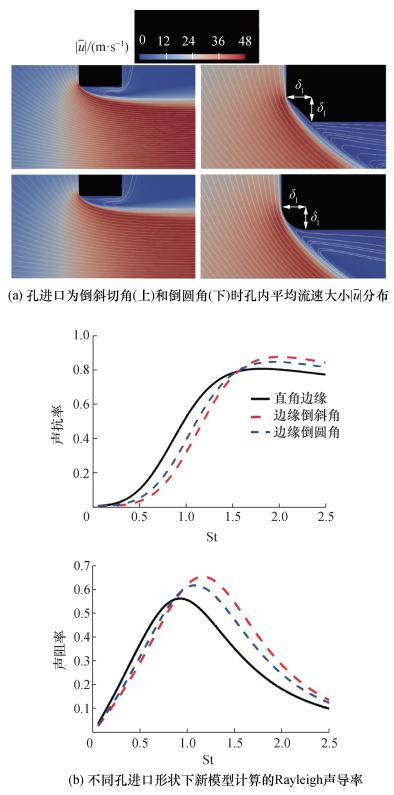
基于该理论模型,进一步探讨了孔两侧扩张比对孔吸声特性的影响机制[22]。研究表明:在所关注的低频范围内,当扩张直径比大于5时,可近似认为孔两侧为半无限大空间[21]。通过对孔入口边缘形状作细微改变,采用数值模拟和理论分析方法,可发现孔入口边缘形状约2%的微小变化能使孔吸声特性发生约50%的改变,结果如图 7所示[22],δl为倒角长度。小孔入口边缘的微小变化会引起涡脱落轨迹明显变化,从而影响小孔声响应特性。此外,圆角/倒角边缘产生的平均射流轮廓收缩程度低于直角边缘,使吸声性能在高频处增加,而在低频处略有下降。因此,有平均流动的消声孔进口形状设计十分重要,适宜的消声孔进口形状可确保在所要研究的频率范围内获得最佳的声学性能。
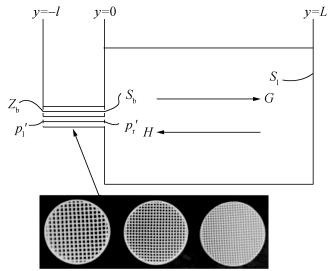
推导了考虑孔Forchheimer非线性效应及颈部流动非充分发展效应下的静流阻率,表示如下:
其中:p0和pl分别为孔两侧的压力,σr为实验测量的静流阻率,σ为理论静流阻率,l为共振器颈部长度,d为颈部穿孔直径,${\bar v}$为轴向脉动速度截面平均值,K为考虑非线性效应的黏性耗散,ρ0为常温常压空气密度,c为声速,ε为修正系数,ξ为无量纲管道长度和流动Reynolds数之比。
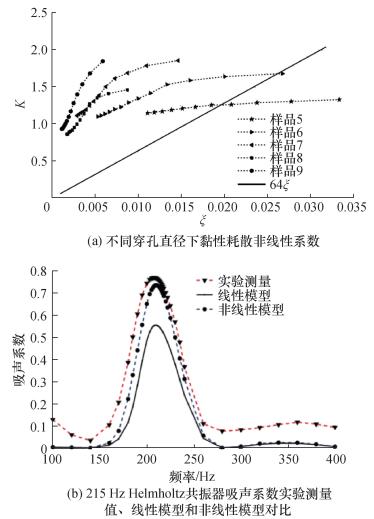
通过单独的静流阻实验系统测量了穿孔材料的静流阻率非线性因子η0 (η0=Kρ0/(2l))求解K值,测量结果如图 10a所示,孔黏性耗散与流速之间呈现一定非线性。而后基于滞止焓法,推导了考虑上述非线性流阻效应的平行穿孔优化Helmholtz共振器入口声阻抗模型,阻抗值Zb表示如下:
其中:o和i为虚数单位,Sb为共振器颈部截面积,ϕ为穿孔率,p′l为共振器颈部压力脉动幅值,${\bar v}$′z为共振器颈部轴向脉动速度幅值在穿孔截面上的平均值,l′为修正后的共振器颈部长度,V为共振器空腔体积,S1为共振腔截面积,k为波数, L1为吸声空腔长度。
图 10b为安装颈部穿孔材料的215 Hz的Helmholtz共振器吸声系数实验测量值、线性模型和非线性模型计算值对比。可知穿孔材料中流动引起的非线性效应对共振器入口声阻抗及吸声系数影响大。并且,存在最佳的孔径尺寸(孔径为最佳值时,偏离共振可提供更大声阻尼),以保证最优的吸声效果,模型计算的最优穿孔直径与实验测量值吻合。推导的模型可用于Helmholtz共振器穿孔优化分析及设计。
1.2 多频段声学抑制器
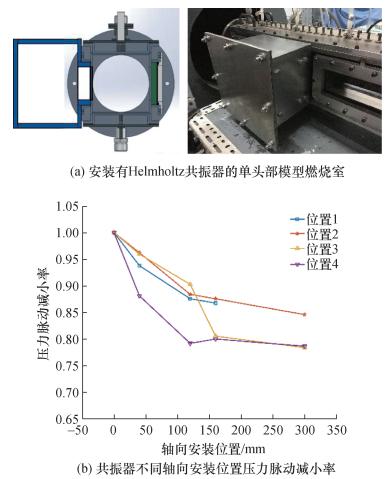
Helmholtz共振器是一种应用广泛的热声振荡被动控制装置(见图 1),包括细长颈部和腔体两部分。但Helmholtz共振器的引入将改变燃烧室的声学边界,进而影响燃烧热声振荡特性。基于单头部模型燃烧室实验装置研究了Helmholtz共振器对燃烧室热声振荡特性的影响[25]。实验装置如图 11a所示,抑制器不同轴向安装位置压力脉动减小率如图 11b所示。实验结果表明:燃烧振荡可产生单一模态(单个频率)或多个模态(多频)。燃烧室和Helmholtz共振器的耦合对热声振荡特性的影响明显:振荡幅度减小。Helmholtz共振器影响热声振荡频率和幅值,其影响效应为非线性。同时,Helmholtz共振器安装在离燃烧室压力模态波腹越近的位置,抑制效果越好。
但现代燃气轮机燃烧室具有宽裕的工况范围及燃料灵活性,因此运行中脉动频率易发生较大程度变化。对于轴向分级及环形燃烧室,容易产生多个热声模态。传统声学抑制器吸声频段单一且有效吸声频率范围窄,较难应对上述情况。多频段声学抑制器可同步抑制多个脉动频率,且有较宽的吸声频段。目前能产生多频段同步抑制效果的声学抑制器方案较多,包括采用多腔体组合结构抑制器、超材料结构[26]、多层穿孔板[27]及分流管抑制器[28]等。Bothien等[29]报道了一种多腔体的Helmholtz共振器可拓宽抑制器吸收频段,并在全尺寸全压燃烧室上进行了验证,结果表明脉动振幅可降低80%以上。GE公司[30]提出了一种在Helmholtz共振器中嵌入穿孔板而获得多腔室的抑制器结构,并开有多个颈部与燃烧室机匣相连,该种抑制器具有可在高频段获得近千赫兹的宽裕范围吸收特性。Griffin等[31]研究了2个Helmholtz共振器共享相同侧壁的组合结构,可实现具有多个吸收频段的目标。多层穿孔板组合的声衬结构可实现对多频、宽频脉动的吸收。文[27, 29]研究了多层微孔板声衬结构的吸声和能量传输损失特性。
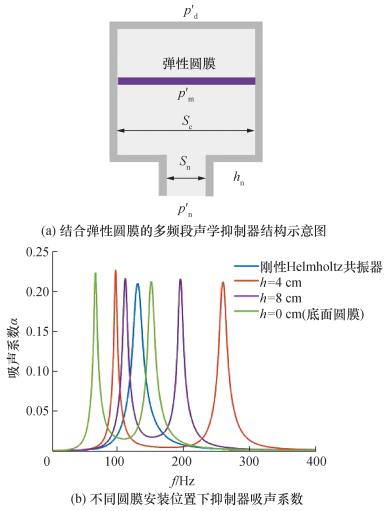
建立了极坐标系下圆膜受迫振动的控制方程,并通过分离变量法求解控制方程,分别得到圆膜振动位移随时间和径向变化的解析解。对于低频脉动,由于声学抑制器尺寸远小于所研究的频率范围内的最小声波波长,其声振荡规律可简化为质点弹簧阻尼系统或电路系统[33]。该结构采用传递矩阵法,建立了各部分声波方程,推导了结合弹性圆膜的Helmholtz共振器入口声阻抗模型,表示如下:
其中:ϕ为膜恢复力,r为径向位置,j为虚数单位,k1为波数,ρ1为密度,ωn为特征频率,t为时间,X1为膜位移,P为膜张力,${\bar v}$1为入口速度脉动平均值,a为颈部半径,Z为阻抗,ζ为膜恢复系数,β为膜弹性模量。
依据推导的声阻抗模型,可计算出声学抑制器对声学管道的吸声系数,不同圆膜轴向安装位置下吸声系数α计算结果如图 12b所示,其中h为圆膜底板高度。结果表明:在Helmholtz共振器中加入弹性圆膜可引入新的脉动吸收峰。并且,改变弹性圆膜轴向安装位置及膜的刚度和材料,可方便调节抑制器吸声系数的峰值频率分布特性。相较于传统Helmholtz共振器,弹性材料的加入使吸声频段宽度由20.8 Hz提高至23.8 Hz,拓宽了约14.4%。
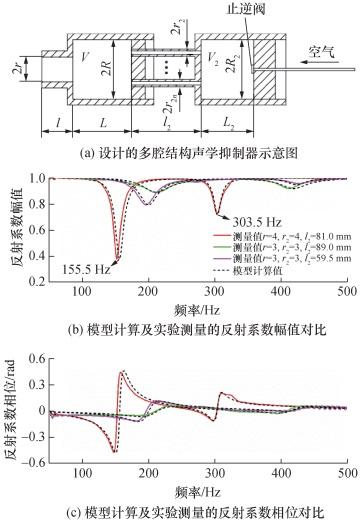
1.3 声学抑制器效果分析计算
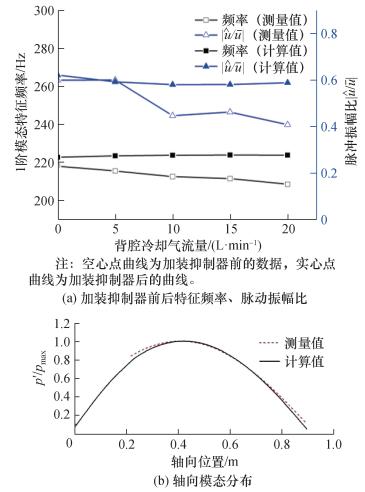
预测声学抑制器对燃烧室热声振荡的影响可用于指导被动控制设计。通过结合时域阻抗边界的三维可压计算流体力学模拟,可直接求解声学抑制器对燃烧室自激热声振荡特性的抑制效果[37],但该方法计算成本高,较难适用于设计过程中存在大量计算工况的情况。
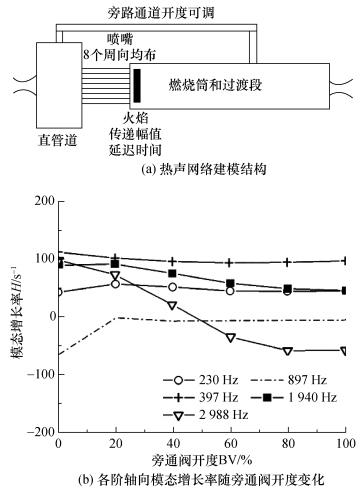
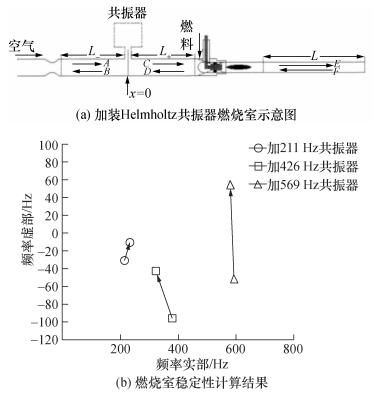
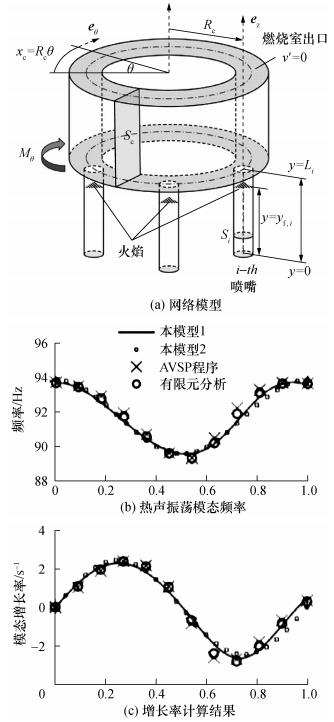
对于环形燃烧室,横向平均流动和横向声扰动将影响火焰响应,进而改变环形燃烧室横向热声模态频率、增长率和模态特性(如出现驻立、旋转或混合模态等)[43]。以往环形燃烧室低阶网络模型通常只考虑轴向火焰响应,拓展的低阶网络模型可用于预测火焰横向响应下环形燃烧室的热声振荡特性,模型计算结果与Helmholtz法求解结果一致,并且计算所用时间更短[44]。二维扰动下环形燃烧室声学网络模型及计算结果如图 17所示,结果表明:尽管环形燃烧室横向火焰响应比轴向火焰响应小得多,但对横向热声模态的旋转比有很大影响。横向和轴向火焰响应的不对称性(例如由于声学抑制器周向布置的影响)和横向平均流动对声传播影响都可改变横向热声模态的旋转比[44]。
2 声学抑制器参数设计优化
2.1 传热与平均流动的影响
目前声学抑制器研究中均假设流动是等温的:平均流动Ma较低(Ma≤0.3),忽略湍流流动损失所导致的温度升高(熵增)。根据热力学关系dT/T= (γ-1)dp/γp+ds/cp(其中T、p、s、γ和cp分别为温度、压强、熵、热容比和等压热容),流场中熵扰动可忽略,故温度扰动只与压力扰动有关。但如图 18所示,当抑制器安装在真实燃烧室侧壁时,燃烧室内流体温度可达1 000~2 000 ℃及以上,而声学抑制器中冷却气流一般来源于压气机出口,温度约为200~600 ℃。声学抑制器两侧温差可高达1 000 ℃以上[45],将导致声学抑制器附近存在较大的温度梯度。消声孔中冷却射流(包括平均和扰动流量部分)及其受到声扰动时所产生的脱落涡,都将在孔出口附近与高温气体掺混[46-48]。
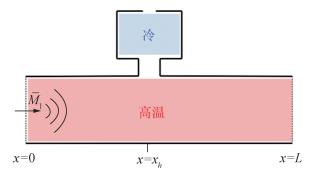
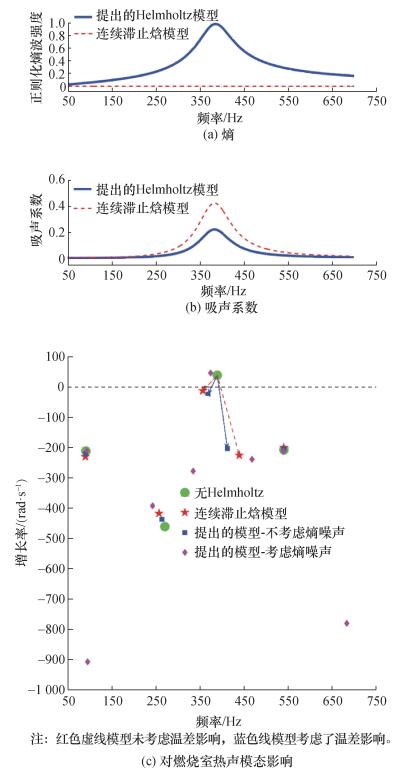
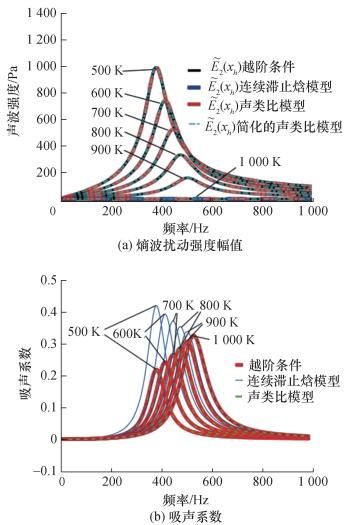
针对上述问题,基于Helmholtz共振器与燃烧室间的温差对Helmholtz共振器吸声特性进行了理论计算[48]。基于质量、动量和能量守恒方程,推导了考虑温差效应的Helmholtz共振器吸声模型,数学模型表示为:
其中:$\widetilde A_1^ + $ 和$\widetilde A_2^ + $ 为声波,$\widetilde E_1^ + $ 和$\widetilde E_2^ + $ 为熵波,M1和M2为平均Mach数,${\bar u}$n为颈部脉动速度,Sb为颈部截面积,${\widetilde m_n}$ 为颈部流体质量脉动,S1为腔体截面积,xh为管道轴向位置。
2.2 燃烧室变截面的影响
穿孔声衬广泛应用在航空发动机与燃气轮机燃烧室设计中,如通用公司的TAPS环形燃烧室壁面装有声衬以实现高效且低污染排放的燃烧。三菱重工公司的G级燃机燃烧室对1 000~5 000 Hz高频热声振荡,采用在火焰筒上安装多排微孔声衬进行抑制[8]。
但对于真实燃气轮机,压气机出口及透平进口过渡段常以渐扩或是渐缩截面的方式与燃烧室连结;对于火焰筒,其轴向截面尺寸也不完全相同。因此有必要研究适用于变截面段的声衬,与等截面声衬相比,截面的变化可拓宽脉动吸收频段范围。为此开展了相应理论和实验验证工作[54]。变截面声衬流场示意图如图 21所示。采用滞止焓法(eldredge and dowling method,EDM)推导了变截面声衬理论模型,将一维质量与动量方程中的变量分离成平均量和脉动量后进行展开和消去,得到对应的线性脉动量方程,引入滞止焓脉动量B′=p′/ρ+${\bar u}$u′=${\bar c}$2ρ′/ρ+${\bar u}$u′,p′为压力脉动量,ρ为平均密度,${\bar c}$为平均声速,ρ′为密度脉动,u′为切向流速度脉动,则声衬内滞止焓连续脉动方程与滞止焓动量脉动方程表示如下:
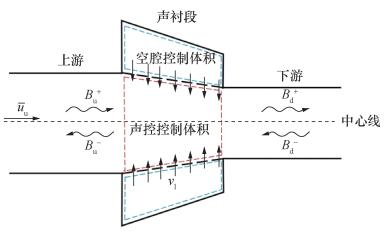
其中:l1表示空腔内物理参数,ρ′l1为腔内平均密度,X2为轴向距离,${\bar u}$1为切向流平均流速,A为管道截面积,Cl1为管道圆周长,v′为声衬流速度脉动。
经过简化并加入壁面作用力项,得到空腔内滞止焓连续脉动B′l1方程式和滞止焓动量脉动方程表示如下:
其中: Al1为空腔内截面积,u′l1为空腔内切向流速度脉动,θca为声衬安装倾斜角度。
上述变截面声衬方程可进一步转化成矩阵形式,通过数值方法计算出声衬出口的状态参数,从而获得相应阻抗模型。
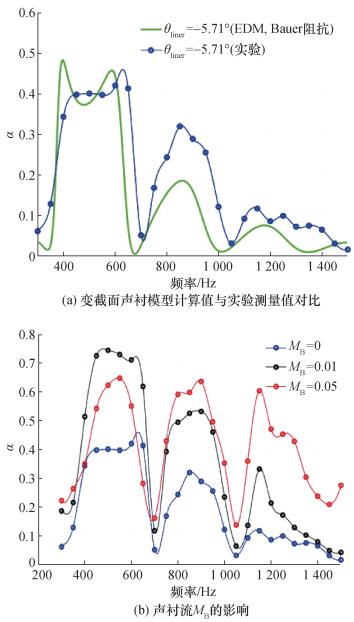
搭建了可考虑声衬流和切向流的流管试验台,并对变截面声衬吸声系数进行了实验测量,并与上述推导的理论模型计算结果对比,如图 22a所示。结果表明:渐缩截面声衬提升了中频段的吸声系数且峰值主频向高频偏移,但高频的吸声系数幅值有一定下降。渐扩截面声衬中频段的吸声系数下降,而高频段吸声能力上升。渐缩变截面声衬具有更佳的中低频段吸收性能。建立的变截面声衬理论模型与实验结果也较吻合。进一步地,理论和实验研究了声衬流和切向流对变截面声衬吸声特性的影响,部分结果如图 22b所示。加入声衬流后,渐缩管道会使声衬流汇入主管道后同时在管道内加速,形成加速的切向流流场,进而增加了声阻尼耗散作用,提升了吸声性能。声衬偏流马赫数MB增加使吸声系数幅值频率略微向高频转移。切向流的加入,使声衬内部整体切向流的阻抗增加,阻尼耗散作用增强,因此吸声系数值将提升。
2.3 不同模态之间的相互作用机制
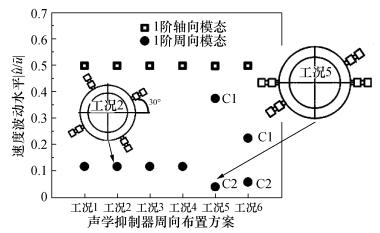
在实际燃气轮机燃烧室中,往往会出现多个不同频率和模态形状的热声振荡模态,需使用多个及多种类型声学抑制器组合以达到更佳的抑制效果。多个声学抑制器的引入会改变燃烧系统的声学边界条件,且不同抑制器之间存在相互影响。声学抑制器的引入还可能给系统带来额外的特征值(声学抑制器模态),当该模态与燃烧系统本身的热声振荡模态较为接近时,二者可能产生强相互作用,从而改善或恶化系统热声稳定性[55]。因此,研究多抑制器之间的相互影响以及抑制器带来的额外模态与系统多类型热声模态之间的相互作用,对抑制器的设计和优化具有重要指导作用。
1) 对原有模态影响。
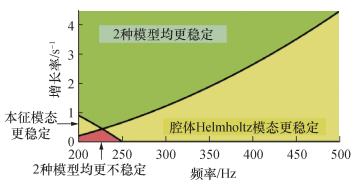
在多声学抑制器对燃烧室多类型热声模态影响研究中,可将热声模态分为两类,一类是由燃烧室结构主导的声学模态,另一类是火焰的固有模态。研究中同时考虑声学抑制器对这两类模态的控制效果。以一个单筒模型燃烧室为例,简化为包含集气腔、燃烧喷嘴及火焰筒的模型,其中声学抑制器安装在燃烧室侧壁。基于开发的声学网络模型对上述燃烧室结构进行计算,获得了不同抑制器参数下,燃烧室腔体Helmholtz模态和火焰固有模态的稳定性变化情况,如图 23所示。红色区域表明两类模态均更不稳定,绿色区域表明两类模态在该抑制器参数下将更加稳定。
2) 模态间耦合。
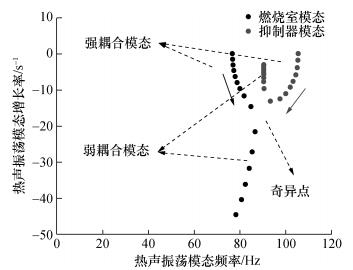
2.4 基于伴随方法的系统优化
如2.3节所述,在实际燃烧室中,往往需要同时使用多个声学抑制器以同时消除多个热声振荡模态。此外,每一个抑制器都有若干个可调节的参数,如几何结构尺寸、平均流动速度和安装位置等,同时使用多个抑制器时将产生大量可调节参数[63]。因此,需使用系统性的方法优化该多参数复杂系统。
常见的系统优化方法大致可分为3类[64]:1)针对目标函数,在控制变量参数空间内直接寻优;2) 基于目标函数一阶梯度的方法;3) 基于目标函数二阶梯度的方法。当目标函数可获取控制变量的梯度信息时,基于目标函数梯度的方法通常可大幅提高优化效率,适用于针对热声振荡问题的低阶网络模型或Helmholtz求解器。
开发了基于声学网络模型的伴随优化程序[66],可实现基于多个声学抑制器多控制参数,针对多个热声振荡模态进行系统性优化,并可依据应用需求(例如所关注的模态频率范围、重点抑制模态和模态稳定性不确定区间等)灵活选取合适的优化目标函数和抑制器控制参数。该方法可快速准确地寻找系统局部最优解,且计算成本低。
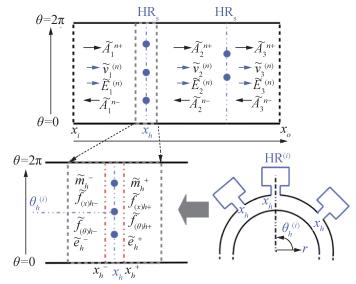
其中:λ为周向不同阶模态的强度,Mi2o为从系统入口到出口不同周向模态数扰动的传递矩阵。系统的特征值(模态)表示为
选定需要优化的多个特征值的增长率Im(ω)和g,建立加权的优化目标函数。
其中:qi为第i个模态的增长率,k表示一个突出最不稳定模态的加权函数,F表示限定控制参数范围的给定函数。目标函数J对优化g的梯度可写为系统特征值向量对控制参数向量的敏感性关联式表示为
其中,ω对g的敏感性可通过伴随求解的方法求得,其中伴随表达式由Lagrange乘数法推导得到,即
其中:λi+是伴随变量,()H表示共轭变形。在得到目标函数梯度之后,更新后的控制参数向量计算表达式为
其中:dn为第n步的搜索方向(可由式(16)计算梯度结果),αn为第n步的搜索步长。
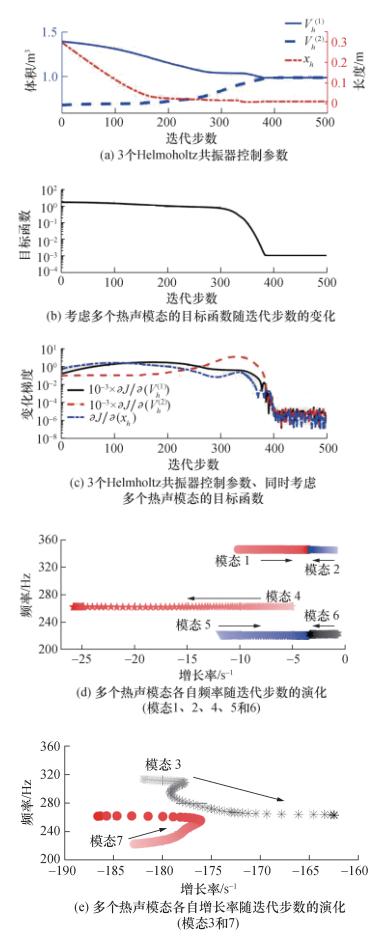
在优化过程中,为能正确追踪所有被优化的模态,通常需要取较小αn,以防止模态遗失或交换,这在当2个或以上模态彼此接近的情况下尤其重要。另外,dn可能在一些控制参数方向上梯度较大,但在令某一些参数方向上梯度较小,进而导致总体迭代收敛速度缓慢,本优化方法通过增加在特定方向上的参数变化速度来加快迭代收敛速度。考虑多个热声模态的目标函数及其梯度、多个热声模态各自频率和增长率随迭代步数的演化如图 27所示。
3 总结与展望
未来燃气轮机燃烧室由于具有更高的运行温度、更宽裕的工况范围、更高的碳中性燃料适应性和更复杂的燃烧室结构(轴向分级或环形等),热声振荡存在高振幅、多脉动频率、脉动频率时变和多热声模态共存等特点,现有抑制器方案面临很大挑战。因此,开展先进多模态宽吸收声学抑制器机理分析和其设计优化研究具有重要意义。
本文从以下几个方面总结了所开展的代表性研究工作结果:
1) 针对现有消声孔模型基于无穷薄及两端半无限大空间假设的局限性,提出了涡-声耦合的消声孔半解析声学模型,可考虑孔长度、涡运动轨迹和孔两侧的有限几何扩张效应,同时预测到了孔的声吸收和声产生,并且发现孔入口边缘形状细微变化可引起吸声特性大幅改变。
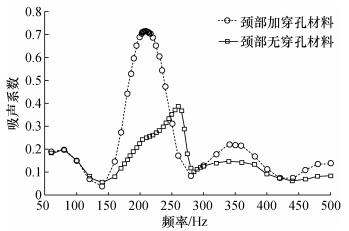
2) Helmholtz共振器吸声频率范围窄,通过在其颈部添加平行穿孔材料增加了整体声阻尼,进而拓宽了其吸声性能;推导了考虑颈部流动非线性效应的吸声系数理论模型,结果与实验测量值吻合。
3) 针对常规声学抑制器存在吸收频段单一问题,开展了基于弹性膜及多腔结构的多频段声学抑制器研究。抑制器系统内弹性膜及多腔体的引入,可带来新的脉动吸收峰,且有增强的阻尼耗散作用。
4) 采用嵌入非线性火焰动力学及声学抑制器模型的低阶网络模型,实现了单/多声学抑制器作用下,求解筒型和环形燃烧室热声振荡频域和时域,成功预测了加装抑制器后热声振荡频率、振幅及模态演变,并且发现抑制器等引起的火焰横向响应的非对称性将影响环形燃烧室的稳定性。
5) 现有抑制器模型未能考虑温差效应影响,因而建立了结合能量方程的声学抑制器理论模型。结果表明:温差将引发沿下游传播的熵波,改变抑制器共振频率附近的声阻尼,降低吸收系数;熵扰动进入燃烧室后还可能影响其热声稳定性。
6) 理论和实验研究了变截面声衬的声学特性,渐缩截面声衬吸收频段范围更宽,渐缩截面还将加速切向平均流动,使吸声性能进一步提升。
7) 抑制器的引入会改变燃烧室腔体声学模态和火焰固有模态,并可使抑制器模态与原有热声模态耦合,因此需合理设计抑制器参数。
8) 多个抑制器同时使用时将产生大量的可调节参数,基于声学网络模型的伴随优化程序,实现了使用多个声学抑制器下,同时抑制多个热声振荡模态的多控制参数系统性快速优化的求解。
未来研究工作展望包括以下几个方面。
1) 努力探索下一代多模态宽吸收频段声学抑制器结构,该结构拟结合Helmholtz共振器、不规则声衬及吸声材料等多种抑制技术,并采用新加工工艺与燃烧室有机集成。
2) 深入探究具有非线性、平均流动、温差等复杂真实条件下声学抑制器的特性及机理,构建并完善适用于该条件下的模型数据库,并基于大数据分析及机器学习等人工智能手段,挖掘声学抑制器性能提升途径,提高复杂声学抑制器设计效率。
3) 针对复杂燃烧室结构及复杂声学抑制器结构、形状和流动条件等,进一步提高现有设计优化方法的适用性和鲁棒性。这些研究工作将有力推动中国高效、低碳、低排放燃气轮机燃烧室研发。


