

为满足日益严格的低污染、低碳需求,燃气轮机的技术发展呈现低排放、高参数、多燃料和宽工况灵活运行的趋势。现有的基于强旋流和头部分级的贫预混燃烧技术逐渐难以适应这些新的发展要求。李苏辉等[1]分析了10种具有潜力的先进燃烧技术,提出了分步实现轴向分级和微混燃烧的发展方向。这表明,考虑到多方面性能的平衡,未来先进燃烧室将是多种燃烧技术的组合。
燃烧室结构日渐复杂,这意味着传统的经验和半分析设计方法将难以应用于未来的燃烧室设计中。对此,针对燃烧室开发先进的数值模拟方法将在未来燃烧室设计中发挥不可替代的重要作用。先进燃气轮机燃烧室技术的发展,对燃烧过程的数值模拟方法也提出了更高要求。
首先,低排放的发展目标,要求燃烧数值模拟方法能够准确预测NOx、CO等污染物,为燃气轮机燃烧室的设计提供指导意见。这些污染物都是燃烧过程的非主要产物,涉及复杂化学反应机理。因此,面向燃气轮机燃烧室的燃烧数值模拟方法,必须能够反映复杂的化学反应机理相。其次,高参数、多燃料、宽工况的发展目标,要求发展对于燃烧工况覆盖面更广的燃烧数值模拟方法。目前许多燃烧模型都是基于预混或非预混火焰的前提发展的,在真实的燃气轮机燃烧室中,预混、非预混和部分预混火焰的形态都可能出现。为此需要拓展燃烧模型的适用范围,进而准确预测真实燃烧室的内部流场和火焰形态。同时,燃烧室内Reynolds数可达106,燃烧过程与湍流高度耦合,如何对非线性的化学反应源项与标量的统计量进行建模是计算湍流燃烧过程的关键。最后,数值模拟方法对计算效率提出要求,即在保证计算精度的前提下,尽可能减少计算量,可大幅度降低燃烧室设计周期。因此,在开发燃气轮机燃烧室的数值模拟方法的同时,必须兼顾计算精度和计算成本。
在过去几十年里,学者们不断发展湍流燃烧模型以满足工业燃烧设备的实际设计需求。Pope[2]认为这一过程的主要挑战来自湍流燃烧过程中小尺度和多组分这两个方面,并根据对这两个问题的处理方式,将当前最具有潜力的湍流燃烧模型分为两大类:火焰面(flamelet)方法和概率密度函数(probability density function, PDF)方法。火焰面方法认为复杂的组分空间从本质上可以回归到二维或三维的低维空间[3]。基于这一假设,燃烧问题中的多组分求解就可退化为个别的标量求解,其余组分都是关于这个标量的函数,在进行计算流体力学(computational fluid dynamics,CFD)前就已经建立函数关系。这样便可以在使用详细化学反应机理的情况下保持较小的计算代价。PDF方法没有采用低维空间的假设,而是通过联合PDF的概念体现燃烧过程中涉及的多组分问题[4]。燃烧问题则退化成联合PDF的求解。求解联合PDF需要建立PDF的输运方程,这种求解PDF输运方程的方法也被称为输运PDF(transported probability density function, TPDF)方法。不同于标量方程,PDF的输运方程求解通常需要求解大量Lagrange粒子,因此计算量巨大。王海峰等[5]分别采用PDF方法和火焰面方法对Sandia Flame D火焰进行了数值模拟,前者的计算量高达后者的103倍。可见火焰面方法在现阶段针对真实燃气轮机燃烧室开展数值模拟具有计算量小的显著优势。
本研究针对燃气轮机的发展趋势,对火焰面方法在燃气轮机燃烧室中应用所面临的主要技术难点及其相关模型的发展历程进行了回顾,主要分为4部分内容:火焰面方法在自适应湍流燃烧中的应用、进度变量的优化选择、湍流燃烧耦合模型及火焰面方法在污染物预测中的应用,并对面向未来燃气轮机燃烧室数值模拟的火焰面方法发展趋势提出了相关建议。
1 火焰面方法简介
火焰面方法最早由Peters[3]提出,被称为稳态层流火焰面模型(steady laminar flamelet method, SLFM)。该方法首先用于扩散火焰的研究,认为湍流扩散火焰是一系列层流扩散小火焰的集合,假设燃烧过程中火焰厚度远小于流动和湍流的最小尺度,湍流虽然改变了流场,但并不能影响火焰内部的一维结构,即火焰面。由于这种一维结构存在,只需要求解某个特殊标量在流场中的分布情况就可获得整个火焰在流场中的形态分布。在扩散火焰中,混合分数是这种特殊标量的最佳选择。一方面是因为混合分数从燃料端到氧化剂端的单调性,另一方面也是因为混合分数特有的守恒性。
对于扩散火焰,SLFM认为在整个流场中,所有化学组分质量分数都是混合分数的单一函数,即
其中:yk表示第k个组分,Z表示混合分数,fk表示对应的函数关系。组分质量分数关于时间和空间的偏导数可分别表示为:
其中,t和xi分别表示时间和空间。将式(2)和(3)代入组分守恒方程,可表示为
其中:ρ为密度,ui为速度,D为扩散系数,${\mathit{\dot \omega }_k}$ 为反应源项。式(4)可重新整理为
由于混合分数具有守恒性,即
最终得到稳态火焰面方程,可表示如下:
其中,χ为标量耗散率。
从式(7)可以看出,以混合分数Z为控制变量的稳态火焰面方程中,只有扩散项和化学反应源项。因此,从平衡的角度理解,火焰面方法的一维假设本质上反映的是扩散和反应两者之间的平衡。在进行CFD计算前,通过求解方程(7)可预先得到关系(1),以化学信息表的形式预存。在CFD计算时,只需求解混合分数的标量方程,就可以通过查表得到详细的化学信息。
其中:χst是Zst处对应的χ,st表示化学当量比。Z和χst在不同的一维火焰中不同,因此也可以认为是相互独立的。而关系(9)也被称为火焰面数据库(flamelet library)。不同χst下的火焰面数据库如图 1所示。
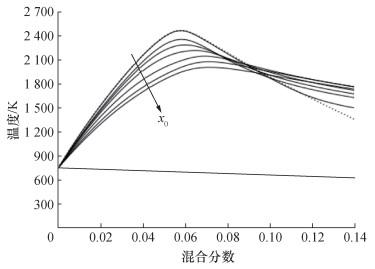
将每个χst对应的火焰面中温度的最大值记为Tmax,随着χst增加,Tmax会逐渐降低,直到χst达到χq,火焰熄灭,即S形曲线,如图 2所示。
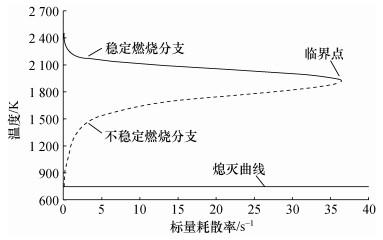
SLMF只能覆盖曲线中稳定燃烧的分支和大于χq的不稳定燃烧分支(图 2中虚线部分),稳定燃烧和不稳定燃烧之间的中间状态会被投影至这2个分支上,因此SLMF无法模拟局部点熄火的燃烧过程。Pierce[7]对此给出了一种解释:混合分数由于不包含任何化学反应的内在信息,因此无法解释垂直于混合分数梯度方向上的化学变化。于是,Pierce[7]在此基础上发展了火焰面/进度变量(flamelet/progress variable, FPV)模型。该方法在CFD中除了求解混合分数的守恒方程,还增加了一个新的标量方程来表征化学反应的进程,该标量被称为进度变量C,在火焰面数据库中,用进度变量作为自变量代替标量耗散率,具体可表示为
由此,新的火焰面数据库便可覆盖整个S形曲线。
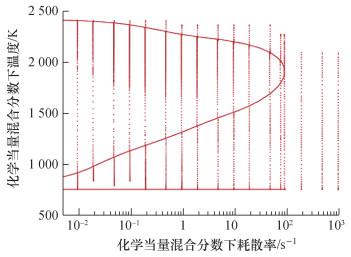
FPV方法虽可覆盖完整的S形曲线,但本质上依然是一种稳态的火焰面方法。事实上,湍流中标量耗散率的快速波动,温度变化不能立刻响应,这意味着流场中会存在S形曲线以外的非稳定点。Pitsch等[8]进一步推导出非稳态火焰面/进度变量(unsteady flamelet/progress variable, UFPV)模型。在UFPV中,火焰面方程在方程(7)的基础上增加了非定常项,
通过求解熄灭和再着火的过程建立火焰面数据库,如图 3所示。
以上以混合分数为核心参数的火焰面方法,都是以扩散火焰为主要面向对象。近年来,不断有学者将该类方法拓展至预混和部分预混火焰;而另一部分学者则致力于开发基于预混火焰的火焰面模型,其中最具有代表性的方法则是文[12]所发展的火焰面生成流形(flamelet generated manifolds, FGM)法。
在预混火焰中,混合过程不再是反应快慢的主导因素,详细的化学反应决定了火焰中各类组分的变化率。因此,早期的预混火焰模拟方法都将工作重点放在了化学反应机理的简化上。学者们提出了固有低维流形(intrinsic low-dimensional manifold, ILDM)[13]和计算奇异摄动(computational singular perturbation, CSP)[14]等化学反应简化方法,将化学反应中的快反应与慢反应区分开,提出平衡假设,通过建立组分与组分之间的代数关系代替微分方程,从而降低计算量。而FGM方法则在预混火焰的研究中采纳了层流火焰面方法的核心思想,认为预混火焰中也存在不受流场干扰的火焰内部结构,即火焰面。在考虑化学反应时,FGM方法也加入了分子扩散在预混火焰中的影响,这使其在简化化学反应的同时弥补了ILDM和CSP等方法在低温区精度不够的缺陷。文[15]利用坐标变换从数学角度分析了强拉伸下的火焰面方程,为FGM方法的简化假设提供了理论支持。除FGM方法之外,也存在其他耦合化学反应和扩散的方法[16-20],但是目前发展最广泛的依然是FGM方法,并且已逐渐推广至部分预混和非预混火焰。
2 火焰面方法在自适应湍流燃烧中的应用
燃烧室的燃烧过程涉及多种燃烧模式,不同燃烧模式下湍流-化学相互作用的机制存在较大差异。为了发展燃烧室内普适、高效的湍流燃烧模型,发展高效自适应湍流燃烧模型是一个亟需开展的研究方向[26]。
基于第1节的讨论可以发现,火焰面方法形式多样,不同建表方法得到的火焰面数据库可以适用不同的燃烧模式。因此,利用火焰面方法开展自适应湍流燃烧模型对于燃气轮机燃烧室是一种具有较好前景的方向。
文[27-28]通过引入Pareto最优(Pareto-efficient)的概念提出了一种自适应湍流燃烧模型,以用户给定的几种组分为预测目标,综合考虑预测精度和计算成本在不同区域使用不同的燃烧模型,并以FPV、FPI等火焰面方法作为部分待选模型,实现了对甲烷三叉火焰、二甲醚射流火焰的预测。Xu等[29]则使用反应爆炸模态分析(chemical explosive mode analysis, CMEA)作为判据,将FPV方法和详细组分的有限速率法结合,模拟了正十二烷喷雾抬升火焰,得到了比单纯的火焰面方法更准确的点火延迟时间和火焰抬升高度。Rieth等[30]将FGM和TPDF方法相结合,以FGM为主要的湍流燃烧模型,仅在FGM偏差较大的区域采用TPDF方法计算,并采用混合分数作为判别依据。然而以混合分数作为判别依据经验性强,理论性较弱,很难得到普适的临界标准。
无论是与其他模型相结合的自适应湍流燃烧模型,还是多区域火焰面方法,核心问题都在于建立合适的火焰模式判别依据并对计算域进行区分。在这方面,Yamashita等[34]在探究射流扩散火焰结构的过程中首次提出了火焰指数(flame index)的概念,利用氧化剂和燃料的质量分数梯度进行定义,具体可表示为
其中,YO和YF分别表示氧化剂和燃料质量分数。
当火焰指数为正时,认为火焰处于预混火焰的状态;当火焰指数为负时,认为火焰处于扩散火焰的状态。Fiorina[20]利用该定义,提出了基于火焰指数的多机制火焰面模型。然而,这样的判别标准,更多是由“定义”而来,而非“推导”而来,存在理论缺陷。学者们发现,该方法在一些单步燃烧模型中具有一定的适用性,但与直接数值模拟(directly numerical simulation, DNS)数据匹配的结果较差。为了解决该问题,Knudsen等[35-36]利用标准火焰面坐标变换开发了一种更准确的局部火焰模式判别方法。该方法将物理空间上的组分输运方程进行坐标变换至Ihme等[37]提出的(Z, Λ, τ)坐标系下,其中,Λ=C(Zst, TZst),表示在某个特定火焰面下化学当量混合分数处的进程变量。该坐标保证了统计独立性,进度变量输运方程可以改写为
同时认为,在平衡源项中贡献最多的那一项决定了火焰的燃烧状态。如果不考虑非稳态影响,则2、3项的比值决定了火焰是预混还是扩散状态。为了便于计算,忽略当量比处几乎为0的$\frac{\partial^2 C}{\partial \mathit{\Lambda }^2}$ ,得到新的判别依据,称为“燃烧模式指数”(combustion regime index),具体可表示为
其中,θpre和θnon分别表示预混项和扩散项。由于Λ在流场中不便求解,将θpre进行转化[36]得到
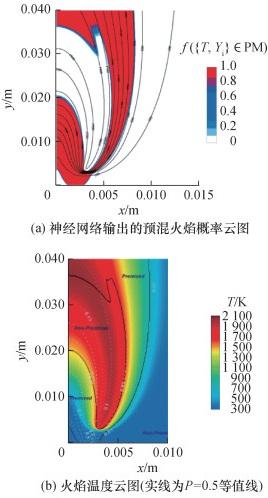
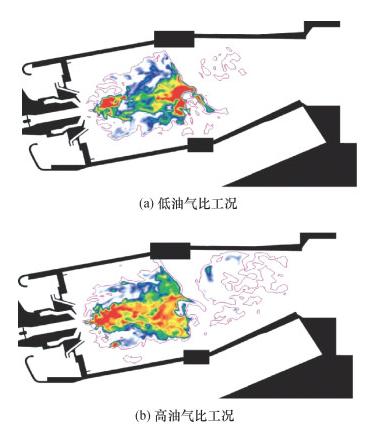
目前多模式火焰面方法的发展依然受判别依据的准确性和计算效率限制。近年来,机器学习的发展使在模式识别问题中通过直接输入样本提取合适的特征得以实现,进而实现分类,这对火焰面和混合火焰面方法具有重要的借鉴意义。部分学者对此展开了探究,建立了可以区分稳定燃烧的预混火焰和非预混火焰的神经网络分类器[40],神经网络的输出值为该区域出现预混火焰的概率(P=1代表一定为预混火焰,P=0代表一定为非预混火焰),以P=0.5为分界线,对预混/非预混模式进行分类判别,并在二维的三岔火焰中取得了较好的分类结果,如图 5所示。该方法目前仅限于区分预混和非预混状态,对于点熄火等燃烧过程的判别仍在探究中,并且该机器学习方法尚未与CFD求解器相结合进行真实的燃烧工况计算。即使如此,该方法依然展示出了巨大的潜力。因此,本文研究团队认为利用机器学习方法提高火焰模式识别的精度和计算效率,会成为未来多模式火焰面方法发展的有力突破口。
3 进度变量优化选取
其中,Tu和Tb表示未燃端和已燃端的温度。
然而,当燃料为混合物或化学反应机理更复杂的多碳燃料时,则简单的温度或单一组分的质量分数无法满足对于进度变量的要求,因此学者们考虑将多种组分质量分数的组合作为火焰面方法中的进度变量,结果发现组合方式会直接影响火焰面数据库的覆盖范围,对于不同进度变量的选取,火焰面数据库会出现不同程度的非单值区间,而非单值区间必须舍去,这意味着火焰面数据库的覆盖面下降。以甲烷燃烧为例,Ma[42]选择了2种不同的组分组合方式作为进度变量,具体表示如下:
其中,Y表示其下标对应的组分质量分数,M表示其下标对应的组分相对分子质量。
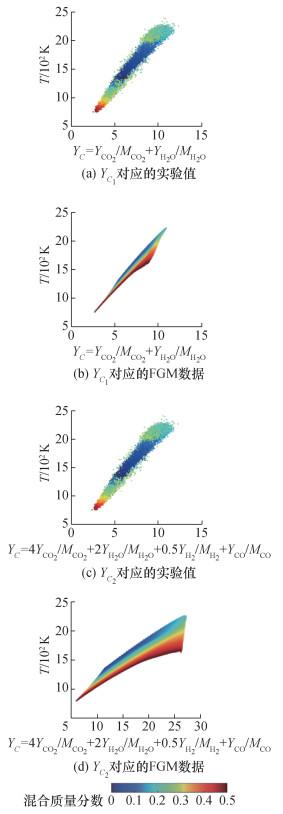
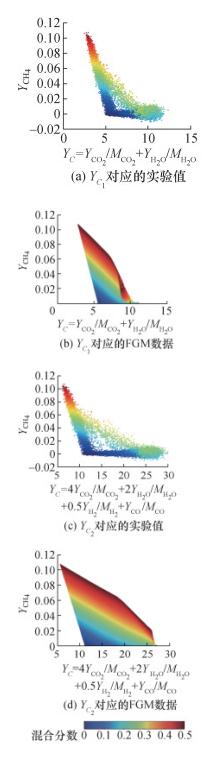
Wang等[48]在此基础上定义了额外的混合分数变量用于描述液滴燃烧的火焰面内部结构:
其中:mox, 1、mox, 2分别表示喷雾侧的载气质量和氧化剂侧的氧化剂质量,mf, vapar表示液滴蒸发产生的质量。
Cai等[49]则是在探究煤粉燃烧过程中多环芳烃(polycyclic aromatic hydrocarbons,PAHs)的生成问题时,引入了用于描述PAHs的额外进度变量,实现了更准确地预测PAHs生成,同时避免了对其他标量预测结果的影响。
Hasse等[50]在探究柴油发动机多射流喷入燃料的问题时,提出了一种双混合分数的造表过程,将火焰面方程拓展至二维,可表示如下:
其中,Lei表示第i个组分的Lewis数。
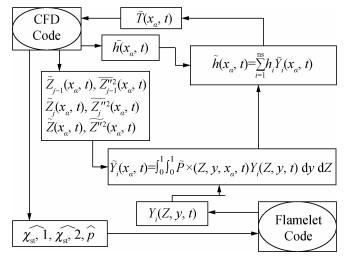
CFD求解器与火焰面造表过程的耦合如图 8所示。
无论是优化混合分数还是进度变量,都根据燃烧过程的先验知识选取。而过于依赖经验易导致无法应对多种燃料、多类燃烧方式组合的未来燃气轮机燃烧室发展趋势。因此,学者们开始探究具有普适性的进度变量优化手段。进度变量是各组分的线性组合,最优进度变量组合方式本质是对其系数向量α进行优化:
优化的关键在于找到合适的约束条件和目标函数。对此,Ihme等[52]首先提出了以增大单调区间为目标的优化方法,对于非单调区间则引入惩罚函数,目标函数是对整个火焰面数据库的惩罚函数进行积分,即代价函数,其最小值对应的α就是最终的优化目标,具体可表示如下:
其中:ε表示一个大于0的小量;H表示Heaviside函数,作为惩罚函数; Ω表示权重函数,体现不同区间单调性的重要程度。
除了从进度变量的单调性需求出发进行优化以外,也有一些学者从火焰面数据库的准确度出发对进度变量进行优化。Niu等[41]认为化学信息表的精确度取决于组分质量分数关于进度变量的导数,若导数的绝对值过大,则会影响插值查表的准确度,因此提出了一种限制导数大小的优化策略:从Lagrange视角考虑层流火焰中的化学轨迹,轨迹上相邻离散点的斜率(代表导数)的倒数作为约束条件,同时也是目标函数,即
其中:xk代表离散的化学轨迹点,Zl表示某条特定化学轨迹的起点混合分数。通过优化α实现对y的最大化。
从数学角度看,火焰面方法的本质是多维空间的投影问题,进度变量和混合分数则是投影平面。进度变量的优化其实是特征向量的选择,最优的进度变量对应特征值最大的特征向量。因此,主成分分析法(principal component analysis, PCA)[54]及其变体等数学工具被运用于这一问题中。Najafi-yazdi等[55]则使用主成分分析探究了独立进度变量的数量。Coussement等[56]提出了核密度加权主成分分析法(kernel density weighted principal component analysis, KEDPCA),可以更准确地重构火焰前沿。Chen等[57]将PCA方法和KEDPCA方法得到的进度变量加入CFD求解器中,应用于CH4/N2/空气抬升火焰,并与DNS数据进行对比,发现KEDPCA方法在外推时具有更高的稳定性。唐鹏[58]则提出了使用K最近邻算法(K-nearest neighbor, KNN)作为降维算法的评估指标。
计算力提升和数学算法优化为进度变量优化问题提供了有利支撑。因此本文认为,未来该领域的研究重点将聚焦于开发可覆盖多燃料体系及真实燃气轮机燃烧室工况条件的最优进度变量选择与计算算法方面。
4 湍流燃烧耦合模型
燃气轮机燃烧室内的燃烧过程通常与湍流相互耦合。由于湍流存在随机性,为了避免DNS方法的巨大计算量,现有的湍流燃烧计算中都对控制方程进行了平均化处理,如Reynolds时均法(Reynolds average Navier-Stockes,RANS)或大涡模拟(large eddy simulation, LES)方法[59]。这样的处理方式也给湍流燃烧模型耦合带来了挑战,即如何保证非线性项的精度。以火焰面模型为例,火焰面模型中火焰数据库反映的是层流火焰中化学信息与控制变量的瞬态关系,即式(9)。对于涉及湍流的CFD问题,由于求解方程是平均化处理后的控制方程,因此只能得到平均化后的流场信息,而非瞬态流场信息,即$\widetilde Z$ 和$\widetilde C$ 。湍流燃烧的非线性问题以数学形式可表示如下:
在湍流燃烧的模拟中,研究人员需要不等式的左侧部分,而求解火焰面方程得到的火焰面数据库只能提供不等式的右侧部分。
考虑到计算量限制,与火焰面方法相结合的PDF方法通常是预设PDF方法。预设PDF方法需要的流场信息包括标量的平均值和方差,平均值由求解控制方程获得,而方差则需要进行建模。Ihme等[62]的研究也表明,标量的Subgrid尺度方法模型对预测火焰抬升高度等信息有着至关重要的影响。
其中,p(Z, C; $\widetilde Z$ , $\widetilde C$ , $\widetilde{Z}^{\prime \prime 2}$ , $\widetilde{C}^{\prime \prime 2}$ )表示给定平均值和方差的PDF函数。
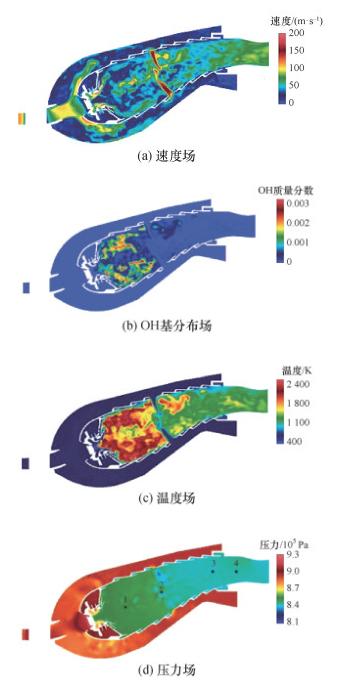
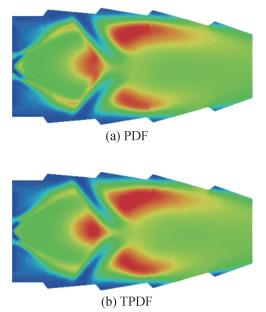
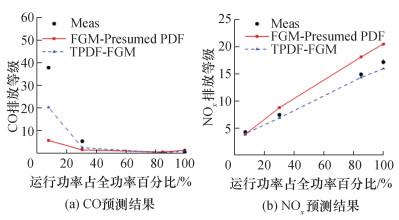
5 火焰面方法在污染物预测中的应用
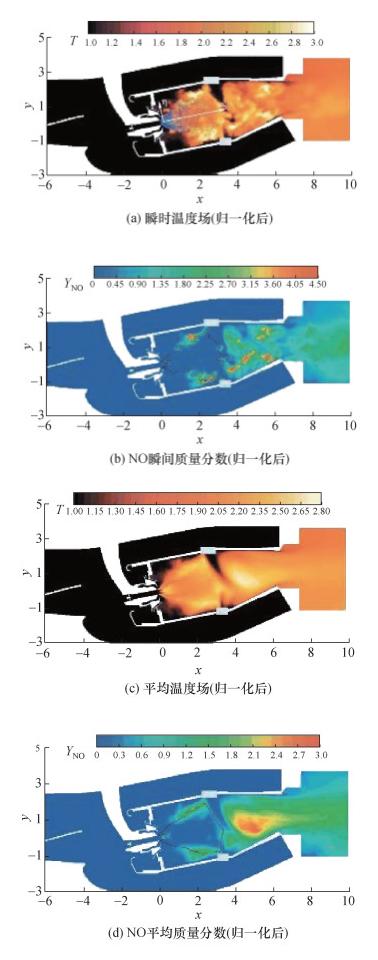
面对日益严格的燃烧设备排放要求,NOx和CO等污染物的预测逐渐成为燃烧模型的讨论重点。而火焰面概念的基本假设使部分学者对于火焰面方法在预测NOx、CO生成等慢反应问题方面的能力产生一定质疑。许多学者也对此进行了大量的探索。
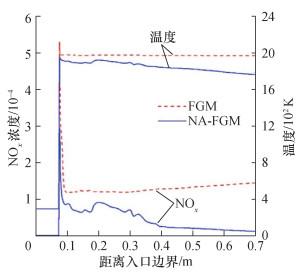
Ren等[76]研究发现小尺度湍流涡强度增加会降低预混火焰前沿中NOx的生成,并通过引入湍流扩散率参数的方式发展了考虑湍流小尺度涡影响的火焰面造表法。
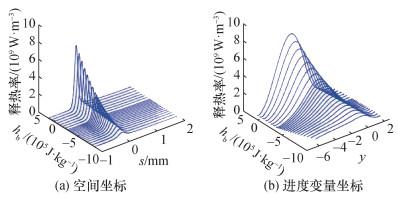
为了实现更准确的污染物预测结果,学者们开始考虑在火焰面方法中加入NOx等关注组分的输运方程进行直接求解。Ihme等[77]提出,输运方程的源项不能直接采用预先造表的结果。这是由于NO逆反应速率取决于自身的质量分数。预先造表中的反应源项,对于这部分的计算仍是在已经达到平衡的前提下得到的。因此为了计算真实的反应源项结果,需要替换其中的NO质量分数:
其中:$\dot \omega _{{\rm{PAH}}}^ + $ 和$\dot \omega _{{\rm{PAH}}}^ - $ 分别表示查表得到的PAH生成和消耗速率,YPAH表示求解输运方程得到的PAH质量分数,YPAHtable表示查表得到的PAH质量分数。PAH的源项比NOx的源项多了聚合相,即气相转为soot过程中的质量传递。该模型对Partt & Whitney燃烧室的soot模拟结果相比于其他模拟结果展现出了巨大的提升,结果如图 14所示。
6 结论与展望
火焰面方法作为一种计算量适中、预测精度高、覆盖多种燃烧机制、能与多种湍流模型相耦合的燃烧模型,适用于探究燃气轮机燃烧室的设计优化。本研究根据燃机发展的趋势,针对火焰面方法的4个重要研究方向进行了综述。
首先是火焰面方法在自适应湍流燃烧中的应用,为了满足低污染、高效率的发展需求,部分预混、分级燃烧等燃烧技术必然会综合应用于未来燃气轮机燃烧室。对此,基于简单的扩散火焰或预混火焰生成的火焰面数据库,燃气轮机内部燃烧过程模拟结果必然会存在偏差。因此,探究合理的燃烧模式判据,实现多模式燃烧的高精度模拟及火焰面方法与其他湍流燃烧模型的耦合,是火焰面方法能够模拟真实燃气轮机燃烧过程的重要环节。而在这一过程中,机器学习等领域的飞速发展将成为一个全新的突破口。
其次是进度变量的优化选择,在中国“双碳”目标的驱动下,使用氢气等低碳、可再生的新型燃料作为燃料的燃气轮机比例将逐渐增加。燃料的多样性意味着更加复杂多变的化学反应机理,同时考虑到气液、气固等燃烧问题的需求,发展具有通用性的优化方法,选择能够表征燃料燃烧过程的进度变量,是火焰面方法适应未来燃气轮机燃烧室多燃料发展趋势的重要前提。同时,对于真实燃气轮机燃烧室中涉及多射流、多混合分数的工况问题,探究有限,需要开展更多的模型适应性研究。
关于湍流燃烧耦合模型。在燃气轮机燃烧室中,高参数在提高燃烧效率的同时,也会造成强湍流影响火焰的稳定性。湍流问题的随机性和燃烧问题的非线性耦合是对模型的主要要求。对此,火焰面方法结合PDF方法成为学者们的主要研究方向。而真实燃机燃烧室的尺寸参数,又对模型的计算量提出了新的要求,如何兼具计算精度与计算效率是火焰面方法在燃气轮机燃烧室模拟中的难点。
最后是污染物预测,污染物的预测涉及慢反应过程,该过程中非绝热效应无法忽略,需要求解焓的输运方程,并将焓作为造表的自变量之一。同时,需要引入关于污染物的独立输运方程进行描述。而输运方程的源项修正是污染物求解准确与否的关键。
火焰面方法经过长期发展,无论是自适应火焰面模型,还是进度变量优化选择,亦或是火焰面方法与湍流模型的耦合及其在污染物预测中的应用都得到了长足发展,也存在一些不足。针对未来燃气轮机燃烧室的发展趋势,本文认为火焰面方法在燃气轮机燃烧室数值模型构建中尚有以下问题值得深入研究:
1) 对于火焰模式识别、进度变量优化等子模型,学者们提出了大量模型方法,但是缺乏针对性的结果检验手段。目前文献中多通过讨论整体的模拟效果对子模型进行检验。然而,燃烧数值模型综合性很高,仅依赖整体模拟结果的准确性难以对其中子模型的优劣性进行针对性的判断。因此,为了促进各子模型的发展研究,需要针对各个子模型开发具有针对性的检验手段。
2) 各子模型之间的耦合研究相对较少。无论是进度变量优化,还是多模式火焰面模型,或湍流耦合模型,均开展了较多独立研究。但当探究某一子模型时,其余模型仍采用相对简化粗糙的初始模型。比如,文献中提到的利用神经网络识别火焰模式,其进度变量的选择依然是比较简单的组合,当选择优化方法计算得到进度变量时,神经网络等的适应性仍有待探究。此外,各种子模型都存在以一定的迭代计算提高精度的问题,当各类子模型全部耦合于CFD求解器中,计算量是否会呈指数性增加而超出工业生产所能接受的范围也缺少研究。因此,对于真实燃气轮机的燃烧室数值模拟,需要进行更多的模型间耦合研究,掌握各种子模型之间的适应性,获取最优的子模型组合以探究燃烧室的整体特性。
3) 大多数模型只经历了实验室级的火焰验证,实验室级的火焰通常在常压下燃烧,但真实燃气轮机的燃烧过程都处于高压之下,在实验室条件下得到火焰面数据库和进度变量是否适合真实的燃气轮机燃烧室,目前尚无定论。因此,其对应的火焰模式识别模型、进度变量优化模型对于真实燃气轮机的适应性也有待探究。随着实验测量手段和大数据管理技术的不断提升,更多真实燃气轮机的运行数据将被获得和利用。因此,在未来的火焰面方法研究过程中,应当注重利用更多的真实燃气轮机燃烧室工况运行数据对火焰面方法及其子模型进行优化,进而得到更适合与燃气轮机燃烧室的火焰面方法。


