

数值模拟作为一种重要的研究手段,在NOx生成特性的预测中表现出较好的经济性和适用性[3-4]。现有研究结果表明:当燃料中不包含N元素时,NOx生成路径主要为热力型路径、快速型路径、N2O中间体路径和NNH路径[5]。鉴于NOx生成机理的复杂性,耦合详细反应机理的数值模拟会消耗大量的计算资源,而耦合简化机理则会显著降低模拟精度[4]。考虑到组分场中的NOx含量相对较少、NOx生成反应的时间尺度远大于燃烧放热反应的时间尺度、NOx生成速率主要由反应动力学主导等因素,研究人员提出了一系列简化的NOx模拟模型,包括NOx后处理模型法[6]、解耦详细反应机理法[6]以及在FGM(flamelet generated manfold)燃烧模型中附加NOx输运方程法[7-10]等。
上述模型均避免了在湍流燃烧中直接求解复杂的化学反应,其基本思路均是在获得温度和重要组分浓度分布后单独求解NOx输运方程。其中,NOx后处理模型往往采用平衡假设[11]和部分平衡假设[12-13]来假定O和OH自由基浓度,并采用经验公式拟合法[6, 14]来模拟燃料类型对快速型NOx生成速率的影响。解耦详细反应机理法[6]假定NOx化学不会影响燃烧场的重要组分浓度,数值模拟工作首先不计算NOx化学而只求解动量、能量和C、H、O组分方程,在获得速度场、温度场和重要组分场(C、H、O)后保持速度、温度和重要组分浓度分布不变,单独求解NOx化学。相较于NOx后处理模型法,解耦详细反应机理法不需要对O、OH自由基浓度进行假设,可直接求解NOx的生成及消耗反应,但该模型并未考虑湍流对NOx生成的影响,且只可应用于稳态数值模拟[6]。FGM燃烧模型将温度与燃烧过程中的关键组分浓度映射到进程变量和混合分数上,并通过假定的联合概率密度函数模拟湍流对燃烧反应的影响[15],该模型可在不牺牲太多计算精度的前提下大幅减少计算时间[16]。NOx生成反应的时间尺度远大于燃料燃烧反应的时间尺度,因此直接从概率密度函数表中读取的NOx质量分数与实际结果会有较大偏差。为此,研究人员提出向该模型中单独附加NOx的输运方程来求解NOx[7-10]。在附加的NOx输运方程中,除NOx质量分数需单独求解外,其他组分的质量分数可直接从概率密度函数表中获取。
大量数值模拟研究均论证了NOx后处理模型法和附加NOx输运方程法对NOx生成特性模拟的适用性,但针对解耦详细反应机理法的研究较少,该模型对NOx生成特性模拟的适用性缺乏验证。此外,现有研究往往只针对一种NOx数值模型分析其适用性,不同NOx数值模型之间的差异性尚不清晰。在针对NOx后处理模型法适用性的研究工作中,李威等[17]验证了NOx后处理模型法在预混旋流燃烧室中的适用性,结果表明:绝热火焰温度低于1 900 K时,NOx后处理模型法会略微低估燃烧室NOx排放;超过这一温度后,NOx后处理模型法会高估燃烧室NOx排放(误差超过25%)。文[18-19]的数值模拟结果同样表明: 当燃烧温度较低时,NOx后处理模型法会低估燃烧室的NOx排放量。但康尧等[20]指出,即使燃烧室中存在大于2 000 K的高温区,NOx后处理模型法依旧低估了19.10%~29.60%的NOx排放。可以看出,NOx后处理模型只可定性,而不可定量地预测NOx污染物排放量[6],且该模型对NOx空间分布特性模拟的适用性尚不明确。在针对附加NOx输运方程法适用性的研究工作中,文[7-8]的研究结果均表明:相较于原始FGM燃烧模型,在FGM模型中附加NOx输运方程可显著提高NOx的计算精度。但Mallouppas等[21]在对某工业燃气轮机燃烧室的数值模拟工作中指出,即使在FGM燃烧模型中附加NOx输运方程,燃烧室出口NOx排放的计算误差仍大于170%。
1 数值模型
1.1 NOx后处理模型法
其中:Qi为组分i的浓度,mol/m3;T为温度,K。
对于快速型NOx,其生成速率可表示为[6]
其中:t为时间,s;反应活化能Ea=303 474.125 J/mol;当量比修正系数f=4.831 9-23.2ϕ+ 32ϕ2-12.2ϕ3,ϕ为局部当量比;R为气体常数;P为压力,Pa;O2的反应级数a可表示为[14]
其中,XO2为O2的摩尔分数。
湍流对NOx生成速率的影响采用β-PDF(β-probability density function)概率密度函数进行描述[6]。
1.2 解耦详细反应机理法
在获得稳态的燃烧场后,假定除含氮(N)组分外的其余组分的质量分数不变,求解时只求解包含N组分的基元反应。其中,C、O组分的质量分数从概率密度函数表中直接读取,含N组分的组分输运方程如下[6]:
其中:ρ为密度,Yi为组分i的质量分数,v为速度,Ji为组分i的扩散通量,Ri为组分i的净生成速率。
1.3 附加NOx输运方程法
其中:k为热导率,Cp为定压比热容,湍流Sc=0.7,μ为湍流黏度,SYi为组分i的净生成速率,其计算方法如下[6]:
其中:SYi, fwd为组分i的生成速率,SYi, rev为组分i的消耗速率,Yi, PDF为联合概率密度函数表中存储的组分i的质量分数。
2 结果分析与讨论
2.1 射流扩散火焰
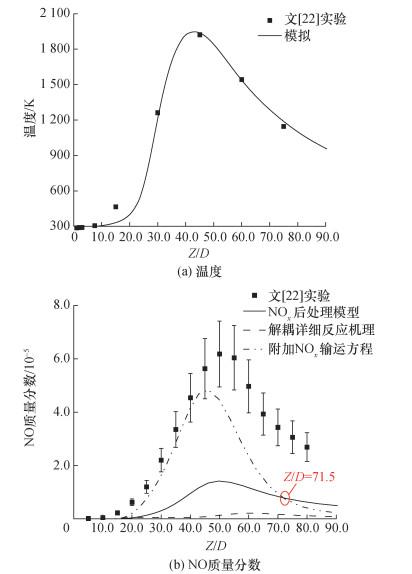
图 2为射流扩散火焰对称轴上温度和NO质量分数的计算结果,其中Z/D为距离喷嘴的相对距离,Z为纵坐标(单位mm),射流入口喷嘴的直径D=7.2 mm,Z/D=0为喷嘴出口位置。由图 2可知,采用标准k-ε湍流模型和FGM燃烧模型可较好地预测甲烷射流火焰的温度分布。对于NO,NOx后处理模型法和解耦详细反应机理法在所有位置均低估了NO的质量分数;附加NOx输运方程法可以较好地预测火焰位置(25.0 < Z/D < 45.0)的NO分布,但低估了火焰后方(Z/D> 45.0)的NO浓度。原因是,在火焰后方,大量冷空气参与掺混,稀释了火焰后方的组分浓度。数值模拟工作未能准确地再现这一过程,导致火焰后方NO浓度误差较大。在Z/D>71.5时,NOx后处理模型法的计算精度最好,但计算值与实验值之间仍存在较大误差。
为深入分析NOx数值模型的差异性,图 3给出NO净生成速率沿火焰对称轴的分布情况。结合图 2、3可知,采用解耦详细反应机理法时,NO生成速率的峰值位于火焰后方(Z/D>45.0),该位置温度低于NO大量生成的温度范围(T>1 800 K),因此解耦详细反应机理法不能准确预测本算例的NO生成速率。采用NOx后处理模型法和附加NOx输运方程法时,NO生成速率峰值位置位于最高温度点附近,认为这两种模型可更为准确地预测NO的生成位置。与附加NOx输运方程法相比,NOx后处理模型法和解耦详细反应机理法对火焰位置(25.0 < Z/D < 45.0)的NO净生成速率的计算值较低。对于火焰后方,NOx后处理模型法和附加NOx输运方程法的计算结果均显示在火焰后方(Z/D>50.0)NO生成速率显著降低,这是因为火焰后方温度较低,限制了NO的生成。
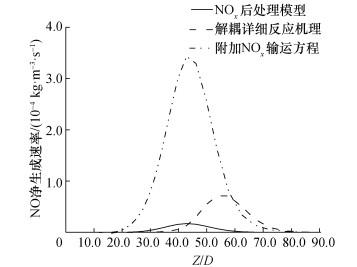
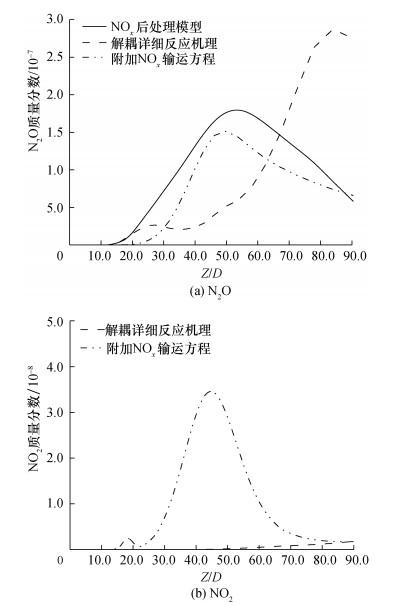
图 4给出了火焰对称轴上N2O、NO2质量分数计算结果。由于Fluent的NOx后处理模型并未对NO2建模,因此在NO2质量分数分布图中并未给出NOx后处理模型法的计算结果。
2.2 旋流预混火焰
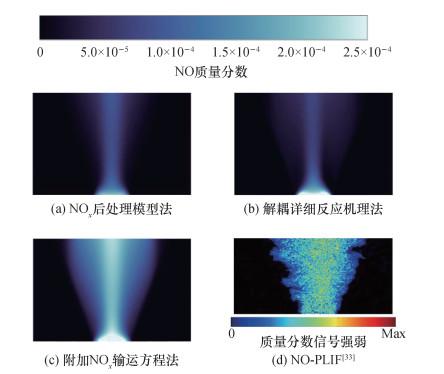
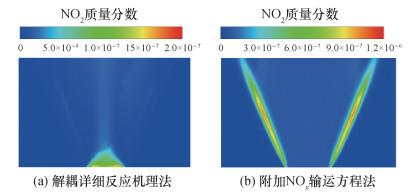
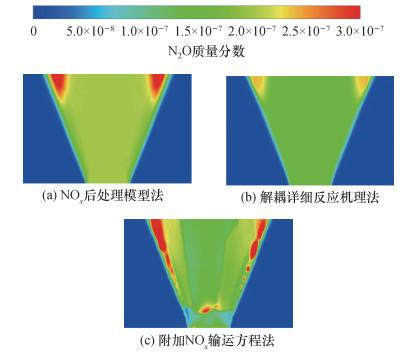
由于Fluent的NOx后处理模型并未对NO2建模,因此图 9未给出NOx后处理模型法的计算结果。与射流扩散火焰的NO2分布类似,采用附加NOx输运方程法时火焰锋面位置NO2浓度较高,而解耦详细反应机理法时该位置NO2浓度较低。
由图 10的N2O质量分数分布云图可知,与射流扩散火焰结果类似,NOx后处理模型法和附加NOx输运方程法计算结果相近,N2O最大浓度出现在喷嘴下游的内剪切层位置,但附加NOx输运方程法的N2O预测值略低。不同于射流扩散火焰,解耦详细反应机理会更高地估计旋流预混火焰的火焰锋面位置和火焰锋面下游的N2O浓度。
2.3 燃气轮机燃烧室
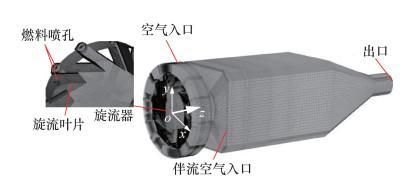
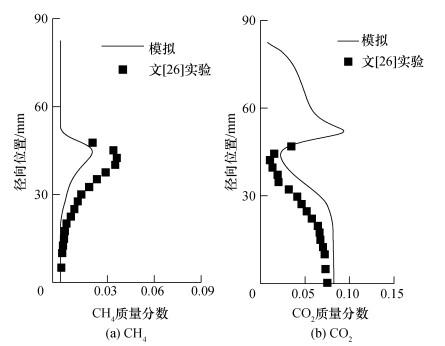
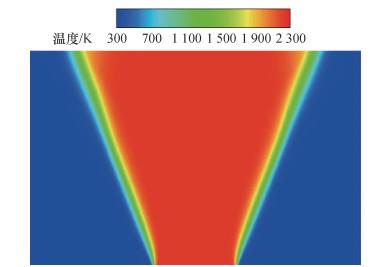
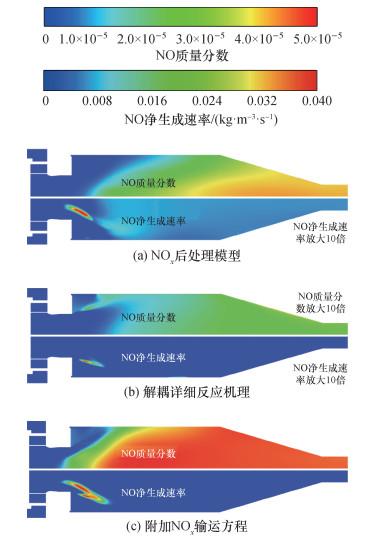
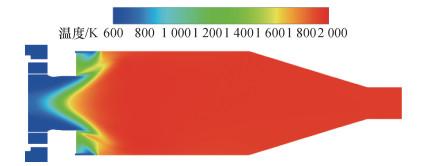
图 13给出燃烧室子午面位置NO质量分数和净生成速率分布云图,图 14给出燃烧室子午面位置温度云图来表征火焰形态。考虑到该燃烧室的组分场具有对称性,因此图 13上半部分为NO质量分数,下半部分为NO净生成速率。由于采用不同NOx数值模型时NO质量分数和净生成速率差异较大,因此对图 13a和13b的云图进行了比例缩放。由图 13可知,采用不同NOx数值模型时,NO净生成速率最高的位置均位于火焰面位置,并且附加NOx输运方程法具有最高的NO净生成速率,这是因为快速型NOx主要在火焰面生成。由于解耦详细反应机理法低估了火焰面和火焰后方的NO生成速率,因此该模型的计算精度较差。对于附加NOx输运方程法,虽然火焰面位置NO净生成速率较高,但火焰后方的NO净生成速率很低,导致火焰后方NO浓度变化较小。而从图 14的温度分布可以看出,火焰后方温度高于1 800 K,热力型NOx可在火焰后方缓慢生成。结合图 2和8,可认为附加NOx输运方程法可较好地预测火焰锋面位置的NOx生成速率和质量分数分布,但会低估火焰后方的热力型NOx生成速率。相较于附加NOx输运方程法,NOx后处理模型法低估了火焰面的NO净生成速率,但该模型可较好地再现焰锋面后方热力型NOx的生成,因此该模型对燃烧室出口NO排放有着较好的计算精度。
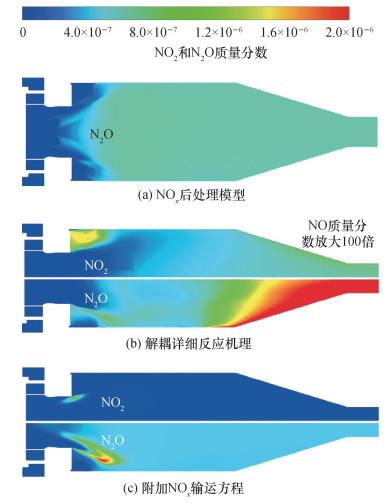
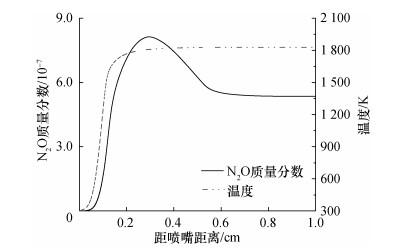
根据2.1节和2.2节所述,附加NOx输运方程法和NOx后处理模型法对燃烧室NO排放有着相对较高的精度,但二者在预测N2O生成特性的结果方面有所不同。考虑到N2O也可能会贡献一定量的NOx排放,为明确NOx后处理模型法和附加NOx输运方程法对N2O生成特性模拟的差异性,图 16给出常温、常压条件下当量比为0.700的甲烷/空气层流火焰中N2O质量分布和温度分布。可以看出,随着燃烧反应的进行,N2O质量分数先升高后降低,并在温度达到最高值后N2O质量分数达到最大值,这与湍流射流火焰中采用附加NOx输运方程法对N2O的计算结果相近,而NOx后处理模型法并不能很好地再现这一现象。对比图 4、10、15和16可知,附加NOx输运方程法可较好地预测火焰附近的N2O生成特性。需要注意的是:图 4中N2O在火焰后方质量分数的下降主要是由于火焰后方空气的掺混作用。
3 结论
1) 对于射流扩散火焰、旋流预混火焰和燃气轮机燃烧室而言,火焰后方NO占总NOx的95.00%以上,N2O的生成量较少,NO2的生成量极少。
2) NOx后处理模型法可较好地预测NOx生成位置和火焰后方NOx生成速率,可定性地预测射流扩散火焰、旋流预混火焰的NOx分布,对燃气轮机燃烧室出口NO排放的预测误差约为29.75% (质量分数为3.60×10⁻⁶)。该模型会低估火焰锋面位置的NOx生成速率,并且不能再现火焰锋面附近N2O浓度先升高后下降的变化规律。
3) 解耦详细反应机理法不能很好地再现NOx生成速率及NOx质量分数的空间分布。
4) 附加NOx输运方程法对火焰锋面位置的NOx生成量和生成速率有着最好的计算精度,但该模型低估了火焰锋面后方的NOx生成速率,并高估了燃气轮机燃烧室的NO排放,约48.76%(质量分数为5.90×10⁻⁶)。


