

1 数据来源与分析方法
1.1 数据来源及预处理
为全面反映研究动态,本文将英文文献和中文文献先分别计量,后综合分析。
英文文献来源于WoS(Web of Science),中文文献来源于中国知网(China National Knowledge Infrastructure, CNKI)。WoS检索式为“‘soil salinization’ OR ‘soil salinity’ OR ‘saline soil reclamation’”,CNKI检索式为“土壤盐渍化+土壤盐碱化+盐渍土+盐碱地+盐碱地改良+盐碱地利用”。文献截止时间为2022年。经联机检索,最终得到27 212篇有效文献。其中WoS文献7 395篇,CNKI文献4 797篇。
采用文献计量软件COOC对遴选出的样本进行数据清洗和预处理,包括剔除重复文献、删除无意义单元、合并相同单元等。
1.2 分析方法框架
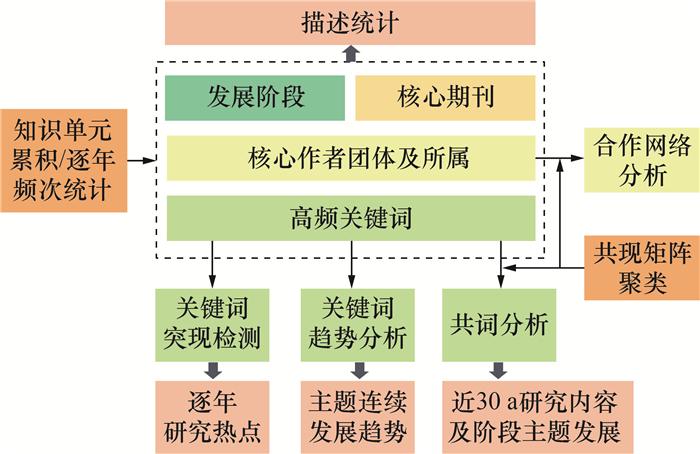
通常,文献综述多依赖于作者阅读的文献及其知识归纳能力。近年来文献计量学的发展为定量研究学科方向发展动态提供了有力工具。
其中:a为条件常数,即初始文献量;b为时间常数,即持续增长率。1962年,Kuhn提出科学发展过程是一个由“原始科学”转变为“常规科学”,以及由一个“常规科学”过渡到另一个“常规科学”的过程。在原始科学阶段,科学文献呈指数规律增加;当转变为常规科学,学科处于成熟稳定发展时期,这时的文献数量庞大,每年增加的文献量也很大,但增加率已减小,文献的增加由指数模式转化为逻辑曲线模式。将某一学科方向发文量时间序列绘点或按式(1)拟合后,用Kuhn模型即可判定其发展阶段。
其中m为核心作者中个人最低发文数。即发文数大于m的作者发文总数恰好等于全部论文数的一半。m可用下式估算:
其中:year为该关键词出现年份,Cyear为year年份该关键词出现频次。
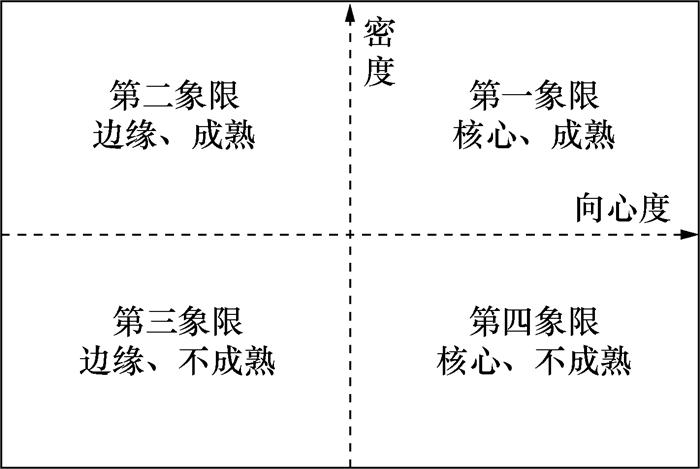
本文将向心度和密度联系起来,构建学科发展热点及方向战略坐标图,用以判断某一学科热点的发展状态。以向心度为X轴,以密度为Y轴,以(各聚类平均向心度,各聚类平均密度)为原点,以象限表征聚类及主题在一定时间范围内的相对的发展水平,象限划分如图 2。
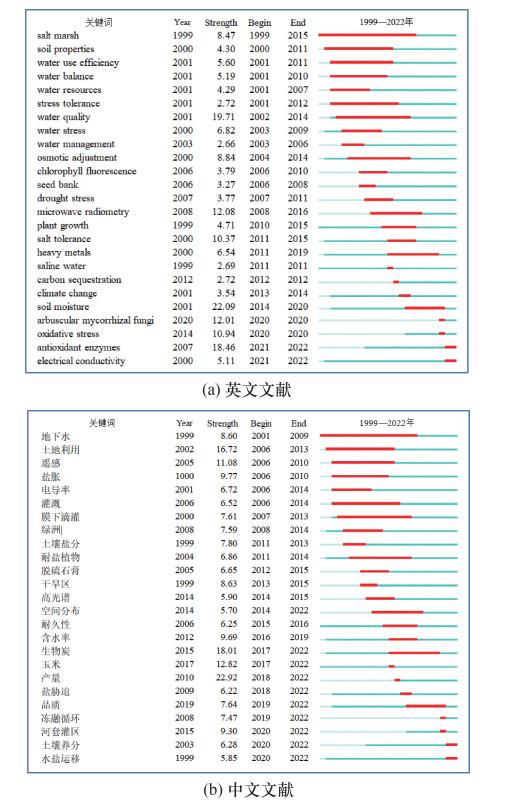
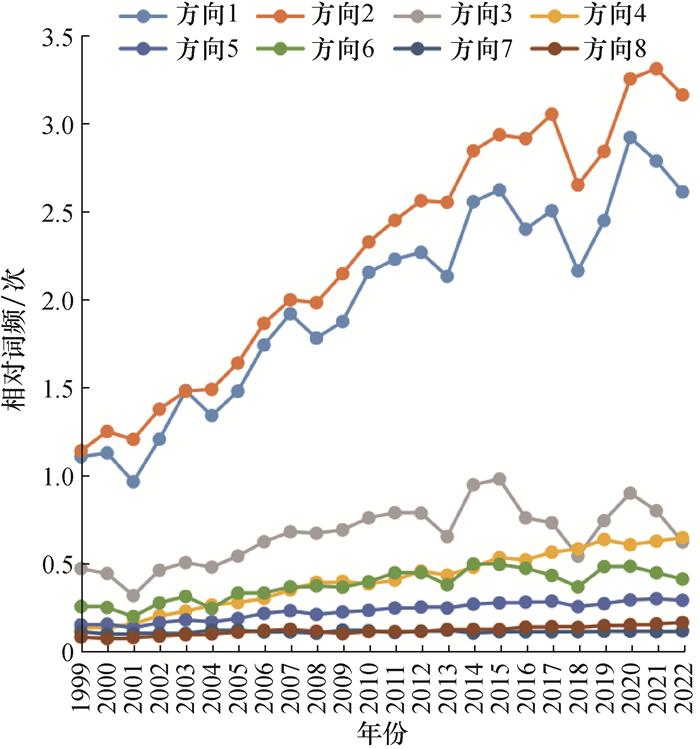
关键词突现分析和关键词趋势分析进一步将关键词与时间维度结合,用于发现关键词间显著性随时间的相对变化,确定前沿研究态势及主题演化趋势,二者结果相互印证。关键词突现分析可用Citespace软件中的J.Kleinburg突现算法进行,用突现强度量化该关键词在一定时间内的热点程度,表征热点的转移过程。关键词趋势分析是研究共现分析所得各主题下所有关键词逐年出现的相对词频变化趋势,用以表征学科研究热点的动态发展趋势,其中相对词频是指关键词某年词频与该年发文量比值。
2 土壤盐渍化研究动态基本特征分析
2.1 发展阶段特征
年发文量是表征一个研究方向发展历程和未来趋势的重要指标,累计发文量变化趋势可帮助识别该研究方向的发展阶段和未来趋势。将1.1节检索到的数据绘于图 3,以划分土壤盐渍化和盐碱地改良与利用学科方向研究的发展阶段。
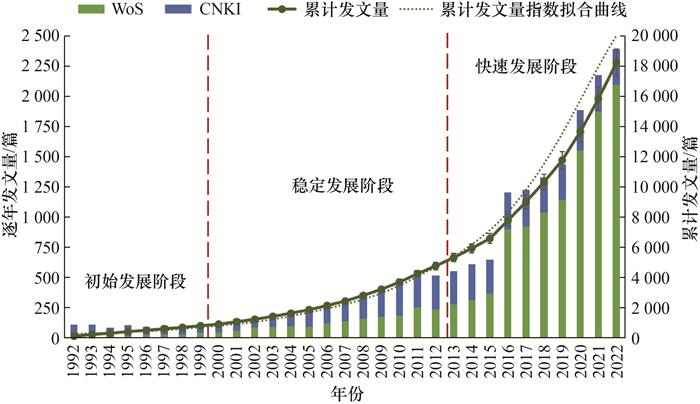
限于电子数据库收录年限,本文检索到的土壤盐渍化的研究文献最早发表于1992年。实际上,早在20世纪20—30年代,美国、澳大利亚等国就开展了土壤盐渍化研究[7],20世纪50年代中国也开始了土壤盐渍化研究[8]。从图 3可以看出,21世纪以前,土壤盐渍化和盐碱地改良与利用的研究论文数量总体较少;之后,稳定上升;2011年起,上升幅度明显加快,这与中国部署了大批盐碱地改良与利用国家科技计划项目和美、澳等国关于盐碱地开发利用的政策增多[24]有关。考虑政策和发文数增幅明显变化的时间节点,本文将1999年以前划为土壤盐渍化研究初始发展阶段,2000—2011年为稳定发展阶段,2012年之后为快速发展阶段。对1999—2022年数据回归分析可得到高度拟合指数曲线y=214.93e0.146 3t(R2=0.98),参照Kuhn的科学发展模型[15],判定当前土壤盐渍化研究处于初始科学时期,未来仍将快速增长。
2.2 期刊作者特征
在过去近30 a中,共有1 898种期刊发表了土壤盐渍化论文,后文讨论均特指该类论文。其中,国际期刊1 258种,国内期刊640种;年均发文量大于4篇的有17种,如表 1所示。
表 1 近30 a年均发文不少于4篇的期刊 |
| 序号 | 期刊名称 | C | NP | IF |
| 1 | Agricultural Water Management | 荷兰 | 344 | 6.61 |
| 2 | Science of the Total Environment | 荷兰 | 321 | 10.75 |
| 3 | Frontiers in Plant Science | 荷兰 | 298 | 10.75 |
| 4 | Agronomy-Basel | 瑞士 | 257 | 3.95 |
| 5 | Remote Sensing | 瑞士 | 215 | 5.35 |
| 6 | 土壤通报 | 中国 | 212 | 2.11 |
| 7 | Plants-Basel | 瑞士 | 196 | 4.66 |
| 8 | Sustainability | 瑞士 | 195 | 3.89 |
| 9 | Water | 瑞士 | 187 | 3.53 |
| 10 | Environmental Science and Pollution Research | 德国 | 161 | 5.19 |
| 11 | Geoderma | 荷兰 | 159 | 7.42 |
| 12 | 土壤 | 中国 | 144 | 2.73 |
| 13 | Plant and Soil | 荷兰 | 143 | 4.99 |
| 14 | 农业工程学报 | 中国 | 136 | 3.76 |
| 15 | 灌溉排水学报 | 中国 | 136 | 2.88 |
| 16 | 水土保持学报 | 中国 | 132 | 3.83 |
| 17 | 江苏农业科学 | 中国 | 132 | 1.52 |
注:C-国家;NP-发文量;IF-影响因子,英文期刊影响因子来源于2021年Journal Citation Report (《期刊引证报告》),中文期刊影响因子来源于2022年度CNKI复合影响因子;期刊按照发文量多少排列。 |
国际期刊中,Agricultural Water Management发文量最多,Science of the Total Environment和Frontiers in Plant Science跟随其后。中文期刊中,《土壤通报》《土壤》《农业工程学报》《灌溉排水学报》《水土保持学报》发文量靠前、期刊影响因子较高。上述期刊可视作土壤盐渍化领域核心期刊。
在过去近30年中,共有约45 580名作者发表了土壤盐渍化方向的论文。按式(3)计算,核心作者157名,占总数的0.34%。其中,国际学者75名,国内学者82名。年均发文量不少于1篇的作者有30名,如表 2所示。可以看出,中国学者已成为土壤盐渍化研究的中坚力量。
表 2 近30 a年均发文量不少于1篇的学者 |
| 作者 | 发文量/篇 | 作者 | 发文量/篇 | |
| 杨劲松 | 139 | 万书勤 | 36 | |
| 丁建丽 | 89 | 王振华 | 36 | |
| 姚荣江 | 74 | 杨帆 | 35 | |
| 史海滨 | 60 | 梁正伟 | 35 | |
| 王志春 | 59 | SHABALA Sergey | 35 | |
| 李彦 | 57 | 张俊华 | 34 | |
| 柴寿喜 | 49 | 崔保山 | 34 | |
| 刘广明 | 49 | 许兴 | 33 | |
| 刘小京 | 49 | GHEYI Hans Raj | 32 | |
| 康跃虎 | 48 | 魏丽 | 31 | |
| 张凤华 | 46 | 李敏 | 31 | |
| 田长彦 | 45 | 汤洁 | 31 | |
| 白军红 | 43 | 赵庚星 | 31 | |
| 伍靖伟 | 41 | 陈小兵 | 31 | |
| 乔宏霞 | 36 | 王清 | 31 |
2.3 国别机构特征
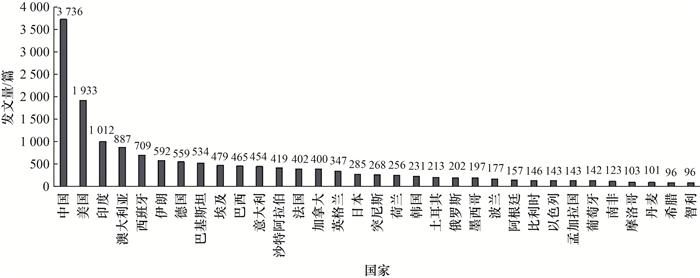
有150个国家和地区发表了土壤盐渍化研究论文。图 4列出了过去近30 a在WoS中年均发文量不少于3篇的国家,发文最多的仍是中国,其次是美国;中国的发文量约是美国的2倍。
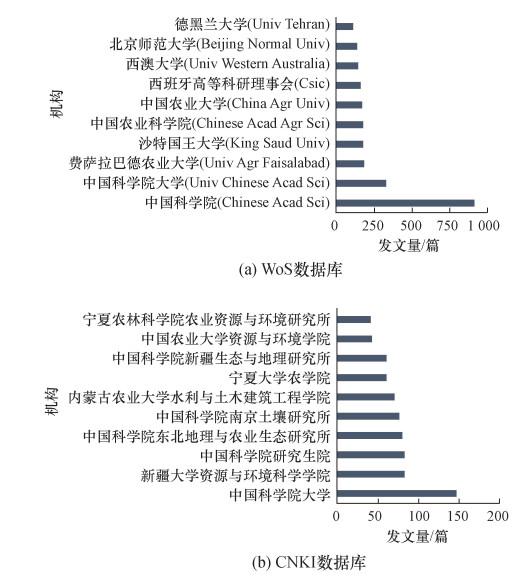
将WoS和CNKI中发文量前10的机构列于图 5。WoS中发文前10的机构中中国占5席位,这与中国发文总量排名首位相对应。其中,中国科学院以917篇位居第一,是排名最靠前国外机构的近5倍。美国虽总发文量排名第2,但是其发文最多的机构在全球未进前十,仅排第13。国内发文量前十机构中,中国科学院大学发文最多,但地处中国西北的研究机构却占有5席,这与西北盐碱地众多的状况相符。
2.4 合作网络特征
合作网络共现分析是定量研究某一学科领域或方向研究中跨国家(地区)、跨机构部门合作的情况。本文采用VOSviewer软件分析了开展土壤盐渍化和盐碱地改良与利用研究的机构与机构、国家与国家之间的合作情况,如图 6所示。
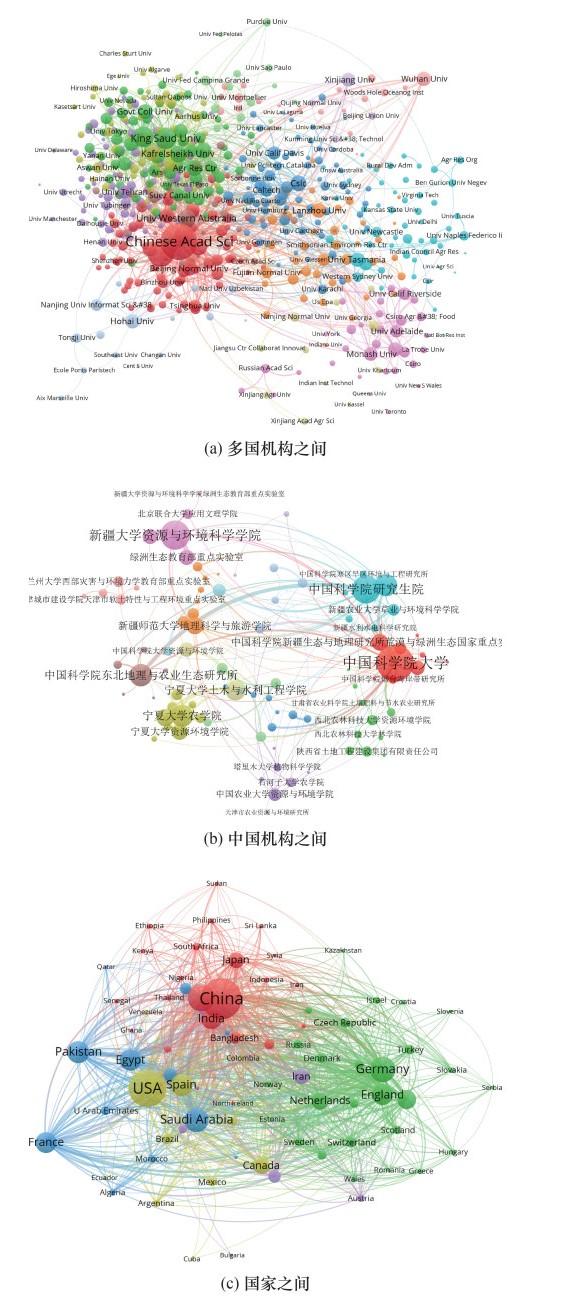
从图 6a可以看出,多国机构合作形成以中国科学院、西澳大学、沙特国王大学和加利福尼亚大学等为核心的网络图,美国农业部、江苏农业科学院等政府机构在其中也发挥着重要作用。
从图 6b可以看到,中国科学院的合作对象以国内高校和科研院所为主;中国机构合作集中在同一机构的不同二级单位或两所院校间,两所以上的院校合作不多。
从图 6c可以发现,国家间合作关系明显不同。土壤盐渍化研究水平较高的国家间合作密切,如中国、美国、德国、法国、西班牙和巴基斯坦。从合作强度上看,欧洲各国间合作紧密,中美两国发文量虽高但与他国合作强度不高,或许与其自身从事该领域研究队伍已经有足够体量有关。
3 土壤盐渍化研究动态发展趋势分析
如果说合作共现分析可以定量评价某一学科领域研究中国家间、机构间和学者间的合作关系,则关键词共现分析或可定量发现某一学科方向的研究动态和发展趋势。
采用VOSviewer、Citespace和SPSS软件,通过关键词共现、突现和趋势分析的联合应用,可以揭示不同时期土壤盐渍化和盐碱地改良与利用的研究热点、持续时间、变化节奏及迭代重现等规律,以期从中预测研究动态发展趋势。
3.1 关键词共现分析
关键词是论文主题的高度概括,其出现频次、出现时间和关联程度代表着该领域的研究热点。图 7表述了过去近30 a土壤盐渍化研究出现频次大于20的关键词的聚类结果,可以概括出土壤盐渍化的重点研究方向。其中,所属相同聚类的关键词呈一纵列;同时,颜色由蓝到黄表征关键词出现的平均年份由老到新,可用于判断聚类下研究热点演变。
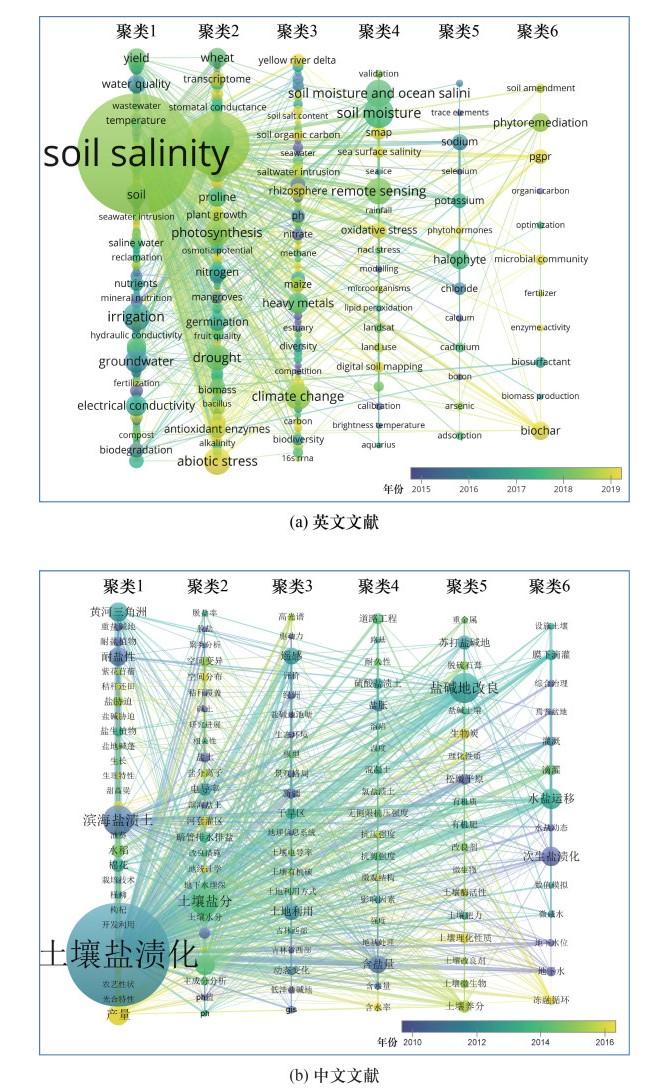
研究发现,相同参数下中英文关键词所得聚类数量均为6个,且内容相似。聚类中的关键词个数从聚类1到6递减,具体情况如表 3所示。综合来看,对于近30 a的关键词共现分析共得到8个土壤盐渍化的主要研究方向,分别为:1) 土壤水盐动态调控机制与优化调控技术[25-29];2) 土壤植物盐分互作机制及耐盐植物培育[30-36];3) 变化环境下土壤盐渍化响应机制[37-38];4) 盐碱地水分、盐分动态遥感监测[39-47];5) 改良过程中盐渍土壤微量元素的响应[48];6) 盐渍土改良剂的研发及应用[49-53];7) 盐碱地改良农艺措施的探索[54-60];8) 盐碱地区道路盐胀修复[61-62]。
表 3 关键词共现聚类表 |
| 语种 | 聚类 | 主要关键词 | 主题概括 |
| 英文 | 1 | 土壤盐渍化(soil salinity)、灌溉(irrigation)、地下水(groundwater)、重金属(heavy metals)、农业(agriculture)、水质(water quality)、用水效率(water use efficiency)、咸水(saline water)、滴灌(drip irrigation) | 盐渍土水盐调控技术及水质水量影响 |
| 2 | 盐胁迫(salt stress)、干旱(drought)、耐盐度(salt tolerance)、小麦(wheat)、水稻(rice)、脯氨酸(proline)、植物生长(plant growth)、光合作用(photosynthesis)、盐生植物(halophyte)、丛枝菌根真菌(arbuscular mycorrhizal fungi)、基因表达(gene expression)、蛋白质组学(proteomics)、代谢组学(metabolomics) | 盐胁迫下植物生长机制与耐盐性培育、耐盐基因的研究 | |
| 3 | 气候变化(climate change)、氮(nitrogen)、根际(rhizosphere)、营养素(nutrients)、磷(phosphorus)、盐沼(salt marsh)、红树林(mangroves)、硝酸盐(nitrate)、黄河三角洲(Yellow River Delta)、滨海湿地(coastal wetland) | 气候变化下土壤盐渍化的响应 | |
| 4 | 土壤水分(soil moisture)、土壤湿度和海洋盐度(Soil Moisture and Ocean Salinity)、遥感(remote sensing)、SMAP卫星(Soil Moisture Active and Passive)、海面盐度(sea surface salinity)、验证(validation)、L波段(L-Band)、微波辐射线测定(microwave radiometry)、数据同化(data assimilation)、校准(calibration) | 遥感反演土壤水分与盐分 | |
| 5 | 钠(sodium)、钾(potassium)、植物修复(phytoremediation)、氯(chloride)、镉(cadmium)、钙(calcium)、砷(arsenic)、锌(zinc)、硼(boron)、硒(selenium) | 植物修复盐渍土时土壤微量元素变化 | |
| 6 | 生物炭(biochar)、pH值(pH)、土壤改良剂(soil amendment)、生物表面活性剂(biosurfactant)、生物质产品(biomass production)、微生物多样性(microbial diversity)、酶活性(enzyme activity)、有机肥料(organic fertilizer)、危害植物的毒性(phytotoxicity) | 盐渍土改良剂的研发及应用 | |
| 中文 | 1 | 土壤盐渍化、产量、滨海盐渍土、黄河三角洲、棉花、耐盐性、水稻、玉米、品质、耐盐植物 | 耐盐植物培育与品质、产量的提升 |
| 2 | 土壤盐分、电导率、河套灌区、土壤水分、秸秆覆盖、脱盐率、改良措施 | 盐碱地改良措施探索 | |
| 3 | 遥感、土地利用、干旱区、动态变化、高光谱、模型、景观格局、评价、土地利用方式、生态环境 | 盐碱地动态遥感监测及生态环境评价 | |
| 4 | 盐胀、道路工程、抗剪强度、影响因素、抗压强度、混凝土 | 盐碱地区道路盐胀修复研究 | |
| 5 | 盐碱地改良、土壤养分、土壤理化性质、脱硫石膏、生物炭、改良剂、有机肥 | 盐渍土改良剂的研发及应用 | |
| 6 | 水盐运移、次生盐渍化、膜下滴灌、地下水、冻融循环、微咸水、设施土壤、水盐动态、综合治理、数值模拟 | 土壤水盐动态调控机制与优化调控技术 |
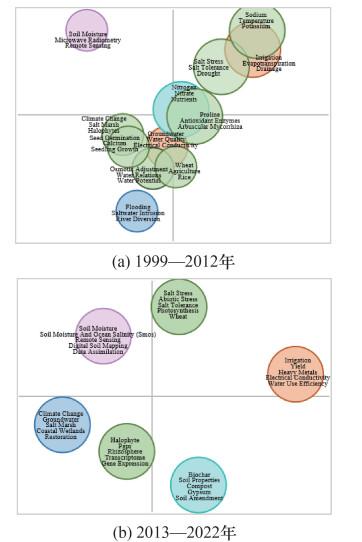
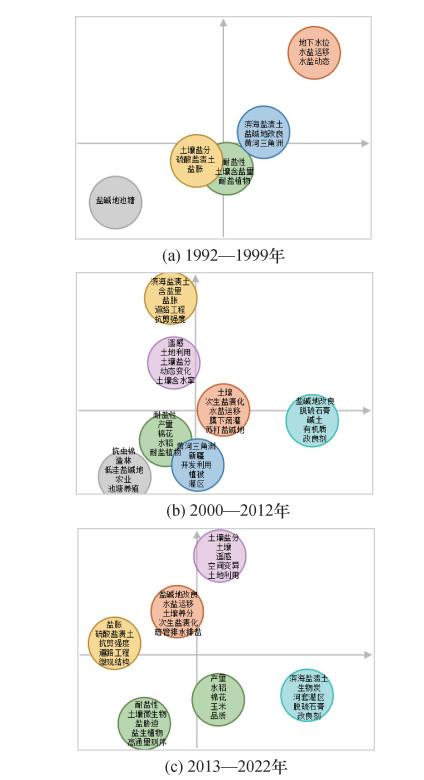
由图 8和9中4个象限的意义可知,土壤水盐动态调控机制与优化调控技术方向常驻第一象限,几乎始终为国内外研究的核心,且发展相对比较成熟,但在国内快速发展阶段向心度略有减少,研究核心有所转移。在初始发展与稳定发展阶段,土壤植物盐分互作机制及耐盐植物培育方向研究主题广泛,在国际上盐碱地区作物栽培主题位于第一象限,耐盐机制主题位于第三象限;而国内,栽培技术与产量提升主题位于第一象限。在快速发展阶段,作物栽培主题仍为国内外核心,此外耐盐基因筛选主题出现在第三象限,该主题具有很大的发展潜力。盐碱地水分、盐分动态遥感监测方向在稳定发展阶段出现,处于第二象限,关键词内部连接紧密,已经具有一定的研究体系,到了快速发展阶段向心度增大,与其他方向联系更为紧密,在国内已处于第一象限,成为核心方向。盐碱地的开发利用与变化环境下土壤盐渍化响应机制等方向在国际上处于第三象限即边缘地位;在国内较为核心,但成熟度较低,有待进一步发展。值得注意的是,盐渍土改良剂的研发及应用方向在国内外均处于核心地位,但成熟度相对较低,具有很大的发展潜力。
3.2 关键词突现分析
关键词突现分析是指研究不同年份关注度快速爆发式增长的关键词,以表征热点转移与发展。在Citespace软件中,以1 a为时间间隔单位,选取1999—2022年各年份出现频次不低于10次的关键词,分别得到了中文、英文各25个突现词。图 9展示了关键词首次出现年份(Year)、突现强度(Strength)、突现开始年份(Begin)与结束年份(End)及在时间轴上的位置(红色部分为突现年份),并将关键词按照突现开始时间从前到后、突现强度从大到小的顺序排列。从图 10可以看到,“生物炭”“产量”“盐胁迫”“品质”“冻融循环”“水盐运移”等都是近年关注的热点,其中,出现年份较早但近年突现的关键词对应的研究方向可能有新技术或新发现产出。
3.3 关键词趋势分析
为定量揭示出学科研究热点的动态发展趋势,根据3.1节所得研究方向,分析了中英文共8个方向相对词频变化趋势。取滑动平均跨度为3,绘制中英文各方向相对词频变化趋势图如图 11所示。可以看出,相对词频较高且趋势呈逐年上升趋势的研究方向为方向1、2、3、4、6。
3.4 发展趋势
经上述逐年、阶段、连续时间3个时间尺度的关键词的共现频次、突现年代的定量分析,经加权量化后,可以看到近期土壤盐渍化及盐碱地改良与利用研究的发展集中在以下几个方向。
3.4.1 土壤植物盐分互作机制及耐盐植物培育
耐盐植物培育是改良盐渍土的有效生物措施。研究内容主要包括:阐明盐生与非盐生植物的耐盐机制,选择和培育耐盐品种,以及探索提高植物耐盐性的方法。许多研究人员已经对植物的耐盐性进行了基因水平的研究,并总结了其机制,但是仍需要大量的实验验证[63]。因此,进一步研究盐生和非盐生植物的耐盐基因,比较同一基因在不同植物物种中的功能差异,利用反向遗传学研究同一基因在不同植物中的调控机制,并对基因功能进行验证分析[64-65],具有重要意义。以往的研究已经选育出小麦、水稻、玉米、棉花、甜菜、苜蓿、牧草、枸杞、碱蓬、油葵等各种作物的耐盐品种[66],但与常规育种条件相比产量较低,提高耐盐品种的产量是一个有待克服的重要瓶颈。
3.4.2 土壤水盐动态调控机制与优化控制技术
基于水盐运移规律, 优化灌排方式和耕作方式,进而调控土壤水盐动态属于盐渍土改良的物理措施。调控灌排方式主要包括通过建设水利设施,优化淋水、灌水、排水方式,进行盐渍土洗盐、排盐。初期灌排方式主要包括大水漫灌、井灌、明沟排水排盐,但这些方式易造成地下水位上升,积盐反盐。随着研究不断深入,灌排方式从大水漫灌发展到精准滴灌、从明沟排水排盐发展到暗管排水排盐。目前,暗管排水、微咸水灌溉和膜下滴灌是优化灌溉排水的重要技术措施。在淡水资源短缺的背景下,新型节水灌排方式和淋洗水循环处理再利用技术[70],以及非淡水资源的合理利用[71],可能是未来灌排治理盐渍土的工作重点。调控耕作方式主要针对养分贫乏的盐渍土,采用一些措施来改善土壤结构,增加土壤水分和养分,包括深耕、平整、覆土(材料使用地膜、秸秆等)和施肥。上述措施均能有效治理盐渍土,但其效果取决于土壤质地、气象条件和灌溉水质水量等。未来,多措施协作下土壤盐渍化的长期治理效果以及因地制宜优化土壤水盐调控的系统方案仍将受到关注[72-73]。现阶段用到的土壤水盐动态模拟模型主要有HYDRUS、SWAP、SHAW等,也仍将是今后的主要工具[74]。
3.4.3 盐渍土改良剂研发技术及其规模化应用
改良剂的使用属于盐渍土改良的化学措施。常用的土壤改良剂包括无机物质如石灰、脱矿石膏、磷石膏、沸石、氯化钙、硫酸亚铁、硫磺和硫酸等以及有机物质如腐植酸、腐植酸钙、黄腐酸、生物糖和木醋溶液等。中国的土壤改良剂研究始于20世纪80年代初,但由于土壤改良剂成本高等原因,没有大规模开展。20世纪90年代,中国逐渐开始从国外进口新型土壤改良剂。21世纪初,中国开始开发有效、经济、生态环境友好型土壤改良剂。近年来,生物炭作为一种新兴材料广受关注,但它对土壤的理化性质、植物的生长发育和产量的影响是由特定土壤的理化性质和植物的生物性质以及制备的材料和温度决定的。由于这些复杂的相互作用使得试验结果不尽一致,改进效果存在很大不确定性。因此,需要对生物炭和其他新兴土壤改良剂(如木醋等生物炭副产品)与土壤团聚体、土壤微生物和土壤水分之间在微观层面上的相互作用机制进行系统研究[75]。此外,土壤改良剂的不适当应用可能会造成土壤污染和资源浪费。因此,研究每种材料的适当剂量和使用方法,以及联合应用的长期效果,将是未来一个重要研究方向[76-77]。
3.4.4 盐碱地动态遥感监测及盐渍化影响评价
4 结论与展望
土壤盐渍化的研究纷繁复杂,传统文献综述方法已难以系统全面把握发展动态。本文运用文献计量学方法系统分析土壤盐渍化发展动态,得到主要结论如下:
1) 总体趋势上,国内外土壤盐渍化研究呈上升趋势,越来越多学者投入其中。1999年以前为初始发展阶段,2000—2011年为稳定发展阶段,2012年至今为快速发展阶段,但总体上仍处于研究的原始阶段,仍有很大发展空间;
2) 合作网络分析表明,科研院校和政府直属机构对促进机构合作均有重要推动作用,但合作类型主要集中在机构内部合作,今后应强调跨背景、跨机构、跨国家的合作以及跨学科的作用,这有助于不同团队之间的相互学习,有助于土壤盐渍化研究的跨越式、多元化发展。
3) 关键词分析综合表明,近30年土壤盐渍化的研究热点集中在以下4个方向:土壤植物盐分互作机制及耐盐植物培育;土壤水盐动态调控机制与优化控制技术;盐渍土改良剂研发技术及其规模化应用;盐碱地动态遥感监测及盐渍化影响评价。
本文仍存在一些不足:一是数据来源依靠的电子数据库,未能包含1992年以前的文献,即使结合使用WoS和CNKI也存在文献漏选,可考虑纳入更多的数据库和更好的筛选软件;二是所用文献计量软件的聚类主题概括仍需经验判断,有必要改进智能算法减少概括的主观性,在可视化过程中需提高知识图谱参数设置的灵活性。


