

液体燃料是中国重要的能源,在基础能源消费中液体燃料消费占比超过20%[1]。在液体燃料储运过程中,液体火灾事故时有发生[2-3]。由于传统泡沫具有良好的覆盖和隔热性能,因此被广泛应用于液体火灾扑救[4]。但传统泡沫热稳定性较差,在大面积液体火灾扑救过程中,液体火灾易发生复燃现象。同时,传统泡沫含有全氟辛烷磺酰基化合物(PFOS),PFOS降解困难,会对环境造成污染,进而危害人体健康[5-6]。例如,2015年4月,福建省漳州市某化工厂发生大型储罐火灾事故,救援中使用大量泡沫(1 600 t以上)进行灭火,灭火过程先后发生4次复燃,整个过程耗时56 h,并且产生了大量含氟废水。因此,研发一款适用于液体火灾的高稳定性环保型泡沫具有重要意义。
近年来,国内外学者致力于提升泡沫的灭火性能。Xu等[7]使用水成膜泡沫(aqueous film forming foam, AFFF)用于扑灭柴油油池火(油盘尺寸为50.0 cm×50.0 cm×10.0 cm),研究了不同气液比对AFFF灭火性能的影响,发现当气液比为4∶2时,AFFF的灭火时间最短。Zhang等[8]对比分析了耐醇水成膜泡沫(AFFF/AR)和耐醇氟蛋白泡沫的灭火性能,发现AFFF/AR在扑救甲醇池火中冷却效果更好。除关注传统泡沫外,国内外学者也致力于研制高稳定环保型泡沫。曹海珍等[9]通过在碳氢表面活性剂中添加疏水改性二氧化硅,制备了疏水改性泡沫,相比改性前,所制备的疏水改性泡沫的发泡倍数和析液半衰期分别提升了16.3%和15.7%。Han等[10]采用海藻酸钠、L-乳酸钙、烷基糖苷和茶皂素,研发了一种交联时间可控的新型生物基凝胶泡沫,发现当凝胶时间为10.0 min时,泡沫稳定性最好,析液半衰期达16 d。Fan等[11]采用α-烯烃磺酸钠(AOS)作为表面活性剂,通过添加木质素纳米颗粒(LNPs)提升泡沫的稳定性,发现当AOS和LNPs的质量分数均为0.2%时,泡沫的稳定性最好,液膜厚度增加了1~3倍,析液半衰期提升了9倍。Xi等[12]使用微生物多糖、半乳甘露聚糖生物聚合物(PC)和有机硼络合物(OBC)这3种物质联合制备了用于扑灭煤火的高保水凝胶泡沫,发现PC与OBC的浓度处于3.4~4.8 g/L和2.0~3.4 g/L时,泡沫冷却效果最好。Xi等[13]采用聚环氧乙烷、十二烷基硫酸钠和聚己内酯等,制备了一款多晶型泡沫。该泡沫受热后发泡,可覆盖在可燃物表面,起到抑火和灭火作用。Qin等[14]使用粉煤灰(FA)和十二烷基苯磺酸钠(SDBS)制备了三相泡沫,对比了SDBS/FA三相泡沫与SDBS两相泡沫扑灭煤火的效果。该研究发现,三相泡沫和两相泡沫覆盖煤堆30.0 min后,中心温度分别为83 ℃和350 ℃,表明三相泡沫的冷却效果更好。综上所述,国内外学者通过使用不含氟表面活性剂替代含氟表面活性剂以减少环境污染。同时,部分学者通过引入聚合物、固相粒子等添加剂以增加泡沫黏度和液膜厚度,进而提高泡沫稳定性。但现有研究大多停留在实验室参数测量阶段,且已有泡沫大多针对煤火等固体火灾,而针对液体火灾的高稳定性环保型泡沫研究较少。
首先,本文采用脂肪醇聚氧乙烯醚葡糖苷(AEG)和椰油基糖苷(APG-0810)这2种表面活性剂(不含氟)进行复配,同时引入成本低且易降解的瓜尔豆胶作为稳泡剂,研发了一款适用于液体火灾的环保型多糖聚合物泡沫;其次,测量了环保型多糖聚合物泡沫的发泡倍数和析液半衰期,并开展了灭火和抗复燃测试;最后,对比了环保型多糖聚合物泡沫与氟蛋白泡沫(液体火灾中常用的泡沫灭火剂)的灭火性能。
1 研究方法
1.1 材料
实验使用的材料包括:椰油基糖苷(APG-0810,纯度50%,山东优索化工科技有限公司),脂肪醇聚氧乙烯醚葡糖苷(AEG,纯度50%,山东优索化工科技有限公司),椰油酰胺丙基甜菜碱(CAB,纯度35%,山东优索化工科技有限公司),月桂酰肌氨酸钠(LS-30,纯度30%,山东优索化工科技有限公司),瓜尔豆胶(纯度99%,浙江一诺生物科技有限公司),氟蛋白泡沫(FFFP,纯度6%,苏州凌恩科技有限公司),汽油(92号),自来水。
1.2 表面活性剂发泡性能
其中:V1和V2分别为泡沫液发泡前和发泡后的体积,V1=50 mL。
1.3 复合发泡剂配比
泡沫稳定性是影响泡沫灭火与抗烧性能的关键指标,析液半衰期是衡量泡沫稳定性的常用指标之一[9]。选择2种发泡倍数最大的表面活性剂进行不同比例复配。发泡后,记录析出一半液体质量所用的时间,即析液半衰期T1/2。泡沫综合值FC表示如下:
根据FC确定最佳复配比例[9]。每组实验重复3次,取平均值。
1.4 瓜尔豆胶质量分数
在表面活性剂质量分数确定的基础上,分别配置瓜尔豆胶质量分数为0.1%、0.2%、0.3%、0.4%、0.5%、0.6%、0.7%的复合发泡液,搅拌均匀后即可得到多糖聚合物泡沫,测量其发泡倍数和析液半衰期,通过计算FC确定最佳瓜尔豆胶质量分数。
1.5 灭火性能与抗复燃性能
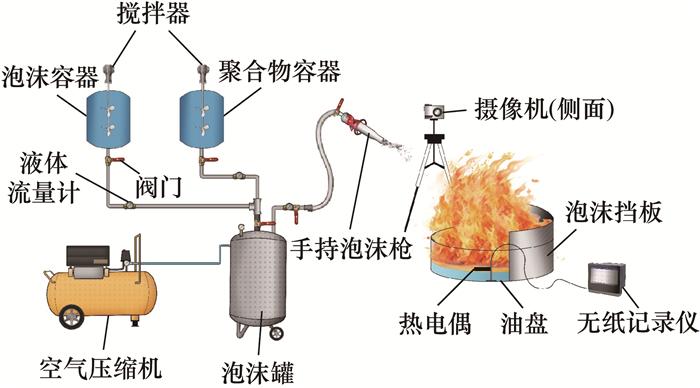
油盘内火焰完全熄灭后,冷却5.0 min,开展抗复燃实验。在抗复燃实验中,将直径为20.0 cm的抗烧罐放入油盘中,随后加入1 L(液位高度约3.2 cm)汽油并引燃。抗复燃实验中,分别记录25%复燃、90%复燃和完全复燃的对应时刻,以评估泡沫的抗烧能力[18]。
2 结果与讨论
2.1 发泡剂成分筛选
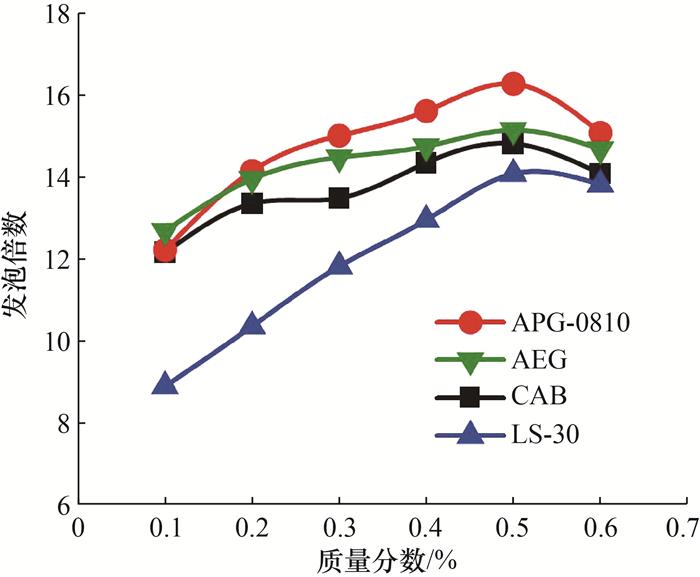
不同质量分数下的CAB、APG-0810、LS-30和AEG这4种表面活性剂的发泡倍数如图 2所示。
2.2 复合发泡剂配比
根据2.1节的实验结果,设置总质量分数为0.5%,调整AEG和APG-0810的比例,明确AEG和APG-0810不同质量比(mAEG∶mAPG-0810)下的泡沫综合值。不同质量比下的发泡倍数、析液半衰期和泡沫综合值如图 3所示。
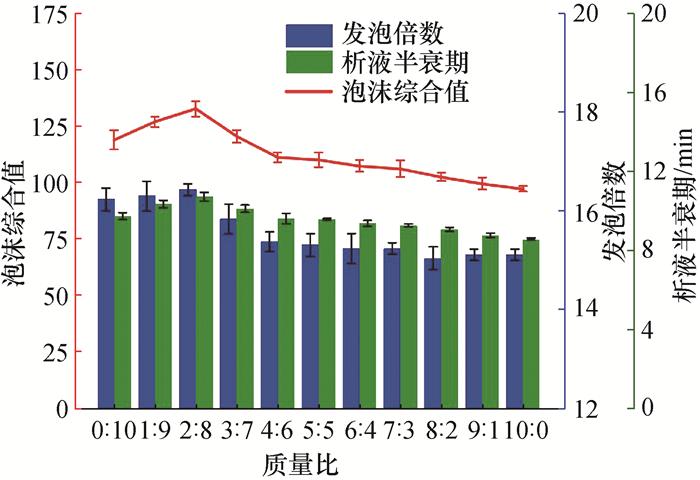
可以看出,发泡倍数、析液半衰期和泡沫综合值均随质量比增大而先增大后减小,且在mAEG∶mAPG-0810=2∶8时泡沫综合值达到最大,此时发泡倍数为14.5,析液半衰期为10.8 min,泡沫综合值为133.4。
2.3 稳泡剂含量确定
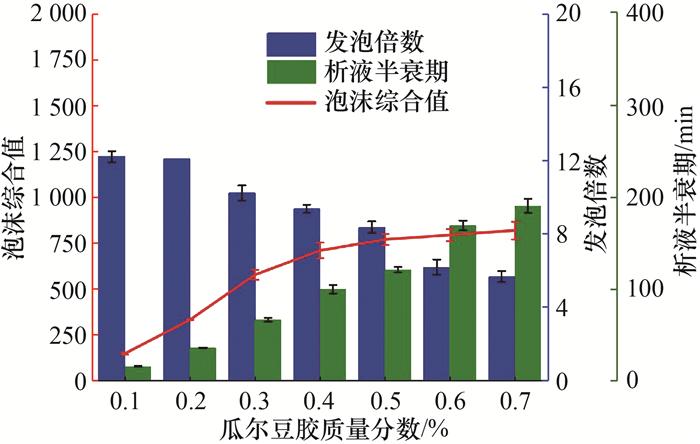
由2.2节可知,当mAEG∶mAPG-0810 =2∶8、总质量分数为0.5%时,泡沫综合值最大,进一步添加稳泡剂瓜尔豆胶用于增强泡沫稳定性。不同瓜尔豆胶质量分数下多糖聚合物泡沫的发泡倍数、析液半衰期和泡沫综合值如图 4所示。
2.4 灭火性能分析
为验证最佳的多糖聚合物泡沫配方和实际灭火效果,选择了3种泡沫配方进行灭火,其中配方1、2和3分别对应瓜尔豆胶质量分数0.3%、0.4%和0.5%。图 5为不同时刻下3种泡沫配方的泡沫灭火过程。
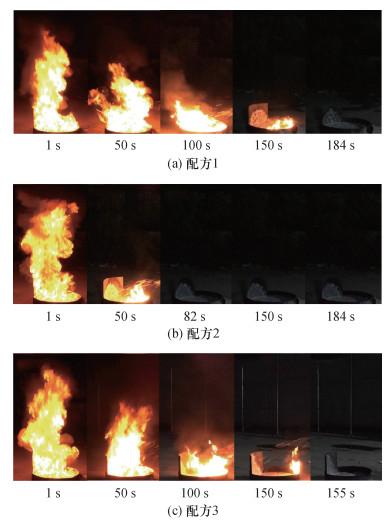
可以看出,3种多糖聚合物泡沫配方的整个灭火过程基本一致,但灭火时间存在较大差异。首先,喷射泡沫后,火焰高度逐渐下降,火焰体积逐渐缩小,这主要是因为喷射泡沫后,燃烧油品液面逐渐被泡沫覆盖并冷却,抑制了油品的蒸发速度;其次,持续喷入泡沫,油盘内部由全液面燃烧逐渐转变为局部液面燃烧,这主要是由于泡沫的覆盖面积不断增加;最后,火焰消失,泡沫覆盖整个油品液面。
进一步分析3种多糖聚合物泡沫配方的灭火效果发现,50 s时,配方2的油盘火焰呈局部液面燃烧,且控火面积已接近90%,但配方1和3对应的油盘仍处于全液面燃烧状态。100 s时,配方2已完全扑灭油池火,而配方1和配方3的泡沫仍没有扑灭油池火。这表明,泡沫配方中瓜尔豆胶质量分数为0.4%时,实际灭火效果最好。
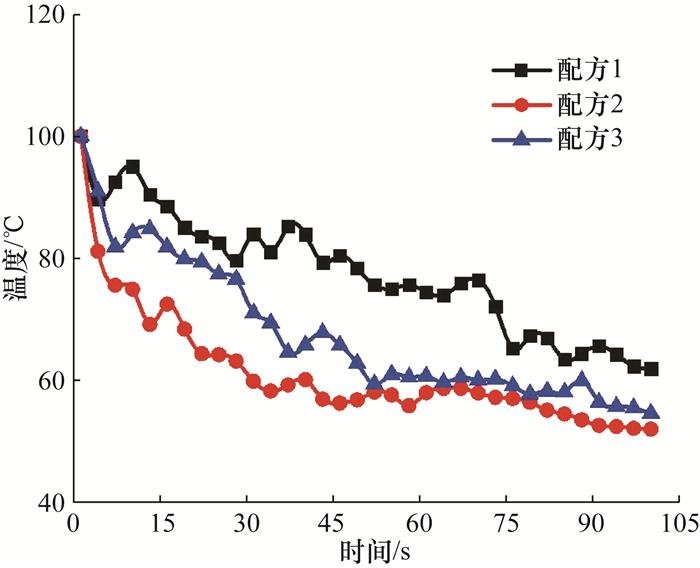
可以看出,采用配方2灭火时,油品液面温度下降最快;采用配方1灭火时,油品液面温度下降最慢。从冷却效果看,3种泡沫的灭火能力从大到小依次为配方2、配方3、配方1,这与图 5的结果基本保持一致。
为进一步说明多糖聚合物泡沫的灭火效果,本文给出了3种泡沫配方的具体灭火时间,同时,与FFFP的灭火时间进行对比。不同泡沫灭火时间如图 7所示。
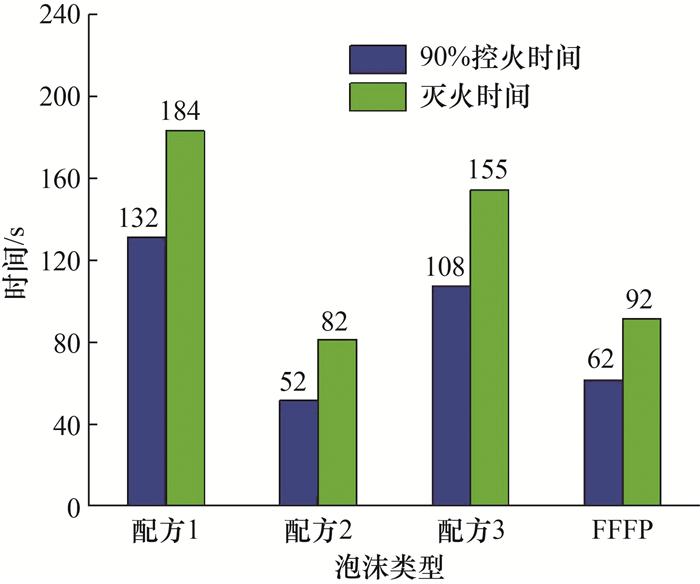
对比配方2与FFFP的灭火效果发现,配方2的90%的控火时间和灭火时间都比FFFP短,分别缩短了16.1%和10.9%,这表明配方2具有良好的灭火效果。
2.5 抗复燃性能分析
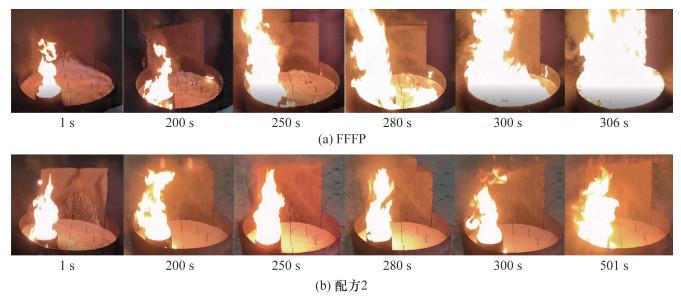
由图 8可知,在油盘中放置燃烧的抗烧罐,火焰燃烧一段时间后,抗烧罐周围出现了不稳定燃烧,时而发生闪火现象。这主要是因为高温抗烧罐破坏了邻近的泡沫,造成泡沫局部坍塌,而周围泡沫会快速补充并覆盖坍塌区域。随着燃烧持续,燃烧面积逐渐扩大,这主要是因为随着泡沫坍塌面积增加,周围泡沫无法及时补充,油品暴露面积不断增加。最终火焰覆盖油面,油品完全复燃。
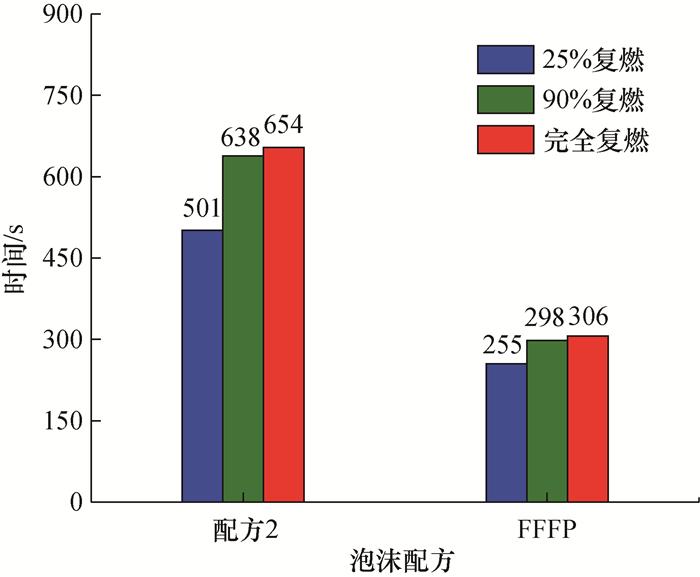
由图 9可知,配方2的25%复燃、90%复燃和完全复燃的对应时间分别为501、638和654 s,比FFFP的25%复燃、90%复燃和完全复燃的对应时间分别延长了96.5%、114.1%和113.7%。这与瓜尔豆胶的黏性和保水性密切相关,瓜尔豆胶能够增强泡沫的黏性和保水性,在强辐射作用下可有效阻碍气泡融合、破裂,减缓失水。
3 结论
本文研制了一种用于扑灭液体火灾的环保型多糖聚合物泡沫。采用AEG和APG-0810作为发泡剂,瓜尔豆胶作为稳泡剂,并进行了泡沫参数测试,确定了最佳的复合发泡剂组合。通过计算泡沫综合性能及进行实际灭火与复燃实验,得出如下结论:
1) 当AEG和APG-0810的质量比为2∶8,且质量分数均为0.5%时,泡沫综合值最大,达133.4,此时泡沫的发泡倍数为14.5,析液半衰期为10.8 min。
2) 瓜尔豆胶质量分数为0.4%时,泡沫综合值逐渐稳定,且灭火性能最好。90%控火时间约为52 s,灭火时间为82 s。随后,与FFFP的控火时间和灭火时间进行对比,发现新配方的控火时间和灭火时间分别缩短了16.1%和10.9%。
3) 瓜尔豆胶质量分数为0.4%时,多糖聚合物泡沫的抗复燃性能最佳。25%复燃、90%复燃和完全复燃的对应时间分别比FFFP的延长了96.5%、114.1%和113.7%。这主要是由于适量添加聚合物可增强泡沫的黏性和保水性,在强辐射作用下可有效阻碍气泡融合、破裂,减缓失水。
本文采用了小尺度的油池火进行灭火测试,这与实际场景存在一定偏差。同时,本文并未测试环保型多糖聚合物泡沫的流动性。下一步将重点研究该泡沫的流动性,采用实体储罐火作为测试场景,验证泡沫的灭火效果。


