Special Section: Public Safety

International research progress on driving under the influence of drugs

  • Jia WANG 1 ,
  • Mengyao HUANG 1 ,
  • Shizhe JIA 1 ,
  • Weixi WANG 1 ,
  • Lei ZHANG 2 ,
  • Xin PEI , 3, * ,
  • Shifei SHEN , 1, *
Expand
  • 1. School of Safety Science, Tsinghua University, Beijing 100084, China
  • 2. School of Public Security, People's Public Security University of China, Beijing 100038, China
  • 3. Department of Automation, Tsinghua University, Beijing 100084, China

Received date: 2024-08-14

  Online published: 2025-01-06

Copyright

All rights reserved. Unauthorized reproduction is prohibited.

Abstract

Objective: Driving under the influence of drugs or drugged driving refers to operating a vehicle after consuming certain drugs, posing a significant risk to public safety. While international research on drugged driving is extensive, domestic studies are lacking. This paper aims to bridge this gap by reviewing international research progress and summarizing specific research directions and achievements to guide domestic research. Methods: To thoroughly assess the research progress on drugged driving, data was collected from the Web of Science Core Collection Database. The search used keywords such as "drug (medicine) and drive (driving)", limiting the research direction to "transportation" and publication period from "1999 to 2023". Totally 264 research articles were gathered. The mapping knowledge domain (MKD) method was used to analyze the annual distribution, source publications, keyword co-occurrence, and other relevant literature aspects, providing specific insights into progress in drugged driving research. Results: The results show that international research on drugged driving has been extensive and diverse since the 1990s. Qualitative and quantitative studies have explored various aspects of the issue, including the types of drugs affecting drivers, their impact on driving abilities, the risks associated with drugged driving, the prevalence of drugged, driver attitudes and perceptions, drug detection technologies, and relevant legislation. To promote governance and prevent drugged driving incidents in China, several projects need attention: classifying drugs that impair driving and understanding their pharmacological effects, developing drug detection technologies, conducting epidemiological investigations on the prevalence of drugged driving among drivers, and carrying out empirical analysis and legislative research on drugged driving cases. Conclusions: This paper employs structured network analysis methods to comprehensively review international research achievements in drugged driving during the past 30 years. The analysis of annual publication distribution, source publications, and keyword co-occurrence supplements existing literature reviews. This study offers valuable guidance for future research and governance strategies related to drugged driving in the domestic domain.

Cite this article

Jia WANG , Mengyao HUANG , Shizhe JIA , Weixi WANG , Lei ZHANG , Xin PEI , Shifei SHEN . International research progress on driving under the influence of drugs[J]. Journal of Tsinghua University(Science and Technology), 2025 , 65(1) : 125 -134 . DOI: 10.16511/j.cnki.qhdxxb.2024.22.048

随着中国经济的发展和人民生活水平的提高,国内机动车保有量和机动车驾驶人数量呈不断上升趋势。据公安部统计,2023年全国机动车保有量达4.35亿辆,其中汽车3.36亿辆;机动车驾驶人达5.23亿人,其中汽车驾驶人达4.86亿人[1]。与此同时,国内医药产业加速发展。据统计,2023年中国医药零售市场的药品销售规模达到5 015亿元,同比增长3.3%[2],用药人群与日俱增。用药人群与机动车驾驶人群交叉增多,服用药物后驾驶车辆的行为越来越频繁,因药物影响导致交通事故发生频率也不断增加,造成严重社会影响。
药物影响下驾驶(简称药驾)的定义是驾驶人服用了某些药物后驾驶交通工具的行为。国外针对药驾定义有专门研究术语,包括“driving under the influence of drugs (DUID)”“drug driving”等。药物影响下驾驶在一些国家已经成为很严重的问题。据统计,美国机动车事故中涉及使用药物的驾驶人约占10%~22%[3];在奥地利,一项研究表明有16%的事故是驾驶员服了某种药物后驾驶导致发生的[4]。在中国,约有10%的交通事故源于药物驾驶[3]。例如,2022年3月20日邯郸市刘某北因超量服药导致其驾驶车辆在非机动车道内撞上多辆非机动车,造成4人死亡、14人受伤[5]
药物影响下驾驶易引发交通事故,严重危害交通安全。因此,需要更多研究关注药物影响下驾驶这一危险驾驶行为,进而为药物影响下驾驶的防控和管理提供支撑。然而,现有研究没有对药物影响下驾驶研究进行综合、全面的分析。通过对国际药物影响下驾驶研究文献的定量分析,可以更加直观地了解国际药驾研究的方向和现状,更加清晰地认识国内现有药驾研究和管理与国际上先进国家和地区的差距。
本文通过收集药驾研究英文文献,应用科学知识图谱(mapping knowledge domain, MKD)[6]方法,对药驾的国际研究进展进行分析。通过分析文献出版年度、国家和地区、来源期刊、关键词共现等信息,进行绘图、挖掘、分析、分类,进而展示及阐述以下问题:1) 药物影响下驾驶研究历程;2) 药物影响下驾驶研究主要涉及的国家和地区;3) 药物影响下驾驶研究核心期刊;4) 药物影响下驾驶研究的主要议题及其现状。本研究还分析了国内药驾研究和管理的不足,可以为后续国内药驾研究的开展及实际监管提供参考。

1 数据来源与分析方法

1.1 数据来源

世界卫生组织(World Health Organization, WHO)曾列出7大类在服用后可能影响驾驶行为安全性的药品,包括:催眠药、止痛类药、兴奋剂、降压药和降血糖药等[3]。同时,英文中表示药物的词“drug”的含义还有毒品的意思,因此药驾中“药”的范围囊括广义概括类的毒品。一些研究将可能影响驾驶的药物分为两大类:合法药物和非法药物。其中:合法药物是指法律允许的民众日常能够获得的用来治疗特定疾病的药物,如感冒药、抗病毒药、抗抑郁药等;非法药物主要指毒品。在中国,毒品是指鸦片、海洛因、甲基苯丙胺(冰毒)、吗啡、大麻、可卡因以及国家规定管制的其他能够使人形成瘾癖的麻醉药品和精神药品(《中华人民共和国刑法》第三百五十七条)。
酒驾作为一种宏观意义上的药驾,在国内外已经得到较为深入的研究。在国内,酒驾行为已经纳入《中华人民共和国刑法》的管理范畴,整体治理水平已经较高,因此本文研究讨论的药驾范围中不再考虑酒驾这一内容。
本研究在《Web of Science核心合集数据库》中,针对关键词“drug (medicine) and drive (driving)”“drug driving” “drugged driving”等开展检索,通过限制研究方向、发表时间等,并剔除“酒驾”研究和重复文献,最终得到英文文献264篇,作为本文的文献分析数据来源。

1.2 分析方法

本研究使用科学计量学中的MKD方法,对收集的264篇文献数据进行统计和可视化分析。
本研究使用的分析软件是VOSviewer,该软件被广泛应用于文献综述和统计分析。VOSviewer由荷兰莱顿大学的研究者们开发,其原理是基于相似度可视化(visualization of similarities, VOS)技术,对文献中的知识单元进行相似度计算,进而根据相似度对文献信息进行关联和可视化[7]。主要分析步骤包括相似度矩阵构建以及VOS布局两部分。
1) 相似度矩阵构建。通过对共现矩阵中有关元素(如关键词、发表年份等)出现总数的差异进行校正,分析计算元素间的关联强度,构建相似度矩阵。关联强度计算方法为
$S_{i j}=\frac{c_{i j}}{w_i w_j}$
式中:Sij为元素i和元素j之间的关联度或相似度,cij为元素i和元素j共同出现的次数,wiwj分别为元素i和元素j分别出现的次数。
2) VOS布局。VOS布局是用元素ij的空间距离来反映它们之间的关联度Sij。元素间距离越近,则关联度越高。通过最小化所有元素对之间的Euclid距离的平方加权和,可得到VOS布局:
$\text { s. t. } \frac{2}{n(n-1)} \sum\limits_{i<j}\left\|x_i-x_j\right\|=1 .$
式中:n是布局的元素数目, ‖·‖是Euclid范数。

2 研究进展分析

本文在《Web of Science核心合集数据库》中针对关键词“drug (medicine) and drive (driving)”“drug driving”“drugged driving”等,进行英文文献检索,一共得到文献3 000余篇。然后,将研究方向限制为“transportation”,文献类型限制为“论文、综述论文以及会议论文”,最近出版时间限制为2023年12月31日,最远出版时间限制为1999年1月1日,最终获得264篇英文文献。

2.1 文献出版年度分布统计
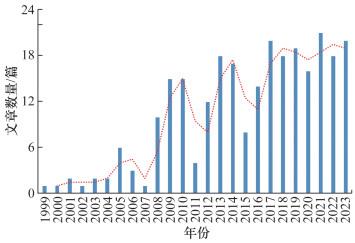
通过对药物影响下驾驶研究领域的文献出版年度分析统计,研究了国际上该研究领域的发展趋势与研究热度。图 1展示了1999—2023年期间有关药驾的文献发表数量变化趋势。结果显示,针对药驾的国际研究总体呈现增长趋势。在检索范围内,有关药驾影响研究的文献最早出现于1999年,Everett等[8]分析了美国大学生的药物使用与增加机动车碰撞和碰撞相关伤害风险的行为之间的联系,并发现服用药物的大学生更有可能增加机动车碰撞和碰撞相关伤害风险。2008年之后,针对药驾的研究显著增加。2021年,国际全年共发表文献达到21篇。
图 1 药驾文献发表年份统计
药驾的研究方法和研究重点也随着时间显著变化。2005年之前的一些研究聚焦于探究年轻驾驶员、老年驾驶员的药物使用(包括毒品和其他药物)与驾驶碰撞风险、伤害风险以及不安全驾驶行为之间的关联性。2005年,首次出现了利用驾驶模拟实验研究哌甲酯对驾驶表现影响的文献[9]。这些研究初步揭示了药驾行为和交通风险之间的关系。
2008年之后有关药驾的研究显著增加。随着路边调查、液相色谱-串联质谱(liquid chromatography-tandem mass spectrometry,LC-MS/MS)等技术的应用和普及,各个国家和地区分别开展了药驾流行情况调查,有关药物使用与驾驶风险之间关联性的研究内容也更为丰富,所涉及的药物包括大麻、苯丙胺、可卡因、阿片类药物、苯二氮卓类药物以及抗抑郁类药物等。驾驶模拟实验被用于研究各类药物,如亚甲基二氧甲基苯丙胺(methylenedio- xymethamphetamine,MDMA)、大麻(cannabis)、兴奋剂(stimulants)、阿片类(opioids)等,对驾驶表现的影响[10],考察指标包括车道内偏差、平均速度、横向位置的标准偏差等。部分文献还探讨了药物使用对不使用安全带等危险驾驶行为、攻击性驾驶行为、交通相关技能受损以及驾驶员罪责判定的关联和促进作用。
随着研究的深入,部分研究开始着手对药驾行为的管控和立法管制进行分析,探讨了可能实施的惩罚对药驾行为的影响[11]。2008年,有文献首次提到了有关药驾的零容忍法律[12],分析了瑞典零容忍法律的实施对药驾流行率的影响。此外,还有部分文献研究了用以识别事故驾驶员体内药物的简化方法[13-14]、分析了药驾行为的成因等,以推动药驾立法。2013年之后,部分研究关注药物损伤特征、对药驾驾驶员开展治疗的效果、药品形象包装对药驾行为的影响、民众对药驾影响的认知等,进一步扩展了药驾相关研究领域。

2.2 国家和地区统计

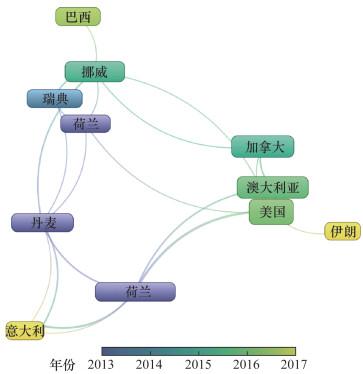
通过统计分析,本文收集的国际文献中共涉及34个国家和地区。图 2展示了发表5篇及以上相关文献的国家和地区,及其在时间维度上的分布。网络中的节点大小代表该国家/地区的发文数量,颜色越深代表研究时间越早。由图 2可知,在交通领域针对药驾影响的研究早期以丹麦、荷兰和芬兰为主,随后美国、加拿大、澳大利亚等国家开始关注药驾研究并发表大量论文成果。
图 2 文献的机构归属国家及地区(1999—2023年)
表 1为药驾研究国际文献发表数量排名前10位的国家和地区统计(1999—2023年)。其中,美国有关药驾的文献总量最多,达到72篇,占总数的29.27%,篇均引用次数达到16.7次。丹麦作为最早开展药驾研究的国家之一, 虽然后期发表的文献数量总体较少,但篇均引用次数达到44.3次,体现了其研究的高质量性。
表 1 药驾研究文献发表数量排名前10位的国家和地区(1999—2023年)
序号 国家和地区 文献数量/篇 占比/% 总引用次数 篇均引用次数
1 美国 72 29.27 1 199 16.7
2 澳大利亚 38 15.45 1 052 27.7
3 加拿大 34 13.82 691 20.3
4 挪威 25 10.16 816 32.6
5 荷兰 16 6.50 473 29.6
6 丹麦 9 3.66 399 44.3
7 西班牙 9 3.66 122 13.6
8 瑞典 8 3.25 178 22.3
9 意大利 8 3.25 62 7.8
10 巴西 8 3.25 69 8.6

2.3 来源期刊分析

对文献来源期刊(1999—2023年)进行统计分析,结果如表 2所示。由表 2可知,有5种期刊有关药驾的文献发表数量在5篇以上。其中,《Traffic Injury Prevention》和《Accident Analysis and Prevention》是研究者选择的典型期刊,其次是《Transportation Research Part F—Traffic Psychology and Behaviour》和《Journal of Safety Research》。《Traffic Injury Prevention》和《Accident Analysis and Prevention》期刊上所发表的文献数量分别占据全部文献的41.06%和40.24%,且《Accident Analysis and Prevention》影响引子达到6.376,篇均引用次数达到42.8次。
表 2 药驾研究国际文献发表数量排名前5位的期刊(1999—2023年)
序号 期刊名称 2023年影响因子 文献数量/篇 占比/% 总引用次数 篇均引用次数
1 Traffic Injury Prevention 2.183 101 41.06 1 461 14.5
2 Accident Analysis and Prevention 6.376 99 40.24 4 238 42.8
3 Transportation Research Part F—Traffic Psychology and Behaviour 4.349 12 4.88 134 11.2
4 Journal of Safety Research 4.264 11 4.47 194 17.6
5 Transportation Research Record 2.019 5 2.03 12 2.4

2.4 关键词共现分析

本研究对收集到的国际文献中的关键词开展共现分析,其共现关系网络如图 3所示。DUI为driving under the influence的缩写。在图 3中,关键词共聚类为3类,同一聚类下的关键词在研究课题上具有一定相似性,节点大小表示关键词使用频次。类似于“drug driving”等的通用关键词在不同集群中均会有所体现,而一些特殊关键词如“prevalence”等则能表明该聚类下的主要研究方向。同时,由于很多研究不只关注于某一点,往往存在交叉性,导致集群间也存在一些交叉性。图 3结果表明,药驾研究领域主要围绕药驾流行病学调查、药物使用与驾驶风险的关联性、药物对驾驶表现的影响等主题来展开研究。
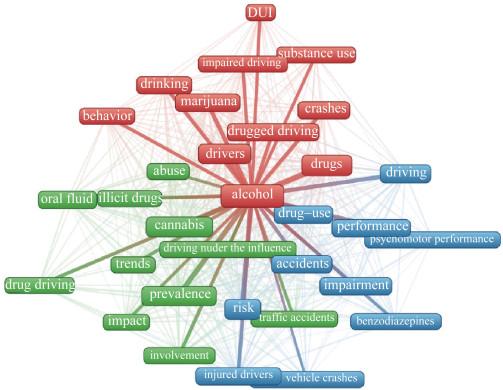
图 3 文献关键词共现网络图
1) 群集1(绿色):药驾流行病学调查。本群集共包含11个关键词,主要有大麻(cannabis)、唾液(oral fluid)、流行率(prevalence)、趋势(trends)以及非法药物(illicit drugs)等。
药驾流行病学调查是指在某一时间段对药驾行为在不同国家和地区、不同性别和年龄的人群中的流行程度进行调查,由此分析药驾行为的现状和发展趋势。药驾流行病学调查是了解特定地区一段时间内驾驶人员药驾行为的现状和发展趋势的有效手段,是制定药驾监管和治理策略的基础。
目前大多数研究通过路边测试[15]快速采取驾驶员的生物样本,如唾液、血液和尿液等,并记录驾驶员的基础信息,利用LC-MS/MS等方法分析样本中的药物种类和浓度,进而统计药物流行情况[16]。部分研究也通过访谈和电话访谈[17-18]等方式来粗略地了解各类药物在驾驶员中的流行情况。在检索到的文献中,最大的统计样本量达到2 400万人[19]
趋势分析方面的研究主要总结了驾驶员常用的药物种类以及其在几十年内的流行趋势[16-17, 20-26]图 3显示,现有药驾的药物主要包括酒精、大麻和其他非法药物等。虽然酒精未被纳入到本文的群集中,但酒精是药驾流行病学研究中最常被发现的物质之一,且往往和其他药物同时被检测到,对交通安全构成严重威胁[26-29]。大麻是在各个国家和地区驾驶员中主要流行的药物之一[16, 30]。此外,可卡因(cocaine)、甲基苯丙胺(methamphetamine)等非法药物以及安非他命(amphetamines)、阿片类等药物的非法使用和药药联用现象在某些国家的驾驶员中流行率也较高[16, 19, 29-33]
除了药物种类调查以外,许多研究进一步分析了药物在不同性别[34-35]、年龄段[27, 36]、种族[15]、地区[37]等人群中的流行率。还有研究利用药驾流行病学调查,分析了药驾立法管制和娱乐性大麻合法化后对药物流行率的影响[38-40]
2) 群集2(红色):药物使用与驾驶风险的关联性。本群集共包含11个关键词,主要有行为(behavior)、损伤驾驶(impaired driving)以及碰撞(crashes)等。
药物使用与驾驶风险的关联性研究是指借助逻辑回归模型等统计学方法,分析驾驶员药物使用现象与驾驶风险之间的关联性。已有文献涉及的药驾报告系统和数据库主要有美国国家公路交通安全管理局(National Highway Traffic Safety Administration,NHTSA)建立的伤害分析报告系统(Fatality Analysis Reporting System,FARS)[41]、美国加利福尼亚州全州卫生规划和发展办公室(California Office of Statewide Health Planning and Development, COSHPD)的住院病人住院数据[42]、挪威道路交通事故登记和法医毒理学数据库(Norwegian Road Traffic Crash Registries and Forensic Toxicology Databases, NRTCRFTD)[43]以及各个国家的尸检报告[44]等。在检索到的文献中,最大的统计样本量达到35万个[45]
药物使用与驾驶风险研究考察范围同样较为广泛。图 3显示,在检索到的文献中,酒精和大麻依然是研究的重点关注药物。大麻或者酒精的使用与碰撞次数[46]、交通事故死亡[47]以及超速驾驶行为[48]等多方面驾驶风险之间有着紧密的联系。除了大麻和酒精外,针对甲基苯丙胺[49]、阿片类[50]、苯二氮卓类(benzodiazepines)[51]、佐匹克隆(zopiclone)以及唑吡坦(zolpidem)[52]等药物的使用与交通碰撞风险和不安全驾驶行为等的关联性研究也十分广泛。尽管多数研究给出了药物使用和驾驶风险之间的联系,但是也有部分研究分析发现,药物使用对交通事故并无明显影响[53-54]
除了定性分析外,部分研究还对药驾风险开展了量化研究。例如Wickens等[55]通过电话调查方式分析了大麻、处方阿片类药物与碰撞风险的相关关系。Kelly等[56]分析了包括年龄段以及性别等驾驶人员特征因素与药驾风险的关系。此外,部分研究还针对驾驶员对药驾的风险态度和认知开展了分析。Malhotra等[57]通过调查问卷分析方法研究了新西兰地区驾驶人员对药驾的风险认知、态度等特征。
3) 群集3(蓝色):药物对驾驶表现的影响。本群集共包含10个关键词,主要有药物使用(drug-use)、驾驶(driving)、表现(performance)、损伤(impairment)、受伤司机(injured drivers)、风险(risk)以及苯二氮卓类(benzodiazepines)等。
药物对驾驶表现的影响研究是指借助实验和模拟手段开展药物使用对具体的驾驶能力的影响分析。这类研究的开展时间相对较晚,相关文献相对较少。
已有研究主要借助驾驶模拟器来分析服用特定药物后的驾驶人员的驾驶表现,评价指标主要包括反应时间、碰撞次数、平均速度、车辆行驶轨迹等[49, 58]。部分文献也利用简单视觉反应时间测试(simple visual reaction time,SVRT)、标准化现场清醒度测试(standardized field sobriety test,SFST)[59-60]、计算机测试(computerized test,CT)[61]等方法开展驾驶相关的认知能力、行为水平等研究。
药物影响驾驶能力研究是评价药驾风险的基础,是支撑药驾治理的理论依据。目前研究仅关注单一药物的影响,缺乏有关混合药物影响的研究。而且,过量用药和混合用药一直是药驾事故产生的重要原因。因此,未来研究可以拓展至典型常见药物过量服用和混合服用后对驾驶能力的影响。

3 研究进展讨论

通过以上文献分析不难发现,关于药驾研究和治理可从以下5个方面展开。

3.1 药物影响驾驶能力研究

国际上对药物影响驾驶能力的研究采取的主要方法是,通过实验观察被试者服用特定类型的药物后所做出的模拟驾驶行为或真实驾驶行为,定量化统计相关驾驶行为参数,进而评估该类型药物对驾驶能力的影响程度。学者们已针对苯二氮卓类、大麻、兴奋剂和阿片类药物等开展了服用后对驾驶过程中反应时间、速度偏差以及平均速度的影响研究[58-61]。然而,国内此类研究主要还是采用对已有文献的研究成果总结归纳的方式,且缺少相应针对国民身体特征和药物使用的特有的实验研究。这也导致中国在制定相关政策法规时缺乏科学依据。因此,药物影响驾驶能力研究是国内药驾研究未来的重点关注方向之一。
建议1  针对国民身体特征,开展药驾模拟驾驶实验,定量评估药物对驾驶能力的影响。

3.2 药驾流行病学调查研究

国际上对药驾流行病学调查研究开展范围广,样本量大,整体进展充分。这类研究主要通过路边药物检验、访谈、问卷收集等方式,调查特定人群、特定地区、不同时期的驾驶人员的用药流行情况[35-37]。国内在这方面整体研究比较欠缺。仓勇[62]曾对上海地区的药驾情况开展过调查,除此之外再无文献记录。因此,针对国内药驾流行情况,还需要更多研究来挖掘现状和发现规律。未来有必要在国内一些地区开展药驾流行病学调查,进而更好地了解中国驾驶人员的药驾情况,以开展更有效的治理工作。
建议2  开展药驾流行病学调查,厘清国内特定区域特定人群的药驾流行情况。

3.3 药驾风险研究

国际上的药驾风险研究主要关注两方面内容:1) 药驾风险评价及影响因素分析;2) 驾驶员对药驾风险的态度和认知调查。定量化研究分析药驾风险评价及影响因素,能够更好地帮助决策者控制相关风险变量,进而制定药驾管控策略;对药驾风险的态度和认知调查研究,能够摸清特定地区驾驶员或一般群众对药驾的态度和认知,可以为药驾相关的知识普及策略制定提供一定参考依据。国内目前在这两方面整体研究不足,后续可以积极开展。
建议3  开展药驾影响因素分析和驾驶员对药驾风险的态度、认知调查,定量评估药驾风险。

3.4 影响驾驶药物检测技术研究

国际上对影响驾驶药物检测技术的研究也有所进展。实际工作中,常用以下几种检材来进行药物分析,包括血液、尿液和唾液。分析方法有免疫筛选法、高效液相色谱(high-performance liquid chromatography,HPLC)、LC-MS/MS等[63]。例如,Shrivastava等[64]对唾液、尿液、血液作为检材开展药物检测的优缺点进行了分析对比,梳理了各自的优缺点。国内方面,李瑾等[65]研发的毒品快速检测设备,通过检测唾液可实现对大麻、吗啡等药物的快速检测,整体检测时间仅需1 min。科学高效的药物检测技术和装备能够帮助交警更及时准确地发现药驾行为。因此,有必要开展相关技术和装备的研发,以支撑药驾辨识与管理。
建议4  开展药物快速检测技术研究,促进药驾行为路边检测。

3.5 药驾管理法律建设研究

通过文献分析发现,国外发达国家对药驾的管理制度整体上比国内更加完善,很多国家已专门针对药驾行为建立了法律惩戒机制。例如,Favretto等[66]研究了意大利药驾流行情况及立法影响。总结来说,国际上对药驾行为的违法性判断标准可分为3类:“零容忍”“药物浓度”和“综合状态”[67]。各类判断标准具体执行依据及采用该标准的国家如表 3所示。国内尚未形成针对药驾管制的系统、科学的法律法规,仅在《中华人民共和国道路交通安全法》第二十二条提到:“服用国家管制的精神药品或者麻醉药品,不得驾驶机动车”。因此,也有学者呼吁对药驾行为进行立法管理[67-70]
表 3 药驾违法性判断标准
标准类型 具体执行依据 特点 代表性国家和地区
“零容忍”标准 只要在驾驶人身体内检测出药物成分就认为是药驾行为。对于他是否服用药物、药物浓度如何、成分具体属于何种药物、当时客观驾驶能力等因素均不考虑 操作成本最低,可实现性较高 澳大利亚、新西兰、芬兰、荷兰、法国、德国、瑞典、比利时、美国10个州等
“药物浓度”标准 根据案发时驾驶人的血液中检测出的药物浓度是否超过当地规定标准阈值来判断是否符合药驾行为 考验检测技术的精确性 英国、美国部分州等
“综合状态”标准 需要综合考量案例中的各种因素:血液药物浓度是否超过标准阈值,当事人车辆的行进轨迹是否正常,驾驶人本身能否独立行走、姿态是否歪斜,是否出现言语能力降低等情况 考验规章制度的细化完善性及一线执法人员的经验判断 瑞士、日本等
国外一些发达国家早就开始了针对药驾行为的监管和立法工作,而国内关于药驾的相关法律法规还处于起步阶段。由于学术界未对药驾行为开展充分研究,药驾立法存在科学支撑不足的问题,国内尚未出台针对药驾行为的惩罚性制度,造成人们对药驾的风险认知性不强。因此,有必要开展药驾相关基础性研究和立法研究,加强对药驾行为的监督管理和惩戒干预。
建议5  开展药驾案例的实证分析与立法研究,促进药驾监督管理和惩戒干预。

4 结论

本文利用文献计量和结构化网络分析方法梳理了药物影响下驾驶研究领域国际上近30年的研究成果,对该领域现有文献进行综述和分析总结,可为药驾研究和治理提供参考。研究形成主要结论如下:
1) 药驾的国际研究整体时间久远,涉及的主题很丰富,在药物类型、药物影响驾驶能力、药驾风险、药驾流行情况、驾驶员对药驾风险的态度与认知、药物检测技术、药驾立法等多方面均开展有定性定量研究。
2) 为促进国内药驾治理、遏制因药驾引发重特大事故,需要从多方面进行努力:开展对影响驾驶的药物梳理及其药理作用规律的研究;开展对药物检测技术的研究;开展对驾驶人员的药驾流行病学调查研究;开展药驾影响因素分析;开展对药驾案例的实证分析和立法研究等。
本文针对药物影响下驾驶的国际研究现状开展分析,并展望了国内的未来研究方向。下一步工作考虑具体从流行病学调查等方面开展研究,分析国内典型驾驶人群体对药驾风险的态度和认知,为药驾问题监管等提供支撑。
1
公安部网站. 全国机动车保有量达4.35亿辆驾驶人达5.23亿人新能源汽车保有量超过2 000万辆[EB/OL]. (2024-01-11)[2024-08-12]. https://www.gov.cn/lianbo/bumen/202401/content_6925362.htm.

Website of the Ministry of Public Security. The number of motor vehicles nationwide has reached 435 million, while the number of drivers reaching 523 million and the number of new energy vehicles exceeding 20 million[EB/OL]. (2024-01-11)[2024-08-12]. https://www.gov.cn/lianbo/bumen/202401/content_6925362.htm. (in Chinese)

2
中康科技. 5 015亿!2023年医药零售市场趋势重磅解读[EB/OL]. (2024-02-11)[2024-08-12]. https://www.sohu.com/a/759117903_121241025.

Sinohealth. 501.5 Billion! In-depth analysis of the 2023 pharmaceutical retail market trend[EB/OL]. (2024-02-11)[2024-08-12]. https://www.sohu.com/a/759117903_121241025. (in Chinese)

3
魏中许, 佘宇璐, 卢玲. 药物驾驶危害与治理研究总结与展望[J]. 科技和产业, 2022, 22 (1): 253- 257.

DOI

WEI Z X , SHE Y L , LU L . Summary and prospect of research on harm and treatment of drug driving[J]. Science Technology and Industry, 2022, 22 (1): 253- 257.

DOI

4
成洁. 驾驶员用药勿大意[J]. 汽车与安全, 2002 (10): 45.

CHENG J . The driver should not be careless about taking the medication[J]. Car and Safety, 2002 (10): 45.

5
李玮. 邯郸男子超量服药驾车致4死!安全驾驶, 别被"药驾"反杀[EB/OL]. (2022-03-22)[2024-08-13]. https://baijiahao.baidu.com/s?id=1727972361270664969&wfr=spider&for=pc.

LI W. A Handan man caused 4 deaths because of driving under the excessive medicine condition! Driving safely and do not be anti-killed by "drug driving"[EB/OL]. (2022-03-22)[2024-08-13]. https://baijiahao.baidu.com/s?id=1727972361270664969&wfr=spider&for=pc. (in Chinese)

6
周园春, 王卫军, 乔子越, 等. 科技大数据知识图谱构建方法及应用研究综述[J]. 中国科学: 信息科学, 2020, 50 (7): 957- 987.

ZHOU Y C , WANG W J , QIAO Z Y , et al. A survey on the construction methods and applications of sci-tech big data knowledge graph[J]. Scientia Sinica Informationis, 2020, 50 (7): 957- 987.

7
张旭欣, 王雪松, 马勇, 等. 驾驶行为与驾驶风险国际研究进展[J]. 中国公路学报, 2020, 33 (6): 1- 17.

DOI

ZHANG X X , WANG X S , MA Y , et al. International research progress on driving behavior and driving risks[J]. China Journal of Highway and Transport, 2020, 33 (6): 1- 17.

DOI

8
EVERETT S A , LOWRY R , COHEN L R , et al. Unsafe motor vehicle practices among substance-using college students[J]. Accident Analysis & Prevention, 1999, 31 (6): 667- 673.

9
BARKLEY R A , MURPHY K R , O'CONNELL T , et al. Effects of two doses of methylphenidate on simulator driving performance in adults with attention deficit hyperactivity disorder[J]. Journal of Safety Research, 2005, 36 (2): 121- 131.

DOI

10
LAMERS C T J , RIZZO M , BECHARA A , et al. Simulated driving and attention of repeat users of MDMA and THC compared with THC users and non-drug-using controls[J]. Transportation Research Record: Journal of the Transportation Research Board, 2006, 1969 (1): 50- 57.

DOI

11
JONES C , DONNELLY N , SWIFT W , et al. Preventing cannabis users from driving under the influence of cannabis[J]. Accident Analysis & Prevention, 2006, 38 (5): 854- 861.

12
HOLMGREN A , HOLMGREN P , KUGELBERG F C , et al. High re-arrest rates among drug-impaired drivers despite zero-tolerance legislation[J]. Accident Analysis & Prevention, 2008, 40 (2): 534- 540.

13
PORATH-WALLER A J , BEIRNESS D J . Simplifying the process for identifying drug combinations by drug recognition experts[J]. Traffic Injury Prevention, 2010, 11 (5): 453- 459.

DOI

14
WATLING C N , FREEMAN J . Exploring the theoretical underpinnings of driving whilst influenced by illicit substances[J]. Transportation Research Part F: Traffic Psychology and Behaviour, 2011, 14 (6): 567- 578.

DOI

15
JAMT R E G , GJERDE H , NORMANN P T , et al. Roadside survey on alcohol and drug use among drivers in the Arctic county of Finnmark (Norway)[J]. Traffic Injury Prevention, 2017, 18 (7): 681- 687.

DOI

16
WEBSTER J M , DICKSON M F , STATON M . A descriptive analysis of drugged driving among rural DUI offenders[J]. Traffic Injury Prevention, 2018, 19 (5): 462- 467.

DOI

17
NARENJIHA H , RAFIEY H , JAHANI M R , et al. Substance-dependent professional drivers in Iran: A descriptive study[J]. Traffic Injury Prevention, 2009, 10 (3): 227- 230.

DOI

18
STARKEY N J , CHARLTON S G , MALTHOTRA N , et al. Prevalence of psychotropic drug use prior to driving[J]. Journal of Transport & Health, 2017, 4, 108- 117.

19
MØRLAND J , STEENTOFT A , SIMONSEN K W , et al. Drugs related to motor vehicle crashes in northern European countries: A study of fatally injured drivers[J]. Accident Analysis & Prevention, 2011, 43 (6): 1920- 1926.

20
HØISETH G , AUSTDAL L E , WⅡK E , et al. Prevalence and concentrations of drugs in older suspected drugged drivers[J]. Traffic Injury Prevention, 2017, 18 (3): 231- 236.

DOI

21
DE BONI R B , BASTOS F I , DE VASCONCELLOS M , et al. Drug use among drivers who drank on alcohol outlets from Porto Alegre, Brazil[J]. Accident Analysis & Prevention, 2014, 62, 137- 142.

22
INGSATHIT A , WORATANARAT P , ANUKARAHAN-ONTA T , et al. Prevalence of psychoactive drug use among drivers in Thailand: A roadside survey[J]. Accident Analysis & Prevention, 2009, 41 (3): 474- 478.

23
JEWETT A , PETERSON A B , SAUBER-SCHATZ E K . Exploring substance use and impaired driving among adults aged 21 years and older in the United States, 2015[J]. Traffic Injury Prevention, 2018, 19 (7): 693- 700.

DOI

24
BALDOCK M , LINDSAY T . Illicit drugs are now more common than alcohol among South Australian crash-involved drivers and riders[J]. Traffic Injury Prevention, 2020, 21 (1): 1- 6.

DOI

25
ROBERTSON R D , MAINEGRA HING M , PASHLEY C R , et al. Prevalence and trends of drugged driving in Canada[J]. Accident Analysis & Prevention, 2017, 99, 236- 241.

26
FURUHAUGEN H , JAMT R E G , NILSSON G , et al. Roadside survey of alcohol and drug use among Norwegian drivers in 2016-2017: A follow-up of the 2008-2009 survey[J]. Traffic Injury Prevention, 2018, 19 (6): 555- 562.

27
BEIRNESS D J , BEASLEY E E . A roadside survey of alcohol and drug use among drivers in British Columbia[J]. Traffic Injury Prevention, 2010, 11 (3): 215- 221.

28
SHULTS R A , JONES J M , KOMATSU K K , et al. Alcohol and marijuana use among young injured drivers in Arizona, 2008-2014[J]. Traffic Injury Prevention, 2019, 20 (1): 9- 14.

29
SIMONSEN K W , LINNET K , RASMUSSEN B S . Driving under the influence of alcohol and drugs in the eastern part of Denmark in 2015 and 2016: Abuse patterns and trends[J]. Traffic Injury Prevention, 2018, 19 (5): 468- 475.

30
JØRGENRUD B , BOGSTRAND S T , FURUHAUGEN H , et al. Association between speeding and use of alcohol and medicinal and illegal drugs and involvement in road traffic crashes among motor vehicle drivers[J]. Traffic Injury Prevention, 2018, 19 (8): 779- 785.

31
MILLS L , FREEMAN J , DAVEY J , et al. The who, what and when of drug driving in Queensland: Analysing the results of roadside drug testing, 2015-2020[J]. Accident Analysis & Prevention, 2021, 159, 106231.

32
MICHAEL WALSH J , FLEGEL R , ATKINS R , et al. Drug and alcohol use among drivers admitted to a level-1 trauma center[J]. Accident Analysis & Prevention, 2005, 37 (5): 894- 901.

33
BERNHOFT I M , HELS T , LYCKEGAARD A , et al. Prevalence and risk of injury in Europe by driving with alcohol, illicit drugs and medicines[J]. Procedia: Social and Behavioral Sciences, 2012, 48, 2907- 2916.

34
GJERDE H , NORMANN P T , PETTERSEN B S , et al. Prevalence of alcohol and drugs among Norwegian motor vehicle drivers: A roadside survey[J]. Accident Analysis & Prevention, 2008, 40 (5): 1765- 1772.

35
TUV S S , BERGH M S S , VINDENES V , et al. Methiopropamine in blood samples from drivers suspected of being under the influence of drugs[J]. Traffic Injury Prevention, 2016, 17 (1): 1- 4.

36
VALEN A , BOGSTRAND S T , VINDENES V , et al. Increasing use of cannabis among arrested drivers in Norway[J]. Traffic Injury Prevention, 2017, 18 (8): 801- 806.

37
DAVEY J , ARMSTRONG K , MARTIN P . Results of the Queensland 2007-2012 roadside drug testing program: The prevalence of three illicit drugs[J]. Accident Analysis & Prevention, 2014, 65, 11- 17.

38
STEENTOFT A , SIMONSEN K W , LINNET K . The frequency of drugs among Danish drivers before and after the introduction of fixed concentration limits[J]. Traffic Injury Prevention, 2010, 11 (4): 329- 333.

39
CHRISTOPHERSEN A S , GJERDE H . Prevalence of alcohol and drugs among car and van drivers killed in road accidents in Norway: An overview from 2001 to 2010[J]. Traffic Injury Prevention, 2014, 15 (6): 523- 531.

40
EICHELBERGER A H . Marijuana use and driving in Washington State: Risk perceptions and behaviors before and after implementation of retail sales[J]. Traffic Injury Prevention, 2019, 20 (1): 23- 29.

41
RUDISILL T M , ZHU M T , ABATE M , et al. Characterization of drug and alcohol use among senior drivers fatally injured in U.S. motor vehicle collisions, 2008-2012[J]. Traffic Injury Prevention, 2016, 17 (8): 788- 795.

42
CALLAGHAN R C , GATLEY J M , VELDHUIZEN S , et al. Alcohol- or drug-use disorders and motor vehicle accident mortality: A retrospective cohort study[J]. Accident Analysis & Prevention, 2013, 53, 149- 155.

43
VALEN A , BOGSTRAND S T , VINDENES V , et al. Driver-related risk factors of fatal road traffic crashes associated with alcohol or drug impairment[J]. Accident Analysis & Prevention, 2019, 131, 191- 199.

44
ANZILLOTTI L , DAGOLI S , CALÓ L , et al. Road traffic deaths: A retrospective analysis (2009-2019) in the north of the Italian region Emilia Romagna[J]. Traffic Injury Prevention, 2022, 23 (1): 29- 33.

45
MOVIG K L L , MATHIJSSEN M P M , NAGEL P H A , et al. Psychoactive substance use and the risk of motor vehicle accidents[J]. Accident Analysis & Prevention, 2004, 36 (4): 631- 636.

46
FERGUSSON D M , HORWOOD L J , BODEN J M . Is driving under the influence of cannabis becoming a greater risk to driver safety than drink driving? Findings from a longitudinal study[J]. Accident Analysis & Prevention, 2008, 40 (4): 1345- 1350.

47
POULSEN H , MOAR R , PIRIE R . The culpability of drivers killed in New Zealand road crashes and their use of alcohol and other drugs[J]. Accident Analysis & Prevention, 2014, 67, 119- 128.

48
BOGSTRAND S T , LARSSON M , HOLTAN A , et al. Associations between driving under the influence of alcohol or drugs, speeding and seatbelt use among fatally injured car drivers in Norway[J]. Accident Analysis & Prevention, 2015, 78, 14- 19.

49
STOUGH C , DOWNEY L A , KING R , et al. The acute effects of 3, 4-methylenedioxymethamphetamine and methamphetamine on driving: A simulator study[J]. Accident Analysis & Prevention, 2012, 45, 493- 497.

50
DUBOIS S , BÉDARD M , WEAVER B . The association between opioid analgesics and unsafe driving actions preceding fatal crashes[J]. Accident Analysis & Prevention, 2010, 42 (1): 30- 37.

51
DUBOIS S , BÉDARD M , WEAVER B . The impact of benzodiazepines on safe driving[J]. Traffic Injury Prevention, 2008, 9 (5): 404- 413.

52
GUSTAVSEN I , AL-SAMMURRAIE M , MØRLAND J , et al. Impairment related to blood drug concentrations of zopiclone and zolpidem compared to alcohol in apprehended drivers[J]. Accident Analysis & Prevention, 2009, 41 (3): 462- 466.

53
SMINK B E , RUITER B , LUSTHOF K J , et al. Drug use and the severity of a traffic accident[J]. Accident Analysis & Prevention, 2005, 37 (3): 427- 433.

54
SMINK B E , MOVIG K L L , LUSTHOF K J , et al. The relation between the use of psychoactive substances and the severity of the injury in a group of crash-involved drivers admitted to a regional trauma center[J]. Traffic Injury Prevention, 2008, 9 (2): 105- 108.

55
WICKENS C M , IALOMITEANU A R , DI CIANO P , et al. Use of cannabis and/or prescription opioids among adult drivers in Ontario, Canada: Prevalence and association with motor vehicle collisions[J]. Journal of Transport & Health, 2021, 22, 101091.

56
KELLY E , DARKE S , ROSS J . A review of drug use and driving: Epidemiology, impairment, risk factors and risk perceptions[J]. Drug and Alcohol Review, 2004, 23 (3): 319- 344.

57
MALHOTRA N , STARKEY N J , CHARLTON S G . Driving under the influence of drugs: Perceptions and attitudes of New Zealand drivers[J]. Accident Analysis & Prevention, 2017, 106, 44- 52.

58
SADEGHI TEHRAN D , NAHVI A , HAJIRASOULI M , et al. Effects of stimulant and opiate drugs on driver behavior during lane change in a driving simulator[J]. Travel Behaviour and Society, 2016, 4, 69- 78.

59
DOROUDGAR S , MAE CHUANG H , BOHNERT K , et al. Effects of chronic marijuana use on driving performance[J]. Traffic Injury Prevention, 2018, 19 (7): 680- 686.

60
THOMAS K , CANEDO J , PERRY P J , et al. Effects of valerian on subjective sedation, field sobriety testing and driving simulator performance[J]. Accident Analysis & Prevention, 2016, 92, 240- 244.

61
HØISETH G , HJELMELAND K , MØRLAND J . A comparison of driving related skills impaired by ethanol and zopiclone[J]. Traffic Injury Prevention, 2021, 22 (1): 26- 31.

62
仓勇. 交通安全中精神活性药物的影响与对策研究[D]. 苏州: 苏州大学, 2009.

CANG Y. Effects and countermeasures to driving ability under the influence of psychoactive drugs[D]. Suzhou: Soochow University, 2009. (in Chinese)

63
徐琛, 姚焕焕. 在药物影响下驾驶的国内外研究进展[J]. 中国法医学杂志, 2019, 34 (4): 383- 386.

XU C , YAO H H . Research progress of DUID at home and abroad[J]. Chinese Journal of Forensic Medicine, 2019, 34 (4): 383- 386.

64
SHRIVASTAVA S , BASTIAN T S , SINGH A , et al. The use of saliva as an unconventional sample for drug detection: A review[J]. Medico-Legal Update, 2008, 8 (2): 16- 18.

65
李瑾, 陈桂勇, 张超, 等. 毒品唾液快速检测试剂及其应用[J]. 警察技术, 2013 (4): 57- 62.

LI J , CHEN G Y , ZHANG C , et al. Drug saliva rapid detection reagent and its application[J]. Police Technology, 2013 (4): 57- 62.

66
FAVRETTO D , VISENTIN S , STOCCHERO G , et al. Driving under the influence of drugs: Prevalence in road traffic accidents in Italy and considerations on per se limits legislation[J]. Traffic Injury Prevention, 2018, 19 (8): 786- 793.

67
王之一. "药驾"风险与刑事法律责任研究[D]. 开封: 河南大学, 2020.

WANG Z Y. Study on the risk and criminal legal liability of "drug driving"[D]. Kaifeng: Henan University, 2020. (in Chinese)

68
刘红英. 试析药驾及药驾管理的法律化: 以常见的感冒药为视角[J]. 河南工程学院学报(社会科学版), 2015, 30 (1): 48- 51.

LIU H Y . Test and analyze the legalization of drug driving and drug driving management: Taking the common cold medicine as the perspective[J]. Journal of Henan Institute of Engineering (Social Science Edition), 2015, 30 (1): 48- 51.

69
李郁铭. 药驾与缺位的法律[J]. 大科技(百科新说), 2011 (7): 28.

LI Y M . Drug driving and the absence of the law[J]. Super Science (Encyclopedia Newspeak), 2011 (7): 28.

70
陈发明. 危险驾驶行为一体化入罪的路径研究[J]. 辽宁公安司法管理干部学院学报, 2017 (4): 80- 84.

CHEN F M . Research on the path of incriminating dangerous driving behaviors[J]. Journal of Liaoning Administrators College of Police and Justice, 2017 (4): 80- 84.

Outlines

/