

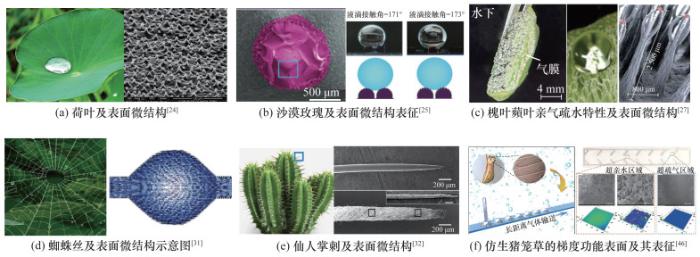
目前,水下气泡的收集和输运受到了研究者的广泛关注[5-7],在多个领域有重要的应用,从科学研究到工业生产,如催化反应[8-13]、废水处理[14-18]、和水下减阻[19-23]等。具有特定润湿性的功能表面在捕获、输运与收集气泡方面变得越来越重要,主要源于这些表面可以通过精确调控气泡的接触角、黏附力和表面能来控制气泡的行为。例如,荷叶表面微小的凸起减少了水滴与叶面实际接触的面积,在凸起的表面上还覆盖着一层纳米级的蜡质物质(见图 1a)。这些蜡质分子本身具有疏水性,进一步降低了荷叶的表面能,因此气泡可以在荷叶上迅速扩散形成一层气膜[24]。此外,玫瑰花瓣的疏水性和荷叶表面的超疏水性有相似之处,但两者在表现形式上不同,由于花瓣表面微米乳头和纳米金颗粒的层次结构,微米乳头结构提供了大尺度的表面拓扑变化,有效控制了液体的润湿性(见图 1b),而纳米金颗粒则在小尺度上增加了局部的化学活性。双尺度结构的协同作用可以优化气泡捕获的性能[25]。同样地,漂浮的蕨类植物叶片表面的层次结构包括微米级的乳头状突起和纳米级的纤维或颗粒(见图 1c),这种微纳复合的层次结构是其具有超疏水能力的关键。当叶片表面受到扰动或水压变化时,原有的气膜可能会受到破坏。然而,这种层次结构具有卓越的自恢复能力,可以在水的浮力作用下快速重新捕获空气并恢复气膜的连续性,这种机制对于保持叶片的浮力和防水性能至关重要[26-27]。因此,仿生植物表面的超疏水性和气膜形成能力可以用于设计特殊的气体捕获装置。这些装置利用表面的微纳米结构在水下形成稳定的气膜,使气体通过该气膜与水环境隔离,从而实现气体的捕获与存储。气泡在水中不仅需要大量的吸附融合,还需要进行定向输运才能进行收集,而广为人知的是形状梯度表面产生不对称的Laplace压力可以有效地输送气体[28-29]。在自然界中,蜘蛛丝[30-31]和仙人掌棘[32]均通过圆锥形表面实现环境中的雾滴收集分别如图 1d和1e所示。大量研究表明,经过精细修饰的锥形表面能够产生显著的Laplace压力梯度和表面自由能梯度[33-35]。不仅如此,通过修改化学性质以产生润湿性梯度[36-41],或通过适当排列非对称微结构以产生不平衡的表面张力[42-45],可以实现气泡的定向扩展。例如,仿生猪笼草的非对称微结构在液体自驱动输运中的应用展现了独特的优势,尤其是相比传统依赖外部电源的液体输运系统。这种仿生策略采用非对称的表面微结构设计(见图 1f),在微观尺度下,表面张力和毛细力对液体的流动起决定性作用。通过精细控制表面的润湿性,仿生非对称结构可以增强毛细力,使得液体沿着设计好的路径自发流动,适用于多种微流控系统和材料表面功能化的场景[46]。因此,自然生物提供了许多有前途的策略供科研人员借鉴,结合界面调控设计先进的人工智能材料,以更有效地捕获和输运水下气泡。
近年来,许多论文从表面形貌和表面能梯度[47-49]等方面报道了操纵气泡的现有方法。然而,人们对气泡捕获、输运、收集一体化的设计的关注较少,限制了实际应用的发展和拓宽。为了进一步提高燃料气泡捕获的可控性和适应性,迫切需要设计和制造一体化模型,扩大气泡应用场景。本文首先系统性的讨论了气泡捕获的原理和方法。其次,介绍了气泡的输运机理,详细讨论了气泡在水中的运动以及外部能量(电场、磁场、声波、光源、供热等)输入对其运动的控制与引导。此外,还展示了捕获—输运—收集气泡一体化手段以及气泡在气膜稳定性和流固界面减阻领域的相关应用。最后,总结了当前挑战,并展望未来新的技术和理论有望克服现有问题,提升气泡操作的效率和可控性,以促进气泡捕获、输运与收集一体化的快速发展。
1 气泡的捕获
1.1 气泡捕获的原理
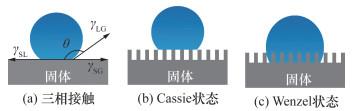
捕获气泡通常涉及气泡在液体中的运动和气泡与固体界面之间的相互作用[50]。在水下,气泡因较低的密度而向上浮升,并通过与周围液体的相互作用形成稳定的聚集。当液体的流动速度、黏度与气泡的直径三者匹配时,气泡能够在液体中保持稳定,并最终被捕获或固定。气泡的捕获效率受到多种因素的影响,包括气泡的尺寸、表面性质、流体的黏度和表面张力,以及界面的亲疏水性[51-56]。当气泡接触固体表面时,若界面为疏水性,气泡容易附着于表面,从而被捕获。在亲水性界面上,气泡捕获效率较低[57]。液体对表面的润湿作用是由表面化学成分和微纳米三维形貌决定的。假设一滴液体被放置在理想的固体表面上,形成图 2a的形状,在固体—液体到气体—液体界面的三相界面处的角度被称为接触角θ。三相界面的表面张力通常遵循杨氏方程[58]:
1.2 气泡捕获的方法
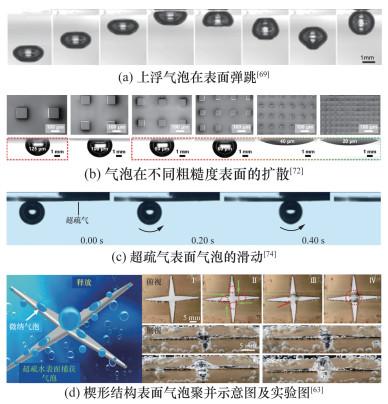
目前大多数气泡捕获都是使用疏水表面,使气泡容易黏附在平面[44, 63]或是锥体表面[64-65]上。气泡的稳定性受液—气界面表面张力的影响。这种表面张力驱使气泡趋向于形成球形,从而提高气泡的稳定性,在维持气泡结构和防止破裂过程中起着关键作用,是气泡稳定性的重要物理基础[66]。表面活性剂等分子可以通过降低表面张力,延长气泡的寿命并提高捕获效率[37]。当气泡与固体接触时,通常会发生反弹[67-68]。这是在水被排出时,薄膜内的润滑压力所致[69-71]。反弹过程较为缓和,气泡会逐渐减速并最终达到球形状态(见图 3a)。而当气泡与微结构表面接触后,诱导气泡聚并的两步机制,即破裂和随后的吸收,气泡破裂随着特征尺寸的减小而加快(见图 3b)。减少液体与固体表面的接触面积显著提高了气泡破裂后的自发吸收,这是因为气泡扩散时减少了移动接触线消耗的能量,以及接近平衡时减小了接触线钉扎的效应。气泡破裂通常发生在固体表面的边缘特征上,移动的液固接触线影响了气泡的吸收率和最终平衡状态。因此,适当减小表面特征尺寸和优化接触线相互作用对于加速气泡的破裂和吸收至关重要[72]。气泡在不同表面的附着取决于表面能和润湿角。疏水性表面倾向于捕获并稳定气泡,而亲水性表面则可能更容易使气泡脱落(见图 3c)[62, 73-74]。不仅如此,固体的表面积决定了气泡在其上方生长的尺度以及临界体积的大小。随着超疏水固体表面半径减小,气泡的最小接触角减小,最小切向约束力增大。而当表面半径增大时,其最大气泡捕获率、气泡顶端和底部的Laplace压差、长径比和气泡填充比也随之增大[75]。最重要的是可以通过制造表面润湿性梯度来引导气泡在表面上移动并最终在特定区域聚集。这种界面张力梯度会在气泡周围产生不平衡的界面力,促使气泡移动到低润湿性区域并保持稳定,因此,设计多个楔形结构可以使气泡快速聚集并定向输运直至被捕获(见图 3d)[63]。
2 气泡的输运方式
2.1 浮力及Laplace压力驱动
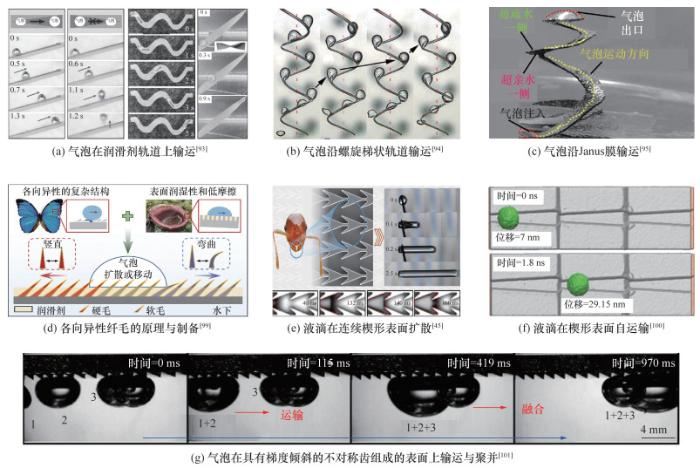
气泡内部的气体密度通常比周围液体的密度低,因此气泡会受到向上的浮力作用,推动其向上运动,因此只要表面可以吸附气泡而不使其钉扎,就可以让气泡沿着表面向上输运[5, 90-91]。带有微纳米孔洞并涂抹润滑液的表面具有类似海绵的结构和超滑特性,适用于操纵水环境中的气泡,在具有充分的气泡黏附性的基础上,可以利用该表面形状的轨迹来引导气泡的传递,促进气泡的连续输运[92]。然后引入一个不对称的界面结构并入表面,能够轻松地控制单个气泡的定向输运(见图 4a)[93]。对于螺旋梯状锥形柱,气泡可以沿着柱体表面快速输运(见图 4b)。通过调整锥形柱各部分的润湿性、倾斜角度和几何形状,可以将气泡的运动速度提高3倍左右,其中由几何梯度引起的Laplace力在调节气泡速度中起着重要的作用[94]。Tahzibi等[95]制备了一侧亲水一侧超疏水的Janus膜,表现出自发捕获和定向输运水下气泡的能力;带状的Janus膜能够在任何扭转度下高速、长距离转移气泡(见图 4c)。除此之外,大量研究表明,蜘蛛丝和仙人掌棘表面独特的多级微量结构可以产生Laplace压力和表面能梯度,作为气泡定向输运的协同驱动力[65, 96-98];同时猪笼草楔形结构也可以使气泡快速自驱动(见图 4d)[99]。受蚂蚁等微小昆虫的下颚的启发,文[45]设计了一种具有不对称微观结构的液体自驱动定向扩散表面,具有新颖的颚状微结构,可以视为微型单向阀,表现出快速、长距离的液滴单向扩散行为(见图 4e)。该研究结果为二维不对称微观结构设计和有效的自驱动气泡单向扩散开辟了一条很有前途的路径。Zhang等[100]从分子动力学模拟的角度对液滴在功能化表面上的可控定向输运进行了理论推导,并设计了一种新颖的连续楔形微结构表面,实现了液滴的单向自运输(见图 4 f)。文[101]中一种独特的棘轮由具有梯度倾斜的不对称齿组成,这种几何梯度结构能产生不对称的驱动力,推动气泡向棘轮倾斜的方向移动,实现气泡的聚并及输运(见图 4g)。浮力与Laplace压力是影响气泡在流体中行为的重要因素,前者源自气泡与周围液体密度差,驱动气泡上升并可能引发流动不稳定性及界面破裂;后者由气泡内外的表面张力差异产生,决定气泡的形态及稳定性。这两种力共同影响气泡的形成、稳定性和运动轨迹,成为多相流、气液界面动力学等研究中的关键问题。
2.2 外场驱动
外场(如电场、磁场、声波、光源、供热等)对气泡运动的控制与引导是多领域研究中的热点[102]。气泡在液体中运动时,外场能够通过不同的物理与化学机制来影响气泡的运动轨迹、速度和形态。
2.2.1 电场驱动
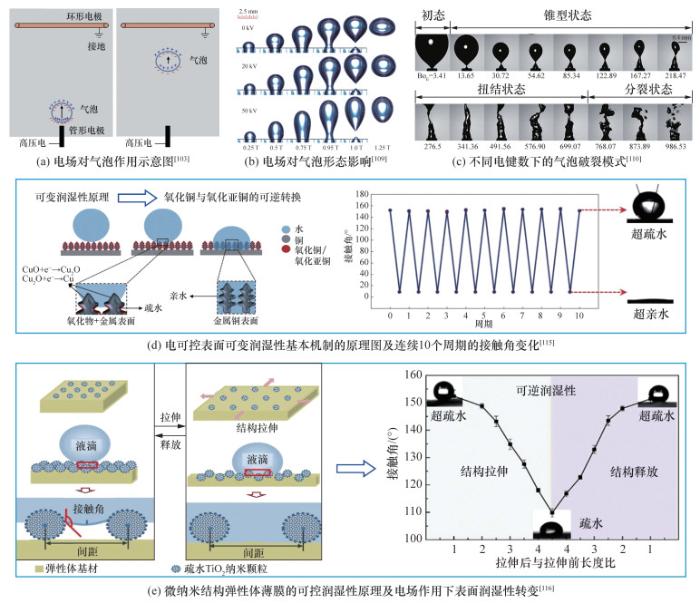
气泡在电场中会因极化而受力,电场强度的增加使气泡生长周期缩短,气泡尺寸明显减小,产生频率加快(见图 5a)[103]。这种方法在电解水制氢[85, 104-107]、气泡流动控制[108]等方面有所应用。实验证明作用在气泡表面的电作用力是朝向气泡内部的,这种力挤压气泡从腰部开始收缩,导致气泡在平行于电场的方向上伸长。在电场、浮力和压力的作用下,不同注射条件下生成的气泡表现出截然不同的变形模式(见图 5b)。负电场对向上缓慢生长的气泡有轻微抑制作用,但对向侧面和向下缓慢生长的气泡有一定的促进作用[109]。在非均匀电场中,通过操纵电场,可以实现滴泡、锥泡、扭结泡和支泡4种截然不同的破泡行为。随着电场强度的增大,气泡沿电场方向拉伸,气液界面的不稳定性增强,最终导致气泡破碎成一簇微气泡(见图 5c)[110]。而以上仅仅是对气泡本身形态进行调控,目前通过电场还可以改变气泡与固体界面接触的润湿性,从而控制气泡的附着与滑动[111-114]。通过电化学操控氧化态,调节施加电压和持续时间可以实现对电沉积铜表面润湿性从超疏水(θ≈157°)到超亲水(θ<10°)的快速可逆主动精准控制,且响应时间短(见图 5d)[115]。Li等[116]将疏水二氧化钛纳米颗粒的微纳米结构团簇与弹性体薄膜相结合,制备了超疏水弹性体表面,由于弹性体薄膜的电场自适应变形,可以通过电场动态、可逆地调整微纳米结构。因此,通过电场诱导的形貌变换,可以得到Cassie和Wenzel态之间的快速可逆转变和表面上的可调附着力(见图 5e)。然而电场可能会破坏气泡表面的稳定性,导致气泡更容易破裂或发生合并。尤其是在强电场作用下,气泡表面的电荷积累加剧了这种不稳定性。电场诱导的变润湿表面用于气泡输运,存在气泡附着力受润湿性变化的影响导致滑动不稳定、气泡形态和稳定性受电场与表面张力的共同作用发生变形、不均匀电场引起气泡移动路径不确定、界面电荷积累效应干扰气泡运动,以及气泡与液体动力学的耦合效应引发流动不稳定等问题。这限制了该技术在精确控制气泡输运中的应用,需进一步优化和研究。
2.2.2 磁场驱动
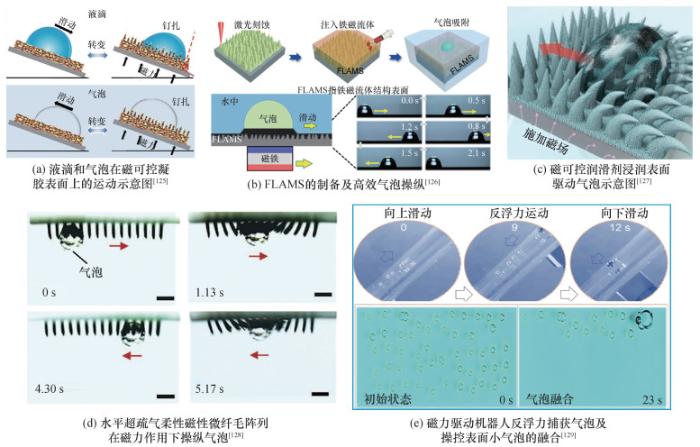
磁响应结构表面上液滴与气泡多功能操作在科学和工程研究中引起了广泛关注[117-121]。为了实现磁驱动,目前的方法通常采用设计良好的高纵横比结构组件的微阵列(如微纤毛、微柱和微孔板等),并结合磁性颗粒,实现磁场驱动的可逆弯曲变形[122-124]。例如,含有铁粉和硅油的磁响应聚二甲基硅氧烷可用于创造两栖光滑的表面,通过交替施加和撤出外部磁场,可以可逆地产生和消除光滑表面的微观结构,从而能够操纵液滴和气泡的钉扎、滑动行为(见图 6a)[125]。也可以将铁磁流体涂覆激光消融微结构表面(FLAMS),一个2 μL的气泡可以在该表面实现超过25 mm/s的超快速度输运(图 6b)。此外,这种表面还能实现气泡反向浮力运动、按轨迹移动、可编程聚合等可控运动。它不仅表现出优异的气泡操控效果,还能使气泡在特定平台上实现浮力或Laplace压力驱动难以实现的单向输送[126]。Han等[127]也基于铁磁流体涂覆表面技术制备了一种磁控润滑剂浸润表面,通过控制磁响应微锥的排列来操控气泡的附着力,并实现2种可逆的附着状态:当微锥竖直时,气泡钉扎,当微锥倾斜时,气泡沿着微锥倾斜方向滑动。磁控润滑剂浸润表面的这一独特特性使得气泡能够通过在黏性—滑动界面上产生的线几何梯度力实现双向且不受几何形状限制的输运(见图 6c)。将超疏气润湿性与磁响应微纤毛结构表面相结合,不仅可以实现高效、无损、可逆的气泡操作,还可以通过调节磁场来调节气泡的输运速度(见图 6d)[128]。不仅如此,通过将润滑剂浸润表面与磁控气泡吸附平台相结合来实现气泡的输运与操控也是一种有效途径。Chen等[129]提出了一种基于激光蚀刻润滑剂浸润表面的磁力驱动机器人系统。磁力驱动机器人携带的水下气泡能够在施加磁场的情况下,沿任意方向移动。得益于磁力驱动机器人对气泡的强吸附力,一个20 μL的气泡在其表面上可以加速至500 mm/s2,并获得超过205 mm/s的超高速。此外,磁力驱动机器人同样具备抗浮力特性,能够在倾斜的表面上操控水下气泡运动(见图 6e)。然而磁响应结构表面在多功能气泡操作中面临多个挑战,包括磁场控制精度不足导致运动轨迹偏差、气泡形态和稳定性受磁场和表面张力影响而变形或破裂、界面润湿性变化导致操作不稳定、多功能操作的复杂性增加操作难度,以及磁响应材料的性能受限,如对磁场的灵敏度和耐久性不足。这些问题限制了该技术在精确、稳定的气泡操作中的应用。
2.2.3 光驱动
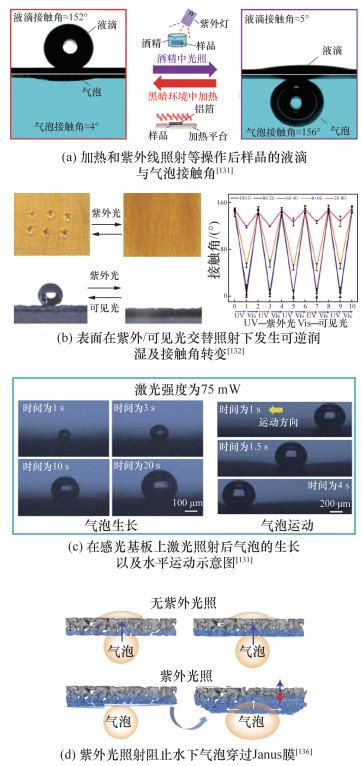
基于光源调控的气泡吸附、脱附与输运机制依赖于光敏材料表面润湿性的动态变化,通过光激活材料表面的光敏分子或纳米颗粒,引发材料界面能的改变[130],从而调控气泡在表面的接触角。具体而言,采用飞秒激光垂直交叉扫描制备的多尺度二氧化钛方形微柱阵列,因激光烧蚀、冲击压缩及碎片自沉积的协同作用形成微纳米结构。这些微结构在黑暗环境加热和酒精中紫外线照射下表现出可切换的气泡润湿性(见图 7a),加热后的烧蚀钛表面在水中表现出超亲气性(气泡接触角约为4°),具备出色的水中气泡捕获能力,进而为气泡的高效操控提供了有利条件[131]。文[132]通过一种多功能浸涂方法制造了具有光开关超润湿性的智能聚合物功能化柔性表面,展现出类似玫瑰花瓣的超疏水性。这种智能表面能够通过交替照射紫外光和可见光,实现超疏水性与超亲水性之间的快速光触发润湿性转变(见图 7b)。更重要的是,基于优良的光控特性,可以通过选择性光照获得具有不同润湿特性的各种可擦除和可重写图案。文[133]结合飞秒激光刻蚀和复制成型方法也制造了一种光响应超疏水形状记忆聚合物微板阵列,原理是碳黑的光热效应与形状记忆聚合物的形状记忆效应,使微板阵列在直立状态和暂时弯曲状态之间可逆切换,从而控制微板阵列在低附着力和高附着力之间可逆切换,最终实现选择性捕获和释放液滴及水下气泡的两栖操作。不仅如此,通过软光刻和仿生改性与SiO2纳米颗粒的结合,可以制备出在3种不同润湿状态之间可逆转变的超疏水表面,这些状态分别为高附着力状态(玫瑰花瓣状)、超疏水各向同性状态(莲叶状)和超疏水各向异性状态(稻叶状)。这种通过非接触光操控动态调节界面的3种不同超疏水状态的方法在微接触印刷、微流体控制等领域具有广阔的应用潜力[134]。Li等[135]开发了一种多功能光学策略,当聚焦激光束照射时,会在气泡下方引发与温度分布不均相关的强Marangoni效应。产生的过量Laplace压力使气泡抵抗浮力朝向激光聚焦区域移动,实现了出色的光趋向运动(见图 7c)。利用这一光学策略,可以灵活实现气泡的收集、输运和按需释放。超疏水性TiO2纳米颗粒被认为是实现紫外线屏蔽和自清洁功能的优异添加颜料,而且在紫外线照射和暗条件下具备可切换的超亲水/超疏水性能,基于这种能力,Dai等[136]构建的Janus铜泡沫表面在不同时间紫外线照射后,形成了从超疏水—疏水性到超疏水—亲水性不同的润湿梯度,气泡在这些表面上表现出明显不同的渗透行为(见图 7d)。然而,光控智能表面高度依赖光源强度和波长,导致气泡运动控制精度受限;材料特性可能限制响应时间,从而影响操作效率;长时间使用可能导致表面性能衰减,影响气泡附着力;在复杂几何形状上,光照不均匀会导致气泡运动不均匀。以上问题需要进一步研究和改进,以提高光控智能表面在气泡输运中的稳定性和可靠性。
2.2.4 声波及供热驱动
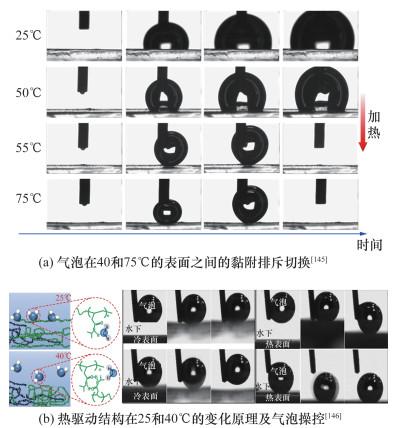
气泡在声波中受到声辐射力的作用,推动其沿压力梯度移动,即声致迁移现象。此外,声波还可诱导局部流体运动,形成声流,从而改变气泡的动力学行为[137]。Xi等[138]提出了一种利用声驻波场进行多气泡输运的方法,并通过建立一个描述液体介质中气泡电推力与水动力平衡的模型,解释了多气泡的平移机制。此外,增加气泡的大小或超声强度可以加速气泡的运动,并增强气泡之间的相互作用。气泡的振荡频率随着超声频率的增大而增大,同时振荡幅度也随超声振幅的增大而增大[139]。施加超声波后,气泡的脱离频率、速度和行进距离显著增加,且生长行为和轨迹极其复杂,两相气液流动极不稳定。随着超声波频率的增加,气泡获得动能[140]。基于声腔共振机制形成的声悬浮气泡显著提升了气泡的稳定性,甚至在没有表面活性剂的情况下,纯水气泡也能稳定维持超过7 min,寿命比传统气泡提高了2个数量级。这种超稳定性源于声波在气泡内外表面形成的独特声辐射压力分布,既平衡了液体的重力,又实现了气泡的稳定悬浮[141]。与此同时,研究还发现,在超声辐照和电应力耦合作用下,非球形气泡无法在液体中稳定振荡。电应力的存在降低了气泡壁的表面张力,并且当气泡同时暴露于超声波和静电场中时,其中心的气体压力和温度会大幅增加,从而更易导致气泡坍塌[142]。尽管声波可以稳定气泡,但在特定频率和功率下,气泡可能会因共振或破裂现象而不稳定,特别是在高频声波下,容易引发气泡振动甚至坍塌。而且声波对不同尺寸和性质的气泡作用效果不同,难以在大范围应用中保持一致效果。声波还容易受到外界振动或其他声源的干扰,这可能导致气泡运动的不确定性,降低输运的可靠性和可控性。这些问题限制了声波在气泡输运中广泛应用的可能性,亟须进一步优化声波控制技术和系统设计。在连续气泡运动过程中,不同流体的流动状态和气泡的初始温度对气泡的运动轨迹和传热过程具有显著影响。这些因素会改变气泡的动力学行为、受力情况和气泡与周围介质之间的热交换效率,从而直接影响气泡的传热性能和运动稳定性[143-144]。热敏基底材料对气泡输运具有显著影响,其响应温度变化的特性可以调控气泡的运动和附着行为。温度的变化会导致热敏材料的润湿性、表面张力和形状发生变化,从而影响气泡的运动路径、速度和与界面之间的相互作用。Jiang等[145]展示了一种可切换水下疏气性的热敏聚合物基底,交联的聚乙烯—醋酸乙烯酯基底带有纳米粗糙顶面的微圆柱阵列,拓扑结构的变化使得基底从亲气性转变为疏气性,因此最初附着在平坦基底上的气泡可以被加热后的表面排斥(见图 8a)。气泡排斥开始的温度可以通过在温度记忆编程过程中改变变形温度来调节,这种在不改变材料化学性质的情况下,通过表面形貌变化来改变疏水聚合物基底的水下气泡润湿性的方法,对智能传感器材料的设计具有吸引力。另外,由聚(N-异丙基丙烯酰胺)和聚丙烯制成的复合薄膜也可以通过控制温度(高于或低于临界溶解温度)实现对气泡黏附行为的智能、可逆且可靠的调控。通过升高温度,复合薄膜上的聚合物链可以从分子间氢键向分子内氢键进行热驱动转变,导致气泡从低黏附向高黏附转变,降低温度则可以实现逆转。利用这一机制,气泡可以被精确捕获、定向输运,并在任意指定位置精准释放(见图 8b)[146]。然而热敏基底在气泡输运过程中面临的主要问题包括温度控制精度不佳、表面响应的滞后效应、气泡稳定性降低以及表面污染的干扰等。这些因素导致基底表面张力、接触角和气泡运动路径的不稳定,影响气泡传输效率。此外,局部加热的非均匀性可能引发气泡在非预期区域的聚集或滞留,进一步加剧传输困难。因此,优化基底材料、提高温度调控精度及深入研究气泡与基底的界面行为是提升气泡传输性能的关键。
气泡输运机制通过调控流体环境中的力学作用和界面相互作用,实现了对气泡运动路径和行为的有效控制,在化工、能源、环境等领域中具有重要的应用价值。未来研究应进一步聚焦于微观尺度下气泡输运的精确调控,结合智能材料与外场作用开发新型技术,以提升气泡输运的效率和稳定性,从而推动其在复杂流体体系中的实际应用。
3 气泡的捕获—输运—收集一体化技术
气体可以通过气泡的形式出现在水中,分离液体和小气泡具有很大的实用价值,可以避免这些气泡造成的危害,或在液体介质中收集有用的燃料气泡。例如海底逃逸的甲烷气泡释放到大气中会造成温室效应,对这种自逃逸的甲烷气泡的捕获和利用有助于满足对能源的巨大需求。具有多孔结构的海绵经疏水纳米颗粒和聚合物复合涂层改性后,可以具有抗润湿及吸气能力。甲烷气泡可以被选择性地吸收,然后被这些特定的海绵储存在水中,海绵任何部分吸收的甲烷气泡将通过固定在海绵上的管道输运与收集(见图 9a)[4]。在水光催化分解成氢的过程中,及时收集产生的氢气泡是最重要的过程[147]。在各种工业废水中,存在大量有毒硫化物气体和氨,收集这些气泡有助于减少废水排放造成的环境污染。因此如何高效收集气泡是一个亟需解决的问题。
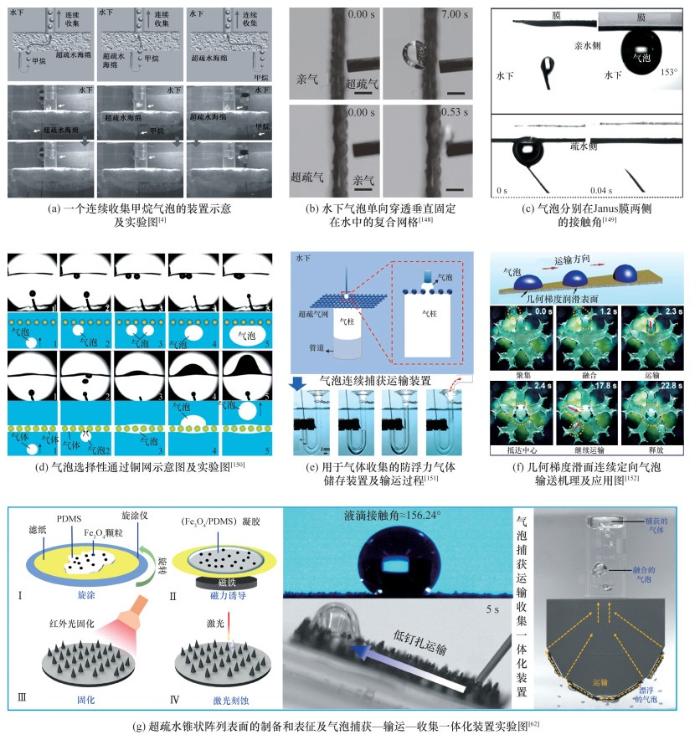
Janus膜因表现出独特的单向气泡传输能力被广泛用于气泡的捕获和收集。通过集成亲气性和超疏气性表面,Pei等[148]制备了一种Janus超润湿网格,实现了水下气泡抗浮力的单向穿透。气泡可以从超疏气侧穿过网格到达亲气侧,但在相反方向则被阻挡(见图 9b)。这种Janus网格可视为气泡二极管,因此在水下气泡的单向传输和收集具有广泛应用前景。同样地,Gao等[149]制备了一侧超疏水一侧亲水Janus膜(见图 9c),展现了独特的单向气泡传输能力,实现了气泡的连续快速的选择性捕获。不只是Janus膜可以单向传输气泡,通过一步化学反应制备的Cu(OH)2纳米针结构的粗糙铜网也可以实现同样的功能。原始粗糙铜网在空气中表现出超亲水性,在水中则表现出超疏气性。而经过氟烷基硅烷改性后的粗糙铜网则表现出相反的特性,水下超亲气性网能够吸附气泡并允许气泡通过铜网。通过结合这2种铜网得到了一种从水管中去除气泡的模型,并设计了一种水中气泡收集装置(见图 9d)[150]。通过不对称微结构也可以实现气泡的收集。受水蜘蛛储气机制的启发,Yong等[151]通过设计与石英管组装的单层水下超疏气网,展示了一种收集和输运水下气泡的策略。由注射泵提供的气泡穿透网孔后聚集在石英管中形成气柱,当气柱达到最大储存高度或压力时会发生崩塌,在连续供气的情况下,压力的变化成为一个循环过程,类似于泵的作用,通过与不对称U形管组装的水下超疏气网装置将气泡从水下连续输运至其他地方(见图 9e)。通过模仿自然界中的物种,如具有形态梯度结构的仙人掌刺和具有润滑内表面的猪笼草,他们还成功地通过CO2激光切割、超疏水改性和氟化液体的注入,制备了一种不对称的润滑表面,不对称的形态会导致气泡的变形,从而产生不对称的驱动力。在不对称形态和氟化液体注入表面的共同作用下,所制备的不对称润滑表面适用于水环境中的气泡定向和连续输送。雪花状和星形结构的不对称润滑表面,在CO2和H2微气泡的连续生成、定向输送和高效收集方面表现出可靠的性能(见图 9f)[152]。Gao等[62]利用激光刻蚀技术制备了磁导锥形阵列表面,实现了超疏水性。与未激光蚀刻表面相比,激光蚀刻表面的气泡具有更高的黏附性和低钉扎输运。吸附在磁导锥形阵列表面内的气膜就像一个气体通道,加速了气泡的融合并迅速扩散,最终实现了输运—融合—收集的一体化。还探讨了气泡在锥形阵列表面上的吸附、输运和融合的动力学行为,揭示了锥形阵列内气膜生成过程的机理。在此基础上,提出了一种新型的多角度磁导锥形阵列表面水下气泡收集装置,实现了对上升气泡的多向捕获、高效输送和收集(见图 9g)。
4 气膜稳定性及减阻
气泡表面易受温度、压力、流速和剪切力等物理扰动影响,这些扰动会破坏界面张力平衡,导致气泡形态发生剧烈变化,如破裂、合并或振荡等。因此,如何使捕获收集的气泡长时间在表面维持也是一个热点问题。Xiang等[26]发现漂浮的蕨类植物具有超排斥液滴的能力,可以用空气有效地取代微结构中的水,并稳定地恢复连续气膜。有鉴于此,利用3D打印技术制作了仿生人工槐叶蘋表面,实现了连续气膜的完全恢复,精确地模仿了槐叶蘋叶的超排斥能力。楔形凹槽中空气的充分膨胀确保了空气柱在任何扰动下以无限长度保持稳定,打蛋器形头的钉扎效果可以提高液气界面的稳定性,提高了气膜回收的鲁棒性,并在极端环境如高静水压力、仿生人工槐叶蘋表面剧烈波动,甚至水下流体快速流动中保持有效。同样地,受槐叶蘋叶结构和功能的启发,Wang等[155]使用硅橡胶—石墨烯复合材料设计并制造了一种具有双尺度微结构触角的仿生防污膜,能够在水下吸附气泡包裹整个触角,形成“气泡屏障”,作为一种环保的物理防污屏障。由于其疏水性和双尺度微结构,具有很强的气泡吸附功能,能够在1.5 m/s的流体速度下保持气泡稳定性(见图 10a)。因此,在超疏水表面添加疏水微结构也是一种有效的保持气泡稳定性的方法,通过改变气泡液膜的界面特性来增强稳定性,但其设计和制造过程通常比较复杂,微结构的尺寸、形态、排列方式等因素都会影响气泡稳定性,因此需要根据具体应用场景进行优化。
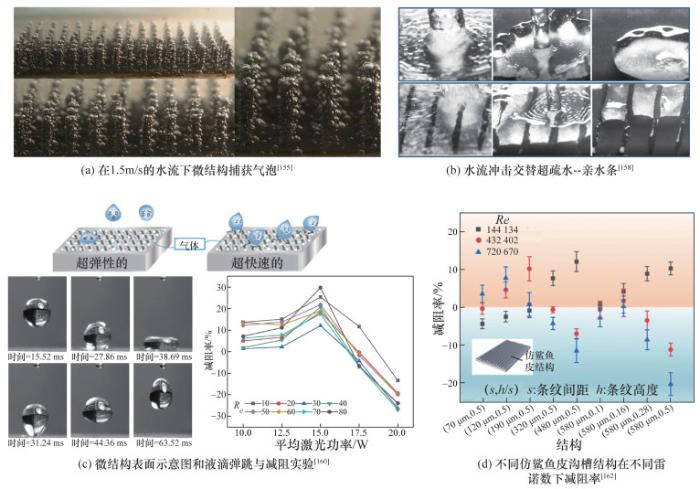
超疏水表面可显著降低水下航行器的阻力,但随着速度增加,气膜易被破坏,导致减阻效果下降甚至阻力增加[156]。通过分子动力学模拟,Hu等[157]证明了三相接触线可以被固定在混合润湿性光滑基底上。研究发现,气—液界面处的局部滑移长度相对较大,并且由于剪切作用下气泡的变形,其空间分布变得不对称,而有效滑移长度几乎保持不变。随着气体面积分数的增加,局部和有效滑移长度都增大。另外,在超疏水表面引入平行亲水性条带可以同时提高水冲击阻力和减阻能力,关键机制在于通过相邻的三相接触线增强了气体层的稳定性。这些接触线不仅在水流冲击过程中通过表面微结构阻止空气排出,固定气体层以抵抗水的穿透,还在Taylor-Couette流中防止空气因浮力上升,确保气体层均匀覆盖在转子表面,从而提高减阻效果(见图 10b)[158]。与此同时,通过在Taylor-Couette装置的内转子上覆盖交替的超疏水和亲水环形条带,可以形成较大的表面能障,牢牢固定气液固三相接触线,防止气体层破坏,从而形成稳定且连续的气体环。在内转子处测得的减阻率可高达77.2%[159]。Chen等[160]提出了一种纳秒脉冲激光烧蚀—化学蚀刻工艺,制备了具有方向、周期和高度可控的微结构超疏水表面。水滴的接触角约为154.7°,表明该表面具有出色的超疏水性。在不使用减阻剂的情况下有效降低微通道中的流动阻力,最大减阻率可达29.83%(见图 10c)。在自然界中,纳米布沙漠甲虫的鞘翅表面不规则地分布着一些亲水性的小凸起,这些区域可以吸附水分,而其他部分则涂有类似蜡的疏水性物质,使得这些区域能排斥水。这种亲水与疏水区域的交替分布,形成了表面的“润湿梯度”,而玫瑰花瓣表面具有疏水性,但同时又能够强力黏附水滴。受其启发,Yao等[21]通过飞秒激光结合蜂窝状孔结构构建了一种交替的超疏水和疏水表面,高附着力疏水表面提供更强的附着力,使气膜牢固地固定在低附着力超疏水表面与疏水表面的交界处,从而增强气膜的稳定性。气膜的临界失效速度可达2.3 m/s,保持37%的稳定减阻效果。基于猪笼草的楔形不对称结构,一种串联的楔形形状的超疏水微结构能够轻松捕获水下气泡,并实现气泡的自发定向输运,平均速度达到444 mm/s。不仅如此,将气泡的连续供应与串联的楔形形状超疏水微结构结合,形成了自发快速移动的气泡膜,这不仅防止了供应气泡的逸散,还在超疏水表面上补充了气泡膜。自发快速移动气泡膜表现出27%的减阻率和80%的抗污率[161]。文[162]提出了一种具有仿鲨鱼皮沟槽结构的功能性超疏水纳米复合表面,可以实现12.1%的减阻率(见图 10d)。
然而气膜减阻技术在应用过程中面临多个挑战。首先,气泡的稳定性受到环境扰动的影响,易导致气膜的破裂和逸散;其次,气膜在不同水域条件下的适应性存在局限性,温度、盐度和流速的变化可能显著降低其性能;此外,超疏水表面的制造和维护成本较高,限制了其大规模应用的可行性。虽然气膜具有一定的抗污能力,但其长期效果及耐久性仍需深入探讨,保持气泡的连续供应和均匀分布是实现有效减阻的关键,但在技术实施上仍存在挑战。针对这些问题的研究将为气膜减阻技术的优化提供重要指导。
5 捕获、输运与收集气泡的挑战
实现水下气泡捕获、输运和收集的一体化需要应对多方面的挑战,包括气泡的捕获与稳定性、输运过程中气泡的破裂和合并问题、设备设计的优化、环境条件的影响,以及新型材料和表面技术的开发。
1) 在水下,气泡由于受浮力、重力、液体的流动性等的影响,呈现复杂的运动轨迹。气泡会沿着液体中的上升流线快速上升,且气泡的形状和路径可能会受到环境扰动,捕获气泡时必须准确预判气泡的轨迹,并设计具有高精度控制的捕获装置。
2) 水下基底表面相邻气泡的融合与生长受到三相界面特性及液膜(气液界面)特性的显著影响,并不会无限制地进行。这种现象表明,不同尺度气泡在功能化表面上的融合机制尚需深入研究。进一步,气泡尺寸的非均匀性导致气泡运动行为的多样化,使其在传输过程中呈现出更为复杂的动力学特征,增加了气泡输运和收集操作的难度。
3) 气泡表面极易受到外界扰动的影响,这些扰动包括温度、压力、液体流速和剪切力等多种物理因素。这些扰动能够破坏气泡的表面张力平衡,进而导致气泡形态发生显著变化,常表现为气泡的破裂、合并或剧烈振荡等现象。气泡破裂不仅意味着气泡体积的减少,还会引发气液界面能量的释放,导致捕获气泡的过程复杂化和不稳定。
6 针对捕获、输运与收集气泡面临挑战的解决方案
为克服捕获、输运与收集气泡的过程中,气泡易受外界扰动影响,出现破裂、合并和运动轨迹复杂等问题,可以从控制气泡运动轨迹、分类分离气泡尺寸以及增强气泡稳定性等方面采取相应策略,借助电场、磁场或声波等非接触方式,并结合气泡的物理化学特性,模拟与实验优化捕获和输运过程,从而有效提升气泡的稳定性和收集效率。
2) 在气泡输运过程中,采用尺寸分离装置或分类技术[165],如利用离心力、重力场或声波对气泡进行分类,将不同尺寸的气泡进行分离,以减少它们在输运过程中的相互干扰。为减少气泡尺寸非均匀性对收集操作的影响,可以设计模块化气泡收集系统,将不同尺寸气泡分阶段、分区域进行收集。例如,大气泡可以在初级收集阶段通过重力沉降等方式率先收集,而小气泡则在后续阶段通过特定的收集装置捕获。因此,合理设计气泡生成和捕获策略,控制气泡的尺寸均匀性,将有助于提高气泡在复杂环境中的稳定性和捕获效率。
7 结论
气泡的捕获、输运与收集在多个领域包括环境工程、化工过程、能源材料和生物医学等具有重要应用。近年来,随着微纳米技术的发展和对气泡界面行为的深入理解,气泡一体化控制技术取得了显著进展。通过调控表面结构和界面能,利用疏水性及毛细力等可以实现对气泡的高效捕获。通过设计微结构表面、优化流体通道以及利用外加场(如电场、磁场和光源)等手段,可以实现气泡在液体中的可控输运。同时,采用智能材料(如响应性聚合物)来调节气泡的流动路径和速率也展现出良好潜力。通过多孔材料、功能化膜等方法,研究者开发了多种高效收集策略。新型材料的引入,尤其是超疏水材料和仿生结构的应用,进一步提高了气泡的捕获效率。未来,在捕获、输运和收集气泡的研究和应用中,新的技术和理论有望克服现有的挑战,提升气泡操作的效率和可控性。纳米材料的引入和界面修饰技术的发展,可能使气泡在复杂体系中的捕获更具选择性和精准性。与此同时,先进的流体动力学模拟和机器学习算法将有助于优化气泡的运动路径,提升输运过程的稳定性与效率。微流控技术的进步也为精确控制气泡输运提供了新的解决方案,使气泡的输运行为可以在微观尺度下实现精确调控。在气泡收集方面,利用外加电场、磁场或声波等非接触手段,有望实现对气泡聚集与分离的精细控制。此外,智能化和自动化设备的引入,有助于实现捕获、输运和收集过程的实时监测与动态调节,为未来工业和环境领域的气泡捕获—输运—收集一体化技术提供更加高效、可持续的解决方案。


