

导电滑环是一类可以实现2个具有相对旋转运动部件之间功率、控制信号电流传输的重要精密机电装置[1-2],按结构主要分为圆柱式和盘式2类,按环路功能主要分为功率环和信号环2类。其具有广泛的应用场景。在风力发电领域,导电滑环用于在风轮机偏航时提供数据和电力的传输[3]。在高端医疗装备领域,导电滑环广泛用于旋转医疗装备如核磁共振成像设备[1]。在一些极端工况下,导电滑环依旧有着丰富的应用场景[4-12]。在航天领域,导电滑环在高低温、超高真空、粒子辐照等极端工况环境下[4-5],承载了航天器太阳帆板[6-7]、天线的电力和数据传输[8-9]。在海洋勘探领域,导电滑环在高压、高盐的海水环境下,广泛用于雷达、旋转声呐设备等海洋船舶装备[10-11]。由此可见,导电滑环是保证设备正常运转的“信息桥梁”和“生命线”。
烧蚀坑是导电滑环电接触稳定性下降的显著结构特征,其微观力学特性、形貌与导电性可能发生改变。烧蚀坑对于导电滑环后续的电接触稳定性影响行为还未明确,机理仍不清晰。本文从滑环电接触稳定性入手,通过微纳材料力学表征、导电原子力显微镜(C-AFM)技术与元素分析,研究了电接触稳定性的位置相关性,从力学、导电性和元素分布的角度,揭示了烧蚀坑对导电滑环电接触稳定性的影响规律,探究其影响机理。研究对理解烧蚀坑对导电滑环电接触稳定性的影响机理具有重要理论意义。
1 导电滑环电接触稳定性的位置相关性
导电滑环在地面进行多周期低转速测试磨损前后的整体环道宏观形貌、在100倍光镜下的磨痕形貌及电压稳定性如图 1所示。可以看出,测试后的环道上存在着粗细均匀、反光度较好的磨痕;使用VHX6000基恩士显微镜放大100倍观察可见,未磨损的环道呈现较强的单向纹理特征,而测试后的磨损环道可见明显颜色变化。磨痕内部存在黏着磨损特征,而非黏着区域比两侧未磨损区域的纹理更平坦。
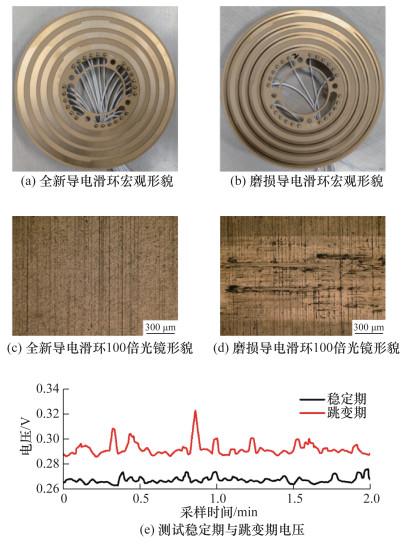
从测试过程中的前期稳定期与后期的跳变期分别截取2 min的采样数据,对其电压信号进行稳定性比较可见,导电滑环的电压在稳定期的均值(0.267 2 V)比跳变期(0.292 1 V)小8.52%,稳定期标准差(0.003 81 V)仅为跳变期(0.007 42 V)的51.35%,且跳变期出现了多次电压跳变的现象。以上结果表明,在测试过程中,稳定期与跳变期的电接触性能存在着显著的差异。
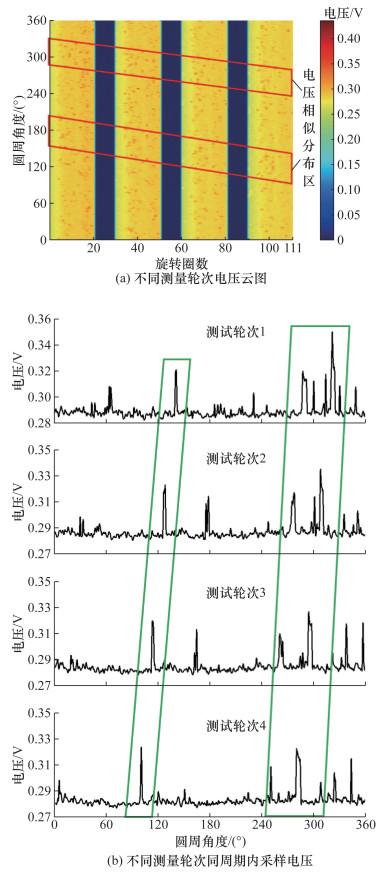
2 导电滑环烧蚀坑的形貌与力学表征
测试中发现,摩擦过程中发生明显电压跳变有时会伴随电弧产生,并在环道上留下烧蚀坑,对后续测试周期的电接触性能产生一定影响。结合第1章对电压信号的位置相关性分析,推测烧蚀坑的存在是电压跳变或瞬断产生的重要原因之一。滑动电接触性能的变化是接触条件、材料导电性能、摩擦性能的综合作用,因此首先针对烧蚀坑进行了形貌与力学表征。
2.1 导电滑环烧蚀坑的三维形貌表征
导电滑环烧蚀坑的光镜下形貌见图 3a,近似为椭圆形,且区域间存在明显反光度区别。使用三维形貌仪(厂家RTEC,型号UP-Lambda)对烧蚀坑以及普通磨痕区域进行形貌表征,表征结果如图 3b和3d所示。其中,图 3b中白色方框所示区域为图 3a中光镜图像区域。结合在长短轴方向上烧蚀坑三维形貌的剖面数据以及在磨痕中线(见红线)和垂线(见蓝线)上磨痕区域的三维形貌剖面数据,可以获取二者的形貌特征,图 3c和3e可见烧蚀坑区域的形貌特征与磨痕区域存在着显著差别。由此,图 3a中可将烧蚀坑根据反光度和形貌不同划分为3个区域:1) 烧蚀坑中心区(银白色,凹陷);2) 烧蚀坑内环区(黑色,凹陷);3) 烧蚀坑外缘区(银白色,凸起)。图 3d中,不含烧蚀坑区域分为:4) 磨痕区(绿色虚线框图区域);5) 未磨损区。
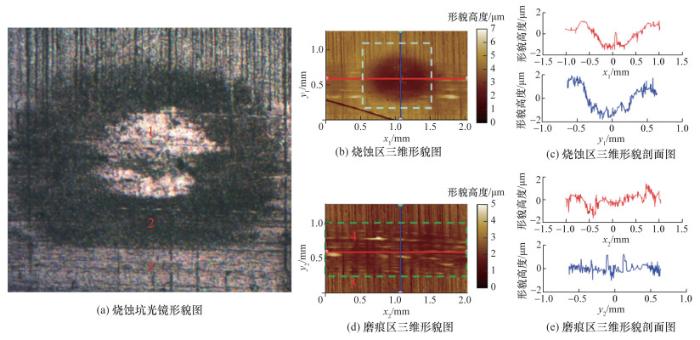
烧蚀坑长轴方向上长度为1.58 mm,短轴方向上宽度为0.96 mm。整体呈现外缘区凸起,中心区与内环区凹陷的整体形貌特征。
磨痕区上表面纹理不明显,而未磨损区表面纹理则依然较为明显。在中线和垂线方向上的波峰均为磨痕中的黏着点,在长轴和短轴方向上最高黏着点高度分别为1.00和1.52 μm。
2.2 导电滑环烧蚀坑的纳米压痕力学表征
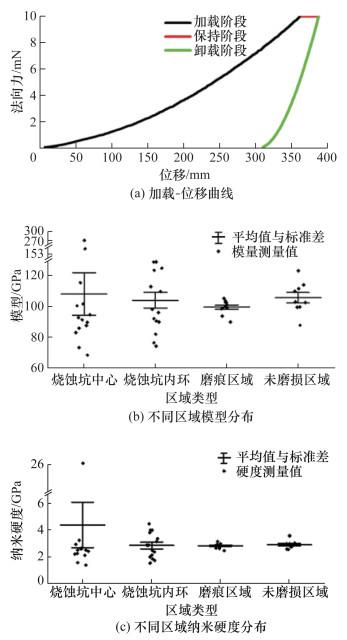
由于烧蚀坑外缘区在光镜下相对无法分辨,因此对2.1节中划分的烧蚀坑中心区、烧蚀坑内环区、磨痕区和未磨损区分别取点进行模量和纳米硬度测量,加载量0~10 mN,加载-位移曲线如图 4a所示,所得结果如图 4b和4c所示。4个部分模量的平均值基本相近,烧蚀坑中心区、烧蚀坑内环区、磨痕区和未磨损区平均模量分别为108.06、103.95、99.48和105.58 GPa。烧蚀坑中心区的模量略大于磨痕区,与未磨损区相近。磨痕区与未磨损区的模量分布非常集中,而随区域逐渐接近烧蚀坑中心,模量分布逐渐分散。纳米硬度也有类似现象,除烧蚀坑中心区域由于存在一个较纳米硬度点导致其平均纳米硬度较高,其余3个区域总体纳米硬度差距较小,烧蚀坑中心区、烧蚀坑内环区、磨痕区和未磨损区平均纳米硬度为4.37、2.83、2.82和2.89 GPa。磨痕区与未磨损区纳米硬度分布集中,越靠近烧蚀坑中心,纳米硬度分布越分散。通过模量分布和纳米硬度分布的测量表明,越靠近烧蚀坑中心,表面的模量和纳米硬度变化越剧烈,推测中心区域的成分组成更加复杂,且各组分的分布离散程度更高。
3 导电滑环烧蚀坑的微观导电性表征与元素表征
3.1 导电滑环烧蚀坑的导电性测试方法
使用原子力显微镜(厂家Bruker,型号Dimension Icon)PeakForce TUNA模式进行微纳尺度导电性表征。该模式区别于接触模式的C-AFM,通过快速单点接触实现精准力控条件下的导电性测量。选用导电探针HQ: NSC18/Pt(厂家MikroMasch),共振频率75 kHz,弹性系数2.8 N/m。将导电环道与原子力显微镜样品台通过导线相连,使得烧蚀坑表面与样品台导通。在实验开始前标定探针弹性系数;在测量导电性时,选取峰值力(peak force)为200 nN,针尖与样品间电压为200 mV,扫描范围5 μm,扫描速度为7.5 μm/s。考察导电电流在区域内的分布。
由于针尖与样品间的电压会引入针尖与样品间的静电力,进而影响表面黏附力的测量,因此在测量表面黏附力时,需设置针尖与样品间的电压为0。
3.2 导电滑环烧蚀坑的导电性表征
按照3.1节中所述测试方法,分别对烧蚀坑中心区、烧蚀坑内环区,烧蚀坑外缘区、磨痕区和未磨损区进行导电性表征,获得表面形貌、表面黏附力和表面导电性分布,结果如图 5所示。
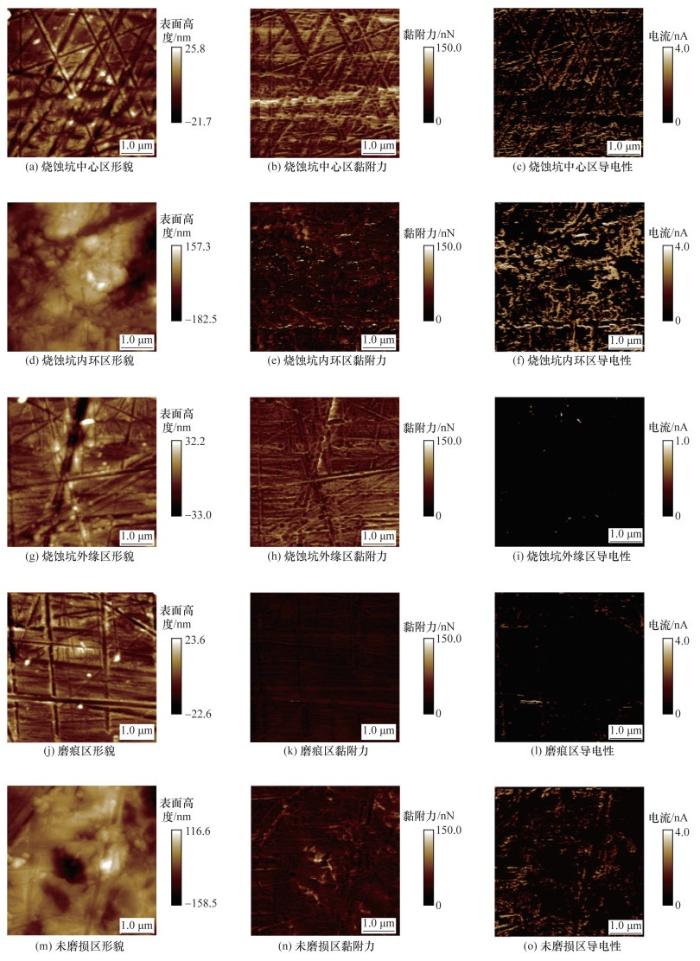
烧蚀坑中心区、烧蚀坑外缘区和磨痕区微观表面形貌较为光滑,表面粗糙度Ra分别为5.29、5.93和4.43 nm(见图 6a)。三者表面均有细小磨痕呈网状分布,磨痕较为平直,磨损形式主要为磨粒磨损。烧蚀坑内环区形貌起伏最大,Ra为39.3 nm;表面有椭圆形凸起分布,未见细小磨痕,可能为烧蚀后烧蚀坑中心区域物质逸散并附着在内环区导致。未磨损区形貌起伏较大,部分区域有较深的磨痕;表面可见部分细小颗粒黏着,主要为环道制备过程中表面平坦化加工所致。
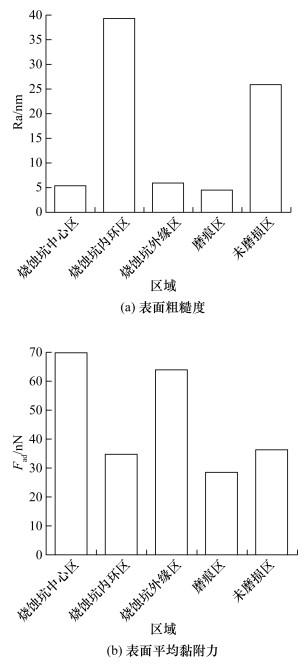
5个区域的黏附力分布可以观察到一定的形貌特征。图 6b中,烧蚀坑中心区和烧蚀坑外缘区表面平均黏附力Fad较大,分别为70.08和64.04 nN。烧蚀坑内环区、磨痕区和未磨损区表面Fad较小,分别为34.75、28.39和36.18 nN。当烧蚀坑存在时,在触头移动方向上,会依次经过烧蚀坑外缘区、内环区、中心区、内环区、外缘区,由此导致界面黏着存在差异性,烧蚀坑区域表面黏附力的波动可能导致触头滑动过程中与环道接触的失稳,从而进一步加剧滑环电接触的不稳定性。
从5个区域的导电性分布可以观察到一定的形貌特征,整体而言,烧蚀坑中心区和内环区的导电性优于烧蚀坑外缘区、磨痕区和未磨损区的导电性。通过导电性分布图计算导电图像中电流总和与图像面积之比,即可得到在外加偏压U为200 mV的条件下的材料面电流密度,进而反映材料的平均导电性。图 7中,烧蚀坑中心区、烧蚀坑内环区、烧蚀坑外缘区、磨痕区和环道面电流密度分别为1.502、2.065、0.003 23、0.132 47和0.555 A/m2。区域导电性排序由强到弱依次为烧蚀坑内环区、烧蚀坑中心区、未磨损区、磨痕区和烧蚀坑外缘区。
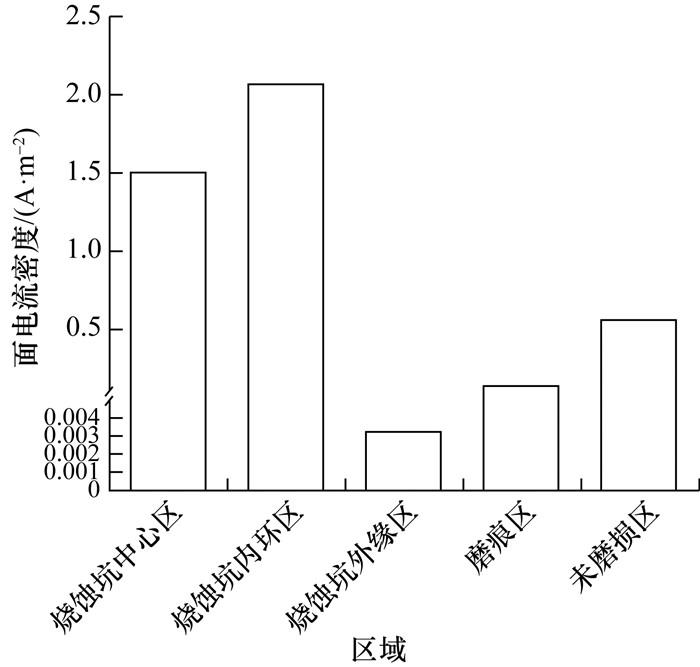
烧蚀坑区域与未磨损区的导电性在测量范围内呈均匀分布,而烧蚀坑外缘区和磨痕区仅在零星区域有导电信号。这可能是因为对于这些位置的材料,导电性测试载荷较小,针尖与样品接触不充分,无法让针尖与样品间完全导通而产生显著的电流。
3.3 导电滑环烧蚀坑的元素表征
3.3.1 导电滑环烧蚀坑的Raman碳元素表征
为了更近一步研究烧蚀坑中心区、烧蚀坑内环区、磨痕区和未磨损区导电性差异的来源,使用Raman光谱仪(厂家HORIBA,型号LabRAM HR Evolution)进行微区Raman表征,选取532 nm激光用于检测,微区光斑直径小于1 μm,结果如图 8所示。
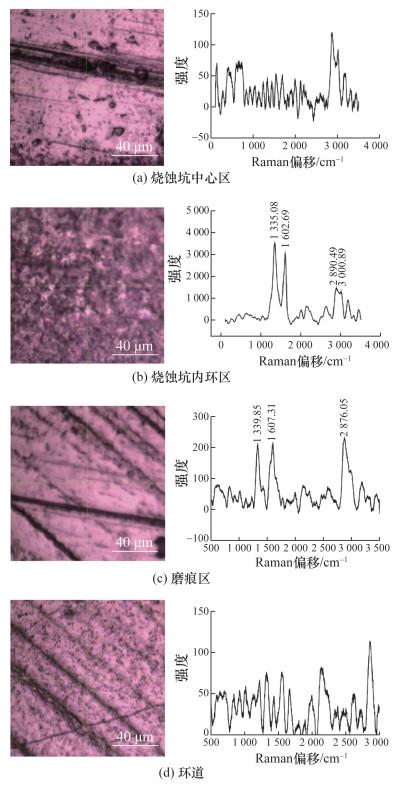
值得注意的是,在摩擦副中,并不含有机碳元素。烧蚀坑内环区碳元素来源主要为烧蚀过程中环境碳元素的沉积,而磨痕区的碳元素来源可能为环境中的有机分子。碳元素的富集是烧蚀坑内环导电性增强且表面黏附力较低的主要原因。
3.3.2 导电滑环烧蚀坑的扫描电子显微镜元素表征
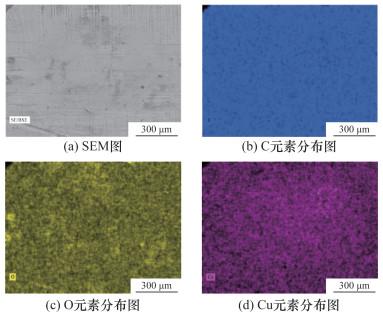
3.4 导电滑环烧蚀坑导电性的载荷相关性
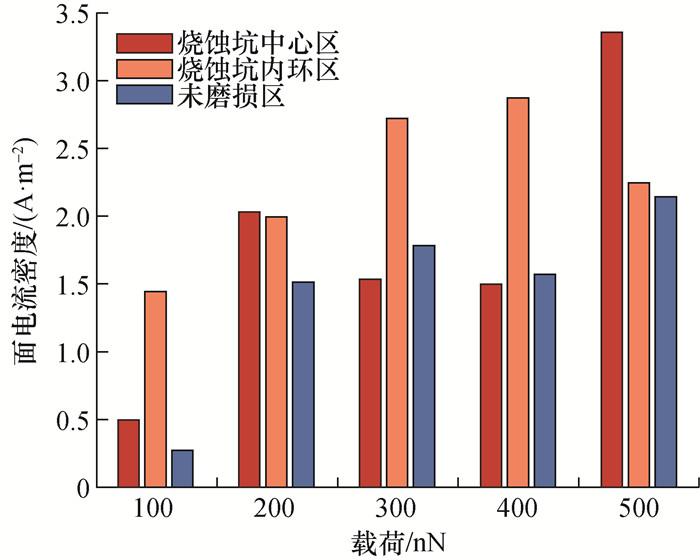
保持扫描范围、扫描速度和外加偏压不变,改变针尖的最大载荷分别为100、200、300、400和500 nN,原位测量烧蚀坑中心区、烧蚀坑内环区和未磨损区的导电性,结果如图 10所示。整体而言,材料导电性随载荷增加有增强的趋势,面电流密度在一定范围内存在波动。这可能由于探针扫描过程中针尖磨损导致的针尖形貌改变。
3.5 导电滑环烧蚀坑导电性的速度相关性
保持扫描范围、载荷和外加偏压不变,改变扫描速度分别为2.5、5、7.5、10和12.5 μm/s,原位测量烧蚀坑中心区、烧蚀坑内环区和未磨损区的导电性,结果如图 11所示。
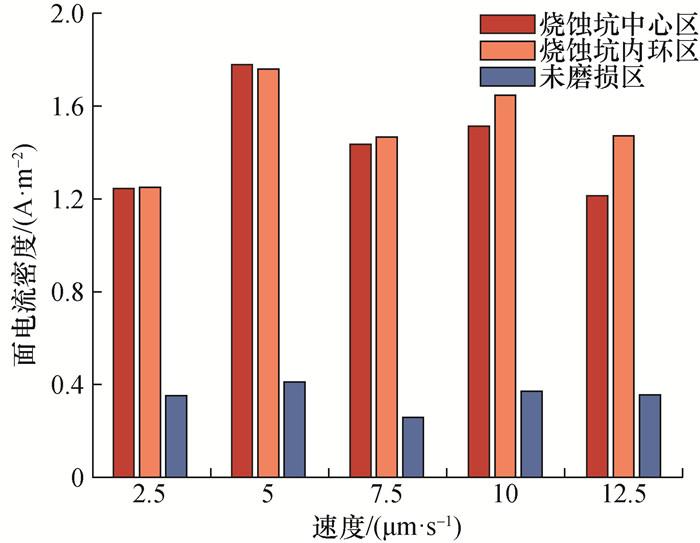
结果表明,在所测试的3个区域内,面电流密度随速度的增加均在一定范围内呈现波动性,且整体波动趋势保持一致。
3.6 导电滑环烧蚀坑导电性的外加偏压相关性
保持扫描范围、载荷和扫描速度不变,改变针尖和样品间的偏压分别为100、200、300、400和500 mV,原位测量烧蚀坑中心区、烧蚀坑内环区和未磨损区的导电性,结果如图 12所示。
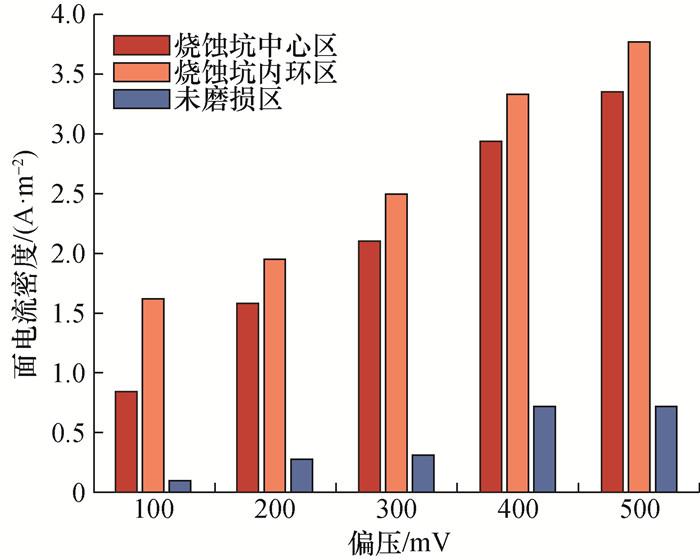
结果表明,在3个选定区域内,面电流密度与针尖和样品间偏压呈近似线性关系,面电流密度随偏压增大而增大。
根据Ohm定律,电压与电流关系为
其中:U为偏压,I为电流,R为回路电阻,Rc为接触电阻。
考虑到RC≫R,电流密度表示为
其中A为接触面积。由于载荷保持一致,不同区域间平均模量差别不大,因此测量过程中针尖与样品间的接触面积变化不大。图 12表明,烧蚀坑中心区与内环区的面电流密度随偏压之比相近,均大于未磨损区面电流密度随偏压之比。这进一步验证了烧蚀坑中心区与内环区导电性相近,且均优于未磨损区导电性。
4 讨论
烧蚀坑由于烧蚀作用导致表面纳米硬度部分增强,形貌呈现中心低外缘高的形貌特征,烧蚀坑长度方向上约为1.58 mm,短轴方向上约为0.96 mm,外缘凸起高度约为1.2 μm,坑的深度约为1.5 μm,坑中心曲率半径约为170 mm,触头表面曲率半径约10 mm,下表面曲率半径远大于触头端部曲率半径。在Hertz接触假设下,烧蚀坑对接触面积的影响不大。
根据白光干涉获得的形貌表面生成几何实体,将触头建模为半径为10 mm的球缺,球缺部分截面直径近似为环道直径,约为0.7 mm。通过ABAQUS软件模拟触头与环道表面不同相对位置条件下的接触面积与接触压力。图 13中,在有烧蚀坑环道表面,随着载荷的增大,触头最先接触区域为烧蚀坑外围,后接触区域逐渐向烧蚀坑内部扩展,但仍未接触烧蚀坑内部凹陷区域;在无烧蚀坑环道表面,接触区域近似均匀分布,接触面积逐渐增大。由于在有烧蚀坑表面上,烧蚀坑中心区域凹陷,当触头经过该区域时,会造成一定程度接触质量下降。
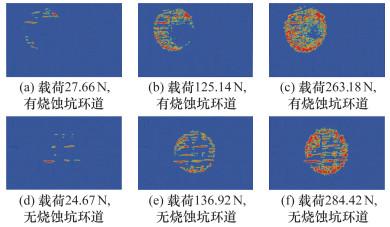
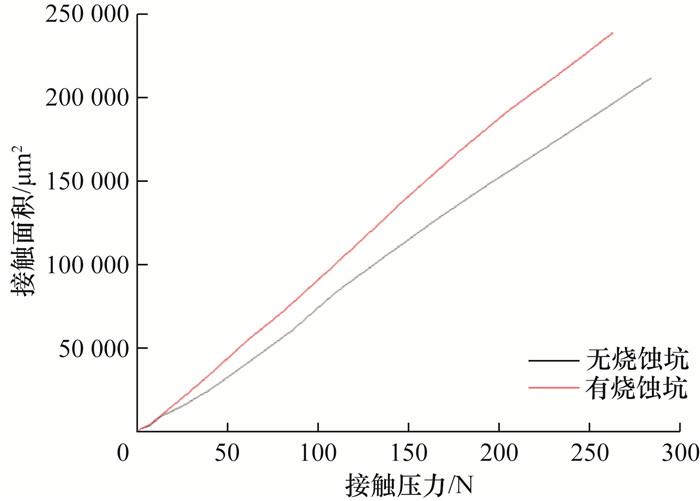
图 14中,接触面积随载荷的增大而增大,近似呈现线性。在相同载荷下,有烧蚀坑环道表面接触面积略大于无烧蚀坑环道表面接触面积。在载荷小于25 N条件下,烧蚀坑表面形貌的改变对触头与环道接触面积的影响不大。然而,烧蚀坑外缘区导电性比磨痕区和烧蚀坑内环区降低了2个数量级,烧蚀坑外缘区导电性降低对烧蚀坑区域电接触的稳定性造成显著影响。
对于弹簧阻尼摩擦系统,等效阻尼为
其中:x为滑块位置,ẋ为滑块某一时刻速度,η为系统的阻尼系数,F(ẋ)为系统的摩擦力关于滑块速度ẋ的函数。当α < 0时,系统趋于不稳定[19]。烧蚀坑区域的表面黏附力差异会影响微观尺度的材料黏着,影响界面摩擦系数,进而造成界面接触不稳定。
5 结论
本文通过微纳材料力学表征、导电原子力显微镜技术与元素分析,研究了烧蚀坑对导电滑环电接触稳定性的影响。烧蚀过程改变了表面形貌,使得烧蚀坑呈现外缘凸起、内部凹陷的形貌特征,该形貌特征对接触面积的影响不大。但烧蚀坑外缘区导电性比磨痕区下降了2个数量级,降低了烧蚀坑电接触的稳定性。与此同时,烧蚀过程导致环境有机物沉积到烧蚀坑内环,改变了烧蚀坑表面材料,导致烧蚀坑不同区域导电性与表面黏附力的差异,影响界面电阻与界面黏着,由此降低电接触的稳定性。本文从烧蚀坑区域力学、形貌特征、导电性和黏附力波动4个方面阐释了导电滑环烧蚀坑降低滑环电接触稳定性的作用机理,对理解烧蚀坑对导电滑环电接触稳定性的影响机理具有重要理论意义。


