

随着航空、航天和核电等高端制造业的快速发展,重载工况下关键活动部件面临着越来越苛刻的摩擦磨损问题,极大程度上限制了机械系统运行寿命和可靠性。碳基或过渡金属二硫化物基薄膜自配副摩擦时会表现出优异的润滑性能,但在高接触应力状态下会迅速失效。许多学者已开展了含氢碳膜(a-C: H)与层状二硫化钼(MoS2)薄膜构建的异质摩擦体系方面的研究,宏观尺度上主要是通过摩擦剪切效应在滑动区域原位形成两相异质界面实现超滑[1-3]。相关研究发现非晶碳膜在滑动过程中通过摩擦诱导磨球表面形成富集sp2相类石墨烯转移膜[4-6],滑动过程由初始的强相互作用界面演变至有序化摩擦膜与非晶碳质剪切层易滑移界面,从而获得超低摩擦系数。该设计理念可以发挥含氢碳膜与MoS2薄膜的协同润滑作用,实现具有超长寿命的鲁棒性宏观超滑。但是由于纯MoS2薄膜本征结构疏松,硬度较低,致使整个润滑系统承载能力较差,无法在高接触应力下稳定工作。Yu等[7]发现MoS2和含氢非晶碳膜相对滑动时可以获得超低摩擦系数。Li等[8]通过滑动诱导滑移界面石墨化转变和电子屏蔽效应实现了金属-碳异质界面超滑。Jia等[9]在滑动过程中将Au引入氢化非晶碳(Au@a-C: H)膜基体并获得了0.003的超低摩擦系数。在纳米Au的催化作用下钢球表面形成了多层石墨烯和定向聚烯烃类剪切层,稳定的摩擦过程主要发生在石墨烯和非晶碳滑移界面。密度泛函理论计算发现石墨烯与氢化非晶碳之间的层间分离功与石墨烯层间结合能相当,滑移界面极低的相互作用力促使超滑得以实现。类似地,Liu等[10]通过构建石墨烯纳米卷和H-DLC摩擦体系在潮湿空气中实现了准超滑。Pan等[11]研制了一种TiB2/MoS1.7B0.3双相纳米复合材料,与氧化铝摩擦时具有优异的润滑性能;实验表明该多相薄膜具有超低摩擦系数和磨损率(10-10 mm3/N·m量级),在400 ℃的空气中退火后仍能保持摩擦界面表征和第一性原理计算证实硬质TiB2和软质二硫化物结构的互补效应实现了原子级磨损和超长运行寿命。Yin等[12]在20~300 K宽温域下实现了MoS2-Ag复合薄膜的超滑,发现接触界面形成的纳米银和MoS2薄片的协同润滑作用促使其在超低温环境中具有优异的摩擦学性能。Deng等[13]设计开发了具有优异光学和摩擦学性能的Si-DLC/PLC纳米结构多层薄膜,实验结果显示在高达2.37 GPa的初始峰值Hertz接触应力下,复合薄膜获得了约0.001的摩擦系数和3.13×10⁻⁹ mm3/N·m的超低磨损率。化学结合状态分析和微观结构表征发现滑动过程中磨痕区域始终保持高度钝化的界面,磨斑表面形成了大量富sp2相的断续类石墨烯摩擦膜,上述研究认为摩擦诱导形成的类石墨烯/类聚合物碳基两相滑移界面是多层膜实现超滑并具有超高承载能力的主要原因。更多研究表明,通过在二硫化物基薄膜中掺杂Au或Ag等软质金属并调控制备工艺可以显著提高复合薄膜的机械性能、抗潮解和抗氧化能力,同时能够保证良好的层状结构和润滑性能[14-17]。同时由于Ag成本比Au更低,应用场景更广泛,因此开发具有优良微观结构的掺银二硫化物基复合薄膜是最有应用前景的一种改善含氢碳膜与层状二硫化钼薄膜超滑系统承载能力的方法。
综上,高硬度低含氢碳膜和低硬度的二硫化钼基复合薄膜在惰性气体中相对滑动时可以实现超滑并具有优良的抗磨性能,但相关实验均是在中低载荷下开展,目前还没有相关研究报道该异质摩擦副在重载条件下的宏观超滑行为。此外,超高接触应力下滑移界面原位形成的摩擦膜结构特征及其对超滑构筑的影响规律尚不明晰。
本文研究了含氢碳膜/掺银二硫化物异质界面超高压超滑,针对复合薄膜自身润滑性能影响因素进行系统研究,同时深入理解含氢碳膜和过渡金属二硫化物基薄膜在滑动过程中的摩擦化学反应行为,探究异质界面润滑体系在高接触应力下的结构演化规律和在CO2气氛中的承载特性,以推动相关技术的工程化应用。
1 实验部分
1.1 固体润滑薄膜制备
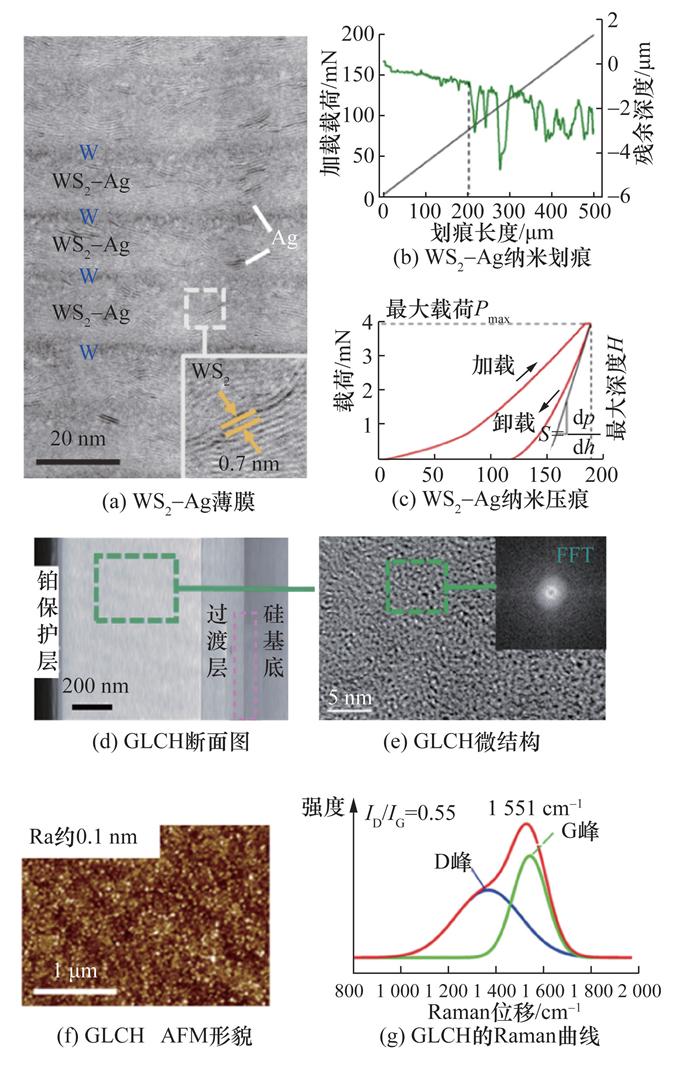
本文利用非平衡磁控溅射和离子束辅助轰击相结合的复合沉积技术,在原子级光滑的硅晶圆表面制备了周期性多层掺银二硫化钼(MoS2-Ag)和掺银二硫化钨(WS2-Ag)薄膜。沉积过程中,分别利用高纯度的MoS2靶、WS2靶和Ag靶作为溅射源,多层结构(MeS2和MeSx交替层)通过控制Ar+离子源的开启和刻蚀时间来实现,Ag纳米晶颗粒则均匀分布在膜层当中,如图 1a所示。其中WS2-Ag多层膜的划痕临界载荷和纳米硬度分别为83.2 mN和5.3 GPa,如图 1b和1c所示。高硬度低含氢类金刚石碳膜(DLCH,氢的质量分数约20%)、类石墨碳膜(GLCH,氢的质量分数小于10%)则通过高能离子束沉积技术利用高度离化的甲苯有机气体实现可控离子能量状态下的含氢碳膜沉积,DLCH碳膜在中等离子能量条件下沉积,GLCH碳膜则在高能量状态下沉积形成,其微观结构和表界面性能特点如图 1d—1g所示。
1.2 摩擦学性能评价及机理分析
对制备的薄膜微结构、力学性能及宏观尺度超滑性能进行实验探索。纳米压痕和划痕实验采用瑞士CSM设备(型号NHT2)。选用轴承钢SUJ2和DLCH球分别与MoS2-Ag和WS2-Ag薄膜来构建异质界面摩擦体系,并在CO2气体环境重载工况下开展长时间的往复滑动测试,以探究润滑系统的超滑特性和摩擦状态的稳定性。实验设备为安东帕真空摩擦试验机(型号VTRB-Ⅲ),所用SUJ2、DLCH和GLCH球直径均为6.000 mm,施加载荷为50 N,初始峰值Hertz接触应力为2.36 GPa。实验前使用纯度为99.999%的CO2气体对摩擦试验机的真空腔室进行4次气体置换,随后将腔室充满CO2气体直至压力达到9.6×10⁴ Pa左右,最后即可开始往复滑动测试。
摩擦实验后对接触界面表面形貌和化学结构进行表征。利用聚焦离子束(FIB)扫描电镜(型号LYRA3,TESCAN))原位提取薄片技术和高分辨透射电子显微镜(HRTEM,型号JEOL JEM 2010F,电压200 kV)对摩擦界面原位形成的摩擦膜纳米结构和磨屑进行微结构观测,分析剪切应力作用下异质界面润滑材料的作用机制。
2 结果与讨论
2.1 异质界面重载超滑特性
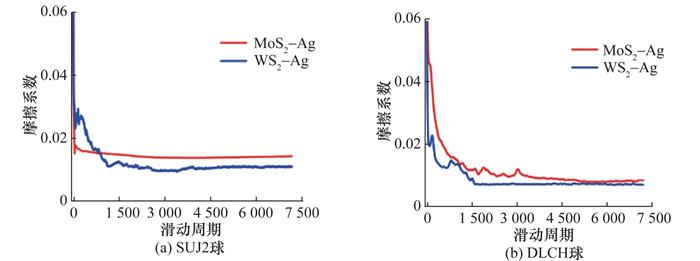
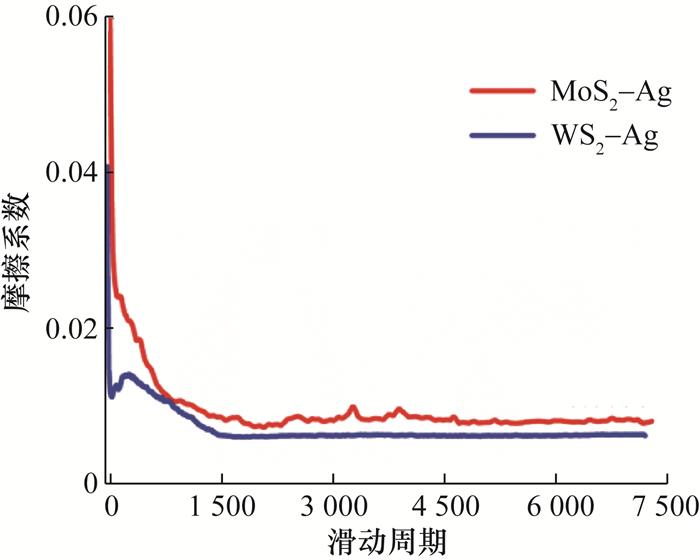
选用SUJ2和DLCH球分别与MoS2-Ag和WS2-Ag薄膜来构建异质界面摩擦体系,并在CO2气体环境、重载工况即高接触应力下开展往复滑动测试,以探究润滑系统的超滑特性和稳定性。由图 2a可以看到,在50 N的高接触应力(初始峰值Hertz接触应力2.6 GPa)下SUJ2分别与MoS2-Ag和WS2-Ag相对滑动时稳态平均摩擦系数分别约为0.014和0.011,处于低摩擦状态。图 2b显示,在相同载荷下,DLCH/MoS2-Ag和DLCH/WS2-Ag对偶副相对运动时产生的摩擦系数明显降低,润滑系统在经过约4 000个滑动周期后摩擦系数可以分别达到并稳定在0.008 3和0.007 2左右,处于超滑状态。以上研究结果表明DLCH与掺银二硫化物薄膜构建的异质界面摩擦系统在CO2气体环境、高接触应力下能维持长时间稳定超滑,并且DLCH/WS2-Ag的协同润滑效应更佳。此外,可以发现4组摩擦配副在滑动过程中都会经历一个长时间的高摩擦磨合过程,然后才能实现低摩擦,表明初始摩擦阶段接触区域发生了材料转移或结构转变等界面活动,这对后续低摩擦状态构筑及维持具有至关重要的作用。
2.2 超滑承载极限
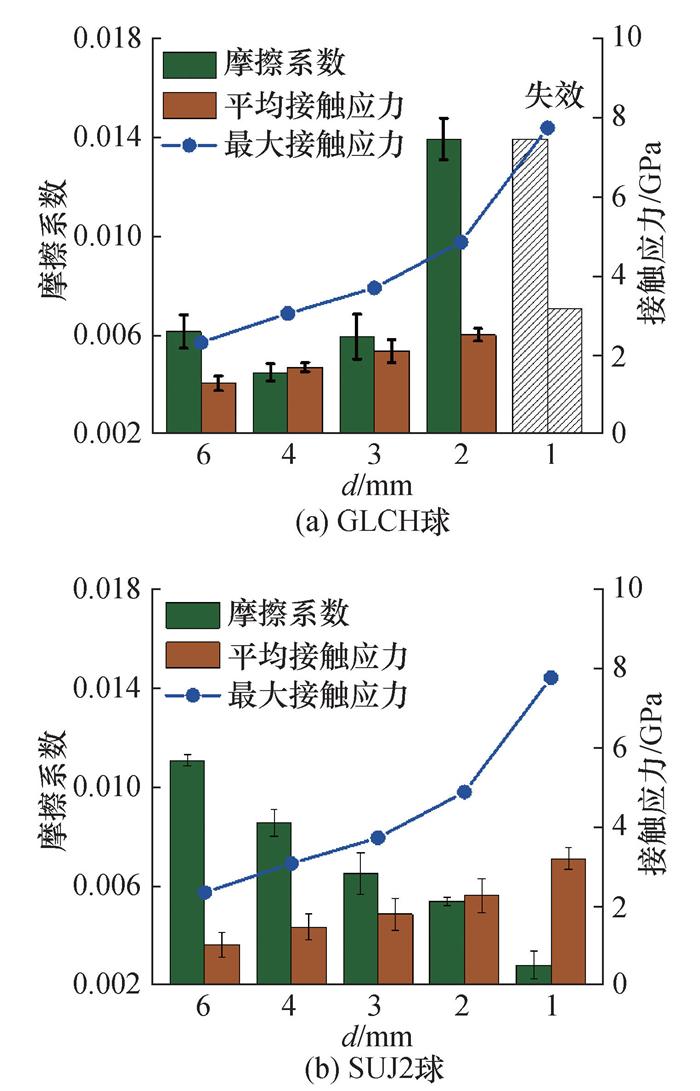
为了进一步探究掺银二硫化物薄膜的超滑承载极限,以便为后续工程应用提供指导意见,在CO2环境中选用SUJ2和GLCH球分别在不同接触应力下与WS2-Ag薄膜对磨并实时记录摩擦数据,实验结果如图 4所示。值得注意的是,本文使用的摩擦磨损试验机最大加载力为50 N, 因此主要通过减小磨球直径来增加摩擦副界面接触应力。SUJ2和GLCH球直径d分别为1.000、2.000、3.175、4.000和6.000 mm,在50 N载荷下所产生的初始最大接触应力分别为7.78、4.90、3.57、3.09和2.36 GPa。
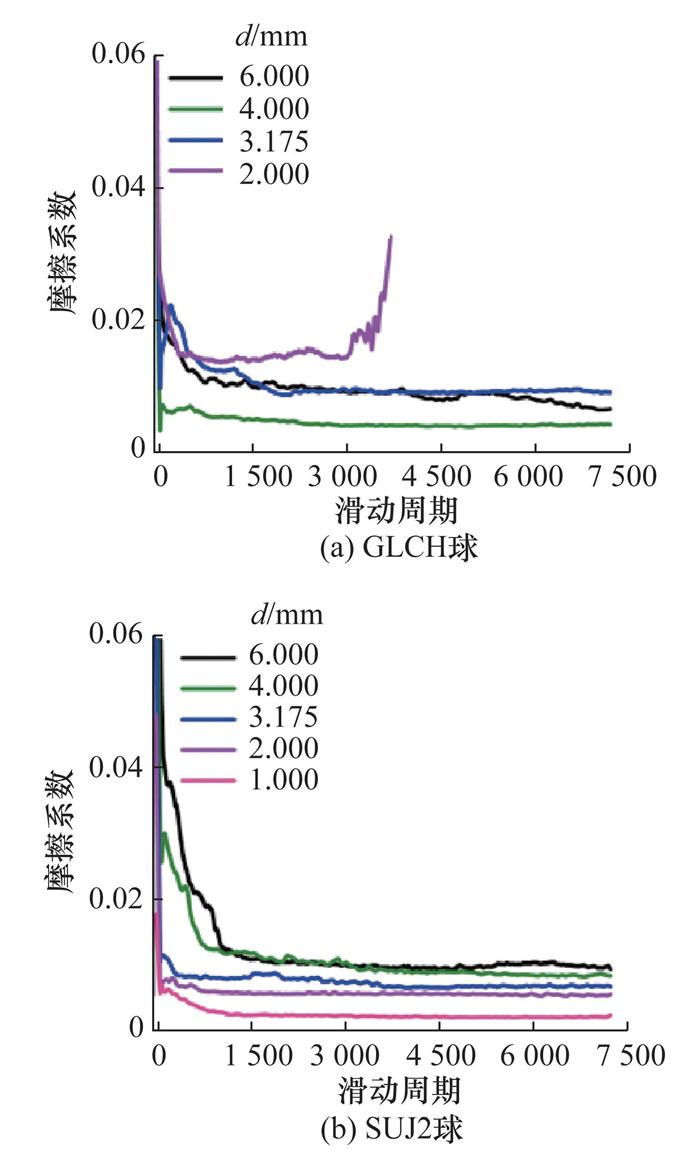
图 4展示了接触应力对异质界面滑动副超滑行为影响规律。从图 4a可以看出,在50 N载荷下,当磨球直径大于3.175 mm时,GLCH/WS2-Ag对偶副均可以保持稳定超滑状态,使用直径为4.000 mm的GLCH球可以获得0.004 5左右的最低摩擦系数。同时可以发现当GLCH球直径减小至2.000 mm时,整个滑动系统在维持了3 000个滑动周期的低摩擦状态后快速失效,表明界面接触应力超过了WS2-Ag薄膜的承载能力。由图 4b可以看到,5种直径的SUJ2球与WS2-Ag薄膜相对滑动时在经过约1 500个滑动周期后摩擦系数都会显著降低并且稳定至实验结束。当磨球直径为6.000 mm时,SUJ2/WS2-Ag对偶副的稳态摩擦系数在0.01左右,系统的摩擦系数随着直径减小而下降,并且当使用直径1.000 mm的SUJ2球时可以获得0.002 8的超低摩擦系数。本文还发现2组滑动副在不同接触载荷下进行摩擦时都会经历长时间磨合过程才能实现超滑,意味着滑移区域经历复杂的摩擦化学反应过程是一种普遍现象,并有效促进了后续低摩擦状态的实现。以上研究结果说明GLCH和SUJ2与WS2-Ag薄膜构建的异质界面润滑系统在CO2环境中经过界面材料转移和润滑单元重构后均可实现高载超滑,在超高接触应力下SUJ2/WS2-Ag滑动副的摩擦系数更低。
为了明晰图 4中2组滑动副界面摩擦系数和接触应力的对应关系,本文系统地总结了施加50 N载荷使用不同直径磨球时滑动系统的摩擦系数、平均和最大接触应力,如图 5所示。图 5a中,当GLCH球直径由6.000 mm减小至2.000 mm时,摩擦界面初始峰值Hertz接触应力由2.36 GPa增加至4.89 GPa,平均接触应力由1.3 GPa递增至2.5 GPa。通过摩擦系数曲线可以发现,在平均1.7 GPa(d=4.000 mm)的高接触应力下GLCH/WS2-Ag对偶副具有最佳的润滑效果,当接触应力超过2.5 GPa时整个系统的润滑性能显著下降。图 5b中,当SUJ2球直径由6.000 mm减小至1.000 mm时,摩擦界面初始峰值Hertz接触应力由2.36 GPa增加至7.78 GPa,平均接触应力由1.02 GPa递增至3.2 GPa。可以明显地观察到,SUJ2/WS2-Ag滑动副的摩擦系数随着界面接触应力的增大而减小,在3.2 GPa的超高接触压力下润滑系统获得了最低的摩擦系数。通过对比分析图 5中摩擦系数和接触应力的演变规律可知,当机械系统运动副所受的平均接触应力小于2.1 GPa时,GLCH/WS2-Ag摩擦副能够起到更好的协同润滑作用;当机械系统运动副所受的平均接触应力大于或等于2.1 GPa时,可以直接选用SUJ2与WS2-Ag作为滑动配副材料。
2.3 超滑耐久性
润滑材料的耐磨特性会显著影响机械系统服役寿命,为了探究GLCH/WS2-Ag异质界面摩擦副在重载工况下的超滑耐久性,本文在CO2气体中开展了长时间的往复滑动测试,实验结果如图 6所示。摩擦实验选用的GLCH球直径为6.000 mm,施加载荷为25 N,初始峰值Hertz接触应力为1.87 GPa。
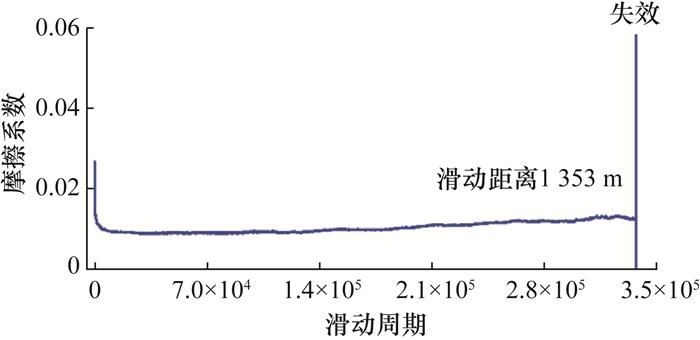
由图 6可知,整个润滑系统在经历磨合期之后进入摩擦系数约为0.008的超滑状态。随着滑动持续进行,界面接触状态有所退化且相应摩擦系数缓慢增大,在经过大约270 000个滑动周期后系统摩擦系数增加至0.01左右。当摩擦实验进行约330 000次滑动周期(滑动距离1 353 m)后,整个系统的摩擦系数会突然增大。基于GLCH与WS2-Ag薄膜摩擦后磨痕区域磨屑堆积,因此可以推测该系统润滑状态失效主要源自WS2-Ag薄膜的磨穿或破损。高接触应力下GLCH与WS2-Ag薄膜超滑耐久性测试过程中表现出了优异的自润滑性能,能够实现长寿命超滑,在润滑失效之前始终保持稳定的低摩擦状态,表明所构筑的碳基异质界面摩擦体系具有良好润滑特性。
2.4 摩擦膜纳米结构
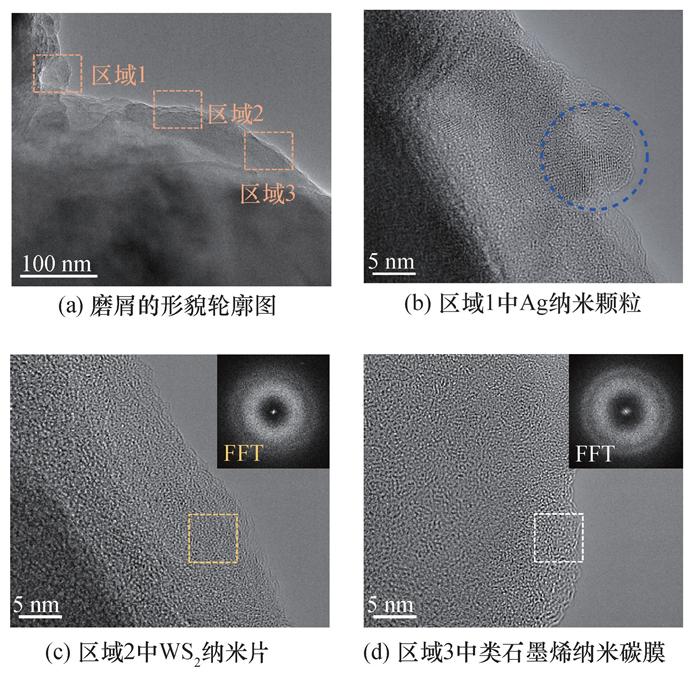
通常,碳基薄膜和过渡金属硫化物薄膜在滑动过程中的润滑状态主要取决于接触区域原位形成摩擦膜的厚度、形态和结构等。本团队前期实验研究[12, 18]表明,重载工况下含氢碳膜和掺银二硫化物薄膜构建的异质润滑体系在摩擦过程中滑移区域的有序化界面演化是实现低摩擦的必要条件。为了进一步阐明摩擦界面纳米结构特征及其对超滑构筑的作用机理,利用HRTEM对摩擦试验后SUJ2/WS2-Ag和GLCH/WS2-Ag两组对偶副接触界面的摩擦膜进行了表征分析。利用乙醇分散法收集了图 2a和3中在50 N载荷下SUJ2和GLCH球与WS2-Ag滑动实验后对磨球表面的磨屑,然后使用HRTEM对摩擦膜不同区域进行观察分析,对比2组实验下摩擦膜的结构特性并建立摩擦界面行为与润滑性能的对应关系,表征结果如图 7所示。
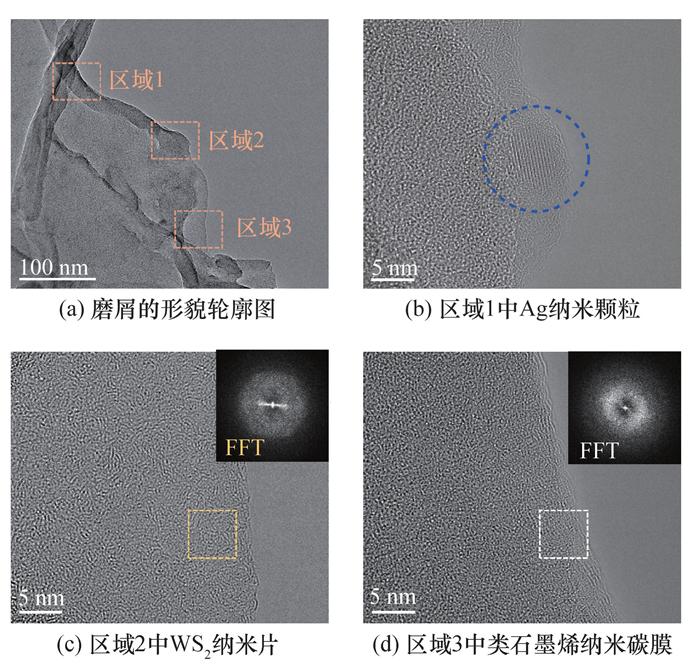
图 7清楚地呈现了磨屑不同区域的微观结构特征。图 7a为磨屑的轮廓形貌图,可以看出其整体上具有薄片状形态,随后本文对磨屑3个特征区域进行了精细表征,结果如图 7b—图 7d 所示。在区域1能观察到Ag颗粒主要镶嵌在WS2润滑层内并且具有典型纳米晶结构;在区域2发现了大量非晶化WS2摩擦膜。在区域3中发现摩擦膜中还存在纳米团簇化的WS2摩擦膜,相比原始薄膜出现了一定的结构退化。图 7c、7d即区域2和3中虚线内的FFT图像均是圆环衍射斑,进一步证实了WS2摩擦膜整体无序的结构特征。根据以上研究可以推测,在磨合阶段SUJ2与WS2-Ag薄膜相对滑动时,在界面高剪切应力作用下断续WS2薄片和Ag颗粒会转移到磨球表面并形成稳固的摩擦膜,随后在摩擦作用下接触区摩擦膜会发生结构定向演化,逐渐趋于局部有序,这种润滑层结构有利于降低界面摩擦和磨损[18-19]。当滑动区域处于低摩擦状态时界面剪切效应会显著减弱,相应的界面结构转变也会处于动态平衡,从而实现稳定的低摩擦状态。因为在50 N载荷下对磨球表面摩擦膜有序化程度相对较低,因此SUJ2/WS2-Ag润滑系统的摩擦系数为0.01左右,未能实现超滑,但是当进一步减小球径、增加接触应力从而诱导界面结构产生更加有序化的转变,整个润滑系统可以实现超滑。
图 8展示的是从GLCH球表面收集的磨屑HRTEM图像,清楚地呈现了不同区域摩擦膜的微观结构特征。从图 8a可以看出磨屑整体上呈现出薄片状形态。在图 8b中可以观察到由WS2纳米碎片和Ag纳米晶构建的复合摩擦膜,表明滑动过程中WS2-Ag薄膜部分材料转移到了对磨球表面并且产生了一定的结构退化。图 8c显示了WS2摩擦膜富集区域的纳米结构,能够发现大量纳米团簇化的断续WS2摩擦膜,但其有序化和富集程度高于SUJ2对磨球表面的摩擦膜,意味着滑动过程中具有更低的摩擦系数。在图 8d中进一步发现对磨球滑动表面原位形成了类石墨烯纳米碳膜(graphene-like nanostructured carbon film,GNCF),其结构相较于GLCH碳膜出现了演化与重排,说明界面剪切作用会促使GLCH表界面纳米结构有序化。高sp2相的类石墨烯碳基摩擦膜具有优异的润滑性能,因此可以推测本实验中GLCH表面形成的GNCF在高载滑动中起到了一定的减摩作用。图 8c、8d中虚线内区域的FFT图像均是圆环衍射斑,进一步证实了WS2和GNCF摩擦膜整体无序的结构特征。根据以上的HRTEM表征结果可以认为,GLCH和WS2-Ag薄膜在滑动初始的磨合阶段接触界面具有较高的滑移能垒和剪切作用,这一方面会诱使WS2-Ag薄膜表层材料转移到对磨球表面形成镶嵌有Ag纳米晶的断续WS2转移膜,另一方面GLCH表层作用区域纳米结构会发生由无序向有序的转变并最终形成GNCF摩擦膜。在后续摩擦过程中一旦对磨球表面形成了稳定的多相摩擦膜,整个系统的摩擦系数会显著下降并达到超滑。通过对比2种对磨球表面摩擦膜的组成、形态与结构可以清楚发现,在50 N载荷下GLCH球表面形成了碳相和WS2基多相摩擦膜,且有序化程度相对更高,因此GLCH/WS2-Ag润滑系统的摩擦系数为0.006 5,比SUJ2作为滑动副时有所下降。
摩擦过程中磨痕表面的结构演化通常也会影响整个系统的润滑性能。基于此,在超滑实验后利用SEM-FIB双束系统从WS2-Ag薄膜的磨痕中心区域原位提取了摩擦膜并使用HRTEM进行了观察分析,以深入了解滑动接触时磨痕表层区域结构演化特性,进一步阐释超滑机理。
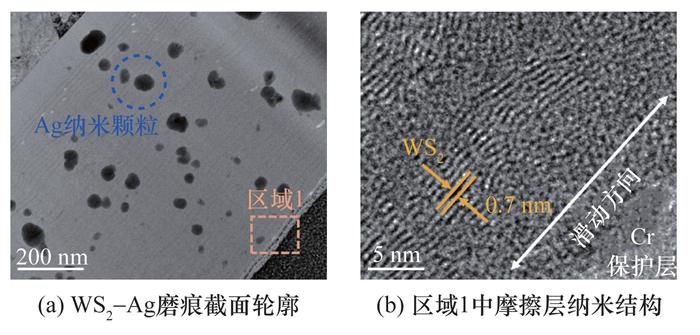
图 9a是WS2-Ag薄膜滑动接触区域的截面轮廓,呈现了薄膜在滑动测试后整体的形貌特征,能够发现其内部仍然保持着和原始涂层相同的结构特征,说明摩擦仅影响表层区域。图 9b进一步对摩擦界面的微观结构进行了表征,可以看到,滑动区域的WS2-Ag摩擦层呈现出结构良好且高度有序的层状结构,层间距约为0.7 nm。此外接触区域表层WS2主要是沿着滑动方向且以(0 0 2)晶面曲向为主,通常这种取向的二硫化物基薄膜具有最佳的润滑特性。以上研究表明,在摩擦剪切作用下磨痕表层滑动界面发生了结构演化与重排,逐渐形成高度定向分布的WS2摩擦层,并且薄膜内部保持本征的良好结构。这种应力作用诱导的摩擦化学反应有利于弱剪切界面的构筑,从而保证GLCH/WS2-Ag润滑系统的稳定超滑。
2.5 重载超滑机理
摩擦学实验表明含氢碳膜/掺银二硫化物对偶副在进入稳定超滑之前会经历长时间的磨合期,在此过程中滑移界面会发生结构演化并原位形成多相摩擦膜。通常碳基或二硫化物基薄膜滑动时在初始高摩擦阶段会发生一系列摩擦化学反应,如化学键的断裂和界面原子的重构等,研究不同摩擦阶段滑移界面的接触行为可以直观地理解超滑行为。由图 10可以看出,在磨合期滑动表面会发生多种界面原子活动,包括表面氧化层的去除、粗糙峰填充、界面平坦化和WS2薄膜的结构退化等。值得注意的是,在高接触应力作用下,一方面摩擦剪切效应会促使WS2纳米片和Ag纳米颗粒转移到对磨球表面并形成稳固的转移膜,另一方面GLCH薄膜表层碳膜会发生结构转变以形成具有类石墨烯结构的纳米摩擦膜。此外WS2-Ag薄膜的表层区域会发生结构演化,逐渐形成平行于滑动方向的高度有序的重定向摩擦层。
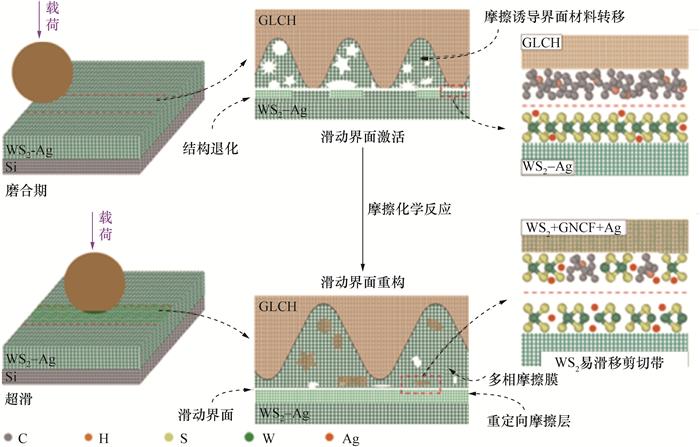
随着滑动行为的进行,对偶副接触区域摩擦膜厚度和纳米结构逐渐演化,这主要表现为摩擦系数的不断演变,一旦形成最佳摩擦状态,整个系统就可以获得稳定的超低摩擦系数并具有优异的承载能力和服役寿命。因此可以合理地推测,对于GLCH/WS2-Ag系统,当摩擦系数小于0.01时,滑动副表面已经形成了稳固的多相摩擦膜,接触界面演变至GNCF/WS2/Ag与WS2-Ag摩擦层之间的滑动。新构筑的多相异质滑移界面不仅自身具有易剪切纳米结构,还可以提供全域非公度接触,进而显著降低了接触区域的剪切阻力、滑动势垒和边缘缺陷。从摩擦能量耗散的角度分析可知,在磨合过程中GLCH与WS2-Ag相对滑动时会发生材料转移等界面活动,高的界面能耗产生了较大的摩擦阻力。随后超滑态的实现表明接触界面之间化学键的断裂与重组等原子运动大幅度减少,能量耗散水平极低,进而会抑制摩擦力的产生。
3 结论
本文基于含氢碳膜和纳米化掺杂改性二硫化物薄膜的异质界面调控,探究了高硬度含氢碳膜/掺银二硫化物异质界面超高压超滑特性,主要结论如下:
1) 在CO2气体环境重载工况下,SUJ2、DLCH和GLCH分别与掺银二硫化物薄膜构建的异质界面润滑体系均具有优异的协同润滑效应。结果表明,DLCH/WS2-Ag对偶副在1.7 GPa的平均接触应力下可维持稳定润滑,摩擦系数低至0.007 2。研究发现GLCH/WS2-Ag对偶副在1.3~2.5 GPa的平均接触应力域内可维持稳定润滑,在1.7 GPa时可获得0.004 5左右的最低摩擦系数,整个润滑系统在1.87 GPa的高载下可实现330 000次滑动循环周期的长寿命超滑。相比之下,SUJ2/WS2-Ag对偶副在1.02~3.2 GPa的平均接触应力域内摩擦系数随着接触应力的增大而减小,在3.2 GPa的超高压接触应力下获得了0.002 8的超低摩擦系数。
2) 摩擦界面纳米结构表征结果显示,在高载滑动过程中SUJ2对磨球表面形成了由WS2纳米片和Ag颗粒组成的复合摩擦膜。GLCH对磨球表界面通过压力诱导的摩擦化学反应原位形成了由GNCF、层状WS2转移膜和Ag纳米颗粒构建的多相摩擦膜。此外,WS2-Ag薄膜表界面摩擦区域在滑动剪切作用下发生了结构演化,呈现出结构良好且高度有序的层状结构,表层WS2纳米片主要是沿着滑动方向且以(0 0 2)晶面取向为主。超低摩擦状态下滑动行为主要发生在GNCF/WS2/Ag多相摩擦膜和WS2-Ag重定向摩擦层之间,这种摩擦构型可以提供全域非公度接触,具有极低的界面滑移阻力和能量势垒;此外WS2-Ag薄膜具有优异的力学行为,因此整个润滑系统可实现高载和长寿命超滑。


