Fire in Buildings and Timber Structures

Effect of purlin height on the response performance of smoke detectors in ancient buildings of the Ming and Qing dynasties

  • Huiling JIANG 1, 2 ,
  • Leiyin YANG 1 ,
  • Liang ZHOU , 1, 2, *
Expand
  • 1. School of Civil and Resource Engineering, University of Science and Technology Beijing, Beijing 100083, China
  • 2. Research Institute of Macro-Safety Science, University of Science and Technology Beijing, Beijing 100083, China

Received date: 2024-04-22

  Online published: 2025-03-27

Copyright

All rights reserved. Unauthorized reproduction is prohibited.

Abstract

Objective: The unique design and complex morphological characteristics of roof structures in the "purlin-type" ancient buildings of the Ming and Qing dynasties significantly influenced the spread of smoke. However, the existing fire detection systems used in ancient structures lack sufficient consideration of the impact of roof architecture on the placement of smoke detectors, which makes it challenging to realize early fire detection effectively and accurately. Therefore, further research on the response time of fire detectors considering purlin height is necessary to strengthen fire prevention and control in ancient buildings. Methods: Through the job-site survey of several gable-roofed buildings in the Forbidden City, the existing smoke detectors were found to be primarily installed on the purlins below the ridge or both sides of the ceiling. However, the scientific basis for these installation positions remains unclear. Thus, this study selected typical gable-roofed buildings with a slope of 27.41° constructed during the Ming and Qing Dynasties as the research object. Fire dynamics simulator was utilized for numerical fire simulation to analyze smoke movement in the different fire source positions (center, edge, and corner) and various purlin heights (low: 10-20 cm; middle: 30-40 cm; high: 50-60 cm). The research further explored the influence of smoke detector response performance on each fire position and purlin height by setting up a 9 × 11 smoke detector array and several slices of smoke mass fraction. In this model, as the purlin height increased, the detectors arranged under them maintained their x and y coordinates, while the z coordinate moved down the corresponding height. The position of the detectors on the ceiling remained unchanged. Results: The findings showed the following: 1) The variation law of the smoke propagation path: In the scenarios of central and edge fires, smoke primarily spread along the horizontal direction of the main ridge. In those of corner fire, when the purlin height was low, the smoke tended to expand upward along the sloping roof; when the purlin height was high, the smoke propagated along the purlin in a "stepped" path. 2) The response time sequence of smoke detectors: For the center and edge fires, the differences in response time of smoke detectors affected by purlin height was approximately 30 s. For the corner fire, when the purlin height was below 20 cm, the detector at the main ridge responded within 60 s, and the variation in the response time of smoke detectors affected by the purlin height can reach up to 45 s. 3) The locations suggested for detector installation: When the purlin height is below 30 cm, the smoke detector should be installed at the center of the main ridge; when the purlin height is above 30 cm, the detectors should be placed on the ceiling near the center of the main ridge on both sides. Conclusions: These findings provide technical support for the rational placement of fire detectors in similar "purlin style" buildings from the Ming and Qing dynasties to achieve comprehensive and timely early detection and warning of fire prevention in ancient buildings.

Cite this article

Huiling JIANG , Leiyin YANG , Liang ZHOU . Effect of purlin height on the response performance of smoke detectors in ancient buildings of the Ming and Qing dynasties[J]. Journal of Tsinghua University(Science and Technology), 2025 , 65(4) : 634 -643 . DOI: 10.16511/j.cnki.qhdxxb.2024.27.034

古建筑多采用木质结构,耐火等级较低,极易受到火灾威胁,导致不可估量的文化损失。例如,2021年云南省翁丁寨发生火灾,烧毁老寨房屋104间,造成直接财产损失813.48万元[1]; 2023年贵州省西江千户苗寨一栋木结构建筑发生火灾,过火面积450 m2,2名村民不幸遇难[2]; 2024年河南大学明伦校区大礼堂起火,致使整栋楼被焚烧殆尽,近百年历史文物建筑在修缮期间毁于一旦[3]。这些频频发生的火灾事故进一步表明,木结构古建筑在火灾防控方面仍然面临着风险与挑战[4]
由于古建筑独特的结构形式,现代建筑普遍采用的防火手段、灭火器材以及消防设施等并不能完全适用于古建筑,且容易对建筑外观和内部文物造成不可逆的破坏,因此早期火灾探测技术成为古建筑预防和控制火灾的常用手段之一[5]。为了减少火灾造成的严重后果,Li等[6]研究发现吸气式感烟探测器在大型明清官式建筑火灾极早期预警方面的效果显著; Sun等[7]研究了在不同烟雾浓度影响下,Retinex算法的使用对提升古建筑火焰轮廓识别精度的有效性; Lin等[8]和Palma等[9]均提出利用无线传感器网络进行探测器布置,可解决有线传感器破坏古建筑美观性和结构的问题; Dai等[10]设计了电气火灾监测物联网框架EFM-IoT,通过监测剩余电流来实现古建筑早期火灾预警; Wang等[11]提出了基于YOLOv5的宫殿建筑火灾预警算法,实现了烟雾预警的可视化; Gao等[12]提出了一种基于Fire-Det的文物建筑实时火灾视频图像识别方法,在大空间和室外环境中实现了较低的误报率。古建筑火灾初期规模小、热量低,火灾探测技术主要以烟雾探测为主。当前国内广泛使用的是点型光电感烟探测器,因具有小巧、轻便且不破坏古建筑原貌和结构的特点,成为古建筑火灾探测的优先选择[13]
复杂多样的屋顶形式和建筑构件对烟气流动路径以及感烟探测器安装位置、响应特性也产生了较大影响。刘慧等[14]利用BIM和CFD技术对4种典型古建筑屋顶形式开展不同风速下火灾烟雾蔓延研究,为古建筑探测器的选择与布置提出了建设性意见; Khan等[15]建立了一个基于机器学习的智能模型来预测“假天花”下方和上方的火灾烟雾运动以及火灾探测时间; Liu等[16]研究了双坡屋顶结构不同屋顶坡度火灾顶棚射流特性,提出加强屋脊方向火灾探测和灭火装置设计的建议; Cleary等[17]分别使用温度近似法和固定浓度阈值法对各种感烟探测器激活时间进行预测,得出平滑天花板实验的预测结果普遍优于有梁的天花板; Zigar等[18]采用FDS软件研究“华夫格”结构对顶棚感烟探测器响应时间的影响,进而确定在该类天花板上安装探测器的最佳位置; Chen等[19]利用FDS软件对4种不同镂空率下格栅吊顶上方、下方的烟气运动和感烟探测器响应特性进行了研究,通过与实验结果对比验证了数值模拟的正确性。
然而,目前针对明清时期古建筑火灾烟气传播规律和探测器布置的研究仍有待完善,其主要构件如梁、檩等对探测器响应特性的影响尚未揭示。因此,本文选取明清时期较为典型的硬山顶建筑为研究对象,通过火灾数值模拟方法,系统分析了不同火源位置下檩高变化对烟气蔓延过程和感烟探测器响应特性的影响,旨在为硬山顶建筑火灾安全防控提供参考依据和技术支持,以期实现明清时期“有檩式”古建筑防火工作中的极早期探测预警。

1 数值模型建立

1.1 建筑概况
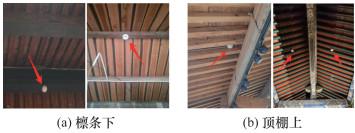
硬山顶是明清时期典型双坡屋顶结构形式之一,梁、檩、柱和椽等都是其基本组成构件。通过对故宫内多个硬山顶建筑的现场调研发现,现有感烟探测器主要布置在正脊下方的檩条(见图 1a)或两侧的顶棚上(见图 1b),但其安装位置是否科学尚不明确。
图 1 屋顶探测器安装位置
本文选取明清古建筑中广泛存在的硬山顶建筑作为研究对象,该建筑的长为16.0 m,宽为11.1 m,屋身高度为3.6 m,屋顶高度为2.8 m,屋顶坡度投影长度为5.4 m,由此可得屋顶坡度θ为27.41°,通过3D设计软件SketchUp构建精细化三维物理模型,随后导入Pyrosim软件中进行优化处理,其模型结构如图 2所示。通过该模型实现火源位置及檩高对探测器响应特性综合影响的可视化。
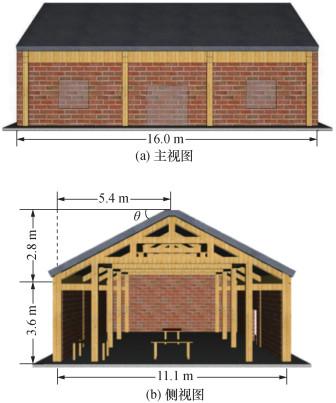
图 2 硬山顶建筑模型结构

1.2 火灾场景及工况条件

由于古建筑内部木质可燃构件较多,火灾荷载值较高,因此模拟火源选用非稳态t2型增长火来描述火灾发展的全过程,具体见式(1)。假设热释放速率Q为240 kW,将火源达到最大热释放速率的时间t设置为100 s,之后热释放速率将不随时间发生变化,总模拟时长设为200 s。
$Q=\alpha t^2 .$
其中α为火灾发展系数,kW/s2
由于热烟气在建筑内部的流动路径与建筑自身结构、火源位置、通风情况等均密切相关,因此模拟中环境风速设为0 m/s,门开启,窗户关闭,室内无喷淋设施、无机械排烟装置。为了探究檩高对感烟探测器响应特性的影响,共设置了3种火源位置,分别为中心、边缘和墙角,如图 3所示; 将檩高划分为低(10、20 cm)、中(30、40 cm)、高(50、60 cm)3个等级区间。利用3种火源位置和6种檩高组成18种工况开展模拟,以便全面分析不同火源位置、不同檩高条件下的烟气蔓延路径与探测器响应特性。
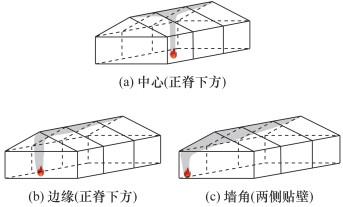
图 3 火源位置分布

1.3 切片及测点设置

为了便于观察烟气蔓延情况,首先基于3种火源位置的中心处,分别沿水平和垂直方向设置碳烟质量分数切片(见图 4a),同时由于木材燃烧速度较快且产烟量大,因此在模型中设置了点型光电感烟探测器以定量监测烟雾颗粒浓度的变化,选择Heskestad启动模型进行计算[20],单位特征长度为1.8 m,感烟探测器响应阈值设为3.28 %obs/m。根据《火灾自动报警系统设计规范》(GB50116—2013)[21],当梁突出顶棚的高度超过600 mm时,被梁隔断的每个梁间区域应至少设置一只探测器。考虑到梁架结构的遮挡作用,分东、西、中3个区域沿斜屋面均匀布置测点。由图 4a可知,在水平x方向上同一梁区间内每列测点间隔均为1.0 m,在垂直y方向上每行测点间隔为0.9 m。A列测点的横坐标为2.6 m,将A1—A11测点沿x轴依次向右平移得到BCXYZDEF列测点。编号为奇数项的测点在顶棚处,编号为偶数项的测点在檩条处,从而形成9只× 11只的探测器阵列。随着檩高的增加,在檩下布置的探测器保持x坐标和y坐标不变,z坐标依次向下移动相应的高度,而顶棚处的探测器位置始终保持不变(见图 4b)。为了更加清晰地展示探测器在竖直z方向上的位置随檩高变化的规律,以Y列测点为例,分别对低、中、高檩工况下探测器的高度位置逐一进行说明,如图 4c所示。
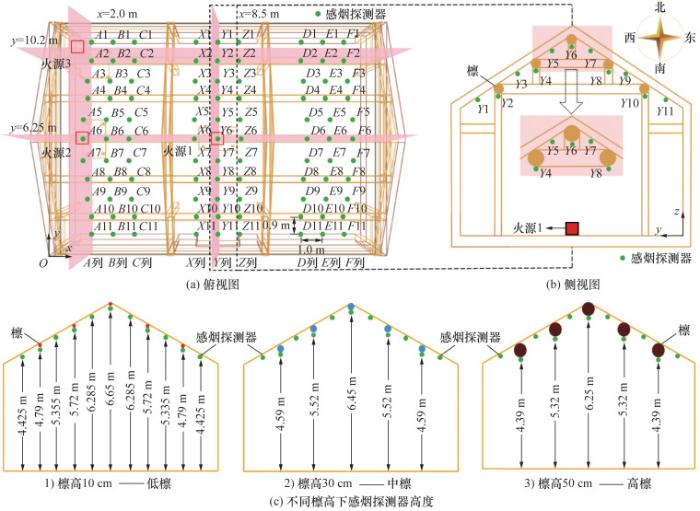
图 4 切片及测点布置图

1.4 网格划分及独立性验证

网格尺寸的设置决定着数值模拟的时间和精确度。在模拟计算前,首先对所建立模型的网格进行了划分,并采用经验公式(见式(2))对网格尺寸进行独立性验证。FDS用户手册中指出,当火源特征直径D*与计算网格尺寸Gx的比值在4~16之间时,模拟运算结果较精确[22],计算结果见表 1
$D^*=\left(\frac{Q}{T_0 C_P \rho_0 \sqrt{g}}\right)^{\frac{2}{5}} .$
表 1 网格独立性验证
D* 模拟区域(长×宽×高)/m Gx(长×宽×高)/m $\frac{D^*}{G_x}$ 验证结果
0.578 17×12.6×7.2 0.1×0.1×0.1 5.78 满足要求
其中:Q为240 kW; 环境温度T0为25 ℃; 定压比热容CP为1.006 9 kJ/(kg·K); 空气密度ρ0为1.004 kg/m3; 重力加速度g为9.80 m/s2

2 模拟结果分析

2.1 中心火模拟结果

2.1.1 烟气传播路径分析

当火源位于正脊中心(见图 3a)时,通过三维可视化软件Smokeview查看烟气蔓延的结果。可以发现,不同檩高下的烟气蔓延具有共性规律,蔓延路径均为:起火点—正脊—水平运动到山墙—反方向水平运动—逐渐下沉形成烟气层。以檩高30 cm场景为例,从3个角度(正视、侧视、俯视)分别选取25 s、50 s、75 s、100 s共4个特征时刻的烟气质量分数云图进行展示,其烟气蔓延情况如图 5所示。由图 5a可知,烟气首先从起火点竖直上升,到达屋顶受到阻碍后,发生顶棚射流,向四周流动,在抵达山墙后发生反浮力壁面射流,沿反方向继续水平回流; 伴随着燃烧的持续进行烟气层不断向下沉降,且同一高度位置处远火端烟气层沉降速率更快; 此外受到梁的影响,烟气在梁架附近受到阻碍更容易向下聚集沉降,使得烟浓度相对较高。由于烟气在沿正脊处浮力B方向与烟气流动速度u方向垂直(见图 5a),而沿斜屋顶向下处所受浮力B的分力B1与烟气流动速度u方向相反(见图 5b),导致烟气沿倾斜屋面垂直蔓延的速率小于沿长轴水平蔓延的速率[23]。俯视分布如图 5c所示,沿长轴方向,屋脊下方和东西两侧山墙处烟气浓度较高。
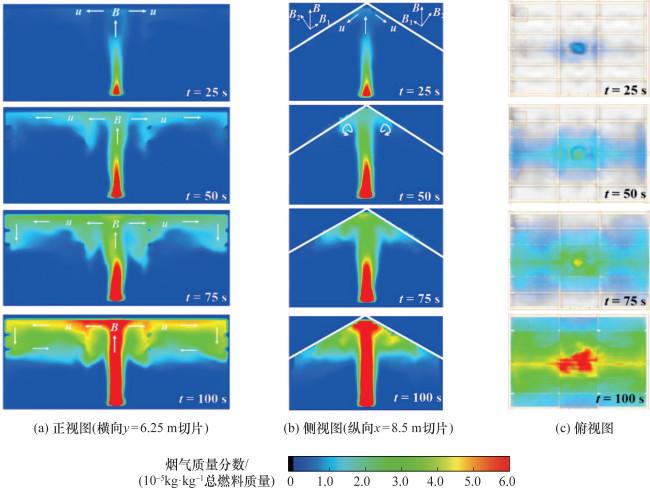
图 5 中心火烟气蔓延情况

2.1.2 感烟探测器响应情况

当火源位于正中心位置(见图 3a)时,重点对中部梁区间内不同檩高影响下每列探测器的响应时间进行了对比分析,结果如图 6所示。由图可知:1) 正脊两侧呈对称分布的2只探测器的响应时间十分接近,在靠近火源区域内,檩高20与30 cm的探测器响应时间曲线几乎重合,檩高40与50 cm的探测器响应时间曲线几乎重合; 2) 随着檩高的增加,正脊下方的X6和Z6探测器响应时间逐渐延长,当檩高增至40 cm时,X6探测器响应开始时间晚于布置在两侧顶棚上方的X5和X7探测器,同理Z6探测器响应时间也晚于Z5和Z7探测器,说明此时檩高对烟气蔓延已经产生了一定的阻挡作用; 3) 沿斜屋顶向下,靠近南北墙面的探测器整体响应时间最晚,这是因为此处的探测器高度最低,距离火源最远。
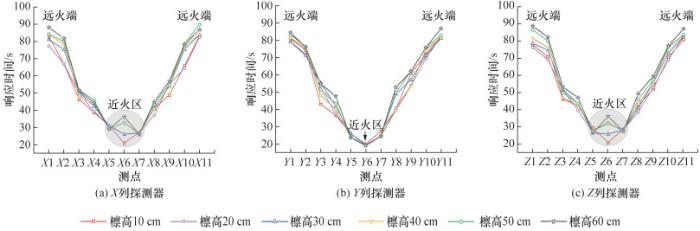
图 6 中部梁区间不同檩高下各列探测器响应时间

2.2 边缘火模拟结果

2.2.1 烟气传播路径分析

当火源位于正脊下方靠近边墙位置(见图 3b)时,与中心火相似,在不同檩高影响下的烟气传播路径基本一致。同样以檩高30 cm场景为例,从3个角度(正视、侧视、俯视)分别选取25 s、50 s、75 s、100 s共4个特征时刻的烟气质量分数云图进行展示,烟气蔓延情况如图 7所示。由图可知,热烟气首先从着火点紧贴墙面垂直上升,到达顶棚后先沿正脊方向水平蔓延(见图 7a)。当t=50 s时可以看出在两侧垂脊处产生涡旋(见图 7b),这种卷吸现象会损耗烟气的一部分能量,从而减缓烟气沿斜屋顶向下坡方向的蔓延速率和范围[24]。同一时间内,烟气沿正脊方向水平向右的蔓延速率大于沿斜屋顶向下的蔓延速率,因此导致在烟气蔓延俯视图中沿正脊呈现为等腰三角形的结构(见图 7c)。
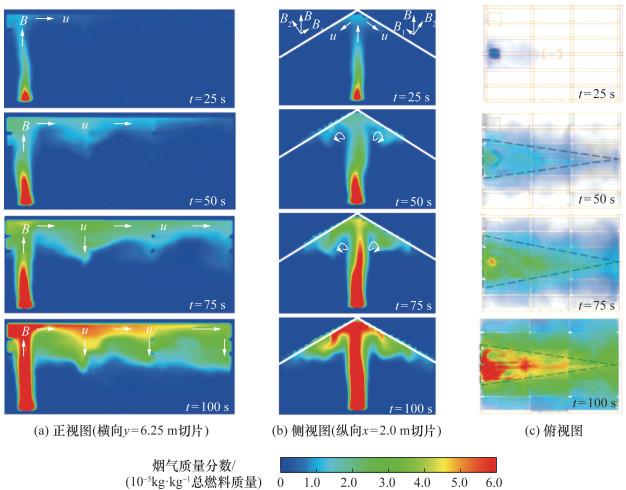
图 7 边缘火烟气蔓延情况

2.2.2 感烟探测器响应情况

当火源位于西部边缘靠近墙壁(见图 3b)时,重点对火源所在梁区间不同檩高影响下每列探测器的响应时间进行了对比分析,如图 8所示。由图可知:1) 边缘火与中心火相似(火源均位于正脊下方),在靠近火源区域内,檩高20与30 cm的响应时间曲线几乎重合,檩高40与50 cm的响应时间曲线几乎重合; 2) 檩高超过30 cm时,位于顶棚两侧的A5和A7、B5和B7、C5和C7探测器响应提前,均早于正脊下方的A6、B6、C6探测器,最大时差可达25 s; 3) 随着檩高的增加,远火端的探测器响应时间依次递增,火源所在梁区间内远火端探测器整体响应最晚,因檩高影响的探测器响应最大时间差约为30 s。由此可得,当火源位于正脊下方时,烟气沿屋脊长轴传播的路径越长,在南北两侧远火端的探测器受到檩高影响的程度越大,进一步说明在设计火灾探测器时需考虑建筑结构、烟气流动规律等因素,以提高不同火灾情况下的响应速率。
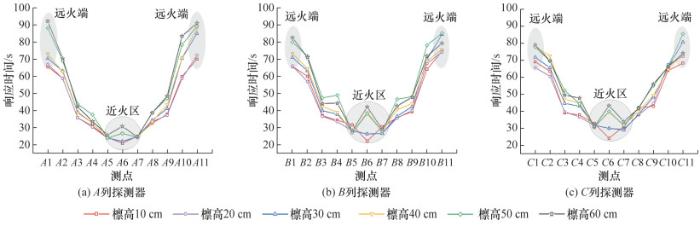
图 8 西部梁区间不同檩高下各列探测器响应时间

2.3 墙角火模拟结果

2.3.1 烟气传播路径分析

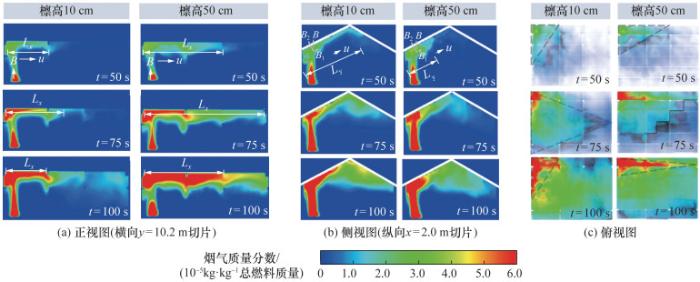
当火源位于西北部靠近墙角位置(见图 3c)时,主要以低檩高10 cm和高檩高50 cm这2个场景作对比,从3个角度(正视、侧视、俯视)分别选取50 s、75 s、100 s共3个特征时刻的烟气质量分数云图进行展示,烟气蔓延情况如图 9所示。
图 9 墙角火烟气蔓延情况
由图可知,同一时刻,沿水平方向,檩高50 cm的烟气水平扩展长度Lx约为檩高10 cm的2倍(见图 9a); 当t=50 s时,沿垂直方向,檩高10 cm的烟气扩展长度Ly约为檩高50 cm的2倍(见图 9b)。从图 9a图 9b对比可见,低檩高时,烟气沿檩条方向水平蔓延的速率小于沿斜屋顶向上坡方向的垂直蔓延速率,由于此时竖直向上的浮力B沿倾斜顶棚方向的分力B1与烟气蔓延速度u方向一致,进一步加速了烟气的流动,导致烟气沿斜屋顶扩展速率变大[25]; 高檩高时,烟气沿斜屋顶向上坡方向的蔓延受到檩的阻挡,因此小于沿檩条方向水平蔓延的速率,从而导致烟气沿水平方向扩展速率变大。由烟气蔓延俯视图(见图 9c)可以看出,当t=75 s时,低檩高场景下,烟气沿上坡方向到达屋脊下方后,会先沿正脊水平向右蔓延; 而高檩高场景下,烟气跨越檩条沿倾斜顶棚蔓延的过程中,呈现出“阶梯”状的传播路径。

2.3.2 感烟探测器响应情况

当火源位于西北部靠近墙角位置(见图 3c)时,由于梁的遮挡和分隔,将探测器响应时间划分为东、西、中3个区域进行对比分析,不同檩高影响下每列探测器的响应结果如图 10所示。由图可知:1) 整体上,檩高10与20 cm探测器响应时间曲线几乎重合,檩高30与40 cm探测器响应时间曲线几乎重合,檩高50与60 cm探测器响应时间曲线几乎重合; 2) 在火源所在梁区间内(见图 10a10c),探测器的响应时间由北至南呈逐步上升趋势,并随着距火源距离的增加而不断延长,檩高越大,挡烟作用越明显,探测器响应时间越长[26],在远火端因檩高影响的探测器响应时间差最高可达45 s; 3) 随着时间的推移,中部为过渡梁区间,可以发现檩高为10与20 cm的探测器响应时间曲线斜率相比前者有所减缓(见图 10d10f),并且在东部梁区间探测器响应时间逐渐呈现出关于正脊中心对称的趋势(见图 10g10i),此时位于正脊处的D6、E6、F6探测器依然可以在60 s内做出响应,这是因为较低的檩高对烟气的阻碍作用较小,当烟羽流撞击顶棚后,沿倾斜顶棚向上坡方向蔓延的速率较快,抵达屋脊后会先沿水平方向蔓延,致使在远火梁区间位于正脊下方的探测器可以快速做出响应。
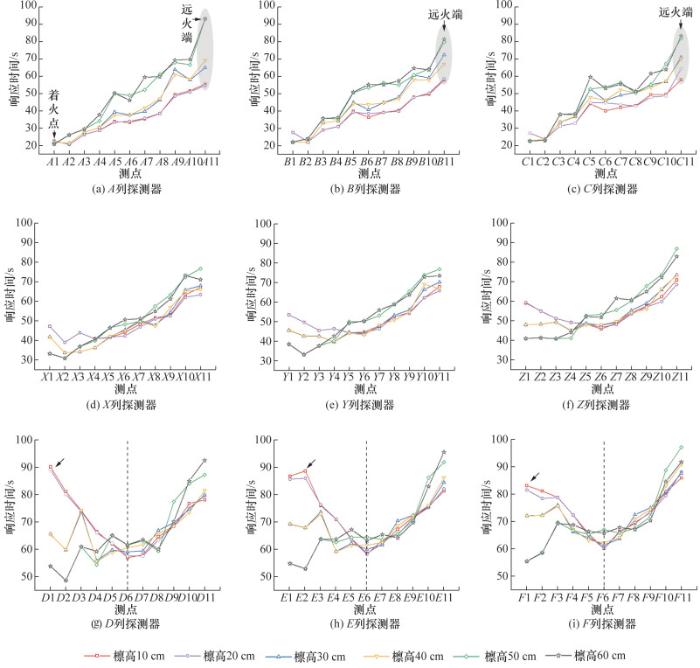
图 10 东、西、中3个梁区间不同檩高下各列探测器响应时间

3 结论

本文以明清时期典型硬山顶建筑为例,通过研究不同火源位置和檩高组合下烟气蔓延情况以及感烟探测器响应时序规律,所得如下结论:
1) 烟气传播路径变化规律:在中心火和边缘火场景下,烟气主要沿正脊方向蔓延,且水平蔓延速率较快,檩高的变化对烟气传播路径影响较小,只是在一定程度上减缓烟气的蔓延速率。而在墙角火场景下,檩高对烟气蔓延的影响更为显著,低檩时,烟气倾向于沿斜屋顶向上蔓延; 檩高较高时,烟气沿檩条则呈现“阶梯”状传播路径。
2) 感烟探测器响应时序规律:对于中心火和边缘火,由于火源均位于正脊下方,当檩高不超过30 cm时,正脊处的探测器最先响应; 当檩高超过30 cm后,烟气沿南北垂直方向的蔓延受到阻碍,致使烟气更易在顶棚蓄积,最先响应的是正脊两侧顶棚处的探测器,因檩高影响的远火端探测器响应时间差约为30 s。而对于墙角火,当檩高不超过20 cm时,正脊处的探测器均可在60 s之内做出响应; 当檩高超过20 cm后,探测器响应时间由北至南逐渐延长,在远火端因檩高影响的探测器响应时间差最高可达45 s。
3) 探测器安装位置建议:综合考虑火源位置和檩高对火灾烟气蔓延路径以及探测器响应时间的影响,建议檩高小于30 cm时,在正脊中心处安装感烟探测器; 檩高大于30 cm时,在靠近正脊中心两侧的顶棚处布置探测器。针对梁区间面积较大的情况,可考虑适当在正脊两端增设探测器,以提高明清时期“有檩式”古建筑火灾早期探测报警的全面性和及时性。
1
WU Y F , CHEN S , WANG D Z , et al. Fire risk assessment of heritage villages: A case study on Chengkan village in China[J]. Fire, 2023, 6 (2): 47.

DOI

2
吴儒鸿, 田琼, 郭华, 等. 基于知识图谱的古建筑防火研究热点与发展趋势分析[J]. 湖北工程学院学报, 2023, 43 (6): 123- 128.

DOI

WU R H , TIAN Q , GUO H , et al. Analysis of hot spots and development trends of ancient building fire prevention research based on knowledge map[J]. Journal of Hubei Engineering University, 2023, 43 (6): 123- 128.

DOI

3
翟羽佳. 教育建筑遗产的消防与可持续保护利用研究——以河南大学近代建筑群为例[D]. 河南: 河南大学, 2022.

ZHAI Y J. Research on fire protection and sustainable conservation and utilization of educational architectural heritage—The example of modern building complex of Henan University[D]. Henan: Henan University, 2022. (in Chinese)

4
ZANG X W , LIU W , WU D L , et al. Contemporary fire safety engineering in timber structures: Challenges and solutions[J]. Fire, 2023, 7 (1): 2.

DOI

5
VORWERK P , KELLETER J , MÜLLER S , et al. Classification in early fire detection using multi-sensor nodes—a transfer learning approach[J]. Sensors, 2024, 24 (5): 1428.

DOI

6
LI Y, DU H J, WANG B, et al. Research on very early warning aspirating smoke detector deployed in massive guan style buildings from Ming and Qing dynasties in the palace museum[C]//Proceedings of the 5th International Conference on Building Energy and Environment. Singapore: Springer, 2023: 1553-1566.

7
SUN B , ZHANG W S , WANG W , et al. Study on the image processing methods for a flame exposed to an incense smoke environment[J]. Fire, 2023, 6 (7): 270.

DOI

8
LIN Q J , ZHANG F Z , JIANG W L , et al. Environmental monitoring of ancient buildings based on a wireless sensor network[J]. Sensors, 2018, 18 (12): 4234.

9
PALMA P , STEIGER R . Structural health monitoring of timber structures-review of available methods and case studies[J]. Construction and Building Materials, 2020, 248, 118528.

10
DAI H , SHI P Z , LIU H B , et al. Electrical fire monitoring IoT framework for ancient architectural complex leveraging edge computing[J]. International Journal of Communication Systems, 2022, 35 (17): e5329.

DOI

11
WANG Z M , PENG J N , LIU X Z , et al. Research on grid based fire warning algorithm with YOLOv5s for palace buildings[J]. Emergency Management Science and Technology, 2024, 4, e008.

12
GAO S Y , HUANG G Z , CHEN X L , et al. Two-stage deep learning-based video image recognition of early fires in heritage buildings[J]. Engineering Applications of Artificial Intelligence, 2024, 129, 107598.

DOI

13
王茹, 李朴杰, 王亚康, 等. 明清古建筑群火灾智能监测技术研究[J]. 湖南大学学报(自然科学版), 2023, 50 (7): 169- 177.

WANG R , LI P J , WANG Y K , et al. Research on intelligent fire monitoring technology of historic buildings in Ming and Qing dynasties[J]. Journal of Hunan University (Natural Sciences), 2023, 50 (7): 169- 177.

14
刘慧, 李亭, 钟晨. 基于BIM及仿真技术的古建筑火灾防控技术研究[J]. 消防科学与技术, 2023, 42 (9): 1228- 1232.

DOI

LIU H , LI T , ZHONG C . Research on ancient building fire prevention and control technology based on BIM and simulation technology[J]. Fire Science and Technology, 2023, 42 (9): 1228- 1232.

DOI

15
KHAN A A , ZHANG T H , HUANG X Y , et al. Machine learning driven smart fire safety design of false ceiling and emergency response[J]. Process Safety and Environmental Protection, 2023, 177, 1294- 1306.

DOI

16
LIU C X , LIU S T , HUANG P , et al. Experimental study on the temperature distribution of impingement flow in a double slope roof generated by jet fire[J]. Journal of Building Engineering, 2024, 82, 108247.

DOI

17
CLEARY T , TAYLOR G . Evaluation of empirical evidence against zone models for smoke detector activation prediction[J]. Fire Technology, 2023, 59 (6): 3129- 3156.

DOI

18
ZIGAR D N , BLAGOJEVIĆ M D , PEŠIĆ D J , et al. Smoke detector placement in compartments with honeycomb ceiling: A numerical study[J]. Thermal Science, 2023, 27 (3): 2489- 2500.

19
CHEN N , ZHANG T W , MEI Z B . Experimental study on the response characteristics of photoelectric smoke detectors below grid ceilings of different hollowing rate[J]. Procedia Engineering, 2012, 45, 602- 609.

DOI

20
YAN X , GERNAY T . Numerical modeling of localized fire exposures on structures using FDS-FEM and simple models[J]. Engineering Structures, 2021, 246, 112997.

DOI

21
中华人民共和国公安部. 火灾自动报警系统设计规范: GB 50116—2013[S]. 北京: 中国计划出版社, 2014.

Ministry of Public Security of the People's Republic of China. Code for design of automatic fire alarm system: GB 50116—2013[S]. Beijing: China Planning Press, 2014. (in Chinese)

22
刘瑾洲, 都海江, 王波, 等. 基于FDS软件的故宫博物院养心殿后殿火灾数值模拟研究[J]. 工业建筑, 2023, 53 (6): 171- 180.

LIU J Z , DU H J , WANG B , et al. Research on numerical simulation of fire in the back hall of Yangxin Hall of the Palace Museum based on FDS[J]. Industrial Construction, 2023, 53 (6): 171- 180.

23
CICIONE A , WALLS R S . Towards a simplified fire dynamic simulator model to analyse fire spread between multiple informal settlement dwellings based on full-scale experiments[J]. Fire and Materials, 2021, 45 (6): 720- 736.

DOI

24
HUANG P , LIU S T , LIU C X , et al. Flame extension lengths beneath a double slope roof induced by gaseous fuel jet flame[J]. Fuel, 2023, 350, 128891.

DOI

25
ZHANG X L , HU L H , DELICHATSIOS M A , et al. Experimental study and analysis on flame lengths induced by wall-attached fire impinging upon an inclined ceiling[J]. Proceedings of the Combustion Institute, 2019, 37 (3): 3879- 3887.

DOI

26
杨一帆. 砖木结构古建筑火灾风险分析与数值模拟研究——以庙宇类建筑为例[D]. 西安: 西安建筑科技大学, 2023.

YANG Y F. Fire risk analysis and numerical simulation of ancient buildings with Brick and Wood Structure—taking temple buildings as an example[D]. Xi'an: Xi'an University of Architecture and Technology, 2023. (in Chinese)

Outlines

/