People Evacuation and Risk Assessment

Experimental study of the influence of proactive avoidance and emergency degree on bidirectional pedestrian flow

  • Zheng ZHOU 1, 2 ,
  • Yanchao YE 1, 2 ,
  • Huiling JIANG 1, 3 ,
  • Yuansheng WANG 4 ,
  • Longhai YE 5 ,
  • Guozhong HUANG 1, 2, 3 ,
  • Qing DENG , 1, 2, *
Expand
  • 1. Research Institute of Macro-Safety Science, University of Science and Technology Beijing, Beijing, 100083, China
  • 2. School of Civil and Resource Engineering, University of Science and Technology Beijing, Beijing 100083, China
  • 3. Technical Support Center for Prevention and Control of Disastrous Accidents in Metal Smelting, University of Science and Technology Beijing, Beijing 100083, China
  • 4. North China University of Water Resources and Electric Power, Zhengzhou, 450045
  • 5. Anyang Institute of Technology, Anyang, 455099

Received date: 2024-10-24

  Online published: 2025-03-27

Copyright

All rights reserved. Unauthorized reproduction is prohibited.

Abstract

Objective: With the increase in emergency incidents, research on pedestrian dynamics has received widespread attention. Bidirectional pedestrian flow has been identified as a major factor in numerous global disasters over the past few decades. Conflicts can arise between individuals moving in opposite directions. Additionally, under different emergency conditions, evacuation behavior can vary significantly. This study primarily examines the impact of proactive avoidance and urgency on bidirectional pedestrian flow. Methods: Experiments were conducted by establishing an outdoor experimental setup and recruiting participants. A controlled variable method was used to design 17 experimental trials to investigate the movement of bidirectional pedestrian flow under different levels of urgency and the presence of proactive avoidance behavior. Variations in urgency and proactive avoidance were implemented through a monetary reward and penalty mechanism. Pixel coordinates were first recorded using the Tracker software and then converted into real-world coordinates using direct linear transformation. The analysis focused on the evacuation speed, evacuation time, movement trajectories of the evacuees, maximum offset during the evacuation process, and behavior exhibited throughout the evacuation. Moreover, variance analysis was conducted to assess the stability of the experimental conditions and the validity of the experiments. Finally, a questionnaire was administered to collect some basic parameters of the participants, such as height, weight, and age. Furthermore, information on whether the participants experienced feelings of anxiety during the experiment and their perspectives on whether the provision of additional rewards influenced their sense of urgency was obtained. Results: Common phenomena observed during the evacuation process included overtaking, following, and side-by-side behavior. An innovative behavior termed boundary flow acceleration was identified, where individuals moving against the flow exhibited significantly higher walking speeds when adhering to the wall compared with those not using the wall for support. Notably, groups of individuals moving against the flow spontaneously formed lanes when faced with a larger number of pedestrians moving in the opposite direction, which enhanced their ability to navigate through the crowd. In emergencies, the evacuation speed of individuals with disabilities was slower than that of normal pedestrians. Therefore, individuals with disabilities need more attention during emergencies. In nonemergency situations, the average evacuation speed of individuals moving against the flow was 1.26 m/s, which increased to 1.49 m/s when proactive avoidance behavior was present. In emergencies, the average speed of individuals moving against the flow increased to 2.04 m/s. When no individuals were moving against the flow, the evacuation speed was 1.77 m/s in nonemergency situations and 3.50 m/s in emergencies. The questionnaire results indicated that approximately 82.9% of the participants experienced anxiety during the evacuation process, and 91.4% of the participants believed that providing additional rewards could enhance the urgency of the experiment. This finding validated the effectiveness of the monetary reward mechanism in simulating emergency conditions. Conclusions: The results indicated that proactive avoidance behavior effectively reduced pedestrian conflicts. Moreover, the behavior improved the evacuation efficiency of individuals moving against the flow by 24.60% and increased the evacuation speed by 19.87%. Furthermore, the phenomenon of stratification became more pronounced with the introduction of proactive avoidance behavior. Compared with nonemergency situations, the evacuation speed of the larger crowd significantly increased compared with that of the smaller crowd during emergencies. These findings can provide valuable insights for managing bidirectional pedestrian flow in emergencies and offer relevant support for modeling research in this area.

Cite this article

Zheng ZHOU , Yanchao YE , Huiling JIANG , Yuansheng WANG , Longhai YE , Guozhong HUANG , Qing DENG . Experimental study of the influence of proactive avoidance and emergency degree on bidirectional pedestrian flow[J]. Journal of Tsinghua University(Science and Technology), 2025 , 65(4) : 750 -758 . DOI: 10.16511/j.cnki.qhdxxb.2024.27.052

近年来,由于突发事件(例如火灾事故)的增多,行人动力学的研究受到了广泛的关注。双向行人流是众多行人运动中的一种典型场景,指的是两群来自对立方向的人在一个有限区域内相遇的情况,在许多研究中也被称为逆行[1-3]。在日常生活中经常可以看到双向行人流的现象,例如拥挤地铁站的上下车过程,商场或超市的走廊,人行天桥或地下通道等[4-5]。也存在一些特殊的双向行人流场景,例如在人群紧急疏散过程中,由于人对所处环境不熟悉造成的心理恐慌,使得行人所选的疏散路径与正确的疏散路径相反,特别是在地铁场所的长通道内;行人为了寻找自己的同伴或拾取丢失的物品而返回事故现场从而造成逆行场景;发生紧急情况时,需要疏散救援人员或引导人员前往现场,从而与正向疏散人员造成逆行场景[6]。上述特殊的双向行人流场景中的人流均为不对称人流,且双方的目标互相冲突。
双向行人流已被确认为20世纪80年代初以来全球多起拥挤踩踏灾难的主要诱因[7]。例如2014年12月31日中国上海外滩踩踏事件发生初期,仍有市民、游客逆行涌上观景平台,上下人流不断对冲后,在阶梯中间形成僵持,延误了事件处置的黄金时间,造成了较为严重的人员伤亡[8];2015年9月24日,约200万人在沙特阿拉伯麦加参加活动,由于人群拥挤导致人流逆行,发生冲撞,引发踩踏[9]。因此,研究双向行人流的相关机理对人员密集场所和突发事件下的行人疏散具有重要意义。
针对双向行人流实验研究,董方姝[10]通过室内可控实验的方法研究了携带行李对双向流通道中行人的速度、密度和流量等的影响。杨潘云[11]基于通道中双向行人流的实验,着重研究了不同规模群组在通道中运动时的典型现象、构型、速度、偏向角度等运动特征。Fu等[12]通过实验研究了存在残疾人的双向行人流,发现帮助行为对提升存在残疾人的人群移动效率有积极影响。Jin等[13]提出了一种修正的社会力模型,基于4个大规模实验采集的视频数据,验证了该模型的有效性和鲁棒性,并能很好地描述双向运动。Kretz等[1]在2 m的走廊内对67名被试进行了不同人流比例的双向行人疏散,研究了不同人流比例下的疏散时间、步行速度、流量等相关特性。Heliovaara等[14]研究了走廊内行人的出口选择行为,发现了非合作行为可能会减少整体的疏散时间。上述双向人流实验研究一般只涉及非紧急情况,很少考虑紧急情况。
为了研究不同紧急度对人群疏散的影响,国内外众多学者进行了相关实验,采用多种方法来创建或模拟不同的紧急情境。Helbing等[15]在2001年的疏散实验中就使用声学信号来模拟紧急情况。后续有更多的研究者通过播放连续响亮的警报声来增加紧迫感,使疏散情景更加接近现实[16-18]。此外,利用金钱激励的方法来模拟紧急情况更为普遍,且模拟效果也使得实验更加真实[18-22]
行人避让行为的研究主要包括对固定障碍物和移动障碍物的避让[23-24]。Yamamoto等[25]研究了行人在避让过程中的身体旋转行为,提出身体旋转有助于提高狭窄走廊的通行效率。Cheng等[26]开展了行人对固定障碍物的避让实验,分析行人行为的微观特征,为行人避让固定障碍物的行为提供实验依据。Wu等[27]发现地铁走廊上多数行人越过障碍物后会回到原来路径。霍非舟等[28]建立了考虑主动避让弱势群体行为的元胞自动机模型,得出了避让行为可以使疏散更加流畅。在避让相关的实验研究中,大多未考虑主动避让行为对双向行人流的影响,而考虑主动避让行为的研究也是在相关模型的基础上进行改进,很少基于真实实验进行比较分析。
因此,本文开展了关于主动避让行为和不同紧急度条件下的双向行人流实验,可为主动避让行为和紧急度对疏散效果的影响提供实证数据,并进一步了解行人在紧急条件下的行为规律,为特殊场景下的人群管理提供参考。

1 实验及分析方法

1.1 实验场地及人员设置

实验于2024年在中国北京科技大学进行。公开招募了35人参加实验,其中男性15名,女性20名;参与实验人员(以下称为志愿者)的年龄在18~30岁; 身高在155~183 cm,平均值为168.54 cm,标准偏差为8.64 cm;肩宽为34~48 cm,平均值为39.11 cm,标准偏差为3.89 cm。需要说明的是,为了模拟情景的丰富性,令其中3位志愿者分别拄拐杖,坐轮椅和推轮椅,其余人员正常行走。各志愿者的身高和肩宽情况具体如图 1所示。所有志愿者均被告知了实验目的和方案,并同意参加实验。
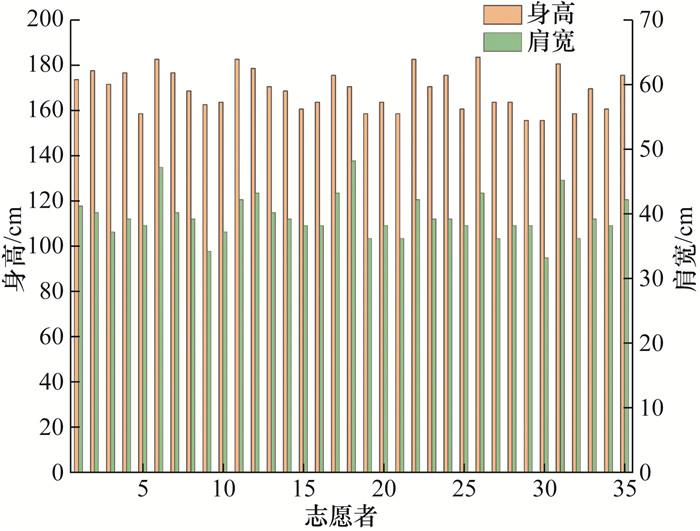
图 1 志愿者的身高和肩宽信息
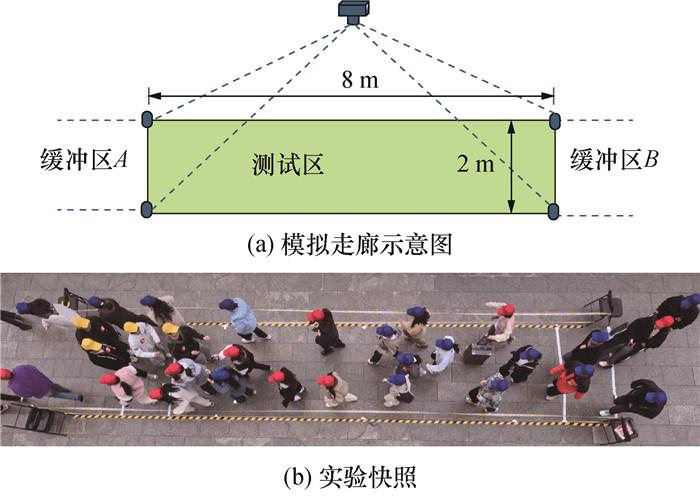
实验在室外进行,参考Helbing等[15]的实验场景布置方式,利用椅子和警戒线规划出一片固定的行走区域用以模拟走廊。如图 2a所示,走廊宽为2 m,长为8 m;在本实验场景中存在2个缓冲区,缓冲区A的志愿者从左向右移动,代表正向疏散人员,需要疏散到缓冲区B。缓冲区B的志愿者则向相反方向移动,代表本研究中的逆行者,例如消防员或其他应急处置人员等。如图 2b所示,实验过程中,志愿者胸前均贴有带编号的贴纸,且头戴不同颜色(红色、黄色和蓝色)的安全帽,以便提取数据时予以识别。
图 2 疏散实验示意图和过程图
实验的控制变量包括紧急度水平和是否存在主动避让行为,在每种工况实验开始前,由实验助手告知志愿者具体的变量选取情况。

1.2 实验过程

本研究共设计了17种实验工况。基础组的1-6号工况(作为基础组)中,通过改变B区的人数(0~5人),观察在不同行人流比例下的双向疏散特性与行为模式;7-11号工况中,设置A区行人需主动躲避B区行人,以评估避让行为对双向行人流的影响;12-17号工况探讨了紧急情况下不同人流比例对双向行人流疏散的影响。具体设置如表 1所示,其中若区域A中的行人主动避让区域B中的行人,用1表示;若不避让,则用0表示。是紧急情况用1表示,否则用0表示。基于此,通过设计相应标识代表不同实验工况,例如Param-30-1-1-0表示A区行人为30人,B区行人为1人,A区行人主动避让B区行人,实验为非紧急情况下进行。
表 1 实验工况
序号 A区人数 B区人数 A区行人是否主动避让B区行人 是否紧急 工况标识
1 30 0 否(0) 否(0) Param-30-0-0-0
2 30 1 否(0) 否(0) Param-30-1-0-0
3 30 2 否(0) 否(0) Param-30-2-0-0
4 30 3 否(0) 否(0) Param-30-3-0-0
5 30 4 否(0) 否(0) Param-30-4-0-0
6 30 5 否(0) 否(0) Param-30-5-0-0
7 30 1 是(1) 否(0) Param-30-1-1-0
8 30 2 是(1) 否(0) Param-30-2-1-0
9 30 3 是(1) 否(0) Param-30-3-1-0
10 30 4 是(1) 否(0) Param-30-4-1-0
11 30 5 是(1) 否(0) Param-30-5-1-0
12 30 0 否(0) 是(1) Param-30-0-0-1
13 30 1 否(0) 是(1) Param-30-1-0-1
14 30 2 否(0) 是(1) Param-30-2-0-1
15 30 3 否(0) 是(1) Param-30-3-0-1
16 30 4 否(0) 是(1) Param-30-4-0-1
17 30 5 否(0) 是(1) Param-30-5-0-1
实验前,各参与人员分布在相应缓冲区(见图 2a)中,工作人员哨响即发出疏散指令,随后A区志愿者开始疏散,直至所有志愿者均已转移到B区。实验过程中如果AB区的行人同时开始疏散,则在A区行人和B区行人相遇之前,双向人流几乎是互不影响的。因此为了深入探讨相向人流对彼此的影响,在另一名实验助手的协助下,设定B区志愿者的疏散起始时间比A区晚5 s,如此设置旨在延长人员间的相互作用时间,并增大双向行人流间的相互影响,直至所有B区志愿者均成功疏散到A区,实验结束。在包含主动避让行为的实验中,向A区行人明确指出,B区的行人是救援人员,需要对其进行主动避让。在模拟紧急情况的实验中,建立了一套奖励机制,最先到达对面缓冲区的前20%行人将获得金钱奖励[21]。而在避让实验中,在实验结束时,对有主动避让行为的行人给予额外的奖励,或扣除没有避让行为的行人的奖励。通过统计检验,即方差分析(analysis of variance,ANOVA),研究了在与正向疏散人员相遇前的最前方的疏散人员的疏散速度以及后方疏散人员的疏散速度,得到了较高的方差分析F值(F=0.11)和p值(p=0.74>0.05),验证了人流的稳定性和实验场景的稳定性。

1.3 数据采集

于实验场地上空8 m处安装一台30 fps的高清摄像机,根据志愿者胸前带编号的贴纸,从视频中观察获取每个志愿者实验结束的时间。通过跟踪每个志愿者的运动将其轨迹半自动地提取出来,同时使用追踪器软件Tracker以像素坐标进行记录[29]

2 结果分析

着重分析不同个体的运动轨迹、双向行人流运动过程中的疏散行为、不同情境下的疏散时间和疏散速度,为特殊场景疏散管理和应急方案设计提供科学支持。

2.1 运动轨迹

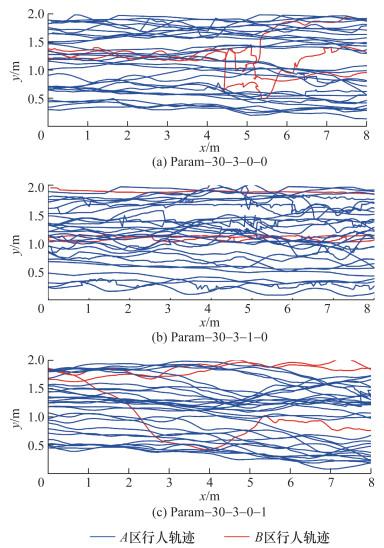
为了削弱不同数量逆行人员对双向行人疏散的影响,选取逆行人员数量为3的场景,以没有主动避让且非紧急的工况(Param-30-3-0-0)作为参考,对比只有主动避让(Param-30-3-1-0)和只有紧急(Param-30-3-0-1)的工况。工况4、9和15的行人运动轨迹如图 3所示,其中红色的线为B区逆行人员的运动轨迹(初始位置在右),蓝色线条为A区行人的运动轨迹。由图可知,即使双方数量存在较大差距,紧急情况和非紧急工况下均有自组织现象出现,即出现了分层现象。由图 3a可知,初始阶段3个逆行人员为并排行走,但经过一段时间后行人自发形成一列,可说明逆行人群在面对较多与自己运动方向相反的行人时,会自发形成“车道”,从而增加自己的通行能力。通过对比图 3a3b3c,可以看出在主动避让行为存在的情况下,行人的运动轨迹会更加平滑。
图 3 行人在不同工况下的运动轨迹
为了定量分析行人在疏散实验过程中的避让行为,选取最大偏转距离doffset进行分析。doffset的计算如式(1)所示。
$d_{\text {offset }}=y_{\max }-y_{\min } .$
其中:ymaxymin分别表示行人在走廊内y坐标的最大值和最小值。工况Param-30-3-0-0、Param-30-3-1-0和Param-30-3-0-1中双方行人的平均doffset图 4所示。通过对比可以发现,在工况Param-30-3-0-0和Param-30-3-0-1中,A区行人的平均doffset要小于B区行人的平均doffset,造成这一现象的原因可能是B区行人在面对比自己数量更多的A区行人时,更容易选择避让策略,从而造成偏转距离的增大。对比3组工况在B区的情况可以看出,工况Param-30-3-1-0的行人平均doffset在0.1~0.2 m,比其他2种工况下的小,这主要是A区行人主动避让的结果。
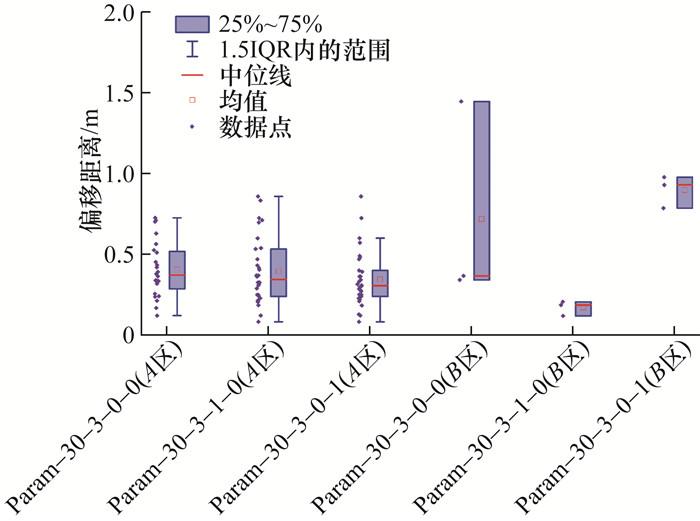
图 4 不同方向的行人在不同工况下的偏移距离

2.2 双向流中的典型行为

分析疏散过程中双向行人流的行为模式,有助于设计出更为高效的疏散路线和策略,从而提高整体疏散效率,这对于在紧急情况下的救援工作尤为重要。通过分析双向流中的典型行为,明晰各行为的优缺点及其可能产生的内在机理,有助于进一步揭示行人在疏散过程中的决策模式和行为特点。

2.2.1 “超车”行为
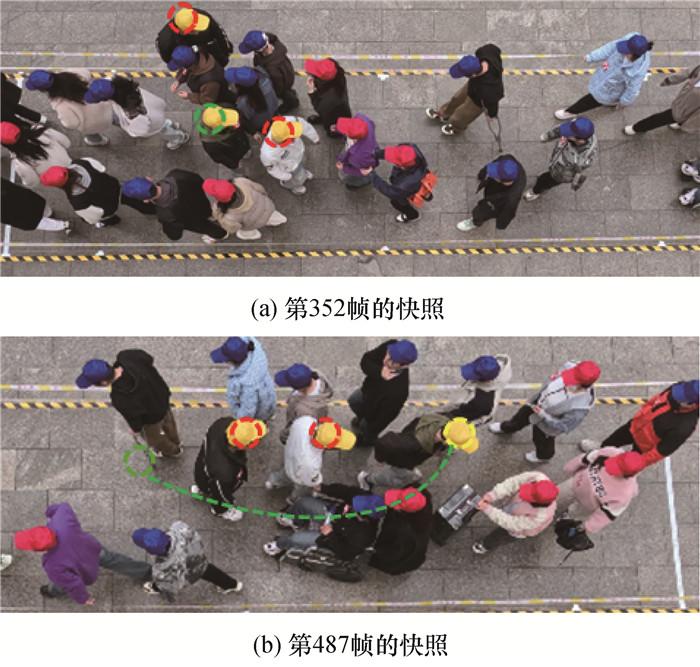
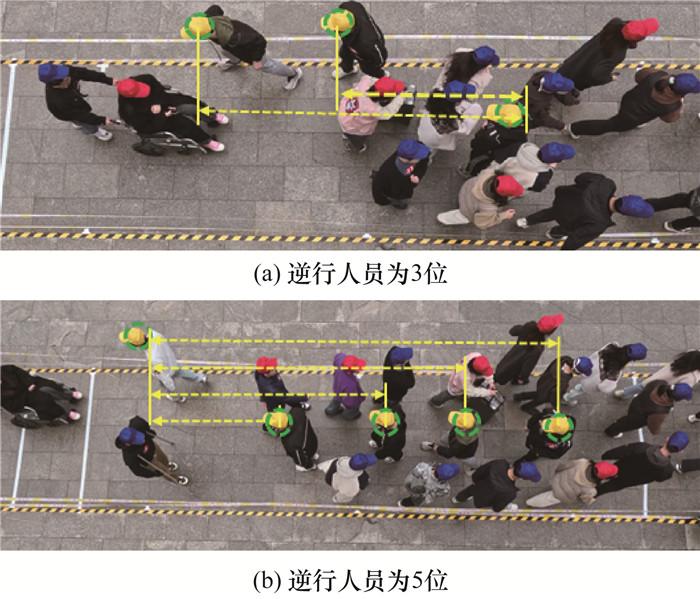
疏散过程中的“超车”行为通常涉及行人在拥挤或密集环境中试图绕过移动速度较慢的其他行人,以维护或恢复自己的行走速度[30]。如图 5所示,在双向疏散过程中发现了“超车”行为。“超车”行为可以提高个体行人的行进效率,尤其是对于急于到达目的地的行人;在一定程度上,通过合理的“超车”,可以减少局部区域的拥堵,但也可能会增加行人流中的混乱和不确定性,可能导致行进速度降低,甚至碰撞事故;“超车”行为还可能会引起行人间的冲突。
图 5 “超车”行为

2.2.2 跟随与并排行为

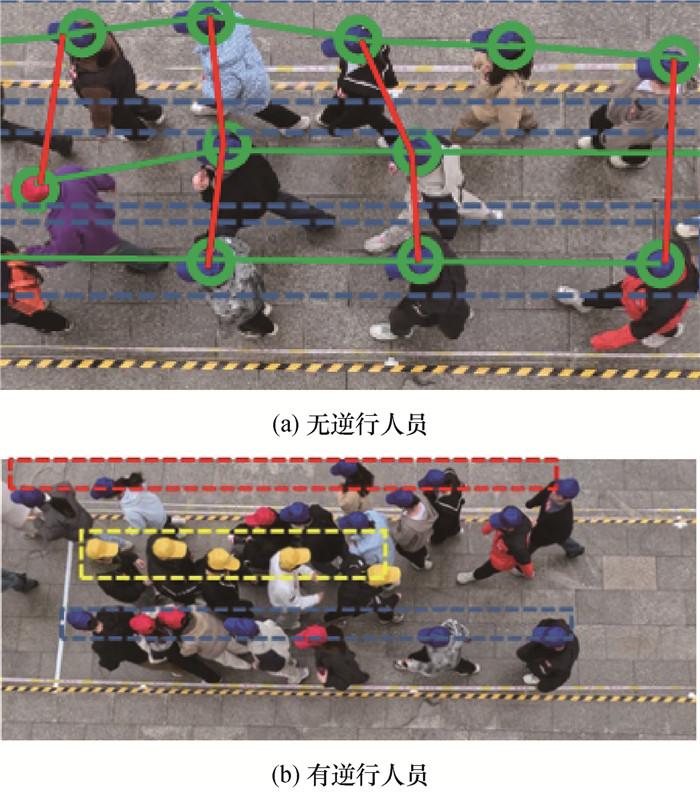
图 6a6b分别是不存在与存在逆行人员情况下的行人疏散快照,可以看出明显的跟随行为。由图 6a中的红线可以看出,在不存在逆行人员时,行人同时会出现并排行为,并且通常为2~3人一组。对比图 6a6b可知,并排行为在遇到逆行行人后由于避让行为而消失,但跟随行为会较大程度地保持,后方的行人会效仿前面行人的行为从而避免更多的冲突,在某种程度上对提高疏散效果起到了积极效果。但如果在能见度较低情况下,由于前方行人的错误选择,伴随着跟随效应,可能会造成更多行人的错误选择。
图 6 跟随与并排行为

2.2.3 边界流动加速行为

在存在逆行人员的疏散过程中,无论是否紧急的情况下,都发现了如图 7所示的现象,即B区个别行人靠墙行走速度明显超过非靠墙行走的B区行人,可以将这种现象命名为边界流动加速行为。造成此现象的原因可能是:1) 靠墙行走的行人因墙壁的存在而受到空间上的限制,这导致他们的路径选择更趋向于直线,从而提高行走速度;2) 靠边走可能给人一种安全感,这在心理上促使行人保持较快的步伐。总之,该现象是一个多因素共同作用的结果,涉及空间动态、心理感知和行为策略。在考虑行人流动和疏散模型时,认识到这一效应的存在是很重要的。
图 7 边界流动加速行为

2.3 平均疏散时间

行人平均疏散时间如图 8所示,由图可知,区域A的平均疏散时间用红色表示,区域B的平均疏散时间用蓝色表示。比较区域A中有无主动避让行为的志愿者的疏散时间,发现存在主动避让行为会导致平均疏散时间略有增加。这一增加可以理解为区域A的行人为避开区域B的行人而延迟的时间。此外,存在避让行为会显著减少区域B的行人的时间。结合实验视频还可知,主动避让行为的存在极大地减少了行人碰撞,从而有效缩短了行人疏散时间。由于区域A中行人的避让行为,区域B行人的疏散效率(以疏散时间的变化率衡量)平均提高了11.75%,而区域A行人的效率降低了5.84%。
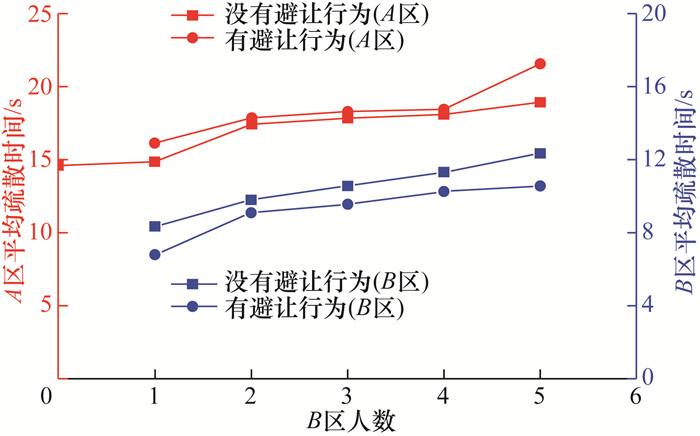
图 8 有无避让行为条件下行人的疏散时间
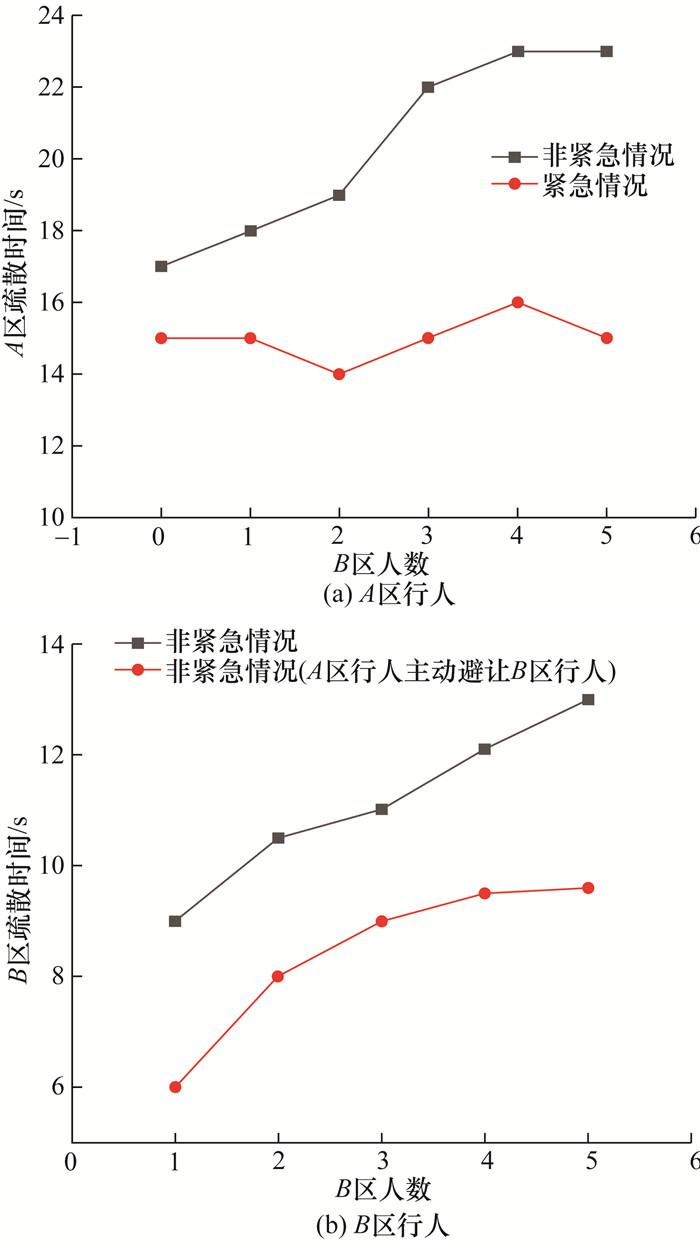
A区行人在紧急和非紧急情况下,随着B区疏散人数变化而产生的疏散时间如图 9a所示,由图可知,在非紧急情况下随着逆行人数的增加,正向疏散人群的疏散时间也增加,而紧急情况下随着逆行人数的增加正向疏散人群的时间并没有很大的变化。B区行人在主动避让和非紧急情况下的疏散时间如图 9b所示,由图可知,对比主动避让和非紧急情况下的B区疏散时间,主动避让下的疏散时间比非紧急情况下的少,这同时也验证了奖励机制的效果。随着B区人数的增加,B区的疏散时间也有一定程度的增加。
图 9 不同紧急情况下不同区域行人的疏散时间

2.4 疏散速度

疏散速度V是衡量志愿者疏散性能的重要因素,对于确定疏散时间是至关重要的。每个志愿者的V值可以使用式(2)来计算。
$V=L / \Delta T.$
其中:L代表移动距离,m;ΔT代表志愿者在相应距离上花费的时间,s。本文使用的时间间距为一帧,即$\frac{1}{30}$ s。
不同个体的V值如图 10所示,由图可知,在不存在逆行人员时,紧急情况下的V值整体比非紧急情况下的更快。紧急情况下的V值(拄拐杖、坐轮椅、推轮椅的3名志愿者的行为不参与此处计算)为3.50±0.70 m/s,非紧急情况下人员的V值为1.77±0.24 m/s,差异较为明显(p<0.05)。值得注意的是,后3位人员分别为拄拐杖、坐轮椅和推轮椅的情况,在紧急和非紧急情况下的V值相差不大,但比正常人缓慢很多,因此应多关注行动不便人士在突发紧急情况下的安全。
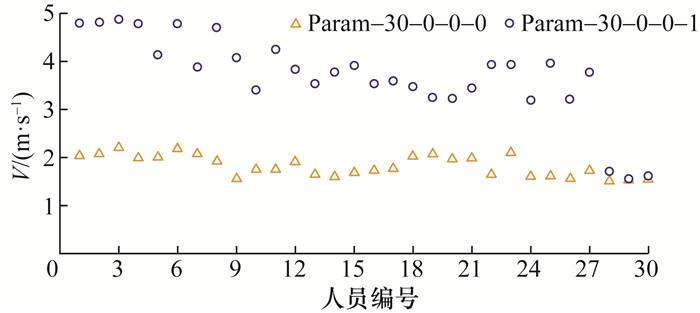
图 10 不同紧急情况下A区行人的疏散速度
不同紧急情况下A区人员的V值如图 10所示,在图 10中人员编号1-8、28、30为男性,编号9-27、29为女性,编号28拄拐杖,编号29和30分别坐轮椅和推轮椅,其余人员正常行走。由图可知,非紧急情况下的男性和女性的V值基本没有太大差异;但在紧急情况下编号1-8(男性)的V值比编号9-27 (女性) 的V值有明显上升,其中男性人员的平均V值为4.42±0.49 m/s,女性人员的平均V值为3.62±0.30 m/s,紧急情况下男性人员的V值差异比女性人员更大(p<0.05),男性人员的V值在紧急情况下比女性快21.79%。
不同工况下B区人员的V值随人数的变化如图 11所示,由图可知,在非紧急情况下,B区人员平均V值为1.26±0.09 m/s。在紧急情况下逆行人员的平均V值为2.04±0.13 m/s;在非紧急情况下,当A区的行人主动避让B区行人时,B区行人的V值为1.49±0.14 m/s。上述实验结果可以看出,避让行为下的V值与正常情况下疏散速度差异明显(p<0.05),紧急情况下人员疏散速度较非紧急情况下有较大差异(p<0.05),当主动避让存在时,B区行人的V值会提升18.25%。
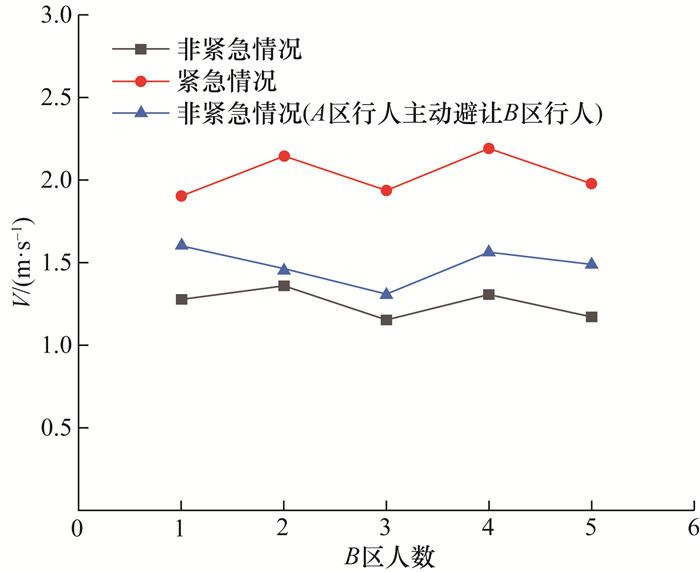
图 11 不同紧急情况下B区行人疏散速度

2.5 问卷分析

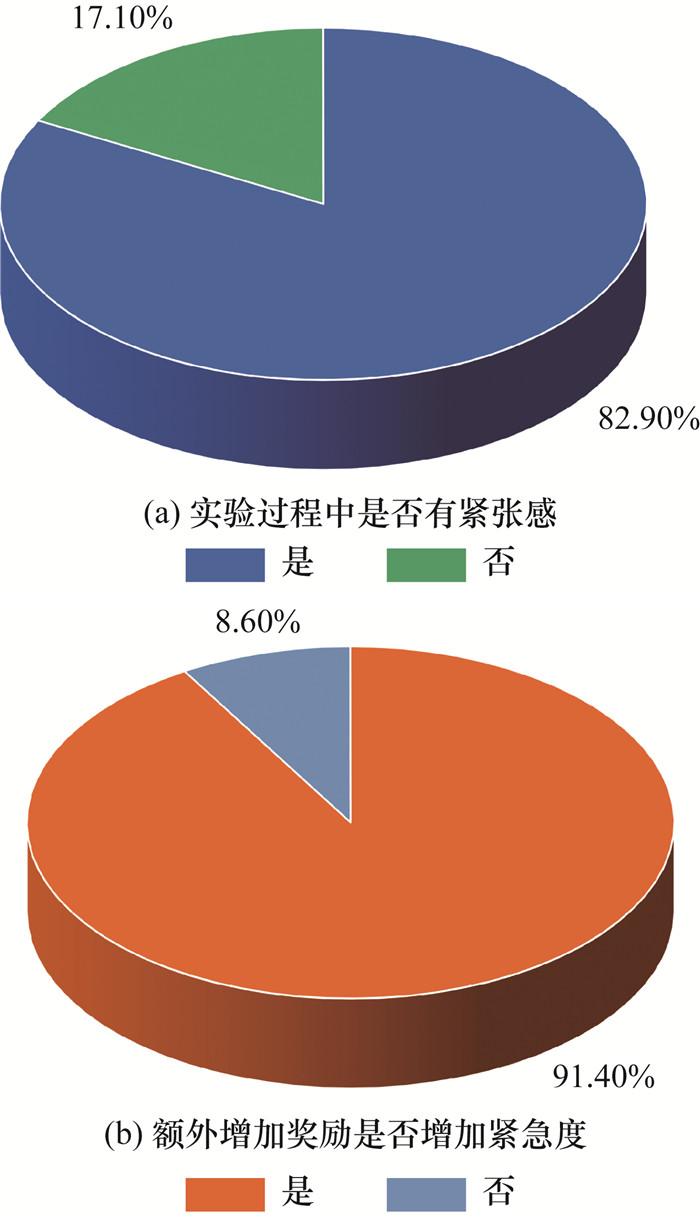
本实验中设计了一个基于额外金钱激励的方案来模拟紧急情况。在紧急情况下的疏散实验中,前20%的志愿者离开疏散区域即可获得额外的金钱奖励。完成整个实验的志愿者可以获得基本奖励,非紧急条件下的志愿者没有额外奖励。对志愿者在实验后所填问卷调查进行分析,结果如图 12所示,由图可知,82.90%的志愿者在疏散过程中会有紧张感,91.40%的志愿者认为通过额外增加奖励的方式可以增加实验的紧急度。因此,本次实验的金钱奖励机制对于给志愿者增加紧急程度起到了不错的效果。
图 12 问卷结果分析

3 结论

本文通过观测实验和数据分析,研究了主动避让行为和不同紧急度对双向行人流的影响。获得了疏散时间、运动速度和疏散行为的定性和定量数据并进行了分析。主要研究结果如下:
1) 人流比例很大的情况下也会出现分层现象。疏散过程中观察到一些典型的疏散行为,如并排行为、跟随行为、“超车”行为,“超车”行为在紧急情况下发生的更多。此外还发现了边界流动加速效应。
2) 主动避让行为可以有效减少行人冲突,存在主动避让行为下的逆行人员的疏散效率平均提升11.75%,疏散速度提升18.25%。与非紧急情况相比,紧急情况下人流量大的一方的疏散速度增加幅度比人流量小的一方大。
3) 通过问卷调查的结果可以看出,82.9%的实验参与人员会在疏散过程中感觉到紧张感,91.4% 的实验人员认为通过额外增加奖励的方式可以增加实验的紧急度。验证了额外金钱奖励机制对模拟紧急情况的有效性。
本实验也存在一些局限性,例如实验参与人数不多,且绝大多数为在校学生,需要在未来研究中作进一步完善。
1
KRETZ T , GRÜNEBOHM A , KAUFMAN M , et al. Experimental study of pedestrian counterflow in a corridor[J]. Journal of Statistical Mechanics: Theory and Experiment, 2006, 2006 (10): P10001.

DOI

2
YANG Z , ZHANG Y Y , GREMBEK O . Combining traffic efficiency and traffic safety in countermeasure selection to improve pedestrian safety at two-way stop controlled intersections[J]. Transportation Research Part A: Policy and Practice, 2016, 91, 286- 301.

DOI

3
ISOBE M , ADACHI T , NAGATANI T . Experiment and simulation of pedestrian counter flow[J]. Physica A: Statistical Mechanics and its Applications, 2004, 336 (3-4): 638- 650.

DOI

4
SERIANI S , FERNANDEZ R . Pedestrian traffic management of boarding and alighting in metro stations[J]. Transportation Research Part C: Emerging Technologies, 2015, 53, 76- 92.

5
YE R , LIAN L P , ZENG Y P . A quantitative analysis on bidirectional pedestrian flows through angled corridors[J]. Physica A: Statistical Mechanics and its Applications, 2024, 641, 129723.

6
CŁAPA I , CISEK M , TOFIŁO P , et al. Firefighters ascending and evacuation speeds during counter flow on staircase[J]. Safety Science, 2015, 78, 35- 40.

7
SHI X M , YE Z R , SHIWAKOTI N , et al. Empirical investigation on safety constraints of merging pedestrian crowd through macroscopic and microscopic analysis[J]. Accident Analysis & Prevention, 2016, 95, 405- 416.

8
邓青, 周郑, 邓立, 等. 存在逆行人员的疏散模型构建及稳定性分析[J]. 中国安全科学学报, 2023, 33 (9): 196- 203.

DENG Q , ZHOU Z , DENG L , et al. Construction and stability analysis of an evacuation model for contrary movement personnel[J]. China Safety Science Journal, 2023, 33 (9): 196- 203.

9
刘思施. 人群踩踏事故的触发及演化机理研究[D]. 武汉: 武汉理工大学, 2018.

LIU S H. Research on the trigger and evolution mechanism of crowd stampede[D]. Wuhan: Wuhan University of Technology, 2018. (in Chinese)

10
董方姝. 携带行李对地铁站双向流行人运动影响规律的实验研究[D]. 合肥: 中国科学技术大学, 2020.

DONG F S. A experimental study on the influence of carrying luggage to bidirectional pedestrian flows in subway station[D]. Hefei: University of Science and Technology of China, 2020. (in Chinese)

11
杨潘云. 考虑群组行为的双向行人流运动特性研究[D]. 福州: 福州大学, 2020.

YANG P Y. Study on group behavior in bidirectional flow[D]. Fuzhou: Fuzhou University, 2020. (in Chinese)

12
FU L B , LIU Y X , QIN H G , et al. An experimental study on bidirectional pedestrian flow involving individuals with simulated disabilities in a corridor[J]. Safety Science, 2022, 150, 105723.

DOI

13
JIN C J , SHI K D , JIANG R , et al. Simulation of bi-directional pedestrian flow under high densities using a modified social force model[J]. Chaos, Solitons & Fractals, 2023, 172, 113559.

14
HELIÖVAARA S , KUUSINEN J M , RINNE T , et al. Pedestrian behavior and exit selection in evacuation of a corridor: An experimental study[J]. Safety Science, 2012, 50 (2): 221- 227.

15
HELBING D , BUZNA L , JOHANSSON A , et al. Self-organized pedestrian crowd dynamics: Experiments, simulations, and design solutions[J]. Transportation Science, 2005, 39 (1): 1- 24.

16
HAGHANI M , SARVI M , SHAHHOSEINI Z . When 'push' does not come to 'shove': Revisiting 'faster is slower' in collective egress of human crowds[J]. Transportation Research Part A: Policy and Practice, 2019, 122, 51- 69.

17
DAAMEN W , HOOGENDOORN S P . Emergency door capacity: Influence of door width, population composition and stress level[J]. Fire Technology, 2012, 48 (1): 55- 71.

DOI

18
HAGHANI M , SARVI M , SHAHHOSEINI Z . Evacuation behaviour of crowds under high and low levels of urgency: Experiments of reaction time, exit choice and exit-choice adaptation[J]. Safety Science, 2020, 126, 104679.

19
XUE S Q , SHI X M , JIANG R , et al. Incentive-based experiments to characterize pedestrians' evacuation behaviors under limited visibility[J]. Safety Science, 2021, 133, 105013.

20
ZHANG P , YANG L Z , LO S , et al. Experimental study on evacuation behavior with guidance under high and low urgency conditions[J]. Safety Science, 2022, 154, 105865.

21
MUIR H C , BOTTOMLEY D M , MARRISON C . Effects of motivation and cabin configuration on emergency aircraft evacuation behavior and rates of egress[J]. The International Journal of Aviation Psychology, 1996, 6 (1): 57- 77.

22
HAGHANI M , SARVI M , SHAHHOSEINI Z , et al. Dynamics of social groups' decision-making in evacuations[J]. Transportation Research Part C: Emerging Technologies, 2019, 104, 135- 157.

23
LIU W S , ZHANG J , LI X D , et al. Avoidance behaviors of pedestrians in a virtual-reality-based experiment[J]. Physica A: Statistical Mechanics and its Applications, 2022, 590, 126758.

24
NI B C , LIN Z , LI P . Agent-based evacuation model incorporating life jacket retrieval and counterflow avoidance behavior for passenger ships[J]. Journal of Statistical Mechanics: Theory and Experiment, 2018, 2018 (12): 123405.

25
YAMAMOTO H , YANAGISAWA D , FELICIANI C , et al. Body-rotation behavior of pedestrians for collision avoidance in passing and cross flow[J]. Transportation Research Part B: Methodological, 2019, 122, 486- 510.

26
CHENG Z Y , YUE H , ZHANG N , et al. Research on mechanism and simulation for avoiding behavior of individual pedestrian[J]. Physica A: Statistical Mechanics and its Applications, 2024, 634, 129443.

27
吴娇蓉, 冯建栋, 陆苏刚. 通道行人超越行为研究[J]. 同济大学学报(自然科学版), 2012, 40 (2): 228- 234.

WU J R , FENG J D , LU S G . Research on pedestrians' overtaking behavior in passageway[J]. Journal of Tongji University (Natural Science), 2012, 40 (2): 228- 234.

28
霍非舟, 刘昶, 马亚萍, 等. 考虑主动避让行为的养老场所人员疏散研究[J]. 中国安全科学学报, 2022, 32 (1): 142- 148.

HUO F Z , LIU C , MA Y P , et al. Study on evacuation in elderly care places considering active avoidance behavior[J]. China Safety Science Journal, 2022, 32 (1): 142- 148.

29
BROWN D. Video modeling: Combining dynamic model simulations with traditional video analysis[C]// AAPT 2008 Summer Meeting. Edmonton, Canada: AAPT, 2008.

30
YUEN J K K , LEE E W M . The effect of overtaking behavior on unidirectional pedestrian flow[J]. Safety Science, 2012, 50 (8): 1704- 1714.

Outlines

/