Fire in Aircraft

Experimental and modeling study on the burning behavior and burning characteristics of aviation kerosene pool fire at sub-atmospheric pressure

  • Jie Hu 1 ,
  • Qingyuan ZHANG 1, 2 ,
  • Xiaotian WANG 3 ,
  • Jinlong ZHAO , 1, 2, * ,
  • Hong HUANG 4
Expand
  • 1. School of Emergency Management and Safety Engineering, China University of Mining and Technology (Beijing), Beijing 100083, China
  • 2. Civil Aircraft Fire Science and Safety Engineering Key Laboratory of Sichuan Province, Guanghan, 618307, China
  • 3. China Tianchen Engineering Corporation, Tianjin, 300232, China
  • 4. Institute of Public Safety Research, Tsinghua University, Beijing 100084, China

Received date: 2024-01-04

  Online published: 2025-03-27

Copyright

All rights reserved. Unauthorized reproduction is prohibited.

Abstract

Objective: In recent years, the development of the economy in plateau areas has resulted in the increase in the flights in plateau areas, resulting in a large demand for aviation kerosene. However, the occasional aviation kerosene pool fire that occurs in plateau areas poses a great threat to the safe storage of aviation kerosene. The burning behavior and the corresponding characteristics of liquid fuels, such as aviation kerosene, are different because of the influences of sub-atmospheric pressure and oxygen amount. Moreover, the available reports in the literature concerning sub-atmospheric pressure are mainly based on small-scale experiments, which are greatly affected by heat convection and heat conduction. Furthermore, the burning characteristics are far from the practical fire conditions in plateau areas, which are mainly controlled by heat radiation. Thus, the burning characteristics of liquid fuel pool fires at large scales remain unclear. This study aims to clarify the difference between the burning characteristics of aviation kerosene pool fire under sub-atmospheric pressure and that under atmospheric pressure as well as develop the corresponding prediction models under sub-atmospheric pressure. Methods: A series of pool fire experiments using aviation kerosene with different pool diameters under sub-atmospheric pressure (69 kPa) were carried out. The burning behavior during the whole burning process was analyzed. Moreover, the evolution of some important parameters (including mass burning rate, flame height, and radiative fraction) with the pool diameter were measured and analyzed in detail, and the corresponding prediction models were proposed. Results: The results showed that the burning rate of aviation kerosene under sub-atmospheric pressure was lower than that under atmospheric pressure for the same burning scale and that the ratio of the rate under sub-atmospheric pressure to that under atmospheric pressure was about 0.58. This result is primarily the result of the heat radiation and heat convection feedback between flame and fuel surface under sub-atmospheric pressure being lower than those under atmospheric pressure. Furthermore, a prediction model of the burning rate was proposed based on the heat feedback. The flame height under sub-atmospheric pressure was higher than that of the same burning scale under atmospheric pressure, primarily because the net oxygen content in the air under sub-atmospheric pressure was reduced and more air was required for fuel burning. In addition, based on the flame entrainment theory, a prediction model of the dimensionless flame height of aviation kerosene under sub-atmospheric pressure was obtained. The radiative fraction decreased slightly with the increase of pool diameter under sub-atmospheric pressure. And at the same burning scale, the radiative fraction under sub-atmospheric pressure was slightly lower than that under atmospheric pressure, primarily because of the reduction of soot particles generated during fuel burning under sub-atmospheric pressure. Subsequently, a prediction model of radiative fraction was developed by modifying the key parameters. Conclusions: The evolution of the burning characteristics of radiation-dominated aviation kerosene pool fires under sub-atmospheric pressure with pool diameter was found to be consistent with those under atmospheric pressure; however, the values of different burning characteristics changed substantially. The results enrich the large-scale aviation kerosene pool fire data under sub-atmospheric pressure and have practical significance for ensuring the use and storage safety of aviation kerosene in plateau areas.

Cite this article

Jie Hu , Qingyuan ZHANG , Xiaotian WANG , Jinlong ZHAO , Hong HUANG . Experimental and modeling study on the burning behavior and burning characteristics of aviation kerosene pool fire at sub-atmospheric pressure[J]. Journal of Tsinghua University(Science and Technology), 2025 , 65(4) : 786 -794 . DOI: 10.16511/j.cnki.qhdxxb.2024.27.021

全球许多城市包括一些国家的首都均建立在高原上,例如巴西首都巴西利亚就位于海拔1 100 m的巴西高原上[1]。近年来,随着高原经济的发展,高原地区的航班次数增加,航空煤油的需求量也随之增长。飞机在起飞和降落过程中可能发生事故导致油箱泄漏,如若泄露的航空煤油被引燃则会形成油池火灾,造成严重的人员伤亡及经济损失[2]。例如2018年,一架客机在加德满都特里布万国际机场(海拔约1 338 m)降落时急转弯冲出跑道,引发的火灾事故造成49人死亡。此外,高原地区的地理条件复杂,航空煤油在储运过程中易发生泄漏,引燃后引发火灾。高原低气压条件下,空气密度低,氧气净含量少,油品的燃烧行为与常压存在一定的不同[3]。因此,研究低气压下航空煤油的燃烧特性对于保障高原地区航空用油安全具有实际意义。
国内外学者围绕航空煤油的燃烧特性开展了一些研究,对于常压下的航空煤油池火,Babrauskas等[4]通过对池火传热分析,基于航空煤油等液体燃料的实验数据,建立了燃烧速率的经验公式$m^{\prime \prime}=m_{\infty}^{\prime \prime}(1-\exp (-k \beta D))$,其中m″为单位质量燃烧速率,g/(m2·s);$m_{\infty}^{\prime \prime}$为油池面积无穷大时的质量燃烧速率,g/(m2·s);k为消光系数;β为平均光程。在此基础上,Koseki[5]收集整理了其他文献中航空煤油等燃料油池火的实验数据,进一步得到m″在燃烧尺度(以油池直径D量化)为3~5 m时达到最大值,在更大直径的油池中则几乎保持不变。Yan等[6]D为30 cm的油池中开展了航空煤油池火实验,关注了稳态和瞬态条件下的燃烧速率,发现稳态燃烧速率的大小与瞬态的峰值保持一致且与Blinov的数据吻合[7]。庄磊[8]开展了不同油池直径(D为5~60 cm)下的航空煤油池火实验并测量了火焰高度Hf,发现HfD的增大而增加,随后引入了无量纲数Fc得到无量纲火焰高度的关系式为$H_{\mathrm{f}} / D \propto F_{\mathrm{c}}^{2 / 3}$,其中:$F_{\mathrm{c}}=\dot{m}^{\prime \prime} / \rho_{\mathrm{a}} \sqrt{g D}$ρa为空气密度,kg/m3g为重力加速度,m/s2。赵金龙等[9]开展了不同边长(30、40 cm)的矩形油池火薄层航空煤油实验,通过对比不同火焰模型发现模型预测值小于实际测量值,其中不均匀的卷吸是导致火焰偏高的原因。蒋新生等[10]开展了小燃烧尺度(D为40、50 cm)的航空煤油池火实验,测量了全过程的热通量变化,发现油池火燃烧过程中对外传热方式主要有辐射和对流2种,且辐射通量的变化与火焰高度变化趋势一致。Hiroshi等[11]开展了不同直径的油池火实验研究,并利用航空煤油等燃料的实验数据,发现辐射占比随D的增大而逐渐减少。随后,McGrattan等[12]基于航空煤油等不同燃料的油池火实验数据,结合固体粒子火焰模型,定量研究了辐射占比的变化,给出了辐射占比预测模型。余彬彬等[13]开展了航空煤油燃烧实验,研究了全氟己酮对航空煤油的抑制作用,发现随着全氟己酮浓度的增加,航空煤油火焰先缓慢增高再迅速降低,抑制作用逐渐增强。对于低气压下的航空煤油池火,刘全义等[14]在中国康定市(大气压P为62.8 kPa)开展了不同燃烧尺度(D为10~40 cm)的航空煤油油池火实验,重点关注了m″,发现低气压下油池火燃烧辐射占主导地位,m″随D的增大而增加。陈钦佩[15]分别在中国拉萨市(P为65 kPa) 和合肥市(P为100.8 kPa)开展了小燃烧尺度(D为15~18 cm)航空煤油池火实验,测量了准稳态阶段的m″,发现m″随P的降低而减小。Zhou等[16]在不同气压下开展了边长为60 cm的矩形航空煤油池火实验,发现低气压下火焰高度增加,并得到Hf与气压的关系式为Hf/D~(m″/P)2/5。周志辉等[17]在低压舱内(P为40~100 kPa)选用了4种燃烧尺度(D为4、6、8、10 cm)开展航空煤油池火实验,发现随着P的下降,辐射占比不断下降,并指出原因是低气压条件下火焰碳烟形成量的减少。由以上研究可知,环境中气压的变化会影响航空煤油的燃烧速率、火焰高度等关键燃烧特性参数。现阶段对于低气压条件下的油池火实验研究大多在低压舱内进行,低压舱内受气流影响可能导致热流反馈不稳定,进而影响实验结果的准确性。此外,低气压下的实地实验普遍使用受对流和传热影响较为明显的小直径油盘,关于大尺度池火的实验数据较少。因此,低气压条件下大尺度液体池火的燃烧规律仍需进一步研究。
本文在高原低气压条件下开展了一系列航空煤油池火实验,重点关注了低气压条件下的燃烧行为,分析了航空煤油燃烧的燃烧速率、火焰高度、辐射占比随直径和燃烧时间的变化规律,并根据热流反馈,火焰卷吸拟合得到关键参数的数理表征模型。

1 实验设计

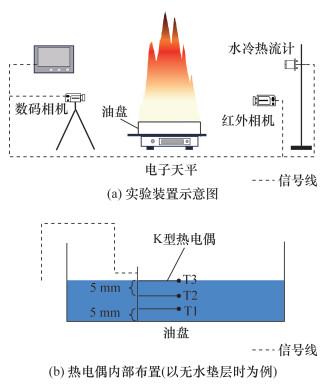
实验装置及热电偶的内部布置如图 1所示。本实验使用了圆形钢制油盘,D分别为20、40、60、80和100 cm,侧壁高度为10 cm,厚度为3 mm。采用Sartorius牌电子天平(量程为35 kg,精度为0.1 g)实时测量油盘中剩余油品的质量,进而确定实时燃烧速率;采用数码相机记录火焰形态,并用红外相机测量火焰温度,2台相机均置于距油盘中心3 m处;选用水冷热流计(型号为SBG-01,量程为0~50 kW/m2)测量火焰的辐射热流密度,布置在距离油盘中心5倍油池直径(5D)位置处。油盘中心轴上布置3根K型热电偶,由下至上编号为T1—T3。无水垫层时热电偶T3距离油盘底部为5 mm,含水垫层时热电偶T3距离油盘底部55 mm。
本实验使用的燃料为RP-3号航空煤油,纯度大于99.99%,其主要物性参数如表 1所示。
表 1 RP-3号航空煤油的物性参数
参数
密度/(kg·m-3) 795
闪点/℃ 60
沸点/℃ 130~300
燃烧热/(MJ·kg-1) 42
本实验在中国青海省某地的户外开展,当地的P为69 kPa。为了降低风速对实验结果的影响,在实验平台四周布置了防风网。实验过程中,油盘附近风速均小于0.5 m/s,对实验结果的影响可忽略不计。本实验共设计了20种工况,包含不同的初始油层厚度h0D,相关参数见表 2,每种工况重复实验3次。
表 2 实验工况
实验组编号 D/cm h0/mm 水垫层厚度/cm 实验组编号 D/cm h0/mm 水垫层厚度/cm
1 20 15 0 11 20 15 5
2 20 20 0 12 20 20 5
3 40 15 0 13 40 15 5
4 40 20 0 14 40 20 5
5 60 15 0 15 60 15 5
6 60 20 0 16 60 20 5
7 80 15 0 17 80 15 5
8 80 20 0 18 80 20 5
9 100 15 0 19 100 15 5
10 100 20 0 20 100 20 5

2 结果与讨论

2.1 燃烧行为

为了展示低气压下航空煤油池火的燃烧全过程,以D为100 cm的9号和19号实验组为例,给出了火焰形态和m″随燃烧时间的变化情况,结果如图 2所示。
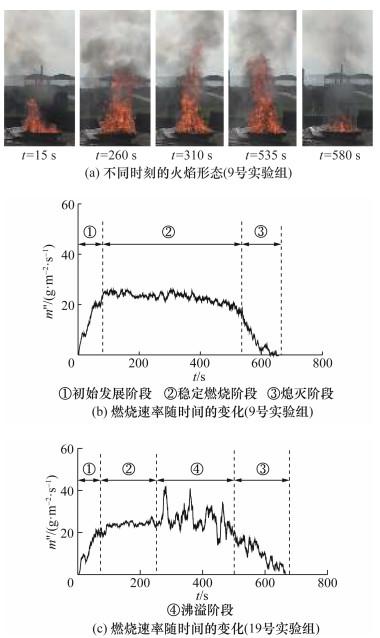
图 2 油池火燃烧过程参数变化
图 2a2b可知,不含水垫层的工况下,航空煤油被点燃后火焰会迅速蔓延至整个油品表面。燃烧刚开始时Hf低,但随着燃烧时间的增加,Hf迅速增加,m″也随之增大。随后,Hfm″整体保持稳定。最后,随着油品被消耗殆尽,m″迅速降低,火焰逐渐消失。结合火焰形态和m″的变化规律,航空煤油池火的整个燃烧过程可分为3个阶段:初始发展阶段、稳定燃烧阶段、熄灭阶段, 这与常压下池火的燃烧阶段划分一致[18]。由图 2c可知,含水垫层的航空煤油池火在稳定阶段持续一定时间后会发生沸溢喷溅,m″剧烈波动,定义该阶段为沸溢阶段,其余3个阶段的变化规律与不含水垫层的池火基本保持一致。
对比图 2b2c可观察到,含水垫层与不含水垫层的航空煤油池火在稳定阶段的m″几乎保持一致,且其他试验组也呈现出相同的规律,这表明水垫层对稳定阶段的m″影响较小,主要是由于在稳定阶段的航空煤油油层厚,油水界面处的传热对m″影响小。因此,后续关于m″的讨论中,仅考虑稳定燃烧阶段。
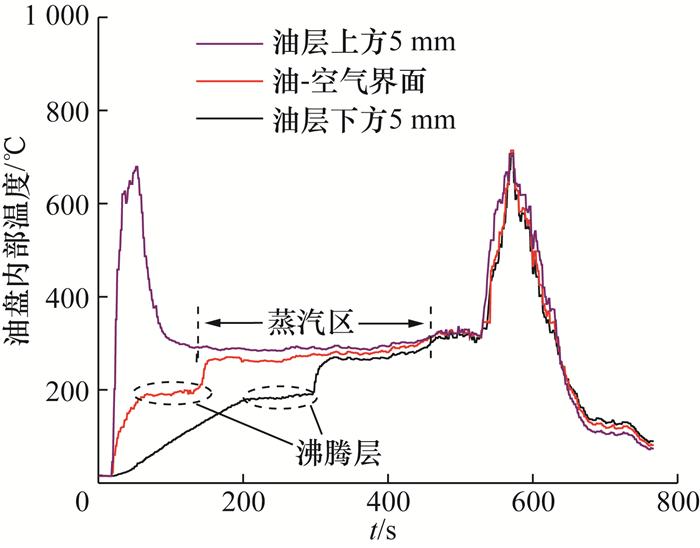
油品的燃烧过程与热量在油品内部的传递规律密切相关[18]。航空煤油燃烧全过程中,油盘内部不同位置的温度随燃烧时间的变化规律如图 3所示,由图可知,油盘内温度的变化可大致分为3阶段:先不断上升,随后保持相对稳定,最后急速上升再下降,这与燃烧阶段的划分对应。
图 3 油盘内部温度随燃烧时间的变化(9号实验组)
进一步分析温度变化产生的原因,以油品与空气分界面为例,在初始发展阶段,该处的油品温度迅速升高,这主要是因为Hf迅速增加,火焰辐射热反馈增大从而加热了油品。燃烧进行至65 s左右,温度达到航空煤油沸点,趋于稳定。这表明该处形成了一定厚度的沸腾层[19]。油层表面温度保持较长时间的稳定,投入燃烧的油品蒸汽的蒸发速率也保持稳定,因而Hfm″也保持基本稳定;燃烧进行至150 s左右时,温度迅速上升并稳定在295 ℃左右,这主要是因为随着油品消耗,该处进入具有一定厚度的蒸汽区;燃烧进行至530 s时,该处温度突然升高,达到700 ℃,随后迅速下降,这主要是因为油品消耗殆尽,火焰高度下降,该处的热电偶直接接触到火焰,随即火焰熄灭。对于油层上方5 mm处,油品从某一处点燃到火焰扩散至全表面时,接触到了油层上方的热电偶,该处温度迅速升高至约700 ℃;随后火焰高度迅速增加,待燃烧稳定后火焰底部与油品表面之间形成了一定厚度的蒸汽区,该处的温度又迅速降低并维持在油品蒸汽温度(295 ℃);燃烧300 s后,与初始位置在油层下方5 mm处的热点偶的温度变化规律保持一致。

2.2 燃烧速率

燃烧速率是油池火灾的重要特性参数,从火焰到燃料表面的热反馈决定池火的燃烧速率。在稳定燃烧阶段,燃料表面达到如下能量平衡[20]:
$q_{\mathrm{fs}}^{\prime \prime}=m^{\prime \prime} \Delta H_{\mathrm{g}}=q_{\mathrm{c}}^{\prime \prime}+q_{\mathrm{r}}^{\prime \prime} .$
其中:qfs″为燃料表面接收的热流密度,kW/m2;ΔHg为汽化热,kJ/kg;qc″为对流热流密度,kW/m2qr″为辐射热流密度,kW/m2。在该式中未考虑热传导热流密度,这主要是因为对于D>20 cm的油盘,热辐射和热对流占主导,热传导影响较小,可忽略不计[21]
Ditch对热传递进行测量时发现火焰与油层间的qc″可近似为常数[20]。对于热辐射,表面积为Af的火焰在单位时间内发出的辐射$\dot{Q}_{\mathrm{r}}$可表示为
$\dot{Q}_{\mathrm{r}}=A_{\mathrm{f}} \sigma\left(T_{\mathrm{rf}}^4-T_0^4\right)\left[1-\exp \left(-k l_{\mathrm{m}}\right)\right] .$
其中:σ为Stefan-Boltzmann常数;Trf为有效火焰辐射温度;T0为环境温度;lm为平均光束长度[22]
总热释放速率$\dot{Q}_{\mathrm{ch}}$可估计为
$\dot{Q}_{\mathrm{ch}}=\dot{q}^{\prime \prime \prime} A_{\mathrm{f}} \beta l_{\mathrm{m}} .$
其中$\dot{q}^{\prime \prime \prime}$为体积热释放速率,被证实为常数[23]
基于式(2)和(3),辐射占比Xr可被定义为
$\frac{X_{\mathrm{r}}}{X_{\mathrm{ch}}}=\frac{\dot{Q}_{\mathrm{r}}}{\dot{Q}_{\mathrm{ch}}}=\frac{k \sigma}{\dot{q}^{\prime \prime \prime} \beta}\left(T_{\mathrm{rf}}^4-T_0^4\right)\left[\frac{1-\exp \left(-k l_{\mathrm{m}}\right)}{k l_{\mathrm{m}}}\right].$
其中Xch为燃烧效率。
在光学薄的极限下,火焰辐射与(0.01+Ys)1/4成正比,其中Ys为产烟量,即烟雾质量与燃料质量之比[24]。因而,既保留光学薄极限的渐进行为,又通过公式(4)中的指数项保留非薄行为,则
$q_{\mathrm{r}}^{\prime \prime}=\alpha q_{\mathrm{r} 0}^{\prime \prime} Y_{\mathrm{s}}^{1 / 4}\left[1-\exp \left(-k l_{\mathrm{m}}\right)\right] .$
其中:α为辐射热通量损失因子,qr0″为常数。
基于热释放速率的经典公式,进一步得到
$\begin{gathered}\dot{Q}_{\mathrm{ch}}=S m^{\prime \prime} \Delta H_{\mathrm{ch}}=S\left(q_{\mathrm{c}}^{\prime \prime}+q_{\mathrm{r}}^{\prime \prime}\right) \frac{\Delta H_{\mathrm{ch}}}{\Delta H_{\mathrm{g}}}= \\\frac{X_{\mathrm{r}}}{X_{\mathrm{ch}}} \dot{Q}_{\mathrm{r}}=A_{\mathrm{f}} \frac{q_{\mathrm{r}}^{\prime \prime}}{\alpha} .\end{gathered}$
其中:S为油池面积;ΔHch=XchΔHc,ΔHc为燃烧热,kJ/kg。
大尺度油池火为辐射主控,$q_{\mathrm{c}}^{\prime \prime} \ll q_{\mathrm{r}}^{\prime \prime}$,又因为从式(4)可得$k \propto \frac{X_{\mathrm{r}}}{X_{\mathrm{ch}}}$,则
$k \propto \frac{X_{\mathrm{r}}}{X_{\mathrm{ch}}}=\frac{A_{\mathrm{f}}}{\alpha S} \frac{\Delta H_{\mathrm{g}}}{\Delta H_{\mathrm{ch}}} \propto \frac{\gamma}{\alpha} \frac{\Delta H_{\mathrm{g}}}{\Delta H_{\mathrm{ch}}} .$
其中γ为空气与燃料的化学计量质量比,本文中假设Af/Sγ成正比。
基于以上公式可将式(1)改写为
$q_{\mathrm{fs}}^{\prime \prime}=q_{\mathrm{c} 0}^{\prime \prime}+q_{\mathrm{r} 0}^{\prime \prime} Y_{\mathrm{s}}^{1 / 4}\left\{1-\exp \left[-\left(\frac{\Delta H_{\mathrm{g}} \gamma}{\Delta H_{\mathrm{ch}}}\right)^m\left(\frac{D}{D_0}\right)^n\right]\right\} .$
其中:qc0″,mnD0均为常数。
Ditch进一步分析发现mn的值几乎相同[20],假设m=n=d。同时对于大多数油品,γHchD0为定值,即γHchD0=C。则上式可简化为
$q_{\mathrm{fs}}^{\prime \prime}=q_{\mathrm{c} 0}^{\prime \prime}+q_{\mathrm{r} 0}^{\prime \prime} Y_{\mathrm{s}}^{1 / 4}\left\{1-\exp \left[-\left(C \Delta H_{\mathrm{g}} D\right)^d\right]\right\} .$
由此可得到燃烧速率的表达式为
$m^{\prime \prime}=\frac{q_{\mathrm{c} 0}^{\prime \prime}}{\Delta H_{\mathrm{g}}}+\frac{q_{\mathrm{r} 0}^{\prime \prime}}{\Delta H_{\mathrm{g}}} Y_{\mathrm{s}}^{1 / 4}\left\{1-\exp \left[-\left(C \Delta H_{\mathrm{g}} D\right)^d\right]\right\} .$
Ditch基于常压下的数据,给出了常压下的燃烧速率方程[20]
$m^{\prime \prime}=\frac{12.5}{\Delta H_{\mathrm{g}}}+\frac{68.3}{\Delta H_{\mathrm{g}}} Y_{\mathrm{s}}^{1 / 4}\left\{1-\exp \left[-\left(C \Delta H_{\mathrm{g}} D\right)^d\right]\right\} .$
低气压下m″随D的变化如图 4所示。由图可知,低气压下m″随D的增大而增加,且增加幅度随D的增大逐渐减小。低气压条件下,热对流和热辐射均受到影响,预测式(10)不适用于低气压。因此,基于式(9)及航空煤油特性参数(ΔHg=0.28 kJ/kg, Ys=0.12)对低气压条件下的油池火燃烧数据进行拟合,确定了相应的预测公式如下:
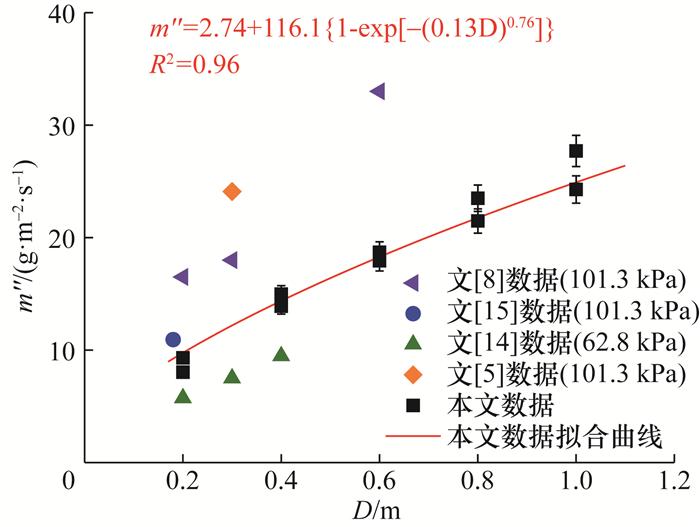
$m^{\prime \prime}=2.74+116.1\left\{1-\exp \left[-(0.13 D)^{0.76}\right]\right\} .$
图 4 燃烧速率随油盘直径的变化及其拟合曲线
其中:qc0″=9.8 kW/m2qr0″=56.1 kW/m2C=0.46 g/(m·kJ),d=0.76。
由图还可知,实验值与拟合曲线预测值相差较小(R2=0.96),可以较好地预测低气压(69 kPa)条件下航空煤油的m″。文[5, 8]为常压下的m″数据,低气压下的m″约为常压下的0.58,且预测公式中的qc0″和qr0″的值也更低,这主要是因为低气压条件下火焰对流反馈和辐射反馈均有所降低。对于火焰辐射反馈,低气压条件下的Hf高,火焰中心到油池表面的距离更远,角系数降低,油品表面接收的热流反馈降低;对于火焰对流反馈,相同卷吸强度下,低气压条件下反应区离油品表面更远[25]。文[14]中测得的低气压(62.8 kPa)下航空煤油的m″低于本文的实验值。这主要是因为其所用的气压比本实验的更低,火焰对流和辐射反馈的降低更明显。

2.3 稳定火焰高度
对于稳定阶段的Hf的处理,常用方法主要利用MATLAB软件编写相应的识别算法,将火焰图像转换为灰度图,进一步识别火焰轮廓,并根据比例尺换算得到实际的Hf[26-27]
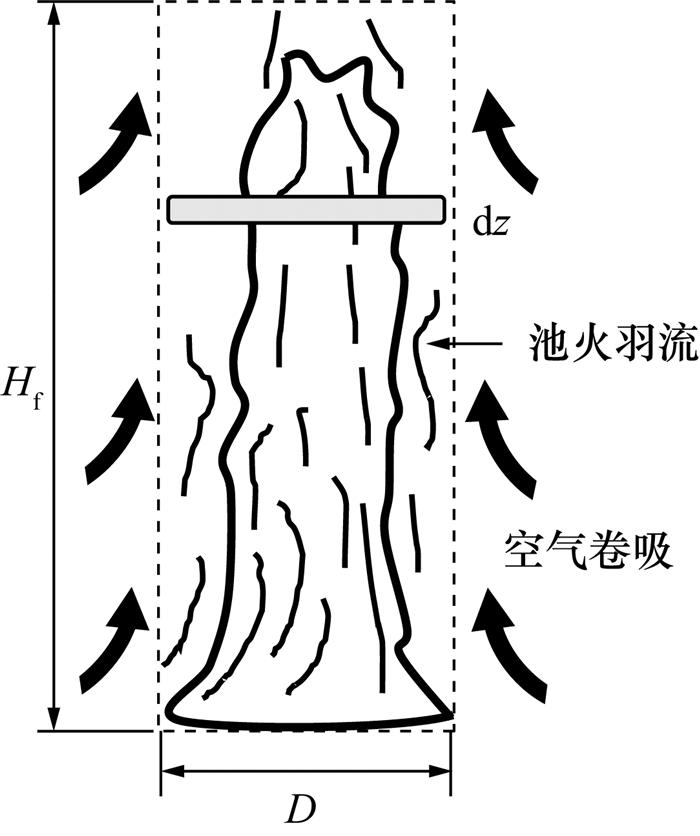
池火火焰的卷吸过程如图 5所示。本文参考常压条件下的火焰卷吸理论[8],对卷吸过程进行了一定的简化,具体如下:
图 5 池火火焰卷吸模型示意图
1) 火羽流由高度z=0处发出,羽流四周卷吸边界为圆柱,其直径为D,即油池直径;
2) 采用Boussinesq假设,认为空气密度ρa和热烟气密度ρ近似相等,仅在分析燃烧浮力时考虑密度差Δρ
$\Delta \rho=\rho_{\mathrm{a}}-\rho.$
3) 火羽流区域中的上升速度u
$u=u(z).$
其中u(0)=0。
4) 在任一高度z上的卷吸速率v
$v(z)=\eta u(z) .$
其中η为常数。
5) 在火焰顶部(z=Hf),认为燃料可燃蒸气和卷吸空气中的氧气燃烧完全。
$\gamma m_{\mathrm{f}}^{\prime \prime}=m_{\mathrm{a}}^{\prime \prime}\left(H_{\mathrm{f}}\right) .$
其中:mf″为质量燃烧速率,kg/s;ma″为空气卷吸速率,kg/s。
火羽流在z处的微元体dz为研究对象,其受到的浮力可表示为
$\mathrm{d} F=g\left(\rho_{\mathrm{a}}-\rho\right) \mathrm{d} z \cdot \pi r^2, $
$\frac{\mathrm{d} F}{\mathrm{~d} z}=g \Delta \rho \pi r^2 .$
其中:r为卷吸边界半径,r(z)=D/2。
该微元体向上运动的动量为
$m_{\mathrm{p}}^{\prime \prime} u=\pi r^2 \rho u^2, $
$\frac{\mathrm{d}\left(m_{\mathrm{p}}^{\prime \prime} u\right)}{\mathrm{d} z}=\frac{\mathrm{d}\left(\pi r^2 \rho u^2\right)}{\mathrm{d} z} .$
由动量定理联合式(18)和(20)可得
$\frac{\mathrm{d}\left(\pi r^2 \rho u^2\right)}{\mathrm{d} z}=g \Delta \rho \pi r^2, $
$\left.\left(\pi r^2 \rho u^2\right)\right|_0 ^z=g \pi \int_0^z \Delta \rho r^2 \mathrm{~d} z.$
基于火羽流假设,上式可简化为
$u(z)=\sqrt{\frac{g \Delta \rho}{\rho} z} .$
微元体空气卷吸量dma″为
$\mathrm{d} m_{\mathrm{a}}^{\prime \prime}=2 \pi r \rho_{\mathrm{a}} \eta u \mathrm{~d} z$
将式(24)从高度0~z积分得到
$m_{\mathrm{a}}^{\prime \prime}(z)=\frac{4}{3} \pi r \rho_{\mathrm{a}} \eta \sqrt{\frac{g \Delta \rho}{\rho}} z^{\frac{3}{2}} .$
z=Hf处,将式(25)代入式(16)得到
$\frac{H_{\mathrm{f}}}{D}=\left(\frac{3 \gamma}{8 \eta \sqrt{\frac{\Delta \rho}{\rho}}}\right)^{2 / 3} \cdot\left(\frac{m^{\prime \prime}}{\rho_{\mathrm{a}} \sqrt{g D}}\right)^{2 / 3} .$
$\frac{m^{\prime \prime}}{\rho_{\mathrm{a}} \sqrt{g D}}$为无量纲量,则
$\frac{H_{\mathrm{f}}}{D} \propto\left(\frac{m^{\prime \prime}}{\rho_{\mathrm{a}} \sqrt{g D}}\right)^{2 / 3}.$
因此,低气压条件下航空煤油的无量纲火焰高度可表示为
$\frac{H_{\mathrm{f}}}{D}=A\left(\frac{m^{\prime \prime}}{\rho_{\mathrm{a}} \sqrt{g D}}\right)^{2 / 3}$
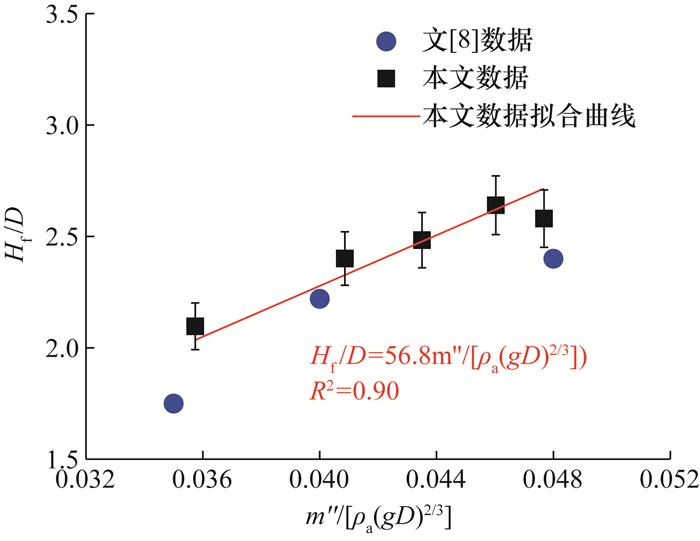
低气压下航空煤油的无量纲火焰高度数据如图 6所示,Hf/DD的增大而增加。对比文[8]中常压下的数据,可看出低气压条件下的Hf高于常压条件下同尺度下的Hf。这主要是因为Hf与火焰卷吸有关,低气压氧气净含量低,单位火焰长度卷吸的氧气量减少,需要更长的火焰卷吸长度满足燃烧需要[28]
图 6 火焰高度实验值与拟合曲线
进一步对实验数据进行处理,拟合得到A=56.8。
$\frac{H_f}{D}=56.8\left(\frac{m^{\prime \prime}}{\rho_{\mathrm{a}} \sqrt{g D}}\right)^{2 / 3} .$
由图可得,实验值与拟合曲线预测值相差较小(R2=0.90),该公式可用于低气压(69 kPa)条件下航空煤油池火无量纲火焰高度的预测。

2.4 辐射占比

油池火灾的危害主要来源于火焰对外热辐射,辐射的大小与火焰辐射占比密切相关[17]。对于池火的辐射占比,目前常采用点源法确定[29]。点源法是将火源看作一个质点,不考虑火焰形态,火焰所有辐射集中在一点发射,该方法适用于计算远距离(L≥5DL为测点到火源的距离,m)条件下的辐射占比Xr,具体公式如下[30]
$X_{\mathrm{r}}=\frac{\dot{Q}_{\mathrm{r}}}{\dot{Q}}=\frac{S_{\mathrm{r}} q_{\mathrm{r}}^{\prime \prime}}{m^{\prime \prime} S \Delta H_{\mathrm{c}}}=\frac{4 \pi L^2 q_{\mathrm{r}}^{\prime \prime}}{\frac{\pi}{4} m^{\prime \prime} D^2 \Delta H_{\mathrm{c}}}=\frac{16 L^2 q_{\mathrm{r}}^{\prime \prime}}{m^{\prime \prime} D^2 \Delta H_{\mathrm{c}}} .$
其中:$\dot{Q}_{\mathrm{r}}$是火焰发出的总热辐射,kW;Sr为辐射区域面积,m2qr″可通过布置在距油盘5D处的热流计获得。
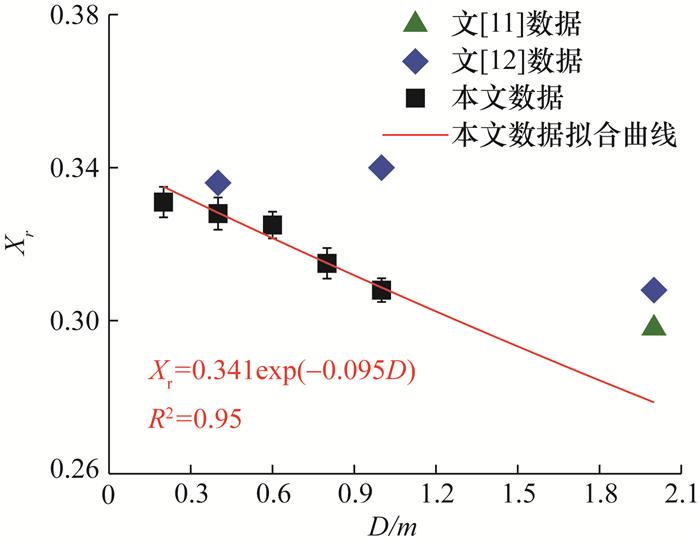
不同D条件下航空煤油池火的辐射占比如图 7所示。由图可得,低气压条件下,航空煤油的XrD的增大逐渐减小,与常压下油池火的Xr变化趋势保持一致[25]。与文[11-12]中的常压条件相比,低气压条件下相同D的油池火的Xr略微降低,这主要是因为高原低气压条件下,空气密度低,氧气量少,碳烟颗粒的生成量减少[31]
图 7 辐射占比随油池直径的变化
McGrattan给出了油池火XrD的关系式[12]
$X_{\mathrm{r}}=X_{\mathrm{r}-\max } \exp (-k D).$
基于航空煤油池火的实验数据:Xr-max= 0.341,k=0.095 m-1,拟合得到低气压条件下的Xr关系式。
$X_{\mathrm{r}}=0.341 \exp (-0.095 D) .$
由图还可知,实验值与预测值的偏差较小(R2=0.95),可以较好地预测较大尺度的低气压(69 kPa)航空煤油池火的Xr

3 结论

本文开展了低气压条件下不同油池直径的航空煤油池火实验,详细分析了燃烧速率、火焰高度、辐射占比这3个燃烧关键参数随油池直径的变化规律。得到如下结论:
1) 对于航空煤油池火,含水垫层和不含水垫层对于稳定阶段的燃烧速率影响较小。燃烧速率随直径的增大而增加,且增加速度不断减小。与常压相比,低气压条件下同等尺度的燃烧速率更低,主要是因为到达油品表面的辐射和对流反馈降低。基于火焰热流反馈计算得到了低气压(69 kPa)条件下航空煤油池火燃烧速率的预测公式$\left(m^{\prime \prime}=2.74+\right.\left.116.1\left\{1-\exp \left[-(0.13 D)^{0.76}\right]\right\}\right)$
2) 低气压条件下火焰高度随油池直径的增大而增加,且比常压下同等条件下的火焰高度更高,主要原因是低气压空气密度的降低对火焰卷吸的影响。基于火焰卷吸理论得到了低气压(69 kPa)条件下航空煤油无量纲火焰高度的预测模型$\left(H_{\mathrm{f}} / D=\right.\left.56.8\left(\frac{m^{\prime \prime}}{\rho_{\mathrm{a}} \sqrt{g D}}\right)^{2 / 3}\right)$
3) 低气压条件下,辐射占比随油池直径的增大缓慢降低。与常压相比,同等燃烧尺度下,燃烧时碳烟颗粒的生成量减少,辐射占比降低。根据经验公式拟合得到适用于低气压(69 kPa)的航空煤油池火辐射占比预测公式$\left(X_{\mathrm{r}}=0.341 \exp (-0.095 D)\right)$
现有研究丰富了低气压条件下大尺度航空煤油池火燃烧数据,但主要是在单一环境压力(69 kPa)下进行的。在后续的工作中可继续开展更大尺度的多种压力条件下的池火实验研究,进一步验证现有模型。
1
花荣胜. 不同低气压环境下甲醇和乙醇池火燃烧特性的实验研究[D]. 合肥: 中国科学技术大学, 2011.

HUA R S. Experimental study on combustion characteristics of methanol and ethanol pool fires under different low ambient pressure conditions[D]. Hefei: University of Science and Technology of China, 2011. (in Chinese)

2
LI M H , LU S X , GUO J , et al. Effects of pool dimension on flame spread of aviation kerosene coating on a metal substrate[J]. International Journal of Heat and Mass Transfer, 2015, 84, 54- 60.

DOI

3
李振华. 西藏高原低压低氧条件下可燃物燃烧特性和烟气特性研究[D]. 合肥: 中国科学技术大学, 2009.

LI Z H. Research on the fuel combustion characteristics and the flue gas characteristics under the Tibetan Plateau environment of hyperpiesia and hypoxia[D]. Hefei: University of Science and Technology of China, 2009. (in Chinese)

4
BABRAUSKAS V . Estimating large pool fire burning rates[J]. Fire technology, 1983, 19 (4): 251- 261.

DOI

5
KOSEKI H . Combustion properties of large liquid pool fires[J]. Fire Technology, 1989, 25 (3): 241- 255.

DOI

6
YAN S H, CIRO W, EDDINGS E G, et al. Experimental study of burning rate in jet-fuel pool fires[C]// Proceedings of the 3rd Joint Meeting of the U.S. Sections of the Combustion Institute. Chicago, USA: Combustion Institute2004.

7
BLINOV V I , KHUDYAKOV G N . Diffusion burning of liquids[M]. Fort Belvoir, VA: Army Engineer Research and Development Laboratories, 1961.

8
庄磊. 航空煤油池火热辐射特性及热传递研究[D]. 合肥: 中国科学技术大学, 2009.

ZHUANG L. Studies on thermal radiation character and heat transfer of aviation fuel pool fires[D]. Hefei: University of Science and Technology of China, 2009. (in Chinese)

9
赵金龙, 田逢时, 赵利宏, 等. 航空煤油薄油层燃烧特性实验研究[J]. 中国安全生产科学技术, 2020, 16 (5): 129- 135.

ZHAO J L , TIAN F S , ZHAO L H , et al. Experimental study on burning characteristics of thin-layer aviation kerosene[J]. Journal of Safety Science and Technology, 2020, 16 (5): 129- 135.

10
蒋新生, 张霖, 何东海, 等. 航空煤油不同尺寸池火热流及温度特性研究[J]. 化工学报, 2020, 71 (3): 1398- 1408.

JIANG X S , ZHANG L , HE D H , et al. Study on radiation and temperature characteristics of aviation kerosene fire with different sizes in pools combustion[J]. CIESC Journal, 2020, 71 (3): 1398- 1408.

11
HIROSHI K , TARO Y . Air entrainment and thermal radiation from heptane pool fires[J]. Fire Technology, 1988, 24 (1): 33- 47.

12
MCGRATTAN K B, BAUM H R, HAMINS A, et al. Thermal radiation from large pool fires: NISTIR 6546[R]. Gaithersburg, MD: U.S. Department of Commerce, National Institute of Standards and Technology, 2000.

13
余彬彬, 蒋新生, 禹进, 等. 全氟己酮抑制航空煤油燃烧实验及化学动力学研究[J]. 化工学报, 2022, 73 (4): 1834- 1844.

YU B B , JIANG X S , YU J , et al. Experimental and chemical dynamics study on the inhibition of combustion of aviation kerosene by C6F12O[J]. CIESC Journal, 2022, 73 (4): 1834- 1844.

14
刘全义, 朱文田, 朱博, 等. 高高原机场环境下可燃液体燃烧特性研究[J]. 消防科学与技术, 2021, 40 (5): 613- 616.

LIU Q Y , ZHU W T , ZHU B , et al. Investigation on combustion characteristics of combustible liquids in high-plateau airport pressure environment[J]. Fire Science and Technology, 2021, 40 (5): 613- 616.

15
陈钦佩. 常压和低压下水含量对液体燃料火灾危险性影响机理研究[D]. 合肥: 中国科学技术大学, 2018.

CHEN Q P. Experimental and theoretical study on the influence of water content on liquid fuel fire hazard under normal and low pressures[D]. Hefei: University of Science and Technology of China, 2018. (in Chinese)

16
ZHOU Z H , YAO W , LI H H , et al. Experimental study on Jet-A pool fire at high altitude[J]. Fire Safety Science, 2014, 11, 510- 516.

DOI

17
周志辉. 低气压环境对池火火行为及羽流特性的影响机理研究[D]. 合肥: 中国科学技术大学, 2014.

ZHOU Z H. Effects of low ambient pressure on pool fire behavior and plume characteristics[D]. Hefei: University of Science and Technology of China, 2014. (in Chinese)

18
ZHAO J L , ZHANG J P , CHEN C K , et al. Experimental investigation on the burning behaviors of thin-layer transformer oil on a water layer[J]. Process Safety and Environmental Protection, 2020, 139, 89- 97.

19
VALI A , NOBES D S , KOSTIUK L W . Transport phenomena within the liquid phase of a laboratory-scale circular methanol pool fire[J]. Combustion and flame, 2014, 161 (4): 1076- 1084.

20
DITCH B D , DE RIS J L , BLANCHAT T K , et al. Pool fires-an empirical correlation[J]. Combustion and flame, 2013, 160 (12): 2964- 2974.

DOI

21
HOTTEL H C . Certain laws governing the diffusive burning of liquids: A review[J]. Fire Research Abstracts and Reviews, 1959, 1, 41- 44.

22
HOTTEL H C , SAROFIM A F . Radiative transport[M]. New York: McCravv Hill, 1967.

23
ORLOFF L, DE RIS J. Froude modeling of pool fires[C]//Symposium (International) on Combustion. Israel: Elsevier, 1982, 19(1): 885-895.

24
DE RIS J L, ORLOFF L. Flame heat transfer between parallel panels[C]// Proceedings of the 8th International Symposium. Beijing, China: International Association for Fire Safety Science, 2005: 999-1010.

25
FANG J , TU R , GUAN J F , et al. Influence of low air pressure on combustion characteristics and flame pulsation frequency of pool fires[J]. Fuel, 2011, 90 (8): 2760- 2766.

DOI

26
ATALLAH S . Flame heights and burning rates of liquid fuels in open tanks[J]. Combustion and Flame, 1965, 9 (2): 203- 205.

27
OTSU N . A threshold selection method from gray-level histograms[J]. IEEE Transactions on Systems, Man, and Cybernetics, 1979, 9 (1): 62- 66.

DOI

28
LIU J H , ZHOU Z H , CHEN M Y . Experimental investigation on the effect of ambient pressure on entrainment coefficient of pool fires[J]. Applied Thermal Engineering, 2019, 148, 939- 943.

29
HU L H , WANG Q , DELICHATSIOS M , et al. Flame radiation fraction behaviors of sooty buoyant turbulent jet diffusion flames in reduced-and normal atmospheric pressures and a global correlation with Reynolds number[J]. Fuel, 2014, 116, 781- 786.

30
HANKINSON G , LOWESMITH B J . A consideration of methods of determining the radiative characteristics of jet fires[J]. Combustion and Flame, 2012, 159 (3): 1165- 1177.

31
MOST J M, MANDIN P, CHEN J, et al. Influence of gravity and pressure on pool fire-type diffusion flames[C]// Proceedings of the 26th Symposium (International) on Combustion. Pittsburg, USA: The Combustion Institute, 1996: 1311-1317.

Outlines

/