Electrical Fire

Experimental study on the fire spread behavior of downward-bending cables

  • Changkun CHEN ,
  • Wuhao DU ,
  • Tong XU ,
  • Lang SHI
Expand
  • Institute of Disaster Prevention Science and Safety Technology, Central South University, Changsha 410075, China

Received date: 2023-12-29

  Online published: 2025-03-27

Copyright

All rights reserved. Unauthorized reproduction is prohibited.

Abstract

Objective: Due to the height differences during the power transmission process, the bending installation of cables is a common method. The stress in the bending section of cables is usually relatively concentrated and more susceptible to damage, leading to a greater fire hazard. According to the different bending forms, the bending cables can be divided into upward-bending cables and downward-bending cables. Methods: An experimental study was conducted to investigate the effect of the bending angle and number of cables on the flame spread behavior of downward-bending cables. Results: Results show that: (1) the peak temperature on the cable surface of downward-bending cables gradually increases, as the number of cables increases. The temperature peak of 5 downward-bending with 60°bending angle was about 782.3℃, which was 1.8 times higher than that of a single cable at the same angle. This is mainly due to the fact that combustion of multiple cables laid side by side produces more combustible pyrolysis gases, while the flame has a stronger preheating effect on the cables. (2) As the bending angle increases the flame spread time of downward-bending cables is shortened and the average flame spread rate increases. Under the ignition condition of five 90°downward-bending cables, the average flame spread rate of the cables was 5.4 cm/min, which was 1.9 times of that of five 0° downward-bending cables; under the ignition condition of five 90°downward-bending cables, the temperature peak reached 868.3℃, which was about 1.4 times of that of that of five 0°downward-bending cables. This is mainly due to the larger bending angle, which was mainly due to the difference in the role of the flow of melt drippings on the cable under different bending angles, when the flame spread in the inclined section of the cables, the flow of high-temperature melt drippings was an important driving force to ignite the cables in the unburned section. As the bending angle increased, the force of gravity increased in the direction of the cables, and the drippings were more likely to flow downwards under the combined effect of the gravitational component force, surface tension, friction of the melt drippings. The melt drippings had a more significant effect on the preheating of the unburnt section of the cables, which in turn shortens the ignition time of the cable and increased the average flame spread rate. In addition, as the bending angle increased, the "flame attached" effect was more significant, which increased the thermal convection and thermal radiation in the unburned section of the cables. Conclusions: The peak temperature on the cable surface of downward-bending cables are positively related to the number of cables and the bending angle. The average flame spread rate increases as the number of cables and the bending angle increase. Regressivity analyses between flame temperature and the number of cables were carried out to analyze the flow mechanism of melt drippings in inclined sections of cables in this work, these correlations are well described by physically based models for all the experimental results.

Cite this article

Changkun CHEN , Wuhao DU , Tong XU , Lang SHI . Experimental study on the fire spread behavior of downward-bending cables[J]. Journal of Tsinghua University(Science and Technology), 2025 , 65(4) : 805 -812 . DOI: 10.16511/j.cnki.qhdxxb.2024.27.012

电缆因绝缘层破损、过载、短路等故障容易引发火灾事故。例如2023年5月中国山西省吕梁市的2栋高层建筑先后发生火灾,事故原因皆为电缆起火,事故共造成8人死亡,2人受伤。为应对输送电力过程中坡度与高度的变化,电缆通常以折弯的形式敷设。根据不同折弯形式可以将折弯电缆分为上折弯电缆与下折弯电缆,如图 1中红色虚线框所示。然而,电缆折弯处所受应力通常相对集中,老化后的电缆外护套更易发生破损,从而诱发电缆火灾事故,具有较大的安全隐患。本文针对下折弯电缆燃烧行为展开研究。
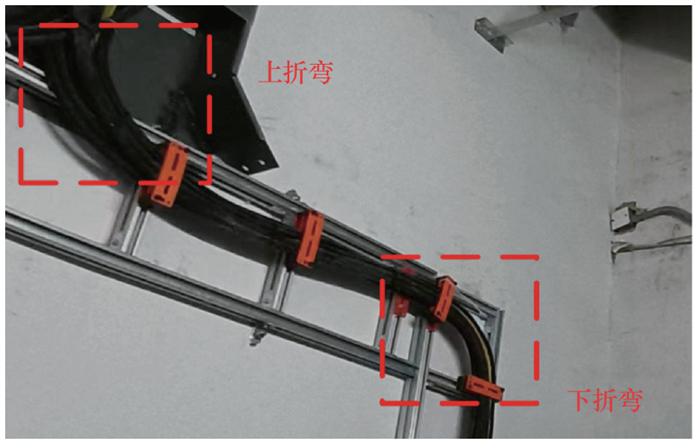
图 1 地铁站中敷设的折弯电缆
目前,国内外众多学者针对电缆火灾燃烧行为已开展了一系列试验。例如张佳庆等[1]基于典型低压电缆热重实验,结合热分析动力学理论,得到电缆热解反应参数和机理。包光宏等[2]基于不同布置间距与热边界条件下电缆燃烧试验究,发现间隔敷设的电缆在火灾条件下具有更大产烟速率和热释放速率。龚泰等[3]研究了电缆热解和燃烧动力学过程,从机理上解释了阻燃电缆的受热膨胀行为规律,建立了电缆燃烧临界热流判据。Huang等[4]研究了环境压力、氧浓度等条件对电缆的火蔓延行为的影响,研究发现火蔓延速率随着氧浓度增加而增大,环境压力对电缆点燃特性的影响较小。An等[5]开展聚氯乙烯电缆火灾试验,结果表明随着电缆根数的增加,热解燃烧区长度增加。Yoshinar等[6-7]研究了不同导线材质对火蔓延的影响,结果表明高导热性铜芯会加快火焰传播速率。Zavaleta等 [8-10]分析了密闭与机械通风条件下桥架电缆火灾的影响,引入了FLASH-CAT模型以预测桥架电缆燃烧时的热释放速率。Xie等[11-12]研究了聚苯乙烯(PS)、聚乙烯(PE)和聚丙烯(PP)等聚合材料的熔融、滴落和流动燃烧行为,研究发现PE和PP的燃烧危险性明显高于PS。
电缆倾斜角度对电缆火蔓延行为有重要影响。Hu等[13]对不同倾角的电缆燃烧行为进行深入研究,发现电缆的火蔓延速率随倾斜角度的变化先减小后增大,发现火焰底部的宽度和长度热解区与火蔓延速率密切相关。Chen等 [14-15]开展了不同折弯角度下U型电缆燃烧试验,研究发现电缆质量损失速率、火蔓延速率随折弯的角度增加而增大。Seung等[16]研究了倾斜电缆的火蔓延特性,发现电缆火焰宽度随倾斜角度的增加而增大。Lu等[17-18]在风洞中进行了不同倾角下电缆火蔓延试验,研究了不同导线间距条件下火蔓延过程中的传热机制。
上述研究主要集中于揭示平直电缆火蔓延规律,然而折弯电缆通常多根并排敷设,且折弯处容易发生老化破损,具有更大的火灾隐患,却少有研究报道。因此本文将重点研究多根并排敷设电缆的中部被引燃条件下,折弯角度和电缆数量对火灾行为的影响,以期为电缆的消防安全设计和火灾扑救提供理论支撑。

1 试验设计

下折弯电缆燃烧试验台如图 2a所示。下折弯电缆固定于电缆支架上,电缆支架通过钢索悬挂长度2.0 m、宽度1.8 m试验台上。托盘用于承接外护套熔融热解而产生的高温熔滴,托盘上方的热电偶用于采集熔滴火焰温度。托盘正下方的天平(精度为0.1 g)采集熔滴质量变化数据。热电偶用于记录温度数据。
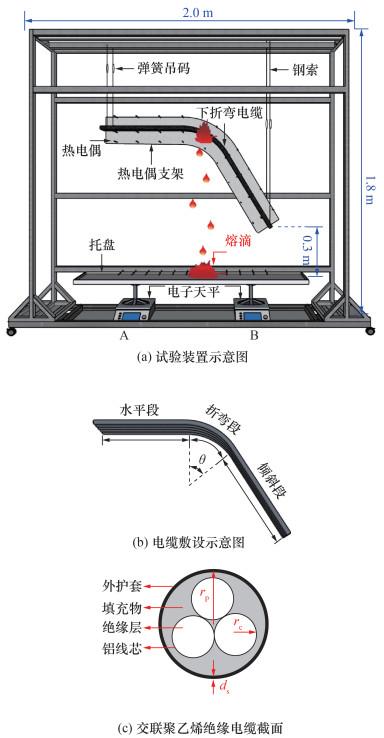
图 2 下折弯电缆燃烧试验设计
本试验采用三铝芯交联聚乙烯绝缘电缆,型号为YJLY 3×25。电缆折弯段如图 2b所示,根据设计规范设置折弯半径为15 D[19](D为电缆外径),本文取36 cm;设置3种折弯角度θ,分别为30°、60°、90°。如图 2c所示,电缆从外到内由外护套、填充物、绝缘层、铝线芯4部分构成。电缆半径rp、铝芯半径rc、外护套厚度ds分别为12.0 mm、2.8 mm、2.0 mm。试验中采用的下折弯电缆长度为1.5 m,在本研究中多根电缆采用紧密并排敷设。
热电偶支架用于固定热电偶,根据电缆的3种折弯角度对应制作了3种热电偶支架,如图 3所示。每个支架共有9列热电偶,每列热电偶共有5个测点,分别用于测量火焰(A点)温度、电缆上表面(B点)温度、电缆线芯(C点)温度、电缆下表面(D点)温度、托盘熔滴(E点)温度。
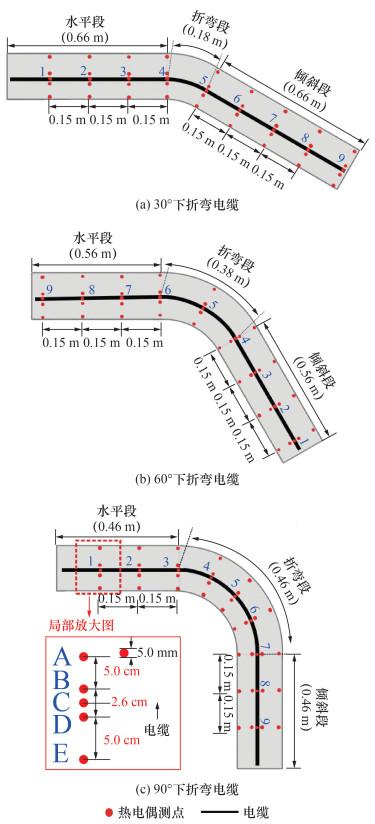
图 3 3种热电偶支架及测点布置
试验前将电缆固定于试验装置,调整热电偶位置,开启天平、Sony高速摄像机与FORTRIC热像仪(测温范围为0~700℃),点燃电缆中部并控制火源功率为2 kW,每次点火时间为1 min,利用Sony高速摄像机与FORTRIC热像仪记录电缆燃烧行为和火焰形态。待电缆表面和托盘可燃物燃尽,关闭试验测量系统,试验结束。
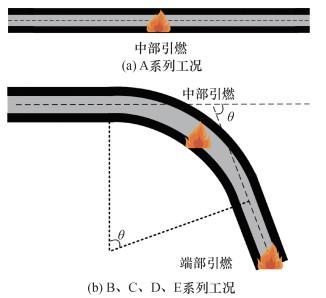
根据不同折弯角度θ与电缆数量n共设置9组工况,如表 1所示,每组工况下进行2~3组重复试验,以减少误差。各工况中引燃的具体位置如图 4所示。
表 1 试验工况表
工况名称 θ/(°) 引燃位置 n/根
A1 0 中部 1
A2 0 中部 5
B1 30 中部 1
B2 30 中部 5
C1 60 中部 1
C2 60 中部 3
C3 60 中部 5
D1 90 中部 1
D2 90 中部 5
E1 60 端部 1
图 4 各工况中电缆的引燃位置

2 结果与分析

2.1 折弯角度对下折弯电缆燃烧行为的影响

n=1条件下分析不同折弯角度对火焰温度分布情况的影响。由图 5a可以看出,水平电缆中部被引燃后火焰向两端蔓延,引燃位置两侧热电偶测点温度在400℃左右,并且引燃位置两侧温度变化趋势基本一致。当下折弯电缆中部被引燃后,火焰会分别向电缆水平段与倾斜段蔓延,由图 5b—5d可以看出,相比于水平段(热电偶测点A1~A3),倾斜段(热电偶测点A6~A9)响应时间更早,即火焰前沿在电缆倾斜段蔓延速率更快。这是由于当下折弯电缆中部被引燃,火焰会向电缆倾斜段和水平段2个方向蔓延,由于倾斜段火焰电缆未燃段的预热区长度会比水平段更长,故倾斜段电缆会被更快地燃烧消耗。而在水平段蔓延过程中,电缆未燃段火焰预热长度较短,电缆未燃段受到的热辐射和热对流作用相对较弱,火蔓延速率较慢。此外,将电缆被引燃至电缆表面火蔓延至端部的时间间隔定义为电缆火蔓延时间td,可以进一步获得:td, 0°= 77 min,td, 30°=68 min,td, 60°=52 min,td, 90°=46 min。
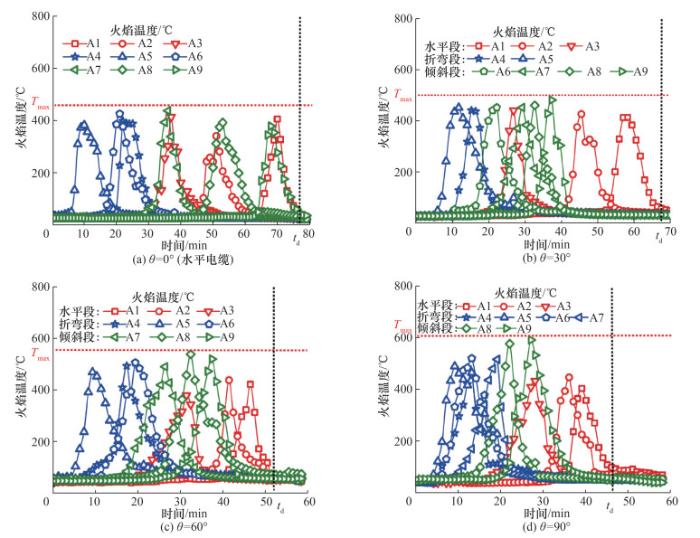
图 5 不同折弯角度下火焰温度分布(n=1)
为进一步分析不同折弯角度对电缆火蔓延速率的影响,本文将电缆长度与td的比值定义为电缆平均火蔓延速率Vf。由图 6可知,在n=1和n=5条件下,Vf均随θ增加而增大。例如在n= 1,θ分别为0°、30°、60°和90°时,Vf分别为1.9、2.2、2.9和3.2 cm/min。线性拟合获得Vfθ的关系式:n=1时,Vf=0.014θ+1.92;n=5时,Vf=0.028θ+2.88。这主要是由于不同折弯角度下电缆表面熔滴的流淌行为存在差异,火焰在电缆倾斜段的蔓延行为类似于逆流火蔓延行为,高温熔滴的流淌是引燃未燃段电缆的重要驱动力。
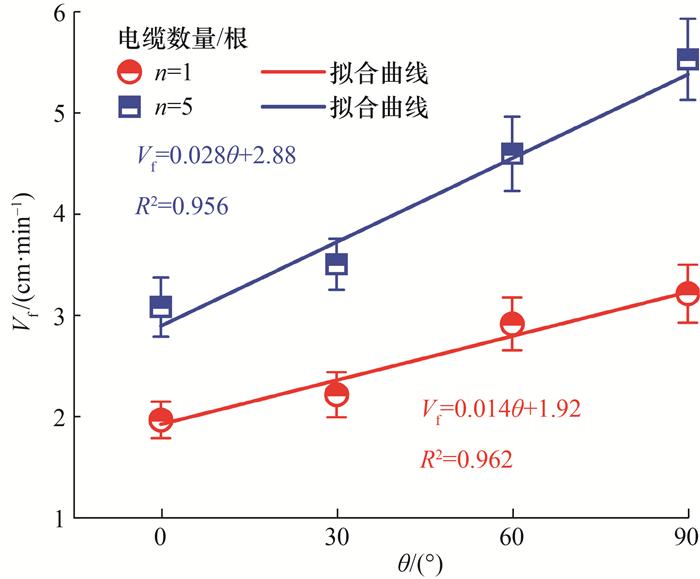
图 6 电缆平均火蔓延速率随折弯角度的变化
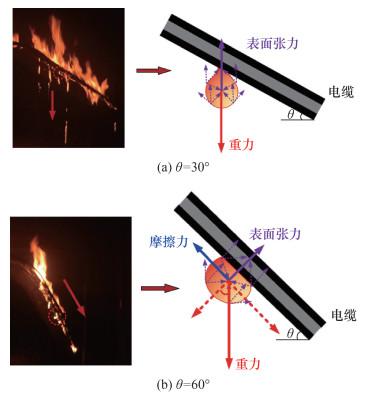
θ=30°和θ=60°条件下,电缆下表面熔滴的流淌行为的受力分析如图 7所示。可以看出,熔滴沿电缆外护套流淌时主要受到重力、表面张力和摩擦力;随着θ增加,重力沿电缆方向的分力增大,熔滴更容易发生向下流淌。熔滴流淌对未燃段电缆的预热作用更显著,缩短了电缆引燃时间,提高了Vf。此外,当电缆末端被引燃后,电缆的θ越大,电缆火焰越容易产生“火焰附壁”现象[20-21],该现象拓宽热解区域与预热区域长度,提高了火焰与电缆表面传热传质效率,从而导致Vf的提高。
图 7 电缆表面熔滴流淌行为的受力分析
n=1和n=5条件下,电缆火焰温度峰值Tmaxθ的变化情况如图 8所示。可以看出,θ越大,Tmax越高。这主要是由于随着θ的增加,折弯段和倾斜段未燃区域受到火焰热对流和热辐射作用增强,同时高温熔滴也更容易沿电缆表面流淌,这一定程度上拓展了电缆的预热区长度,加快了电缆热解速率,进而导致Tmax升高。
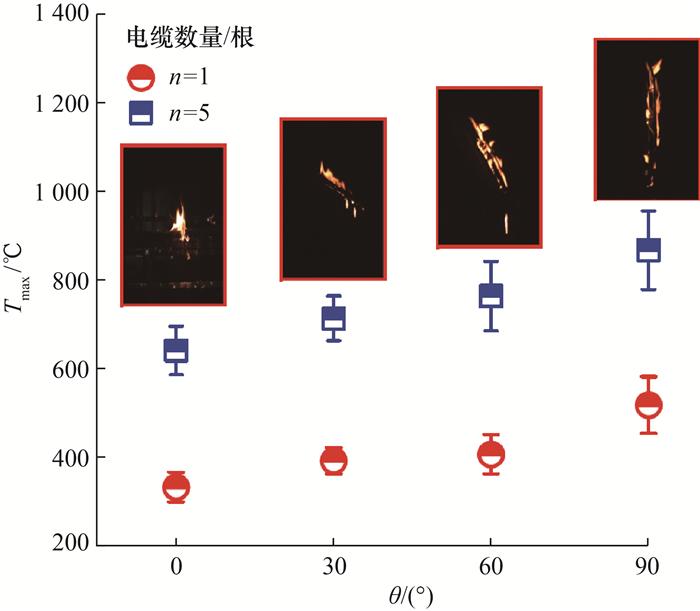
图 8 电缆火焰温度峰值随折弯角度的变化
值得注意的是,在n=5,θ=90° (D2工况)条件下,Vf=5.4 cm/min,约为n=5,θ=0° (A2工况)条件下的1.9倍;D2工况下Tmax达到了868.3℃,约为A2工况下的1.4倍。这主要是由于当90°下折弯电缆被引燃后,熔滴会依次沿着电缆折弯段和倾斜段流淌,滴落至未燃段电缆正下方。熔滴火焰以热对流与热辐射的形式加热未燃段电缆,加快了未燃段电缆热解速率,具有更大的火灾危险性。

2.2 电缆数量对下折弯电缆燃烧行为的影响

θ=60°条件下不同数量电缆燃烧行为如图 9所示。从左侧火焰图可以看出,不同数量电缆的燃烧行为有较大差异。例如在30 min时,n=1条件下电缆水平段与倾斜段同时燃烧;n=3条件下倾斜段燃烧殆尽,火焰在水平段蔓延;n=5条件下仅托盘熔滴在维持燃烧。从右侧热像图可以看出,在10 min时,n=5条件下电缆出现大面积高温区域,并集中在折弯段和倾斜段,Tmax超过了700℃。
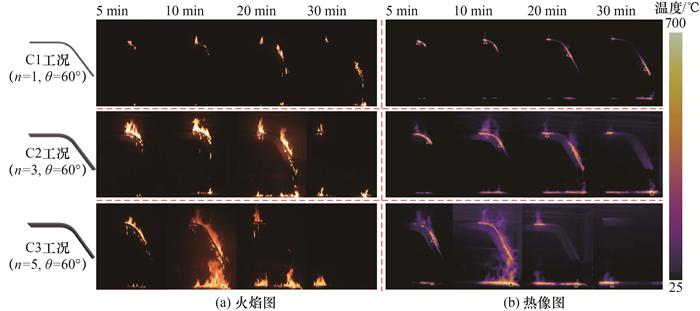
图 9 下折弯电缆火焰行为变化(θ=60°)
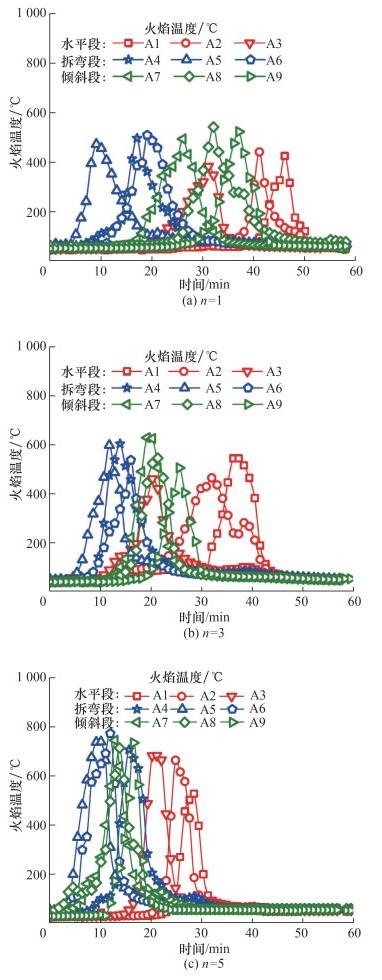
θ=60°条件下折弯电缆的火焰温度如图 10所示。可以看出,n越大电缆火焰温度整体上越高,温度曲线也更加集中,即各温度测点峰值间隔更短。此外,从图 10c中可以发现倾斜段热电偶(A6~A9)在15 min左右就达到Tmax且高于其他工况。这主要是由于在5根电缆中部被引燃时,电缆热解熔融产生更多高温熔滴,熔滴沿电缆倾斜段流淌,拓宽了电缆的预热长度。同时托盘上的熔滴火焰以热对流与热辐射的形式加热倾斜段的电缆,这也缩短了电缆引燃时间,提高了温度峰值。
图 10 折弯电缆火焰温度变化(θ=60°)
不同电缆数量条件下,电缆燃烧过程中VfTmax变化情况如图 11所示。可以看出,在θ=60°条件下,VfTmax均与n呈正相关,通过线性拟合获得相应的关系式,Vf=0.42n+2.43,Tmax=54.14 n+482.32。在n=5,θ=60° (C3工况)条件下,Tmax=782.3℃,为n=1,θ=60°(C1工况)条件下的1.8倍。这主要是由于多根电缆燃烧时会比单根电缆在单位时间内产生更多热解气体,具有更高的热释放速率,因此Tmax更高。此外,当多根电缆并排布置时,中部的电缆燃烧时需要卷吸更多的空气以维持燃烧,故电缆束燃烧形成了中部较高、两侧较低形状的火焰,火焰对未燃区域电缆的预热作用更强烈,电缆热解时间更短,Vf更高。
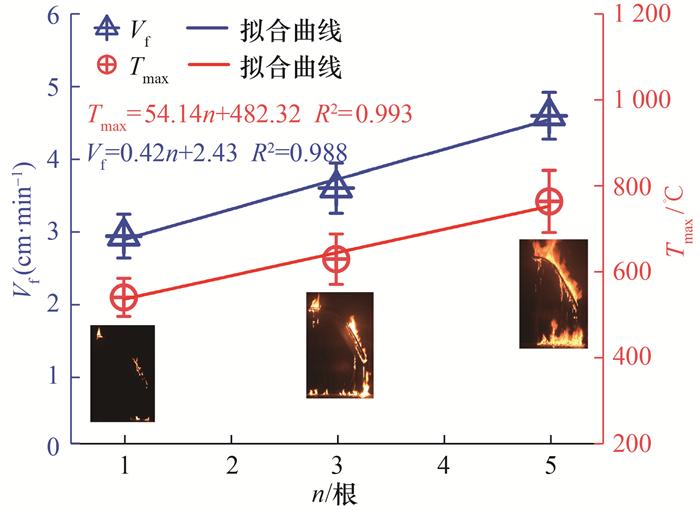
图 11 不同电缆根数下VfTmax的变化情况(θ=60°)

2.3 下折弯电缆与倾斜电缆火蔓延行为对比分析

下折弯电缆与倾斜电缆火蔓延行为存在较大差异,因此有必要对比二者火蔓延行为。当倾斜电缆端部被引燃后,火焰会沿着电缆底部向上不断蔓延[22-23]。火焰在热浮力的作用下对电缆未燃区域的预热作用逐渐增加,这种预热作用随着电缆倾斜角度的增加而增大,进而导致火蔓延速率不断增加。当电缆倾斜角度为90°时,电缆火焰高度会出现“爆发式增长”现象,进而产生更快的火蔓延速率。
当下折弯电缆端部被引燃时(E1工况),火焰会依次经过倾斜段、折弯段和水平段,如图 12所示。当火焰依次蔓延至折弯段和水平段时,由于折弯角度的不断降低(水平段θ=0°),火焰对未燃段电缆的预热作用逐渐减弱,导致火蔓延速率减缓,最终保持不变,这是下折弯电缆与倾斜电缆在火蔓延行为上的差异。
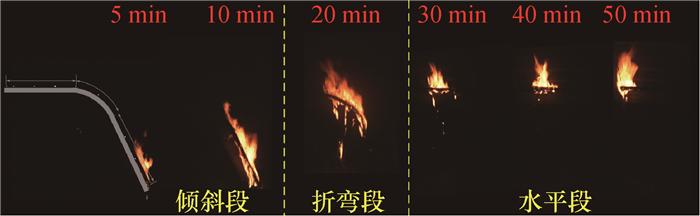
图 12 折弯电缆火蔓延行为

3 结论

本文为探究折弯角度与电缆数量对下折弯电缆燃烧火蔓延行为的影响,以三铝芯交联聚乙烯绝缘电缆为试验对象开展下折弯电缆中部引燃试验。测量并分析了火焰温度、电缆火蔓延时间、平均火蔓延速率等参数对电缆火蔓延行为的影响,得到如下结论:
1) 随着折弯角度增加,下折弯电缆火蔓延时间缩短,平均火蔓延速率增大。这主要是由于折弯角度越大,熔滴流淌作用与“火焰附壁”效应越显著,增强了电缆未燃区域所受的热对流和热辐射作用,进而提高了电缆平均火蔓延速率。
2) 电缆火焰温度峰值随电缆数量增加而增大,这主要是由于多根电缆并排敷设时燃烧产生更多可燃热解气体,同时火焰对电缆预热作用更强。
3) 开展了火焰温度与电缆数量之间的回归性分析,分析了熔滴在倾斜段电缆的流淌机理,发现随着折弯角度增加,重力沿电缆方向分力增大,熔滴更容易发生向下流淌。
1
张佳庆, 过羿, 冯瑞, 等. 典型变电站阻燃低压电缆外护套材料火灾条件下热解固气产物特性及反应机理[J]. 清华大学学报(自然科学版), 2022, 62 (1): 33- 42.

DOI

ZHANG J Q , GUO Y , FENG R , et al. Solid-gas products and reaction mechanism of pyrolysis of the sheath material of a typical flame-retardant low-voltage cable in substations during a fire[J]. Journal of Tsinghua University (Science and Technology), 2022, 62 (1): 33- 42.

DOI

2
包光宏, 胡林明. FEP通信电缆燃烧性能试验研究[J]. 消防科学与技术, 2021, 40 (5): 621- 624.

DOI

BAO G H , HU L M . Experimental study on combustion performance of FEP communication cable[J]. Fire Science and Technology, 2021, 40 (5): 621- 624.

DOI

3
龚泰. 渐强环形热流作用下的阻燃电缆细观膨胀与引燃机理研究[D]. 合肥: 中国科学技术大学, 2017.

GONG T. Study on detailed swelling and ignition mechanism of flame-retardant cable in the annular heating condition with increasing heat fluxes[D]. Hefei: University of Science and Technology of China, 2017. (in Chinese)

4
HUANG X Y , NAKAMURA Y , WILLIAMS F A . Ignition-to-spread transition of externally heated electrical wire[J]. Proceedings of the Combustion Institute, 2013, 34 (2): 2505- 2512.

DOI

5
AN W G , TANG Y H , LIANG K , et al. Experimental study on flammability and flame spread characteristics of polyvinyl chloride (PVC) cable[J]. Polymers, 2020, 12 (12): 2789.

DOI

6
KOBAYASHI Y , HUANG X Y , NAKAYA S , et al. Flame spread over horizontal and vertical wires: The role of dripping and core[J]. Fire Safety Journal, 2017, 91, 112- 122.

DOI

7
KOBAYASHI Y , KONNO Y , HUANG X Y , et al. Effect of insulation melting and dripping on opposed flame spread over laboratory simulated electrical wires[J]. Fire Safety Journal, 2018, 95, 1- 10.

DOI

8
ZAVALETA P , HANOUZET R , BEJI T . Improved assessment of fire spread over horizontal cable trays supported by video fire analysis[J]. Fire Technology, 2019, 55 (1): 233- 255.

DOI

9
ZAVALETA P , SUARD S , AUDOUIN L . Cable tray fire tests with halogenated electric cables in a confined and mechanically ventilated facility[J]. Fire and Materials, 2019, 43 (5): 543- 560.

10
BASCOU S , ZAVALETA P , BABIK F . Cable tray FIRE tests simulations in open atmosphere and in confined and mechanically ventilated compartments with the CALIF3S/ISIS CFD software[J]. Fire and Materials, 2019, 43 (5): 448- 465.

DOI

11
XIE Q Y , TU R , WANG N , et al. Experimental study on flowing burning behaviors of a pool fire with dripping of melted thermoplastics[J]. Journal of Hazardous Materials, 2014, 267, 48- 54.

12
LUO S F , XIE Q Y , QIU R . Melting and dripping flow behaviors on the downward flame spread of a wide XPS foam[J]. Fire Technology, 2019, 55 (6): 2055- 2086.

13
HU L H , ZHANG Y S , YOSHIOKA K , et al. Flame spread over electric wire with high thermal conductivity metal core at different inclinations[J]. Proceedings of the Combustion Institute, 2015, 35 (3): 2607- 2614.

DOI

14
CHEN C K , DU W H , XU T . Experimental study on combustion behavior of U-shaped cables with different bending forms and angles[J]. Fire, 2023, 6 (9): 348.

15
XU T , CHEN C K , DU W H , et al. Experimental study on fire spread behavior of single 110 kV cable under different layout conditions[J]. Fire Safety Journal, 2023, 141, 103957.

16
LIM S J , PARK S H , PARK J , et al. Flame spread over inclined electrical wires with AC electric fields[J]. Combustion and Flame, 2017, 185, 82- 92.

17
PARK S H , LIM S J , CHA M S , et al. Effect of AC electric field on flame spread in electrical wire: Variation in polyethylene insulation thickness and di-electrophoresis phenomenon[J]. Combustion and Flame, 2019, 202, 107- 118.

18
LU Y , HUANG X Y , HU L H , et al. Concurrent flame spread and blow-off over horizontal thin electrical wires[J]. Fire Technology, 2019, 55 (1): 193- 209.

19
中华人民共和国住房和城乡建设部. 建筑电气工程施工质量验收规范: GB 50303—2015[S]. 北京: 中国建筑工业出版社, 2016.

Ministry of Housing and Urban-Rural Development of the People's Republic of China. Code for acceptance of construction quality of building electrical engineering: GB 50303—2015[S]. Beijing: China Architecture & Building Press, 2016. (in Chinese)

20
VIEGAS D X , SIMEONI A . Eruptive behaviour of forest fires[J]. Fire Technology, 2011, 47 (2): 303- 320.

21
XIE X D , LIU N A , RAPOSO J R , et al. An experimental and analytical investigation of canyon fire spread[J]. Combustion and Flame, 2020, 212, 367- 376.

22
CHEN C K , CHEN J , ZHAO X L . The effect of inclination angle on fire behaviors of stay cable in an intercepted double-layer cable model[J]. Journal of Thermal Analysis and Calorimetry, 2020, 140 (6): 2701- 2710.

23
曾文琦. 聚乙烯电缆火蔓延及熔融滴落行为研究[D]. 长沙: 中南大学, 2022.

ZENG W Q. Research on fire spread and melt dripping behavior of polyethylene cable[D]. Changsha: Central South University, 2022. (in Chinese)

Outlines

/