

医用直线加速器(medical linear accelerator,MLA)是对癌症进行放射治疗的高端医疗装备[1],随着全球癌症发病率和死亡率的增加[2],MLA的市场需求越来越大[3]。多叶光栅作为MLA的核心部件,决定着放射治疗的精准度和效率。Li等[4]和Zhang等[5]设计了快速成野多叶光栅(fast multi-leaf collimator, F-MLC),采用两相圆筒形永磁同步直线电机(permanent magnet synchronous tubular linear motor, PMSTLM),通过连杆直接驱动多叶光栅叶片,提高了叶片运行精度和射线剂量分布的精准性[6]。但PMSTLM的电感、磁链、电阻等参数容易受到温度影响产生变化[7],影响电流环稳态误差,电流的剧烈波动又会产生额外的能耗。因此,能耗影响了叶片运动精度和放疗质量的进一步提升。目前学者们主要从速度规划、控制算法、电机结构优化3方面,对电机能耗开展了广泛研究。其中通过速度规划来降低能耗的研究,主要是设计加减速规划来降低永磁同步电机能耗。Lu等[8]采用动态规划算法,得到稳态下的经济运行速度轨迹。Chakraborty等[9]提出了一种基于能量消耗和加速时间优化的舒适性驾驶策略,得出不同速度驾驶舒适性约束下的最优加速度。Vaz等[10]、Li等[11]研究了加速过程中的加速度大小及其变化率和目标车速对电动汽车能耗的影响。Huang等[12]重点研究了一种基于电磁—流体—热模型的PMSTLM的速度规划模型,得到了温度限制下的最优动态性能。还有学者进行降低能耗的控制算法研究,通过构建更精确的电机模型,提升电机的驱动效率。Sun等[13]采用模糊控制自适应算法,提高电机线性化模型的精度,降低能耗。邓国发[14]分析了损耗模型控制和最大转矩电流比控制(MTPA)两种控制算法的优缺点以及dq轴电流最优运行轨迹,提出新型效率优化控制算法。Yang等[15]、Navrapescu[16]、Senjyu[17]在等效电路模型中引入铁耗电阻,建立考虑铁损的损耗模型控制。Zhang等[18]构建非线性功率转换器损耗模型,优化逆变器和电机损耗。学者们针对MTPA进行改进,实现对永磁同步电机的最大转矩控制[19-21]。也有学者采用优化算法针对电机的结构特性进行优化设计,从而降低能耗。Zang等[22]采用响应面模型和非支配排序遗传算法(NSGA-Ⅱ)设计高速永磁同步电机,分析了恒功率最优轨迹。Kalaivani等[23]、Yu等[24]和Guazzelli等[25]在电机结构优化、速度控制模型中使用NSGA-Ⅱ算法求解,得到较好的效果。然而上述研究存在以下局限性:1) 速度规划能耗研究中,PMSTLM梯形速度规划模型仅考虑了梯形加减速过程中铜损的能量消耗,研究内容只涉及加速段的时间比例,且能耗机理研究仅考虑加速段,不适用于全行程;2) 损耗模型研究只考虑永磁同步电机在匀速运转时的能耗优化,对于运行速度快、匀速段行程短的PMSTLM影响较小;3) 最大转矩电流比控制不适用PMSTLM,其d、q轴电感差值对转矩影响可以忽略;4) 通过电机结构进行能耗优化只适用于电机研制阶段,当前使用的PMSTLM已经成型。
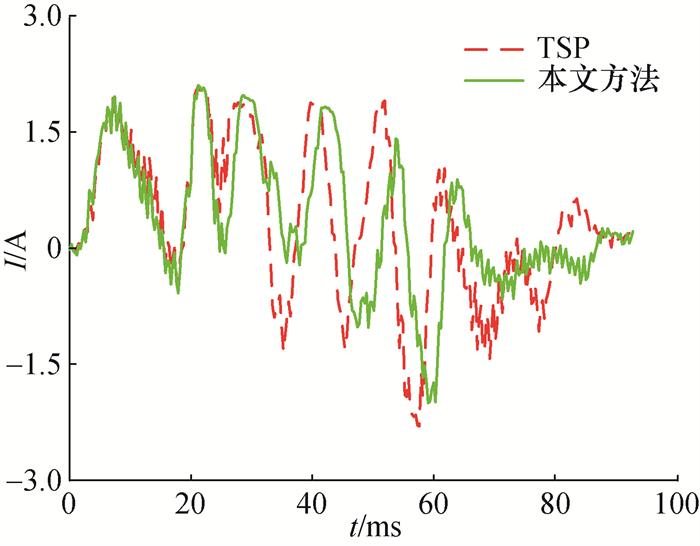
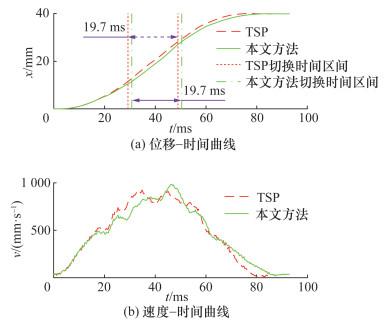
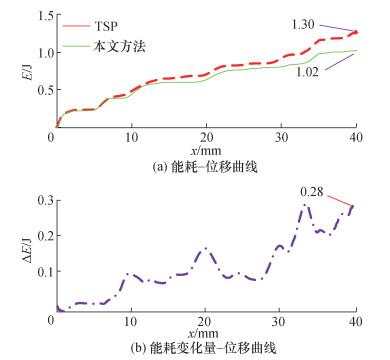
本文提出了一种基于速度规划的多叶光栅直线电机能耗优化方法。首先基于引入动摩擦系数的力矩边界提出改进指数型加减速规划(IESP);然后引入加速距离、减速特性系数,建立能耗—切换时间速度规划模型,使用NSGA-Ⅱ开展全行程能耗最小和切换时间最短的多目标优化。通过比较该方法和梯形加减速规划(TSP)的实验数据,得出能耗降低21.5%的结论,证明该方法有效。
1 多叶光栅和PMSTLM动力学
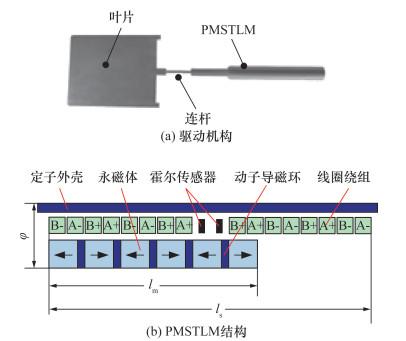
1.1 多叶光栅驱动机构
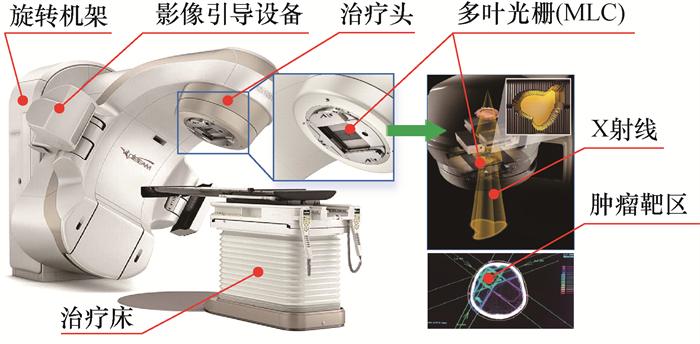
一种MLA具体结构如图 1所示,主要由旋转机架、影像引导设备、治疗头和治疗床等4部分组成。多叶光栅位于治疗头中,能够在X射线照射到肿瘤靶区之前进行射野形状控制,同时对辐照剂量调制,保证最大程度地实现X射线在靶区的累积,从而实现精准放射治疗。
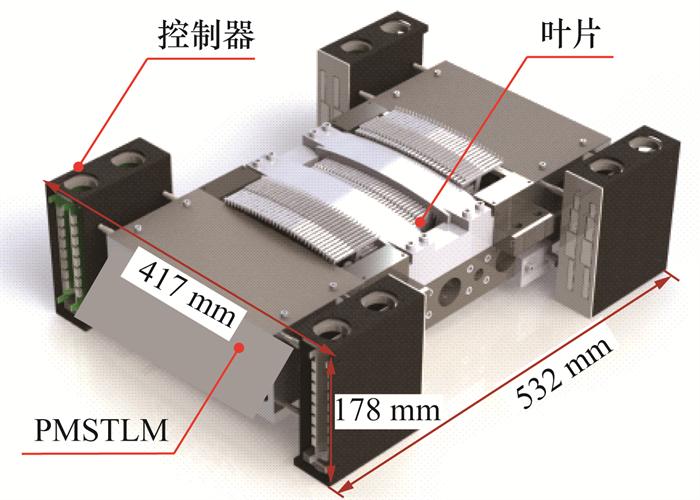
本文研究的多叶光栅具体结构如图 2所示,主要分为控制器、钨合金叶片阵列和64个PMSTLM组成的2组电机阵列。在MLA中,对多叶光栅有着严格的体积限制。本文中PMSTLM直径为18 mm,在418 mm×178 mm空间内由32个PMSTLM组成一个电机阵列。狭小空间内,发热严重且散热困难,导致电机产生的热量积聚,降低电机能耗是控制温升的重要手段。
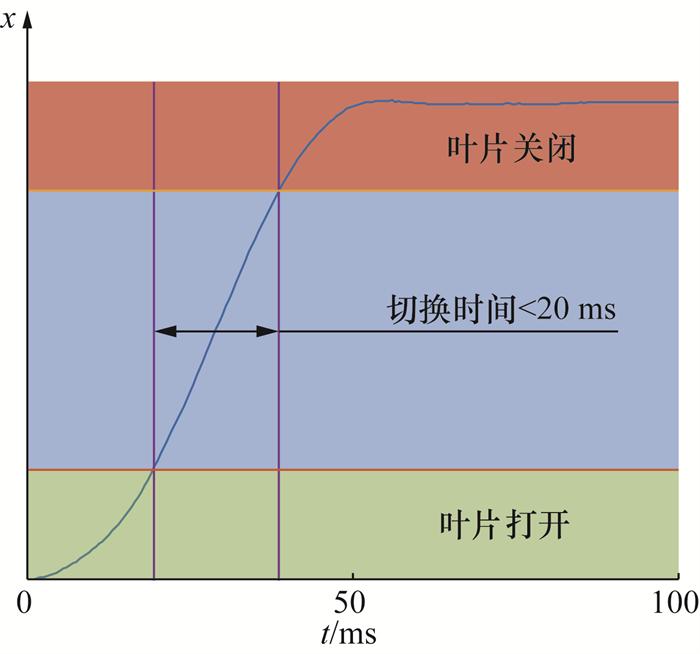
多叶光栅叶片工作要求见图 4,中间位移段的切换时间决定着放疗效率,其中x为动子位移。
1.2 PMSTLM动力学模型
PMSTLM动力学模型是描述电机运行特性的数学模型,能够作为速度规划的依据。永磁同步直线电机dq坐标系下的电压和磁链方程[26]为
其中:$r_{\mathrm{s}}$ 为动子电阻,$v$ 为动子速度,$\sigma$ 为极距,$\lambda$ 为定子永磁体励磁磁链,$u_{d}$ 和$u_{q}, ~ i_{d}$ 和$i_{q}, ~ L_{d}$ 和$L_{q}$ 分别为$d$ 和$q$ 轴动子电压,电流,电感。矢量控制下,电磁推力为
其中P为极对数。多叶光栅所用的PMSTLM各参数如表 1所示。
表 1 PMSTLM参数 |
| 符号 | 含义 | 值 |
| rs | 电阻 | 12 Ω |
| L | 电感 | 1.5 mH |
| max(ld-lq) | 轴电感差值 | 0.3 mH |
| Ψ | 磁链 | 40 mWb |
| ls | 定子长度 | 110 mm |
| lm | 动子长度 | 60 mm |
| φ | 电机外径 | 18 mm |
由表 1可知,$d, ~ q$ 轴电感差值在0.3 mH左右,永磁体磁链为$41 \mathrm{mWb}, ~ \max \left(l_{d}-l_{q}\right) i_{d}$ 的大小约为$\lambda$ 的$7 ‰$ ,因此式(1)简化为
其中$k_{\mathrm{e}}$ 为电磁推力系数。只考虑驱动机构负载和黏性阻尼,忽略直线电机推力波动对直驱伺服系统动态特性的影响时,运动学模型可简化为
其中:$m$ 为电机动子质量,$k_{\mathrm{f}}$ 为动摩擦系数,$\dot{x}$ 为动子速度,$F_{\mathrm{n}}$ 为其他干扰力。
1.3 PMSTLM力矩边界
在位置控制中,PMSTLM提供给动子的电磁推力与动子运动速度v、加速度a相互耦合。最大速度vmax、加速阶段最大加速度amax、减速阶段最大加速度dmax等单一运动约束不能与电磁推力构成等效对应关系,而力矩边界能够建立速度、加速度与电磁推力之间的线性关系,最大程度发挥PMSTLM的驱动性能。对于PMSTLM而言,电磁推力的边界如式(4)所示,加速阶段、减速阶段运动方程如式(5)所示。
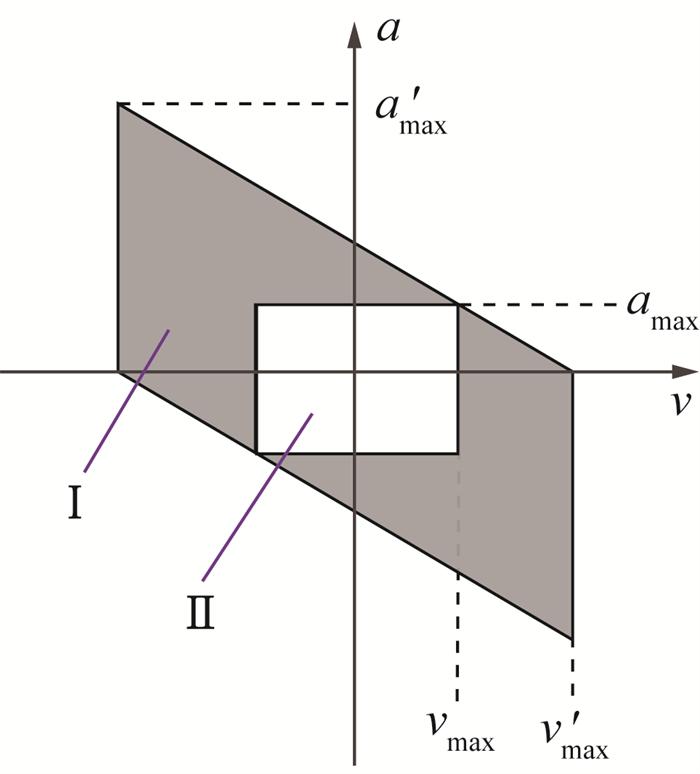
PMSTLM工作域是由系统电流约束决定的理论力矩边界,其中$a^{\prime}{ }_{\text {max }}$ 和$v^{\prime}{ }_{\text {max }}$ 分别为理论力矩边界对应下的最大加速度和最大速度。基于式(4)和(5),力矩约束下速度、加速度关系如图 5所示,可以看出力矩约束下的PMSTLM工作域Ⅰ的面积大于运动学约束对应的工作域Ⅱ的,电机的驱动性能得到进一步发挥。
2 改进指数型加减速规划
2.1 传统指数型加减速规划
传统指数型加减速规划,通过给定行程l、极限速度vc、初速度vs、中止速度ve、amax、dmax,得到时间常数T1和T2、比例系数α、加速段终止时间t1、匀速段终止时间t2、行程总时间t3,确定加速段位移s1、减速段位移s2,当s1+s2≤l时完成全行程的速度规划。全行程速度方程见式(7),具体规划流程如图 6所示。
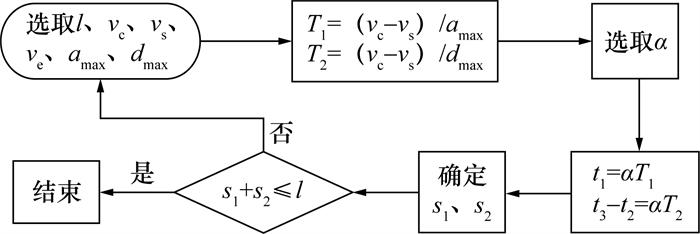
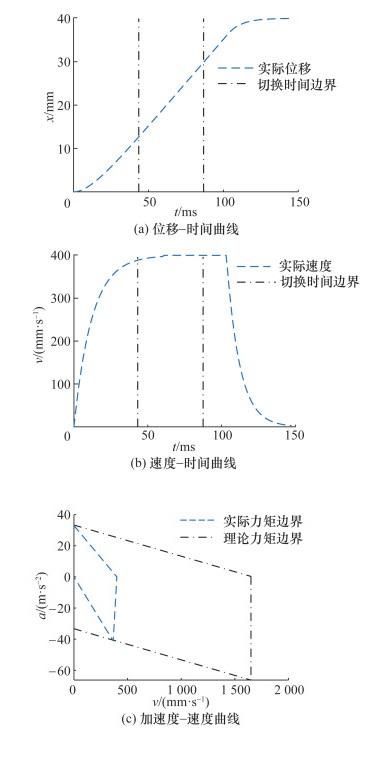
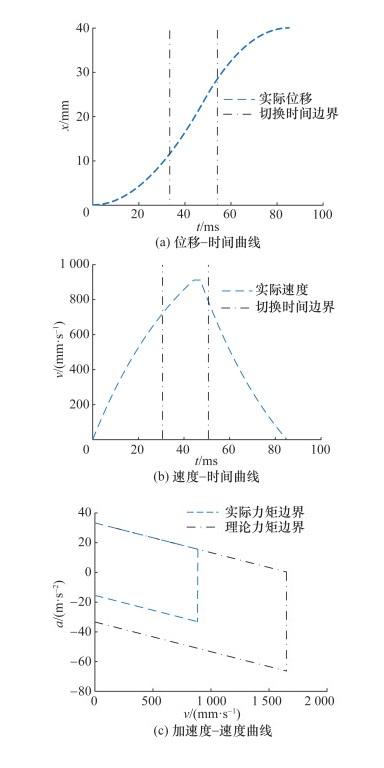
由图 6可知,amax、vc、α决定t1、s1,该规划方式不能准确将速度波峰定位于中间位移段,即传统指数型加减速规划不能优化电机行程中间位移段切换时间。由式(7)可知,加速段转变为匀速段时,存在速度阶跃。α越大,阶跃越小,但s1随之增加。若在较高vc下控制s1,则需要选取较小的α,速度阶跃过大。因此,各参数之间的强关联性,使该规划方式难以实现PMSTLM特定行程要求。传统指数型加减速规划曲线如图 7所示。可以看出,加速阶段向匀速阶段转变时,加速度变化较小,但是最大速度较小,导致该速度规划不满足切换时间要求;从加速度—速度曲线可以看出,实际力矩边界远小于理论力矩边界,无法充分发挥电机的驱动能力。
2.2 基于力矩边界的改进指数型加减速规划
为了解决传统指数型加减速规划算法在本文中的局限性,通过PMSTLM力矩边界来改进指数型加减速规划,充分利用电机的驱动性能。基于式(4)和(5),力矩边界为
根据式(7),利用常微分方程求指数型加减速公式,可得到加速阶段运动公式为
减速阶段的运动公式为
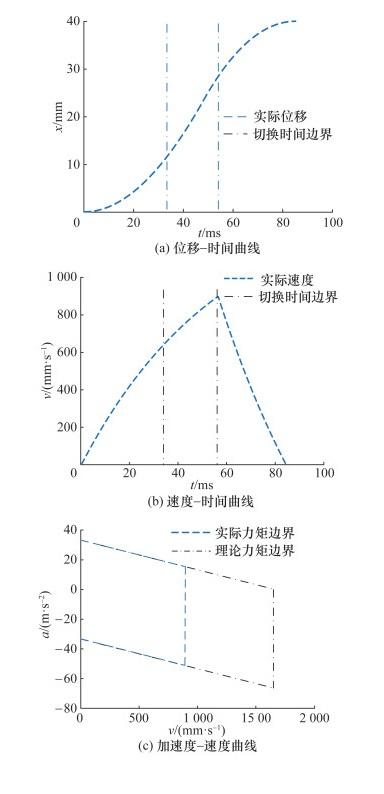
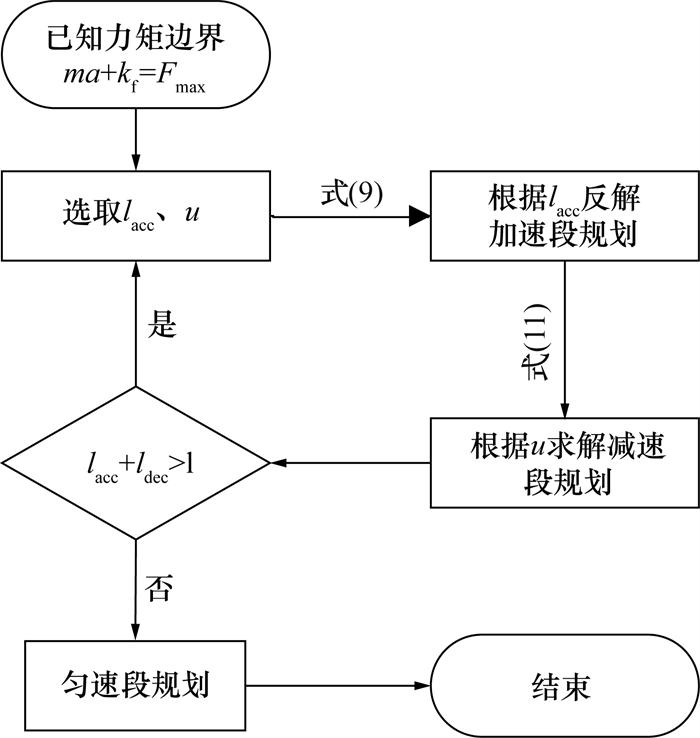
首先根据力矩约束,利用常微分方程数值求解指数型加减速公式,可以得到加速阶段,减速阶段的运动公式(8)和(9);通过设置$l_{\mathrm{acc}}$ 反求加速阶段的最大速度,运行时间;进而根据选定的$u$ ,来确定减速段的速度方程及位移,减速段的运动公式见式(10);通过加减速段位移之和与$l$ 的比较,来确定匀速段的运动情况,完成全行程速度规划。
由此,得到改进指数型加减速规划流程如图 9所示。
2.3 能耗、切换时间的速度规划离散模型
为了实现中间位移段尽可能利用速度波峰,引入$l_{\text {acc }}$ 和$u$ ,通过迭代搜索优化全行程能耗$E$ 和切换时间$\tau$ 。
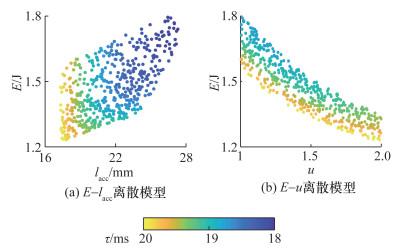
离散模型的整体趋势表明,能耗越小,其对应的切换时间越大,能耗与切换时间是一对互相矛盾的优化量。局部范围内,可以通过改变lacc和u,付出较小的切换时间代价,获得较高的能耗优化。
3 能耗、切换时间速度规划模型的多目标优化
3.1 能耗、切换时间的多目标优化
本文采用第二代非劣排序遗传算法(NSGA-Ⅱ) 对lacc、u进行求解。NSGA-Ⅱ引入快速非支配排序算法、精英策略和拥挤度比较算子,能够提高种群的多样性和优化结果的准确性。同时具有运行速度快、解集收敛性好等优点,在处理多目标优化问题时具有显著的优势。建立优化数学模型如下:
使用NSGA-Ⅱ进行优化计算,种群数量取12,进化代数取20,交叉指数取10,变异指数取20,交叉概率取0.95。虽然在全行程能耗中引入lacc和u降低了各参数的相关性,但是离散模型中往往存在奇点,即给定的一组优化参数不存在符合约束条件的优化结果。如果直接使用NSGA-Ⅱ,在进行迭代寻优时,往往会导致算法中断而失去寻优能力。因此需要建立连续的能耗、切换时间优化模型。
3.2 能耗、切换时间优化模型
本节利用速度规划中$l_{\mathrm{acc}}, ~ u$ 与$E, ~ \tau$ 之间的映射关系,建立连续的能耗,切换时间优化模型,映射关系表达式如下:
其中f1和f2表示映射函数。根据改进指数加减速规划算法框图可知,该映射函数难以直接求解。因此,本节采用优化拉丁超立方试验设计,在lacc和u取值范围内抽取1 000组样本点,取其中745组有效值作为代理模型数据,利用最小二乘法拟合,得到能耗、切换时间优化模型。使用决定系数R2和均方根相对误差RMSE验证模型拟合精度。R2越接近1,RMSE越接近0,拟合精度越高。拟合精度结果见图 11,是以系统仿真结果为横坐标,以模型近似结果为纵坐标的样本点散点图。结果表明,R2非常接近于1,RMSE非常接近于0,散点均靠近中间对角线,说明能耗—切换时间速度规划模型拟合精度较高,能准确反映输入和输出之间的映射关系。
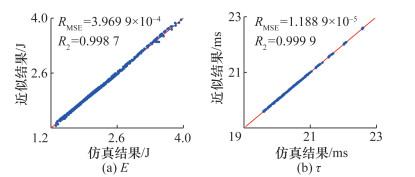
利用式(11),得到能耗、切换时间优化模型参数的近似表达式如式(12)所示;基于式(12),绘制E、τ的函数图像如图 12所示。
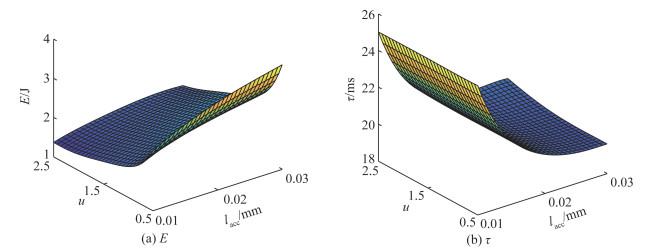
能耗、切换时间优化模型表明:$l_{\text {acc }}$ 取越小,$u$ 取越大,则$E$ 越小;$l_{\mathrm{acc}}$ 取越大,$u$ 取越小,则$\tau$ 越小。连续的能耗、切换时间优化模型变化趋势基本与离散模型的一致。
3.3 多目标优化结果分析
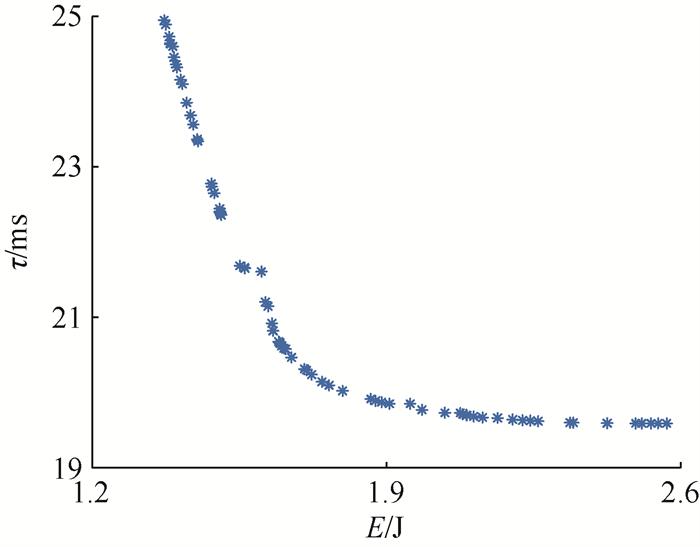
基于3.2节的能耗、切换时间优化模型,使用NSGA-Ⅱ,得到由82组非劣解组成的Pareto前沿,如图 13所示。
3.4 实验对比验证
4 结论
本文提出了一种基于速度规划的多叶光栅直线电机能耗优化方法。首先引入动摩擦系数得到力矩边界,提出改进指数型加减速规划(IESP);然后引入加速距离、减速特性系数,建立能耗、切换时间的速度规划模型,使用NSGA-Ⅱ开展全行程能耗最小和切换时间最短的多目标优化。理论研究和实验验证表明,该方法能够通过选择合适的加速距离、减速特性系数,使得切换时间对应的中间位移段能够更有效地利用速度波峰;基于能耗、切换时间优化模型选择合适的优化参数,能够在保证切换时间满足多叶光栅性能的前提下降低能耗。


