

微重力实验通常成本昂贵且操作条件严苛[10],而数值模拟方法在研究微重力火焰方面表现出成本更低且更方便进行参数化研究的优势。Charest等[11-12]分别针对甲烷/空气和乙烯/空气同轴射流扩散火焰进行了常重力和微重力条件下的数值模拟,发现在微重力条件下火焰温度更低,碳烟浓度更高; 随着压力的增大,微重力条件下火焰的高度明显升高。远洪亮等[13]研究了重力对甲烷/空气同轴射流扩散火焰中碳烟的影响,发现微重力条件下的火焰温度更低,碳烟峰值浓度增加至常重力条件下的2倍,同时碳烟生成位置向火焰外侧移动。Bhowal等[14]通过瞬态模拟研究发现微重力条件下火焰温度与碳烟浓度达到稳定所需的时间比常重力与0.5倍重力下长得多,且碳烟的表面生长与凝并更加剧烈。Dobbins等[15]结合实验与模拟方法研究发现,虽然重力对2种不同尺寸燃烧器中火焰的形状及温度的影响规律相似,但对尺寸较大燃烧器中火焰的影响更为显著。
本文以乙烯/氧气/氩气火焰为例,建立了多元扩散燃烧器的计算模型,通过数值模拟研究多元层流扩散火焰在不同重力条件下的结构区别,并比较压力、氧气体积分数2种因素在微重力和常重力条件下对该多元扩散火焰结构的影响,同时分析其与同轴扩散火焰变化规律的异同。
1 计算模型与方法
1.1 燃烧器几何结构与工作条件
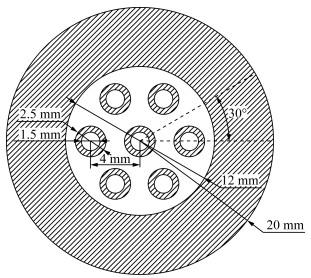
本文研究一种多元扩散燃烧器产生的乙烯层流扩散火焰。燃烧器气体出口截面的几何结构如图 1所示,由图可知,中心分布7根乙烯燃料管道,内径为1.5 mm,外径为2.5 mm; 管道两两间距为4 mm; 氧气经由乙烯管道周围内径为12 mm的通道通入,在出口处设有多孔塞使其出流速度均匀分布; 燃烧器整体被外径40 mm的圆筒形支撑结构固定。由于燃料管道的正六边形分布,燃烧器整体分别对称于2个夹角为30°的面,如图中虚线所示,一个对称面穿过乙烯管道中心,由于其平行于x-z平面,后续简称为x-z对称面; 另一个对称面则穿过两管道间的空隙。
在所有工况下,气体流量均为标况(压力为101 325 Pa,温度为298 K),环境温度保持为300 K,重力加速度g分别设置为0(微重力条件)、2.0、5.0、9.8(常重力条件)m/s2,环境压力pa设置为50、100、200、500 kPa。此外,为了研究氧气体积分数对火焰的影响,将氧气在通入前与氩气按照一定比例混合,使得氧气的体积分数φO2在0.25~ 1.00范围内变化。在研究重力与压力影响时,乙烯的总流量Qf为100 mL/min,氧气和氩气的总流量Qox为240 mL/min,在标准状况下乙烯和氧气的平均流速分别为13.5和5.1 cm/s,该条件下的Reynolds数远远小于湍流转捩值,因此火焰均为层流扩散火焰; 研究φO2的影响时,将Qf降至50 mL/min,其余条件保持不变。各工况汇总于表 1中。
表 1 计算工况汇总 |
| 组别 | Qf/(mL·min-1) | Qox/(mL·min-1) | g/(m/s2) | pa/kPa | φO2 |
| Ⅰ | 100 | 240 | 9.8、5.0、2.0、0 | 100 | 1.00 |
| Ⅱ | 100 | 240 | 9.8、0 | 50、200、500 | 1.00 |
| Ⅲ | 50 | 240 | 9.8、0 | 100 | 0.25、0.50、 0.75、1.00 |
1.2 计算域与边界条件
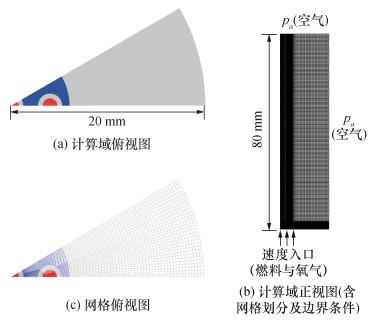
此外,为了在竖直方向得到完整的火焰信息,计算域的高度设为80 mm。计算域正视图如图 2b所示,各边界条件已标出,其中压力入口与出口的环境气设为空气以模拟空气气氛中的燃烧(假设火焰半径小于20 mm,边界处只有空气组分); 乙烯出口流速设为充分发展的管道流动,即流速仅与管道中心距离有关,沿径向呈抛物面形分布; 氧气出口流速设为均匀分布。所有气体的初始温度设为300 K,壁面设为绝热黑体。
1.3 数值模型与方法
求解的控制方程包括连续性方程、动量方程、能量方程和传质方程。
所有气体组分简化为不可压缩理想气体,混合气体的密度ρ按照如下公式计算:
其中: p表示混合气体的压力,Yi和Wi分别表示气体i的质量分数和摩尔质量,n表示气体种类总数,T表示气体温度(本文中与火焰温度含义相同),Ru表示通用气体常数。
辐射换热使用离散坐标(discrete ordinate, DO)模型计算[23]。混合气体的吸收系数使用灰气加权求和模型(weighted-sum-of-gray-gases model, WSGGM)计算,即将所有能够吸收辐射的气体都简化为灰气,在一段距离s内的混合气体总发射率ε近似为所有不同种类灰气发射率的加权总和。
针对物质扩散过程,扩散通量使用Fick扩散定律进行计算。
其中:Ji表示气体i的扩散通量,Di表示其质量扩散率。化学反应速率使用有限速率模型(finite-rate model)计算,即对于反应n,其化学反应式及参与该反应的气体i的反应速率$\hat{R}_{i, n}$计算式如下:
其中:$\nu_{i, n}^{\prime}$ 和$\nu_{i, n}^{\prime \prime}$分别表示反应物与产物的化学计量数,Mi表示气体i的化学式,kf, n表示反应速率常数,Cj, n表示气体j的物质的量浓度(单位为kmol/m3),η′j, n表示反应物的速率指数,Γ则为第三体的净影响因子。kf, n使用Arrhenius公式计算如下:
其中:An表示指前因子,βn表示温度指数,En表示反应活化能,三者均为常量。
利用ANSYS Fluent 22.0软件进行数值模拟。控制方程使用有限体积法离散,其中连续性方程采用二阶格式,其余方程采用二阶迎风格式; 使用Coupled算法对压力与速度场耦合求解。
1.4 网格无关性验证
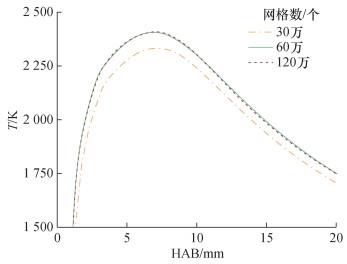
1.5 火焰轮廓计算方法
为了定量比较不同工况下的火焰形状,本研究使用混合分数Z来表征火焰形状。具体而言,定义Z等于化学当量值的位置为火焰轮廓。
对于乙烯燃烧,使用Bilger[28]提出的方法(见式(7))对Z进行计算,并在此基础上获得当乙烯与氧气按照化学当量比混合时的计算式(见式(8))。
其中:YC、YH、YO分别表示计算域内碳、氢、氧元素的质量分数,MC、MH、MO表示3个元素的摩尔质量; YO, 2、YC, 1和YH, 1分别表示氧气出口处的氧元素、燃料出口处的碳元素和氢元素的质量分数。
1.6 实验验证
2 计算结果与讨论
2.1 重力的影响
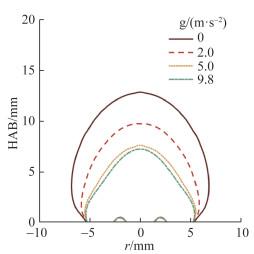
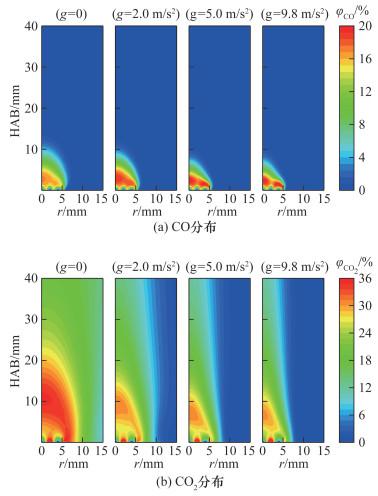
为了探明双层火焰的形成机制,总结了不同重力条件下CO和CO2体积分数(φCO和φCO2)的分布,如图 5所示。由图可知,CO主要分布在内、外层火焰之间,随着HAB的增加,φCO整体呈现先增大后减小的趋势; CO2则集中在内、外层火焰处生成,在2层火焰之间的φCO2偏低。这表明火焰内的反应分为3个阶段:乙烯与氧气首先混合反应生成CO和部分CO2,形成内层火焰; 在2层火焰之间,CO2受高温影响被碳氢中间产物还原为CO; 最后CO遇空气反应生成CO2,形成外层火焰。
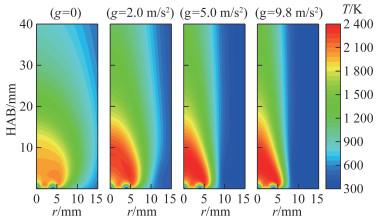
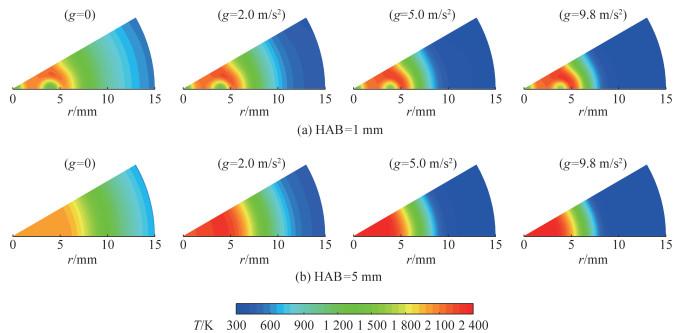
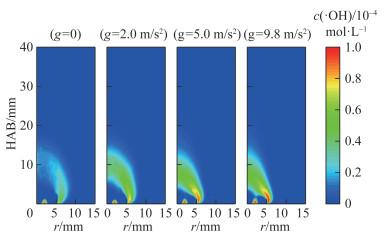
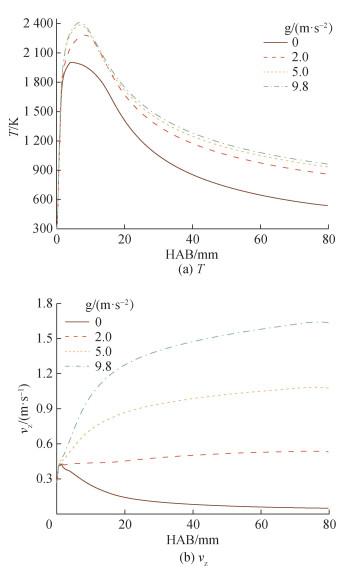
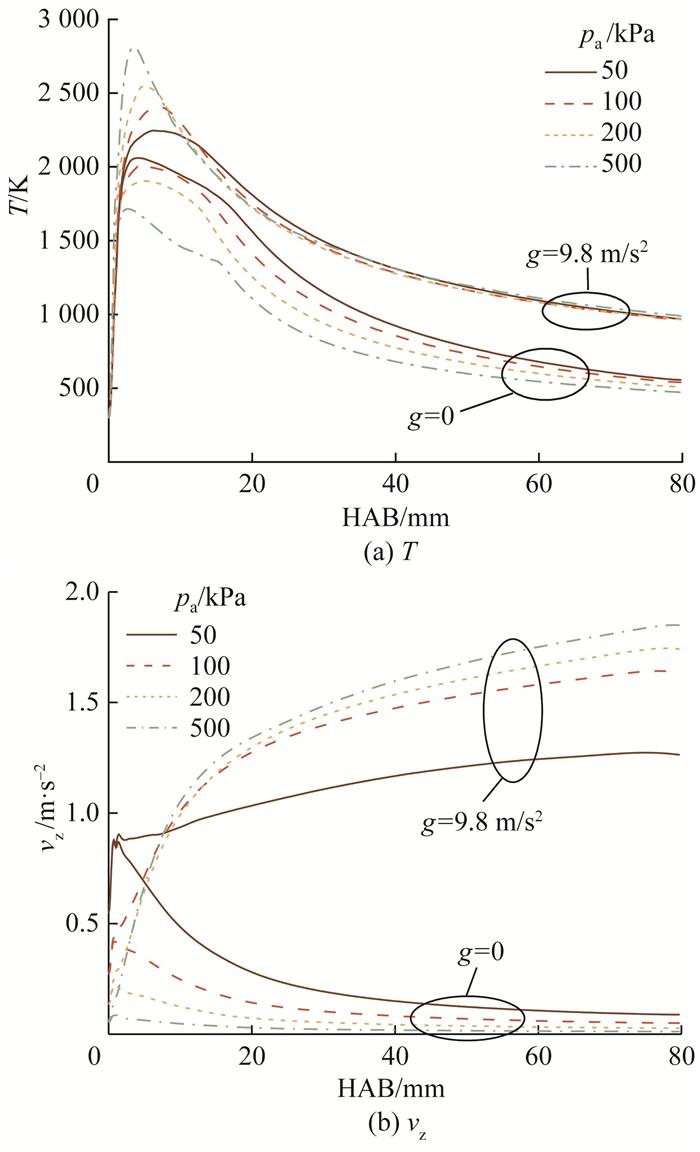
为了进一步分析g的改变对T和停留时间的影响,绘制了中轴线上的T与气体轴向速度vz随HAB的变化曲线,如图 9所示。微重力条件下的辐射热交换的影响变得更加显著,气体温度在达到峰值后的下降梯度增大(见图 9a),这是由于重力的存在使高温气体受到浮力作用加速上升,g越大则气体的上升速度越快,导致停留时间缩短(见图 9b),加速了燃料与空气的混合过程,从而加快反应速率,使外层火焰高度降低,宽度减小。此外,图 9a中g=0曲线的温度峰值在HAB=4.5 mm处,明显低于火焰高度,结合图 8可发现,重力存在时浮力使火焰收缩、对流传质增强,从而提高了反应速率,而微重力条件下由于停留时间的增长,辐射换热量增加,同时反应速率的降低使得放热速率减小,因此中心温度的峰值位置明显向底端移动[11]。
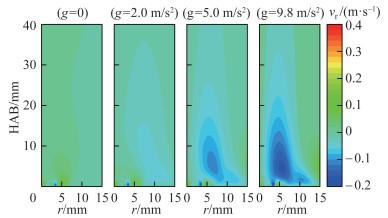
从以上分析可知,由于浮力的消失,微重力条件下的火焰在流场结构及反应速率等特性上与其他重力条件下存在较大差异。因此,在分析pa与φO2的影响时,选取微重力(g=0)及常重力(g=9.8 m/s2)这2种条件进行计算比较。
2.2 环境压力的影响
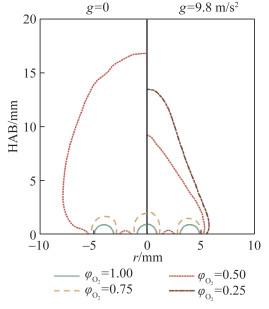
为了研究常重力与微重力条件下pa的改变对火焰形态的影响,计算了表 1中第Ⅱ组工况的乙烯火焰,并结合第一组工况的计算结果进行比较。利用Z所绘制的火焰轮廓如图 11所示。由图的右半侧可以看出,在常重力下外层火焰的高度由50 kPa时的10.0 mm降至200 kPa时的5.1 mm,内层火焰则由0.5 mm升至0.8 mm; 当pa升至500 kPa时火焰已不再具备双层结构,而是分离至每个乙烯出口的上方,其中心火焰高度为3.4 mm。这一规律与同轴射流扩散火焰的结果显著不同:在保持质量流量不变的条件下,后者的高度随pa增加而升高[12, 30]。水平方向上,外层火焰的宽度随着pa的增大而减小,这与同轴射流扩散火焰的结果类似:pa的增大加强了浮力的作用,使得火焰面被推向中心线,因此外层火焰的宽度减小[12, 31-32]。
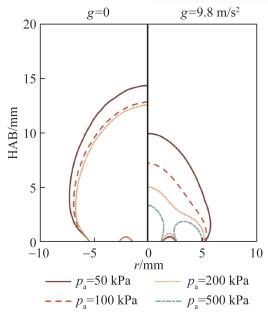
由图的左半侧可以看出,微重力条件下的外层火焰高度整体上比常重力条件下的明显升高。随着pa由50 kPa增至200 kPa,外层火焰高度由14.4 mm降至12.6 mm,宽度也有所减小。当pa增大至500 kPa时,计算发现火焰由尖端封闭转变为尖端开口,此时由于火焰轮廓在尖端处不连续,式(7)和(8)给出的火焰轮廓判定方法不再有效[28]。
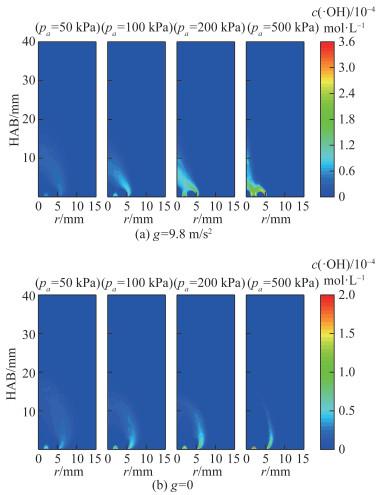
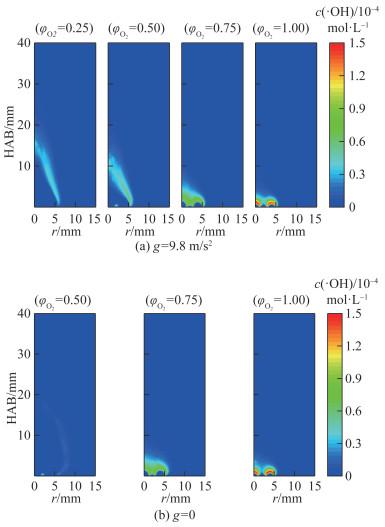
为了进一步研究火焰形态和反应速率随pa的变化规律,绘制了在常重力和微重力条件下的c(·OH) 的分布,如图 12所示。由图可知,不论是常重力还是微重力条件下,压力的增加使得各气体组分的物质的量浓度增加,火焰内的反应速率加快,因此火焰高度均随pa的增加而降低。从图 12a可见,在常重力条件下,随着pa增加,由于浮力作用的增强,在回流区将火焰进一步压缩,反应速率显著提高,因此常重力下火焰宽度也有明显下降。从图 12b可见,当pa增加至500 kPa时,微重力条件下·OH的分布区域在中轴线附近断开,这表明火焰由尖端封闭转变为尖端开口。与同轴射流扩散火焰类似,这一现象是由于高压条件下的气体出口流速减小,导致辐射换热量增加,沿流动方向的温度损失增加,因此在火焰面尖端反应速率降低乃至熄灭,发生开口的现象[2, 8]。
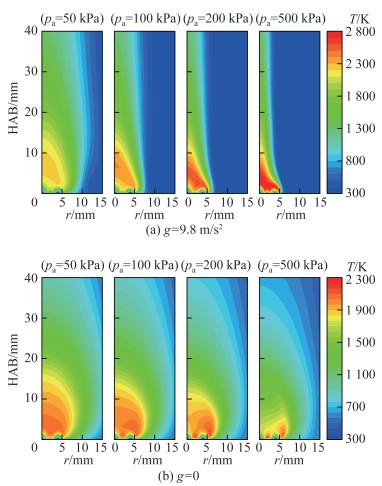
不同pa下火焰在x-z对称面上的温度分布如图 13所示。在常重力条件下,随着pa增大,火焰峰值温度从2 260 K提升至2 850 K,这是由于火焰内反应速率加快,放热量增加; 而在微重力条件下,一方面受辐射作用,火焰峰值温度明显低于常重力火焰; 另一方面火焰的峰值温度随pa的增大由2 080 K升至2 160 K,仅增加80 K。此外,在微重力条件下,随着pa增大,峰值的位置发生了明显的转移:由火焰中心处转移至根部及外侧,这是气体出口流速减小,反应区域整体降低导致的。
2.3 氧气体积分数的影响
由于在微重力条件下,保持Qf为100 mL/min所产生的火焰超出了计算域的范围,即不满足1.2节中应用压力入口边界条件的假设,因此在研究φO2值对火焰形态的影响时将乙烯的流量调整为50 mL/min (表 1中第Ⅲ组工况),随后按照式(7)和(8)计算得到该工况下的4种火焰轮廓如图 15所示。由图可知,火焰高度整体上随φO2降低而升高,但按照φO2的不同火焰呈现2种主要形态:当φO2=0.75, 1.00时当量比小于1时为贫燃燃烧,火焰表现为分布在乙烯出口上的小火焰,此时g对火焰高度的影响很小,微重力情况下中心火焰的高度略微降低,而周围火焰的高度则略微升高; 当φO2=0.25, 0.50时当量比大于1时为富燃燃烧,此时火焰分为内、外2层,φO2=0.50时重力的消失使得外层火焰高度由9.3 mm升至16.9 mm。当φO2降低至0.25时,微重力火焰在水平方向超出计算域,因此舍弃该情况下的计算结果。
为进一步研究反应速率的变化趋势,绘制了不同条件下c(·OH)的分布,如图 16所示。由图可知,当φO2为0.75和1.00时,·OH的分布区域集中于乙烯出口上方,当φO2为0.50时,·OH的分布区域则分为2层,这与火焰轮廓的形状一致。不论何种重力条件下,随着φO2增加,燃烧反应发生区域越来越集中,反应速率也相应增加。由常重力火焰变为微重力火焰时,双层火焰中的c(·OH)明显减小,而分离火焰中的c(·OH)几乎不变,这表明富燃火焰的反应速率随g的减小而减小,而贫燃火焰的反应速率则没有明显变化。
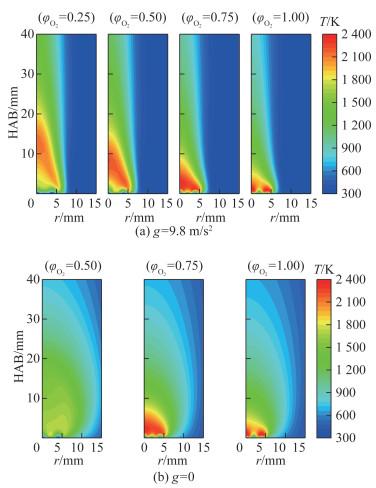
此外,绘制了不同φO2条件下的T分布,如图 17所示。由图可知,常重力条件下,火焰峰值温度随着φO2的增加而升高,从2 160 K逐渐升高至2 410 K,这是φO2升高使乙烯的反应速率加快导致的; 同样,微重力条件下T也随φO2的增加而升高,但从1 795 K升高至2 390 K,升高近600 K。在φO2相同时,常重力下的贫燃火焰的峰值温度高于微重力下的,差异小于10 K; 但当φO2=0.50时富燃火焰在微重力条件下的峰值温度比常重力条件下降低了360 K,其受g影响更显著。
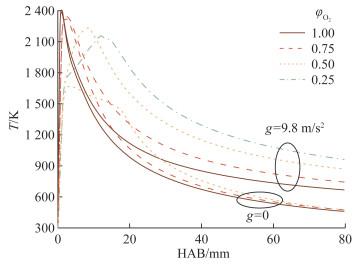
为比较不同φO2条件下辐射换热的影响,绘制了中心温度随HAB的变化曲线,如图 18所示。由图可知,自燃烧器出口起的一段距离内,由于乙烯与氧气迅速混合燃烧,火焰温度快速上升。此后,对于贫燃火焰,温度直接上升至峰值后开始下降,由于在火焰内的停留时间较短,因此辐射影响可忽略,峰值温度几乎相同; 对于富燃火焰,常重力条件下受浮力影响,高温气体自内层火焰流至外层火焰的时间较短,辐射换热量较小,相比之下,微重力火焰中高温气体停留时间显著增长,因此内、外层火焰之间的辐射换热量增加,同时反应速率减慢,导致温度在2层火焰间随着HAB的变化趋势在常重力条件下为升高,在微重力条件下为降低。这表明富燃火焰的双层结构受辐射影响更加显著,因此微重力条件对T的影响比常重力条件下的更显著。
3 结论
本文通过数值模拟方法研究了不同重力条件下乙烯/氧气/氩气多元层流扩散火焰的结构差异,对比分析了微重力条件和常重力条件下,压力和氧气体积分数对火焰结构的影响。主要结论如下:
1) 该多元扩散火焰的形态与当量比和压力相关,常压及富燃火焰形成双层火焰,其中内、外层分别由乙烯、CO燃烧产生; 高压及贫燃火焰变为分离于燃料出口处的小火焰;
2) 微重力条件对火焰的影响主要包括2个方面:一是增加气体的停留时间,增强辐射换热的作用,使火焰温度显著降低; 二是消除浮力所产生的回流区,传质方式由对流为主变为扩散为主,使得火焰高度升高、宽度增加;
3) 在常重力条件下,压力的增大一方面增加了浮力作用,使得火焰高度降低,宽度减小; 另一方面也增加了反应各组分浓度,加快燃烧速率。而在微重力条件下,压力的增大使气体流速减小,反应区位置下降,且辐射的作用显著增强。当压力增至500 kPa时,由于尖端温度过低,火焰尖端发生开口;
4) 火焰高度随氧气体积分数减小而升高。贫燃火焰的结构与温度受重力影响较小; 富燃火焰的结构受辐射影响显著,在微重力条件下的火焰温度明显降低。


