Frontiers in New-Quality Communication Technology

Construction of small-cycle-free QC-LDPC codes by integrating DDS and row-weight extension

  • Jiayu SHE ,
  • Guohua ZHANG , *
Expand
  • School of Communications and Information Engineering, Xi'an University of Posts and Telecommunications, Xi'an 710121, China

Received date: 2024-12-02

  Online published: 2025-11-07

Copyright

All rights reserved. Unauthorized reproduction is prohibited.

Abstract

Objective: Quasi-cyclic low-density parity-check (QC-LDPC) codes are a class of channel codes known for their quasi-cyclic structure and sparse parity-check matrices. They have attracted significant attention due to their relatively simple hardware implementation and superior decoding performance. However, short cycles—particularly four and six cycles—can severely degrade the decoding performance of QC-LDPC codes. A key challenge in current LDPC code construction research is designing QC-LDPC codes with flexible circulant sizes and column weights while eliminating four and six cycles. Existing methods to eliminate short cycles can be broadly divided into two categories: search-based and explicit methods. Search-based methods provide parameter flexibility but involve high descriptive complexity. In contrast, explicit methods construct QC-LDPC codes directly through formulas, resulting in low descriptive complexity. In recent years, several explicit methods based on combinatorial mathematics have been introduced, with disjoint difference sets (DDS) playing a central role in constructing QC-LDPC codes free of four and six cycles. However, existing methods cannot simultaneously achieve the elimination of four and six cycles, support diverse column weights, and offer flexible circulant sizes. To address this gap, this study proposes an explicit construction method for QC-LDPC codes based on DDS that satisfies all three requirements. Methods: This study integrates DDS with row-weight extension (RE) techniques to propose a new construction method termed DDS-RE. First, the existence of four and six cycles in the Tanner graph corresponding to the new construction is analyzed using cycle control equations. Second, the flexibility of circulant size selection in the new construction is compared with the original DDS method. Finally, bit error rate (BER) and block error rate (BLER) performances of the newly constructed QC-LDPC codes are evaluated through simulations using the sum-product algorithm (SPA) and compared with several representative explicit methods: the greatest-common-divisor (GCD), Golomb ruler (GR), Sidon sequence (SS), and the original DDS methods. Additionally, decoding performance is compared with two construction methods incorporating RE techniques (GCD-RE and SS-RE). Results: This study rigorously proves, using cycle control equations, that the Tanner graph of the QC-LDPC codes constructed by the new method is free of four and six cycles. Analysis reveals that, compared with existing DDS methods, the newly proposed DDS-RE method enables smaller circulant sizes, particularly for larger column weights, where circulant size flexibility is significantly enhanced. Simulation results of decoding performance demonstrate that the new codes outperform GR codes in the high signal-to-noise ratio (SNR) region while also offering flexible column weights and circulant sizes. They also perform comparably to DDS-based codes but with the added advantage of circulant size flexibility. Furthermore, the DDS-RE codes significantly outperform those constructed by the GCD and GCD-RE methods. In high SNR regions, they also slightly surpass SS-RE codes while benefiting from flexible circulant sizes. Conclusions: By combining the DDS method with RE techniques, this study presents a new explicit construction method for QC-LDPC codes—DDS-RE. The resulting codes are guaranteed to be free of four and six cycles and support flexible circulant sizes. Compared with existing explicit methods and other RE-based methods, DDS-RE constructs codes with excellent performance while simultaneously achieving the elimination of four and six cycles, diverse column weights, and flexible circulant sizes. This study offers new insights into the explicit construction of high-performance QC-LDPC codes.

Cite this article

Jiayu SHE , Guohua ZHANG . Construction of small-cycle-free QC-LDPC codes by integrating DDS and row-weight extension[J]. Journal of Tsinghua University(Science and Technology), 2025 , 65(11) : 2105 -2111 . DOI: 10.16511/j.cnki.qhdxxb.2025.27.036

低密度奇偶校验(low-density parity-check, LDPC)码是一种译码性能可以非常接近Shannon极限的信道编码。作为LDPC码中的一类特殊类型,准循环(quasi-cyclic, QC)LDPC码因其编码结构简单、性能优越且易于硬件实现,逐渐受到信道编码领域越来越多的关注[1-2]。围长被用来衡量Tanner图中的最短环长度,是影响QC-LDPC码性能的重要指标。因此,增加围长是构造具有良好性能的QC-LDPC码的主流方法之一[3-7]。常见的构造方法大致可以分为2类:计算机搜索方法[8-9]和显式构造方法[10-14]。计算机搜索方法参数选择灵活,但描述复杂度较高;显式构造方法能够直接构造QC-LDPC码,且具有更低的描述复杂度。近年来,基于组合数学的几种显式构造方法已被提出[5-7, 10]。Esmaeili等[10]提出了一种基于差集的无4环QC-LDPC码,但仍存在6环。Kim等[5]采用Golomb尺(Golomb ruler, GR)构造了无4环和6环的QC-LDPC码,但列重限制为3。Zhang等[6]通过Sidon序列(Sidon sequence, SS)提出了构造列重为4且无4环和6环的QC-LDPC码的方法,但循环尺寸较大,为4L2(L为奇偶校验矩阵每行的重量)量级。为了解决这一问题,Zhang等[7]提出了一种基于不相交差集(disjoint difference sets, DDS)的方法,生成了无4环和6环的列重为4的QC-LDPC码,其循环尺寸相对较小,为2L2量级。然而,DDS方法提供的循环尺寸仍然较大,这限制了该方法的应用。因此,上述方法在特定情况下各有优势,但难以同时满足以下3个特征:无4环和6环、列重具备多样性、灵活且较短的循环尺寸。
本研究通过结合DDS方法与行重扩展(row-weight extension, RE)[15]技术,提出了一种新的构造方法DDS-RE,可提供同时具有上述3种特性的新型QC-LDPC码。为了验证其译码性能,针对比特错误率(BER)和块错误率(BLER)指标,将DDS-RE方法构造的码与以下5种方法构造的码进行了对比:1) GR方法[5];2) DDS方法[7];3) 最大公约数(greatest-common-divisor, GCD)方法[16-17];4) SS和RE结合(SS-RE)的方法;5) GCD和RE结合(GCD-RE)的方法。

1 理论基础

1.1 QC-LDPC码

LDPC码是一种线性分组码,其奇偶校验矩阵(parity-check matrix, PCM)非常稀疏。在LDPC码中,如果PCM每列的重量为J,每行的重量为L,则这种编码称为(J, L)-规则LDPC码。PCM可以通过一种特殊的二部图,即Tanner图,进行图形化表示。Tanner图中的短环通常被认为是影响编码性能的主要因素之一,其中最短环的长度称为围长(girth, g)。如果LDPC码的PCM由相同大小的循环块构成,则该码称为QC-LDPC码,这种结构使其编码器和译码器在硬件实现上更为简单。因此,如何构造具有较大g的QC-LDPC码尤其受到关注。QC-LDPC码的PCM和环可以通过一个非常小的矩阵(称为指数矩阵E)和循环尺寸P来紧凑地描述[7]

1.2 DDS序列

首先选择集合Ζv={0, 1, 2, …, v-1}。然后产生tZv的子集{d1, d2, …, dt},每个子集中包含k个元素。如果式(1)表示的tk(k-1)个差值互不相同,则{d1, d2, …,dt}构成DDS,用三元组(v, k, t)表示并记作(v, k, t)-DDS。
$\begin{array}{c} \left\{d_{i}(r)-d_{i}(s) \mid 0 \leqslant r \neq s \leqslant k-1 ; 1 \leqslant i \leqslant t\right\} \\ ({\text{mod}}\; v) . \end{array}$
其中:di(r)和di(s)为子集di中的第r个和第s个元素,mod v为运算结果对v取模。
构造DDS的方法主要分为:显式构造法[11]和随机搜索法[8]。DDS的常用性质如下:
性质1:(v, k, t)-DDS满足vtk(k-1)。
性质2:如果{d1, d2, …, dt}是一个(v, k, t)-DDS,那么对于任意整数b,{d1+b, d2+b, …, dt+b}(mod v)也是一个(v, k, t)-DDS。
性质3:1) 每个子集中的所有元素在mod v下均不同;2) 子集内各元素之间的差值在mod v下均不同;3) 一个子集内任意两元素之差在mod v下与另一个子集中任意两元素之差均不同。

2 基于DDS-RE的新型QC-LDPC码构造

本研究将DDS方法与RE技术相结合得到DDS-RE方法,其构造出的新型QC-LDPC码可以达到和DDS方法相比拟的性能,但在P的覆盖范围上更加广泛。
现有常用的QC-LDPC码构造的通用技术包括掩膜技术(masking)[16]、列分割(column-splitting, CS)[17]和中国剩余定理(Chinese remainder theorem, CRT)[18]等。这些通用技术可以提高代数或随机方法生成的码的译码性能或参数灵活性。相比之下,RE技术由于以往没有发现匹配度高的基础码,受到的关注相对较少。本研究探究了RE技术与DDS方法的结合,为构造具有灵活P和优异译码性能的新型码提供了新思路。
RE技术在QC-LDPC码的构造中有以下性质(上文已有性质1—3,为了全文连贯性,以下承接编号为性质4):
性质4[15]:假设C1是一个满足g≥8且循环尺寸为P1的(J, L1)-规则QC-LDPC码;C2是一个满足g≥8且循环尺寸为P2的(J, L2)-规则QC-LDPC码。则存在一个g≥8且循环尺寸为P的(J, L)-规则QC-LDPC码,其中L=L1L2P=P1P2
下面简要证明该性质。
证明:根据RE技术,给定2个分量PCM,其指数矩阵表示为
$\begin{gather*}\boldsymbol{E}^{(x)}= \\\left(\begin{array}{cccc}e^{(x)}(0, 0) & e^{(x)}(0, 1) & \cdots & e^{(x)}\left(0, L_{x}-1\right) \\e^{(x)}(1, 0) & e^{(x)}(1, 1) & \cdots & e^{(x)}\left(1, L_{x}-1\right) \\\vdots & \vdots & & \vdots \\e^{(x)}(J-1, 0) & e^{(x)}(J-1, 1) & \cdots & e^{(x)}\left(J-1, L_{x}-1\right)\end{array}\right), \\x \in\{1, 2\} . \end{gather*}$
e(x)(i, rx)表示指数矩阵E(x)中第i行第rx列的元素。
复合PCM的指数矩阵可以表示为
$\boldsymbol{E}=\left(\begin{array}{cccc}e(0, 0) & e(0, 1) & \cdots & e(0, L-1) \\ e(1, 0) & e(1, 1) & \cdots & e(1, L-1) \\ \vdots & \vdots & & \vdots \\ e(J-1, 0) & e(J-1, 1) & \cdots & e(J-1, L-1)\end{array}\right).$
e(i, r)表示指数矩阵E中第i行第r列的元素,且被定义为
$\left\{\begin{array}{l}e(i, r)=P_{2} \cdot e^{(1)}\left(i, r_{1}\right)+e^{(2)}\left(i, r_{2}\right), \\r=r_{1} L_{2}+r_{2} .\end{array}\right.$
假设与E相关的Tanner图中存在一个4环,则可用下式表示该环:
$\left\{\begin{array}{l}e(i, r)-e(j, r)+e(j, s)-e(i, s)=0({\text{mod}}\; P) ; \\0 \leqslant i<j<J, 0 \leqslant r<s<L .\end{array}\right.$
因为e(i, r)=P2·e(1)(i, r1)+e(2)(i, r2),其中0≤iJ, 0≤rL,所以该环可以进一步表示为
$\begin{gathered}P_{2} \cdot\left[e^{(1)}\left(i, r_{1}\right)-e^{(1)}\left(j, r_{1}\right)+e^{(1)}\left(j, s_{1}\right)-\right. \\\left.e^{(1)}\left(i, s_{1}\right)\right]+\left[e^{(2)}\left(i, r_{2}\right)-e^{(2)}\left(j, r_{2}\right)+\right. \\\left.e^{(2)}\left(j, s_{2}\right)-e^{(2)}\left(i, s_{2}\right)\right] \\\triangleq P_{2} \cdot Q_{1}+Q_{2}=0({\text{mod}}\; P) .\end{gathered}$
因为P2P的因子,所以Q2=0(mod P2),而这仅在r2=s2的情况下成立,此时Q2=0。因此,P2·Q1=0(mod P)。然而,r2=s2意味着r1s1,所以Q1≠0(mod P1)。因此P2·Q1≠0(mod P)。矛盾。
假设与E相关的Tanner图中存在一个6环,则可用下式表示该环:
$\left\{\begin{array}{l}e(i, s)-e(j, s)+e(j, r)-e(k, r)+e(k, t)-e(i, t)=0({\text{mod}}\; P) ;\\0 \leqslant i<j<k<J, 0 \leqslant r, s, t<L, r \neq s, s \neq t, t \neq r.\end{array}\right.$
则该环可以进一步表示为
$\begin{aligned}& P_{2} \cdot\left[e^{(1)}\left(i, s_{1}\right)-e^{(1)}\left(j, s_{1}\right)+e^{(1)}\left(j, r_{1}\right)-e^{(1)}\left(k, r_{1}\right)+e^{(1)}\left(k, t_{1}\right)-e^{(1)}\left(i, t_{1}\right)\right]+\left[e^{(2)}\left(i, s_{2}\right)-\right. \\& \left.\quad e^{(2)}\left(j, s_{2}\right)+e^{(2)}\left(j, r_{2}\right)-e^{(2)}\left(k, r_{2}\right)+e^{(2)}\left(k, t_{2}\right)-e^{(2)}\left(i, t_{2}\right)\right] \triangleq P_{2} \cdot Q_{1}+Q_{2}=0({\text{mod}}\; P).\end{aligned}$
因为P2P的因子,所以Q2=0(mod P2)。接下来,分5种情况进行讨论:1) 当s2=r2=t2时,Q2=0。因此,P2·Q1=0(mod P)。然而,s2=r2=t2意味着s1r1t1是3个不同的整数,因此Q1≠0(mod P1),从而P2·Q1≠0(mod P),与P2·Q1=0(mod P)矛盾;2) 当s2r2t2取值互不相同时, Q2≠0(mod P2),与Q2=0(mod P2)矛盾;3) 当s2=r2t2时,Q2化简为一个4环表达式[e(2)(i, s2)-e(2)(k, s2)+e(2)(k, t2)-e(2)(i, t2)],此时Q2≠0(mod P2),与Q2=0(mod P2)矛盾;4) 当s2=t2r2时,分析过程与3)类似;5) 当r2=t2s2时,分析过程与3)类似。
以下通过一个示例具体说明RE技术的过程。
P1=12,由定义可知d={0, 3, 5}是一个(12, 3, 1)-DDS。根据DDS方法,定义E(1)=(0, 1, 2)T·(0, 3, 5)。使用式(5)中的矩阵作为E(2),其中P2=3。然后,根据式(3)将E(1)E(2)组合后生成一个复合PCM的指数矩阵E,如式(6)所示,其中P=P1P2=36。如果E(1)有4行,则可以采用式(7)中的矩阵作为E(2)。上述矩阵具体为
$\boldsymbol{E}_{1}^{(2)}=\left(\begin{array}{ll}0 & 0 \\0 & 1 \\0 & 2\end{array}\right), $
$\boldsymbol{E}=\left(\begin{array}{cccccc}0 & 0 & 0 & 0 & 0 & 0 \\0 & 1 & 9 & 10 & 15 & 16 \\0 & 2 & 18 & 20 & 30 & 32\end{array}\right), $
$\boldsymbol{E}_{2}^{(2)}=\left(\begin{array}{ll}0 & 0 \\0 & 1 \\0 & 2 \\0 & 3\end{array}\right) . $
与直接使用DDS方法和SS方法相比,DDS-RE方法提供了更灵活的P。为了构造一个(4, L)-规则QC-LDPC码,根据性质1,DDS方法的P需要大于2L(L-1);SS方法的P需要大于2L(2L-1)[6];新提出的DDS-RE方法根据上述构造过程仅需大于4·2(L/2)(L/2-1)。举例来说,若要构造一个(4, 12)-规则QC-LDPC码,采用DDS方法、SS方法和DDS-RE方法时P分别需大于264、552和240。
DDS方法和DDS-RE方法提供的最小循环尺寸Pmin图 1所示。由图可知:1) 在J=4的情况下,DDS-RE方法提供的Pmin小于DDS方法提供的Pmin;2) 在J=3的情况下,DDS-RE方法提供的Pmin远小于DDS方法提供的Pmin,并且随着行重L的增加这一差距变得愈发显著。因此,与原始DDS方法相比,本研究所提出的DDS-RE方法使P的选择更加灵活。
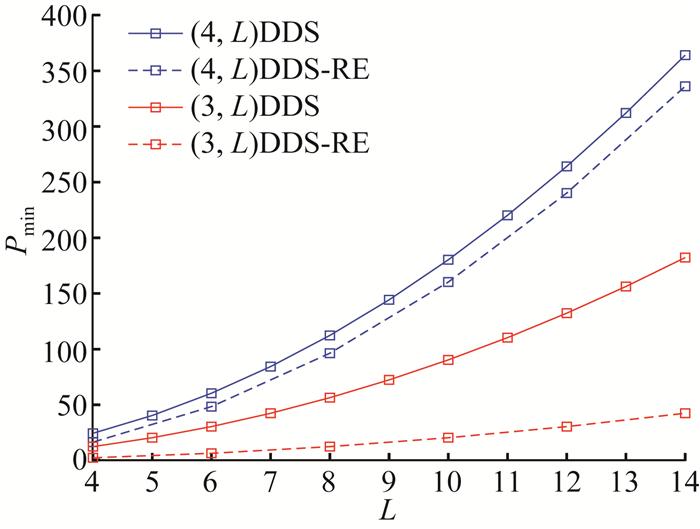
图 1 DDS方法和DDS-RE方法提供的最小循环尺寸随行重的变化

3 示例与仿真

在本节中,首先将DDS-RE方法与现有的GR、DDS、GCD方法以及将RE技术应用于现有的GCD和SS方法而获得的2种构造方法(分别称为GCD-RE和SS-RE)进行了比较。接着,比较了用DDS-RE方法构造的不同P的QC-LDPC码的性能。在所有仿真中,统一采用最大迭代次数为50的和积算法(sum-product algorithm, SPA)来对通过加性Gauss白噪声(additive white Gaussian noise, AWGN)信道传输的BPSK调制码字进行译码。

3.1 DDS-RE方法与GR方法的比较

本小节根据DDS-RE和GR方法构造了2个设计码率为1/2的QC-LDPC码,并对其BER和BLER指标进行了对比。
L=6,使用第2节式(6)对应的(3, 6)-规则QC-LDPC码作为DDS-RE构造的码。为了便于比较,将向量(0, 1, 2)T与(36, 6)-GR{0, 1, 8, 12, 14, 17}[5]相乘,生成了一个P为36的(3, 6)-规则QC-LDPC码作为对照。2种码的BER和BLER指标如图 2所示。由图可知,当比特信噪比SNR大于5 dB时,DDS-RE方法构造的码的BER和BLER指标优于GR方法构造的码。此外,DDS-RE方法能生成GR方法无法生成的码:例如使用(10, 3, 1)-DDS和本文所提方法可以构造出一个P为30的(3, 6)-规则QC-LDPC码,而GR方法的P需要大于30,因此在该情况下无法生成相应的码。
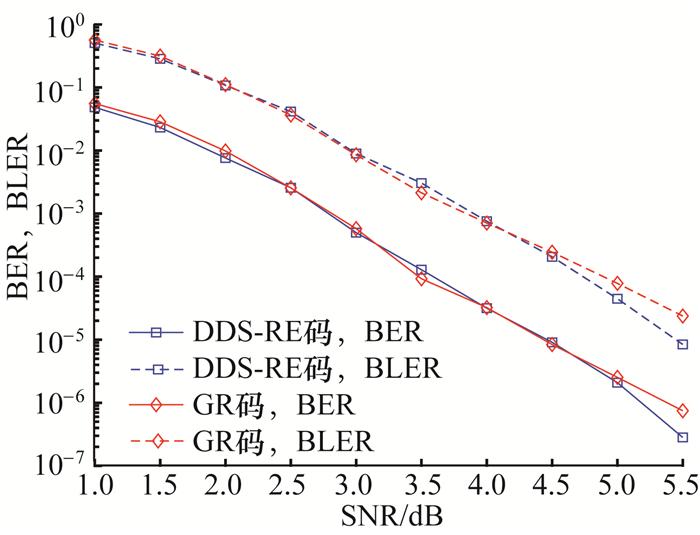
图 2 DDS-RE和GR方法构造的1/2码率(3, 6)-规则QC-LDPC码性能比较(P=36)

3.2 DDS-RE、DDS和GCD方法的比较

本小节使用3个示例对DDS-RE、DDS和GCD方法所构造码的BER和BLER指标进行对比,设计码率分别为1/2、3/5和2/3。
L=8,选取d1={0, 2, 14, 22},d2={0, 9, 10, 16}。由定义可知,其构成了一个(37, 4, 2)-DDS。该DDS结合式(3)生成一个P为148的DDS-RE(4, 8)-规则QC-LDPC码。为了进行比较,从文[7]的表1中选择一个(150, 8, 2)-DDS生成DDS码,其中d1={0, 2, 61, 66, 69, 70, 103, 121},d2={0, 58, 73, 93, 112, 123, 129, 136}。对于GCD方法,由指数矩阵((0, 1, L, L+1)T·(0, 1, …, L-1))生成GCD码,并将该矩阵记为EGCD。DDS码和GCD码的P均为150。3种QC-LDPC码的BER和BLER指标如图 3a所示。
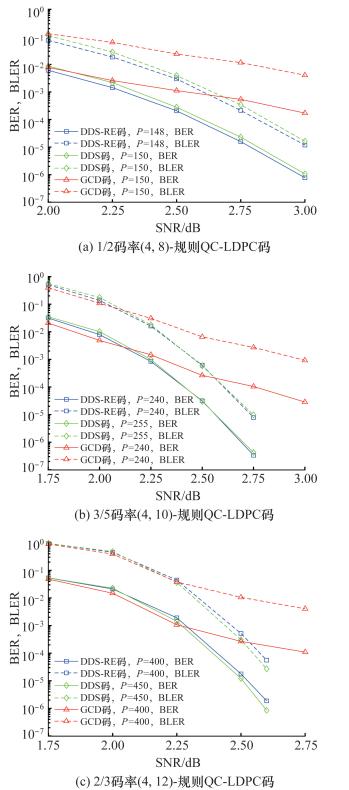
图 3 基于DDS-RE、DDS和GCD方法构造码的性能比较
L=10,选取d1={0, 15, 16, 29, 41},d2={0, 2, 6, 11, 39}。由定义可知,其构成了一个(60, 5, 2)-DDS。该DDS生成一个P为240的DDS-RE(4, 10)-规则QC-LDPC码。为了便于比较,分别生成一个DDS码和一个GCD码。DDS码是通过选择一个(255, 10, 2)-DDS生成的,其中d1={0, 27, 38, 52, 106, 126, 143, 186, 209, 221}, d2={0, 40, 49, 50, 53, 55, 81, 97, 173, 191}。采用指数矩阵EGCD生成GCD码。DDS码和GCD码的P分别为255和240。3种QC-LDPC码的BER和BLER指标如图 3b所示。
L=12,选取d1={0,8,23,34,39,40},d2={0,12,19,37,57,70}。由定义可知,其构成了一个(100, 6, 2)-DDS。该DDS生成了一个P为400的DDS-RE(4, 12)-规则QC-LDPC码。为了便于比较,从文[7]的表1中选择一个(450, 12, 2)-DDS生成P为450的DDS码,其中d1={0, 13, 22, 33, 40, 151, 185, 187, 210, 279, 310, 342}, d2={0, 26, 30, 96, 106, 161, 256, 275, 337, 343, 378, 390}。采用指数矩阵EGCD生成GCD码,其P为400。3种QC-LDPC码的BER和BLER指标如图 3c所示。
图 3可知,在较高SNR下,DDS-RE方法生成的码显著优于GCD方法生成的码;尽管新码的长度明显较短,但其性能几乎与DDS码相当。

3.3 DDS-RE、GCD-RE和SS-RE方法的比较

本小节根据DDS-RE、GCD-RE和SS-RE方法构造了设计码率为1/2的QC-LDPC码,并对它们的BER和BLER指标进行对比。
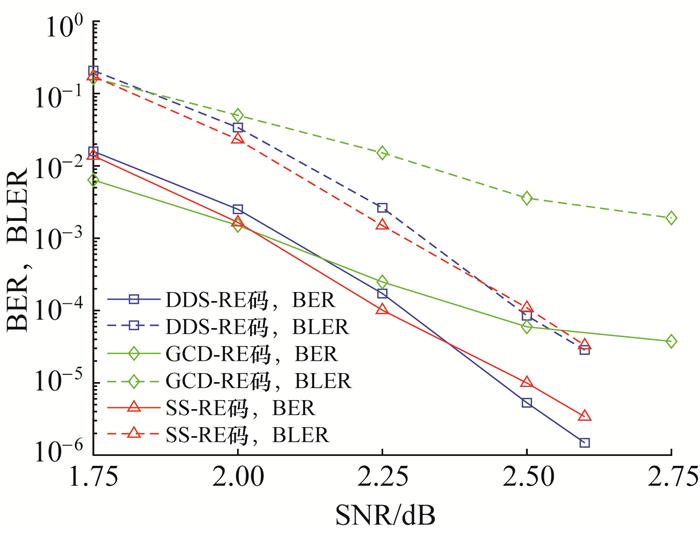
L=8,选取d1={0,24,50,52},d2={0,4,11,21}。由定义可知,其构成了一个(66, 4, 2)-DDS。该DDS与RE结合生成了一个DDS-RE (4, 8)-规则QC-LDPC码,P为264。为了便于比较,生成2种其他码作为对照。根据Sidon序列s={0, 6, 10, 37, 46, 51, 53, 54}的前4位和后4位,使用SS方法[6]生成第一种码的指数矩阵E(1),第二种码的指数矩阵E(1)EGCD相同;使用式(7)中的矩阵作为E(2)。然后根据式(3)生成用于比较的2种码,分别记作SS-RE码和GCD-RE码。这3种码的BER和BLER指标如图 4所示。由图可知,DDS-RE生成的码在较高SNR下的性能明显优于GCD-RE生成的码,并且略优于SS-RE生成的码。此外,所提出的DDS-RE方法与SS-RE方法相比还有一个优势:前者的P更为灵活,因为DDS方法能够提供比SS方法短得多的P
图 4 DDS-RE, GCD-RE和SS-RE方法构造的1/2码率(4, 8)-规则QC-LDPC码性能比较(P=264)

3.4 不同循环尺寸的新码比较

本小节选择了一组均匀间隔的P,用来评估所提出的DDS-RE码在P逐渐增加时BER和BLER指标的变化。
使用具有不同v值的(v, 4, 2)-DDS来构造3个不同的E(1)。具体而言,对于v=37,使用的DDS为d1={0, 2, 14, 22}和d2={0, 9, 10, 16};对于v=42,使用的DDS为d1={0, 1, 4, 17}和d2={0, 5, 7, 15};而对于v=47,使用的DDS为d1={0, 3, 7, 13}和d2={0, 8, 19, 24}。通过RE技术将E(1)E(2)结合,生成了3个新的DDS-RE(4, 8)-规则QC-LDPC码,其P为4v,这3种码的BER和BLER指标如图 5所示。由图可知,随着P的增大,所提码的性能呈现持续提高的趋势。这一特性表明,新码在较大的P范围内性能表现优良。
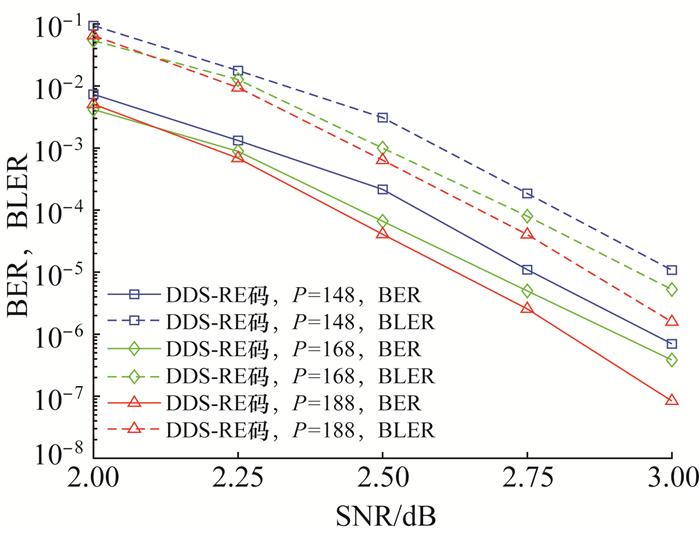
图 5 DDS-RE方法生成的不同循环尺寸的1/2码率(4, 8)-规则QC-LDPC码的性能比较
关于E(1)E(2)有2点说明:
1) 仿真中使用的E(2)除了式(5)和式(7)的形式外,还有许多其他可能性,例如E(2)的行可以任意排列。这表明,有可能从这些候选的E(2)中找到性能更好的新码。
2) 本文中的E(1)是由DDS生成的矩阵。如果在式(3)中交换E(1)E(2)的位置(即E(2)是由DDS构造的矩阵,而E(1)是从式(5)和式(7)中选择的矩阵),仍然可以保证不存在4环和6环。但是,仿真结果表明,这种交换后构造的码的译码性能略逊于不交换的情况。这一现象的原因值得进一步研究。

4 结论

本文通过结合不相交差集(DDS)方法和行重扩展(RE)技术,提出了一种新的QC-LDPC码构造方法(DDS-RE)。该方法可以构造出无4环和6环的QC-LDPC码,并提供灵活的循环尺寸。译码性能仿真结果显示:新码表现出与基于DDS方法构造的码相当的译码性能;同时,在高信噪比时新码的性能显著优于基于GCD方法所构造的码。此外,与本文中所考虑的其他2种基于RE的方案相比,新码可以同时具有优良的性能和灵活的循环尺寸。本文提出的DDS-RE是一种能够同时满足无4环和6环、多样列重以及灵活的循环尺寸这3种特性的QC-LDPC码显式构造方法。
1
FOSSORIER M P C . Quasi-cyclic low-density parity-check codes from circulant permutation matrices[J]. IEEE Transactions on Information Theory, 2004, 50 (8): 1788- 1793.

DOI

2
FANG Y , HAN G J , CAI G F , et al. Design guidelines of low-density parity-check codes for magnetic recording systems[J]. IEEE Communications Surveys & Tutorials, 2018, 20 (2): 1574- 1606.

3
VASIC B , PEDAGANI K , IVKOVIC M . High-rate girth-eight low-density parity-check codes on rectangular integer lattices[J]. IEEE Transactions on Communications, 2004, 52 (8): 1248- 1252.

DOI

4
ZHANG G H , HU Y L , FANG Y , et al. Constructions of type-Ⅱ QC-LDPC codes with girth eight from Sidon sequence[J]. IEEE Transactions on Communications, 2019, 67 (6): 3865- 3878.

DOI

5
KIM I , SONG H Y . A construction for girth-8 QC-LDPC codes using Golomb rulers[J]. Electronics Letters, 2022, 58 (15): 582- 584.

DOI

6
ZHANG L T , WANG J H . Construction of QC-LDPC codes from Sidon sequence using permutation and segmentation[J]. IEEE Communications Letters, 2022, 26 (8): 1710- 1714.

DOI

7
ZHANG G H , NI M D , HU Y L , et al. Quasi-cyclic LDPC codes with girth at least eight based on disjoint difference sets[J]. IEEE Communications Letters, 2023, 27 (1): 55- 59.

DOI

8
RKIZAT K, NOUH S, LAHMER M, et al. A new quasi-cyclic majority logic codes constructed from disjoint difference sets by genetic algorithm[M]//MIZERA-PIETRASZKO J, PICHAPPAN P, MOHAMED L. Lecture Notes in Real-Time Intelligent Systems. Cham: Springer, 2019: 168-177.

9
KIM I , KOJIMA T , SONG H Y . Some short-length girth-8 QC-LDPC codes from primes of the form t2+1[J]. IEEE Communications Letters, 2022, 26 (6): 1211- 1215.

DOI

10
ESMAEILI M , JAVEDANKHERAD M . 4-cycle free LDPC codes based on difference sets[J]. IEEE Transactions on Communications, 2012, 60 (12): 3579- 3586.

DOI

11
TOWNSEND R , WELDON E . Self-orthogonal quasi-cyclic codes[J]. IEEE Transactions on Information Theory, 1967, 13 (2): 183- 195.

DOI

12
TASDIGHI A , BANIHASHEMI A H , SADEGHI M R . Symmetrical constructions for regular girth-8 QC-LDPC codes[J]. IEEE Transactions on Communications, 2017, 65 (1): 14- 22.

13
张国华, 孙蓉, 王新梅. 围长为8的QC-LDPC码的显式构造及其在CRT方法中的应用[J]. 通信学报, 2012, 33 (3): 171- 176.

ZHANG G H , SUN R , WANG X M . Explicit construction of girth-eight QC-LDPC codes and its application in CRT method[J]. Journal on Communications, 2012, 33 (3): 171- 176.

14
张轶, 达新宇, 苏一栋. 任意列重大围长QC-LDPC码的确定性构造[J]. 电子学报, 2016, 44 (8): 1814- 1819.

ZHANG Y , DA X Y , SU Y D . Deterministic construction of QC-LDPC codes for any column weight with a large girth[J]. Acta Electronica Sinica, 2016, 44 (8): 1814- 1819.

15
MATSUMOTO W , MIYATA Y , YOSHIDA H . A study on QC-LDPC codes with girth 8 or 10 for broadband communications[J]. IEICE Technical Report, 2007, 107 (244): 31- 35.

16
ZHANG J H , ZHANG G H . Deterministic girth-eight QC-LDPC codes with large column weight[J]. IEEE Communications Letters, 2014, 18 (4): 656- 659.

DOI

17
ZHANG G H , HU Y L , FANG Y , et al. Relation between GCD constraint and full-length row-multiplier QC-LDPC codes with girth eight[J]. IEEE Communications Letters, 2021, 25 (9): 2820- 2823.

DOI

18
MYUNG S , YANG K . A combining method of quasi-cyclic LDPC codes by the Chinese remainder theorem[J]. IEEE Communications Letters, 2005, 9 (9): 823- 825.

DOI

Outlines

/