New advances in coupled simulation of high-temperature pebble flow in pebble-bed reactors

  • Tiezhong LU 1, 2 ,
  • quan ZOU 1 ,
  • Mengqi WU 1 ,
  • Yiyang LUO 1 ,
  • Nan GUI , 1, * ,
  • Xingtuan YANG 1 ,
  • Shengyao JIANG 1
Expand
  • 1. Key Laboratory of Advanced Reactor Engineering and Safety of Ministry of Education, Collaborative Innovation Center of Advanced Nuclear Energy Technology, Institute of Nuclear and New Energy Technology, Tsinghua University, Beijing 100084, China
  • 2. China National Nuclear Power Co., Ltd., Beijing 100097, China

Received date: 2025-07-28

  Online published: 2025-12-26

Copyright

All rights reserved. Unauthorized reproduction is prohibited.

Abstract

Significance: In 2023, China marked a significant milestone in nuclear energy development, becoming the first nation to successfully commercialize fourth-generation high-temperature gas-cooled reactor (HTGR) technology. This accomplishment represents a substantial advancement in nuclear power generation, offering enhanced safety features, improved thermal efficiency, and greater operational flexibility compared with conventional reactor designs. Progress: This paper provides a comprehensive and systematic examination of recent advancements in coupled simulation methodologies for high-temperature pebble flow dynamics within pebble-bed reactor cores, focusing on elucidating the fundamental physical mechanisms governing granular flow behavior and heat transfer processes. These mechanisms are critical for optimizing HTGR performance metrics, operational reliability, and safety parameters. Historically, research in this domain has faced two primary limitations. First, there have been methodological shortcomings in accurately modeling the complex multiphysics phenomena involved. Second, there have been substantial computational resource requirements, virtually rendering full-core-scale numerical investigations of the HTR-PM reactor configuration impractical. This study makes significant breakthroughs by developing innovative computational frameworks and artificial intelligence-enhanced methodologies. It systematically examines three key research areas. The first area is modeling and simulation techniques, including the discrete element method (DEM) for pebble flow characterization, computation fluid dynamics—DEM coupling methodologies, and graphical processing unit (GPU)-accelerated DEM software development. The second is heating transfer mechanisms, encompassing intra-and inter-particle conduction models, convective heat transfer formulations, and high-temperature radiative heat transfer approaches. The third is artificial intelligence (AI)-enhanced methodologies featuring the use of neural networks for pebble residence time prediction, future state forecasting networks, and convolutional neural networks-based radiative view factor estimation. A significant component of this study is the creation of GRAPE, a proprietary three-dimensional DEM-based numerical model that incorporates GPU heterogeneous parallel acceleration. This approach facilitates efficient simulation of pebble flow dynamics with up to tens of millions of particles on standard workstations while maintaining superior computational accuracy. The study's particle-scale heat transfer model integrates neural network-accelerated radiative heat transfer computation with enhanced mesh search algorithms, demonstrating remarkable capability in predicting pebble-bed temperature distributions at reactor core scales. Furthermore, the introduction of two novel deep learning architectures represents a significant advancement in pebble flow research methodologies. RT-Net is a multi-branch convolutional network designed for real-time pebble flow residence time prediction, and Pre-Net is an image generation network employing guided learning principles to forecast pebble flow evolution. These AI-driven tools, integrated within our integrated computational framework, serve to not only address critical research gaps but also establish new paradigms for analyzing multiphysics coupling in high-temperature multiphase particle systems. This development marks a substantial advancement in HTGR core research and development through key innovations, including the GRAPE simulation platform, neural network-enhanced heat transfer modeling, and pioneering applications of deep learning in pebble flow prediction. Conclusions and Prospects: These advancements provide a theoretical foundation and the practical tools necessary to address the next generation of challenges in nuclear energy technology, particularly in reactor safety, operational optimization, and the development of even more advanced reactor designs. Through a review, elaboration, and synthesis of these key issues, this paper identifies critical challenges and future research directions for developing high-temperature gas-cooled reactor cores, as well as high-temperature multiphase particle flow and multiphysics coupling.

Cite this article

Tiezhong LU , quan ZOU , Mengqi WU , Yiyang LUO , Nan GUI , Xingtuan YANG , Shengyao JIANG . New advances in coupled simulation of high-temperature pebble flow in pebble-bed reactors[J]. Journal of Tsinghua University(Science and Technology), 2025 , 65(12) : 2522 -2538 . DOI: 10.16511/j.cnki.qhdxxb.2025.21.052

国内在建或者在运行的核电机组大多采用第二代或第三代核能技术,如AP1000、华龙一号、EPR等[1]。第四代核能系统具有四大发展目标:可持续性、安全与可靠性、经济竞争性及防扩散。2002年,第四代核能系统国际论坛(GIF)上提出了6种四代核能技术方案,超高温气冷堆(VHTR)是其中预估热效率最高的一种堆型[2]。超高温气冷堆堆芯仍采用石墨作为慢化材料,氦气作为一回路的冷却剂,氦气出口温度设计值超过950 ℃。因此堆芯的球床高温多相流动及传热规律是其中的一个核心科学问题。
高温气冷堆主要分为2条技术路线:其一采用规则棱柱状燃料组件(如美国的FSV[3]、日本的HTTR[4]);其二采用堆积的球形燃料元件(如德国的AVR[5]和中国的HTR-10[6]、HTR-PM[7])。德国的AVR因为技术问题终止[5]。清华大学核研院设计研发的HTR-10实验堆和HTR-PM示范堆率先走出了一条独立自主进行先进第四代核电研发的成功之路,引领了国际高温气冷堆事业的发展。
球床式高温气冷堆堆芯持续性地卸出、装入球形燃料元件,燃料球的堆积、流动会影响反应堆堆芯中的中子通量分布及冷却剂流动状态,进而影响反应堆的功率和温度。燃料球间的传热机理和温度状态也会间接通过核反应截面、流体物性等因素影响球床的功率和温度分布。从经济性和安全性的角度出发,深入理解堆芯球床的流动和传热规律是高温气冷堆(HTGR)工程研究的重要组成内容。
球床流动是一种大尺寸燃料球的极缓慢的多相流动,属于颗粒流的研究范畴。颗粒流动现象常见于多个领域如农业[8]、矿冶[9]、医药[10]、地质[11]、化工[12]等。一般用“particle”或者“granular”指代颗粒,这些颗粒一般比较小,相比流体较为稀疏,具有较强的流动性。在HTGR或者聚变堆研究中,一般用“pebble”指代堆积球床中的燃料球[13-14],这些燃料球相对较大,堆积比较紧密,不流动或者缓慢流动。
球流的特殊性在于高温气冷堆中燃料球和石墨球随机堆积在堆芯区域,由于连续装料的设计,球床内燃料球按恒定的速率进行装卸,且装卸速率极慢,呈现为一种缓慢稠密循环流动形式。并且,这种流动极为特殊,与快速稀疏流不同,后者常被认为满足气体动理论。反应堆球床流动为宏观稠密复杂系统,球堆积紧密且相邻球之间的接触力持续时间相对长得多,但又会发生间断,球流运动难以用气体动理论描述、也难借鉴已有的连续介质的流动规律。
球流的复杂性在于球床堆芯堆积紧密,球间接触时间长、运动存在间歇性、球床堆积率较高,使得装卸料过程中球形元件的运动与多物理耦合较为复杂,存在丰富的非线性现象。然而目前并没有统一的方程描述宏观球流的运动,只能通过广泛的研究尽可能地发现与总结各可能因素对球流运动的影响,以深入理解球流运动规律。
一般,堆芯流动的影响因素主要包括(见图 1):几何参数(床尺寸与球直径之比、球床壁面结构、出口大小、球床底部倾角等)、物性参数(球密度、摩擦系数、恢复系数、材料的弹性模量、Poisson比等)、运行条件(循环速率、加载比等)。实验场景复杂,较难完全复刻实验工况得到所有燃料球数据;实验周期长,限制了通过大量的实验研究得到足够数据以揭示球流运动的普适规律。这些导致球流问题的复杂性仍未得到充分的解释,需要借助更多的研究方法,计算机模拟的快速发展使之成为燃料球流动研究的主要方式之一。
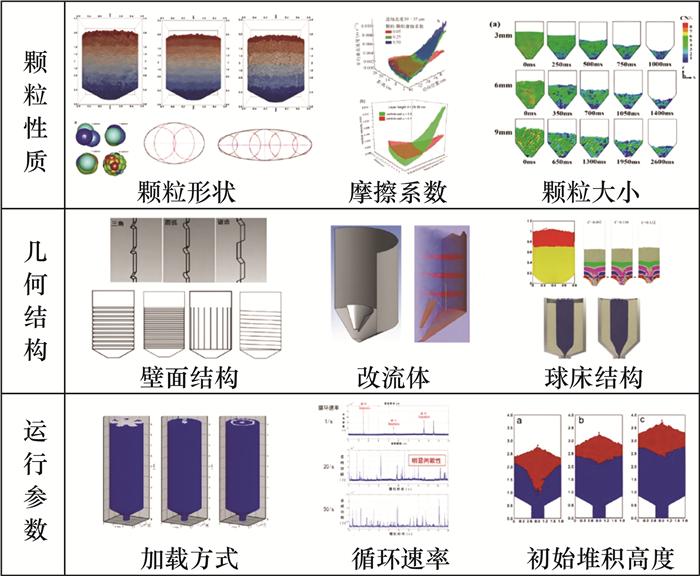
图 1 球流的参数问题研究

1 球流研究

1.1 球流模型

Lagrange方法求解燃料球运动分为4类:元胞自动机(CA)、蒙特卡罗(MC)方法、硬球模型和软球模型[15]。经过长期的摸索,离散元方法(DEM)即软球模型成为了球流数值模拟的主流方法[13]。DEM关注燃料球本身,基于Newton力学计算每一个燃料球的运动,最早由Cundall等[16]提出,用于研究接触燃料球间的受力情况,因此软球模型认为燃料球的接触是持续性的,属于时间驱动方法(对应于硬球模型属于事件驱动方法)。燃料球的受力通过接触模型进行计算,且对时间步长比较敏感。
在DEM数值研究中,燃料球相互作用模型是最关键的内容,最早提出的是线性弹簧模型[16],后续又发展出其他模型如粘-弹性接触模型[15]、Hertz-Mindlin模型[17]、Hertz-JKR[18]模型及DMT模型[18]。其中,Hertz-Mindlin模型及其改进型[19]被广泛用于各种数值计算。该模型在法向基于Hertz理论[20],在切向基于Mindlin-Deresiewicz理论[21]。切向模型在后续的研究中又被简化为了Mindlin无滑移模型[19]
从方法研究的角度,研究者尝试以上模型与DEM进行耦合。例如将计算流体动力学(CFD)与DEM进行结合以实现球床中流场的精确计算[22],将DEM和格子Boltzmann(LBM)耦合以研究球床中的氦气流动[23]等。这2种方法均属于Euler-Lagrange混合方法,更常见于流化床、化工、采矿等领域[12]。光滑粒子流体动力学(SPH)与DEM的耦合方法则完全基于Lagrange思想[24]。为更好地与燃料球内部力学特性的研究耦合,本文团队也尝试将有限元方法(FEM)与DEM相结合,提出了DEFEM模型,可用于精细化分析燃料球的运动、变形和传热[25-26]。DEFEM方法不仅能够准确模拟燃料球的变形及燃料球内部的温度分布,也具有较好的并行性,可以借助并行算法来提高计算效率。

1.2 燃料球流动参数

开展DEM数值仿真时,燃料球物性参数的选取可能会对结果产生影响。例如,石墨的摩擦系数在不同气体氛围、不同温度条件下会发生显著变化[27-31];较小的杨氏模量值对燃料球碰撞时间和形变量有显著影响,但却对最终的混合效果影响不大[32];不同恢复系数对球流也存在影响[33]。Yurata等[34]基于实验结果给出了不同材料恢复系数的参数表达式,为后续DEM数值研究提供了参考数据。Lima等[35]基于实验分析了DEM模拟中恢复系数和摩擦系数的取值,提出特别要考虑材料性质及燃料球碰撞的尺度。Wang等[36]和Li等[37]均分析了恢复系数和摩擦系数分别对静态堆积球床和HTGR球流的影响,指出燃料球相对壁面的摩擦系数对流型的影响很大。对聚变反应堆中摩擦系数对球床结构的影响也有专门讨论[38-39]

1.3 燃料球流动设计

球床的几何形状是数值研究和工程设计的重点关注内容。例如,Rycroft等[40]发现卸料口倾角越大,燃料球在球床中的总体滞留时间越短,但燃料球结晶化现象可能导致部分燃料球的滞留时间偏离均值。Khane等[41]从流型、速度分布的角度讨论了卸料口倾角的影响,指出速度曲线的径向分布呈现明显的下凹抛物线形状,且卸料口倾角越大,速度曲线下凹的现象越明显。Li等[42]发现壁面沟槽结构能够减少球床中近壁面燃料球的结晶化问题。Wu等[43]对比分析了多种卸料口漏斗形状,发现传统的锥形卸料口可能并非最优设计,外凸形的卸料口可以进一步提高流动的均匀性;还分析了球床高度、卸料口倾角和直径对球流的影响,发现卸料口倾角对燃料球流动性的影响更大,且更大的卸料口直径能够加强流动的均匀性[44]。Li等[45]对比分析了多种三维壁面结构对球流的影响,发现带沟槽的壁面结构会减缓近壁面区域的燃料球流速,但能够加强上下层燃料球的混合,有助于展平反应堆功率分布。Reger等[46]开展了HTR-PM全尺寸堆芯球流模拟,对比了不同壁面挖孔结构对流动的影响。该研究发现,壁面挖孔结构使得不同高度的近壁面孔隙率更加一致,且有助于防止燃料球的结晶化,如图 2所示。
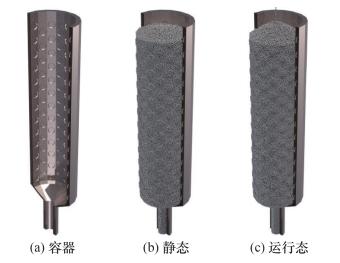
图 2 球流的壁面挖孔结构的模拟[46]
燃料球的形状和尺寸也是数值研究的重点关注内容。Lu等[47]和Feng[48]对这个领域进行了总结性回顾和评述。Cui等[49-50]结合数值模拟和实验讨论了方形、球形燃料混合对卸料的影响,结果显示:过多的方形燃料元件会阻碍球床卸料,且增大中心流道与近壁面燃料球的速度差,导致更加严重的燃料球滞留现象。Ge等[51]讨论了椭球形、球形燃料混合对球床卸料的影响,发现当椭燃料球的长径比小于或等于2时,其体积占比增加可以促进球床卸料,而更大长径比的椭燃料球则会对球床卸料起阻碍作用。Kim等[52]讨论了不同尺寸燃料球混合对聚变反应堆球床堆积的影响,同样发现燃料球相对尺寸是一个重要因素。Wu等[53]也讨论了不同尺寸燃料球混合对球床卸料和孔隙率分布的影响,发现当装载比与其数量比一致时,球流在循环过程中的分区比例保持稳定。Pupeschi等[54]结合实验讨论了燃料球尺寸对球床的影响,通过改变床层高度与球尺寸比(H/d)进行了参数化研究,为此还采用了不同大小的商用单一粒径氧化锆球,系统评估了床层高度、球尺寸和球材料的影响。Feng等[55]讨论了燃料球尺寸以及摩擦系数对球床结构的影响,指出较低的球间摩擦系数和较宽的球尺寸分布会带来更高的球床堆积分数;随着球床宽度的增加,球床平均堆积分数逐渐增大,同时壁面效应的影响逐渐减弱。
综上,燃料球流动规律和行为的影响因素很多,而且往往与传热因素、物理因素发生深度关联。因此,燃料球流动需要根据具体工程设计中关注的重点进行针对性设计和优化。

2 燃料球传热研究

除了HTGR,堆积床中的燃料球传热问题也广泛出现在各种工程如流化床反应器[56]、聚变反应堆[57]等。有关球床内燃料球传热的数值模型可分为两大类:一类是基于Euler-Euler模型的连续论方法[58],如双流体模型(TFM)[59]和多孔介质模型[60];另一类则基于Euler-Lagrange框架的混合方法,如CFD-DEM、LBM-DEM。连续论方法将燃料球与流体均视为连续体,这一假设能够降低网格划分难度,同时简化复杂的流固耦合问题。因此,通常认为连续论方法具有较好的计算性能。相比连续论方法,CFD-DEM等混合方法更加契合真实的物理机制,能够有效揭示燃料球尺度的各种物理信息[61],但该类方法依赖于准确的流固耦合模型,同时可能导致巨大的计算量。总体而言,目前已有非常多基于DEM的燃料球传热模型[62]和实验研究[62],但是大多数模型并不适用于球床中的燃料球传热问题。一方面,HTGR球床中的燃料球最高温度可达1 600 ℃[63],此时热辐射占主导地位,但大部分燃料球传热模型并没有充分在燃料球尺度考虑辐射换热。另一方面,HTGR中的燃料球数目较大,如HTR-PM包含约420 000个燃料球,直接套用已有的模型方法可能会带来不可接受的计算量,因此还需要对计算模型进行优化。
对于堆积球床,大部分工程研究基于多孔介质模型[60]开展全堆芯尺寸的流动传热模拟。这是因为球床流场中存在复杂的固体边界条件,很难基于燃料球解析的CFD-DEM方法开展大尺度的流动传热模拟。Sharma等[57]结合实验数据,对比分析了多孔介质模型和CFD-DEM模型在矩形堆积床热工水力特性研究中的效果,发现2种方法具有一致性。Baggemann等[64]基于多孔介质模型和MGT-3D程序分别模拟了德国SANA实验中的温度场分布,验证了程序的准确性。Novak等[65-66]同样利用SANA实验结果验证了新开发的数值程序,后续基于该程序开展了球床式高温熔盐堆中的多物理场数值研究。Zou等[67]将多孔介质模型和燃料球内部导热模型相结合,开发了球床堆中的多尺度传热模型。Nouri-Borujerdi等[68]基于改进的多孔介质模型开发了名为THPP的计算程序,采用IAEA提供的HTGR基准题进行了验证。

2.1 燃料球导热模型

导热、对流、辐射是燃料球热传导的3种方式,而基于DEM的燃料球尺度导热模型则是其中被研究最多的。

2.2.1 燃料球内导热

Luo等[69]从解析的尺度对传统的接触热阻模型进行了改进,提出了一种新型的燃料球接触面附近的导热热阻模型,该模型基于温度场和应力场的类比,使得燃料球表面的热流密度连续变化,消除了接触面边缘温度的奇异性问题,更加具有物理意义。该新型热阻模型与实验结果吻合较好。将该模型运用于HTTU(hochtemperatur-test-Urananlage) 堆的导热计算,得到了球床的温度分布和有效导热系数的分布,并可用于分析球床的动态性能。
$\left\{ {\begin{array}{*{20}{l}}{\frac{{{\partial ^2}\theta }}{{\partial {r^2}}} + \frac{1}{r}\frac{{\partial \theta }}{{\partial r}} + \frac{{{\partial ^2}\theta }}{{\partial {z^2}}} = 0;}\\{q(r) = f(r), \quad z = 0;}\end{array}} \right.$
$f(r) = \left\{ {\begin{array}{*{20}{l}}{\xi \sqrt {1 - \frac{{{r^2}}}{{r_{\rm{c}}^2}}, } \quad z = 0, \quad r \le {r_{\rm{c}}};}\\{0, \quad \quad \quad\quad z = 0, \quad r > {r_{\rm{c}}};}\end{array}} \right.$
$R = \frac{3}{{\pi ka}}B{\left( {\frac{3}{2}, 1} \right)_3}{F_2}\left( { - \frac{1}{2}, \frac{1}{2}, 1;1, \frac{5}{2};1} \right).$
式(1)、(2)、(3)分别给出了热-力比拟求解的温度方程、比拟边界条件、热阻解。
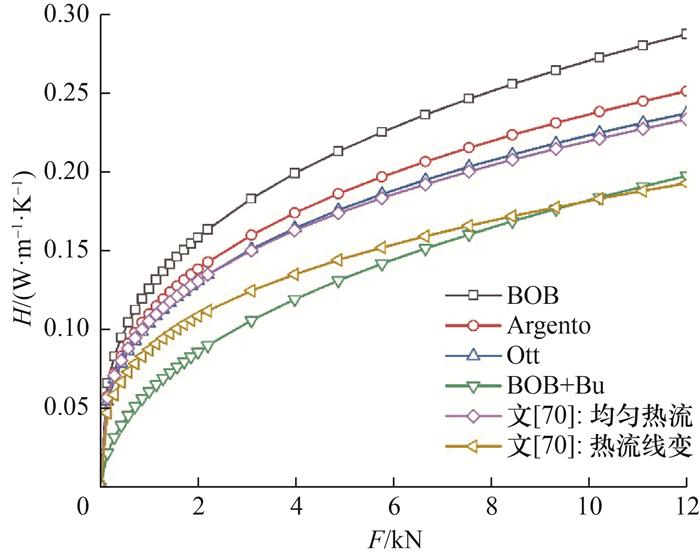
将广义热阻理论引入热阻的建模当中,基于严格的解析解,Luo等[70]又提出了一种新型的燃料球内部导热热阻模型。该模型是对接触热阻模型的补充,具有的优势包括:1) 物理意义明确,热阻的大小能够反映系统的传热能力耗散;2) 能够考虑边界条件对导热的影响;3) 能够考虑燃料球半径对传热的影响,对大尺寸燃料球的球床导热具有指导意义;4) 能够考虑燃料球内部温度的不均匀性(因此不必遵循传统热阻模型要求导热系数接近无穷大的限制)。该模型可扩展性强,具有工程价值和实际意义。经过验证,该模型结果与CFD和实验结果均吻合较好,如图 3所示。
图 3 球流的广义热阻理论导出的导热模型与其他模型的对比[70]
针对燃料球表面两接触点之间的导热热阻计算依赖于数值解,理论和解析的研究不够充分的问题,Luo等[71]继续将广义热阻模型进一步推广到三维的情况,从严格的数学推导出发,基于广义热阻理论推导出了燃料球表面任意2个接触点之间的导热热阻的解析解。该模型能够反映燃料球之间的接触面的大小和相对位置关系,能够为球床的导热问题提供参考,可依据该模型获得更精确的温度分布,并获得基本堆积方式的有效导热系数。
为验证模型准确度及提供物理热工设计和安全分析的基准数据,需要对燃料球石墨材料的导热系数进行测量。一般分为稳态法和瞬态法[72]:稳态法[73-74]基于Fourier热传导定律,当系统到达稳定状态时,其温度分布不随时间变化,进而分析热传导问题;瞬态法[75-78]是通过短时间内对石墨材料施加热量并观察其热响应来计算热导率。这2种方法都被用于小样品燃料元件材料的导热系数研究和球床等效导热系数研究。
由于燃料球二氧化铀燃料核芯的温度不能超过限值是反应堆设计的准则之一,对核芯温度计算的建模需要结合堆芯物理热工耦合的瞬态模拟。相关研究结果可见文[79],采用液态氟化盐作为冷却剂、内嵌包裹燃料颗粒的球形燃料元件的氟盐冷却球床堆,并进行堆芯瞬态分析。

2.2.2 燃料球间导热

燃料球间的导热可以分为非直接接触和直接接触2类。对于非直接接触,Cheng等[80]基于Voronoi单元体建立了燃料球的非直接接触导热模型。Gan等[81]将该模型进行了拓展,可计算不同尺寸的球形、非球形燃料间的导热。Yang等[82]定量化讨论了Voronoi单元体与燃料球尺寸、堆积密度的关系。关于直接接触,可将其进一步分为动态接触和静态接触2类,Oschmann等[83]提出了燃料球间接触导热及燃料球与壁面导热的数值模型,并将其与CFD耦合,在旋转圆筒和堆积床中进行了数值验证。Zhou等[84]利用FEM研究了燃料球的瞬态导热问题,对Sun等[85]提出的碰撞导热模型进行了深入讨论。
HTGR球床属于准静态稠密堆积,聚变堆中的球床属于静态堆积,因此静态、直接接触模型最适合用于描述这2个领域的燃料球传热问题。典型的接触导热模型一般为
$q_{\mathrm{c}, j i}=H_{\text {cond }}\left(T_{\mathrm{p}, j}-T_{\mathrm{p}, i}\right) .$
其中:qc, ji代表单位时间第j个燃料球向第i个燃料球传导的热量,Tp, iTp, j分别为第ij个燃料球的温度,Hcond为接触热导率,单位为W/K。燃料球导热模型的重点在于如何计算接触热导率。在大部分模型中,接触热导率与燃料球的固体热导率、接触半径、碰撞时间等因素有关。Batchelor等[86]基于Hertz理论提出了经典的燃料球静态接触导热模型,该模型是后续诸多研究的基础。
这里需要提及导热模型与DEM模拟耦合的一个问题。DEM为了减少计算量往往会采用比真实值更小的杨氏模量,这会导致模拟得到的燃料球重叠量大于真实值。因此,计算燃料球接触半径时还需要针对这一情况进行修正。例如,Zhou等[87]通过引入修正因子来缩小接触半径,从而修正燃料球的接触导热模型,该因子与杨氏模量构成幂函数关系。Morris等[88]同样针对DEM模拟的燃料球软化问题提出了修正后的接触导热模型,还考虑了碰撞时间的修正。Liu等[25]基于FEM构建了更加精细的二维燃料球导热模型,但计算量偏大,很难支持超大规模的燃料球流动传热模拟。

2.2 燃料球对流模型

球与流体的对流换热是CFD-DEM研究的重要内容之一。具体而言,当流体流过燃料球表面或者壁面时,流体相和固体相在温度梯度的作用下会产生热量交换,一般采用对流换热系数来计算换热量:
$q_{\mathrm{f}, j i}=h_{\text {conv }, i} A_i\left(T_{\mathrm{f}}-T_{\mathrm{s}}\right) .$
其中,hconv, i为第i个燃料球的对流换热系数,Ai为第i个燃料球或壁面的表面积,Tf为当前位置处的流体温度,Ts为固体相的局部温度。
对流换热系数与诸多因素如流场流速、流体热导率、球床孔隙率、固体热导率、固体比热容等存在关联。基于实验或者如图 4的直接数值模拟(DNS),大量研究[56-61]给出了对流换热系数与这些参数的关系式。Wakao等[89]和Gunn等[90]各自提出了随机堆积床中Nu数的拟合式,这也是最为经典的2个拟合式。Wakao等的拟合式默认孔隙率为定值(约等于0.4),而Gunn等的拟合式则考虑了孔隙率的变化。后续Tavassoli等[91]在这2个拟合式的基础上进行了诸多修正[92-93]。Chen等[94]和Chang等[95]基于LBM和浸没边界法(IBM)的高精度模拟,拟合了特殊形状燃料元件的对流换热系数。需要注意的是,这里提到的拟合式适用范围各有不同,在球床传热计算中需要根据实际的流场参数选择合适的模型。
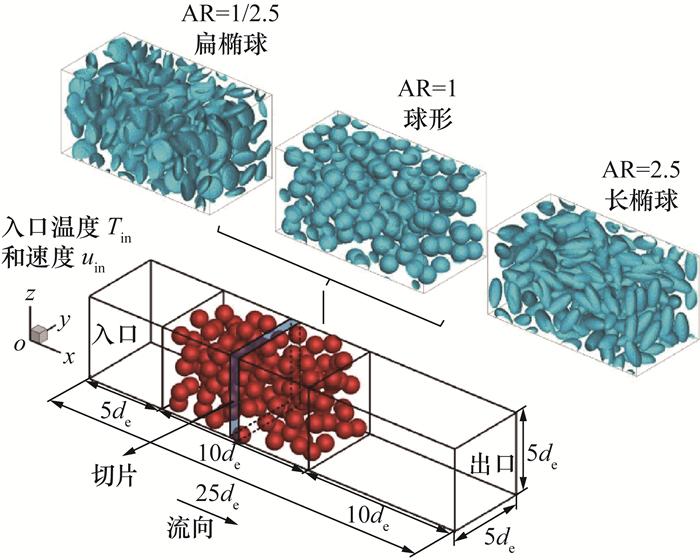
图 4 基于浸没边界法的两相对流模拟[73]

2.3 燃料球辐射模型

热辐射是HTGR中的燃料球传热的主要方式,重要程度甚至超过燃料球之间的接触导热。例如Wu等[96]指出,当温度大于550 ℃时,HTGR球床中的燃料球热辐射不可忽略。Forgber等[97]则发现高Pe下辐射换热量是接触导热的100倍以上。热辐射的研究包括连续性理论和离散化理论。连续性理论一般通过各种方法求解辐射传输方程(RTE)来得到辐射换热量[98]。Shi等[99]针对RTE提出了新的求解方式,通过引入UGKP格式将微观和宏观物理量联系在一起。HTGR和聚变堆中的稠密球床更适合采用离散化方法来计算热辐射。Cheng等[100]基于Voronoi单元体计算燃料球间的辐射换热,Wu等[101]在其辐射实验数据[102]的基础上提出了长程和短程辐射换热模型,以及燃料球尺度模型[101]、均匀化连续模型[103]、神经网络模型[104]、亚颗粒辐射模型(SCM)[105]及其改进型(SCRC)[106],以及梯度提升决策树的机器学习模型[107]等多种燃料球热辐射计算方法。最近,谢宛均[108]将相关性函数与集成学习算法结合,将角系数函数分解为距离和遮挡函数,距离函数由理论推导得出,遮挡函数由集成学习模型预测,进一步提高了预测精度。以上这些工作,为球床辐射换热研究做出了重要贡献(见图 5)。
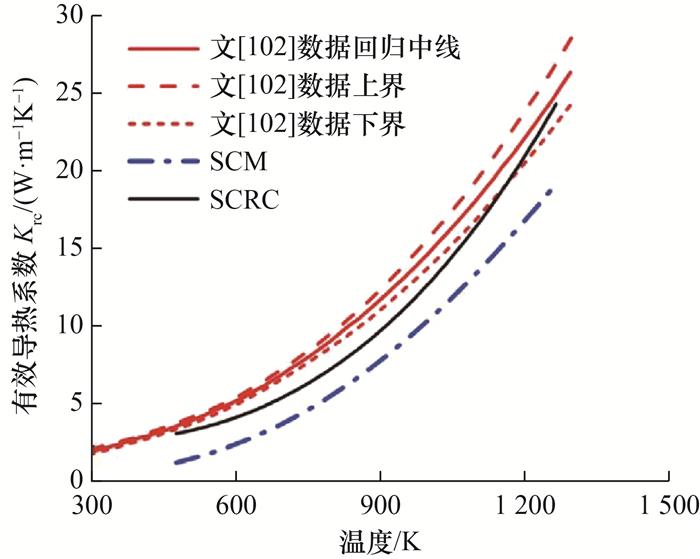
图 5 基于文[102]实验数据、亚颗粒辐射模型SCM[105]及其改进SCRC[106]模型(ϕ=0.39, ε=0.8, ν=0.5, E=10 GPa, ρp=1 846 kg/m3, Hbed=1.0 m)的有效导热系数曲线
式(6)为经典的灰体辐射模型:
$q_{\mathrm{r}, j i}=A_i X_{i j} \varepsilon_{\mathrm{r}} \sigma\left(T_{\mathrm{p}, j}^4-T_{\mathrm{p}, i}^4\right) .$
其中:Xij为燃料球ij之间的辐射换热角系数,εr为表面发射率,σ是Stefan-Boltzmann常数。辐射换热角系数是计算燃料球辐射换热的重要物理量。Tannaka[109]给出对于中间无遮挡的2个同尺寸球形燃料元件之间的辐射传热角系数的解析表达式。而对于复杂堆积,球形燃料元件间的辐射传热角系数难以得到精确值,一般采用MC方法[110]进行计算。考虑到MC方法的计算量过大,一些研究[111-113]选择采用经验拟合式计算辐射传热角系数。Wu等[111]提出了辐射作用函数,并在此基础上提出了近似函数模型,可用于快速计算等效热导率。

3 数值实现

3.1 GPU-DEM模型

当前,并行计算成为了数值研究的一个重要研究方向。传统的并行计算一般依托于开源多处理器(open multi-processing,OpenMP)或者消息传输接口(message passing interface,MPI)的架构[114],采用CPU多核实现并行加速。随着图形处理器(GPU)硬件和人工智能技术的迅猛发展,GPU逐渐被用于科学计算领域。
GPU并行技术属于异构计算,存在2条技术路线。一条路线是基于OpenCL标准[115],优势在于支持多平台和更多硬件型号,对硬件具有更大的调控权;缺点在于代码开发难度相对较大。另一条技术路线则是基于CUDA架构[116],优势在于良好且丰富的技术支持,代码开发难度较低;缺点是必须使用NVIDIA公司的硬件设备。
近年来,有关GPU-DEM的研究显著增长。例如,基于GPU并行开发的FDEM数值模型[117]、可用于三角形边界的检测算法[118]、基于超二次曲线构造的非球形燃料数值模型[119]、基于开源项目Chrono开发的可实现11倍加速的GPU-DEM代码[46]。应用方面,文[120-121]基于GPU-DEM研究了堆积床中多面体燃料球的有效导热系数;文[122]采用CFD-DEM耦合方法研究了滚筒中非球形燃料的导热、滚筒式磨机和料斗中的燃料球运动问题。总体而言,单块GPU可以实现百倍量级的加速,同时支持千万规模的燃料球数目,是DEM数值研究走向高性能计算的可选方案[123]

3.2 GRAPE软件

基于DEM-GPU并行加速技术,本文团队提出了一套三维数值模型,并自主开发了对应的C++数值程序,取名为“面向高温气冷堆球床燃料球元件的GPU加速反应堆芯分析代码”(GPU-based reactor analysis code for pebble elements in HTGR,GRAPE),如图 6所示。该程序针对HTR-PM设计优化,能够低成本、高效率地开展大规模燃料球流动、传热数值研究,最多支持千万量级燃料球的模拟。GRAPE可以在配有GPU的个人主机上实现核电站堆芯的数值计算。例如,模拟HTR-PM球床中42万个燃料球循环卸料100 s,时间步长取10-5 s,GRAPE在一块RTX 3090显卡上只需要运行11 h即可完成计算(作为对比,若采用12核的CPU需要大概20 d)。
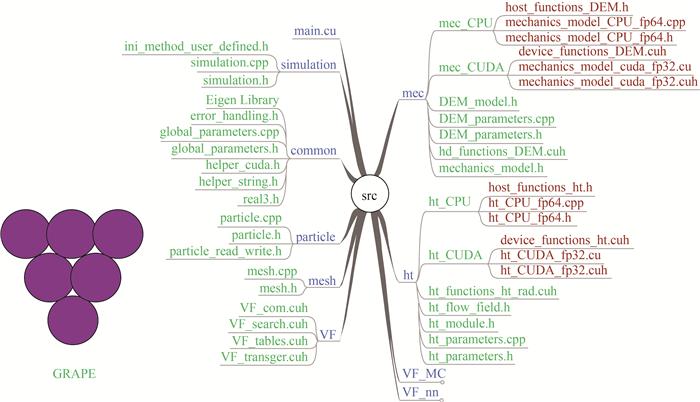
图 6 本文团队开发的高温气冷堆球元分析软件GRAPE[124]

4 AI技术的应用

4.1 球流研究中的机器学习应用

随着人工智能的发展,深度学习方法可以学习数据的内在规律,建立输入与输出间的广义映射关系。
近年来,颗粒物质相关的研究领域也逐步开始探索深度学习的应用。在燃料球流动领域,早期主要是利用人工神经网络对DEM参数进行校正(此时使用的神经网络层数较浅,不属于深度学习范畴),而后逐渐使用更深的人工神经网络或者更复杂的神经网络如卷积神经网络对燃料球流动特性进行探索与预测,如图 7所示。
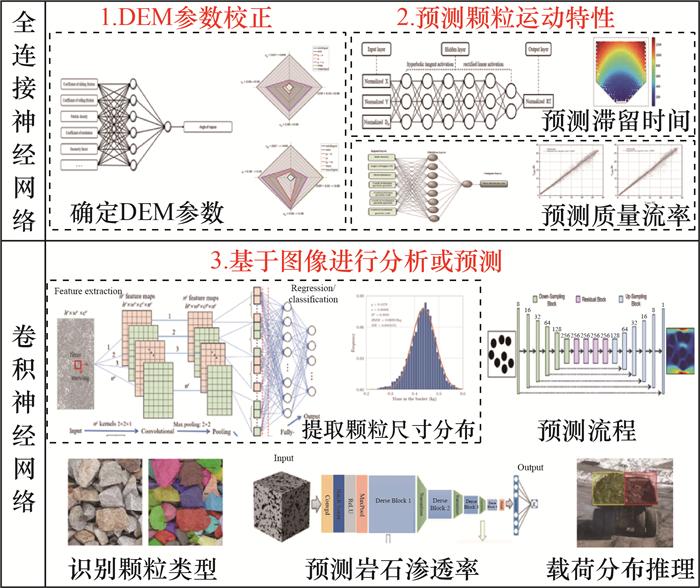
图 7 深度学习在燃料球流动中的应用

4.1.1 卷积神经网络在球流中的应用

目前球流研究中卷积神经网络主要用于以下几方面。
1) 模型参数校正。
DEM参数需要经过校正才能精确地模拟物理过程。通过实验方式很难有效和准确地涵盖所有参数,获得代表性的参数集。而全连接神经网络作为最早的神经网络之一,为DEM参数的校正提供了新思路。Ye[125]、Benvenuti[126-127]通过反向传播(BP)神经网络对DEM输入参数进行校正,建立动态宏观燃料球流动特性与DEM参数之间的非线性关系,提供了一种有效准确的方法来选择DEM参数集。
2) 预测球流运动特性。
为了预测燃料球流动速度分布及其影响,Kumar[128]从DEM模拟结果中选择了堆积密度、平均直径、燃料球流动摩擦系数等7个参数,作为全连接神经网络的输入,得到了质量流率。He[129]等人针对两相流体系,使用相邻燃料球流动位置、雷诺数Re及空隙率信息作为神经网络的输入,预测流体在稠密燃料球流动中的流动阻力。Cui[130]结合DEM与全连接神经网络,预测了燃料球流动流经双挡板后的剩余动能,以优化挡板设计。Liu[131]利用六层隐藏层的深度神经网络对二维料斗内的停留时间分布展开研究,网络输入为燃料球流动的水平坐标、高度坐标与球床出口直径,输出为该燃料球流动在料斗内的停留时间。
类似地,深度全连接网络也被应用于预测黏性燃料球流动在球床内的滞留时间[132],采用数据驱动方法建立输入数据和输出数据之间的广义映射关系,其中输入数据通常是一系列变量如物理参数、燃料球流动位置坐标等。
3) 基于图像获取燃料球流动信息。
随着更先进的神经网络的出现,深度卷积神经网络在图像识别、缺陷检测、超分重建等诸多图像任务中取得了巨大成功,近年来开始有研究者对燃料球物质的图像驱动方法进行探索。例如,使用卷积神经网络(convolutional neural network, CNN) 从单张照片中自动提取燃料球的形状和尺寸分布[133];根据燃料球的堆积状态自动提取图像特征,以实现较高准确度的有效载荷分布预测[134];结合CNN和数字图像处理提取和评估粒子形状[135];预测自由卸料漏斗流的卸出时间和剩余燃料球比例[136];使用三维CNN输出不同燃料球形状以及堆积高度的填充率与质量流率[137];基于图像获取岩石渗透率信息[138];对混合流动燃料球体系的混合燃料球径和形状信息进行分类[139];开发完全自动化的能够识别并跟踪燃料球的位置信息的算法[140]等。
目前,深度学习在球流研究中的应用大多使用的是全连接神经网络,输入为燃料球坐标值、物性参数、球床参数等,输出为流动指标如滞留时间、质量流率等。以图像数据驱动的CNN在球流领域的应用如在岩土、化工领域中对颗粒信息(如尺寸、类型、渗透率等)的提取方面取得了较好的效果。尽管如此,CNN在获取颗粒球信息或预测流动行为方面仍然显示出巨大潜力。

4.1.2 燃料球剩余停留时间和未来分布状态的预测

球流运动的很多信息如燃料球剩余停留时间实际上可通过图像挖掘,该特性对于高温气冷堆来说是一个重要特性,对于了解燃料燃耗、核换料循环和反应堆运行均具有重要意义。不仅如此,在料仓卸料问题中,通过图像快速预测燃料球剩余停留时间将有助于卸料进度的监测和球流状态的评估。除此之外,燃料球的分布变化规律也会反映在图像之中。由于高温气冷堆中的球流是一种稠密缓慢流动,燃料球数目多,循环速率慢,以往这方面的研究往往涉及较大的计算量或者较高的实验成本,而通过CNN方法对燃料球的未来分布状态进行图像预测,能够提高计算效率,更高效地进行参数设计,具有良好的工程应用前景。
鉴于此,本文团队利用CNN对燃料球剩余停留时间与未来分布状态进行了智能预测。
针对球流实验图像,本文团队提出了燃料球剩余停留时间预测的RT-Net[141]模型。RT-Net为直筒式架构,训练时该模型利用多分支卷积组件增强网络的表达能力,提高准确度,而在推理时将多分支卷积组件等价合并为单路径架构,在保留准确度的同时,降低计算量与显存,可以实现更快的推理速度。与VGG、AlexNet对比,RT-Net模型在准确度和计算效率上均能达到最佳的平衡,模型性能获得了提升。
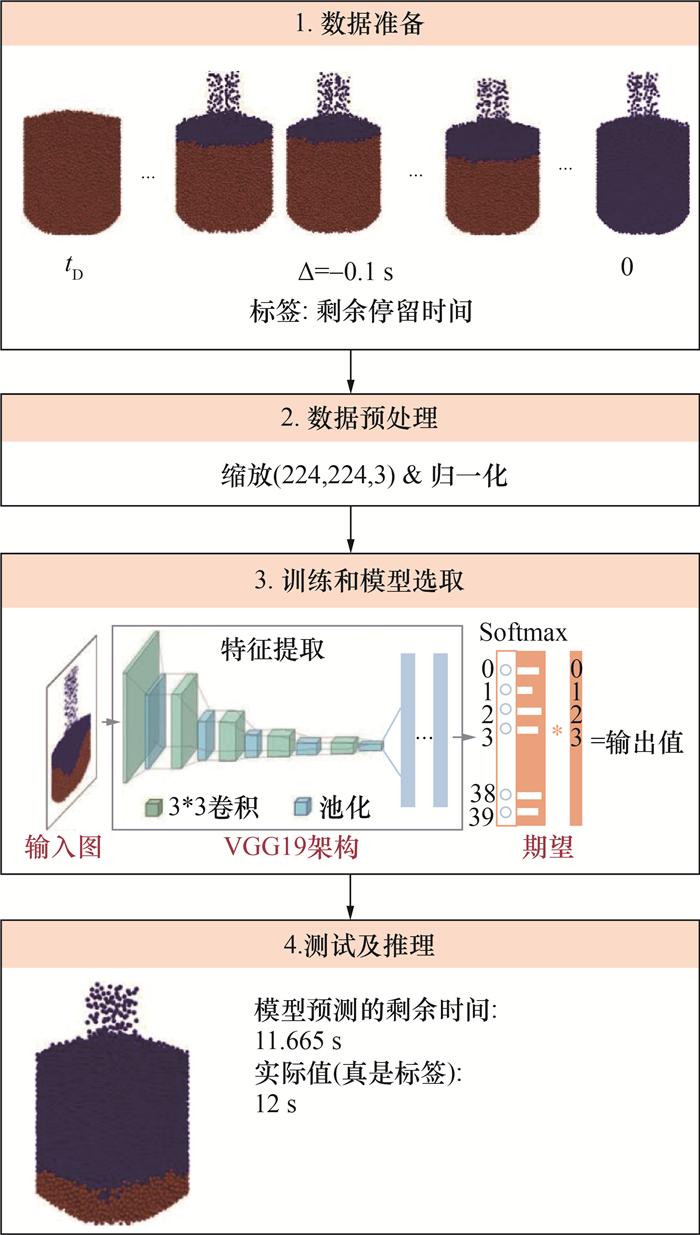
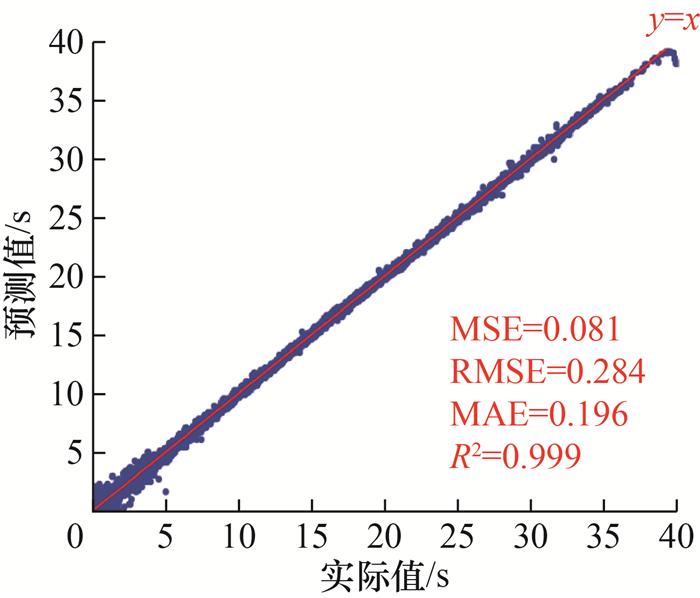
RT-Net的训练流程见图 8,包括数据准备、数据预处理、模型训练、模型评价与选取。在完成训练后,用最终选取的模型对测试集进行预测以验证其泛化能力。经过研究分析,由图 9得到以下结论:1) CNN具有优异的图片特征提取能力,可以应用在图像重要特征(如燃料球剩余停留时间)识别的相关任务中,具有较大的发展潜力,可为涉及图像的球流研究提供新思路。2) CNN可用于预测燃料球剩余停留时间,预测与真实值吻合度较高,说明以CNN为代表的深度学习算法在球流图像任务中的应用是可行的。
图 8 RT-Net的训练流程[141]
图 9 燃料球剩余停留时间预测效果对比[141]
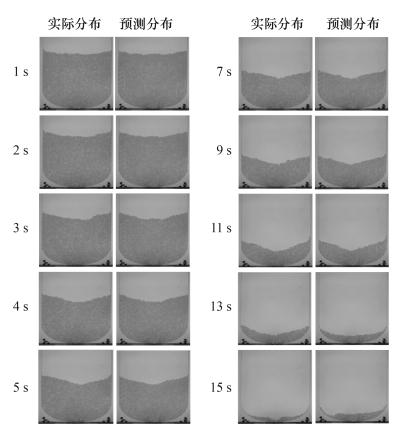
为预测指定时刻的球流分布,本团队继续提出了燃料球未来分布状态预测的Pre-Net[142]算法(如图 10所示),并实现了较好的生成效果。
图 10 燃料球未来分布状态预测与物理图像的对比
本文认为:为使模型能够预测更广的未知数据,拥有更强的泛化能力,数据集的多样性扩充和应用域的拓宽将是未来有待深入的方向。Pre-Net模型没有考虑图像数据的时间序列特点,将各个图像视为独立对象,而未利用图像之间的序列关系。事实上,CNN与递归神经网络(RNN)组合可能在这些时间序列数据上表现得更好,甚至可以识别一些与时间相关的特征如球的滞留率如何随时间变化等。另外,可以使用主动学习,利用不确定度有针对性地补充数据集以提高模型的外推能力。

4.2 球床传热研究中的神经网络应用

神经网络技术也被用于燃料球辐射换热计算。Wu等[104]训练了多套神经网络,可计算不同情形下燃料球间的辐射角系数,结果显示神经网络的预测值比较准确。Tausendschön等[143]采用深度神经网络来计算辐射角系数,不仅支持计算燃料球之间的辐射角系数,也可用于计算燃料球与壁面间的辐射角系数。Kianimoqadam等[144]开发了更加复杂的神经网络算法,同样用于辐射角系数的计算,结果显示该算法在短程辐射中具有比较高的准确性。上述方法在模型泛化能力或大规模运算方面仍有不足,辐射换热角系数的计算方法仍然值得广泛研究。
本文团队早先开发了一套神经网络,可用于计算同尺寸燃料球间的角系数[145]。针对不同的物理情形训练了对应的神经网络,通过分情况讨论来提高神经网络的准确性。图 11给出了部分物理情形的示意图。其中,两球情形代表整个工况共有2个燃料球,球间没有阻挡;三球情形代表共有3个燃料球,2个燃料球之间存在1个阻挡燃料球;剩下的情形以此类推。共开发了一球到八球情形对应的神经网络。采用的是全连接神经网络(FCN)。FCN的迭代训练采用LM-BP算法,所有训练在个人主机上完成。所有情形对应的神经网络均包含2层隐含层。神经网络的输入为所有燃料球的相对位置关系,输出为燃料球S1相对燃料球S2的角系数,所有输入输出值都需要归一化处理。解析值和MC方法被用于神经网络的训练和检验。两球情形存在解析表达式,直接采用解析值进行FCN的训练和检验;三球情形以上没有解析表达式,采用MC方法进行FCN的训练和检验。不同情形的训练、检验数据量不同。训练数据最少为1.6万组,最多为20万组,检验数据则从1 600组到1万组不等。简而言之,情形越复杂训练数据量越大,更多细节可见文[145]。
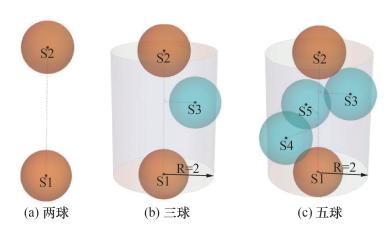
图 11 神经网络计算角系数的两球、三球、五球情形
FCN训练完成后,首先结合测试数据检验其预测效果。对于两球情形,采用解析值进行检验;对于更多球情形,采用MC程序生成的数据进行检验。所有测试数据都未参与FCN训练。图 12为其中4种情形的检验结果。数据点越接近y=x直线,表示神经网络的预测效果越好。
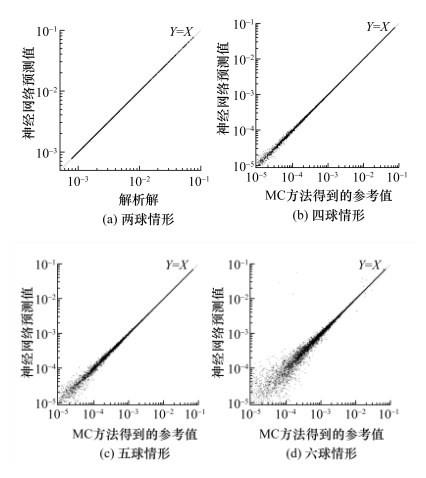
图 12 神经网络相比测试数据的准确性验证

5 结论

本文以高温气冷堆堆芯球床流动与传热为重点,回顾总结了围绕球床燃料球高温流动与传热的耦合的数学模型、数值模拟方法及基于神经网络的深度学习技术及其应用。
后续研究主要包括:
1) 对于燃料球动力学,一方面,虽然目前的模型在大型工程问题的计算结果初步验证了其可行性,但是对冷却剂流场的耦合,特别是基于CFD-DEM的大型工程过程中两相流动的模拟方法、软件及验证,仍然需要深入研究。另一方面,对使用连续介质描述的宏观球流本构及控制方程也值得认真研究。
2) 对于燃料球传热学,耦合计算不同尺度的传热,特别是与冷却剂的耦合传热仍然是一个重要的问题。包含传热、传质及燃料球燃耗计算的多物理过程十分复杂,但是工程需求非常迫切,而现有解决方案的效率和准确程度仍然不令人满意。建立一个工业上适用、计算准确、运行高效的堆芯流动与传热的耦合计算程序是下一步研究的重要目标。
1
王茜, 李林蔚, 高彬, 等. 世界核电发展趋势走向分析[J]. 产业与科技论坛, 2022, 21 (13): 17- 19.

WANG Q , LI L W , GAO B , et al. Analysis of the development trends of global nuclear power[J]. Industrial & Science Tribune, 2022, 21 (13): 17- 19.

2
第四代核能系统国际论坛. 第四代核能系统技术路线图(2014年修订版)[R/OL]. (2014-12-29)[2025-01-06]. https://gif.china-nea.cn/1803/201412/8584.html.

Generation Ⅳ International Forum. Technology roadmap for generation Ⅳ nuclear energy systems: 2014 update[R/OL]. (2014-12-29)[2025-01-06]. https://gif.china-nea.cn/1803/201412/8584.html. (in Chinese)

3
BREY H L . FORT St. Vrain operations and future[J]. Energy, 1991, 16 (1-2): 47- 58.

DOI

4
NAKAGAWA S , TACHIBANA Y , TAKAMATSU K , et al. Performance test of HTTR[J]. Nuclear Engineering and Design, 2004, 233 (1-3): 291- 300.

DOI

5
ZIERMANN E . The AVR nuclear power facility — Progress report[J]. Nuclear Engineering and Design, 1984, 78 (2): 99- 108.

DOI

6
WU Z X , LIN D C , ZHONG D X . The design features of the HTR-10[J]. Nuclear Engineering and Design, 2002, 218 (1-3): 25- 32.

DOI

7
ZHANG Z Y , WU Z X , SUN Y L , et al. Design aspects of the Chinese modular high-temperature gas-cooled reactor HTR-PM[J]. Nuclear Engineering and Design, 2006, 236 (5-6): 485- 490.

DOI

8
ZHANG P C , LI F G , WANG F Y . Optimization and test of ginger-shaking and harvesting device based on EDEM software[J]. Computers and Electronics in Agriculture, 2023, 213, 108257.

DOI

9
张瑶, 钟星立, 钟渝, 等. 基于StreamDEM的高炉布料首层料面研究[C]//第十一届中国钢铁年会论文集——S01. 炼铁与原料. 北京: 冶金工业出版社, 2017.

ZHANG Y, ZHONG X L, ZHONG Y, et al. Study on the first layer of blast furnace fabric based on streamDEM[C]//Proceedings of the 11th China Iron & Steel Annual Conference. Beijing, China: Metallurgical Industry Press, 2017. (in Chinese)

10
SINGH M , SHIRAZIAN S , RANADE V , et al. Challenges and opportunities in modelling wet granulation in pharmaceutical industry—A critical review[J]. Powder Technology, 2022, 403, 117380.

DOI

11
周平根, 冯春, 武杰, 等. 基于GDEM的泥石流启动过程及成灾范围反演分析[J]. 中国铁路, 2024 (1): 38- 47.

ZHOU P G , FENG C , WU J , et al. Inverse analysis of initiation process and disaster range debris flow based on GDEM[J]. China Railway, 2024 (1): 38- 47.

12
ZHAO Z J , ZHOU L , BAI L , et al. Recent advances and perspectives of CFD-DEM simulation in fluidized bed[J]. Archives of Computational Methods in Engineering, 2024, 31 (2): 871- 918.

DOI

13
JIANG S Y , TU J Y , YANG X T , et al. A review of pebble flow study for pebble bed high temperature gas-cooled reactor[J]. Experimental and Computational Multiphase Flow, 2019, 1 (3): 159- 176.

DOI

14
GUI N , JIANG S Y , YANG X T , et al. A review of recent study on the characteristics and applications of pebble flows in nuclear engineering[J]. Experimental and Computational Multiphase Flow, 2022, 4 (4): 339- 349.

DOI

15
HORABIK J , MOLENDA M . Parameters and contact models for DEM simulations of agricultural granular materials: A review[J]. Biosystems Engineering, 2016, 147, 206- 225.

DOI

16
CUNDALL P A , STRACK O D L . A discrete numerical model for granular assemblies[J]. Géotechnique, 1979, 29 (1): 47- 65.

17
THORNTON C , YIN K K . Impact of elastic spheres with and without adhesion[J]. Powder Technology, 1991, 65 (1-3): 153- 166.

DOI

18
PROKOPOVICH P , PERNI S . Comparison of JKR—and DMT-based multi-asperity adhesion model: Theory and experiment[J]. Colloids and Surfaces A: Physicochemical and Engineering Aspects, 2011, 383 (1-3): 95- 101.

19
DI RENZO A , DI MAIO F P . An improved integral non-linear model for the contact of particles in distinct element simulations[J]. Chemical Engineering Science, 2005, 60 (5): 1303- 1312.

DOI

20
BARBER J R . Elasticity[M]. 4th ed Cham: Springer, 2022.

21
MINDLIN R D , DERESIEWICZ H . Elastic spheres in contact under varying oblique forces[J]. Journal of Applied Mechanics, 1953, 20 (3): 327- 344.

DOI

22
ZHAO X, MONTGOMERY T, ZHANG S J. Combined CFD and DEM simulations of fluid flow and heat transfer in a pebble bed reactor[C]//Proceedings of the ASME 2011 Small Modular Reactors Symposium. Washington, USA: ASME, 2012.

23
VAN LEW J T , YING A , ABDOU M . Coupling discrete element models of ceramic breeder pebble beds to thermofluid models of helium purge gas using volume-averaged Navier-stokes and the lattice-Boltzmann method[J]. Fusion Science and Technology, 2015, 68 (2): 288- 294.

DOI

24
SUN X S , SAKAI M , YAMADA Y . Three-dimensional simulation of a solid-liquid flow by the DEM-SPH method[J]. Journal of Computational Physics, 2013, 248, 147- 176.

DOI

25
LIU X , GUI N , CUI X Y , et al. Discrete element-embedded finite element model for simulation of soft particle motion and deformation[J]. Particuology, 2022, 68, 88- 100.

DOI

26
LIU X , GUI N , YANG X T , et al. A new discrete element-embedded finite element method for transient deformation, movement and heat transfer in packed bed[J]. International Journal of Heat and Mass Transfer, 2021, 165, 120714.

DOI

27
VON DER DECKEN C B . Mechanical problems of a pebble bed reactor core[J]. Nuclear Engineering and Design, 1972, 18 (2): 323- 333.

DOI

28
VERGARI L , QUINCEY J , DE BELLEFON G M , et al. Self-lubrication of nuclear graphite in argon at high temperature[J]. Tribology International, 2023, 177, 107946.

DOI

29
XIAO J K , ZHANG L , ZHOU K C , et al. Anisotropic friction behaviour of highly oriented pyrolytic graphite[J]. Carbon, 2013, 65, 53- 62.

DOI

30
STANSFIELD O M . Friction and wear of graphite in dry helium at 25, 400, and 800℃[J]. Nuclear Applications, 1969, 6 (4): 313- 320.

DOI

31
CHEN Z L , GUI N , SUN Y F , et al. Experimental study of friction coefficient of graphite for high-temperature gas-cooled reactors[J]. Nuclear Engineering and Design, 2024, 423, 113162.

DOI

32
CHEN H , XIAO Y G , LIU Y L , et al. Effect of Young's modulus on DEM results regarding transverse mixing of particles within a rotating drum[J]. Powder Technology, 2017, 318, 507- 517.

DOI

33
QI H B , GUI N , YANG X T , et al. Effects of restitution coefficient on pebble motion in a thin pebble bed—Lagrangian analysis[J]. Annals of Nuclear Energy, 2020, 145, 107549.

DOI

34
YURATA T , GIDASPOW D , PIUMSOMBOON P , et al. The importance of parameter-dependent coefficient of restitution in discrete element method simulations[J]. Advanced Powder Technology, 2021, 32 (4): 1004- 1012.

DOI

35
LIMA R M , BRANDAO R J , SANTOS R L , et al. Analysis of methodologies for determination of DEM input parameters[J]. Brazilian Journal of Chemical Engineering, 2021, 38 (2): 287- 296.

DOI

36
WANG J , LEI M Z , YANG H , et al. Effects of coefficient of friction and coefficient of restitution on static packing characteristics of polydisperse spherical pebble bed[J]. Particuology, 2021, 57, 1- 9.

DOI

37
LI Y , GUI N , YANG X T , et al. Effect of friction on pebble flow pattern in pebble bed reactor[J]. Annals of Nuclear Energy, 2016, 94, 32- 43.

DOI

38
XI W B , WU Q G , LEI M Z , et al. Numerically investigation of the neutron irradiation swelling on the mechanical and structural evolution of beryllium pebble bed[J]. Fusion Engineering and Design, 2023, 195, 113966.

DOI

39
LEI M Z , LIU S M , WU Q G , et al. Research on purge gas flow characteristics in different pebble bed structures for fusion blanket[J]. Progress in Nuclear Energy, 2023, 155, 104488.

DOI

40
RYCROFT C H , GREST G S , LANDRY J W , et al. Analysis of granular flow in a pebble-bed nuclear reactor[J]. Physical Review E, 2006, 74 (2): 021306.

DOI

41
KHANE V , TAHA M M , MUELLER G E , et al. Discrete element method-based investigations of granular flow in a pebble bed reactor[J]. Nuclear Technology, 2017, 199 (1): 47- 66.

DOI

42
LI Y , GUI N , YANG X T , et al. Effect of wall structure on pebble stagnation behavior in pebble bed reactor[J]. Annals of Nuclear Energy, 2015, 80, 195- 202.

DOI

43
WU M Q , GUI N , YANG X T , et al. Effects of 3D contraction on pebble flow uniformity and stagnation in pebble beds[J]. Nuclear Engineering and Technology, 2021, 53 (5): 1416- 1428.

DOI

44
WU M Q , GUI N , LIU X , et al. Numerical analysis of the effects of different outlet sizes on pebble flows in HTR-10 pebble beds[J]. Nuclear Engineering and Design, 2022, 387, 111620.

DOI

45
LI B , GUI N , WU H , et al. Effects of the 3-D wall structures on the flow and mixing characteristics of pebbles in pebble beds in HTR-10[J]. Annals of Nuclear Energy, 2021, 164, 108607.

DOI

46
REGER D , MERZARI E , BALESTRA P , et al. Discrete element simulation of Pebble Bed Reactors on graphics processing units[J]. Annals of Nuclear Energy, 2023, 190, 109896.

DOI

47
LU G , THIRD J R , MüLLER C R . Discrete element models for non-spherical particle systems: From theoretical developments to applications[J]. Chemical Engineering Science, 2015, 127, 425- 465.

DOI

48
FENG Y T . Thirty years of developments in contact modelling of non-spherical particles in DEM: A selective review[J]. Acta Mechanica Sinica, 2023, 39 (1): 722343.

DOI

49
CUI X Y , GUI N , LIU X , et al. Numerical study of blockage and arching behavior of particle with different shapes in packed bed[J]. Nuclear Engineering and Design, 2023, 405, 112225.

DOI

50
CUI X Y , LI B , GUI N , et al. Experimental study of free drainage of mixed cubic and spherical particles in a monolayer granular system[J]. Powder Technology, 2022, 409, 117826.

DOI

51
GE L , GUI N , YANG X T , et al. Effects of aspect ratio and component ratio on binary-mixed discharging pebble flow in hoppers[J]. Powder Technology, 2019, 355, 320- 332.

DOI

52
KIM D O , HWANG S P , SOHN D . DEM study of packing and connectivity of binary-sized pebbles according to their size and mixing ratios under vibration conditions[J]. Fusion Engineering and Design, 2021, 168, 112648.

DOI

53
WU M Q , GUI N , YANG X T , et al. Numerical investigation of flow characteristics and packing structure of binary-sized pebble flow in a circulating pebble bed[J]. Progress in Nuclear Energy, 2022, 150, 104312.

DOI

54
PUPESCHI S , MOSCARDINI M , GAN Y , et al. Cyclic behavior of ceramic pebble beds under mechanical loading[J]. Fusion Engineering and Design, 2018, 134, 11- 21.

DOI

55
FENG Y J , GONG B P , CHENG H , et al. Effects of bed dimension, friction coefficient and pebble size distribution on the packing structures of the pebble bed for solid tritium breeder blanket[J]. Fusion Engineering and Design, 2021, 163, 112156.

DOI

56
WANG S , HU C S , LUO K , et al. Multi-scale numerical simulation of fluidized beds: Model applicability assessment[J]. Particuology, 2023, 80, 11- 41.

DOI

57
SHARMA A , ABHISHEK , SAHA S K , et al. Thermal-hydraulic characteristics of purge gas in a rectangular packed pebble bed of a fusion reactor using DEM-CFD and porous medium analyses[J]. Fusion Engineering and Design, 2020, 160, 111848.

DOI

58
WANG J W . Continuum theory for dense gas-solid flow: A state-of-the-art review[J]. Chemical Engineering Science, 2020, 215, 115428.

DOI

59
EHLERS W . Darcy, Forchheimer, Brinkman and Richards: Classical hydromechanical equations and their significance in the light of the TPM[J]. Archive of Applied Mechanics, 2022, 92 (2): 619- 639.

DOI

60
DETMANN B . Modeling chemical reactions in porous media: A review[J]. Continuum Mechanics and Thermodynamics, 2021, 33 (6): 2279- 2300.

DOI

61
PENG Z B , DOROODCHI E , MOGHTADERI B . Heat transfer modelling in discrete element method (DEM)-based simulations of thermal processes: Theory and model development[J]. Progress in Energy and Combustion Science, 2020, 79, 100847.

DOI

62
DÍAZ-HERAS M , BELMONTE J F , ALMENDROS-IBÁÑEZ J A . Effective thermal conductivities in packed beds: Review of correlations and its influence on system performance[J]. Applied Thermal Engineering, 2020, 171, 115048.

DOI

63
JIANG S Y , TU J Y , YANG X T , et al. Multiphase flow and heat transfer in pebble bed reactor core[M]. Singapore: Springer, 2021.

64
BAGGEMANN J , SHI D , KASSELMANN S , et al. Use of SANA experimental data for validation and verification of MGT-3D and a CFD porous media model for VHTR application[J]. Nuclear Engineering and Design, 2016, 305, 678- 687.

DOI

65
NOVAK A J , PETERSON J W , ZOU L , et al. Validation of Pronghorn friction-dominated porous media thermal-hydraulics model with the SANA experiments[J]. Nuclear Engineering and Design, 2019, 350, 182- 194.

DOI

66
NOVAK A J , SCHUNERT S , CARLSEN R W , et al. Multiscale thermal-hydraulic modeling of the pebble bed fluoride-salt-cooled high-temperature reactor[J]. Annals of Nuclear Energy, 2021, 154, 107968.

DOI

67
ZOU L , HU G J , O'GRADY D , et al. Explicit modeling of pebble temperature in the porous-media model for pebble-bed reactors[J]. Progress in Nuclear Energy, 2022, 146, 104175.

DOI

68
NOURI-BORUJERDI A , TABATABAI GHOMSHEH S I . An improved porous media approach to thermal-hydraulics analysis of high-temperature gas-cooled reactors[J]. Annals of Nuclear Energy, 2015, 76, 485- 492.

DOI

69
LUO Y Y , GUI N , LIU Z Y , et al. A novel contact thermal resistance model for heat transfer in granular systems: Leveraging the force-heat analogy[J]. International Journal of Heat and Mass Transfer, 2024, 232, 125919.

DOI

70
LUO Y Y , GUI N , YANG X T , et al. Analytical generalized thermal resistance model for conductive heat transfer in pebble beds based on heat flux weighted temperature difference[J]. International Journal of Heat and Mass Transfer, 2025, 236, 126401.

DOI

71
LUO Y Y , GUI N , YANG X T , et al. An analytical model for the three-dimensional thermal resistance of particles considering internal heat conduction based on the generalized thermal resistance concept[J]. International Journal of Heat and Mass Transfer, 2025, 240, 126619.

DOI

72
张娄红, 何华, 谢一玫, 等. 不透性石墨材料导热系数影响因素的分析[J]. 中国化工装备, 2024, 26 (6): 7- 12.

ZHANG L H , HE H , XIE Y M , et al. Analysis on the influencing factors of thermal conductivity of impermeable graphite materials[J]. China Chemical Industry Equipment, 2024, 26 (6): 7- 12.

73
International Atomic Energy Agency. Heat transport and afterheat removal for gas cooled reactors under accident conditions[R]. Vienna: International Atomic Energy Agency, 2001.

74
ROUSSEAU P G , DU TOIT C G , VAN ANTWERPEN W , et al. Separate effects tests to determine the effective thermal conductivity in the PBMR HTTU test facility[J]. Nuclear Engineering and Design, 2014, 271, 444- 458.

DOI

75
任成, 孙艳飞, 杨星团. 高温气冷堆极端高温石墨环境下的温度测量[C]//中国核科学技术进展报告. 北京: 科学技术文献出版社, 2023: 41-50.

REN C, SUN Y F, YANG X T. Temperature measurement in the extreme graphite environment of high temperature gas-cooled reactor[C]//Progress Report on China Nuclear Science & Technology. Beijing: Science and Technology Literature Publishing House, 2023: 41-50. (in Chinese).

76
任成, 杨星团, 李聪新, 等. 高温气冷堆球床等效导热系数实验装置模拟计算[J]. 清华大学学报(自然科学版), 2015, 55 (9): 991- 997.

REN C , YANG X T , LI C X , et al. Modeling of the heat transfer characteristics of the effective thermal conductivity test facility for high temperature gas-cooled reactors[J]. Journal of Tsinghua University (Science & Technology), 2015, 55 (9): 991- 997.

77
任成, 杨星团, 李聪新, 等. 高温堆球床等效导热系数测量实验加热系统设计及可行性验证[J]. 清华大学学报(自然科学版), 2014, 54 (8): 1068- 1072.

REN C , YANG X T , LI C X , et al. Heating system design and validation for the pebble bed effective thermal conductivity experiment in a high temperature gas-cooled reactor[J]. Journal of Tsinghua University (Science & Technology), 2014, 54 (8): 1068- 1072.

78
任成, 杨星团, 李聪新, 等. 高温气冷堆球床等效导热系数实验研究进展[J]. 科学技术与工程, 2013, 13 (7): 1905- 1914.

REN C , YANG X T , LI C X , et al. Progress in pebble bed heat transfer test facility of high temperature gas-cooled reactor[J]. Science Technology and Engineering, 2013, 13 (7): 1905- 1914.

79
鄂彦志. GPU加速的氟盐冷却球床堆堆芯瞬态分析方法研究[D]. 上海: 中国科学院研究生院(上海应用物理研究所), 2017. E Y Z.

Research of GPU-accelerated core transient analysis method for pebble-bed fluoride salt cooled high temperature reactor[D]. Shanghai: Shanghai Institute of Applied Physics Chinese Academy of Sciences, 2017. (in Chinese)

80
CHENG G J , YU A B , ZULLI P . Evaluation of effective thermal conductivity from the structure of a packed bed[J]. Chemical Engineering Science, 1999, 54 (19): 4199- 4209.

DOI

81
GAN J Q , ZHOU Z Y , YU A B . Particle scale study of heat transfer in packed and fluidized beds of ellipsoidal particles[J]. Chemical Engineering Science, 2016, 144, 201- 215.

DOI

82
YANG R Y , ZOU R P , YU A B . Voronoi tessellation of the packing of fine uniform spheres[J]. Physical Review E, 2002, 65 (4 Pt 1): 041302.

83
OSCHMANN T , KRUGGEL-EMDEN H . A novel method for the calculation of particle heat conduction and resolved 3D wall heat transfer for the CFD/DEM approach[J]. Powder Technology, 2018, 338, 289- 303.

DOI

84
ZHOU J H , YU A B , HORIO M . Finite element modeling of the transient heat conduction between colliding particles[J]. Chemical Engineering Journal, 2008, 139 (3): 510- 516.

DOI

85
SUN J , CHEN M M . A theoretical analysis of heat transfer due to particle impact[J]. International Journal of Heat and Mass Transfer, 1988, 31 (5): 969- 975.

DOI

86
BATCHELOR G K , O'BRIEN R W . Thermal or electrical conduction through a granular material[J]. Proceedings of the Royal Society A: Mathematical, Physical and Engineering Sciences, 1977, 355 (1682): 313- 333.

87
ZHOU Z Y , YU A B , ZULLI P . A new computational method for studying heat transfer in fluid bed reactors[J]. Powder Technology, 2010, 197 (1-2): 102- 110.

DOI

88
MORRIS A B , PANNALA S , MA Z , et al. Development of soft-sphere contact models for thermal heat conduction in granular flows[J]. AIChE Journal, 2016, 62 (12): 4526- 4535.

DOI

89
WAKAO N , KAGUEI S , FUNAZKRI T . Effect of fluid dispersion coefficients on particle-to-fluid heat transfer coefficients in packed beds: Correlation of nusselt numbers[J]. Chemical Engineering Science, 1979, 34 (3): 325- 336.

DOI

90
GUNN D J . Transfer of heat or mass to particles in fixed and fluidised beds[J]. International Journal of Heat and Mass Transfer, 1978, 21 (4): 467- 476.

DOI

91
TAVASSOLI H , PETERS E A J F , KUIPERS J A M . Direct numerical simulation of fluid-particle heat transfer in fixed random arrays of non-spherical particles[J]. Chemical Engineering Science, 2015, 129, 42- 48.

DOI

92
SUN B , TENNETI S , SUBRAMANIAM S . Modeling average gas-solid heat transfer using particle-resolved direct numerical simulation[J]. International Journal of Heat and Mass Transfer, 2015, 86, 898- 913.

DOI

93
SINGHAL A , CLOETE S , RADL S , et al. Heat transfer to a gas from densely packed beds of monodisperse spherical particles[J]. Chemical Engineering Journal, 2017, 314, 27- 37.

DOI

94
CHEN Y , MüLLER C R . Gas-solid heat transfer in assemblies of cubes for ReV ≤ 100[J]. Chemical Engineering Science, 2020, 216, 115478.

DOI

95
CHANG Q , YANG L Q , GE W . Fluid-particle heat transfer in static assemblies: Effect of particle shape[J]. International Journal of Heat and Mass Transfer, 2021, 166, 120730.

DOI

96
WU H , GUI N , YANG X T , et al. Numerical simulation of heat transfer in packed pebble beds: CFD-DEM coupled with particle thermal radiation[J]. International Journal of Heat and Mass Transfer, 2017, 110, 393- 405.

DOI

97
FORGBER T , RADL S . A novel approach to calculate radiative thermal exchange in coupled particle simulations[J]. Powder Technology, 2018, 323, 24- 44.

DOI

98
LIU L H . Multiple size group analysis for transient radiative heating of particle polydispersions[J]. Journal of Quantitative Spectroscopy and Radiative Transfer, 2003, 76 (2): 225- 234.

DOI

99
SHI Y , SUN W J , LI L X , et al. An improved unified gas kinetic particle method for radiative transfer equations[J]. Journal of Quantitative Spectroscopy and Radiative Transfer, 2021, 261, 107428.

DOI

100
CHENG G J , YU A B . Particle scale evaluation of the effective thermal conductivity from the structure of a packed bed: Radiation heat transfer[J]. Industrial & Engineering Chemistry Research, 2013, 52 (34): 12202- 12211.

101
WU H , GUI N , YANG X T , et al. Effect of scale on the modeling of radiation heat transfer in packed pebble beds[J]. International Journal of Heat and Mass Transfer, 2016, 101, 562- 569.

DOI

102
WU Y Y , REN C , LI R , et al. Measurement on effective thermal diffusivity and conductivity of pebble bed under vacuum condition in High Temperature Gas-cooled Reactor[J]. Progress in Nuclear Energy, 2018, 106, 195- 203.

DOI

103
WU H , GUI N , YANG X T , et al. A new uniform continuum modeling of conductive and radiative heat transfer in nuclear pebble bed[J]. Journal of Heat Transfer, 2019, 141 (8): 082001.

DOI

104
WU H , GUI N , YANG X T , et al. A matrix model of particle-scale radiative heat transfer in structured and randomly packed pebble bed[J]. International Journal of Thermal Sciences, 2020, 153, 106334.

DOI

105
WU H , GUI N , YANG X T , et al. Particle-scale investigation of thermal radiation in nuclear packed pebble beds[J]. Journal of Heat Transfer, 2018, 140 (9): 092002.

DOI

106
LI B , GUI N , WU H , et al. Sub-cell radiation-conduction (SCRC) model in densely packed beds of mono-sized pebbles for HTGR under vacuum condition[J]. International Journal of Heat and Mass Transfer, 2022, 199, 123445.

DOI

107
吴浩, 牛风雷. 高温球床辐射传热中的机器学习模型[J]. 清华大学学报(自然科学版), 2023, 63 (8): 1213- 1218.

DOI

WU H , NIU F L . Machine learning model of radiation heat transfer in the high-temperature nuclear pebble bed[J]. Journal of Tsinghua University (Science & Technology), 2023, 63 (8): 1213- 1218.

DOI

108
谢宛均. 基于集成学习高温球床热辐射规律研究[D]. 北京: 华北电力大学(北京), 2024.

XIE W J. Ensemble learning modelling of decay heat removal in high temperature gas-cooled reactor[D]. Beijing: North China Electric Power University, 2024. (in Chinese)

109
Tanaka S . Exact view-factor analysis for radiation from a sphere to another sphere linked with a coaxial cylinder[J]. Journal of Maritime Sciences, 2008, 5, 85- 92.

110
WALKER T. The use of primitives in the calculation of radiative view factors[D]. Sydney: University of Sydney, 2013.

111
WU H , GUI N , YANG X T , et al. An approximation function model for solving effective radiative heat transfer in packed bed[J]. Annals of Nuclear Energy, 2020, 135, 107000.

DOI

112
JOHNSON E , BAKER D , TARI I . Development of view factor correlations for modeling thermal radiation in solid particle solar receivers using CFD-DEM[J]. AIP Conference Proceedings, 2019, 2126 (1): 030028.

113
VAN ANTWERPEN W , ROUSSEAU P G , DU TOIT C G . Multi-sphere Unit Cell model to calculate the effective thermal conductivity in packed pebble beds of mono-sized spheres[J]. Nuclear Engineering and Design, 2012, 247, 183- 201.

DOI

114
贝蒂尔·施密特, 豪尔赫·冈萨雷斯-多明格斯, 克里斯蒂安·洪特, 等. 并行程序设计: 概念与实践[M]. 北京: 机械工业出版社, 2020.

SCHMIDT B , GONZALEZ-DOMINGUEZ J , HUNDT C , et al. Parallel programming: Concepts and practice[M]. Beijing: China Machine Press, 2020.

115
STONE J E , GOHARA D , SHI G C . OpenCL: A parallel programming standard for heterogeneous computing systems[J]. Computing in Science & Engineering, 2010, 12 (3): 66- 73.

116
NVIDIA. CUDA C++ programming guide[EB/OL]. (2024-11-20)[2025-01-06]. https://docs.nvidia.com/cuda/cuda-c-programming-guide/index.html.

117
FUKUDA D , MOHAMMADNEJAD M , LIU H Y , et al. Development of a 3D hybrid finite-discrete element simulator based on GPGPU-parallelized computation for modelling rock fracturing under quasi-static and dynamic loading conditions[J]. Rock Mechanics and Rock Engineering, 2020, 53 (3): 1079- 1112.

DOI

118
ZHOU Q , XU W J , LIU G Y . A contact detection algorithm for triangle boundary in GPU-based DEM and its application in a large-scale landslide[J]. Computers and Geotechnics, 2021, 138, 104371.

DOI

119
WANG S Q , ZHANG Q , JI S Y . GPU-based parallel algorithm for super-quadric discrete element method and its applications for non-spherical granular flows[J]. Advances in Engineering Software, 2021, 151, 102931.

DOI

120
GOVENDER N , CLEARY P W , KIANI-OSHTORJANI M , et al. The effect of particle shape on the packed bed effective thermal conductivity based on DEM with polyhedral particles on the GPU[J]. Chemical Engineering Science, 2020, 219, 115584.

DOI

121
DI RENZO A , DI MAIO F P . Comparison of contact-force models for the simulation of collisions in DEM-based granular flow codes[J]. Chemical Engineering Science, 2004, 59 (3): 525- 541.

DOI

122
MITTAL A , MANGADODDY N , BANERJEE R . Development of three-dimensional GPU DEM code-benchmarking, validation, and application in mineral processing[J]. Computational Particle Mechanics, 2023, 10 (6): 1533- 1556.

DOI

123
YU J H , WANG S , LUO K , et al. GPU-accelerated discrete element simulation of granular and gas-solid flows[J]. Powder Technology, 2024, 437, 119475.

DOI

124
ZOU Q , GUI N , YANG X T , et al. A GPU-based DEM model for the pebble flow study in packed bed: Simulation scheme and validation[J]. Powder Technology, 2023, 422, 118441.

DOI

125
YE F P , WHEELER C , CHEN B , et al. Calibration and verification of DEM parameters for dynamic particle flow conditions using a backpropagation neural network[J]. Advanced Powder Technology, 2019, 30 (2): 292- 301.

DOI

126
BENVENUTI L , KLOSS C , PIRKER S . Identification of DEM simulation parameters by Artificial Neural Networks and bulk experiments[J]. Powder Technology, 2016, 291, 456- 465.

DOI

127
BENVENUTI L, KLOSS C, PIRKER S. Characterization of DEM particles by means of artificial neural networks and macroscopic experiments[C]//Proceedings of the 16th International Conference on Engineering Applications of Neural Networks. Rhodes Island, Greece: ACM, 2015: 4.

128
KUMAR R , PATEL C M , JANA A K , et al. Prediction of hopper discharge rate using combined discrete element method and artificial neural network[J]. Advanced Powder Technology, 2018, 29 (11): 2822- 2834.

DOI

129
HE L , TAFTI D K . A supervised machine learning approach for predicting variable drag forces on spherical particles in suspension[J]. Powder Technology, 2019, 345, 379- 389.

DOI

130
CUI Y F , FANG J , LI Y , et al. Assessing effectiveness of a dual-barrier system for mitigating granular flow hazards through DEM-DNN framework[J]. Engineering Geology, 2022, 306, 106742.

DOI

131
LIU Y J , MARQUARDT J , PENG S F , et al. Neural network prediction of residence time distribution for quasi-2D pebble flow[J]. Chemical Engineering Science, 2022, 250, 117363.

DOI

132
CUI X Y , GUI N , YANG X T , et al. Analysis of particle shape effect on the discharging of non-spherical particles in HTR-10 reactor core[J]. Nuclear Engineering and Design, 2021, 371, 110934.

DOI

133
ZHANG P , YU Y Z . A novel deep learning-based modelling strategy from image of particles to mechanical properties for granular materials with CNN and BiLSTM[J]. Computer Methods in Applied Mechanics and Engineering, 2021, 382, 113858.

DOI

134
YAO Z W , HUANG Q P , JI Z , et al. Deep learning-based prediction of piled-up status and payload distribution of bulk material[J]. Automation in Construction, 2021, 121, 103424.

DOI

135
LIANG Z Y , NIE Z H , AN A J , et al. A particle shape extraction and evaluation method using a deep convolutional neural network and digital image processing[J]. Powder Technology, 2019, 353, 156- 170.

DOI

136
LIAO Z H , YANG Y Z , SUN C F , et al. Image-based prediction of granular flow behaviors in a wedge-shaped hopper by combing DEM and deep learning methods[J]. Powder Technology, 2021, 383, 159- 166.

DOI

137
HESSE R , KRULL F , ANTONYUK S . Prediction of random packing density and flowability for non-spherical particles by deep convolutional neural networks and Discrete Element Method simulations[J]. Powder Technology, 2021, 393, 559- 581.

DOI

138
HONG J , LIU J . Rapid estimation of permeability from digital rock using 3D convolutional neural network[J]. Computational Geosciences, 2020, 24 (4): 1523- 1539.

DOI

139
蔡杨, 苏明旭, 蔡小舒. 基于卷积神经网络的混合颗粒分类法研究[J]. 光学学报, 2019, 39 (7): 0712002.

CAI Y , SU M X , CAI X S . Method for mixed-particle classification based on convolutional neural network[J]. Acta Optica Sinica, 2019, 39 (7): 0712002.

140
NEWBY J M , SCHAEFER A M , LEE P T , et al. Convolutional neural networks automate detection for tracking of submicron-scale particles in 2D and 3D[J]. Proceedings of the National Academy of Sciences of the United States of America, 2018, 115 (36): 9026- 9031.

141
WU M Q , LIU X , GUI N , et al. Prediction of the remaining time and time interval of pebbles in pebble bed HTGRs aided by CNN via DEM datasets[J]. Nuclear Engineering and Technology, 2023, 55 (1): 339- 352.

DOI

142
WU M Q , BIN L , GUI N , et al. Deep learning-based prediction of the remaining time and future distribution of pebble flow from real-scene images[J]. Chemical Engineering Science, 2024, 283, 119425.

DOI

143
TAUSENDSCHÖN J , RADL S . Deep neural network-based heat radiation modelling between particles and between walls and particles[J]. International Journal of Heat and Mass Transfer, 2021, 177, 121557.

DOI

144
KIANIMOQADAM A , LAPP J . Calculating the view factor of randomly dispersed multi-sized particles using hybrid GRU-LSTM recurrent neural networks regression[J]. International Journal of Heat and Mass Transfer, 2023, 202, 123756.

DOI

145
ZOU Q , GUI N , YANG X T , et al. Comparative study on the numerical methods for view factor computation for packed pebble beds: Back propagation neural network methods versus Monte Carlo methods[J]. Journal of Heat Transfer, 2021, 143 (8): 083301.

DOI

Outlines

/