

清洁能源开发是落实中国“双碳”目标的重要举措,各地积极部署清洁能源项目投资,水风光储清洁能源项目发展迅速。设计是项目开发的关键,对整个项目实施有重大影响[1-6]。设计过程可以划分为前期论证、招标设计和施工图设计[7-8],其中前期论证可以划分为预可行性研究阶段和可行性研究阶段[9-10](下文简称为预可研阶段和可研阶段)。清洁能源项目外部环境复杂、利益相关方众多、新能源大规模并网难度大,且已建项目存在调节能源配置不足、装机容量与电力需求不匹配、电力外送经济效益低、项目间协同效应差等问题。这些问题主要是设计管理不到位导致的。设计管理在清洁能源项目管理过程中发挥着重要作用[1-2, 11-14]。设计管理不仅是设计方的职责,也需要其他项目利益相关方积极参与。例如,业主方参与设计管理与项目设计成果能否满足业主方需求密切相关[15-16]。但已有研究主要从设计方单一视角开展,缺乏从参建各方协同视角进行清洁能源项目设计管理研究,导致对清洁能源项目设计管理关键因素及相互作用关系缺乏系统认知,并且实证支持不足[17-22]。
本文针对水能、风能和太阳能3类清洁能源,从项目参与方合作伙伴关系视角,构建了清洁能源项目设计管理模型,基于调研数据进行了模型验证,揭示了设计管理关键因素及其相互作用关系,并结合案例分析提出了设计管理建议。
1 模型构建
综上,为探讨伙伴关系、前期论证、业主方设计管理对清洁能源项目实施的影响机理,构建了基于伙伴关系的清洁能源项目设计管理理论模型,如图 1所示。
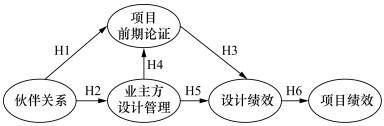
通过理论模型的建立与检验,本研究拟回答下列问题:1) 清洁能源项目伙伴关系、前期论证、业主方设计管理、设计绩效、项目绩效如何测量且测量结果如何;2) 各变量之间的作用关系如何;3) 基于实证研究结果,如何提升清洁能源项目设计管理水平,进而提高项目绩效。
2 研究方法
2.1 数据收集方法
本研究采取定量研究和定性研究相结合的混合研究方法,通过问卷调研获取定量数据,通过半结构化访谈、案例收集获取定性数据。
调研问卷包括3个部分:第1部分收集调研对象的基本信息,包括年龄、学历、参建角色、工作类别、从业年限等;第2部分用Likert-5分法对参建各方伙伴关系、前期论证、业主方设计管理、设计绩效、项目绩效等情况进行量化评估,为理论模型各变量提供测量数据;第3部分收集调研对象对清洁能源项目设计管理的看法与建议。问卷充分考虑清洁能源产能特点及已有清洁能源工程项目实施情况,在清洁能源开发资源条件与制约因素、清洁能源电力市场供需、水风光储多能互补等方面设置了相应的调研指标。
问卷主要面向具有丰富清洁能源项目参建经验的管理和技术人员发放,共回收问卷196份,得到有效问卷160份。调研对象平均从业年数为7.94 a,具有较为丰富的工程建设经验,能够为本研究提供有价值的观点。问卷样本覆盖清洁能源项目业主方、设计方、施工方、监理方等参建角色,涉及设计、采购、施工、运行、建设管理、安全管理、环保水保、质量控制、合同管理、技术研发以及信息化等工作类型,具有良好的代表性。
此外,基于问卷内容形成了访谈大纲,对多位专家及参建人员进行了半结构化访谈,并通过考察工地现场、收集项目全过程资料等方式为问卷分析结果提供定性依据和案例支持。
2.2 数据分析方法
本研究运用SPSS和AMOS等软件对问卷调研结果进行数据分析,采用描述性统计、均值排序分析、差异性检验、聚类分析等方法分析清洁能源项目前期论证与业主方设计管理现状;利用结构方程模型验证基于伙伴关系的清洁能源项目设计管理模型,探讨各变量间的作用关系。
3 调研结果分析
3.1 参建各方伙伴关系
表 1 清洁能源项目参建各方在设计过程中的协同工作情况 |
| 指标 | 得分 | 排序 |
| A. 共同目标与公平 | 4.197 | |
| 各方能清楚认识到共同的目标,并致力于实现这些目标 | 4.206 | 1 |
| 各方责权利分配公平,处事公正 | 4.188 | 3 |
| B. 诚信与信任 | 4.184 | |
| 各方信守承诺 | 4.188 | 3 |
| 各方相互信任 | 4.181 | 6 |
| C. 参建态度 | 4.181 | |
| 对他方提议态度积极 | 4.181 | 6 |
| D. 团队建设 | 4.169 | |
| 相互间配合默契,形成良好项目团队 | 4.169 | 8 |
| E. 信息交流与问题解决 | 4.173 | |
| 相互间有开放的氛围,鼓励信息分享 | 4.144 | 10 |
| 相互间有多元信息沟通渠道与平台,实现高效沟通 | 4.188 | 3 |
| 相互间建立有完善有效的问题解决机制 | 4.169 | 8 |
| 相互间信息反馈迅速,能够及时调控项目活动 | 4.194 | 2 |
| 平均值 | 4.181 |
如表 1所示,清洁能源项目参建各方在设计过程中的协同工作水平较高。各方能够清楚认识并致力于实现共同目标,且在实现共同目标的过程中较好地践行了公平、公正原则;能够信守承诺,建立较好的信任关系;但应进一步加强参建各方信息共享,建立开放、透明的沟通渠道,促进组织间开放氛围的形成,避免“信息孤岛”。
3.2 项目前期论证
表 2 清洁能源项目前期论证情况 |
| 指标 | 得分 | 排序 |
| 关键技术方案论证充分、选择适当 | 4.150 | 1 |
| 项目方案经济可行性论证充分 | 4.138 | 2 |
| 项目组织与实施考虑充分 | 4.125 | 3 |
| 项目风险分析充分 | 4.113 | 4 |
| 技术标准选择得当 | 4.113 | 4 |
| 考虑清洁能源项目总体效益优化,合理确定项目规模和项目方案 | 4.106 | 6 |
| 项目在区域经济发展中的作用论证充分 | 4.088 | 7 |
| 环保水保论证充分 | 4.063 | 8 |
| 设备与材料供应论证充分 | 4.056 | 9 |
| 设计基础资料掌握充分,包括水风光储资源条件、地形地貌、地质条件等 | 4.050 | 10 |
| 市场供给分析充分,明确各类电源产能及潜力 | 4.038 | 11 |
| 项目选址适当,充分考虑站址及周边区域的资源条件和制约因素 | 4.031 | 12 |
| 征地移民论证充分 | 4.025 | 13 |
| 市场需求分析充分,明确区域内和跨区域电力消纳对象 | 4.013 | 14 |
| 平均值 | 4.079 |
调研结果(见表 2)表明,在项目前期论证过程中,应深入分析清洁能源电力市场供需,明确区域内和跨区域电力消纳对象;完整掌握水风光储资源条件、地形地貌、地质条件等设计基础资料,合理选址并加强技术方案论证;充分考虑站址及周边区域的制约因素,合理规划工程移民安置和环保水保,同时确保项目具有经济可行性。
3.3 业主方设计管理
3.3.1 设计单位选择
表 3 清洁能源项目设计单位选择因素重要性分析结果 |
| 指标 | 得分 | 排序 |
| 设计资质与专业能力 | 4.306 | 1 |
| 投标文件中的设计方案技术可行性 | 4.300 | 2 |
| 前期论证介入程度 | 4.281 | 3 |
| 信息化设计管理水平(BIM等技术应用) | 4.238 | 4 |
| 设计团队的人员配置 | 4.231 | 5 |
| 相关项目设计业绩 | 4.206 | 6 |
| 设计费用报价 | 4.119 | 7 |
| 平均值 | 4.240 |
如表 3所示,“设计费用报价”得分最低,源于设计费用按标准化工程总造价占比提取,业主方可将注意力更多地放在考量其他方面。调研结果表明,业主方在选择设计单位时应重点考察专业技术能力、设计方案技术可行性、前期论证介入程度,同时结合信息化设计管理水平、设计团队配置、相关项目业绩以及设计费用报价等综合考量。
3.3.2 设计过程业主方参与情况
清洁能源项目设计过程业主方参与情况如表 4所示。其中:1分表示参与程度很低,5分表示参与程度很高。
表 4 清洁能源项目设计过程业主方参与情况 |
| 指标 | 得分 | 排序 |
| 招标设计 | 4.175 | 1 |
| 可行性研究 | 4.163 | 2 |
| 施工图设计 | 4.144 | 3 |
| 预可行性研究 | 4.100 | 4 |
| 平均值 | 4.145 |
如表 4所示,在清洁能源项目设计过程中,业主方参与度均较高。预可研阶段和可研阶段涉及项目核准,需要业主方出面协调解决用地审批、移民安置、环保水保等问题。招标设计阶段确定项目重大技术方案,需要业主方介入决策。施工图设计阶段的设计方案变更等方面也需业主方参与。
3.3.3 业主方设计管理水平
表 5 清洁能源项目业主方设计管理情况 |
| 指标 | 得分 | 排序 |
| A. 设计需求管理 | 4.258 | |
| 对国家、地区能源政策理解到位 | 4.256 | 4 |
| 对项目目标认知清晰 | 4.225 | 11 |
| 对项目设计需求认知清晰 | 4.294 | 3 |
| B. 设计责权分配 | 4.281 | |
| 合同中双方责任、权利和义务明确 | 4.313 | 2 |
| 设计范围与深度明确 | 4.256 | 4 |
| 设计质量要求明确 | 4.319 | 1 |
| 设计进度要求明确 | 4.238 | 8 |
| C. 设计过程控制 | 4.189 | |
| 建立了完善的设计管理体系,为清洁能源项目规范化设计管理提供依据 | 4.219 | 12 |
| 编制有明确的设计进度计划,并根据实际情况动态调整 | 4.175 | 14 |
| 设置了完善的设计审核流程,对设计方案进行质量审核、造价核算和进度分析 | 4.256 | 4 |
| 引入外部咨询专家,为重大技术方案审核提供支持 | 4.188 | 13 |
| 建立了完善的设计变更管理流程 | 4.256 | 4 |
| 建立了完善的设计优化管理流程 | 4.231 | 9 |
| 建立了设计风险管控机制,能有效辨识、评估、应对和监控设计相关风险 | 4.231 | 9 |
| 建立了完善的设计考核制度 | 4.150 | 16 |
| 建立了完善的设计激励/约束机制 | 4.156 | 15 |
| 建立了完善的利益相关方接口管理机制,以有效沟通解决设计相关问题 | 4.094 | 18 |
| 运用信息技术进行高效设计管理 | 4.125 | 17 |
| 平均值 | 4.221 |
调研结果(见表 5)表明:1) 设计需求管理方面,业主方应充分理解国家和地区能源政策,深化对项目目标和设计需求的认知,以更好地指导设计工作的开展;2) 设计责权分配方面,应在合同中明确设计范围与深度,细化设计质量和进度要求,同时合理设置业主方和设计方的责任、权利和义务;3) 设计过程控制方面,应建立完善的设计管理体系,编制明确的设计进度计划并依据实际情况动态调整,设置完善的设计审核、变更及优化流程,识别设计风险并建立相应管控机制,制定可操作性强的设计考核指标及合理的奖惩措施,建立利益相关方设计接口管理机制,同时运用信息化技术进行高效设计管理。
3.4 设计绩效
表 6 清洁能源项目设计绩效情况 |
| 指标 | 得分 | 排序 |
| A. 设计方案可行性 | 4.093 | |
| 设计依据的标准选用恰当 | 4.125 | 4 |
| 设计基础资料精度和完整性符合要求 | 4.069 | 14 |
| 前期规划和初步设计方案技术可行 | 4.113 | 5 |
| 设计方案造价合理,具有财务可行性 | 4.100 | 8 |
| 设计图纸清晰准确,避免“错漏碰缺”情况 | 4.056 | 16 |
| B. 设计成果及时交付 | 4.113 | |
| 设计成果按时交付并及时通过审查 | 4.113 | 5 |
| C. 设计与采购、施工协同 | 4.070 | |
| 设计深度满足施工需求 | 4.075 | 13 |
| 设计方案可施工性良好 | 4.088 | 11 |
| 及时解决施工过程出现的设计相关技术问题 | 4.069 | 14 |
| 设计过程中及时提供设备与材料采购所需的技术规格 | 4.081 | 12 |
| 及时解决设备与材料采购过程出现的设计相关技术问题 | 4.106 | 7 |
| 设计变更处理及时、得当 | 4.000 | 19 |
| D. 设计成果满足运维需求 | 4.150 | |
| 设计成果满足项目运维需求 | 4.150 | 1 |
| E. 移民安置妥当 | 4.131 | |
| 移民安置方案妥当 | 4.131 | 3 |
| F. 环保水保合规 | 4.150 | |
| 环保水保措施符合要求 | 4.150 | 1 |
| G. 设计创新与优化 | 4.070 | |
| 根据新增信息进行合理设计优化 | 4.100 | 8 |
| 设计方案在技术、材料、工艺、设备选用方面具有创新性 | 4.094 | 10 |
| 设计成果实现了与其他清洁能源项目的良好协同 | 4.050 | 17 |
| 实现了信息化设计目标 | 4.038 | 18 |
| 平均值 | 4.090 |
如表 6所示,设计方案可行性、设计成果及时交付、设计成果满足运维需求、移民安置妥当和环保水保合规方面设计绩效较好,但在“设计与采购、施工协同”和“设计创新与优化”方面还需进一步加强。
3.5 项目绩效
表 7 清洁能源项目总体绩效情况 |
| 指标 | 得分 | 排序 |
| A. 质量、成本与进度绩效 | 4.133 | |
| 项目质量 | 4.244 | 6 |
| 项目成本 | 4.100 | 9 |
| 项目进度 | 4.056 | 10 |
| B. 安全绩效 | 4.313 | |
| 安全 | 4.313 | 2 |
| C. 社会、经济与环境效益 | 4.210 | |
| 环保水保 | 4.281 | 4 |
| 社会效益 | 4.194 | 7 |
| 经济效益 | 4.156 | 8 |
| D. 相关方满意度 | 4.296 | |
| 政府满意度 | 4.269 | 5 |
| 业主方满意度 | 4.294 | 3 |
| 用户满意度 | 4.325 | 1 |
| 平均值 | 4.223 |
调研结果(见表 7)表明,清洁能源项目较为顺利地实现了质量、安全、成本和进度目标,取得了较好的社会、经济和环境效益,政府、业主方和用户满意度较高。
4 模型验证与分析
4.1 信度、效度检验
利用SPSS和AMOS软件计算出该问卷数据的Cronbach's α系数、组织信度(construct reliability,CR)和平均变异萃取量(average variance extracted,AVE),以检验问卷的信度与效度。检验结果如表 8所示。
表 8 信度、效度检验结果 |
| 模型潜变量 | Cronbach's α | CR | AVE | 相关系数和AVE平方根 | ||||
| 1 | 2 | 3 | 4 | 5 | ||||
| 1. 伙伴关系 | 0.977 | 0.965 | 0.846 | 0.920 | ||||
| 2. 项目前期论证 | 0.971 | 0.971 | 0.709 | 0.727 | 0.842 | |||
| 3. 业主方设计管理 | 0.986 | 0.955 | 0.877 | 0.805 | 0.719 | 0.936 | ||
| 4. 设计绩效 | 0.986 | 0.970 | 0.822 | 0.812 | 0.748 | 0.774 | 0.907 | |
| 5. 项目绩效 | 0.963 | 0.956 | 0.844 | 0.769 | 0.618 | 0.719 | 0.752 | 0.919 |
注:右侧5维矩阵对角线为AVE平方根值,其余为相关系数。 |
如表 8所示,各项潜变量的Cronbach's α系数都在0.95以上,均大于0.7,信度检验通过,说明量表测量结果具有很好的内部一致性信度。各潜变量对应的AVE值均大于0.5,CR值均大于0.7,且AVE平方根值均大于与其他潜变量之间的相关系数,反映出潜变量测量具有较好的聚敛效度,潜变量之间具有较好的区分效度,问卷测量结果与模型潜变量之间有着良好的对应关系。综上,量表测量结果适合进行模型分析。
4.2 结构模型检验
表 9 理论模型路径假设检验结果 |
| 假设 | 标准化路径系数 | p | 结论 |
| 假设1:伙伴关系→项目前期论证 | 0.357 | <0.001 | 通过验证 |
| 假设2:伙伴关系→业主方设计管理 | 0.821 | <0.001 | 通过验证 |
| 假设3:项目前期论证→设计绩效 | 0.386 | <0.001 | 通过验证 |
| 假设4:业主方设计管理→项目前期论证 | 0.391 | <0.001 | 通过验证 |
| 假设5:业主方设计管理→设计绩效 | 0.599 | <0.001 | 通过验证 |
| 假设6:设计绩效→项目绩效 | 0.761 | <0.001 | 通过验证 |
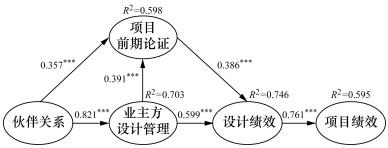
1) “伙伴关系→项目前期论证→设计绩效→项目绩效”。参建各方良好的伙伴关系能够有效提升项目前期论证质量,清洁能源项目前期论证对设计绩效有显著正向直接效应,对项目绩效有显著正向间接效应。具体而言,该路径上伙伴关系对项目前期论证的正向直接效应为0.357,通过项目前期论证对设计绩效、项目绩效产生的正向间接效应为0.138、0.105。项目前期论证对设计绩效的正向直接效应为0. 386,对项目绩效的正向间接效应为0.294。良好的伙伴关系有利于突破清洁能源项目参建各方间的信息壁垒,帮助业主方和设计方及时获取更完整的工程信息,有针对性地开展前期论证工作,从而提高项目获批效率。清洁能源项目高质量的前期论证有利于在复杂的外部环境下选择合理的设计方案,减少项目实施阶段设计变更,保障项目质量、安全、成本和进度目标的顺利实现。例如,预可研和可研阶段充分考虑清洁能源电力市场供需、水风光储开发条件、环保水保和征地移民等制约因素,有利于降低设计风险、保障设计方案的技术可行性和财务可行性,并减少项目实施过程中的设计变更,从而提高清洁能源项目的经济、社会和环保效益。
2) “伙伴关系→业主方设计管理→(项目前期论证)→设计绩效→项目绩效”。参建各方良好的伙伴关系能够有效提升业主方设计管理水平,清洁能源项目业主方设计管理对设计绩效有显著正向效应,设计绩效对项目绩效有显著正向直接效应。具体而言,该路径上伙伴关系对业主方设计管理的正向直接效应为0.821,通过业主方设计管理对项目前期论证、设计绩效、项目绩效产生的正向间接效应分别为0.321、0.492、0.374。业主方设计管理对项目前期论证的正向直接效应为0.391,对设计绩效、项目绩效的总效应分别为0.754、0.574。设计绩效对项目绩效的正向直接效应为0.761。良好的伙伴关系能够促进清洁能源项目参建各方积极参与和互动,帮助业主方形成对能源政策、设计需求的准确认知,有助于各方围绕项目目标进行资源配置,通过优势互补提高业主方设计管理水平。业主方提出清晰的清洁能源项目功能需求、建立完善的设计审核流程、设立合理的激励约束机制和规范利益相关方设计接口管理,既可以促进预可研和可研阶段论证水平,也有助于保障设计质量、提升设计绩效,进而实现清洁能源项目目标,推动清洁能源高质量开发。以雅砻江干流中游Y水电站项目为例,业主方明确了项目设计目标,在合同中规定了设计范围、深度和进度要求;建立了设计绩效考核体系,明确了项目履约过程中设计考核节点,并设置了相应的奖惩条款,包括工期节点奖励、创新优化奖励以及违约情形下的处罚措施,有效提升了设计绩效,也帮助项目获得了“PMI(中国)项目管理大奖‘杰出项目奖’”。
5 案例分析
选取辽宁省抚顺市E抽水蓄能电站项目作为典型案例进行了深入分析,总结E抽水蓄能电站项目设计管理成功经验,并对基于伙伴关系的清洁能源项目设计管理模型进行验证。
5.1 项目概况
辽宁省抚顺市E抽水蓄能电站项目是国内首个百万kW级包含设计、施工、采购完整产业链的工程、采购、建设(engineering, procurement, and construction,EPC)总承包抽水蓄能电站建设试点项目,总投资109亿元,装机容量180万kW,设计发电量30亿kW·h/a。项目供电范围为辽宁电网,担任调峰、填谷、调相、调频和紧急事故备用任务,并具备黑启动能力。业主方为国家电网某全资子公司,EPC总承包方为国内某勘测设计研究院和两家水利水电工程局组成的联合体,监理单位为国内某工程监理咨询公司。
5.2 模型验证结果分析
5.2.1 建立设计考核与激励制度
项目业主方与EPC总承包方在伙伴关系层面,建立了完善的设计考核与激励制度,采取直接考核、综合考核评价、设计合同完工考评3种方式开展设计考核工作,并针对参建各方表现制定了具体的设计激励措施,将设计优化净收益和奖金落实到具体部门和个人,充分调动了设计人员的积极性,有效推动了设计优化,进而提升了项目绩效,体现了“伙伴关系→业主方设计管理→设计绩效→项目绩效”的路径关系。
5.2.2 设计施工一体化管理
E抽水蓄能电站项目组建了EPC总承包联合体,形成了设计、施工深度融合的伙伴关系,实行“现场引领后方”的设计工作方式,克服了设计、采购、施工相互制约、相互脱节的问题;各方协同一致、积极合作,总承包联合体从实施方案策划、总工期安排、资金资源调配、设备物资采购方面统一协调,充分发挥了设计、采购、施工一体化全产业链优势,降低了业主方设计管理投入,提升了设计产品价值和项目绩效。
在设计与施工联合体层面,以月度、季度、年度为设计考核周期,考核内容主要包括设计供图情况、现场设计配合情况、质量管理情况、安全文明施工管理情况、创优管理情况以及EPC总承包方指定的需设计配合的其他工作表现。同时,该项目高度重视对设计质量和安全的考核,在设计考核中实行事故一票否决制,有力保障了设计质量;设置了设计优化奖励机制,总奖励金额的5%用于奖励优化方案提出人以及参与优化的主要设计和施工人员,30%留存EPC总承包方,另外按35%、30%分别奖励给设计和承包该项目工程的施工单位,同时将设计优化带来的净收益按照上述比例进行分配。
5.2.3 制定完善的设计变更流程
项目业主方制定了完善的设计变更管理流程,将设计变更划分为重大设计变更、一般设计变更和小型设计变更3类,实行分类管理,提升了工程造价控制水平,提高了设计绩效。
5.2.4 积极推进设计优化
E抽水蓄能电站项目业主方、EPC总承包方、工程监理基于合作共赢的理念,协商成立了达标创优管理委员会,明确了设计创优职责,积极推进设计创优,取得了一系列创优成果,显著提升了项目绩效。例如,上库大坝坝体材料局部碾压后细粒含量较多,渗透系数小,为此项目对强弱混合料进行多轮试验分析,优化了大坝分区设计,确保大坝填筑就地取材,减少工程弃渣,实现经济效益明显提升且绿色环保。
6 设计管理建议
1) 明确清洁能源电力市场需求。“双碳”目标下,大量清洁能源项目同时建设,存在区域内和跨区域电力消纳对象和需求不明确的情况,应深入分析发电侧清洁能源供给、多能互补、区域内及跨区域用电需求、电力输送通道及电网容量、电力交易机制等因素,匹配清洁能源电力生产和消纳,避免弃水、弃风、弃光现象,并通过适宜的电价机制保障清洁能源项目盈利水平。
2) 辨识清洁能源项目制约因素。清洁能源项目技术和自然环境条件复杂,需要充分考虑站址及周边区域的资源条件、地形地貌、地质条件、交通运输条件、施工组织条件、电网建设情况等因素及其相互影响关系,实现合理选址;应依据项目特点和难点明确技术、社会、环境、经济等方面的制约因素。
3) 建立利益相关方设计接口管理机制。清洁能源项目利益相关方众多,业主方应建立完善的利益相关方设计接口管理机制,加大设计接口管理投入,梳理设计接口管理流程,明确关键设计接口工作内容及相关方职责,推动设计接口管理标准化、信息化建设。
4) 制定适合的设计考核与激励制度。针对清洁能源项目特点制定可操作性强的考核指标及合理的奖惩措施,激励强度设置应符合目标优先次序,激励机制应覆盖参建各方,相应激励措施需落实到具体部门和个人。
7 结论与展望
本文提出并验证了基于伙伴关系的清洁能源项目设计管理模型,揭示了提高清洁能源项目设计管理水平的作用机理,识别出2条作用路径:1) 伙伴关系→项目前期论证→设计绩效→项目绩效;2) 伙伴关系→业主方设计管理→(项目前期论证)→设计绩效→项目绩效。参建各方良好的伙伴关系能够有效提升项目前期论证质量,并促进业主方设计管理;业主方提出清晰的项目功能需求、建立完善的设计审核流程、设立合理的激励约束机制和规范利益相关方设计接口管理,既可以促进预可研和可研阶段论证水平,也有助于保障设计质量、提升设计绩效,进而实现项目目标。以上研究结果为清洁能源项目基于参建各方协同加强设计管理提供了理论基础。
本文建立了清洁能源项目设计管理测量指标体系,调研了参建各方伙伴关系、项目前期论证、业主方设计管理、设计绩效、项目绩效等方面的具体情况,深入分析了清洁能源项目前期论证与设计管理现状,明确了清洁能源项目设计存在的主要问题及应重点关注的因素,有助于参建各方针对性制定设计管理措施。
结合案例分析,提出了如下建议:1) 明确清洁能源电力市场需求;2) 辨识清洁能源项目制约因素;3) 建立利益相关方设计接口管理机制;4) 制定适合的设计考核与激励制度。
本研究未包括电网公司样本数据,而电网公司是清洁能源项目的重要参建方,未来可考虑电网公司需求开展相关研究。未来还可拓展研究范围,进一步探讨清洁能源项目设计、采购、施工和运营一体化管理,并结合数字化技术开展研究。


