Fire in Aircraft

Research on the combustion rate of typical civil aircraft cabin interior wall materials at low ambient pressures

  • Xuhong JIA , 1, 2, 3 ,
  • Xiaoyu ZHANG 1 ,
  • Shangpei DAI 1 ,
  • Wei TIAN 1 ,
  • Sijie DING 1 ,
  • Jing TANG 1 ,
  • Xinhua ZHU 1, 2, 3
Expand
  • 1. College of Civil Aviation Safety Engineering, Civil Aviation Flight University of China, Guanghan 618307, China
  • 2. Civil Aircraft Fire Science and Safety Engineering Key Laboratory of Sichuan Province, Civil Aviation Flight University of China, Guanghan 618307, China
  • 3. Sichuan Key Technology Engineering Research Center for All-Electric Navigable Aircraft, Guanghan, 618307, China

Received date: 2024-01-22

  Online published: 2025-03-27

Copyright

All rights reserved. Unauthorized reproduction is prohibited.

Abstract

Objective: In aviation transportation, which is characterized by low-pressure environments, aircraft fires pose an unpredictable threat. The interior wall materials of civil transport aircraft are predominantly composed of composite materials. The Federal Aviation Administration of the United States and the Civil Aviation Administration of China require experimental validation of their fire-resistant properties. This study aims to address the current research gap by investigating the development patterns of aircraft fires under low-pressure conditions. Specifically, this study examines the combustion rates of interior wall materials in civil aircraft in multiple-pressure environments. The goal is to detect and prevent aircraft fires under low-pressure conditions at the earliest opportunity. Methods: This study investigates the sandwich structure panel material (Panel A) and the laminated panel material (Panel B) used in Airbus aircraft. Panel A comprises the upper and lower layers of resin-based substrates, an aramid honeycomb core intermediate layer, and an adhesive. Panel B is composed of resin-based glass fiber-reinforced laminate. The study is conducted using a low-pressure combustion chamber research facility in Guanghan, Sichuan (96 kPa), and Kangding, Sichuan (61 kPa). Combustion rates and flame phenomena of cabin wall panel materials are examined at 40, 50, 61, 70, 80, and 96 kPa pressure levels. A combustion rate model is applied to adjust the effect of pressure on the combustion rate of cabin wall panel materials. The heat release of the cabin wall panel materials is determined using a cone calorimeter, which enables the assessment of heat release in various pressure environments. Finally, following relevant regulations and standards, a fire penetration resistance test apparatus is constructed to investigate the fire penetration resistance characteristics of cabin wall panel materials under different pressure conditions. Results: The relationship between the combustion rate and pressure for glass fiber/phenolic resin sandwich panels and glass fiber/phenolic resin laminated panels is approximately and, respectively. According to the fire-base dimensions, the combustion rate-pressure models are and, respectively. The peak heat release rates of aircraft interior wall panels in low-pressure environments are lower than those in atmospheric-pressure environments. When the air pressure drops from 96 kPa to 40 kPa, the peak heat release rate of glass fiber/phenolic resin sandwich and glass fiber/phenolic resin sandwich decreased by about 40.97% and 43.85%, Similarly, compared with atmospheric-pressure environments total heat release significantly decreases under low pressure by 14.20% and 24.71%, respectively. The flame color of aircraft interior wall panel materials shifts from bright yellow at atmospheric pressure to a lower degree of brightness under low pressure. Additionally, the flame height significantly decreases under low pressure compared with the height under atmospheric pressure, with glass fiber/phenolic resin sandwich panels and glass fiber/phenolic resin laminated panels experiencing a reduction of approximately 10.9% and 11.6%, respectively, compared with atmospheric pressure. Research on the fire penetration resistance of aircraft cabin interior wall panels reveals that the char layer of sandwich panel materials becomes more pronounced under low pressure than under atmospheric pressure, indicating increased fire resistance. Conversely, laminated panel materials are minimally affected by pressure. Conclusions: According to the above research findings, pressure significantly affects the fire characteristics of cabin wall panel materials. This study provides direct relevance to the practical needs of aircraft fire prevention and control, offering data support for aircraft fire prevention efforts.

Cite this article

Xuhong JIA , Xiaoyu ZHANG , Shangpei DAI , Wei TIAN , Sijie DING , Jing TANG , Xinhua ZHU . Research on the combustion rate of typical civil aircraft cabin interior wall materials at low ambient pressures[J]. Journal of Tsinghua University(Science and Technology), 2025 , 65(4) : 795 -804 . DOI: 10.16511/j.cnki.qhdxxb.2024.27.022

飞机火灾事故是民航业快速、高质量发展过程中面临的一项严峻挑战。航空事故发生时通常伴随着飞机火灾[1-2],由于航空运输大多处于低气压环境中,该环境下的火灾通常比常压环境下更难预测,因此研究低气压环境下的飞机火灾发展规律是十分必要的。
为了保障更高的经济效益和更好的航行性能,当前民机的机舱更倾向于使用树脂基复合材料,例如波音和空客等公司自20世纪90年代至21世纪初制造的客机的内饰构件使用了酚醛树脂,其质量达到整架飞机内饰阻燃材料的80%~90%[3]。树脂基复合材料的具体应用种类从20世纪90年代早期的玻璃纤维/酚醛树脂层压板到20世纪90年代中期的“三明治”结构的玻璃纤维/酚醛树脂,其阻燃性和机械性能等有了明显提升。尽管如此,当前的飞机机身材料与最初的金属机身相比,在高温下仍然具有一定的火灾危险性,因此美国联邦航空条例FAR-25[4]和中国民航规章CCAR-25[5]均要求对飞机壁板在火灾或高温下的危险性进行评估,通过实验和理论分析探究其燃烧和防火特性,以减少可能发生的火灾对人员的伤害。鉴于确定燃烧速率是火灾危险性分析的一个重要方面[6-7],本文围绕不同气压环境下民机舱内壁板材料的燃烧速率进行研究。
燃烧速率显著影响火灾的发展形势和扩散趋势。高燃烧速率会使火灾的控制变得更加困难,火焰的迅速蔓延和大量热能的释放会增加灭火扑救工作的难度。已有研究者对火灾环境中固体材料的燃烧速率开展了相关研究,如任细运[8]利用锥形量热仪分析了材料的质量损失速率随热辐射强度的变化规律。陈少杰等[9]发现在低热通量下,随着碳纤维/环氧树脂层合板厚度的增加其质量损失速率峰值有所下降。考虑到中国乃至世界范围拥有大面积的高海拔地区,气压对可燃物燃烧速率的影响也得到了广泛的研究。Wieser[10]首次在不同海拔高度进行了实地研究,得出平均燃烧速率与气压成正比。De Ris[11]对固体可燃物进行了高压实验,建立了稳态燃烧模型,发现Grashof数(Gr)是影响无量纲质量燃烧速率的主要参数。并得到了气压与燃烧速率的表达式。后来De Ris等[12]针对大尺寸油池火灾提出了辐射模型,解决了气压模型的局限性。Kanury等[13-14]对聚合物进行了不同气压下的燃烧测试实验,发现聚合物的燃烧速率与大气压的$\frac{2}{3}$次方存在正比关系。同年,Aipert[15]又对PMMA进行了燃烧实验,发现燃料尺寸超出某一限值可能会导致气压模型的不适用。Mariusz Zarzecki[16]得到了气压和氧气浓度对PMMA燃烧速率影响的幂函数关系,并预测了全范围气压和氧气实验的燃烧速率特性。冯瑞[17-18]在低气压环境下对瓦楞纸箱进行研究得到了湍流固体火灾燃烧速率的压力表达式。Jia等[19]通过在高原环境进行纸箱等固体火灾的研究提出了气压P与氧气浓度$Y_{\mathrm{O}_2, \infty}$的关联式为$\dot{m}_{\max }^{\prime \prime} / D \sim\left(P^2 L^3 Y_{\mathrm{O}_2, \infty}\right)^{0.72}$,其中$\dot{m}_{\max }^{\prime \prime}$为最大质量燃烧速率;D为火灾基底尺寸;L为特征长度,用以预测固体材料在不同气压和氧气浓度下的燃烧速率;经实际测量数据验证,该关联式的拟合度良好。
尽管前人围绕低气压环境下的火灾特性已开展诸多研究,也得出了相对成熟的气压作用下的燃烧速率模型。但当前实验研究的对象局限于特定类型的材料,如纸箱、油池和木材等,对民机防火救援的实际意义有限。本文通过研究民机舱内壁板材料在不同气压环境下的燃烧速率,明确其低气压下的火灾发展规律,所选取的气压环境和研究对象更贴近航空运输条件,与飞机火灾防控的实际需求紧密相关。本文共设置6种气压,更加深入地研究气压对于机舱壁板材料质量燃烧速率的影响,明确气压与质量燃烧速率间的关系,修正气压作用下的燃烧速率模型;同时探究与燃烧速率密切相关的各个火灾参数,与燃烧速率研究相互验证,明确航空火灾的发展规律,为飞机火险救援提供依据。

1 实验设置

1.1 实验样品

实验样品为大型民用航空器的2种常用壁板材料。一种为玻璃纤维/酚醛树脂蜂窝芯夹层板(下文简称“A壁板”),如图 1所示,上、下2层面板为玻璃纤维/酚醛树脂,中间夹层为芳纶蜂窝芯。另一种为玻璃纤维/酚醛树脂层压板(下文简称“B壁板”),主要材料为玻璃纤维/酚醛树脂。
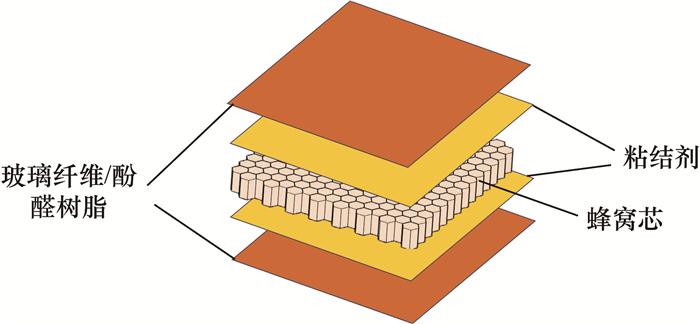
图 1 玻璃纤维/酚醛树脂蜂窝芯夹层板结构

1.2 实验方法

所有测试均在中国四川省广汉市(大气压为96 kPa)和康定市(大气压为61 kPa)环境下进行。在本文中将广汉市的大气压作为常压环境。依据《Reaction-to-fire tests—Heat release, smoke production and mass loss rate—Part l: Heat release rate(cone calorimeter method)and smoke production rate(dynamic measurement)》(ISO5660-1)[21]规定,将A、B壁板材料分别制备为2块方形式样,长×宽×高分别为100 mm×100 mm×8.7 mm和100 mm×100 mm×1.1 mm。制备完成后将实验样品放入烘干箱干燥,以去除水分从而降低实验误差。利用长×宽×高为1 m×1 m×1 m、生产厂家为东莞捷东试验设备有限公司、型号为JD-6004的低气压富氧燃烧舱为本实验提供密闭空间及不同气压环境,本文中设置40、50、61、70、80和96 kPa 6种气压。
舱内的实验布置如图 2所示。将干燥后的样品放置于Ohaus公司生产的ExplorerTM精密天平上,样品上方放置1 200 W的加热棒。设备布置完成后,关闭舱门,按动舱外加热棒开关,加热并引燃试样。利用深圳市诚安视科技有限公司的海康DS-2CD3T86FWDV2-13S型高清摄像机实时记录火焰特性;精密天平实时记录质量损失;Motis燃烧技术仪器有限公司的CCT锥形量热仪测量A、B壁板的热值。
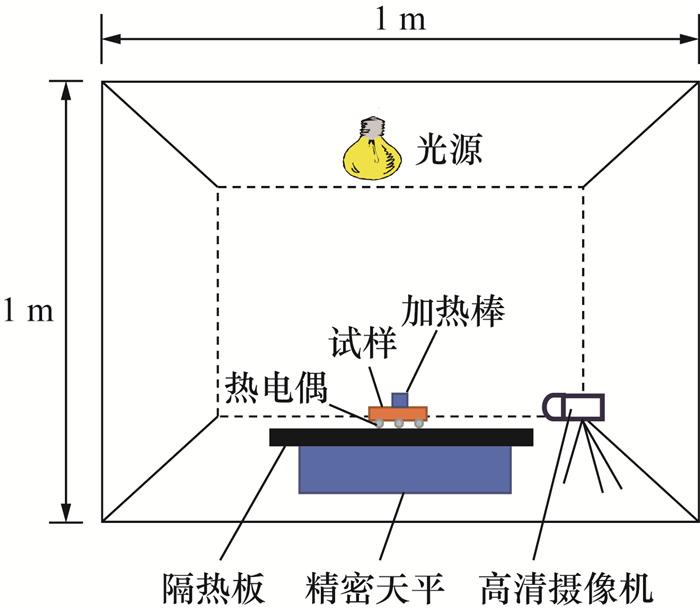
图 2 低气压富氧燃烧舱实验装置
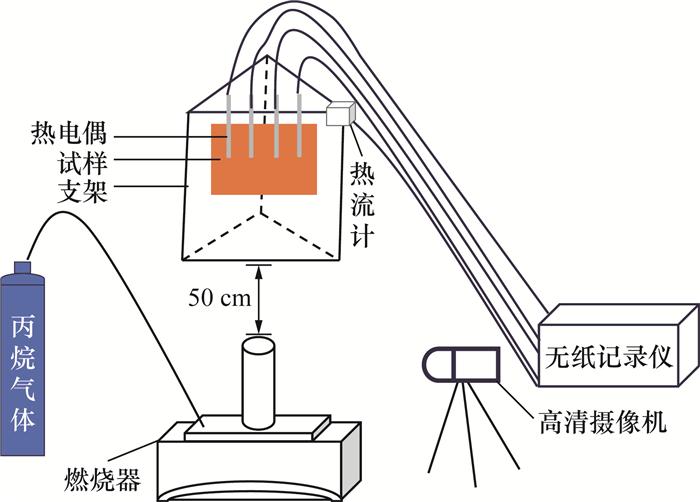
依据民用航空行业标准MH/T 6086-2012[22]中的燃烧器搭建方法开展耐烧穿实验。首先将A、B壁板均制备为长×宽为300 mm×300 mm的实验样品备用。如图 3所示,将燃烧器和实验支架固定于同一地面水平线上,二者间的垂直距离为500±3 mm。样品固定于实验支架上,使间隔为25 mm的4支热电偶紧贴样品,样品右上角距火焰300 mm处固定有TS-34C型热流计,其传热系数为4.62 μV/(W·m-2)。
图 3 耐烧穿实验装置
实验开始前将丙烷气体瓶的阀门打开,控制气体压力范围为2.8~3.2 kPa,保证火焰输出稳定。接着打开燃烧器,将燃烧器及其管道内的空气排出,喷出火焰2 min后观察热电偶的温度数据,确定热电偶温度超过871 ℃,同时热流密度超过8.6 W/cm2。待数据稳定后正式开始实验。每个气压下的实验进行5次,实验结果取平均值以减小误差。初始空气温度设定为25 ℃,相对湿度设定为35%。

2 结果与讨论

2.1 低气压下燃烧速率模型修正

为了研究气压对飞机机舱壁板材料燃烧速率的影响,使用大功率(1 200 W)加热棒分别在40、50、61、70、80和96 kPa环境下进行实验,进而确定飞机机舱壁板材料气压与燃烧速率间的关系,修正燃烧速率模型。
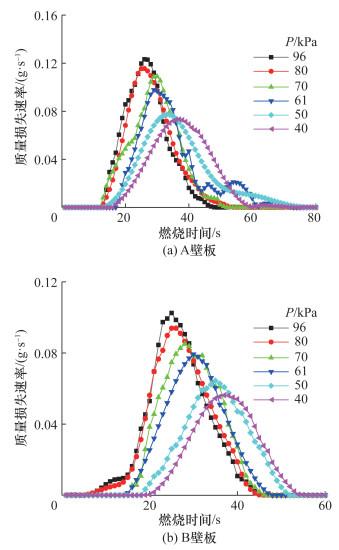
对于固体和液体的明火燃烧,质量燃烧速率近似为质量损失速率[23]。不同气压环境下A、B壁板的质量损失速率如图 4所示。由图可知,气压对2种机舱壁板材料的影响趋势一致,当燃烧时间相同时,随着气压的降低,2种机舱壁板材料的质量损失速率均明显下降。意味着低气压环境下,样品的燃烧速率均有不同程度的降低。同时样品的最大质量损失速率峰值出现时间也随着气压的降低有所延后。这表明低气压对机舱壁板材料的整个燃烧过程存在抑制作用。
图 4 飞机机舱壁板材料质量损失速率
不同气压环境下,A、B壁板的最大质量损失速率如图 5所示,由图可知,A、B壁板的最大质量损失速率与气压成正比,当气压升高时,A、B壁板的最大质量损失速率明显增加。这表明气压可能与A、B壁板的最大质量损失速率存在一定的函数关系,可以借助理论模型对不同气压环境下的最大质量损失速率进行预测。
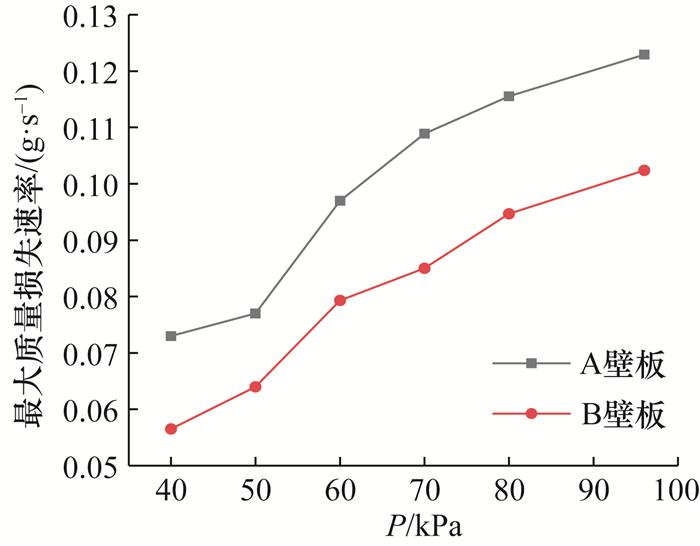
图 5 飞机机舱壁板材料最大质量损失速率
由于燃烧过程中传热传质的复杂性,依据文[23]的合理近似进行计算简化,则稳态燃烧时的能量守恒为[23]
$\dot{m}^{\prime \prime} L_{\mathrm{h}}=\dot{q}_{\mathrm{f}, \mathrm{c}}^{\prime \prime}+\dot{q}_{\mathrm{f}, \mathrm{r}}^{\prime \prime}+\dot{q}_{\mathrm{e}}^{\prime \prime}-\dot{q}_{\mathrm{r}, \mathrm{r}}^{\prime \prime} .$
其中:$\dot{m}^{\prime \prime}$为质量燃烧速率, Lh为燃料的汽化热,$\dot{q}_{\mathrm{f}, \mathrm{c}}^{\prime \prime}$为火焰对流热通量,$\dot{q}_{\mathrm{f}, \mathrm{r}}^{\prime \prime}$为火焰辐射热通量,$\dot{q}_{\mathrm{e}}^{\prime \prime}$为外部环境辐射热通量,$\dot{q}_{\mathrm{r}, \mathrm{r}}^{\prime \prime}$为燃料表面再辐射的热通量。
B-number理论的基本表达式[11]
$\dot{m}^{\prime \prime}=\frac{h}{c_{\mathrm{p}}}\left[\frac{\ln (B+1)}{B}\right] B .$
其中:h为对流换热系数;cp为气相比热容, 为1.0 kJ/kg;B为质量转移数(B-number)。
B-number理论公式进行修正[11]可得
$B=\frac{Y_{\mathrm{O}_{2, \infty}}\left(\Delta h_{\mathrm{c}} / \gamma\right)-c_{\mathrm{p}}\left(T_{\mathrm{v}}-T_{\infty}\right)}{L_{\mathrm{h}}} .$
其中:(Δhc/γ)为单位质量氧的燃烧热,为13 kJ/g;Tv为表面汽化温度;T为环境温度。
联立式(1)—(3)并忽略固相的动力学效应、热解气体对辐射的阻塞作用和燃料热传导等作用,则稳态或准稳态的湍流燃烧符合
$\dot{m}^{\prime \prime}=\frac{\dot{q}_{\mathrm{f}, \mathrm{c}}^{\prime \prime}}{L_{\mathrm{h}}}+\frac{\dot{q}_{\mathrm{f}, \mathrm{r}}^{\prime \prime}}{L_{\mathrm{h}}}+\frac{\dot{q}_{\mathrm{e}}^{\prime \prime}}{L_{\mathrm{h}}}-\frac{\sigma\left(T_{\mathrm{v}}^4-T_{\infty}^4\right)}{L_{\mathrm{h}}} .$
其中σ为Stefan-Boltzmann数。等式左侧为稳态燃烧时汽化所需的能量,右侧为燃料吸收能量的总和。
相对于式(4)中的其余3项,燃料表面再辐射的热通量较小。则式(4)可进一步简化为
$\dot{m}^{\prime \prime} \propto \frac{\dot{q}_{\mathrm{f}, \mathrm{c}}^{\prime \prime}}{L_{\mathrm{h}}}+\frac{\dot{q}_{\mathrm{f}, \mathrm{r}}^{\prime \prime}}{L_{\mathrm{h}}}.$
依据Newton冷却定律,式(5)右侧第一项为火焰向热解区的对流项,可表示为
$\dot{q}_{\mathrm{f}, \mathrm{c}}^{\prime \prime}=h \Delta T=h\left(T_{\mathrm{f}}-T_{\mathrm{v}}\right) .$
其中h计算方式如下:
$h=\frac{C_{\mathrm{Nu}} A k_{\mathrm{g}}}{L} \cdot\left[\frac{g C_{\mathrm{p}}\left(T_{\mathrm{f}}-T_{\infty}\right) L^3}{u_{\mathrm{g}} k_{\mathrm{g}} T_{\mathrm{g}}}\right]^n P^{2 n} .$
其中:CNu为经验常数,A为比例系数,kg为热解区导热率,g为重力加速度,ug为动力黏度,Tf为火焰温度,Tg为平均气相温度。
火焰温度Tf根据Quintiere[23]的研究可得
$\frac{T_{\mathrm{f}}-T_{\infty}}{T_{\infty}}=\left(1-X_{\mathrm{r}}\right)\left(Y_{\mathrm{O}_{2, \infty}} \Delta h_{\mathrm{c}} / T_{\infty} n \gamma_{c_{\mathrm{p}}}\right) .$
其中:Xr为火焰辐射分数,对于同一种材料,Xr可简化为常数;n为常数,其值的选取与流体的类型有关[24],层流情况下n=1/4,湍流情况下n=1/3。
因此$\dot{q}_{\mathrm{f}, \mathrm{c}}^{\prime \prime}$可进一步简化为
$\dot{q}_{\mathrm{f}, \mathrm{c}}^{\prime \prime} \propto P^{2 \mathrm{n}} .$
式(5)右侧第二项是火焰辐射热反馈。火焰吸收系数受到压力影响,火焰吸收系数κ由气态化合物κg和烟灰化合物κs决定,典型火灾中,火焰辐射主要由烟灰提供[25],可近似为
$\kappa=\kappa_{\mathrm{g}}+\kappa_{\mathrm{s}} \approx \kappa_{\mathrm{s}} \propto P^2 .$
根据Stefan-Boltzmann定律和De Ris等[11, 23]的研究,当κlm≤0.3时,(1-exp(-κlm))可简化为κlm,其中lm为火焰平均光束长度。因此$\dot{q}_{\mathrm{f}, \mathrm{r}}^{\prime \prime}$可表示为
$\dot{q}_{\mathrm{f}, \mathrm{r}}^{\prime \prime} \approx \sigma\left(T_{\mathrm{f}}^4-T_{\mathrm{v}}^4\right) \kappa l_{\mathrm{m}} \sim P^{\frac{3}{2}} .$
$\dot{m}^{\prime \prime}$可以表示为气压的函数为
$\dot{m}^{\prime \prime} \propto C_1 P^{2 \mathrm{n}}+C_2 P^{\frac{5}{2}} .$
其中:C1C2为常数。本研究中进行的实验是湍流固体燃烧实验(即n=1/3),则式(6)可改写为
$\dot{m}^{\prime \prime} \propto C_1 P^{\frac{2}{3}}+C_2 P^{\frac{3}{2}}.$
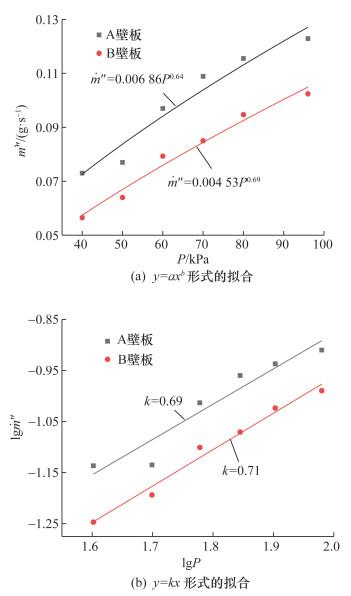
为了明确质量燃烧速率与气压的函数,可以通过拟合图 5数据得到图 6a。由图可知,A、B壁板的质量燃烧速率受气压影响的函数关系分别为$\dot{m}^{\prime \prime} \propto 0.006\;86 P^{0.64}$$\dot{m}^{\prime \prime} \propto 0.004\;53 P^{0.69}$。2种壁板材料的幂指数接近公式(7)右侧第一个对流项,这意味着在飞机机舱壁板材料受气压影响的燃烧中,对流项起主导作用。
图 6 质量燃烧速率拟合曲线
气压模型起初常用来做全尺寸自由对流的流体动力学性质的模拟,后来逐步被用于不同低气压环境中火灾模型的建立[26-27],有学者认为火灾压力模型适用于小尺寸的火灾,因此火灾压力建模的核心规则是受气压影响下保持恒定的质量燃烧速率[15],如式(8)所示。其中μ为黏度。
$\begin{gathered}\frac{\dot{m}^{\prime \prime}}{D}=f(G r)=f\left(\frac{g P^2 L^3}{\mu^2 R^2 T_{\infty}^2}\left(\frac{T_{\mathrm{f}}-T_{\infty}}{T_{\infty}}\right)\right) \sim \\\\\left.f P^2 L^3\right) .\end{gathered}$
$\frac{\dot{m}^{\prime \prime}}{D} \sim f\left(P^2 L^3\right).$
因此,引入火灾基底尺寸D修正火灾压力模型后,再次通过拟合图 5数据得到图 6b,由图可知,2种壁板材料的$\dot{m}_{\max }^{\prime \prime} / D \text { 与 } P^2 L^3$之间的关系分别为
$\dot{m}_{\max }^{\prime \prime} / D \sim\left(P^2 L^3\right)^{0.69}, $
$\dot{m}_{\max }^{\prime \prime} / D \sim\left(P^2 L^3\right)^{0.71}.$

2.2 气压对热释放特性的影响

火灾研究中一般认为热释放速率正比于质量损失速率,二者可以通过燃烧热值建立联系[28]。因此当研究固体材料的燃烧速率时,通常会进一步对其热释放特性进行研究。可以将热释放速率(HRR)正比于质量损失速率,并通过积分得到总热释放量如下所示:
$\mathrm{HRR}=\phi \cdot \Delta H_{\mathrm{c}} \cdot \dot{m} .$
其中:ΔHc为可燃物的有效燃烧热值,在燃烧过程中一般可假定为常数;ϕ为燃烧效率因子,反映不完全燃烧的程度,考虑到机舱为狭长封闭空间,可取值为0.6[29]$\dot{m}$为质量损失速率。
将式(11)进行积分得到
$Q=\phi \cdot \Delta H_c \cdot \Delta m.$
其中:Q为燃料释放的总热量,Δm为可燃物的质量变化。
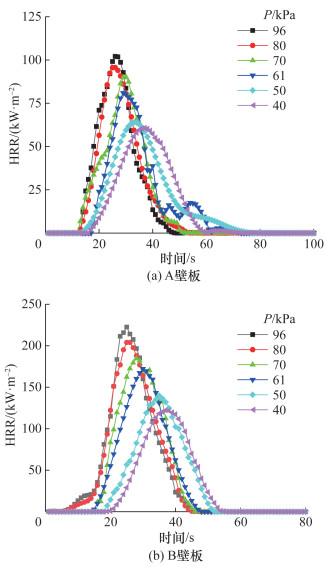
热值为单位质量完全燃烧所释放的热量,由于A、B壁板的热值没有明确的出厂值,所以本文利用锥形量热仪进行测量后,依据式(11)和(12)计算出不同气压环境下,通过加热棒加热引燃壁板材料的Q和HRR。由图 7可知,随着气压的降低,热释放速率到达峰值的时间点逐渐延后,这是因为在燃烧前期,较高的气压使燃烧更加充分,燃烧速率更快,导致热量释放更快。同时,A、B壁板的HRR峰值均随着气压的降低逐渐降低。A、B壁板在最低气压(40 kPa)下的热释放速率比最高气压(96 kPa)下的分别降低了40.97%、43.85%。气压对A壁板和B壁板的HRR的影响趋势几乎一致,但无论何种气压环境下,B壁板的HRR均略高于A壁板。根据理想气体理论,如式(13)所示。
$\mathrm{Gr}=\frac{g \Delta T \beta l^3 \rho^2}{\mu}.$
图 7 不同气压环境下A、B壁板的热释放速率
其中β为体积变化系数,理想气体理论中,β为绝对温度的系数。
由于气压与密度成正比,所以将式(13)简化为
$\mathrm{Gr}^\alpha \sim\left(P^2 l^3\right)^\alpha .$
其中α为指数。
依据火灾的压力模型,$\dot{m}^{\prime \prime}$与Gr相关联, 即
$\dot{m}^{\prime \prime} / D \sim \mathrm{Gr}^\alpha \sim\left(P^2 l^3\right)^\alpha .$
根据式(1)可知,热释放速率受到燃烧速率和热值的影响,由此得到式(14)。
$\dot{m}^{\prime \prime} / D=\frac{\mathrm{HRR}}{\phi \Delta H_{\mathrm{c}} D} \sim \mathrm{Gr}^\alpha \sim\left(P^2 l^3\right)^\alpha .$
因此当ϕ与ΔHc不变时,气压与热释放速率成正比,随着气压的增加,热释放速率随之增加。
不同气压环境下A、B壁板的热释放总量如图 8所示。由图可知,飞机机舱壁板材料的热释放总量随着气压的降低而降低,这是由于低气压环境直接导致了飞机内饰壁板材料的质量损失,从而间接影响了飞机机舱壁板材料的热释放总量。因此,当P从96降至40 kPa,A壁板的Q从1.62降至1.39 MJ/m2,降低了14.20%;B壁板的Q从3.32降至2.41 MJ/m2,降低了27.41%。此外,由于常压(96 kPa)环境下飞机机舱壁板材料燃烧剧烈,热释放总量明显增加。
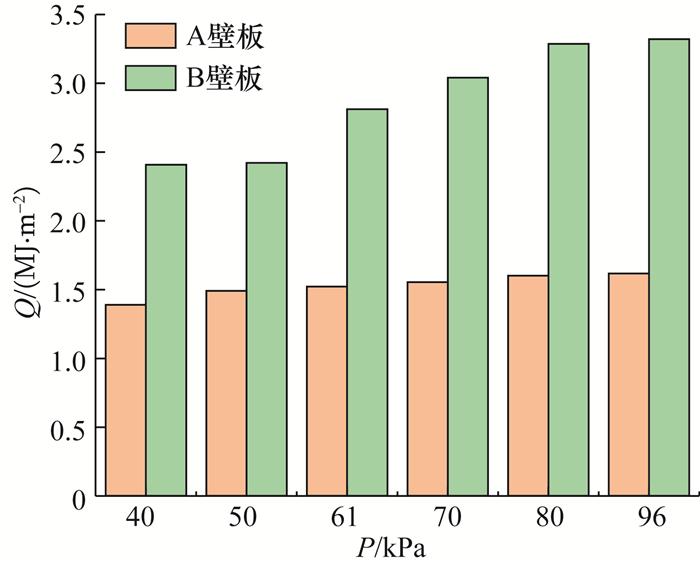
图 8 不同气压环境下热释放总量

2.3 气压对火焰特性的影响

火焰的形状可能会影响氧气与燃料之间的混合程度和燃烧表面积,从而影响燃烧速率[30]。因此可通过火焰的表面积粗略判断气压对燃烧速率的影响。
通过1.2节中的低气压富氧燃烧舱实验,利用高清摄像机记录材料低气压燃烧期间火焰形状的视频,如图 9所示。图像显示了不同压力和不同壁板材料下火焰亮度、火焰高度和火焰形状等的差异。在火焰亮度方面,火焰在常压下呈现亮黄色,而在低气压下亮黄色的强度减弱,说明气压的降低会导致火焰亮度的下降。火焰亮度的变化既与飞机内饰壁板氧化产生的烟尘量有关,又与浮力诱导流场的特征有关,后者随着总气体密度的变化而变化,而气体密度受到气压的影响。较高的气压环境下,浮力诱导的流动会使氧气分布更均匀,有助于燃烧反应的进行,从而增加火焰的亮度。此外,浮力诱导的流动还会使燃烧物质的燃烧速率增加,释放更多的能量,进一步提高火焰的亮度。
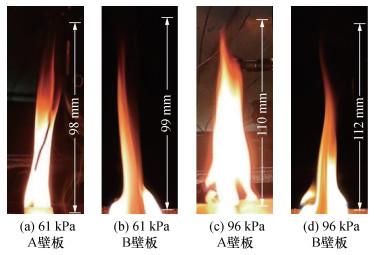
图 9 不同气压环境下的火焰
火焰高度随着气压的降低而逐渐减小。当气压从96降至61 kPa时,A壁板和B壁板的火焰高度分别从110和112 mm降低到98和99 mm。在低气压环境下,火焰高度比常压环境下降低了10.9%和11.6%,表明低气压对飞机内饰壁板材料的火焰高度存在抑制作用,这主要因为在较低气压环境中氧化剂密度较低,实验样品燃烧的质量通量减少,火焰只能维持在接近表面的地方。依据Burke-Schumann扩散火焰的无量纲分析,可以得到火焰高度h[31]
$h \propto \frac{v_0 D^2}{\zeta+\varepsilon};$
$\zeta \propto P^{-\omega}, \quad \omega \in\{1, 2\} .$
其中: v0为火焰传播速度, ε为火焰扩散系数, ζ为分子扩散系数。
结合式(15)和(16)可知,火焰高度与气压成正比。因此低气压下飞机内饰壁板的火焰高度相比于常压环境稍有降低。

2.4 气压对耐烧穿性能的影响

固体可燃物的耐烧穿性能虽然会受到多种因素,如材料的化学组成、密度和厚度等的影响。但对于同一种材料,气压对耐烧穿性能的影响可能与对燃烧速率的影响相似。通过1.2节中的耐烧穿实验,在康定市(61 kPa)和广汉市(96 kPa)进行实地实验,得到表 1中的结果。由表可知,低气压下飞机内饰壁板材料表面的火焰温度更低,且最高火焰温度出现的时间更早,这是因为康定市属于高原地区,海拔较高则气压较低,气压的降低会导致氧气的密度减小,相对较低的氧气密度限制了燃料与氧气的接触,使得燃烧反应不够充分,导致火焰温度较低。同时,高原地区的氧气更为稀薄,不仅火焰燃烧速率较慢,火焰燃烧所需的氧气也供应不足,在相同时间内,高海拔地区与低海拔地区相比,火焰无法达到较高的温度。
表 1 耐烧穿实验结果
P/kPa 材料 热流密度/(W·cm-2) Tf/℃ 最高Tf/℃ 最高Tf发生时间/s
96 A壁板 9.1~10.6 929~976 976 144
B壁板 9.4~10.7 931~987 987 152
61 A壁板 8.8~9.6 914~951 951 138
B壁板 9.1~10.4 942~984 984 149
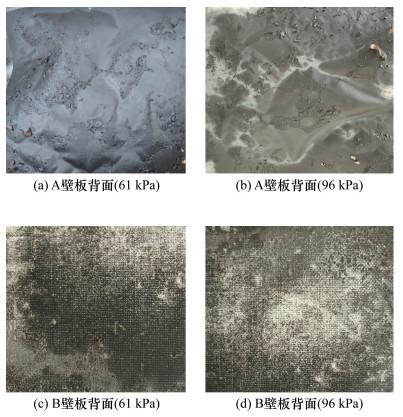
持续燃烧5 min后,A、B壁板的正面无明显变化,而背面形貌如图 10所示。对比图 10a10b可知,低气压下A壁板背面炭层比常压下更为明显,在常压下已露出少部分白色玻璃纤维,表明A壁板在低气压下的耐火性能优于常压,这是因为低气压下气体的密度降低导致空气稀薄,气体分子间的碰撞减少,而蜂窝芯材料中的孔隙主要由气体填充,热传导路径中的气体热阻会增大,导致导热系数降低,隔热性能增加,因此低气压下火焰的温度难以穿透壁板材料,使A壁板背面温度较低,进而提高了A壁板的耐火性能;此外,康定市处于高原地区,机场环境中的氧分压更低,A壁板的燃烧并不充分,侧面提升了其耐火性能。
图 10 不同气压环境下A、B壁板的背面形貌
蜂窝芯导热系数λe受蜂窝芯体材料的固体传热、蜂窝腔体内的空气导热以及自然对流换热3种传热机制影响。其中受气压影响的是蜂窝腔体内的空气导热。空气导热系数λg可由下式计算[32]
$\lambda_{\mathrm{g}}=\frac{\lambda_{\mathrm{g}}^*}{1+2[(2-\delta) / \delta]\left(2 c_{\mathrm{p}} / c_{\mathrm{p}}+1\right)\left(1 / P_{\mathrm{r}}\right)\left(\tau / h_{\mathrm{c}}\right)} .$
其中:λg*为随温度变化的空气的热导率;δ为适应系数,取值范围为0~1;Pr为Prandtl系数;hc为蜂窝芯高度;τ为平均分子自由程,计算方式为
$\tau=K_{\mathrm{B}} T_{\infty} /\left(\sqrt{2} \pi d_{\mathrm{g}}^2 P\right) .$
其中:KB为Boltzmann常数,dg为气体分子碰撞直径。
结合式(17)和式(18)可知
$P \propto \lambda_{\mathrm{g}} \propto \lambda_{\mathrm{e}}.$
随着气压减小,导热系数减小,蜂窝芯隔热性能提高,飞机壁板材料背面温度降低,因此低气压下A壁板温度低于常压下,从而导致A壁板在低气压下燃烧不充分,更耐烧且炭层更加明显。

3 结论

本文重点研究了气压对典型民机舱内壁板材料燃烧速率的影响,同时研究了与燃烧速率相关的火灾参数,具体结论如下:
1) 玻璃纤维/酚醛树脂夹芯板和玻璃纤维/酚醛树脂层压板燃烧速率与气压的关系近似为$\dot{m}^{\prime \prime} \propto0.006\;86 P^{0.64} \text { 和 } \dot{m}^{\prime \prime} \propto 0.004\;53 P^{0.69}$;基于火灾基底尺寸得到的燃烧速率压力模型,分别为$ \dot{m}^{\prime \prime}{ }_{\max } / D \sim\left(P^2 L^3\right)^{0.69} \text { 和 } \dot{m}_{\max }^{\prime \prime} / D \sim\left(P^2 L^3\right)^{0.71}$,飞机机舱壁板材料受气压影响的燃烧中,对流项起主导作用。
2) 随着气压的降低,热释放速率逐渐延后,热释放速率的峰值逐渐下降,导致热释放总量逐渐降低。上述2种壁板在低环境气压(40 kPa)下的热释放速率比常压(96 kPa)下的热释放速率分别降低了40.97%和43.85%;玻璃纤维/酚醛树脂夹芯板的热释放总量降低了14.20%,玻璃纤维/酚醛树脂层压板的则降低了27.41%。
3) 飞机内饰壁板材料的火焰颜色在常压下为亮黄色,低气压下亮黄色减弱,火焰高度也明显降低,上述2种壁板在低气压下的火焰高度比常压下分别降低了10.9%和11.6%。
4) 耐烧穿性能实验结果表明,低气压下夹芯板材料更加耐烧,而层压板材料的此项性能几乎不受气压影响。
1
RIGHI H, MADABHUSHI A, Ouidadi H, et al. Post-Crash Fire Forensic Analysis on Aerospace Composites-Literature Review[R]. Washington, D.C. : U.S. Department of Transportation, Federal Aviation Administration, 2020.

2
WANG J , TAO Z , YANG R , et al. A review of aircraft fire accident investigation techniques: Research, process, and cases[J]. Engineering Failure Analysis, 2023, 153, 107558.

3
杨雪梅. 酚醛阻燃复合材料在民用飞机上的应用[J]. 工程与试验, 2015, 55 (3): 30-34, 103.

YANG X M . Application of flame retardant phenolic composite to civil aircraft[J]. Engineering & Test, 2015, 55 (3): 30-34, 103.

4
Federal Aviation Administration. Department of transportation federal aviation administration regulations with fire: FAR 25.855[S]. Washington: Federal Aviation Administration, 2014.

5
中国民用航空局政策法规司. 中国民用航空规章第25部运输类飞机适航标准: CCAR 25-R4[S]. 北京: 中国民用航空局, 2011.

Department of Policies and Regulations, Civil Aviation Administration of China. Civil aviation regulations of China: Part 25: Airworthiness standards for transport aircraft: CCAR 25-R4[S]. Beijing: Civil Aviation Administration of China, 2011(in Chinese).

6
BABRAUSKAS V . Estimating large pool fire burning rates[J]. Fire Technology, 1983, 19 (4): 251- 261.

DOI

7
IQBAL N, SALLEY M H. Fire dynamics tools (FDTs) quantitative fire hazard analysis methods for the U.S. nuclear regulatory commission fire protection inspection program[S]. Washington: Nuclear Regulatory Commission, 2004.

8
任细运. 阻燃环氧树脂的燃烧特性及其潜在火灾危险性评价的研究[D]. 合肥: 中国科学技术大学, 2021.

REN X Y. Study on combustion behaviors and potential fire hazards assessment of flame retardant epoxy resins[D]. Hefei: University of Science and Technology of China, 2021. (in Chinese)

9
陈少杰, 徐艳英, 王志, 等. 低热通量下碳纤维/环氧树脂层合板的燃烧特性[J]. 材料研究学报, 2020, 34 (12): 933- 938.

CHEN S J , XU Y Y , WANG Z , et al. Combustion characteristics of carbon fiber/epoxy laminates at low heat flux[J]. Chinese Journal of Materials Research, 2020, 34 (12): 933- 938.

10
WIESER D , JAUCH P , WILLI U . The influence of high altitude on fire detector test fires[J]. Fire Safety Journal, 1997, 29 (2-3): 195- 204.

11
DE RIS J , KANURY A M , YUEN M C . Pressure modeling of fires[J]. Symposium (International) on Combustion, 1973, 14 (1): 1033- 1044.

12
DE RIS J L , WU P K , HESKESTAD G . Radiation fire modeling[J]. Proceedings of the Combustion Institute, 2000, 28 (2): 2751- 2759.

DOI

13
KANURY A M . Modeling of pool fires with a variety of polymers[J]. Symposium (International) on Combustion, 1975, 15 (1): 193- 202.

DOI

14
ALPERT R L . Pressure modeling of transient crib fires[J]. Combustion Science and Technology, 1977, 15 (1-2): 11- 20.

DOI

15
ALPERT R L . Pressure modeling of fires controlled by radiation[J]. Symposium (International) on Combustion, 1977, 16 (1): 1489- 1500.

16
ZARZECKI M , QUINTIERE J G , LYON R E , et al. The effect of pressure and oxygen concentration on the combustion of PMMA[J]. Combustion and Flame, 2013, 160 (8): 1519- 1530.

17
冯瑞, 田润和, 陈科位, 等. 低气压环境对固体燃烧特性影响的实验研究[J]. 清华大学学报(自然科学版), 2019, 59 (2): 111- 121.

DOI

FENG R , TIAN R H , CHEN K W , et al. Experimental study of the effect of low pressures on solid fuel combustion characteristics[J]. Journal of Tsinghua University (Science and Technology), 2019, 59 (2): 111- 121.

DOI

18
冯瑞, 田润和, 陈科位, 等. 低气压环境对瓦楞纸箱燃烧速率的影响[J]. 消防科学与技术, 2019, 38 (2): 165- 168.

FENG R , TIAN R H , CHEN K W , et al. An experimental study on the effect of low pressure on the burning rate of corrugated carton[J]. Fire Science and Technology, 2019, 38 (2): 165- 168.

19
JIA X H , MA J H , TANG J , et al. Experimental study on the fire behavior of the corrugated cartons under low-pressure environment with oxygen-enriched[J]. International Journal of Thermal Sciences, 2023, 193, 108450.

20
张晓宇, 贾旭宏, 代尚沛, 等. 低压环境下玻璃纤维/酚醛树脂燃烧特性[J]. 清华大学学报(自然科学版), 2023, 63 (10): 1520- 1528.

DOI

ZHANG X Y , JIA X H , DAI S P , et al. Combustion properties of glass fiber/phenolic resin at low ambient pressures[J]. Journal of Tsinghua University(Science and Technology), 2023, 63 (10): 1520- 1528.

DOI

21
The British Standards Institution. Reaction-to-fire tests-heat release, smoke production and mass loss ratepart l: Heat release rate (cone calorimeter method) and smoke production rate (dynamic measurement): ISO5660-1: 2015[S]. London: The British Standards Institution, 2015.

22
中国民用航空局航空器适航审定司. 中华人民共和国民用航空行业标准飞机货舱衬板耐烧穿实验: MH/T 6086-2012[S]. 北京: 中国民用航空局, 2012.

Aircraft airworthiness Certification Department Civil Aviation Administration of China. Flame burnthrough test for aircraft cargo liners[S]. Beijing: Civil Aviation Administration of China, 2012. (in Chinese)

23
QUINTIERE J G . Fundamentals of fire phenomena[M]. Chichester: John Wiley & Sons, 2006.

24
LAUTENBERGER C W , DE RIS J L , DEMBSEY N A , et al. A simplified model for soot formation and oxidation in CFD simulation of non-premixed hydrocarbon flames[J]. Fire Safety Journal, 2005, 40 (2): 141- 176.

25
INCROPERA F P , DEWITT D P , BERGMAN T L , et al. Fundamentals of heat and mass transfer[M]. 6th ed. Chichester: John Wiley & Sons, 2006.

26
MA Q J , SHAO J C , WAN M S , et al. Experimental study on the burning behavior of cardboard box fire under low air pressure[J]. Fire and Materials, 2021, 45 (2): 273- 282.

27
FENG R , TIAN R H , ZHANG H , et al. Experimental study on the burning behavior and combustion toxicity of corrugated cartons under varying sub-atmospheric pressure[J]. Journal of Hazardous Materials, 2019, 379, 120785.

28
程远平, 陈亮, 张孟君. 火灾过程中火源热释放速率模型及其实验测试方法[J]. 火灾科学, 2002 (02): 70-125+71-74+62.

CHENG Y P , CHEN L , ZHANG M J . The Models and Experimental Testing Method of Heat Release Rate of Fuel During the Development of Fire[J]. Fire Safety Science, 2002 (02): 70-125+71-74+62.

29
罗笛书. 民用飞机客舱火灾燃烧特性及烟气蔓延规律研究[D]. 成都: 四川师范大学, 2021.

LUO D S. Research on combustion characteristics and smoke spread law of civil aircraft cabin fire[D]. Chengdu: Sichuan Normal University, 2021. (in Chinese)

30
SHEPHERD I G. Flame surface density and burning rate in premixed turbulent flames[C]. Symposium (International) on Combustion, Elsevier, 1996, 26(1): 373-379.

31
MOST J M , MANDIN P , CHEN J , et al. Influence of gravity and pressure on pool fire-type diffusion flames[J]. Symposium (International) on Combustion, 1996, 26 (1): 1311- 1317.

32
吴大方, 郑力铭, 潘兵, 等. 非线性热环境下高温合金蜂窝板隔热性能研究[J]. 力学学报, 2012, 44 (2): 297- 307.

WU D F , ZHENG L M , PAN B , et al. Research on heat-shielding properties of superalloy honeycomb panel for non-linear high temperature environment[J]. Chinese Journal of Theoretical and Applied Mechanics, 2012, 44 (2): 297- 307.

Outlines

/