Microgravity Combustion

Burning rate and flame soot behavior of solid materials in different flow environments

  • Kai ZHANG 1, 2 ,
  • Feng ZHU 1 ,
  • Kun LIU 1, 3 ,
  • Shuangfeng WANG , 1, 2, *
Expand
  • 1. Key Laboratory of Microgravity, Institute of Mechanics, Chinese Academy of Sciences. Beijing 100190, China
  • 2. School of Engineering Science, University of Chinese Academy of Sciences, Beijing 100049, China
  • 3. College of Electromechanical Engineering, Qingdao University of Science and Technology, Qingdao 266100, China

Received date: 2024-06-19

  Online published: 2025-08-30

Copyright

All rights reserved. Unauthorized reproduction is prohibited.

Abstract

Objective: The flame spread rate, burning rate, and heat release rate are the key aspects of flammability, which determines the fire development process and the intensity of the heat release. The burning characteristics of a solid fuel strongly depend on the environmental conditions, such as the oxygen concentration, flow rate, and ambient pressure. Most studies have focused on the flame spread rate, and only a few have focused on the burning rate, heat release rate, and soot generation characteristics. When the burning rate of solid materials exceeds the smoke point, the distribution of soot within the flame and the volume fraction of soot undergo a large transformation, thus affecting the heat release rate and changing the flame propagation process. In addition, the generation and transport of soot are crucial for fire safety. An urgent need exists to understand the combustion and soot behavior during flame propagation in real fire scenarios. Methods: In this study, flame spread phenomena over a cylindrical polymethylmethacrylate (PMMA) at different airflow velocities have been experimentally studied under microgravity and normal gravity conditions. Microgravity experiments were performed in a drop tower. In microgravity experiments, flame spread in purely opposed flow was observed, and in normal gravity experiments, downward flame spread behaviors in the mixed flow with buoyancy-induced and forced flows were investigated. The airflow velocities used in both experiments were 1-35 cm/s, and the diameter of the solid sample was 2—10 mm. In the normal gravity environment, the variation in the sample mass during the flame spread process was recorded using an electronic balance, and the soot volume fraction inside the flame was tested using the light extinction method. In both sets of experiments, the luminescent flame and the stoichiometric flame contour photographed with the CH filter were recorded. Results: The flame area, which is estimated from the stoichiometric contour of the CH radicals of the flame, shows a good linear correlation with the measured mass burning rate. Meanwhile, the flame area decreases with increasing flow rate in a normal gravity environment, while in a microgravity environment, the flame area increases to a maximum value and then decreases with increasing opposed flow velocity, indicating a nonmonotonic variation trend. The soot formation of PMMA specimens depends on the diameter of the specimen and the flow conditions, and the experiments in normal gravity show that larger specimen diameters and lower flow rates favor soot formation. However, the flow velocities corresponding to the smoke points of PMMA specimens in different gravity environments are quite different. The flow velocities corresponding to the smoke points of specimens in microgravity environments are even lower. In normal gravity, the soot concentration in the flame decreases with increasing flow velocity. In contrast, in microgravity, solid materials have different smoke points, and the soot concentration increases with the convection velocity. Conclusions: The fuel burning rate and soot formation depend on the airflow velocity. The relationship between the flame area and the burning rate is independent of the fuel smoke point. Because of the variation in the flow condition, the resident time and oxidization time become different, resulting in variation in the soot formation characteristics.

Cite this article

Kai ZHANG , Feng ZHU , Kun LIU , Shuangfeng WANG . Burning rate and flame soot behavior of solid materials in different flow environments[J]. Journal of Tsinghua University(Science and Technology), 2025 , 65(9) : 1653 -1658 . DOI: 10.16511/j.cnki.qhdxxb.2024.27.043

火焰传播趋势、质量燃烧速率、热释放特性以及火焰碳烟特性是固体材料火灾危险性的基本指标,也是相互关联的材料燃烧特性参数,决定着火灾的发展过程以及热量和燃烧产物的释放强度[1]。固体材料燃烧特性受到环境条件如氧气浓度、气流速度和环境压力等[2]的强烈影响,还与火焰状态等密切相关。虽然已有研究针对火焰传播过程中火焰的传播速度、长度特征等进行了实验与数值模拟研究[3-4],但是传播过程中的碳烟特性尚未获得足够重视,目前针对固体材料燃烧过程中碳烟分布的相关研究仍不丰富。
固体材料燃烧过程中热解产生的可燃气体与氧气混合发生燃烧反应,其产物生成总量和热释放特性与气体火焰相似。deRis等[5]首先将气体燃烧烟点的概念引入固体材料燃烧领域,提出了一种在自然对流条件下,使用激光加热固体表面使其热解并被点燃,从而获取火焰长度和碳烟体积分数信息来确定固体材料烟点的方法,实验测量了固体聚甲基丙烯酸甲酯(polymethylmethacrylate,PMMA)的烟点。Linteris等[6]利用锥形量热仪辐射加热PMMA试样顶端,产生热解气,测量强迫对流下固体材料的烟点火焰长度,发现发烟后火焰长度和面积随热释放速率的变化规律存在显著差异。国际空间站立项的燃烧速率模拟器(burning rate emulator,BRE)项目利用多孔平面气体燃烧器模拟凝聚态燃料燃烧表面以提高对固体材料可燃性的理解,空间实验发现稳定状态的火焰辐射分数与火焰高度之间存在对数关系[7],该研究为理解低速流动环境中固体材料的燃烧特性提供了燃烧放热等方面的理论参考。
固体材料燃烧形成的火焰是一种典型的扩散火焰。对气体层流扩散火焰的研究表明,燃烧热释放受到燃烧效率的影响,燃烧效率则与火焰碳烟特性直接相关,碳烟颗粒比气体更能向环境辐射热量,导致火焰向环境的辐射分数增加,同时也会降低燃烧效率,最终导致燃烧释放的总热量减少。气体层流扩散火焰烟点是指燃料燃烧开始发烟时的燃料流量,烟点也可用刚开始产生烟时的火焰长度表示。层流扩散火焰烟点是衡量燃料燃烧完全程度的重要指标[8-9],火焰辐射热损失和燃烧不完全程度都可以与烟点建立关联[5-6, 10]。受到材料发烟特性的影响,目前对微重力下固体材料热释放特性的研究较少。Xiong等[11]结合地面实验结果并分析国际空间站的实验数据发现,火焰面积以及燃料退化速率与热释放速率之间存在关联,该方法忽略了火焰辐射的影响,将燃烧效率视为1。实际上,燃烧效率与火焰状态有关,可在很大范围(0.4~1)内变化[1]。目前,固体材料燃烧过程中的燃烧速率和发烟特性对环境的依赖关系还缺乏系统的认识。
本文针对地面常重力环境和落塔微重力环境中的柱状PMMA试样的燃烧特性开展实验研究。在常重力环境中对不同气流速度下试样燃烧过程中质量变化、火焰面积和长度特征开展详细的分析,并进一步获得材料燃烧发烟临界条件,掌握流动和柱状材料的尺度对发烟特性的影响。在微重力环境中对典型材料的燃烧开展实验,重点关注低速强迫对流环境中柱状PMMA的发烟特性和火焰特征。

1 实验方法

1.1 地面常重力实验

地面常重力实验系统主要包括实验装置主体、气体供应和控制系统、图像记录系统以及质量测量系统。实验装置主体如图 1所示,主要由一个圆柱通道组成,用于形成稳定均匀的气流。通道内径100 mm、高500 mm,整流段高160 mm,内部填充钢丝球和蜂窝器。在通道中心位置,放置一根直径2 mm的不锈钢支杆,支杆的顶部有10 mm长的螺纹,用于固定试样。试样底部距离整流段的高度约为100 mm。利用高压气瓶供应空气,利用质量流量计(品牌:Alicat Scientific,MC系列)控制气体的流量以形成需要的气流速度,实验中的空气平均速度为0~35 cm/s。使用2台相机(型号:Nikon Z5)进行拍摄,一台对点火、火焰传播和熄灭过程进行记录,另一台相机镜头前安装C-H滤光片,以拍摄火焰化学当量反应面表示的火焰,2台相机拍摄帧率均为30 fps。利用电子天平(品牌:Sartorius) 记录燃烧过程中试样的质量变化,天平精度为1 mg,采样频率为1 Hz。
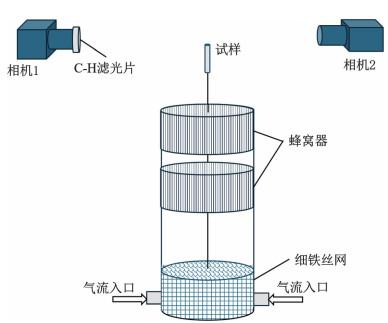
图 1 地面和微重力火焰传播实验段示意图
实验样品为直径2~10 mm的圆柱形PMMA,试样中间长度为62 mm。试样底端为半球形以减小底部对试样周边流动的干扰,底部有一个螺纹孔以便于将其安装在试样支杆上。
具体实验步骤如下:安装好试样后,启动气体供给与控制系统,将流量计设定至预定流量,并打开气瓶供气,同时打开电子天平记录质量变化。待实验段内气流稳定后,点燃试样,用摄像机记录火焰传播过程,并现场观察记录火焰发烟特性。当火焰传播至试样底部时,关闭气体供应系统,电子天平停止记录。
为了研究流动对碳烟分布的影响,对于典型工况,参考文[10]中的消光法测量碳烟浓度。

1.2 落塔微重力实验

微重力实验在中国科学院微重力实验室的落塔中开展,微重力时间为3.6 s,微重力水平为10-3 g(g为重力加速度)。落塔实验装置的原理与地面常重力实验基本相同,不同之处在于微重力环境中无法通过称重来确认试样的质量变化,因此从实验设备中移除了电子天平。此外,在装置中放置一个压力传感器用于记录实验舱内的压力变化。试样的顶部放置螺旋状镍铬合金(Cr20Ni80)电热丝用于点火,点火功率为220 W;电热丝固定在可以旋转的电机上,观察到点火成功后立即启动电机移走电热丝。实验中使用2台相机(型号:Nikon Z5)记录PMMA圆柱点火、燃烧和熄灭的全过程,其中,一台相机镜头前安装C-H滤光片,以记录化学反应当量反应面表示的火焰;另一台相机通过降低曝光时间,拍摄详细的火焰结构。2台相机拍摄的视频分辨率均为3 840像素×2 160像素,拍摄帧率为30 fps,曝光时间1/4 000 s。此外,采用一台数码摄像机(型号:GoPro Hero 7)对实验过程进行记录,相机拍摄的视频分辨率为2 704像素×1 520像素,拍摄帧率为30 fps。
微重力实验中使用直径d为2 mm和6 mm的PMMA试样,其长度与地面常重力实验中一致。气流速度Vg分别设置为1、5、10、15和25 cm/s。落舱整体高为3 m,直径为1 m。实验中还对舱内压力进行监测,结果表明在实验过程中舱内压力基本不变。
具体实验步骤如下:启动GoPro数码摄像机,电热丝通电加热PMMA试样,从监控摄像头观察到试样被点燃后关闭并移开电热丝,整个点火过程持续10~30 s。试样点燃后,依据设定的流量向通道内通入空气以形成所需要的气流速度,之后燃烧持续60~120 s以保证在进入微重力前达到准稳态,具体时间根据地面常重力实验结果确定。当燃烧稳定后释放落舱,令实验装置进入微重力环境。

2 分析与讨论

2.1 质量燃烧速率

试样被点燃后,火焰前锋向上游传播,长度逐渐增加,燃料退化形成的锥角变得尖锐,最终,火焰长度与燃料退化锥角基本不再变化,此时认为火焰达到稳定状态。自然对流条件下d=6 mm的圆柱形PMMA试样在着火后火焰发展至稳定状态的过程如图 2所示,t0为试样被点燃后形成稳定传播火焰的时刻。火焰前锋始终保持蓝色,随着火焰向下游的传播,火焰长度增长直至达到稳定,浮力对流增加,火焰发生轻微的摆动。随着火焰长度的增长,火焰顶端出现了明显的碳烟聚集。
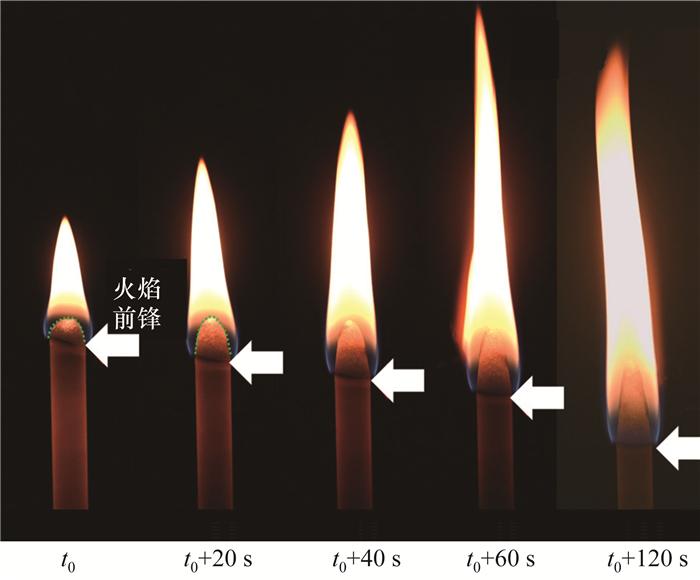
图 2 自然对流条件下着火后火焰发展(d=6 mm)
火焰发展过程中燃料质量m随时间t的变化如图 3所示。由图可知,试样着火后,质量燃烧速率$ \dot m$先增加后保持不变,这也表明燃烧达到稳定状态。对于d=6 mm的试样,在自然对流环境中,火焰达到稳定状态需要大约120 s。试样的d越大,火焰达到稳定状态需要的时间越长。
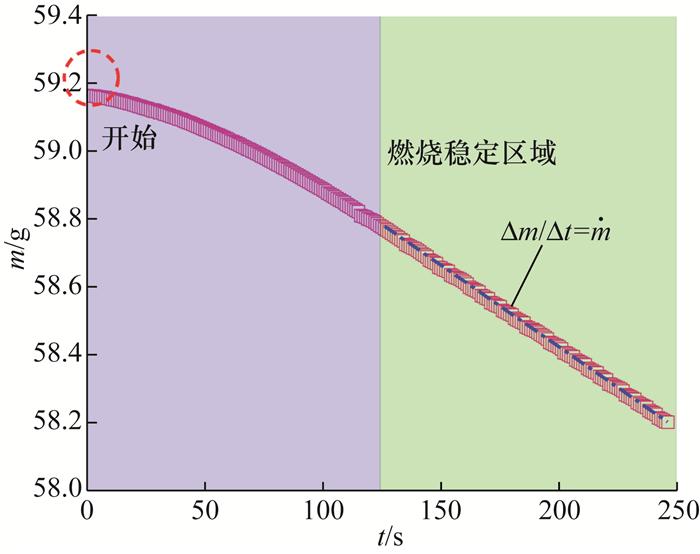
图 3 试样向燃烧稳定状态发展中的质量变化(d=6 mm,自然对流)
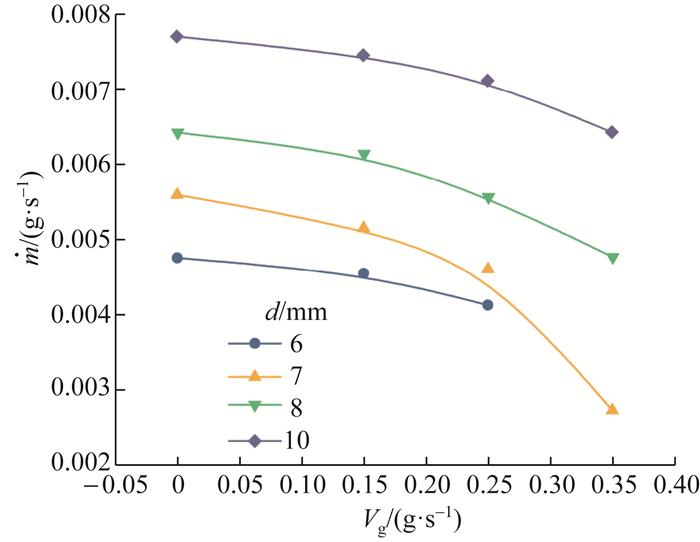
常重力环境下,火焰达到稳定状态时不同d条件下的试样的$ \dot m$Vg的变化如图 4所示。由图可知,Vg增大或d减小均会降低$ \dot m$
图 4 质量燃烧速率随气流速度的变化
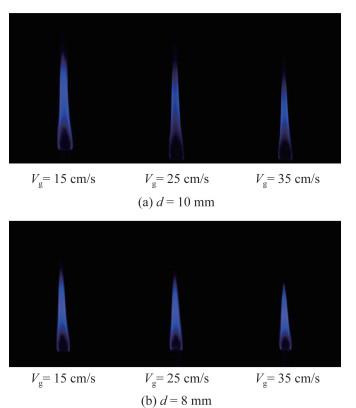
已有研究表明,火焰面积与燃烧热释放速率之间具有线性关系[9]。为了准确计算火焰面积,本文拍摄了不同Vgd下火焰的CH自由基的图像,火焰高度稳定时的图像如图 5所示。比较来看,火焰高度随着Vg的增加而缩短,随着d的增加而增加。
图 5 试样在稳定燃烧时CH自由基图像
通过对拍摄的CH自由基火焰进行提取,可以计算火焰化学计量轮廓面积,进一步可以建立火焰化学计量轮廓面积随$ \dot m$的变化,如图 6所示。可以看出,$ \dot m$与化学计量轮廓面积具有良好的线性关系(R2=0.97)。将文[9]中不传播火焰的热释放与燃烧速率的关系通过公式Q=$ \dot m$ΔHc(Q为热释放速率,ΔHc为燃烧热)转化为$ \dot m$与火焰面积的关系,与本文结果进行对比,结果显示二者的线性关系基本一致,而斜率有所差别,这可能是因为文[9]实验中对试样进行了持续的辐射加热。此外,在常重力环境中,火焰面积随Vg增大呈现减小的单调变化,但在微重力环境中,Vg=10、15和25 cm/s时,d=2 mm的试样表面的火焰面积分别为2.4、2.9和2.2 cm2,随着Vg增加,火焰面积先增加后减小,并不是单调变化的。
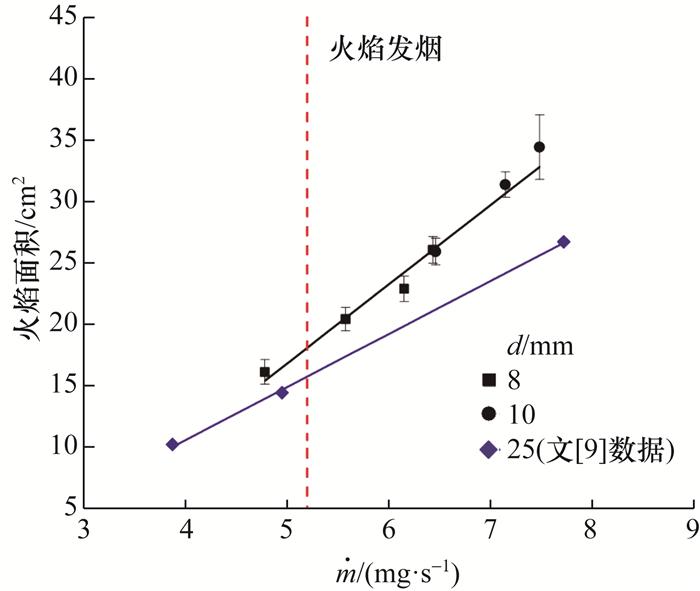
图 6 火焰面积随质量燃烧速率的变化

2.2 火焰碳烟特性

不同dVg条件下的火焰发烟特性图谱如图 7所示。由图可知,常重力环境中,当Vg相同时,d越大越容易析出碳烟;当d相同时,Vg越低火焰越可能有碳烟析出。微重力环境中,对于d= 2 mm的试样,Vg在0~25 cm/s范围内火焰均未发烟,而对于d=6 mm的试样,火焰均发烟。
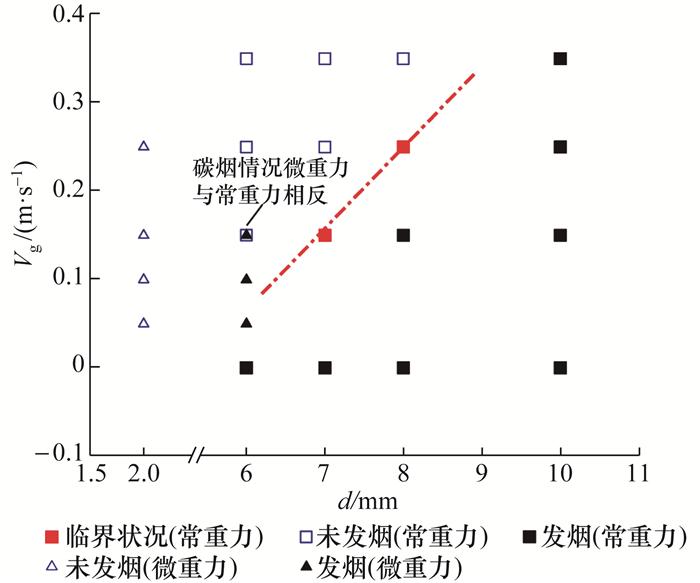
图 7 不同试样直径和气流速度下的火焰发烟特性
进一步探究Vg对碳烟分布的影响。d=6 mm的PMMA试样在不同Vg时的碳烟体积分数Fv的分布如图 8a所示,z表示计算区域相对图像底部的位置,r表示径向长度。由图可知,与气体射流火焰类似,碳烟主要分布于火焰面附近,随着Vg的增加,火焰内碳烟的浓度逐渐下降。图 8b8d分别为z=5、20和30 mm处的Fv的空间分布。可以发现,随着z的增加,Fv的差异增大。对于浮力起主导作用的火焰,通常认为碳烟在火焰中的停留特征时间tres, b与火焰长度hf有关[12],即tres, b~$ \sqrt{h_{\mathrm{f}} / g}$。结合图 5也可看出,随着Vg的增加火焰高度变低,这表明碳烟在火焰中的停留时间缩短,碳烟更难在火焰尖端聚集,造成火焰尖端Fv的降低。
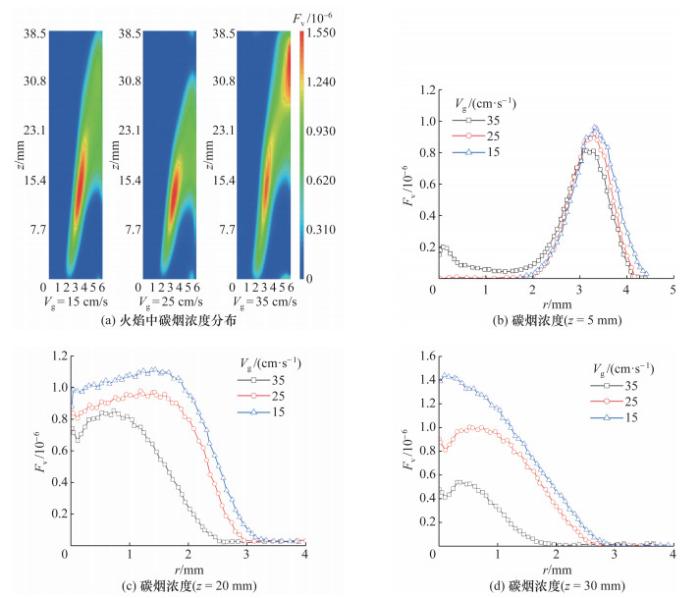
图 8 常重力环境中不同气流速度中火焰碳烟浓度分布(d=6 mm)
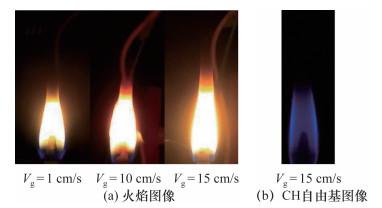
微重力环境中d=6 mm的试样在不同Vg时的火焰图像如图 9所示,同时给出了Vg为15 cm/s时火焰的CH自由基图像。可以看出,火焰尖端一直开口,并析出碳烟。对于d=6 mm的试样,Vg=15 cm/s时,火焰在微重力与常重力环境中的发烟状况相反。Link等[12]在低氧气浓度下柱状PMMA火焰传播实验中发现了随着Vg降低火焰中Fv降低,这表明至少在一定流速范围内,微重力环境中FvVg的变化趋势与常重力环境中相反。
图 9 微重力环境中不同气流速度下的火焰图像(d=6 mm)和CH自由基的图像

3 结论

通过开展落塔微重力实验与地面常重力实验,对固体PMMA柱状材料的质量燃烧速率以及碳烟特性进行了研究。主要结论如下:
1) 固体材料质量燃烧速率受到环境流动的影响。空气流动速度越低,质量燃烧速率越大。质量燃烧速率与火焰化学当量轮廓面积存在线性关系,这种线性关系不会因为质量燃烧速率超过或低于烟点而改变。
2) 流动速度和试样直径共同决定火焰发烟特性。常重力环境中,随着试样直径增加,火焰不发烟时对应的临界气流速度增加。相同的强迫对流环境下,微重力环境中的火焰更容易发烟。对火焰碳烟浓度的定量分析表明,常重力环境中碳烟浓度随着气流速度的增加而减小。
1
LAUTENBERGER C, TORERO J, FERNANDEZ-PELLO C. Understanding material flammability[M]// APTE V. Flammability Testing of Materials Used in Construction, Transport and Mining. 2nd ed. New York, USA: CRC Press, 2022.

2
T'IEN J S, SHIH H Y, JIANG C B, et al. Mechanisms of flame spread and smolder wave propagation[M]// ROSS H D. Microgravity Combustion: Fire in Free Fall. San Diego, USA: Academic Press, 2001.

3
DE RIS J . Spread of a laminar diffusion flame[J]. Symposium (International) on Combustion, 1969, 12 (1): 241- 252.

DOI

4
FERNANDEZ-PELLO A C , SANTORO R J . On the dominant mode of heat transfer in downward flame spread[J]. Symposium (International) on Combustion, 1979, 17 (1): 1201- 1209.

DOI

5
DE RIS J L , CHENG X F . The of role of smoke-point in material flammability testing[J]. Fire Safety Science, 1994, 4, 301- 312.

DOI

6
LINTERIS G T , RAFFERTY I P . Flame size, heat release, and smoke points in materials flammability[J]. Fire Safety Journal, 2008, 43 (6): 442- 450.

DOI

7
DEHGHANI P , SUNDERLAND P B , QUINTIERE J G , et al. Burning in microgravity: Experimental results and analysis[J]. Combustion and Flame, 2021, 228, 315- 330.

DOI

8
GOMEZ A , SIDEBOTHAM G , GLASSMAN I . Sooting behavior in temperature-controlled laminar diffusion flames[J]. Combustion and Flame, 1984, 58 (1): 45- 57.

DOI

9
KENT J H . A quantitative relationship between soot yield and smoke point measurements[J]. Combustion and Flame, 1986, 63 (3): 349- 358.

DOI

10
Meyer F , Schwenteck T , Ruhe M , et al. UB-FIRE experiment results on upward flame propagation along cylindrical PMMA samples in reduced gravity[J]. 47th International Conference on Environmental Systems, 2017,

11
XIONG C Y , FAN H R , HUANG X Y , et al. Evaluation of burning rate in microgravity based on the fuel regression, flame area, and spread rate[J]. Combustion and Flame, 2022, 237, 111846.

DOI

12
DOTSON K T , SUNDERLAND P B , YUAN Z G , et al. Laminar smoke points of coflowing flames in microgravity[J]. Fire Safety Journal, 2011, 46 (8): 550- 555.

DOI

13
LINK S , HUANG X Y , FERNANDEZ-PELLO C , et al. The effect of gravity on flame spread over PMMA cylinders[J]. Scientific Reports, 2018, 8 (1): 120.

DOI

Outlines

/