Combustion and Fire Analysis in Confined Space

Risk prediction of thermal radiation from jet fire of onboard hydrogen storage tanks

  • Linzhi ZOU 1 ,
  • Bei LI , 1, 3, 4, * ,
  • Bing HAN 2, 3 ,
  • Yan LIU 2, 3 ,
  • Chen SONG 4 ,
  • Xin JIN 2, 3
Expand
  • 1. School of Chemical Engineering, Dalian University of Technology, Dalian 116024, China
  • 2. Dalian Boiler and Pressure Vessel Inspection & Detection Institute Co., Ltd., Dalian 116012, China
  • 3. Key Laboratory of Gas Cylinders Safety Technology, State Administration for Market Regulation, Dalian 116012, China
  • 4. Dalian Duda Technology Safety System Co., Ltd., Dalian 116024, China

Received date: 2023-10-30

  Online published: 2025-11-07

Copyright

All rights reserved. Unauthorized reproduction is prohibited.

Abstract

Objective: As the thermal pressure relief device of an onboard hydrogen storage tank is activated by a fire, the released high-pressure hydrogen gas will be ignited to form a jet flame. The large scale and high temperature of the jet flame lead to a potential risk of thermal radiation injury to individuals nearby, including firefighters. This study was based on the bonfire test of a full-size vehicle-mounted hydrogen storage tank, combined with a theoretical system to predict the external thermal radiation of the jet flame and evaluate the danger distance to personnel. Methods: Based on the development process of vehicle fires, the test was structured to include localized and engulfing stages of a bonfire. A Type III hydrogen storage tank with the specifications of 48 L and 70 MPa was used in the test. A pressure sensor and camera were installed to record the internal pressure of the tank and the shape of the jet flame. Based on the real gas state equation and the thermodynamic and fluid characteristics of high-pressure hydrogen, a theoretical calculation framework, which contained the changes to the gas parameters, such as temperature, density, and flow velocity, was obtained. Then, the mass flow rate of hydrogen was estimated by the framework. The heat release rate of the jet flame can be estimated from the combustion heat and mass flow rate. To further determine the radiation flux distribution of the jet flame, this study used the classic single-point-source model. In addition, the prediction accuracy of the model for the external radiation of the jet flame in the near-field (within 3.0 m) has been verified. Finally, the release scenario of the 48 L-70 MPa hydrogen storage tank was cited as an example, and the evolution of the external radiation and thermal dose unit of the jet flame over time at different distances (1.5-5.0 m) was analyzed. The danger distance to personnel was also evaluated in compliance with the injury threshold of the human body under thermal radiation. Results: According to the bonfire test and theoretical calculation of the 48 L-70 MPa hydrogen storage tank: (1) The maximum internal pressure of the tank under full load hydrogen charging conditions in a fire was 77.4 MPa. The maximum flow rate was approximately 0.1 kg/s, with a maximum jet flame length of 4.93 m. (2) The maximum radiation flux of the jet flame at 1.5 m was approximately 13 kW/m2, which decayed to 10.2 kW/m2 after 20 s. (3) At a distance of 2.0-3.0 m from the flame, it would take approximately 5.0 s to cause first-degree burns to personnel, and at a distance of 5.0 m, it would take more than 20 s. (4) A “risk-free” distance of at least 10.0 m was required to ensure that personnel are exposed to thermal radiation of less than 1.6 kW/m2. Conclusions: The results of this study could further improve the theoretical system of jet flame external radiation risk assessment for the emergency release of onboard hydrogen storage tanks that could provide a reference for emergency response in related accident scenarios.

Cite this article

Linzhi ZOU , Bei LI , Bing HAN , Yan LIU , Chen SONG , Xin JIN . Risk prediction of thermal radiation from jet fire of onboard hydrogen storage tanks[J]. Journal of Tsinghua University(Science and Technology), 2025 , 65(11) : 2149 -2156 . DOI: 10.16511/j.cnki.qhdxxb.2025.27.001

氢燃料电池车具有无污染、充装快速和能量转化率高等优势,依据《氢能产业发展中长期规划(2021—2035年)》[1],2025年中国氢能源汽车保有量将达到5万辆。高压气态储氢是目前最成熟的车载储氢技术,氢燃料电池车通常搭载公称压力为35 MPa或70 MPa的高压储氢气瓶。例如丰田Mirai型氢燃料电池车搭载的IV型70 MPa高压储氢气瓶,续航距离可达850 km。
氢燃料电池车行驶时易因碰撞、短路等原因引发车辆火灾,外部火焰冲击可能诱发车载高压储氢气瓶爆裂。气瓶爆裂后会引起冲击波和火球燃爆,气瓶碎片与试验点距离最远为74 m[2]。为避免气瓶爆裂,《燃料电池电动汽车安全全球技术法规》(UN GTR 13)要求车载储氢气瓶应当在瓶阀部位安装温度驱动安全泄压装置(thermal pressure relief device,TPRD)。当发生车辆火灾时,TPRD内易熔塞合金或玻璃泡在温度约(110±5) ℃时发生熔化或破裂,使高压氢气泄放到外部以避免气瓶破裂。泄放后的高压氢气被点燃形成射流火焰会释放大量的辐射热,可能对附近人员与环境产生不同程度的热伤害。车载高压氢气瓶泄放试验[3]与射流火焰热辐射的风险机制如图 1所示。
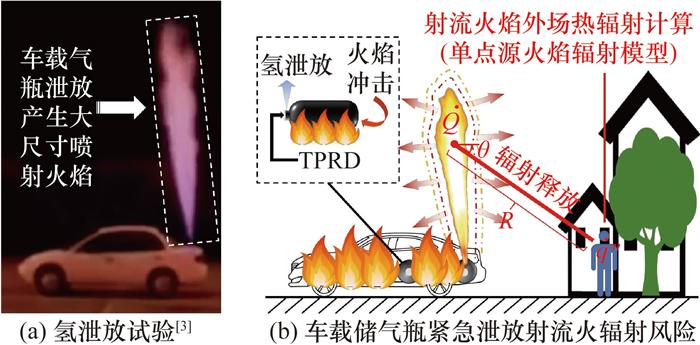
图 1 车载高压氢气瓶泄放试验[3]与射流火焰辐射热风险机制

注:$\dot{Q}$为射流火热释放速率(kW);R为火焰热源到人员位置的直线距离(m);$\dot{q}^{\prime \prime}$为射流火焰辐射通量(kW/m2);θ为从火焰热源到人员位置的连线与水平线夹角(°)。

长时间的火烧热冲击会导致气瓶内部压力持续上升。Wang等[4]发现,公称压力为35 MPa和70 MPa的Ⅲ型高压储氢气瓶火烧后,其内部最大临界泄放压力可达45.6 MPa和81.8 MPa。气瓶内外较高的压力差使氢气具有高喷射速度,在被外部火源点燃后可形成长达5~7 m的射流火焰,并释放大量辐射热。在高压储氢气瓶泄放领域,国外相关研究起步较早,如Bouix等[5]在大尺寸隧道中进行了火烧条件下20 MPa储氢气瓶泄放试验,泄放形成的最大射流火焰长度约为3.9 m,在2 m处测得$\dot{q}^{\prime \prime}$为5.2 kW/m2。Schefer等[6]研究了氢气从压力15 MPa的储氢气瓶中泄放形成的射流火焰,发现喷口直径为7.94 mm时形成的最大火焰长度约为4.8 m。在距离火焰约2.5 m处的$\dot{q}^{\prime \prime}$最大值约为8 kW/m2。此外,Sivathanu等[7]分析了单个测点获取的归一化火焰辐射通量,揭示了火焰辐射与相关参数的关联,建立了外场火焰辐射预测的基础理论。国内在该领域起步相对较晚,实验室级别下的氢泄放压力最高为20 MPa[8]且主要关注层流燃烧火焰的结构、稳定性、传播过程等,缺乏对35/70 MPa以上级别车载储氢气瓶泄放的火焰尺度和风险分析研究。此外,作为氢燃料电池车中的一种车型,氢燃料电池乘用车主要以人员运输为主,而乘用车载气瓶泄放时的射流火焰辐射对人员的热伤害风险评估理论体系目前仍不够健全。
本文基于48 L-70 MPa车载高压储氢气瓶在火烧条件下的泄放射流火焰开展辐射预测和风险评估研究,获取气瓶泄放响应特征参数;结合火焰的单点源辐射模型,预测气瓶泄放射流火焰的外场辐射变化,并对气瓶泄放的辐射伤害范围开展评估。研究结果可为氢燃料电池车的火灾应急处置提供理论参考。

1 研究方法

1.1 储氢气瓶火烧泄放试验
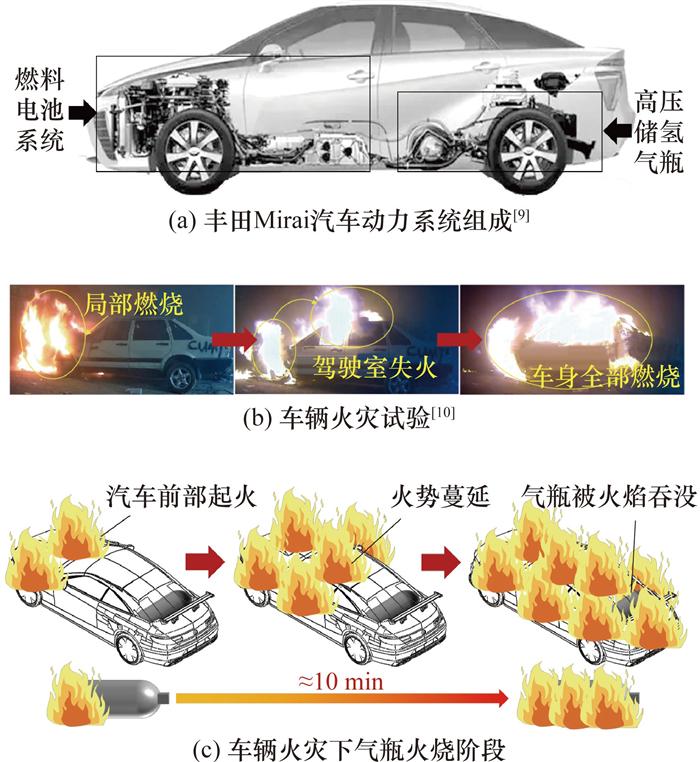
氢燃料电池乘用车的能源系统设计结构与传统燃油车存在一定区别。以丰田Mirai车型为例,其能源系统结构[9]图 2a所示,该车搭载的燃料电池系统位于车辆前半部,气瓶则位于车辆中后部。当车辆发生事故时其前部易先起火燃烧,并逐步蔓延至车辆后方的气瓶位置。图 2b为Li等[10]进行的乘用车(长、宽、高为4.4 m、1.7 m、1.4 m)火灾试验,研究发现汽车从驾驶舱前部着火至火焰吞没车身的时间间隔约为10~11 min。
图 2 气瓶火烧阶段特征(基于氢燃料电池车动力系统[9]与车辆火灾试验[10])
因此本文认为氢燃料电池乘用车的气瓶火烧阶段特征为:首先前部燃料电池起火,随火势发展车身被火焰覆盖,而车载储氢气瓶也伴随着从局部到整体的受火过程。根据乘用车火烧试验结果,推测气瓶局部火烧到整体火烧的时间约为10 min,具体如图 2c所示。
基于该发展过程,结合《车用压缩氢气铝内胆碳纤维全缠绕气瓶》(GB/T 35544—2017)中的相关规定,设置本研究中48 L-70 MPa车载高压储氢气瓶的火烧泄放试验条件,试验系统与气瓶火烧阶段如图 3所示。试验采用航空煤油填充的方形燃烧盘(长×宽为1.6 m×1.1 m)作为火源,模拟车辆火灾环境。通过气瓶下方的隔板及滑轨控制火源面积以实现局部至整体火烧的过渡。在气瓶阀门连接的管路内安装压力传感器以监测气瓶内部压力变化。近场处设置相机和挡风板用于记录试验过程以及排除外界环境风对火焰稳定性的影响。
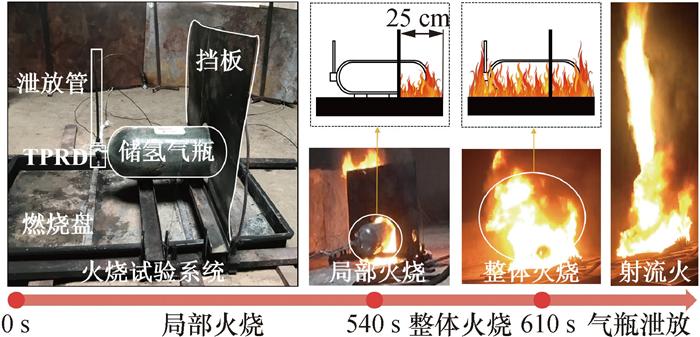
图 3 储氢气瓶火烧试验
试验使用的高压储氢气瓶规格参数[11]表 1所示。气瓶受局部火焰冲击的时间段为0~540 s,540 s之后气瓶瓶身被整体火烧包裹。试验至610 s时TPRD启动,高压氢气瞬间释放并产生向上的射流火焰。
表 1 泄放试验高压储氢气瓶规格参数[11]
规格 参数
气瓶类型 Ⅲ型
容积/L 48
公称压力/MPa 70
直径/mm 360
长度/mm 882
内胆材料种类 6061铝合金
内胆设计厚度/mm 6.5
缠绕层材料种类 碳纤维/环氧树脂
缠绕层设计厚度/mm 23.5
泄放通径/mm 2

1.2 预测泄放火焰辐射的理论基础

参考Zhou等[12]提出的储氢装置瞬态泄放气流参数模型的理论基础,本文以48 L-70 MPa车载高压储氢气瓶泄放过程为例,基于真实气体状态方程、热力学和流体力学定律计算泄放质量流量,进一步获取射流火焰的热释放速率;结合质量流量与射流火焰长度变化,获取火焰的辐射分数;将相关参数代入单点源辐射模型获得射流火焰的$\dot{q}^{\prime \prime}$。具体流程如图 4所示。
图 4 射流火焰辐射预测理论流程

1.3 单点源辐射模型

单点源(single point source,SPS)模型由于计算简便以及远场预测准确性较高而被广泛应用于射流火焰辐射理论预测方面的研究。SPS模型忽略火焰的具体形状,将热源视为火焰轴线上的一个中心点。假设从这个点源释放辐射热到一个接收目标的平坦表面,到达目标位置的$\dot{q}^{\prime \prime}$可表示为
$\dot{q}^{\prime \prime}=\frac{\tau \chi_{\mathrm{R}} \dot{Q}}{4 \pi R^2} \cos \theta.$
其中:τ为在该距离下的大气透射率;χR为辐射分数;Hankinson等[13]研究指出在火焰近场区域(R<3 m)的τ不会对热辐射计算产生影响,即认为近场区域的τ近似为1。
在高压储氢气瓶泄放场景中的$\dot{Q}$
$\dot{Q}=\dot{m} \Delta H.$
其中:$\dot{m}$为气体喷射质量流量,kg/s;ΔH为燃料燃烧热,kJ/kg。
对于χR,Molina等[14]将火焰视为一个黑体辐射源并提出了其对数计算表达式。
$\chi_{\mathrm{R}}=0.089 \lg \left(\tau_{\mathrm{G}} a_{\mathrm{f}} T_{\mathrm{ad}}^4\right)-1.217.$
其中:τG为火焰停留时间,ms;af为燃烧产物的Planck平均吸收系数,m-1Tad为火焰绝热温度,K。本文参考了Ekoto等[15]的取值(af=0.32 m-1Tad=2 390 K)以估算χR
Turns等[16]提出将τG与燃料质量流量和火焰尺寸进行关联,计算方法为
$\tau_{\mathrm{G}}=\frac{\pi}{12} \frac{p_0 M_{\mathrm{H}_2 \mathrm{O}} W_{\mathrm{f}}^2 L_{\mathrm{f}} f_{\mathrm{s}}}{\dot{m} R_{\mathrm{g}} T_{\mathrm{ad}}}.$
其中:p0为环境气压,Pa;MH2O为燃烧产物的摩尔质量,g/mol;Rg为气体常数,J/(mol·K);fs为理想配比下燃料反应的质量分数;Lf为射流火焰长度,m;Wf为射流火焰宽度,m。Schefer等[6]研究指出高压氢气欠膨胀射流火焰的Wf约为0.17Lf,因此将Wf进行了简化以降低计算复杂程度。

1.4 模型验证

基于高压氢气泄放的热力学与流体特征并结合单点源火焰辐射模型,本文提出了较为完整的车载高压储氢气瓶泄放的火焰辐射预测理论流程。考虑到由于大尺度、高危险性试验中的不确定性因素而未能获取射流火焰$\dot{q}^{\prime \prime}$试验值,本文参考了与所设气瓶泄放场景相似的Proust等[17]的试验数据进行验证,以说明整个理论流程的可靠性。Proust等[17]测量了压力90 MPa储氢气瓶通过2 mm孔径泄放的射流火焰热辐射,其中3个测点距离泄放射流火焰分别为1.5、2.0和3.0 m。本文依据相同工况,使用SPS模型对上述3个测点的火焰外场辐射进行计算。如图 5所示,3个测点分布在与火焰中轴呈45°角的方位上,火焰点源位置为火焰长度的一半,根据点源与测点的坐标距离计算火焰在3个测点的$\dot{q}^{\prime \prime}$
图 5 射流火焰的SPS模型及测点位置
利用平均绝对百分比误差(mean absolute percentage error,MAPE)评估SPS模型计算值与文[17]试验值之间的误差。
$\text { MAPE }=\frac{1}{n} \sum\limits_{i=1}^n\left(\left|\frac{\dot{q}_{\text {model }(i)}^{\prime \prime}-\dot{q}_{\exp (i)}^{\prime \prime}}{\dot{q}_{\exp (i)}^{\prime \prime}}\right|\right) \times 100 \% .$
其中:$\dot{q}^{\prime \prime}{ }_{\text {model }}$为模型计算热通量;$\dot{q}_{\text {exp }}^{\prime \prime}$为试验测量热通量;n为选取数据的总数量。
模型计算值与试验值的对比结果如图 6所示。由图可知,在泄放初始时刻的q · ″达到峰值并随时间缓慢降低,而泄放前期压力过高导致射流火具有极高的速度和不稳定性,因此在前期(前10 s)的模型计算值误差一般高于后期。利用式(5)计算出3个测点对应的MAPE值分别为5.0%、4.9%和9.4%,均小于10%,表明计算结果满足工程应用精度要求,能够适用于气瓶泄放火焰辐射预测。需要说明的是,由于测点3(3.0 m距离)的试验值更小,MAPE方法在该点的计算误差偏高。
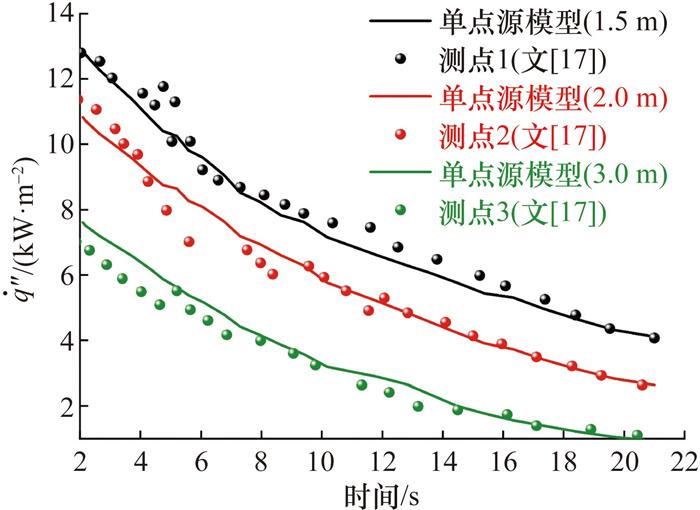
图 6 辐射模型计算值与文[17]试验值的对比

2 结果与讨论

2.1 气瓶泄放响应与射流火焰典型特征

泄放过程中瓶内压力p、火焰长度Lf与质量流量$\dot{m}$的变化如图 7所示。由图可知,受试气瓶在泄放临界时刻p为77.4 MPa,达到公称压力的110%。泄放瞬间氢气的$\dot{m}$为0.1 kg/s,Lf最大为4.93 m。p$\dot{m}$的下降速率均随时间的推移呈现由快至慢的变化,而Lf因湍流等因素呈波动下降。
图 7 泄放后气瓶内压力、火焰长度与质量流量
气瓶泄放火焰典型形态如图 8所示,由图可知,氢气泄放后呈现出典型的明亮湍流火焰,其中Lf随时间降低更加明显,9 s时Lf约为3.9 m;而Wf的下降幅度相对较小,16 s时Wf约为0.53 m。
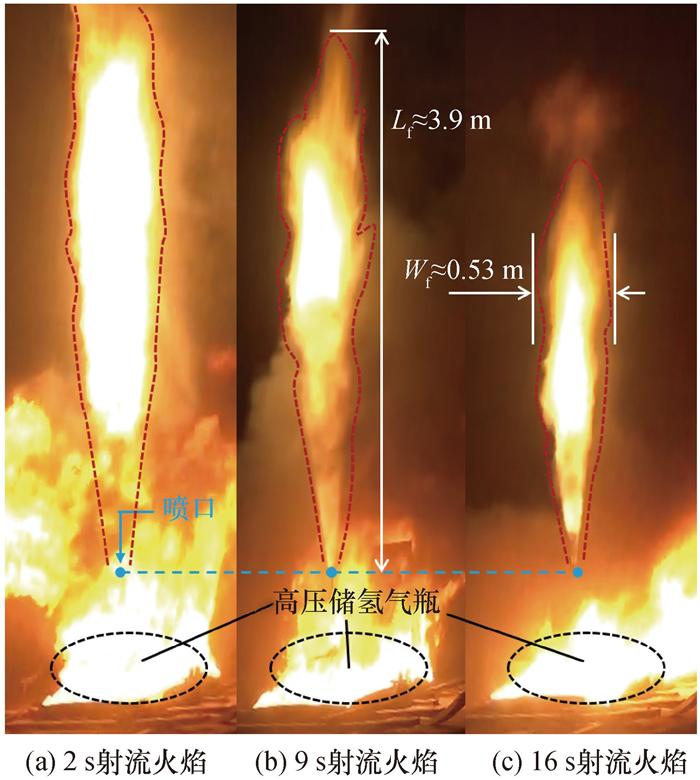
图 8 试验气瓶典型泄放过程中的火焰形态

2.2 火焰辐射对人员伤害风险评估

进行辐射风险评估时,需要考虑空间中的目标位置。以丰田Mirai车型为例,假设泄放方向垂直于地面,在考虑了车辆和行人高度的情况下,以火焰在水平方向上的$\dot{q}^{\prime \prime}$反映人体受到的热伤害情况。基于泄放射流火在空间中的对称性,采用二维坐标系确定目标与火焰的距离,火焰与人员的位置分布如图 9所示,该坐标系以气瓶喷口作为坐标原点,并以人员与喷口的水平距离评估辐射对人的伤害程度。
图 9 射流火焰与人员的风险评估坐标系
确定辐射伤害的阈值是火焰风险评估的重要标准,与此同时,人体在辐射下的热量累积也是导致烧伤的关键因素。热剂量(thermal dose unit,TDU)常被用于估计热辐射累积程度,其被定义为$\dot{q}^{\prime \prime}$与暴露时间t的函数。
$\mathrm{TDU}=t \cdot\left(\dot{q}^{\prime \prime}\right)^{4 / 3}.$
以丰田Mirai车型为例,其搭载的2个储氢气瓶总储氢容积约122.4 L(分别为60.0和62.4 L),在紧急泄放时射流火仅持续2~3 min,不能产生类似管道泄漏的长时间射流火焰。同时由于氢燃料电池乘用车目前主要以人员运输为主,因此本文主要对人员的伤害情况进行评估。LaChance等[18]根据国际能源署对储氢装置的风险评估研究提出了火焰辐射对人员/物体的热伤害阈值,其中火焰辐射对人员热伤害标准如表 2所示。
表 2 火焰辐射对人员热伤害的标准[18]
损伤标准 阈值范围 伤害等级
$\dot{q}^{\prime \prime}$/(kW·m-2) 1.6 长时间对人无害
4.0 20 s引起一级烧伤
9.5 20 s引起二级烧伤
TDU/((kW·m-2)4/3·s) 80~130 一级烧伤
240~730 二级烧伤
870~2 640 三级烧伤
本文以48 L-70 MPa车载高压储氢气瓶泄放时产生的射流火焰为例,计算不同距离下$\dot{q}^{\prime \prime}$与TDU变化,并依据表 2评估气瓶射流火焰对人体造成烧伤的风险。由于Mogi等[19]在35 MPa泄放压力和2 mm通径的试验条件下对氢射流火焰辐射的研究显示,在距离火焰1.5 m处的$\dot{q}^{\prime \prime}$约为7 kW/m2,而Rossi等[20]指出7 kW/m2为消防员在火场中的最大耐受阈值,因此本文参考上述结果从距离火焰1.5 m处进行火焰辐射的预测和评估。
射流火焰不同距离下$\dot{q}^{\prime \prime}$的变化以及火焰对人员的辐射伤害风险区域如图 10所示。由图可知,在距离火焰1.5~2.0 m处的$\dot{q}^{\prime \prime}$受到火焰长度的影响发生连续波动,但波动程度会随距离增加而减弱。距离火焰1.5 m处$\dot{q}^{\prime \prime}$达到最大,约为13 kW/m2,且强度基本维持在二级烧伤水平(9.0 kW/m2)以上,说明该距离以内能够造成人员严重烧伤甚至致死。距离火焰2.0 m处的$\dot{q}^{\prime \prime}$仅在前4 s内短暂超过9.5 kW/m2,在24 s时$\dot{q}^{\prime \prime}$仍高于6.0 kW/m2。距离火焰3.0 m处,$\dot{q}^{\prime \prime}$在前18 s高于4.0 kW/m2,会引起人员的一级烧伤。此外,在距离火焰5 m处,火焰前20 s的$\dot{q}^{\prime \prime}$仍高于无伤害阈值(1.6 kW/m2)。泄放临界时刻的风险区($\dot{q}^{\prime \prime}$>4.0 kW/m2)最大距离约为5.7 m。随泄放时间的增加,火焰减弱导致其风险距离持续减小。根据计算,48 L-70 MPa储氢气瓶在临界时刻发生喷射时需要10.0 m的距离才能保证火焰对人无害($\dot{q}^{\prime \prime}$<1.6 kW/m2)。Gentilhomme等[21]开展车载储氢安全风险评估同样建议,人员应保持10.0 m以上距离以避免气瓶射流火焰的伤害。
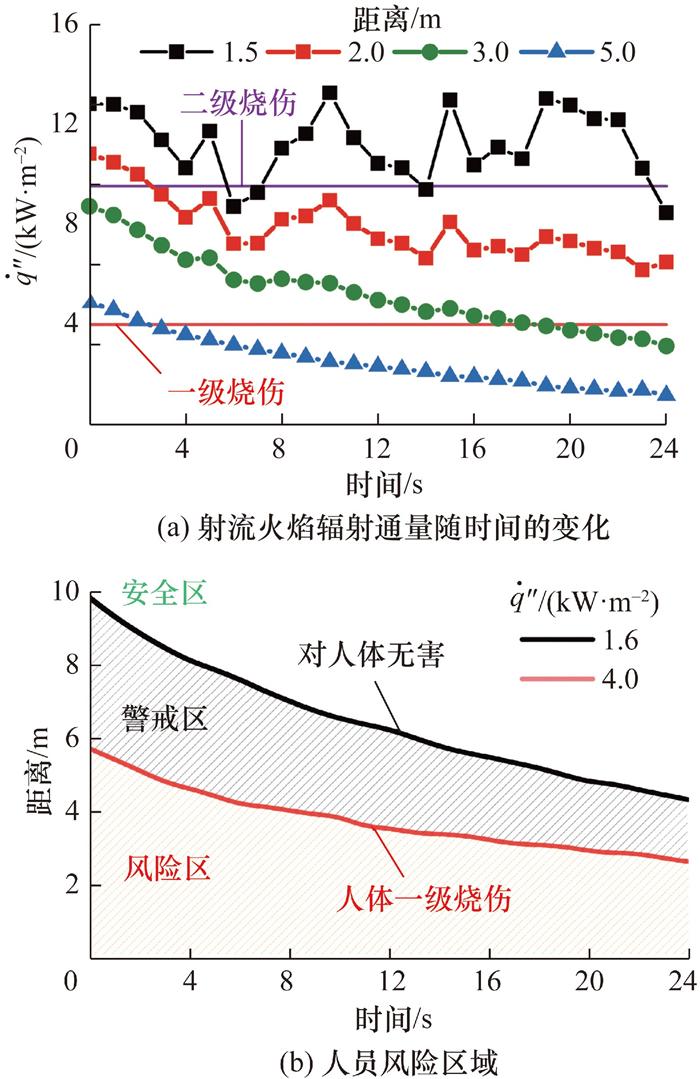
图 10 射流火焰辐射通量与风险区域
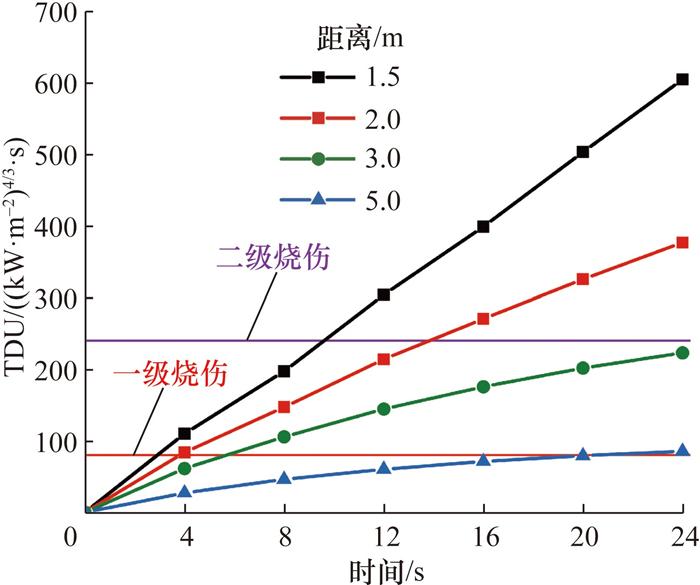
火焰在4个距离处的TDU曲线如图 11所示。1.5 m处TDU在10 s内达到251(kW/m2)4/3·s,可导致人员的二级烧伤;24 s后的TDU已达600(kW/m2)4/3·s。在2.0 m处,16 s左右的热剂量为270(kW/m2)4/3·s,已达到二级烧伤水平。此外,虽然5.0 m处火焰的$\dot{q}^{\prime \prime}$基本下降至不足4 kW/m2,但TDU在20 s左右已积累至80(kW/m2)4/3·s,可能造成人员一级烧伤。火焰距离超过5.0 m时,TDU增长更加缓慢。若仅考虑一级烧伤阈值,以$\dot{q}^{\prime \prime}$与TDU为阈值的人员安全距离相似,为5.0~6.0 m。
图 11 射流火焰的TDU变化

3 结论

本文基于48 L-70 MPa车载高压储氢气瓶在火灾场景的泄放试验,开展了氢燃料电池车极端工况高压储氢气瓶射流火焰热危险性研究,建立了气瓶泄放射流火焰的辐射风险评估理论体系以预测人员的风险距离。结论如下:
1) 气瓶泄放后的压力p、火焰长度Lf与质量流量$\dot{m}$从峰值水平开始快速下降,其中p$\dot{m}$呈线性下降趋势,而Lf则呈现波动下降。气瓶泄放临界时刻的p达到77.4 MPa,Lf最大值为4.93 m,$\dot{m}$最高为0.1 kg/s。
2) 基于真实气体状态方程,根据气瓶内高压氢气泄放的热力变化与流体特征,结合单点源火焰辐射模型与人体热伤害阈值,建立了车载高压储氢气瓶泄放的射流火焰辐射风险评估理论体系,经过试验值误差对比,证明预测结果的精确度满足工程应用领域要求。
3) 根据预测结果,受试气瓶泄放瞬间火焰的辐射通量在1.5 m处可达13 kW/m2。人员在射流火焰2.0~3.0 m处短暂停留4~6 s即可能造成一级烧伤,而停留16~24 s可能导致二级烧伤。长时间(20 s左右)处在距离火焰5.0 m的位置仍会由于热量积累造成一级烧伤。建议人员的“无风险”距离需10.0 m以上。
此外,《燃料电池电动汽车安全全球技术法规》二阶段(UN GTR 13-Ⅱ)更新了燃烧器与火源的内容,以确保试验中燃烧火源的可控性、稳定性与一致性。在未来研究中还需开展泄放火焰的辐射测量工作以进一步优化模型预测流程,并将基于法规二阶段试验系统的特征对火源的外场辐射进行分析,通过考虑火源的辐射水平完善现有辐射风险评估体系。
1
中华人民共和国国家发展和改革委员会. 氢能产业发展中长期规划(2021—2035年) [EB/OL]. (2022-03-24) [2024- 10-30]. https://www.ndrc.gov.cn/xxgk/zcfb/ghwb/202203/t20220323_1320038.html.

National Development and Reform Commission. The development of hydrogen energy for the 2021—2035 period[EB/OL]. (2022-03-24)[2024-10-30]. https://www.ndrc.gov.cn/xxgk/zcfb/ghwb/202203/t20220323_1320038.html. (in Chinese)

2
PARK B , KIM Y . Reenacting the hydrogen tank explosion of a fuel-cell electric vehicle: An experimental study[J]. International Journal of Hydrogen Energy, 2023, 48 (89): 34987- 35003.

DOI

3
SWAIN M . Fuel leak simulation[M]. London, UK: Proceedings of the Institution of Mechanical Engineers, 2004.

4
WANG X Y , LI B , JIN X , et al. Ultimate pressure-bearing capacity of Type Ⅲ onboard high-pressure hydrogen storage tanks under typical accident scenarios[J]. Journal of Energy Storage, 2023, 63, 107135.

DOI

5
BOUIX D, SAUZEDDE F, MANICARDI P, et al. Full-scale tunnel experiments for fuel cell hydrogen vehicles: Fire-jet and explosions[C]//Proceedings of the ICHS 2021: International Conference on Hydrogen Safety. Edinburg, UK: CEA, 2021: 1-14.

6
SCHEFER R W , HOUF W G , BOURNE B , et al. Spatial and radiative properties of an open-flame hydrogen plume[J]. International Journal of Hydrogen Energy, 2006, 31 (10): 1332- 1340.

DOI

7
SIVATHANU Y R , GORE J P . Total radiative heat loss in jet flames from single point radiative flux measurements[J]. Combustion and Flame, 1993, 94 (3): 265- 270.

DOI

8
ZHANG A J , ZOU X , SHEN J H , et al. Experimental investigation on hydrogen jet flame behavior and temperature distribution with different shapes of outlet[J]. International Journal of Hydrogen Energy, 2024, 63, 844- 856.

DOI

9
伍庆龙, 张天强. 丰田燃料电池汽车Mirai技术分析[J]. 汽车文摘, 2020 (4): 18- 21.

WU Q L , ZHANG T Q . Analysis on Mirai fuel cell vehicle technologies of Toyota[J]. Automotive Digest, 2020 (4): 18- 21.

10
LI D Y , ZHU G Q , ZHU H , et al. Flame spread and smoke temperature of full-scale fire test of car fire[J]. Case Studies in Thermal Engineering, 2017, 10, 315- 324.

DOI

11
ZOU L Z , LI B , HAN B , et al. Release of high-pressure hydrogen from type Ⅲ tank in a fire scenario: Analysis and prediction of jet flame length and thermal response characteristics[J]. Fuel, 2024, 372, 132153.

DOI

12
ZHOU K B , LIU J Y , WANG Y Z , et al. Prediction of state property, flow parameter and jet flame size during transient releases from hydrogen storage systems[J]. International Journal of Hydrogen Energy, 2018, 43 (27): 12565- 12573.

DOI

13
HANKINSON G , LOWESMITH B J . A consideration of methods of determining the radiative characteristics of jet fires[J]. Combustion and Flame, 2012, 159 (3): 1165- 1177.

DOI

14
MOLINA A , SCHEFER R W , HOUF W G . Radiative fraction and optical thickness in large-scale hydrogen-jet fires[J]. Proceedings of the Combustion Institute, 2007, 31 (2): 2565- 2572.

DOI

15
EKOTO I W , RUGGLES A J , CREITZ L W , et al. Updated jet flame radiation modeling with buoyancy corrections[J]. International Journal of Hydrogen Energy, 2014, 39 (35): 20570- 20577.

DOI

16
TURNS S R , MYHR F H . Oxides of nitrogen emissions from turbulent jet flames: Part Ⅰ—Fuel effects and flame radiation[J]. Combustion and Flame, 1991, 87 (3-4): 319- 335.

DOI

17
PROUST C , JAMOIS D , STUDER E . High pressure hydrogen fires[J]. International Journal of Hydrogen Energy, 2011, 36 (3): 2367- 2373.

DOI

18
LACHANCE J , TCHOUVELEV A , ENGEBO A . Development of uniform harm criteria for use in quantitative risk analysis of the hydrogen infrastructure[J]. International Journal of Hydrogen Energy, 2011, 36 (3): 2381- 2388.

DOI

19
MOGI T , HORIGUCHI S . Experimental study on the hazards of high-pressure hydrogen jet diffusion flames[J]. Journal of Loss Prevention in the Process Industries, 2009, 22 (1): 45- 51.

DOI

20
ROSSI J L , SIMEONI A , MORETTI B , et al. An analytical model based on radiative heating for the determination of safety distances for wildland fires[J]. Fire Safety Journal, 2011, 46 (8): 520- 527.

DOI

21
GENTILHOMME O , PROUST C , JAMOIS D , et al. Data for the evaluation of hydrogen risks onboard vehicles: Outcomes from the French project drive[J]. International Journal of Hydrogen Energy, 2012, 37 (22): 17645- 17654.

DOI

Outlines

/