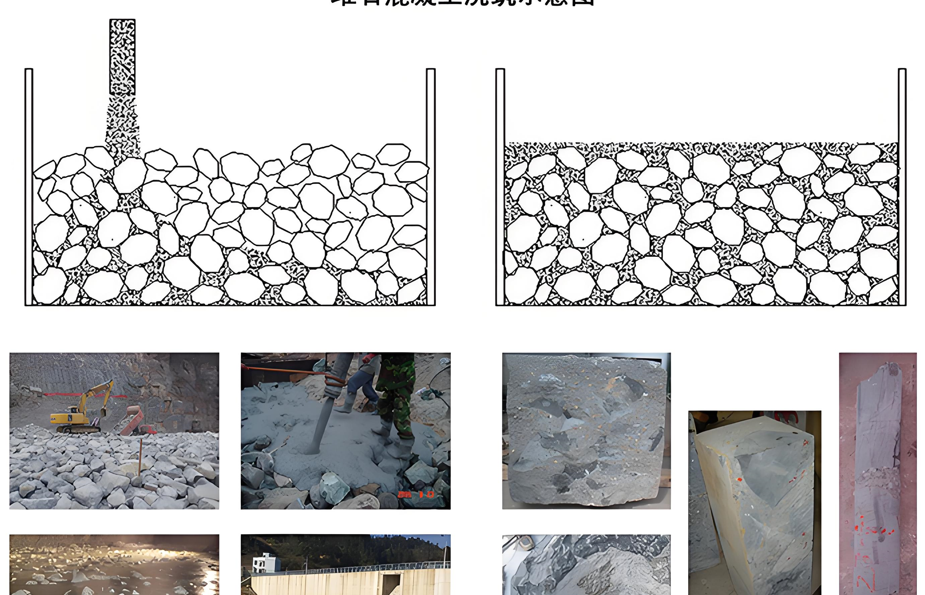
ROCK-FILLED CONCRETE
XU Xiaorong, HE Taohong, LEI Zhengqi, ZHANG Quanyi, LI Cong, JIN Feng
Rock-filled concrete (RFC) is a dam construction technique that heavily relies on engineering machinery. Because of the conservative design concept, currently, many transverse joints exist in RFC gravity dams, resulting in a narrow working space and a small radius for mechanical rotation. The Dagutai RFC gravity dam innovatively adopts a design with fewer joints, and it has the longest section (134 m) among all RFC gravity dams. The reservoir has been in operation for more than 3 years after its impoundment. To determine the safety state of the Dagutai gravity dam during the impoundment operation period, this paper researched the dam's working behavior under different loads, using dam temperature, seepage pressure, and displacement monitoring results, along with the temperature stress simulation of the finite element method (FEM). The results revealed that the dam body's temperature and seepage pressure are within normal limits, and the dam's longest section has no obvious cracking or seepage, indicating that the dam performed well during storage and operation. RFC's adiabatic temperature rise is low, as evidenced by the temperature rise of the most unfavorable position in the long section being less than 10℃. The section length of the RFC gravity dam can be appropriately extended, but the large lifting surfaces near the foundation should not be constructed during hot seasons, to control the initial temperature and reduce temperature stress during construction. Compared to standard dam sections, the long section's stress state meets the requirements, and the maximum stress can reach 2.5 MPa under empty or full reservoir conditions. Reinforcing mesh and short joints should be installed in the upstream impermeable layer. Overwintering in the upstream surface above water and the downstream surface can cause high tensile stress. If a gravity RFC dam with no joints is built, the large tensile stress at both ends of the dam should be considered. Even when the overloading factor is 10.0, there was no yield failure through the upstream and downstream of the dam, indicating that the overloading safety of the dam is high and the dam stability is good. This paper's research can provide scientific guidance for the structure design of RFC gravity dams in the future.