MEDICAL EQUIPMENT
JIANG Nianming, LIU Fan, CHENG Li, GAO Lilei, LIU Hui, LIU Yaqiang
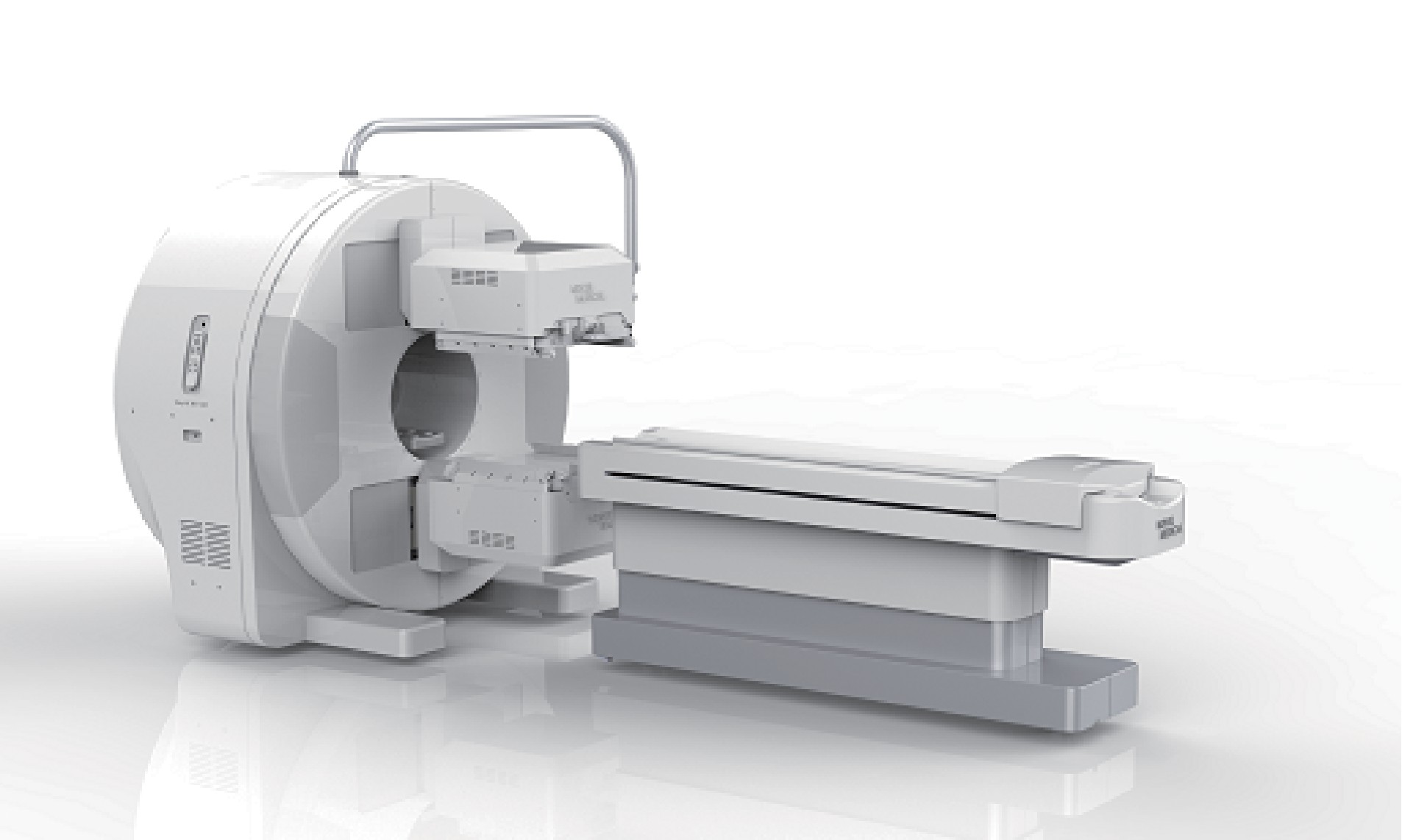
[Objective] Single-photon emission computed tomography (SPECT) is still considered a nonquantitative imaging modality because it cannot perform attenuation correction. To acquire a quantitative SPECT image, Beijing Novel Medical Equipment Co., Ltd. developed a domestic SPECT/CT system, Insight NM/CT Pro. It was equipped with dual digital detectors and enabled various scanning geometries. In addition to better spatial resolution, the system can correct attenuation effects in SPECT and realize quantitative reconstruction using CT. In this study, we evaluated the imaging accuracy of this domestic SPECT/CT system and compared it with advanced abroad systems. [Methods] To obtain quantitatively correct results, physical effects, including collimator blurring, object attenuation, scatter, and radionuclide decay, were modeled and corrected in the reconstruction algorithm. Moreover, a large cylindrical phantom was employed to obtain the calibration factor for the system so that we could convert the reconstruction result to a quantitative image in terms of Bq/mL. Then, the performance of CT-based attenuation correction was tested according to testing method for SPECT imaging based on CT-attenuation correction (YY/T 1546—2017). A cylinder phantom with three cylindrical inserts corresponding to air, nonradioactive water, and bone was filled with a radioactive solution for imaging. The biases inside the air, water, and bone regions of the reconstructed image were calculated to evaluate the performance of CT-based attenuation correction. In addition, the quantitative accuracy of the equipment was tested using the Notional Electrical Manufactures Association (NEMA) torso phantom according to performance measurements of Gamma cameras (NEMA NU 1—2018). Six fillable spheres with different diameters were set as targets for recovery evaluation, and the target-to-background concentration ratio was approximately 8∶1. A large volume of interest (VOI) was placed in the background region to calculate the quantitative bias of the reconstruction. VOIs with the same size of six spheres were drawn based on the registered CT to evaluate recovery coefficients of different sizes. Radionuclide technetium-99m and a low-energy, high-resolution collimator with Insight NM/CT Pro were used for all these tests, and the evaluation results were compared with those of the GE Discovery NM/CT 670. [Results] For attenuation accuracy testing, the biases inside the air, water, and bone regions of Insight NM/CT Pro were 7.84%, 8.38%, and 4.66%, respectively, whereas the corresponding biases in GE Discovery NM/CT 670 were 16.64%, 18.01%, and 11.02%, respectively. For quantitative accuracy testing, in GE discovery NM/CT 670, the quantitative recovery coefficients of the hot spheres with diameters of 13, 17, 22, and 28 mm were 31.04%, 51.36%, 59.91%, and 66.39%, respectively, and the background concentration bias was 10.84%. Insight NM/CT Pro achieved higher recovery coefficients and lower bias. The recovery coefficients were 38.22%, 50.98%, 66.55%, and 71.32% for 13, 17, 22, and 28 mm hot rods, respectively, and the bias in the background region was 7.95%. [Conclusions] Phantom studies have demonstrated that the domestic Insight NM/CT Pro imaging system can obtain smaller biases after CT attenuation correction and achieve quantitative images with high accuracy. The reliability of the Insight NM/CT Pro system for quantitative imaging is validated in this study, and its performance is comparable to that of the advanced GE Discovery NM/CT 670 imaging system.